
Cardiovascular Echocardiography Market Share & Growth Outlook 2034
Coverage: By Type (Transthoracic Echocardiography, Transesophageal Echocardiography, Stress Echocardiography, Fetal Echocardiography), Technology (2D Echocardiogram, 3D Echocardiogram, Doppler), Distribution Channel (Hospitals, Ambulatory Surgery Centers, Diagnostic Labs), and Geography (North America, Europe, Asia Pacific, Middle East and Africa, and South and Central America)
- Status : Published
- Report Code : TIPHE100000964
- Category : Life Sciences
- No. of Pages : 264
- Available Report Formats :


- Last update date : October 07, 2026


2025 Market Size
US$ 154.36 Bn
Base year value
2034 Forecast
US$ 233.11 Bn
Projected by 2034
CAGR 2026-2034
4.7 %
Growth rate
Addressable Market
US$ 1,760.19 Bn
(2026-2034)
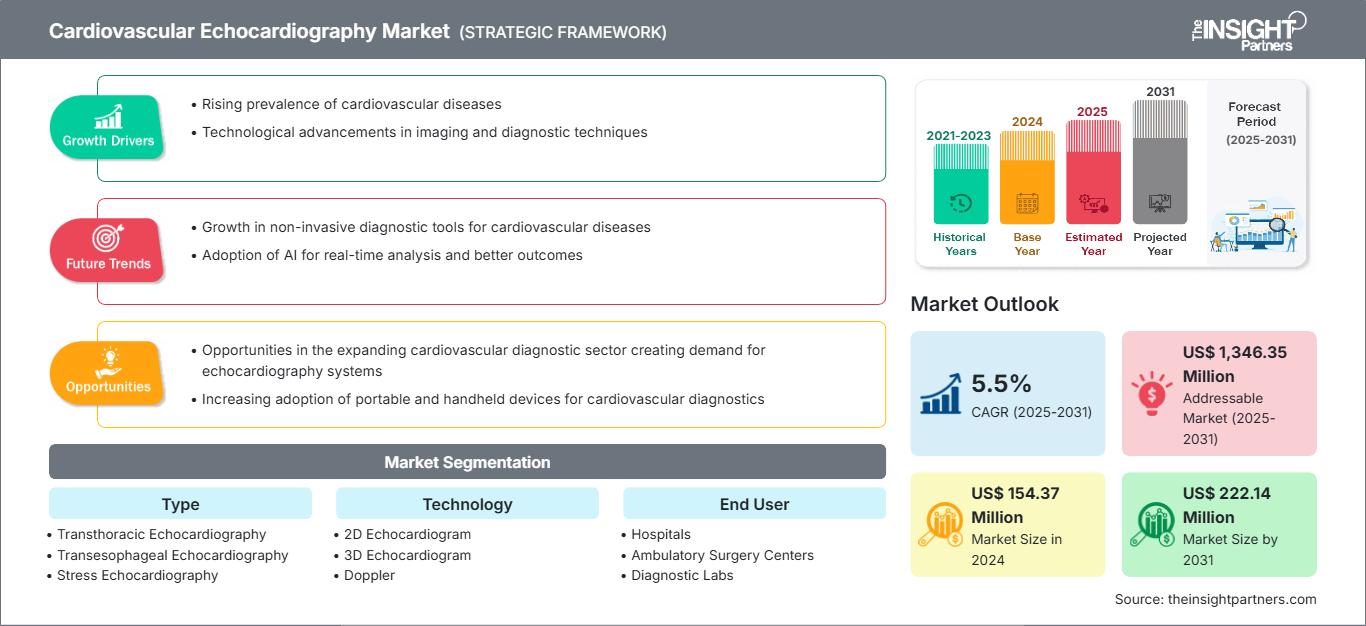
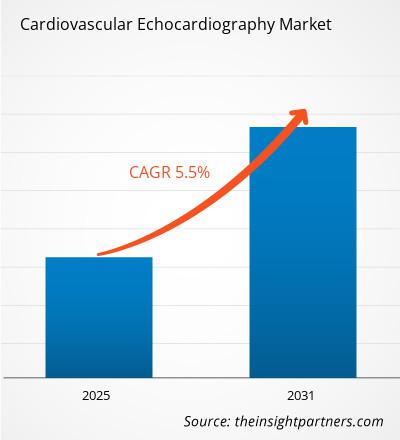
The Cardiovascular Echocardiography Market was valued at US$ 1,54.367 Billion in 2025 and is projected to reach US$ 2,33.110 Billion by 2034, expanding at a CAGR of 4.7% during 2026–2034. The market encompasses cardiac ultrasound systems and associated technologies used to evaluate cardiac anatomy, function, blood flow, and hemodynamics across routine, interventional, fetal, and stress-based examinations.
North America remains a structurally important geography, supported by established cardiac-care infrastructure, high utilization of advanced diagnostic imaging, and a large installed base of ultrasound equipment. The regional outlook indicates a CAGR range of 7.0–7.5%, with replacement cycles, AI-enabled workflow automation, and demand for efficient cardiac diagnostics supporting sustained investment.
Cardiovascular Echocardiography Market Assessment and Insights
- North America: Share in 2025 was 24.8–24.9%, while CAGR between 2026–2034 is estimated at 7.0–7.5%. Mature cardiac-care networks, replacement demand, and technology adoption support continued equipment investment.
- US: Share in 2025 was 81–82% of North American demand, with CAGR between 2026–2034 at 6.9–7.0%, supported by established cardiac imaging pathways and substantial hospital capacity.
- Europe: Share in 2025 was 22.0–22.1%, with CAGR between 2026–2034 of about 7.1–7.2%. Germany, the UK, France, Italy, and Spain remain important contributors, supported by mature healthcare systems and imaging modernization.
- Asia Pacific: Share in 2025 was 46.3–46.4%, with CAGR between 2026–2034 of approximately 8.6%. China, Japan, India, South Korea, and Australia benefit from infrastructure expansion, rising cardiovascular disease burden, and broader access to imaging.
- Largest Segment: Transthoracic Echocardiography held a 52–53% market share in 2025, with CAGR of 6.2–6.5%, reflecting broad first-line clinical use and non-invasive assessment.
- High Growth Segment: Stress Echocardiography represented an estimated 8–12% market share in 2025 and is expected to expand at 8.2–8.3% CAGR, supported by functional cardiac assessment.
- Key companies analyzed in detail: GE HealthCare Technologies Inc., Koninklijke Philips N.V., Siemens Healthineers AG, Canon Medical Systems Corporation, Shenzhen Mindray Bio-Medical Electronics Co., Ltd., Samsung Medison Co., Ltd., FUJIFILM Sonosite, Inc., Esaote S.p.A., Konica Minolta, Inc., and Trivitron Healthcare Pvt. Ltd.
Source: The Insight Partners' analysis based on proprietary research, government publications, company annual reports, investor presentations, industry databases, and expert interviews.
The ongoing advancements in technology are changing cardiac US, moving from purely acquiring images to incorporating measurements, automation, and decision support at the same time. AI-driven quantification, 3D imaging, high-technology Doppler, mobile equipment, and superior performance transducers have dramatically transformed the specification and purchasing of devices. The medical equipment manufacturers not only provide hardware but software probes etc. they also offer services and ensure connectivity. However, healthcare facilities focus on producing consistent results with faster patient throughput, interoperability, and lower operator burden.
The increasing demand will probably extend beyond large cardiac departments, as portable imaging or tele-ultrasound plus an AI-supported exam will help decentralize the service. Emerging Asian countries can be an attractive location for hospital modernization and diagnostic-capacity programs.
Cardiovascular Echocardiography Market Report Scope
| Report Attribute | Details |
|---|---|
| Market size in 2025 | US$ 154.36 Billion |
| Market Size by 2034 | US$ 233.11 Billion |
| Global CAGR (2026 - 2034) | 4.7% |
| Historical Data | 2021-2024 |
| Forecast period | 2026-2034 |
Cardiovascular Echocardiography Market Analysis
Demand is driven by the continuing cardiovascular disease burden and the increasing demand for a radiation-free cardiac assessment that can repeatedly be done. The World Health organization says that cardiovascular diseases accounted for roughly 19.8 million deaths worldwide in 2022 which is about 32% of total deaths, highlighting that earlier detection and monitoring are essential medically. Because of this, echocardiography is still considered to be essential for diagnosis, treatment plan, peri-operative assessment, and follow-up over time. Ultrasound-system manufacturers, transducer suppliers, imaging-software developers distributors service organizations hospitals ambulatory facilities, and diagnostic laboratories all play a role in the ecosystem. These factors that supply the market have now become very dependent on the availability of semiconductors, probe manufacturing, software development, clearing the product by regulatory bodies and the maintenance of installed Base Service contracts. So, the focus of procurement has gradually been moving to product life cycle economy, not just price of the product equipment, even more so where there is demand for interoperability, remote support, cybersecurity, and also standardized workflows.
Competition in the market is mainly dominated by a few big imaging market players with extensive product lines in cardiology as well as specialists mainly focused on ultrasound. For instance, GE HealthCare Technologies, Inc. focuses on cardiovascular ultrasound and AI-enabled imaging, Koninklijke Philips N.V however, combines echocardiography with connected cardiology workflows, besides that,
The main directions for technological advances at the moment are automation, portability of devices, higher visualization capabilities, and differentiation based on software functions. While Esaoute S.p.A. Konica Minolta, Inc. and Trivitron Healthcare Pvt. Ltd. enhance specialty and regional depth, procurers are assessing more frequently such things as system usage rate (up-time), speed of service, training demands, and system upgrade ability. This situation is most beneficial, of course, to those who can connect hardware innovations with actual outcomes, a digital ecosystem and, last but not least, a consistent flow of service offering.
● REPORT CUSTOMIZATION
Tailor This Report To Align With Your Specific Business Requirements
This report can be customized to align precisely with your business objectives, scope, and target markets. Customization options include tailored segmentation, geography, competitive analysis, and strategic insights to support informed decision-making.
Customize This Report →WHAT YOU CAN ADJUST
- ● Segmentations
- ● Geography
- ● Competitive Analysis
- ● Language Preferences
Cardiovascular Echocardiography Market: Strategic Insights
Regional Insights
North America Cardiovascular Echocardiography Market
North America represented 24.8–24.9% of global demand in 2025, with regional growth estimated at 7.0–7.5% through 2034. The standard of care is developed with well-connected cardiac-care networks, high usage rate of the equipment, reimbursement systems that encourage the use of advanced medical services through better paying, strong vendor presence. The US continue to be the country that supplies the biggest part of the market, but Canadians also help to add a few new buyers by improving their healthcare infrastructure and opening up more cardiac-diagnostic capabilities.
Buying new machines comes alongside the need for AI-assisted measurements, three-dimensional imaging, portable platforms, and highly advanced probes. Due to being short-staffed, healthcare professionals are now very dependent on automation and reproducible methods, so the value of automation increases. The demand for accreditation requirements and quality assurance further results in standardized examination protocols and equipment capabilities, leading to technology upgrades in hospitals and specialized cardiac centers.
U.S. Cardiovascular Echocardiography Market
The U.S. accounted for approximately 81–82% of North American demand in 2025 and is expected to expand at 6.9–7.0% CAGR through 2034. Its position reflects extensive hospital infrastructure, high cardiac disease prevalence, established reimbursement, and broad availability of specialized cardiology services.
Applications increasingly extend from routine transthoracic examinations to stress, transesophageal, three-dimensional, and interventional imaging. Major suppliers maintain substantial presence across the country, with GE HealthCare Technologies Inc., Koninklijke Philips N.V., Siemens Healthineers AG, Canon Medical Systems Corporation, and FUJIFILM Sonosite, Inc. supporting different clinical environments. Portable systems are also gaining relevance for emergency, critical-care, and point-of-care workflows.
Europe Cardiovascular Echocardiography Market
Europe held a 22.0–22.1% share in 2025 and is expected to grow at approximately 7.1–7.2% CAGR. Germany is the leading contributor, while the UK, France, Italy, and Spain provide substantial demand through established cardiovascular services and continuing adoption of advanced imaging. Germany accounted for 24.1% of regional demand in 2024 in one recent regional assessment.
The UK benefits from public investment in diagnostic capacity and efforts to reduce waiting times. Germany combines strong hospital infrastructure with established technology procurement. France, Italy, and Spain are expanding outpatient and community-based diagnostic pathways, creating opportunities for efficient systems and portable platforms. Across Europe, AI-assisted quantification and three-dimensional imaging are increasingly positioned as tools for standardization, while interoperability remains a procurement consideration.
APAC Cardiovascular Echocardiography Market
APAC represented 46.3–46.4% of global demand in 2025 and is expected to record about 8.6% CAGR through 2034. China is the leading contributor, followed by Japan, South Korea, India, and Australia. Expansion is supported by cardiovascular disease burden, healthcare infrastructure investment, and broader access to advanced diagnostics.
China and India provide substantial volume opportunities, while Japan and South Korea emphasize advanced technology and established clinical quality. Australia benefits from mature healthcare infrastructure. Public health initiatives, private hospital expansion, and increasing availability of compact systems are broadening access beyond tertiary centers, supporting adoption in regional and resource-constrained settings.
Middle East & Africa Cardiovascular Echocardiography Market
Middle East & Africa represented 2.8–2.9% of global demand in 2025. Growth is expected at approximately 3.7–4.0% CAGR, with Saudi Arabia and the UAE leading Gulf demand and South Africa remaining an important African market. Healthcare modernization and specialized cardiac-center development support equipment procurement.
Saudi Arabia and the UAE benefit from substantial healthcare infrastructure programs, while South Africa serves as a regional diagnostic hub. Rest-of-MEA markets remain constrained by uneven specialist availability and infrastructure. Portable systems can address geographic access limitations, while public and private investment in hospitals and diagnostic facilities creates a gradual pathway for broader ultrasound adoption.
Segmentation Analysis
Type
Type remains clinically differentiated by examination complexity, patient profile, and intended diagnostic use. The segment is expected to expand at 7.0–7.5% CAGR from 2026–2034. Transthoracic studies remain foundational because they are non-invasive and repeatable, while transesophageal, stress, and fetal examinations support specialized clinical pathways and broaden equipment utilization.
- Transthoracic Echocardiography: The dominant examination category, supported by first-line diagnosis, repeat monitoring, broad clinical applicability, and compatibility with hospital, outpatient, and point-of-care workflows.
- Transesophageal Echocardiography: Important for high-resolution assessment of valves and structures, particularly during complex procedures where closer proximity to cardiac anatomy improves visualization.
- Stress Echocardiography: Supports functional assessment and inducible ischemia evaluation, making it strategically relevant to preventive cardiology and diagnostic pathways requiring physiologic information.
- Fetal Echocardiography: Serves specialized prenatal assessment of congenital cardiac abnormalities, requiring high-frequency imaging, experienced operators, and referral pathways for higher-risk pregnancies.
Technology
Technology is projected to grow at 6.7–7.0% CAGR through 2034 as providers balance established two-dimensional imaging with advanced volumetric and hemodynamic capabilities. AI-enabled automation increasingly sits across these modalities, helping standardize acquisition and measurement while improving workflow efficiency.
- 2D Echocardiogram: Maintains broad clinical adoption because of established protocols, comparatively accessible equipment economics, and suitability for routine structural and functional assessment.
- 3D Echocardiogram: Gains strategic importance where volumetric visualization, valve assessment, procedural planning, and anatomical reconstruction require greater spatial context.
- Doppler: Remains essential for blood-flow and hemodynamic evaluation, supporting assessment of valves, chambers, pressure gradients, and vascular characteristics.
Distribution Channel
Distribution Channel is expected to advance at 6.0–6.5% CAGR through 2034 as providers diversify diagnostic delivery while preserving hospitals as the principal equipment base. Ambulatory and laboratory channels increasingly require compact, connected systems capable of efficient patient throughput and standardized interpretation.
- Hospitals: Remain the principal purchasing environment because cardiac departments require comprehensive systems for inpatient, emergency, procedural, and longitudinal diagnostic workflows.
- Ambulatory Surgery Centers: Increasingly adopt compact cardiovascular imaging where outpatient procedures and shorter care pathways justify decentralized diagnostic capabilities.
- Diagnostic Labs: Benefit from growing outpatient testing demand and centralized utilization models, particularly when cloud connectivity enables remote interpretation and efficient equipment scheduling.
Opportunity Snapshot
| Segment Name | Revenue Contribution (High/Medium/Low) | Trend Tag (MAX 2 words) | Adoption Stage (Emerging/Scaling/Mature) |
|---|---|---|---|
| Transthoracic Echocardiography | High | Routine Imaging | Mature |
| Transesophageal Echocardiography | Medium | Structural Guidance | Scaling |
| Stress Echocardiography | Medium | Functional Testing | Scaling |
| Fetal Echocardiography | Low | Prenatal Screening | Scaling |
Cardiovascular Echocardiography Market Growth Drivers and Impact Analysis
Rising Cardiovascular Disease Burden Expands Diagnostic Workloads
Heart diseases are among the leading causes of deaths around the world creating demand for cardiovascular imaging devices. WHO data reveal that CVDs contributed almost 19.8 million deaths globally in 2022 and nearly four-fifths of those CVD-related deaths had taken place in low and middle-income countries. Naturally, this situation from an economic viewpoint is of interest since diagnosis facilities are still highly unevenly distributed across areas. As health systems progressively roll out screening for diseases, develop chronic-disease management, increase specialist referral rates, so echocardiography can be expected to play an important role as it is a diagnostic technique that will bridge the primary assessment stage to the next levels of cardiac care. The market demand is not only for replacement but also for setting up new facilities, portable models, and upgrading of equipment. Also, since the patients may need regular checkups for heart failures, valve diseases, congenital problems and for monitoring treatment effectiveness, the utilization will be a recurring process rather than just a single test.
AI Automation Addresses Workflow and Workforce Constraints
The introduction of automation through AI into cardiac ultrasound has completely revolutionized the economic aspects of it in the medical field. As machines are now doing repetitive work and at the same time, providing consistent results, the manual work has been reduced drastically. Siemens Healthineers AG have added AI features for measurement and strain analysis, while GE HealthCare Technologies Inc. and Koninklijke Philips N.V. still develop automated cardiovascular imaging. These innovations may affect hospitals' procurement decisions as operators consider, plus image quality, throughput of work, personnel variability, and how efficiently the reports get done. With the support of acquisition guidance, automation also enables novices to become less dependent on the experience of others. Standard measurements can be ensured by this method, at the same time, clinical validation and regulatory clearance should not be bypassed before wide deployment takes place. That's why, the most dramatic shift from a commercial perspective will be in areas where staffing problem has been coupled with high examination volume. Equipment suppliers who can prove workflow optimizations will strengthen their position in the sales cycle without relying entirely on the technical parameters of the devices.
Expansion of Decentralized and Point-of-Care Cardiac Imaging
As healthcare delivery slowly starts relocating some diagnostic functions to the patient's side, this shift demands compact equipment and versatile deployment options. Portable ultrasound machines can be used for emergency care intubation regional hospitals, outpatient clinics, and other facilities in resource-limited settings without the need for the infrastructural requirements of large fixed machines. This shift broadens the target market and also brings changes to supply chain aspects, highlighting the significant role played by training, wireless communication, battery life, robustness, and remote technical support in the purchase decision. FUJIFILM Sonosite, Inc. will continue providing portable ultrasound solutions whereas the wider market shows that there is a strong movement towards point-of-care imaging procedures. But, decentralization does not make cart-based systems obsolete; rather it results in a multiphased equipment setting wherein the compact systems are being used alongside the cardiac departments with the most comprehensive imaging suites.
Cardiovascular Echocardiography Market Future Trends
AI-Native Quantification Will Become a Core Platform Attribute
AI tools in cardiovascular imaging may transform from being optional to becoming a part of integrated software systems that will support lots of functions, e.g. image acquisition measurement quality control, reporting, and even the comparison of data over time. This can easily be observed through the availability of auto cardiac measurements, 3D blood flow quantification, and image optimization supported by intelligent systems which is being added more and more in the product portfolio of major companies. Soon still it is not going to be the presence of algorithms alone which will decide the uniqueness of products. Rather the areas of clinical validation, interoperability, Regrettable Evidence and explainability will be the main basis of separation. That's why, suppliers might offer their software updates, workflow modules and cloud connectivity as longer-term technology platforms instead of individual solutions. Such a change could affect the buying pattern of hospitals as they will weigh not only the hardware performance of the machine but also the upgrade potential of the software which the machine is using. Platforms that allow getting a new validated software without doing a big equipment replacement may attract more from budget-constrained hospitals aiming at longer asset lifecycles.
Connected Cardiac Imaging Will Support Distributed Interpretation
By cloud connection, cardiac imaging workflows can be integrated with centralized interpretation, second opinion, training, and QA/QC. Portable systems are becoming widely available in EDs and regionals so remote read could be an effective way to counter specialists' scarcity while not compelling each center to keep a total cardiology department. The internet communication between devices will support implementation of standardized protocols as well as enable patients' data being available at various points-of-care and in a longitudinal fashion. Eventually, vendors can make a product distinction based on aspects such as cybersecurity solutions, data exchange and other standards adherence, workflow coordination, and remote maintenance instead of relying only on imaging hardware features. Really, this change is most pronounced in up-and-coming territories that suffer from the lack of availability of specialists while equipment availability is quite good at the same time. Whether this new idea will really work depends on having robust network, being able to process local data requests, being electronically health records compliant, and providing clear rules about who does what (which is mainly tricky for the so-called "remote care team”.
Cardiovascular Echocardiography Market Opportunities
Investment in AI-Enabled Upgradeable Installed Bases
Vendors and healthcare providers have an opportunity to extract additional value from existing ultrasound fleets through software upgrades, compatible transducers, automated measurement modules, and cloud-based workflow tools. Instead of replacing complete systems whenever a new capability emerges, providers can prioritize upgradeable architectures that preserve capital already deployed while adding higher-value functionality. This model creates recurring commercial opportunities for manufacturers through software, service, cybersecurity, and application packages. Investment decisions should focus on interoperability, regulatory status, data security, and measurable productivity benefits. Providers can also prioritize high-volume cardiac departments where reduced examination time has a direct operational impact. The opportunity is strongest when software improvements address a documented workflow bottleneck rather than adding features without clear clinical or economic utility.
Expansion into Emerging Cardiac Diagnostic Networks
Emerging markets offer investment opportunities where cardiac disease burdens are rising alongside hospital construction, private healthcare expansion, and diagnostic decentralization. Asia Pacific provides the broadest scale opportunity, while selected Middle Eastern and African markets offer targeted opportunities around specialist hospitals and cardiac centers. Market entry strategies can combine premium systems for tertiary institutions with portable or mid-range platforms for regional facilities. Partnerships with distributors, training organizations, and healthcare networks can reduce implementation barriers by addressing installation, education, maintenance, and clinical adoption simultaneously. Investors should assess local reimbursement, procurement structures, import requirements, specialist density, and service infrastructure before prioritizing individual countries. The strongest opportunities are likely to emerge where infrastructure investment is accompanied by sustained clinical capacity development.
Recent Developments
- September 2026: Koninklijke Philips N.V. shared preliminary multicenter clinical data at ESC Congress 2026 showing that its AI-powered 3D Auto Color Flow Quantification technology produced mitral-regurgitation measurements with closer agreement to cardiac magnetic resonance than conventional two-dimensional PISA. The development reinforces Philips’ strategy of integrating AI-based quantification into advanced cardiovascular ultrasound workflows. Philips clinical data announcement
- August 2026: GE HealthCare Technologies Inc. introduced Vivid Explorer, Vivid Advanced, and Vivid Focus, expanding its Vivid cardiovascular ultrasound portfolio across routine echocardiography, comprehensive cardiac imaging, and interventional care. The systems incorporate cSound imaging capabilities and are designed for distinct clinical and workflow requirements across cardiac-care settings. GE HealthCare Vivid portfolio announcement
- July 2026: FUJIFILM Sonosite, Inc. launched Sonosite iLOOK, a compact ultrasound solution designed for vascular-access workflows. The system combines a streamlined interface, wireless transducer, and flexible mounting options to support bedside procedures. The launch demonstrates continued expansion of compact ultrasound capabilities into focused point-of-care applications and reinforces the broader shift toward mobile imaging across clinical environments.
Frequently Asked Questions

- Comprehensive Market Sizing and Forecast Analysis
- Detailed Segmentation Analysis
- In-Depth Market Dynamics Assessment
- Regional and Country-Level Insights
- Competitive Landscape and Company Benchmarking
- Strategic Business Intelligence
Recent Reports
Testimonials

The Insight Partners provided valuable market intelligence that supported our global go-to-market strategy. Their team was professional, responsive, and attentive to our feedback, providing thoughtful analysis and helpful methodological clarifications throughout the project.
Junmo Kim Chief Financial Officer (CFO), Enertech Co., Ltd.
The Insight Partners' SCADA System Market report is comprehensive, with valuable insights on current trends and future forecasts. The team was highly professional, responsive, and supportive throughout. We are very satisfied and highly recommend their services.
RAN KEDEM Partner, Reali Technologies LTDs
I requested a report on a very specific software market and the team produced the report in a few days. The information was very relevant and well presented. I then requested some changes and additions to the report. The team was again very responsive and I got the final report in less than a week.
JEAN-HERVE JENN Chairman, Future Analytica
We worked with The Insight Partners for an important market study and forecast. They gave us clear insights into opportunities and risks, which helped shape our plans. Their research was easy to use and based on solid data. It helped us make smart, confident decisions. We highly recommend them.
PIYUSH NAGPAL Sr. Vice President, High Beam Global
The Insight Partners delivered insightful, well-structured market research with strong domain expertise. Their team was professional and responsive throughout. The user-friendly website made accessing industry reports seamless. We highly recommend them for reliable, high-quality research services
YUKIHIKO ADACHI CEO, Deep Blue, LLC.
This is the first time I have purchased a market report from The Insight Partners.While I was unsure at first, I visited their web site and felt more comfortable to take the risk and purchase a market report.I am completely satisfied with the quality of the report and customer service. I had several questions and comments with the initial report, but after a couple of dialogs over email with their analyst I believe I have a report that I can use as input to our strategic planning process.Thank you so much for taking the extra time and making this a positive experience.I will definitely recommend your service to others and you will be my first call when we need further market data.
JOHN SUZUKI President and Chief Executive Officer, Board Director, BK Technologies
I wish to appreciate your support and the professionalism you displayed in the course of attending to my request for information regarding to infectious disease IVD market in Nigeria. I appreciate your patience, your guidance, and the fact that you were willing to offer a discount, which eventually made it possible for us to close a deal. I look forward to engaging The Insight Partners in the future, all thanks to the impression you have created in me as a result of this first encounter.
DR CHIJIOKE ONYIA MANAGING DIRECTOR, PineCrest Healthcare Ltd.Reason to Buy
- Informed Decision-Making
- Understanding Market Dynamics
- Competitive Analysis
- Identifying Emerging Markets
- Customer Insights
- Market Forecasts
- Risk Mitigation
- Boosting Operational Efficiency
- Strategic Planning
- Investment Justification
- Tracking Industry Innovations
- Aligning with Regulatory Trends





 Get Free Sample for