
3D Woven Fabrics Market Size, Share & Growth by 2034
Coverage: By Type (Solid, Hollow, Shell, and Nodal), Fiber Type (Carbon Fiber, Glass Fiber, and Others), Application (Ballistics, Aircraft, Transportation, Building & Construction, and Others)
- Status : Upcoming
- Report Code : TIPRE00029864
- Category : Chemicals and Materials
- No. of Pages : 150
- Available Report Formats :


- Last update date : July 09, 2026


2025 Market Size
US$ 180.97 Mn
Base year value
2034 Forecast
US$ 607.34 Mn
Projected by 2034
CAGR 2026-2034
14.4 %
Growth rate
Addressable Market
US$ 3,387.37 Mn
(2026-2034)
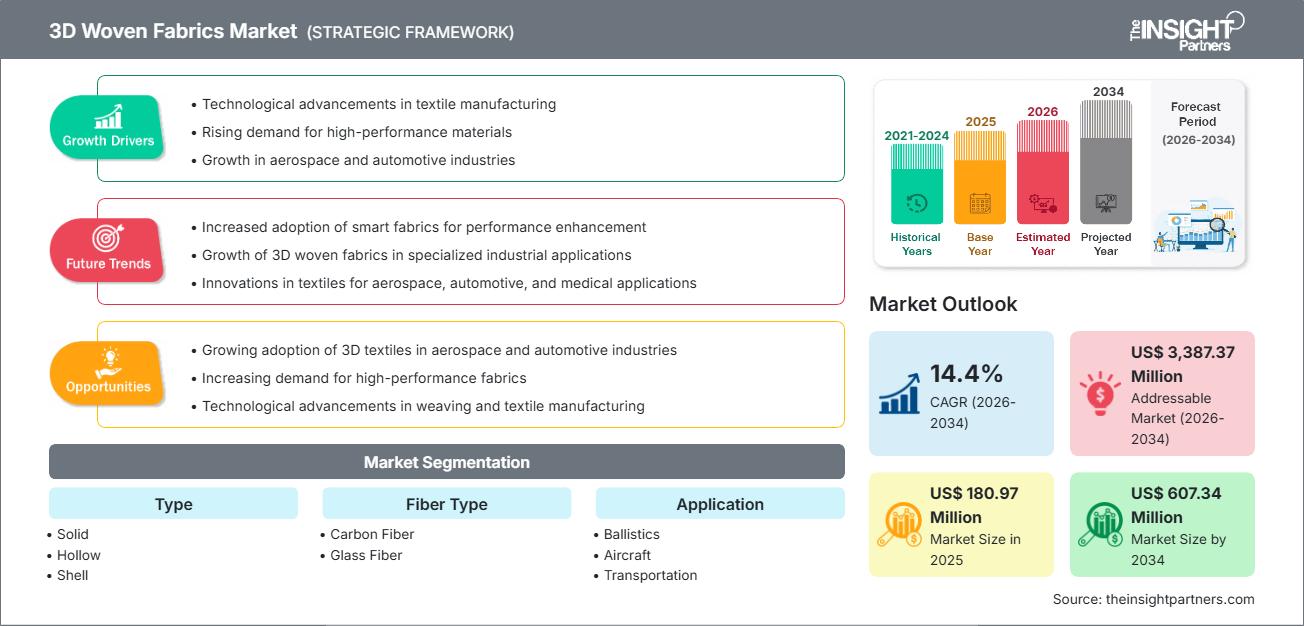
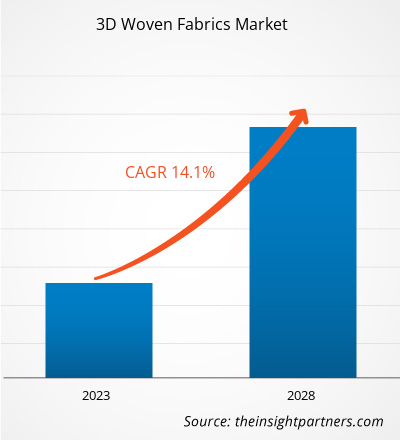
The 3D woven fabrics market was valued at US$ 180.97 million in 2025 and is expected to reach US$ 607.34 million by 2034. This represents a compound annual growth rate (CAGR) of 14.4% from 2026 to 2034. The market is growing due to rising demand for lightweight composite structures, better mechanical performance, and improved textile solutions in aerospace, defense, transportation, construction, and other industries that need higher strength-to-weight ratios.
North America is projected to experience steady growth with an estimated CAGR of 13.5% to 15.5% during the forecast period. This growth is bolstered by aerospace modernization programs, defense material needs, and a rising use of advanced composites. Increased investments in high-performance materials and manufacturing technologies are promoting wider use of 3D woven fabrics in specialized engineering applications, supporting the expansion of the 3D Woven Fabrics Market size.
3D Woven Fabrics Market Assessment and Insights
- North America: North America accounted for 32–36% market share in 2025 and is projected to expand at a CAGR of 13.5%–15.5% during 2026–2034. Growth is driven by increasing adoption of advanced composite materials in aerospace applications, defense modernization programs, and rising demand for lightweight structural solutions.
- U.S.: The U.S. represented 80–84% of the North American market in 2025 and is anticipated to register a CAGR of 13.8%–15.8% during 2026–2034, supported by strong aerospace manufacturing activity, growing defense investments, and increasing utilization of high-performance composite structures.
- Europe: Europe held 28–32% market share in 2025 and is expected to grow at a CAGR of 12.5%–14.5% during 2026–2034. Germany, France, and the United Kingdom remain the leading regional markets, supported by aerospace engineering excellence, automotive innovation, and established expertise in composite material manufacturing.
- Asia Pacific: Asia Pacific accounted for 24–28% market share in 2025 and is forecast to expand at a CAGR of 15.0%–17.0% during 2026–2034. China, Japan, and South Korea drive regional growth through industrial expansion, rising transportation sector demand, and increasing investments in advanced materials technologies.
- Largest Segment – Aircraft: The Aircraft segment represented the largest market segment, accounting for 34–38% market share in 2025, and is expected to grow at a CAGR of 14.5%–16.5% during 2026–2034, driven by increasing adoption of aerospace composites and growing demand for lightweight, high-strength structural components.
- High Growth Segment – Carbon Fiber: The Carbon Fiber segment is projected to register the fastest growth, accounting for 58–62% market share in 2025 and advancing at a CAGR of 15.0%–15.8% during 2026–2034, supported by higher structural performance requirements and expanding applications across aerospace and other high-performance industries.
- Key companies analyzed in detail: Textum OPCO LLC; Tex Tech Industries, Inc.; Sigmatex (UK) Ltd.; 3D Weaving Sàrl; Tantra Composite Technologies Pvt. Ltd.; U-Long High Tech Textile Co., Ltd.; TEAM, Inc.; Changzhou Bolong Three Dimensional Composites Co., Ltd.; Topweaving New Material Technology Co., Ltd.; and China Beihai Fiberglass Co., Ltd.
Source: The Insight Partners' analysis based on proprietary research, government publications, company annual reports, investor presentations, industry databases, and expert interviews.
The 3D woven fabrics market has changed due to improvements in textile design, composite reinforcement methods, and automated weaving technologies. Manufacturers are shifting from traditional layered fabrics to integrated three-dimensional structures. These new designs offer better strength, impact resistance, and dimensional stability. The rising demand for lightweight materials has sped up their use in aerospace, defense, and transportation sectors, where performance and structural reliability are crucial.
Future market growth is likely to benefit from increased investments in composite materials, expanded manufacturing capabilities, and growing adoption across emerging industrial economies. Sustainability initiatives and the demand for resource-efficient materials are encouraging manufacturers to explore advanced weaving technologies and recyclable composite solutions. Infrastructure modernization and transportation electrification are expected to create additional opportunities for high-performance woven reinforcement materials, strengthening the 3D Woven Fabrics Market share.
3D Woven Fabrics Market Report Scope
| Report Attribute | Details |
|---|---|
| Market size in 2025 | US$ 180.97 Million |
| Market Size by 2034 | US$ 607.34 Million |
| Global CAGR (2026 - 2034) | 14.4% |
| Historical Data | 2021-2024 |
| Forecast period | 2026-2034 |
3D Woven Fabrics Market Analysis
Demand for 3D woven fabrics is rising as industries look for composite materials that offer better mechanical performance and lighter components. Unlike traditional textile reinforcements, three-dimensional woven structures provide better resistance to delamination, stronger structural integrity, and improved load distribution. These benefits are driving their use in aerospace components, ballistic protection systems, automotive structures, and advanced construction applications.
The market consists of fiber producers, textile manufacturers, composite processors, equipment suppliers, and end-use industries. Carbon fiber and glass fiber are essential because of their strength, durability, and compatibility with modern composite manufacturing. Supply dynamics depend on fiber availability, technological capabilities, and manufacturers' ability to produce customized woven designs for specific industrial needs.
Competition in the 3D woven fabrics market revolves around material innovation, manufacturing skills, application-specific solutions, and teamwork across the composite value chain. Companies like Tex Tech Industries, Inc., Sigmatex (UK) Ltd., and Textum OPCO LLC focus on creating advanced textile structures for aerospace, defense, and industrial uses. New specialists like 3D Weaving Sàrl and Tantra Composite Technologies Pvt. Ltd. are boosting market capabilities through specialized weaving techniques.
More investments have been made towards automation in manufacturing, high-performance fibers, and developing new applications. U-Long High Tech Textile Co., Ltd. and Changzhou Bolong Three Dimensional Composites Co., Ltd. are supporting manufacturing growth in the region. Topweaving New Material Technology Co., Ltd. and China Beihai Fiberglass Co., Ltd. have supported the availability and development of composite materials. Competition is constantly evolving due to improvements in performance, scaling, and cost reduction.
● REPORT CUSTOMIZATION
Tailor This Report To Align With Your Specific Business Requirements
This report can be customized to align precisely with your business objectives, scope, and target markets. Customization options include tailored segmentation, geography, competitive analysis, and strategic insights to support informed decision-making.
Customize This Report →WHAT YOU CAN ADJUST
- ● Segmentations
- ● Geography
- ● Competitive Analysis
- ● Language Preferences
3D Woven Fabrics Market: Strategic Insights
Regional Insights
North America 3D Woven Fabrics Market
North America accounted for 32 to 36% of the global 3D woven fabrics market in 2025. It is expected to grow at a rate of 13.5 to 15.5% from 2026 to 2034. The region benefits from established aerospace manufacturing, defense spending, and strong programs for developing composite materials.
The presence of engineering companies and institutes contributes to the continuous use of high-performance fabrics. The growing demand for lightweight aircraft components, protective equipment, and heavy-duty industrial products will make the need for three-dimensional textiles an essential requirement.
U.S. 3D Woven Fabrics Market
The United States held 80 to 84% of North America's 3D woven fabrics market in 2025. It is projected to grow at a rate of 13.8 to 15.8% through 2034. Strong aerospace production, defense modernization, and the adoption of composite technology continue to support the domestic market.
Companies like Textum OPCO LLC and Tex Tech Industries, Inc. help to develop advanced textile capabilities within the country. The growing use of 3D woven materials in aircraft structures, protective gear, and transportation parts creates opportunities for specialized fabric manufacturers.
Europe 3D Woven Fabrics Market
Europe accounted for 28 to 32% of the global market in 2025 and is expected to see a CAGR of 12.5 to 14.5% during the forecast period. The region is an important hub for aerospace, automotive, and composite manufacturing. The United Kingdom has a strong presence in the market due to its aerospace innovations, defense applications, and specialized textile development.
There is an increase in the use of advanced woven reinforcement technology in industries where structural performance is enhanced, along with a reduction in the weight of the components. Germany is leading in the European region owing to its highly developed automotive industry and composite material manufacturing capabilities. Demand for three-dimensional woven fabric is increasing because of the need for lightweight automobiles and efficient manufacturing processes.
France, Italy, and Spain add value through aerospace programs, transportation manufacturing, and infrastructure development. Increasing investments in composite materials and advanced textile production continue to create regional opportunities. The European market benefits from cooperation between material producers, manufacturers, and end users, according to the 3D Woven Fabrics Market report.
APAC 3D Woven Fabrics Market
Asia Pacific represented 24 to 28% of global revenue in 2025 and is projected to have a CAGR of 15.0 to 17.0% from 2026 to 2034. Industrial growth, transportation expansion, and infrastructure investment are driving regional development. China is leading growth in APAC thanks to its expanding manufacturing capacity, development of composite materials, and rising aerospace and transportation applications.
Government initiatives supporting advanced materials and modernization are boosting the use of three-dimensional woven structures. Japan, South Korea, India, and Australia also contribute through aerospace, automotive, defense, and construction sectors. Increased investment in lightweight materials, technology development, and manufacturing upgrades helps the wider use of advanced woven composites across the region.
Middle East & Africa 3D Woven Fabrics Market
The Middle East and Africa market is expected to grow at a rate of 11.5% to 13.5% from 2026 to 2034. This growth is backed by infrastructure expansion, defense requirements, and rising interest in composite materials, contributing to a positive 3D Woven Fabrics Market forecast.
Saudi Arabia is the leading market in the region. Its industrial diversification programs, infrastructure development, and investments in manufacturing are key factors. The country's emphasis on boosting non-oil industries opens up chances for using composite materials.
The United Arab Emirates is also increasing its adoption of these materials through projects in aerospace, construction, and transportation. Meanwhile, South Africa is driving regional demand in defense, mining, and industrial uses. Other countries in the Middle East and Africa are benefiting from infrastructure upgrades and a growing awareness of strong, lightweight materials.
Segmentation Analysis
Type
The Type segment plays a key role in determining the structural performance, durability, and suitability of 3D woven fabrics for various applications. This Segment is expected to grow at a CAGR of 14.0–16.0% from 2026 to 2034 as industries increasingly adopt engineered textile designs for high-performance composite applications, reflecting key 3D Woven Fabrics Market trends.
- Solid: Solid 3D woven fabrics are widely used where high strength, stiffness, and structural stability are needed. They support applications in aerospace components, industrial reinforcement, and advanced composite manufacturing.
- Hollow: Hollow structures are lightweight and reduce material use. They are suitable for applications that need better weight efficiency, impact absorption, and flexible design.
- Shell: Shell-type fabrics support complex component designs by offering integrated reinforcement structures. This leads to better mechanical properties and efficient manufacturing of specialized composite parts.
- Nodal: Nodal fabrics provide interconnected reinforcement patterns that improve load transfer and structural performance. They support advanced engineering applications that require greater durability and resistance.
Fiber Type
The choice of fiber affects mechanical properties, processing needs, and end-use suitability of 3D woven fabrics. Carbon fiber and glass fiber are significant materials due to their performance characteristics and compatibility with composite manufacturing technologies.
- Carbon Fiber: 3D woven fabrics made from carbon fiber are preferred for aerospace, defense, and high-performance applications. They offer exceptional strength-to-weight ratios, stiffness, fatigue resistance, and thermal stability.
- Glass Fiber: Fabrics made from glass fiber provide cost-effective reinforcement with good strength, durability, and corrosion resistance. They support applications in transportation, construction, and industrial composites.
Application
Application demand keeps growing as industries adopt 3D woven fabrics to improve structural performance and reduce component weight. Many applications now need materials that can provide reliability in tough operating conditions.
- Ballistics: Ballistic applications use 3D woven fabrics for protective structures that need impact resistance, energy absorption, and greater durability in defense and security settings.
- Aircraft: Aircraft applications represent a major demand area because of the need for lightweight, strong composite structures that boost fuel efficiency, performance, and operational reliability.
- Transportation: Transportation applications make use of lightweight composite materials that enhance vehicle efficiency, optimize structure, and improve performance in automotive and mobility systems.
- Building & Construction: Building and construction applications increasingly rely on 3D woven fabrics for strong reinforcement solutions, better structural integrity, and improved composite-based infrastructure development.
Opportunity Snapshot
| Segment Name | Revenue Contribution | Trend Tag | Adoption Stage |
| Ballistics | Medium | Impact Protection | Scaling |
| Aircraft | High | Lightweight Structures | Mature |
| Transportation | Medium | Composite Mobility | Scaling |
| Building & Construction | Medium | Smart Infrastructure | Emerging |
3D Woven Fabrics Market Growth Drivers and Impact Analysis
Increasing Adoption of Lightweight Composite Materials in Aerospace
The growing need for weight reduction in aerospace, transportation, and industrial sectors is pushing the use of three-dimensional woven fabrics. These materials offer better strength, stiffness, and durability compared to traditional textile reinforcements, allowing manufacturers to cut down on component weight. Aircraft manufacturers and transportation companies are examining new composites to boost energy efficiency and operational performance. The capability of 3D woven fabrics to provide integrated support and reduce structural weaknesses makes them ideal for complex components. This shift towards lighter engineering solutions is generating ongoing demand for specialized textile designs and promoting wider use in high-performance applications.
Growing Adoption in Aerospace and Defense Applications
The aerospace and defense industries are increasingly using advanced composite materials because of the need for better performance, durability, and efficiency. Three-dimensional woven fabrics offer better resistance to delamination, impact, and structural failure, making them suitable for critical components in tough conditions. Defense applications also gain from their ability to support protective structures and ballistic solutions with optimized weight. As aircraft modernization programs grow and defense organizations focus on advanced materials, manufacturers are investing in specialized weaving technologies and material development. These applications are significant drivers of growth for the 3D woven fabrics market.
Advancement of Automated Textile Manufacturing Technologies
Improvements in automated weaving systems are enhancing production efficiency, consistency, and scalability for three-dimensional woven fabrics. New manufacturing equipment allows for precise fiber placement, complex textile designs, and less manual work during production. These advancements help overcome past challenges linked to manufacturing complexity and costs. As automation becomes more integrated into composite manufacturing processes, suppliers can offer customized solutions for various industrial needs. Better production capabilities are encouraging more manufacturers to adopt reliable, consistent, and high-performance reinforcement materials for aerospace, transportation, construction, and other specialized applications.
3D Woven Fabrics Market Future Trends
Integration of Digital Design and Simulation Tools
Digital engineering tools are expected to have a bigger impact on developing three-dimensional woven fabrics. They help with optimized designs before physical production. Simulation platforms let manufacturers assess structural behavior, fiber orientation, and performance characteristics while cutting down development time. Combining digital workflows with automated weaving technologies can improve customization and speed up material qualification. As industries look for more specific composite solutions, digital design capabilities will become essential for creating effective textile structures. This trend is expected to encourage greater collaboration among textile manufacturers, composite developers, and end-use industries, supporting the 3D Woven Fabrics Market.
Expansion of Sustainable Composite Material Solutions
Sustainability considerations are increasingly shaping the development of textile materials as industries aim for solutions that have a lower environmental impact. Manufacturers are looking into recyclable fibers, better production efficiency, and alternative reinforcement materials to promote sustainable composite applications. Growing environmental regulations from sectors like transportation, construction, and industry are driving innovation in material choices and manufacturing processes. Future developments may include improved fiber combinations and better recycling methods that maintain performance. This movement toward sustainable composite solutions is expected to affect product development strategies and create new opportunities in the 3D woven fabrics market.
3D Woven Fabrics Market Opportunities
Expansion into Emerging Transportation Applications
The transportation sector offers significant opportunities as manufacturers look for materials that support lightweight vehicle development and better energy efficiency. Electric vehicles, advanced mobility systems, and next-generation transportation platforms need structural materials that balance performance, durability, and weight reduction. Three-dimensional woven fabrics can meet these needs by providing strong composite reinforcement with efficient material use. Companies that focus on transportation-oriented textile solutions, custom composite designs, and scalable manufacturing could benefit from rising demand. Growth opportunities are expected to arise through partnerships between textile producers, automotive manufacturers, and composite component suppliers.
Increasing Infrastructure Modernization Activities
Infrastructure modernization is creating opportunities for composite materials that enhance durability and extend structural lifespans. Construction applications increasingly need reinforcement solutions that can endure environmental stress, corrosion, and mechanical loading. Three-dimensional woven fabrics provide potential benefits through better structural integrity and flexible designs for specific construction needs. Rising investment in bridges, buildings, transportation systems, and industrial facilities drives the demand for new reinforcement technologies. Companies that concentrate on construction-grade textile solutions and specific composite development can seize emerging opportunities as infrastructure projects adopt new materials.
Recent Developments
- March 2026: Sigmatex (UK) Ltd. announced a strategic distribution agreement with Link Composites at JEC World 2026 to expand access to advanced carbon fiber textiles in India. The partnership supports the 3D woven fabrics market by strengthening the availability of high-performance reinforcement materials for aerospace, automotive, defense, and infrastructure applications requiring lightweight composite structures and improved mechanical performance.
- January 2026: Tex Tech Industries, Inc. entered into an agreement for acquisition by Michelin, strengthening its position in specialty textiles and engineered composite solutions. The development is relevant to the 3D woven fabrics market as Tex Tech's advanced fabrics support aerospace, defense, and industrial applications where high-performance woven reinforcement materials are required.
Frequently Asked Questions

- Comprehensive Market Sizing and Forecast Analysis
- Detailed Segmentation Analysis
- In-Depth Market Dynamics Assessment
- Regional and Country-Level Insights
- Competitive Landscape and Company Benchmarking
- Strategic Business Intelligence
Recent Reports
Testimonials

The Insight Partners' SCADA System Market report is comprehensive, with valuable insights on current trends and future forecasts. The team was highly professional, responsive, and supportive throughout. We are very satisfied and highly recommend their services.
RAN KEDEM Partner, Reali Technologies LTDs
I requested a report on a very specific software market and the team produced the report in a few days. The information was very relevant and well presented. I then requested some changes and additions to the report. The team was again very responsive and I got the final report in less than a week.
JEAN-HERVE JENN Chairman, Future Analytica
We worked with The Insight Partners for an important market study and forecast. They gave us clear insights into opportunities and risks, which helped shape our plans. Their research was easy to use and based on solid data. It helped us make smart, confident decisions. We highly recommend them.
PIYUSH NAGPAL Sr. Vice President, High Beam Global
The Insight Partners delivered insightful, well-structured market research with strong domain expertise. Their team was professional and responsive throughout. The user-friendly website made accessing industry reports seamless. We highly recommend them for reliable, high-quality research services
YUKIHIKO ADACHI CEO, Deep Blue, LLC.
This is the first time I have purchased a market report from The Insight Partners.While I was unsure at first, I visited their web site and felt more comfortable to take the risk and purchase a market report.I am completely satisfied with the quality of the report and customer service. I had several questions and comments with the initial report, but after a couple of dialogs over email with their analyst I believe I have a report that I can use as input to our strategic planning process.Thank you so much for taking the extra time and making this a positive experience.I will definitely recommend your service to others and you will be my first call when we need further market data.
JOHN SUZUKI President and Chief Executive Officer, Board Director, BK Technologies
I wish to appreciate your support and the professionalism you displayed in the course of attending to my request for information regarding to infectious disease IVD market in Nigeria. I appreciate your patience, your guidance, and the fact that you were willing to offer a discount, which eventually made it possible for us to close a deal. I look forward to engaging The Insight Partners in the future, all thanks to the impression you have created in me as a result of this first encounter.
DR CHIJIOKE ONYIA MANAGING DIRECTOR, PineCrest Healthcare Ltd.Reason to Buy
- Informed Decision-Making
- Understanding Market Dynamics
- Competitive Analysis
- Identifying Emerging Markets
- Customer Insights
- Market Forecasts
- Risk Mitigation
- Boosting Operational Efficiency
- Strategic Planning
- Investment Justification
- Tracking Industry Innovations
- Aligning with Regulatory Trends





 Get Free Sample for