
5G Industrial IoT Market Demand, Size & Forecast by 2034
Coverage: By Component (Hardware, Software, Services); Enterprise Size (SMEs, Large Enterprises); Application (Predictive Maintenance, Business Process Optimization, Asset Tracking and Management, Logistics and Supply Chain Management, Real-Time Workforce Tracking and Management, Automation Control and Management, Emergency and Incident Management and Business Communication); End-user (Process Industries, Discrete Industries) , and Geography (North America, Europe, Asia Pacific, and South and Central America)
- Status : Data Released
- Report Code : TIPRE00019482
- Category : Electronics and Semiconductor
- No. of Pages : 150
- Available Report Formats :


- Last update date : July 15, 2026


2025 Market Size
US$ 14.65 Bn
Base year value
2034 Forecast
US$ 263.5 Bn
Projected by 2034
CAGR 2026-2034
6.1 %
Growth rate
Addressable Market
US$ 179.36 Bn
(2026-2034)
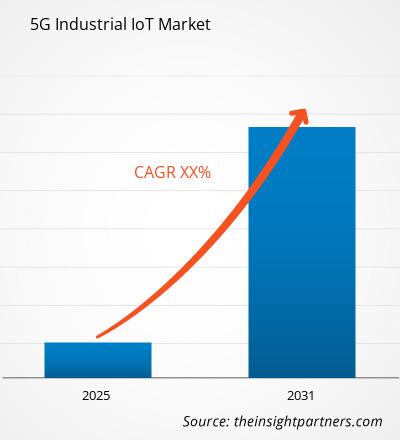
The 5G Industrial IoT Market was valued at US$ 14.65 billion in 2025 and is projected to reach US$ 263.5 billion by 2034, expanding at a CAGR of 6.1% during 2026–2034. Industrial enterprises are adopting 5G-enabled IoT architectures to connect machines, assets, workers, and control systems with lower latency, higher reliability, and better data visibility across factories, utilities, logistics hubs, and process environments.
North America is expected to advance at a CAGR range of 5.6–6.0% during 2026–2034, supported by private wireless deployments in manufacturing, energy, transportation, and defense-linked industrial operations. Strong enterprise connectivity spending, early 5G standalone coverage, and a large base of automation-intensive facilities are strengthening regional adoption. The region also benefits from mature cloud, edge computing, cybersecurity, and systems-integration ecosystems.
5G Industrial IoT Market Assessment and Insights
- North America: 27–31% share in 2025 and CAGR between 2026–2034 of 5.6–6.0%; adoption is led by smart manufacturing, private networks, edge analytics, and connected asset programs.
- US: 72–76% share in North America in 2025 and CAGR between 2026–2034 of 5.7–6.1%; industrial campuses, utilities, ports, and aerospace suppliers drive early scaled deployments.
- Europe: 23–27% share in 2025 and CAGR between 2026–2034 of 5.8–6.2%; Germany, the UK, France, Italy, and Spain lead through automation, spectrum policy, and Industry 4.0 investment.
- Asia Pacific: 34–38% share in 2025 and CAGR between 2026–2034 of 6.4–6.8%; China, Japan, South Korea, India, and Australia benefit from electronics, automotive, and logistics modernization.
- Largest Segment: Hardware held 44–48% of the 5G Industrial IoT market share in 2025 and CAGR range of 5.7–6.1%, supported by radios, gateways, sensors, routers, and edge devices.
- High Growth Segment: Software held 29–33% of the 5G Industrial IoT market size in 2025 and CAGR range of 6.7–7.1%, driven by orchestration, analytics, security, and device-management platforms.
- Key companies analyzed in detail: Advantech Co., Ltd.; AT&T Inc.; Cisco Systems, Inc.; Huawei Technologies Co., Ltd.; International Business Machines Corporation; Nokia Corporation; Qualcomm Incorporated; Siemens AG; Telefonaktiebolaget LM Ericsson; Telefónica, S.A.
Source: The Insight Partners' analysis based on proprietary research, government publications, company annual reports, investor presentations, industry databases, and expert interviews.
The 5G Industrial IoT Market report has moved from connectivity pilots to operational networks that support robotics, machine vision, digital twins, and real-time control. Manufacturers are shifting from wired-only architectures toward private 5G, industrial edge, and secure device orchestration. Production dynamics are also changing as hardware vendors, telecom operators, automation suppliers, and cloud platforms bundle radios, gateways, analytics, and managed services for industrial buyers.
Future 5G Industrial IoT market growth will be shaped by emerging industrial corridors in Asia Pacific, spectrum liberalization in Europe, and U.S. investment in resilient infrastructure. Regulatory interest in cybersecurity, energy efficiency, and supply-chain transparency is encouraging enterprises to modernize connectivity. As 5G standalone, RedCap devices, and edge AI mature, adoption is expected to extend beyond flagship factories into mid-sized industrial sites.
5G Industrial IoT Market Report Scope
| Report Attribute | Details |
|---|---|
| Market size in 2025 | US$ 14.65 billion |
| Market Size by 2034 | US$ 263.5 billion |
| Global CAGR (2026 - 2034) | 6.1% |
| Historical Data | 2021-2024 |
| Forecast period | 2026-2034 |
5G Industrial IoT Market Analysis
Demand is anchored in the need to connect sensors, programmable controllers, autonomous mobile robots, inspection cameras, and remote assets without sacrificing deterministic performance. The ecosystem spans chipset suppliers, module makers, device OEMs, telecom operators, automation vendors, cloud providers, cybersecurity specialists, and industrial integrators. This value chain makes the 5G Industrial IoT Market analysis dependent on both network readiness and operational technology integration.
Supply dynamics remain influenced by spectrum availability, device certification, and enterprise skills. Hardware is essential for initial deployment, but software increasingly determines scalability through network slicing, zero-trust security, analytics, and lifecycle management. The 5G Industrial IoT market size expands as enterprises link connectivity investment to measurable outcomes such as downtime reduction, quality improvement, energy savings, and faster incident response.
Convergence in the industry is happening towards offering integrated solutions, rather than just network equipment. For instance, Nokia Corporation and Telefonaktiebolaget LM Ericsson focus on private wireless and industrial edge platforms, while Siemens AG and Cisco Systems, Inc. combine 5G with automation, routing, security, and shop-floor applications. The company Qualcomm Incorporated supports the device ecosystem, while International Business Machines Corporation enhances enterprise capabilities in data, artificial intelligence, and consulting.
Trends in investing include scalable campus network solutions, managed private 5G, and hybrid cloud-edge solutions. In the mentioned industrial verticals, Advantech Co., Ltd. will provide industrial gateways and ruggedized devices; AT&T Inc. and Telefónica, S.A. will bring their experience deploying services on their operator side; and Huawei Technologies Co., Ltd. will continue contributing to industrial networking solutions. Vertical expertise, cybersecurity assurance, and automation partnerships are increasingly important for strategic positioning in the industry.
● REPORT CUSTOMIZATION
Tailor This Report To Align With Your Specific Business Requirements
This report can be customized to align precisely with your business objectives, scope, and target markets. Customization options include tailored segmentation, geography, competitive analysis, and strategic insights to support informed decision-making.
Customize This Report →WHAT YOU CAN ADJUST
- ● Segmentations
- ● Geography
- ● Competitive Analysis
- ● Language Preferences
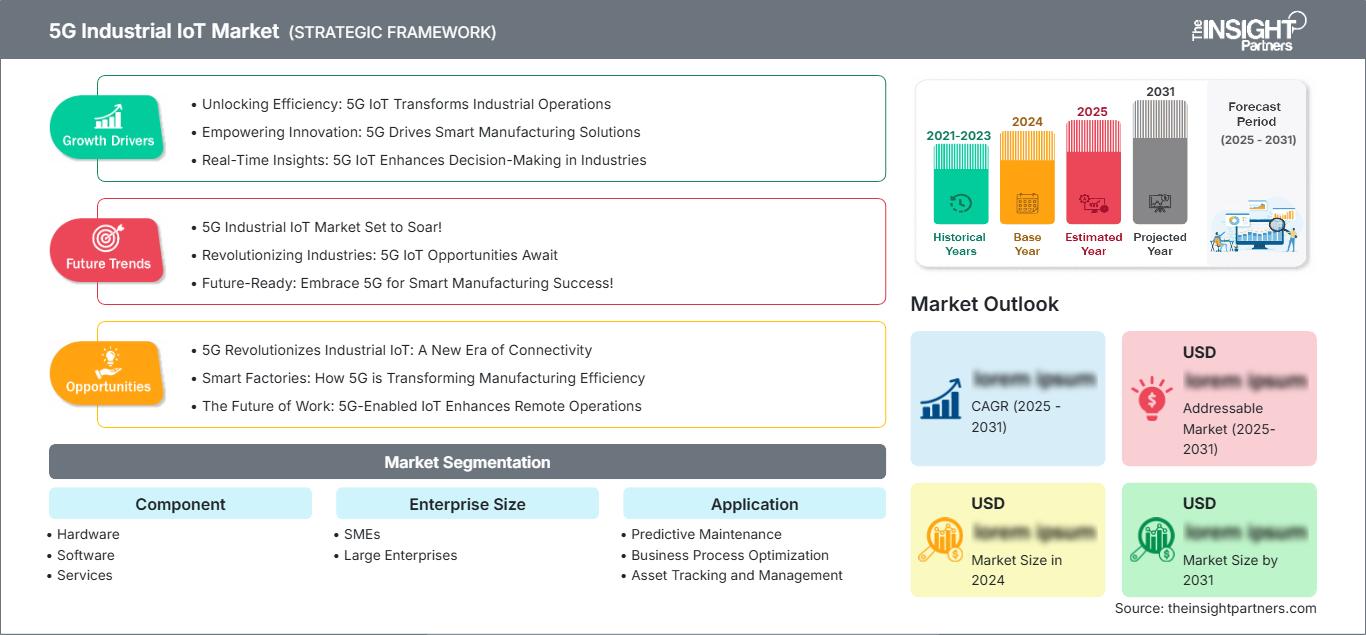
5G Industrial IoT Market: Strategic Insights
Regional Insights
North America 5G Industrial IoT Market
North America accounted for 27–31% share in 2025 and is expected to grow at a CAGR of 5.6–6.0% during 2026–2034. Private 5G deployments are advancing in automotive, aerospace, oil and gas, utilities, ports, and logistics facilities, where Wi-Fi congestion and wired-network inflexibility limit automation. High 5G penetration and industrial edge adoption support strong 5G Industrial IoT market trends.
Strengths include a hyperscale cloud, cybersecurity procurement maturity, and outsourced network management. Additionally, there is a 5G Industrial IoT market share, supported by government-funded infrastructure modernization and resiliency programs. Value propositions from the vendors include ruggedized products, spectrum consultation, and edge computing for predictive maintenance and worker safety.
U.S. 5G Industrial IoT Market
The U.S. 5G Industrial IoT market represented 72–76% of North America share in 2025 and is projected to expand at a CAGR of 5.7–6.1% through 2034. Early deployments are concentrated in manufacturing campuses, energy assets, semiconductor sites, logistics hubs, and defense-adjacent industrial operations. AT&T Inc., Cisco Systems, Inc., Qualcomm Incorporated, and International Business Machines Corporation support the ecosystem through connectivity, hardware, silicon, software, and services.
High demand for application use cases is witnessed in areas such as predictive maintenance, automation control, emergency incident handling, and workforce tracking. Deterministic coverage, cybersecurity, and integrations with current supervision software are being emphasized by enterprises. 5G IIoT applications within the U.S. have expanded to include private spectrum, cloud/edge collaborations, and growing AI-based inspection and digital twin operations.
Europe 5G Industrial IoT Market
Europe held 23–27% share in 2025 and is forecast to grow at a CAGR of 5.8–6.2% during 2026–2034. Germany leads regional adoption because automotive, machinery, chemicals, and electronics manufacturers use campus networks to support automation, mobile robotics, and quality inspection. Spectrum frameworks and Industry 4.0 programs make Germany the region’s reference market.
Within the UK, deployment is underway in port, utilities, advanced manufacturing, and logistics settings, where resilient connectivity enables remote monitoring and management of resources. In France, there is a push towards modernization in the industrial, aerospace, and energy sectors, while in Italy, clusters are helping due to the availability of machinery and automation companies. Within Spain, progress has been made in smart logistics, automotive manufacturing, and renewable energy facilities that require connected field assets.
European regulations are strengthening requirements for secure-by-design devices, data protection, and network resiliency. Siemens AG, Nokia Corporation, Telefonaktiebolaget LM Ericsson, and Telefónica, S.A. have established a presence in the region to integrate their solutions into factory automation, industrial routing, and managed connectivity. Further adoption will occur as medium-sized manufacturers seek to grow the 5G Industrial Internet of Things market by reducing downtime and enabling flexible production cells.
APAC 5G Industrial IoT Market
APAC accounted for 34–38% share in 2025 and is expected to post a CAGR of 6.4–6.8% through 2034. China leads through electronics, steel, automotive, ports, and smart-factory programs supported by extensive 5G coverage.
Japan and South Korea have prioritized robotics, semiconductor manufacturing, and precision manufacturing, since latency is critical for control systems and analysis in automation. In India, the manufacturing sector is making headway in digitalization in the automotive, pharma, logistics, and energy sectors.
The Australian industry participates through mining, ports, utilities, and remote asset monitoring. Favorable government policy for the digital sector, deployment of 5G standalone networks, and the need for increased efficiency make the Asia Pacific the leading region for 5G Industrial IoT Market growth.
Middle East & Africa 5G Industrial IoT Market
Middle East & Africa is projected to grow at a CAGR of 5.2–5.6% during 2026–2034. Saudi Arabia leads adoption through energy, mining, logistics, and industrial diversification programs.
The UAE is investing in smart ports, utilities, and manufacturing zones, while South Africa supports mining automation, asset tracking, and safety applications. Rest of MEA demand remains selective and infrastructure-led.
Energy infrastructure, national digital strategies, and private-network trials create long-term opportunities. However, device cost, spectrum readiness, and integration capability will shape the pace of 5G Industrial IoT Market adoption.
Segmentation Analysis
Component
The component segment is projected to grow at a CAGR of 6.0–6.4% during 2026–2034. Hardware remains essential for deployment, but software and services increasingly determine network utilization, security, and lifecycle value. Enterprises are procuring integrated stacks that combine radios, edge devices, device management, analytics, and operational support for scalable industrial use cases.
- Hardware includes radios, gateways, routers, modules, sensors, and edge appliances, forming the deployment base for reliable industrial connectivity across production lines, warehouses, utilities, and remote operating environments.
- Software supports orchestration, analytics, cybersecurity, network slicing, device lifecycle management, and integration with industrial systems, making it central to scalable deployments and recurring value creation.
- Services cover consulting, design, integration, testing, managed operations, and support, helping enterprises bridge telecom complexity with operational technology requirements and internal capability gaps.
Enterprise Size
The enterprise size segment is expected to grow at a CAGR of 5.9–6.3% during 2026–2034. Large enterprises are early adopters because they operate complex plants and can justify dedicated networks. SMEs are increasingly evaluating managed private 5G and packaged solutions that reduce upfront integration burden while enabling automation, tracking, and process optimization.
- SMEs adopt 5G-enabled IoT where managed services, preconfigured gateways, and cloud dashboards reduce technical barriers, enabling targeted improvements in maintenance, quality monitoring, and asset visibility.
- Large Enterprises lead scaled implementation across multi-site factories, mines, utilities, and logistics networks, using private 5G to standardize connectivity, security, automation, and operational analytics.
Application
The application segment is forecast to grow at a CAGR of 6.2–6.6% during 2026–2034. Demand is strongest where low latency, mobility, high device density, and continuous data capture improve operational performance. Predictive maintenance, logistics visibility, automation control, and incident response are becoming priority use cases as enterprises connect production assets with analytics platforms.
- Predictive Maintenance uses sensor data, equipment diagnostics, and edge analytics to identify failure patterns earlier, reducing downtime risk and improving maintenance planning across automation-intensive industrial assets.
- Business Process Optimization connects machines, workers, and enterprise systems to improve throughput, reduce manual reporting, and support data-led decisions across production, quality, and operations teams.
- Asset Tracking and Management enables real-time visibility of tools, containers, vehicles, inventory, and critical equipment, supporting utilization improvement, loss reduction, compliance, and faster operational coordination.
- Logistics and Supply Chain Management benefits from connected yards, warehouses, ports, and fleets, enabling better routing, inventory accuracy, shipment monitoring, and disruption management across industrial supply chains.
- Real-Time Workforce Tracking and Management supports worker safety, location awareness, access control, task coordination, and emergency response in large plants, mines, utilities, and hazardous operating environments.
- Automation Control and Management uses low-latency wireless connectivity for robots, automated guided vehicles, machine tools, and production cells, improving layout flexibility and reducing dependence on fixed cabling.
- Emergency, Incident Management supports faster detection, alerting, coordination, and response during equipment failures, safety incidents, fires, leaks, or operational disruptions in complex industrial facilities.
- Business Communication enables secure voice, video, collaboration, and field support across industrial sites, improving coordination among operators, maintenance teams, supervisors, and remote experts.
End-user
The end-user segment is expected to expand at a CAGR of 6.1–6.5% during 2026–2034. Process industries prioritize safety, remote monitoring, and asset reliability, while discrete industries emphasize automation flexibility, robotics, and quality control. Both groups require secure, high-availability networks that can support operational technology without disrupting production continuity.
- Process Industries use connected sensing, remote inspection, and incident management in chemicals, energy, metals, and utilities, where reliability, safety, and uptime are central procurement priorities.
- Discrete Industries adopt private 5G for robotics, machine vision, automated material handling, and flexible production, especially in automotive, electronics, aerospace, and industrial machinery manufacturing.
Opportunity Snapshot
| Application | Revenue Contribution | Trend Tag | Adoption Stage |
| Predictive Maintenance | High | Edge Analytics | Scaling |
| Business Process Optimization | Medium | Workflow Sync | Scaling |
| Asset Tracking, Management | High | Asset Visibility | Mature |
| Logistics, Supply Chain Management | High | Connected Yard | Scaling |
| Real-Time Workforce Tracking, Management | Medium | Worker Safety | Scaling |
| Automation Control, Management | High | Mobile Robotics | Scaling |
| Emergency, Incident Management | Medium | Rapid Response | Emerging |
| Business Communication | Medium | Field Collaboration | Mature |
5G Industrial IoT Market Growth Drivers and Impact Analysis
Private 5G Enables Reliable Industrial Automation
Predictable connectivity is essential for industrial facilities, as automated guided vehicles, machine tools, cameras, sensors, and mobile operators all require it to operate autonomously. Private 5G resolves coverage, latency, and security challenges associated with using Wi-Fi or public mobile networks in metallic and highly-interfering environments. The effect will be felt more by facilities striving to use flexible design, digital twins, and automated inspection, because wireless reliability enables equipment to be movable without extensive cabling. As enterprises shift from pilots to production-grade deployments, the 5G Industrial IoT Market benefits from repeatable campus rollouts and managed network models.
Edge AI Increases Value of Real-Time Industrial Data
Connected manufacturing devices generate data that is not useful unless it can be processed at the point of origin. Edge computing using AI enables manufacturers, utilities, mining companies, and ports to analyze video, vibration, temperature, location, and control data on-site. This enables predictive maintenance, quality assurance, safety monitoring, and productivity optimization without exposing all data to the public cloud. Combining 5G with local computing creates stronger use cases by tying investments in connectivity to outcomes in availability, quality, energy efficiency, and safety.
Supply-Chain Visibility Requires Dense Connected Asset Networks
Manufacturers and logistics operators are under pressure to track inventory, tools, containers, vehicles, and field equipment with greater precision. 5G-enabled IoT improves location awareness, data transmission, and mobility across warehouses, ports, yards, and production sites. The market impact extends beyond tracking because visibility data improves scheduling, maintenance, compliance, and customer service. As supply chains become more distributed, enterprises are investing in connected asset networks that integrate with enterprise resource planning, warehouse management, and transportation platforms.
5G Industrial IoT Market Future Trends
5G RedCap Expands Industrial Device Economics
Reduced capability 5G devices are expected to widen adoption by lowering power, complexity, and module cost for industrial sensors, wearables, handhelds, cameras, and trackers. This trend will help bridge the gap between high-performance private 5G use cases and lower-cost IoT endpoints that do not need full broadband capability. As device availability improves, enterprises can connect more assets per site, making predictive maintenance, workforce safety, and asset tracking more economical across medium-scale facilities.
Industrial Network Slicing Moves Toward Operational Use
Network slicing has progressed beyond the telecommunications demo environment to a stage where it is practically applied in industrial service design. This is done by using different connectivity for safety applications, video inspection, mobile robotics, business communications, and non-critical telemetry over the same infrastructure. The value in the future will lie in ensuring a strong correlation among performance, security, and services offered for each operational workload. As 5G standalone coverage expands, slicing can support contractual service assurance and enable operators to package industrial connectivity around measurable business outcomes.
5G Industrial IoT Market Opportunities
Managed Private Networks for Mid-Market Industrial Sites
Many mid-size factories, warehouses, and utilities require wireless connectivity but cannot provide telecommunications services within the organization. This can be solved through vendor solutions that bundle private 5G services with site evaluation, spectrum provisioning, installation, cybersecurity, monitoring, and lifecycle management. The market's attractiveness stems from SMEs starting with a single use case, such as asset tracking or predictive maintenance, and expanding when benefits are proven. Managed models reduce deployment risk and create recurring revenue for operators, integrators, and technology suppliers.
Vertical Solutions for Energy, Ports, and Smart Manufacturing
Energy assets, ports, and advanced manufacturing sites share common needs for high availability, worker safety, asset visibility, and remote operations. Suppliers can create differentiated offerings by combining 5G connectivity with application templates, rugged devices, edge AI, and cybersecurity controls for each vertical. This 5G Industrial IoT market forecast approach reduces customization time and strengthens sales relevance for industrial buyers. It also allows ecosystem partners to move beyond connectivity margins into higher-value software, services, and operational intelligence.
Recent Developments
- March 2026: Qualcomm Technologies, Inc. and Siemens AG showcase a technology implementation to accelerate the autonomous factory production. Qualcomm Technologies will be demonstrating on‑premise intelligence with AI integrated into a Siemens autonomous factory model. Together, the companies showcase the integration of private Industrial 5G connectivity with edge AI-based use-cases to enable more dynamic, efficient and intelligent autonomous production.
- March 2026: Semtech Corporation (Nasdaq: SMTC), a leading provider of high-performance semiconductor, Internet of Things (IoT) systems and cloud connectivity service solutions, announced the FX86E, a 5G RedCap modem designed for industrial IoT applications. The modem delivers plug-and-play connectivity across 5G RedCap, 4G/LTE and public and private networks, enabling organizations to connect devices and machines faster and with lower upfront costs. Purpose-built for industrial IoT OEMs and system integrators, the FX86E is pre-certified to reduce integration complexity and accelerate deployment timelines when compared to embedding a cellular module. The modem’s design addresses critical challenges including lengthy certification cycles, additional integration engineering work while enabling IoT applications to quickly transition from LTE to 5G with future-ready connectivity.
- January 2025: Siemens AG — The technology company Siemens announced a significant update to its industrial-grade private 5G infrastructure solution, that will enable manufacturers to cover larger industrial areas with enhanced connectivity capabilities. The expanded solution now supports up to 24 radio units, with each unit capable of covering approximately 5,000 m².
Frequently Asked Questions

- Comprehensive Market Sizing and Forecast Analysis
- Detailed Segmentation Analysis
- In-Depth Market Dynamics Assessment
- Regional and Country-Level Insights
- Competitive Landscape and Company Benchmarking
- Strategic Business Intelligence
Recent Reports
Testimonials

The Insight Partners' SCADA System Market report is comprehensive, with valuable insights on current trends and future forecasts. The team was highly professional, responsive, and supportive throughout. We are very satisfied and highly recommend their services.
RAN KEDEM Partner, Reali Technologies LTDs
I requested a report on a very specific software market and the team produced the report in a few days. The information was very relevant and well presented. I then requested some changes and additions to the report. The team was again very responsive and I got the final report in less than a week.
JEAN-HERVE JENN Chairman, Future Analytica
We worked with The Insight Partners for an important market study and forecast. They gave us clear insights into opportunities and risks, which helped shape our plans. Their research was easy to use and based on solid data. It helped us make smart, confident decisions. We highly recommend them.
PIYUSH NAGPAL Sr. Vice President, High Beam Global
The Insight Partners delivered insightful, well-structured market research with strong domain expertise. Their team was professional and responsive throughout. The user-friendly website made accessing industry reports seamless. We highly recommend them for reliable, high-quality research services
YUKIHIKO ADACHI CEO, Deep Blue, LLC.
This is the first time I have purchased a market report from The Insight Partners.While I was unsure at first, I visited their web site and felt more comfortable to take the risk and purchase a market report.I am completely satisfied with the quality of the report and customer service. I had several questions and comments with the initial report, but after a couple of dialogs over email with their analyst I believe I have a report that I can use as input to our strategic planning process.Thank you so much for taking the extra time and making this a positive experience.I will definitely recommend your service to others and you will be my first call when we need further market data.
JOHN SUZUKI President and Chief Executive Officer, Board Director, BK Technologies
I wish to appreciate your support and the professionalism you displayed in the course of attending to my request for information regarding to infectious disease IVD market in Nigeria. I appreciate your patience, your guidance, and the fact that you were willing to offer a discount, which eventually made it possible for us to close a deal. I look forward to engaging The Insight Partners in the future, all thanks to the impression you have created in me as a result of this first encounter.
DR CHIJIOKE ONYIA MANAGING DIRECTOR, PineCrest Healthcare Ltd.Reason to Buy
- Informed Decision-Making
- Understanding Market Dynamics
- Competitive Analysis
- Identifying Emerging Markets
- Customer Insights
- Market Forecasts
- Risk Mitigation
- Boosting Operational Efficiency
- Strategic Planning
- Investment Justification
- Tracking Industry Innovations
- Aligning with Regulatory Trends





 Get Free Sample for