
Human Machine Interface Market Trends, Demand & Growth by 2034
Coverage: By Offering (Hardware, Software, and Services); Configuration (Embedded and Stand-alone); End-user Industry (Energy & Power, General Manufacturing, Healthcare and Pharmaceuticals, Automotive, and Others)
- Status : Data Released
- Report Code : TIPRE00005016
- Category : Electronics and Semiconductor
- No. of Pages : 150
- Available Report Formats :


- Last update date : March 18, 2026


2025 Market Size
US$ 6.7 Bn
Base year value
2034 Forecast
US$ 13.2 Bn
Projected by 2034
CAGR 2026-2034
7.83 %
Growth rate
Addressable Market
US$ 89.58 Bn
(2026-2034)
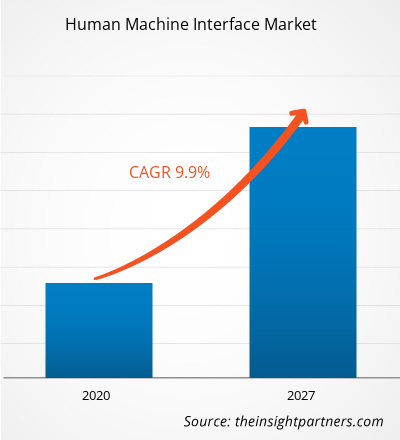
The global Human Machine Interface market was valued at US$ 6.7 billion in 2025 and is expected to reach US$ 13.2 billion by 2034; it is estimated to record a CAGR of 7.83% during 2026-2034.
Key market dynamics include a heightening global focus on industrial automation, rising consumer demand for high-resolution tactile displays, and a significant shift toward Industry 4.0 integrated systems. Additionally, the market is expected to benefit from the growing popularity of smart factories, expansion in automotive infotainment systems across emerging economies, and the increasing inclusion of HMI solutions in high-value segments like medical diagnostics and energy management systems.
Human Machine Interface Market Analysis
The human machine interface market analysis shows a shift toward high-value software-centric solutions as industrial operators prioritize intuitive user experiences and real-time data visualization. Procurement trends indicate the market is splitting into traditional ruggedized hardware for harsh industrial environments and high-growth cloud-integrated HMI software for remote monitoring. Strategic opportunities are emerging in the integration of Augmented Reality (AR) and voice-command interfaces, where hands-free operation in manufacturing and healthcare offers a clear competitive advantage. The analysis also notes that market expansion depends on cybersecurity resilience for interconnected devices and edge computing efficiency for reduced latency. Competitive differentiation now stands out depending on branding that highlights ease of integration, open-source compatibility, and the ability to bridge the gap between legacy machinery and modern IoT ecosystems. This approach helps established technology providers maintain premium positioning in a market seeing a surge of specialized software startups.
Human Machine Interface Market Overview
Human-machine interface is shifting from a simple control panel tradition to a global digital transformation catalyst. While historically focused on physical buttons and basic monochrome displays for machine control, HMI is expanding into value-added solutions like multi-touch screens, gesture recognition, and web-based monitoring platforms. Both large automation conglomerates and specialized software developers are part of this market, making use of advanced processor speeds and high-definition graphic interfaces. More efficiency-conscious operators in North America and Asia-Pacific are looking for alternatives to manual data logging, which has helped HMI gain popularity as a critical bridge for operational transparency. Europe is still a main innovation hub for high-end industrial controls. Still, Asia-Pacific region has become a leader in mass-market adoption and infrastructure scaling, especially through the rapid modernization of electronics and automotive production lines. For instance, the market in the US is characterized by a mature industrial base rapidly pivoting toward advanced robotics and AI-driven manufacturing. There is a strong emphasis on domestic production efficiency and the integration of HMI within complex pharmaceutical and aerospace supply chains, fostering a landscape focused on high-security and high-performance interfaces.
Market Research Highlights
- Global market for Human Machine Interface was valued at US$ 6.70 Billion in 2025
- Annual market size is expected to reach US$ 13.20 Billion by 2034
- Total addressable market (TAM) during 2026-2034 is projected to reach approximately US$ 89.58 Billion
- Market is anticipated to register a CAGR of 7.83% during the forecast period
- The United States represents a key market, supported by Increased adoption of automation and industrial IoT, Focus on reducing human error in critical operations, as well as evolving industry dynamics
- Market analysis covers North America, Europe, Asia-Pacific, South and Central America, Middle East and Africa, with growth evaluated across the forecast period
- Market opportunities such as Emergence of touchless and gesture-based interfaces, Growth in smart manufacturing and Industry 4.0 applications are expected to influence market dynamics and addressable market
- Report profiles industry participants, including ABB Ltd., Advantech Co., Ltd., General Electric Co., Honeywell International, Inc., Kontron S T AG, Mitsubishi Electric Corporation, Rockwell Automation, Inc., Schneider Electric, Siemens AG, Yokogawa Electric Corporation, while analyzing competitive strategies and innovation developments
-
Source: The Insight Partners' analysis based on proprietary research, government publications, company annual reports, investor presentations, industry databases, and expert interviews.
● REPORT CUSTOMIZATION
Tailor This Report To Align With Your Specific Business Requirements
This report can be customized to align precisely with your business objectives, scope, and target markets. Customization options include tailored segmentation, geography, competitive analysis, and strategic insights to support informed decision-making.
Customize This Report →WHAT YOU CAN ADJUST
- ● Segmentations
- ● Geography
- ● Competitive Analysis
- ● Language Preferences
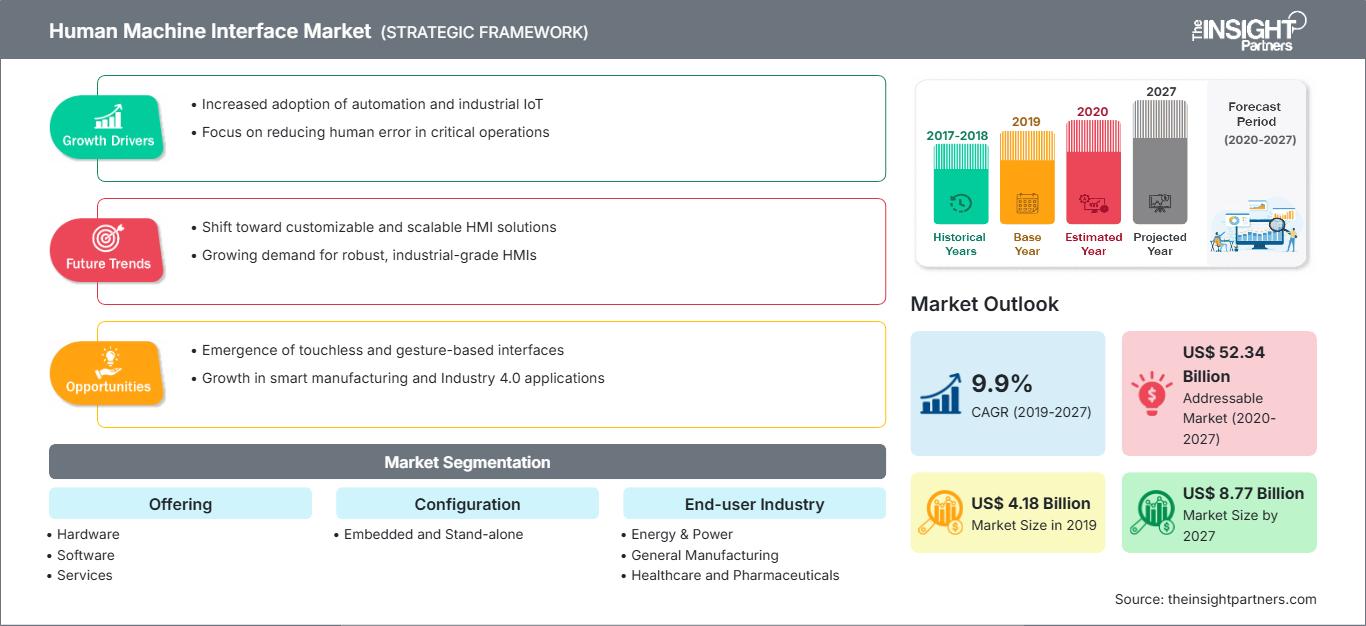
Human Machine Interface Market: Strategic Insights
-
Get Top Key Market Trends of this report.This FREE sample will include data analysis, ranging from market trends to estimates and forecasts.
Human Machine Interface Market Drivers and Opportunities
Market Drivers:
- Rapid Adoption of Industry 4.0 and Smart Manufacturing: The transition toward fully automated factories requires sophisticated HMI systems to monitor complex workflows. This demand for centralized control and data transparency is a primary driver for the modernization of industrial interfaces globally.
- Proliferation of IoT and Connected Devices: The expansion of the Industrial Internet of Things (IIoT) has created a need for interfaces that can communicate with diverse sensors and cloud platforms. As machines become more connected, the HMI serves as the essential portal for human operators to interact with digital twins and big data.
- Heightened Demand for Enhanced User Experience (UX): Modern operators expect industrial interfaces to mirror the ease of use found in consumer electronics. The shift toward capacitive touchscreens, intuitive graphic icons, and customizable dashboards is driving replacement cycles for older, more cumbersome text-based systems.
Market Opportunities:
- Integration of Artificial Intelligence (AI) and Machine Learning: Beyond standard control, there is a significant opportunity to embed AI within HMI software to provide predictive maintenance alerts and diagnostic suggestions directly to the operator, enhancing proactive decision-making.
- Growth in Healthcare and Medical Device Sectors: Developing specialized, high-reliability HMI solutions for diagnostic equipment and patient monitoring systems offers access to high-margin market segments where precision and cleanliness (antimicrobial surfaces) are increasingly prioritized.
- Expansion into Renewable Energy Management: There is a growing opportunity for providers to target the green energy market through HMI solutions designed for solar grid monitoring and wind farm management, as global investments in sustainable infrastructure continue to rise.
Human Machine Interface Market Report Segmentation Analysis
The Human Machine Interface Market share is analyzed across various segments to provide a clearer understanding of its structure, growth potential, and emerging trends. Below is the standard segmentation approach used in most industry reports:
By Offering:
- Hardware: Includes touchscreens, displays, industrial PCs, and physical controllers. This remains a significant segment as ruggedized equipment is essential for industrial floors.
- Software: A fast-growing niche focused on visualization, data management, and cloud connectivity, allowing for remote access and sophisticated analytics.
- Services: Encompass installation, maintenance, and consulting, which are becoming vital as HMI systems grow in complexity and require professional integration.
By Configuration:
- Embedded: The dominant configuration driver, where HMI is built directly into the machinery, providing a compact and specialized control solution for specific industrial tasks.
- Stand-alone: Offers a versatile range of independent terminals and PCs that can be used to monitor multiple systems or integrated into larger control rooms for broad oversight.
By End-user Industry:
- Energy & Power: Utilizes HMI for monitoring grid stability and plant operations, benefiting from the global shift toward smart grids.
- General Manufacturing: Remains the primary channel for HMI adoption, covering everything from food and beverage to textile production.
- Healthcare and Pharmaceuticals: A high-growth market requiring specialized interfaces for precision manufacturing and sterile environments.
- Automotive: Drives innovation in both production line interfaces and in-vehicle driver information systems.
- Others: Includes aerospace, defense, and oil & gas, where high-durability HMI solutions are required for extreme conditions.
By Geography:
- North America
- Europe
- Asia Pacific
- South & Central America
- Middle East & Africa
Human Machine Interface Market Report Scope
| Report Attribute | Details |
|---|---|
| Market size in 2025 | US$ 6.7 Billion |
| Market Size by 2034 | US$ 13.2 Billion |
| Global CAGR (2026 - 2034) | 7.83% |
| Historical Data | 2021-2024 |
| Forecast period | 2026-2034 |
| Segments Covered |
By Offering
|
| Regions and Countries Covered |
North America
|
| Market leaders and key company profiles |
|
Human Machine Interface Market Players Density: Understanding Its Impact on Business Dynamics
The Human Machine Interface Market is growing rapidly, driven by increasing end-user demand due to factors such as evolving consumer preferences, technological advancements, and greater awareness of the product's benefits. As demand rises, businesses are expanding their offerings, innovating to meet consumer needs, and capitalizing on emerging trends, which further fuels market growth.
Human Machine Interface Market Share Analysis by Geography
Asia-Pacific is expected to grow fastest in the coming years. Emerging markets in South & Central America, the Middle East, and Africa also have many untapped opportunities for premium automation providers and industrial software developers to expand.
The human machine interface market is undergoing a significant transformation, moving from a traditional control panel to a global high-value digital asset. Growth is driven by the rising demand for factory automation, a surge in smart infrastructure projects, and the expansion of the high-tech automotive industry. Below is a summary of market share and trends by region:
North America
- Market Share: A robust and technologically advanced segment driven by early adoption of IIoT and a strong presence of key automation players.
- Key Drivers:
- Rapid integration of AI and analytics into industrial software.
- Mainstreaming of advanced HMI in the medical and pharmaceutical sectors.
- Strong focus on domestic manufacturing reshoring initiatives.
- Trends: Scaling of cloud-based HMI solutions and the successful adoption of wireless interfaces to allow operators greater mobility on the factory floor.
Europe
- Market Share: Holds a substantial share globally, anchored by a deep-seated industrial engineering heritage in Germany, France, and Italy.
- Key Drivers:
- Strict adherence to Industry 4.0 standards and sustainable manufacturing.
- Established automotive manufacturing base requiring high-end HMI.
- Strong government incentives for digital transformation in SMEs.
- Trends: A strategic shift toward Green HMI that prioritizes energy efficiency and the use of sustainable materials in hardware production.
Asia-Pacific
- Market Share: The fastest-growing region, with China, Japan, and India acting as the primary engines for electronics and automotive manufacturing.
- Key Drivers:
- Massive industrialization and the rise of mega-factories.
- Government-supported Smart City initiatives and infrastructure growth.
- Rapid urbanization is leading to increased demand for consumer goods and automated production.
- Trends: Heavy reliance on mobile-integrated HMI and B2B contracts for cost-effective hardware solutions used in the consumer electronics assembly industry.
South and Central America
- Market Share: Emerging market with a growing manufacturing industry in countries like Brazil and Argentina.
- Key Drivers:
- Increasing awareness of operational efficiency to compete in global markets.
- Modernization of mining and agricultural processing facilities.
- Rising interest in automotive assembly plant expansions.
- Trends: Growth of entry-level HMI hardware and a focus on ruggedized systems that can withstand varied environmental conditions in resource extraction.
Middle East and Africa
- Market Share: Developing market with a focus on diversifying economies beyond oil, transitioning toward formalized industrial sectors.
- Key Drivers:
- High demand for HMI in the oil & gas and petrochemical industries.
- Strategic investments in smart infrastructure and desalination plants.
- Implementation of modern control technologies to improve local production capacity.
- Trends: Implementation of high-end, high-security HMI for critical energy infrastructure, coupled with a focus on remote monitoring solutions for desert environments.
High Market Density and Competition
Competition is intensifying due to the presence of established leaders such as Siemens AG, Rockwell Automation, Inc., and Schneider Electric SE. Regional technical experts and niche players like Mitsubishi Electric Corporation (Japan) and Advantech Co., Ltd. (Taiwan), alongside North American innovators such as Emerson Electric Co. and Honeywell International Inc., also contribute to a diverse and rapidly expanding market landscape.
This competitive environment pushes vendors to differentiate through:
- Software-Defined Branding: Positioning HMI not just as a screen, but as a central data hub that offers superior edge-computing and predictive capabilities for tech-savvy industrial users.
- Multi-Modal Interfaces: HMI products now include more than touch. Companies offer voice-activated controls, gesture recognition, and haptic feedback to improve safety and accessibility.
- Vertical Integration: Producers manage the entire ecosystem, from proprietary operating systems to custom-built ruggedized casings. This ensures cybersecurity, reliability, and meets strict industrial safety standards.
- Modular Design: New hardware technologies help create modular HMI panels where components can be swapped or upgraded without replacing the entire unit, appealing to cost-conscious facilities.
Opportunities and Strategic Moves
- Partner with high-end cybersecurity firms and cloud providers to tap into the surging demand for secure, remote-access HMI solutions in the European and North American markets.
- Incorporate open-source communication protocols and cross-platform compatibility to appeal to digital-native engineers seeking flexible and scalable automation architectures.
Major Companies operating in the Human Machine Interface Market are:
- ABB Ltd.
- Advantech Co., Ltd.
- General Electric Co.
- Honeywell International, Inc.
- Kontron S T AG
- Mitsubishi Electric Corporation
- Rockwell Automation, Inc.
- Schneider Electric
- Siemens AG
- Yokogawa Electric Corporation
Disclaimer: The companies listed above are not ranked in any particular order.
Human Machine Interface Market News and Recent Developments
- In December 2025, ABB India launched the ACS380-E drive as the latest addition to its all-compatible drive portfolio. This drive, which was specifically designed for automation-centric machine building, simplified the Human Machine Interface integration process and was future-proofed for advanced industrial automation.
- In October 2024, Rockwell Automation, Inc. announced the advancement of its FactoryTalk® Optix™ portfolio through DataReady™ smart machines. This update to the Human Machine Interface portfolio enabled contextualized machine data that was ready to deliver immediate operational value to industrial users.
Human Machine Interface Market Report Coverage and Deliverables
The Human Machine Interface Market Size and Forecast (2021–2034) report provides a detailed analysis of the market covering below areas:
- Human Machine Interface Market size and forecast at global, regional, and country levels for all the key market segments covered under the scope
- Human Machine Interface Market trends, as well as market dynamics such as drivers, restraints, and key opportunities
- Detailed PEST and SWOT analysis
- Human Machine Interface Market analysis covering key market trends, global and regional framework, major players, regulations, and recent market developments
- Industry landscape and competition analysis covering market concentration, heat map analysis, prominent players, and recent developments in the Human Machine Interface Market.
- Detailed company profiles
Frequently Asked Questions

- Comprehensive Market Sizing and Forecast Analysis
- Detailed Segmentation Analysis
- In-Depth Market Dynamics Assessment
- Regional and Country-Level Insights
- Competitive Landscape and Company Benchmarking
- Strategic Business Intelligence
Recent Reports
Testimonials

The Insight Partners provided valuable market intelligence that supported our global go-to-market strategy. Their team was professional, responsive, and attentive to our feedback, providing thoughtful analysis and helpful methodological clarifications throughout the project.
Junmo Kim Chief Financial Officer (CFO), Enertech Co., Ltd.
The Insight Partners' SCADA System Market report is comprehensive, with valuable insights on current trends and future forecasts. The team was highly professional, responsive, and supportive throughout. We are very satisfied and highly recommend their services.
RAN KEDEM Partner, Reali Technologies LTDs
I requested a report on a very specific software market and the team produced the report in a few days. The information was very relevant and well presented. I then requested some changes and additions to the report. The team was again very responsive and I got the final report in less than a week.
JEAN-HERVE JENN Chairman, Future Analytica
We worked with The Insight Partners for an important market study and forecast. They gave us clear insights into opportunities and risks, which helped shape our plans. Their research was easy to use and based on solid data. It helped us make smart, confident decisions. We highly recommend them.
PIYUSH NAGPAL Sr. Vice President, High Beam Global
The Insight Partners delivered insightful, well-structured market research with strong domain expertise. Their team was professional and responsive throughout. The user-friendly website made accessing industry reports seamless. We highly recommend them for reliable, high-quality research services
YUKIHIKO ADACHI CEO, Deep Blue, LLC.
This is the first time I have purchased a market report from The Insight Partners.While I was unsure at first, I visited their web site and felt more comfortable to take the risk and purchase a market report.I am completely satisfied with the quality of the report and customer service. I had several questions and comments with the initial report, but after a couple of dialogs over email with their analyst I believe I have a report that I can use as input to our strategic planning process.Thank you so much for taking the extra time and making this a positive experience.I will definitely recommend your service to others and you will be my first call when we need further market data.
JOHN SUZUKI President and Chief Executive Officer, Board Director, BK Technologies
I wish to appreciate your support and the professionalism you displayed in the course of attending to my request for information regarding to infectious disease IVD market in Nigeria. I appreciate your patience, your guidance, and the fact that you were willing to offer a discount, which eventually made it possible for us to close a deal. I look forward to engaging The Insight Partners in the future, all thanks to the impression you have created in me as a result of this first encounter.
DR CHIJIOKE ONYIA MANAGING DIRECTOR, PineCrest Healthcare Ltd.Reason to Buy
- Informed Decision-Making
- Understanding Market Dynamics
- Competitive Analysis
- Identifying Emerging Markets
- Customer Insights
- Market Forecasts
- Risk Mitigation
- Boosting Operational Efficiency
- Strategic Planning
- Investment Justification
- Tracking Industry Innovations
- Aligning with Regulatory Trends






 Get Free Sample for