Humanoid Robot Assembly and Manufacturing Equipment Market Demand, Share & Growth by 2031
Humanoid Robot Assembly and Manufacturing Equipment Market Size and Forecast (2021 - 2031), Global and Regional Share, Trend, and Growth Opportunity Analysis Report Coverage: By Equipment Type (Assembly Equipment (Welding, Bonding, Fastening, Module or Sub-assembly Equipment, Battery or Motor or Gearbox Assembly Systems, and Others), Machining and Process Equipment (Press, CNC Machining, Metal Processing, Heat Treatment, Surface Treatment, and Others), Handling Transfer and Robotics Equipment (Robot Handlers, Collaborative Robots (Cobots), AGV or AMR, Tooling Systems, Jigs and Fixtures, and Others), and Line Setup and System Integration), By Automation Level (Fully Automated or Smart Factory Equipment, Semi-Automated Production Equipment, and Manual or Assisted Assembly Equipment), By End User (Humanoid Robot OEMs, Contract Manufacturers, System Integrators, and Research and Prototyping Labs) and Geography (North America, Europe, Asia Pacific, Middle East and Africa, and South America), and Geography (North America, Europe, Asia Pacific, Middle East and Africa, and South America)
Historic Data: 2021-2024 | Base Year: 2024 | Forecast Period: 2026-2031- Status : Published
- Report Code : TIPRE00042245
- Category : Electronics and Semiconductor
- No. of Pages : 419
- Available Report Formats :


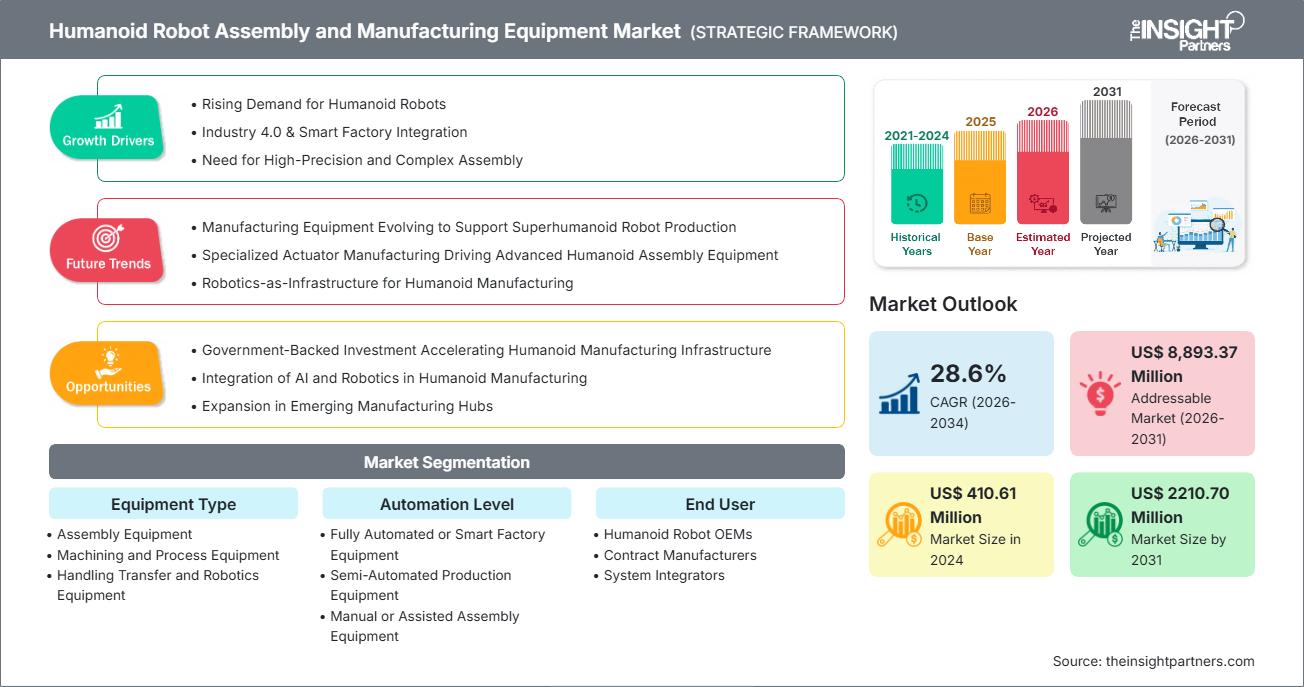
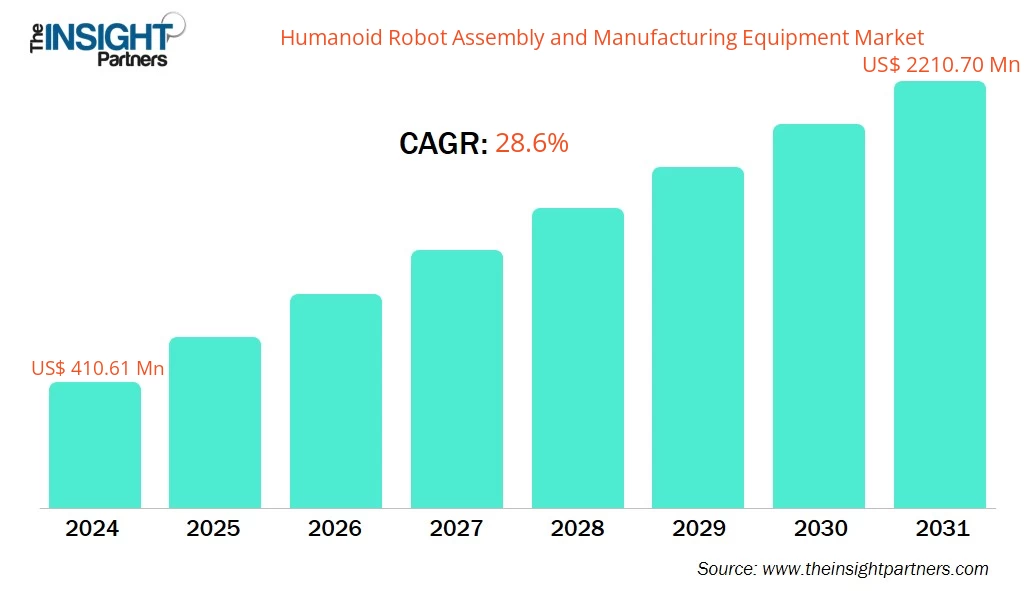
The Humanoid Robot Assembly and Manufacturing Equipment market size reached US$ 410.61 million in 2024 and is expected to reach US$ 2210.70 million by 2031. The market is estimated to register a CAGR of 28.6% from 2025–2031.
Humanoid Robot Assembly and Manufacturing Equipment Market Analysis
Humanoid robots are tools, machines, and automated systems utilized to research, create, and put together humanoid robots. These robots are designed to mimic human movements and behaviors. Thus, they require very precise integration of mechanical parts, sensors, actuators, and AI-operated control systems. The assembly and manufacturing equipment consists of robotic arms, precision assembly stations, sensor calibration systems, testing rigs, and modular production lines designed for high-precision humanoid robotics. Sophisticated assembly and manufacturing equipment are the key to delivering products operating with industrial, commercial, healthcare, and research applications that are quality-checked, efficient, and reliable. A well-equipped production base can shorten the time of manufacturing, resulting in cost savings and providing support to rapid innovation cycles, thus allowing companies to address the increasing demand for human-like robots.
Humanoid Robot Assembly and Manufacturing Equipment Market Overview
The applications of humanoid robots are diverse. In manufacturing and logistics sectors, these robots take over the performance of repetitive, dangerous, and physically demanding jobs. In the healthcare sector, they are patient assistants who provide a means of rehabilitation and are involved in continuous monitoring. Service sectors use humanoid robots for customer interaction, security, and educational activities. Research centers and armies have turned to humanoid robotics for research, simulation, and training.
Key factors contributing to market expansion include a rise in automating industries, technological development in the AI and robotics fields, and the increased spending on research and development of humanoid robotics by different entities. The trend of looking for labor-saving and highly flexible robotic systems is driving the demand for more advanced assembling and manufacturing facilities.
Customize This Report To Suit Your Requirement
Get FREE CUSTOMIZATIONHumanoid Robot Assembly and Manufacturing Equipment Market: Strategic Insights
-
Get Top Key Market Trends of this report.This FREE sample will include data analysis, ranging from market trends to estimates and forecasts.
Humanoid Robot Assembly and Manufacturing Equipment Market Drivers and Opportunities
Market Drivers:
- Growing demand for Humanoid Robots: The manufacturers of humanoid robots are increasingly pressured to increase production volume while ensuring consistency, precision, and quality. This change requires more specialized manufacturing equipment, such as automated assembly lines, precision tooling, AI-driven calibration systems, and advanced testing and inspection platforms, all for producing humanoid robots. The use of humanoid robots has shifted from being merely experimental to becoming standard on an industrial level. In December 2025, CATL made history as the first battery manufacturer in the world to deploy humanoid robots at scale to produce battery packs. They have replaced human labor in the processes that are most critical.
- Industry 4.0 & Smart Factory Integration: The integration of AI, IoT technologies, and cloud-based monitoring systems forms a connected, data-driven environment, thus renewing the traditional production facilities. Manufacturers of humanoid robots can leverage these technologies to allow higher production efficiency, better quality control, and more reliable complex assembly processes. The need for state-of-the-art manufacturing equipment ramps up drastically, with items such as automatic assembly cells, smart robotic tooling, and instant inspection and calibration systems receiving the most interest.
- Need for High-Precision and Complex Assembly: Precision and process control are two major aspects of robot manufacturing in humanoid robots. It is justified to consider the assembly and manufacturing equipment to be specialized. Humanoid robots are made of complex mechanical structures, advanced actuators, dense sensor arrays, and sophisticated electronic and control systems. These parts must be put together in a way that the movements become accurate, the robot gets balanced, and it also becomes responsive and durable for a long time. It is impossible to achieve the tolerances and repeatability necessary for the performance of a humanoid robot only by manual assembly.
Market Opportunities:
- Government-Backed Investment: In March 2025, China's National Development and Reform Commission said a state-backed venture capital fund concentrating on robotics, artificial intelligence, and advanced innovation would be set up. The fund, which is planned to be a long-term one, could gather ~1 trillion yuan (US$ 138 billion) in 20 years from local governments and private sector investors, marking a commitment to the development of advanced manufacturing of humanoid robots
- The Rise of Sustainability-Driven and Circular Logistics Solutions: AI-controlled machinery can carry out automated self-calibration, real-time process optimization, and autonomous quality inspection, the features required for mass production of complex humanoid robots. Human intervention is decreased, mistakes are minimized, and costs are lowered. Also, consistency and output are improved. Humanoid robots have very complex mechanical joints, sensors, actuators, and control systems that need to be integrated perfectly.
Humanoid Robot Assembly and Manufacturing Equipment Market Report Segmentation Analysis
The Humanoid Robot Assembly and Manufacturing Equipment market is divided into different segments to give a clearer view of how it works, its growth potential, and the latest trends. Below is the standard segmentation approach used in industry reports:
By Pressure:
- Fully Automated or Smart Factory Equipment:
Fully automated or smart factory equipment provides complete automation of production processes such as machining, assembly, handling, inspection, and testing with little human involvement. Smart factory equipment combines robotics, AI, sensors, and digital control platforms, providing high precision, consistency, and output. In the production of humanoid robots, fully automated systems produce a large volume of products while maintaining very high-quality standards, along with the possibility of tracing each step of the manufacturing process. - Semi-Automated Production Equipment: Semi-automated equipment is commonly utilized in component positioning, fastening, and sub-assembly processes where humans are necessary for quality control and customization. Manufacturers adopt them to decrease the intensity of labor, increase the degree of repeatability, and control the level of capital expenditure as compared to fully automated systems.
- Manual or Assisted Assembly Equipment: The manual and assisted assembly equipment features workstations, hand tools, assisted lifting devices, as well as simple fixtures that facilitate human-led assembly processes. Manual and assisted equipment provides great flexibility, allowing engineers and technicians to adapt to frequent design changes and complex assembly requirements of humanoid robot development.
By Equipment Type:
- Assembly Equipment
- Welding
- Bonding
- Fastening
- Module or Sub-assembly Equipment
- Battery or Motor or Gearbox Assembly Systems
- Others)
- Machining and Process Equipment
- Press
- CNC Machining
- Metal Processing
- Heat Treatment
- Surface Treatment
- Others
- Handling Transfer and Robotics Equipment
- Robot Handlers
- Collaborative Robots (Cobots)
- AGV or AMR
- Tooling Systems
- Jigs and Fixtures
- Others
- Line Setup and System Integration
By End User:
- Humanoid Robot OEMs
- Contract Manufacturers
- System Integrators
- Research and Prototyping Labs
By Geography:
- North America
- Europe
- Asia Pacific
- South America
- Middle East & Africa
Humanoid Robot Assembly and Manufacturing Equipment Market Report Scope
| Report Attribute | Details |
|---|---|
| Market size in 2024 | US$ 410.61 Million |
| Market Size by 2031 | US$ 2210.70 Million |
| Global CAGR (2026 - 2034) | 28.6% |
| Historical Data | 2021-2024 |
| Forecast period | 2026-2031 |
| Segments Covered |
By Equipment Type
|
| Regions and Countries Covered |
North America
|
| Market leaders and key company profiles |
|
Humanoid Robot Assembly and Manufacturing Equipment Market Players Density: Understanding Its Impact on Business Dynamics
The Humanoid Robot Assembly and Manufacturing Equipment Market is growing rapidly, driven by increasing end-user demand due to factors such as evolving consumer preferences, technological advancements, and greater awareness of the product's benefits. As demand rises, businesses are expanding their offerings, innovating to meet consumer needs, and capitalizing on emerging trends, which further fuels market growth.
Humanoid Robot Assembly and Manufacturing Equipment Market Share Analysis by Geography
North America leads the market due to strong research and development investments, advanced automation infrastructure, and the presence of top robotics innovators who push the demand for high-precision AI, AI-integrated production lines. Asia Pacific is the fastest-growing region due to rapid industrialization, government-backed robotics initiatives, and cost-competitive electronics and component manufacturing ecosystems.
Below is a summary of market share and trends by region:
1. North America
- Market Share: Largest market—especially in the US—driven by strong investment in robotics R&D.
- Key Drivers:
- Rapid development of humanoid robots for logistics
- Significant venture capital funding and public-private partnerships
- Trends: Strong focus on smart factories
2. Europe
- Market Share: Second largest innovation-driven market with strong presence in Germany, the UK, and France.
- Key Drivers:
- Stringent regulations for machine safety
- Established an industrial automation and precision engineering ecosystem.
- Trends: Strong focus on the adoption of automation systems
3. Asia Pacific
- Market Share: Fastest-growing market fueled by rapid industrialization and electronics manufacturing leadership
- Key Drivers:
- Expansion of robotics manufacturing in China
- Strong supply chain integration for sensors, semiconductors, actuators, and control systems
- Trends: Shift from component-level assembly toward fully automated, high-volume humanoid robot production facilities.
4. Middle East and Africa
- Market Share: Emerging market anchored in GCC countries and select African innovation hubs
- Key Drivers:
- Government-led economic diversification programs investing in advanced manufacturing and robotics.
- Development of technology parks and smart industrial zones.
- Trends: Increasing localization of high-tech assembly capabilities and pilot humanoid manufacturing initiatives.
5. South America
- Market Share: A growing market supported by the modernization of industrial sectors in Brazil and Chile.
- Key Drivers:
- Rising interest in automation for manufacturing and logistics.
- Efforts to upgrade industrial infrastructure and attract foreign robotics investment.
- Trends: Strategic collaborations with global robotics firms and adoption of advanced assembly automation technologies.
Medium Market Density and Competition
The competitive landscape is shaped by established players such as Kuka AG, Fanuc Corp, ABB Ltd, Denso Corp, Staubli International AG, Boston Dynamics Inc, and Unitree Robotics. Regional and niche players are contributing across different regions.
This high level of competition urges companies to stand out by offering:
- Redesign assembly lines to minimize energy consumption, material waste, and precision losses in humanoid robot production.
- Implement fully integrated MES, PLM, IoT-enabled monitoring, and AI-driven quality control systems for real-time visibility and predictive maintenance.
- Develop modular, scalable, and reconfigurable manufacturing cells to enable rapid integration and flexible production scaling.
Opportunities and Strategic Moves
- Companies are partnering with automation, precision engineering, and AI vision system providers to co-develop smart, fully integrated humanoid robot assembly lines and digital production control platforms.
- Equipment manufacturers are designing modular, pre-engineered, and skid-mounted assembly cells (actuator assembly units, PCB integration stations, calibration and testing modules) that enable quick installation and minimal disruption to existing factory operations.
- Advanced digital technologies such as IoT sensors, machine vision, digital twins, and real-time analytics are being embedded into production equipment to monitor component traceability, machine health, and overall manufacturing performance. This data, combined with AI/Analytics, allows for predictive maintenance, dynamic slotting, and continuous optimization, providing insourced logistics operations with increased reliability, uptime, and utilization.
Other companies analyzed during the course of research:
- Yaskawa Electric Corporation
- Robologic India Pvt Ltd.
- PRIMO AUTOMATION SYSTEMS PVT LTD
- Yamazaki Mazak Corporation
- Kawasaki Heavy Industries, Ltd.
- Figure AI Inc.
- Dalian Haosen Intelligent Manufacturing Co., Ltd.
- CRP Meccanica
- Figure AI Inc.
Disclaimer: The companies listed above are not ranked in any particular order.
Humanoid Robot Assembly and Manufacturing Equipment Market News and Recent Developments
- Apptronik announced a strategic collaboration with Jabil: Apptronik, the AI-powered humanoid robotics company, and Jabil, a global leader in engineering, manufacturing, and supply chain solutions, announced a pilot and strategic collaboration to build Apollo humanoid robots and integrate them into specific Jabil manufacturing operations. It includes the production lines that will build Apollo humanoid robots, paving the way for Apollo to build Apollo.
- ABB is expanding its portfolio of robotic solutions : ABB expanded its portfolio of robotic solutions for logistics and e-commerce supply chains with the addition of two new AI-powered functional modules to its Item Picking family. Featuring ABB’s own AI-based vision technology, tested by the world’s leading fashion retail and logistics companies, the Fashion Inductor and Parcel Inductor offer solutions for two of the most critical logistics processes: item picking and sorter induction.
Humanoid Robot Assembly and Manufacturing Equipment Market Report Coverage and Deliverables
The "Humanoid Robot Assembly and Manufacturing Equipment Market Size and Forecast (2021–2031)" report provides a detailed analysis of the market covering below areas:
- Humanoid robot assembly and manufacturing equipment market size and forecast at global, regional, and country levels for all the segments covered under the scope
- Humanoid robot assembly and manufacturing equipment market trends, as well as dynamics such as drivers, restraints, and opportunities
- Detailed PEST and SWOT analysis
- Humanoid robot assembly and manufacturing equipment market analysis covering key trends, global and regional framework, major players, regulations, and recent developments
- Industry landscape and competition analysis covering market concentration, heat map analysis, prominent players, and recent developments for the Humanoid Robot Assembly and Manufacturing Equipment market
- Detailed company profiles
Frequently Asked Questions
1. Modular & Reconfigurable Hardware
2. Digital Twin & Simulation Integration
3. Edge Computing and Real‑Time Control Systems
4. Advanced Sensing and Vision Systems
2. Complex system design and engineering requirements
3. Safety and human‑robot interaction concerns
4. Limited standardization across platforms and components
2. Rising Demand for Automation
3. Labor Shortages & Cost Pressures
4. Expansion of Use Cases & Sectors

- Historical Analysis (2 Years), Base Year, Forecast (7 Years) with CAGR
- PEST and SWOT Analysis
- Market Size Value / Volume - Global, Regional, Country
- Industry and Competitive Landscape
- Excel Dataset
Recent Reports
Testimonials

The Insight Partners' SCADA System Market report is comprehensive, with valuable insights on current trends and future forecasts. The team was highly professional, responsive, and supportive throughout. We are very satisfied and highly recommend their services.
RAN KEDEM Partner, Reali Technologies LTDs
I requested a report on a very specific software market and the team produced the report in a few days. The information was very relevant and well presented. I then requested some changes and additions to the report. The team was again very responsive and I got the final report in less than a week.
JEAN-HERVE JENN Chairman, Future Analytica
We worked with The Insight Partners for an important market study and forecast. They gave us clear insights into opportunities and risks, which helped shape our plans. Their research was easy to use and based on solid data. It helped us make smart, confident decisions. We highly recommend them.
PIYUSH NAGPAL Sr. Vice President, High Beam Global
The Insight Partners delivered insightful, well-structured market research with strong domain expertise. Their team was professional and responsive throughout. The user-friendly website made accessing industry reports seamless. We highly recommend them for reliable, high-quality research services
YUKIHIKO ADACHI CEO, Deep Blue, LLC.
This is the first time I have purchased a market report from The Insight Partners.While I was unsure at first, I visited their web site and felt more comfortable to take the risk and purchase a market report.I am completely satisfied with the quality of the report and customer service. I had several questions and comments with the initial report, but after a couple of dialogs over email with their analyst I believe I have a report that I can use as input to our strategic planning process.Thank you so much for taking the extra time and making this a positive experience.I will definitely recommend your service to others and you will be my first call when we need further market data.
JOHN SUZUKI President and Chief Executive Officer, Board Director, BK Technologies
I wish to appreciate your support and the professionalism you displayed in the course of attending to my request for information regarding to infectious disease IVD market in Nigeria. I appreciate your patience, your guidance, and the fact that you were willing to offer a discount, which eventually made it possible for us to close a deal. I look forward to engaging The Insight Partners in the future, all thanks to the impression you have created in me as a result of this first encounter.
DR CHIJIOKE ONYIA MANAGING DIRECTOR, PineCrest Healthcare Ltd.Reason to Buy
- Informed Decision-Making
- Understanding Market Dynamics
- Competitive Analysis
- Identifying Emerging Markets
- Customer Insights
- Market Forecasts
- Risk Mitigation
- Boosting Operational Efficiency
- Strategic Planning
- Investment Justification
- Tracking Industry Innovations
- Aligning with Regulatory Trends




 Get Free Sample For