
Portable Gas Detection Market Share, Growth & Demand by 2034
Coverage: By Type (Single Gas, Multi Gas (2 Gas, 3 Gas, 4 Gas, 5 Gas, 6 and More Gas)), Product Type (Wearable and Non-wearable), End Use Vertical (Oil and Gas, Chemicals and Petrochemicals, Water and Wastewater, Power Generation and Transmission, Metal and Mining, Food and Beverage, Marine, and Others), Components (Hardware and Software), Hardware Type (Sensors, Controllers, Transmitters, Alarms and Signaling Devices, Display Modules, Communication Interfaces, and Accessories), Sensor Type (Electrochemical Sensor, Infrared (IR) Sensor, Photo-Ionization Detector (PID) Sensor, Catalytic Sensor, and Others), Technology (Traditional, Connected), and Geography (North America, Europe, Asia Pacific, Middle East and Africa, and South America)
- Status : Published
- Report Code : TIPRE00042249
- Category : Electronics and Semiconductor
- No. of Pages : 505
- Available Report Formats :


- Last update date : March 04, 2026


2025 Market Size
US$ 2.24 Bn
Base year value
2034 Forecast
US$ 4.31 Bn
Projected by 2034
CAGR 2026-2034
7.7 %
Growth rate
Addressable Market
US$ 29.75 Bn
(2026-2034)
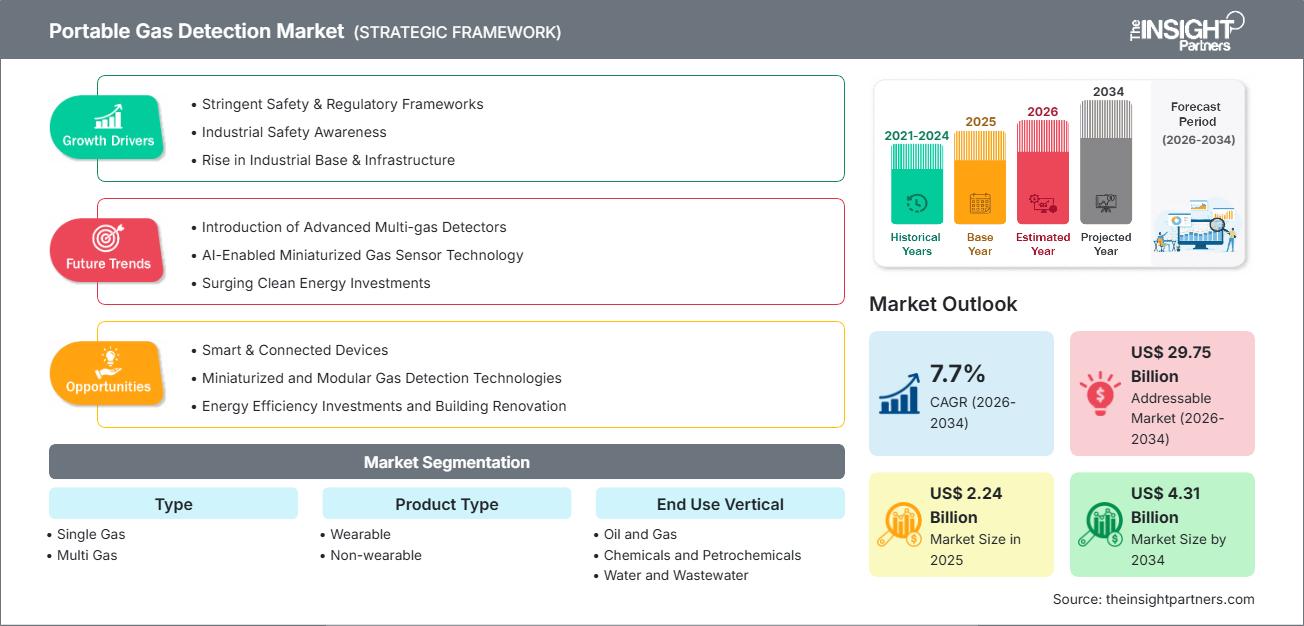
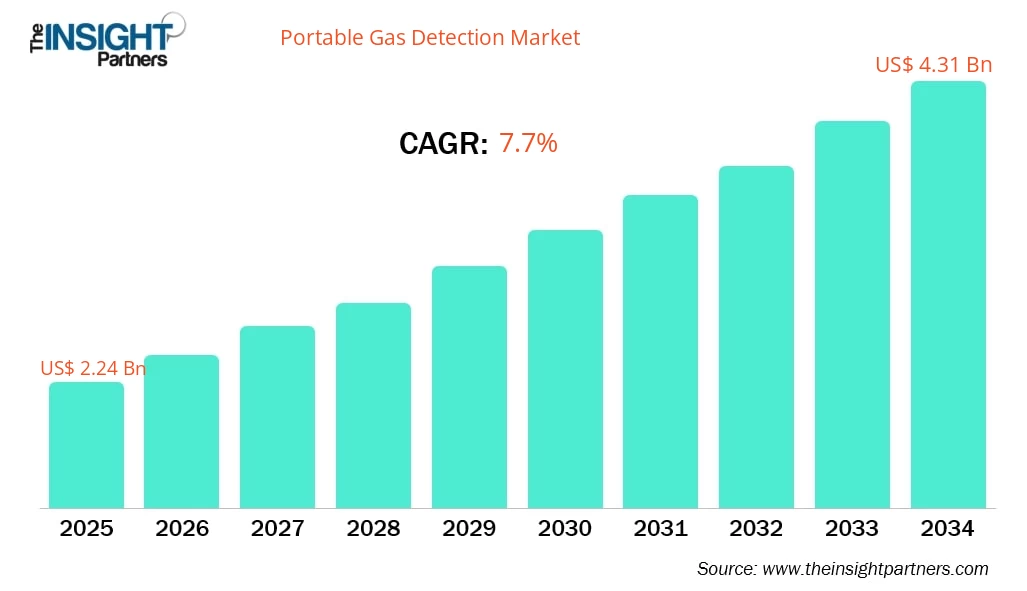
The portable gas detection market size is projected to reach US$ 2.24 billion in 2025 and is expected to reach US$ 4.31 billion by 2034. The portable gas detection market is estimated to register a CAGR of 7.7% during 2026–2034.
Portable Gas Detection Market Analysis
Increasing workplace safety regulations, technological advancements in sensor miniaturization, and rising industrial accidents have escalated the adoption of portable gas detection devices. Advancements in portable gas detectors, such as wireless connectivity and multi-gas sensors, have improved real-time monitoring accuracy. High costs of advanced devices and a lack of trained operators limit market growth.
Portable Gas Detection Market Overview
The portable gas detection market is expanding rapidly due to stringent safety regulations and rising industrial hazards. Key sectors such as oil & gas, chemicals, and mining drive demand for wearable multi-gas detectors with advanced sensors. Innovations in wireless tech and IoT integration boost real-time monitoring, though high costs challenge adoption.
Market Assessment and Insights
- Asia Pacific dominated the market with 36.7% share in 2025.
- Asia Pacific is poised to grow at a CAGR of 8.9% over the forecast period.
- United States market is projected to grow at a CAGR of 7.1% over the forecast period.
- By Type, the Multi Gas segment accounted for the largest market share of 65.7% in 2025.
- By Multi Gas Type, the 5 Gas segment is anticipated to witness the fastest growth, registering a CAGR of 10.1% over the forecast period
- By End Use Vertical, the Oil and Gas segment accounted for the largest market share of 24.7% in 2025.
- By Product Type, the Wearable segment is anticipated to witness the fastest growth, registering a CAGR of 10.2% over the forecast period
- By Components, the Hardware segment accounted for the largest market share of 68.2% in 2025.
- By Hardware Type, the Sensors segment is anticipated to witness the fastest growth, registering a CAGR of 9.7% over the forecast period
- By Sensor Type, the Electrochemical Sensor segment accounted for the largest market share of 38.9% in 2025.
- By Technology, the Connected segment is anticipated to witness the fastest growth, registering a CAGR of 9.6% over the forecast period
- The report profiles key industry players such as Emerson Electric Co, Honeywell International Inc, Dragerwerk AG & Co KGaA, MSA Safety Inc, Halma plc, Teledyne Technologies Inc, Johnson Controls International Plc, Industrial Scientific Corporation, RIKEN KEIKI CO., LTD., GfG - Gesellschaft für Gerätebau mbH, while also analyzing key developments in novel ideas, disruptive products, and innovative services that could reshape the future market and reveal emerging themes across the industry.
Source: The Insight Partners' analysis based on proprietary research, government publications, company annual reports, investor presentations, industry databases, and expert interviews.
● REPORT CUSTOMIZATION
Tailor This Report To Align With Your Specific Business Requirements
This report can be customized to align precisely with your business objectives, scope, and target markets. Customization options include tailored segmentation, geography, competitive analysis, and strategic insights to support informed decision-making.
Customize This Report →WHAT YOU CAN ADJUST
- ● Segmentations
- ● Geography
- ● Competitive Analysis
- ● Language Preferences
Portable Gas Detection Market: Strategic Insights
-
Get Top Key Market Trends of this report.This FREE sample will include data analysis, ranging from market trends to estimates and forecasts.
Portable Gas Detection Market Drivers and Opportunities
Market Drivers:
- Rising Workplace Safety Regulations: Stringent occupational health standards and increasing industrial accidents are driving demand for portable gas detectors to monitor hazardous environments in real-time.
- Preference for Wearable Safety Solutions: Growing adoption of lightweight, wearable detectors with minimal interference supports worker mobility and enhances personal safety.
- Advancements in Sensor Technology: Improvements in multi-gas sensors, wireless connectivity, and IoT integration boost detection accuracy and operational efficiency.
Market Opportunities:
- Growing Demand in Emerging Markets: Portable gas detector manufacturers have ample opportunities due to expanding industrialization and safety awareness in developing regions.
- Technological Innovation and Product Development: Development of connected AI-enabled detectors and compact multi-gas systems is expected to provide lucrative prospects.
- Rising Focus on Remote Monitoring: Expansion into remote and hazardous sites invites portable solutions for real-time gas detection in diverse sectors.
Portable Gas Detection Market Report Segmentation Analysis
The portable gas detection market is divided into different segments to give a clearer view of how it works, its growth potential, and the latest trends. Below is the standard segmentation approach used in industry reports:
By Type:
- Single Gas: Single gas detectors are used for targeted monitoring of CO or H2S in confined spaces, especially in oil & gas and utilities, due to their simplicity, low cost, and reliable detection for individual threats.
- Multi Gas: Multi gas detectors find extensive applications across industries such as chemicals, mining, and manufacturing, as they simultaneously monitor multiple gases (2-6+), ensuring comprehensive safety, real-time alerts, and enhanced worker protection.
By Multi Gas Type:
- 2 Gas
- 3 Gas
- 4 Gas
- 5 Gas
- 6 and More Gas
By End Use Vertical:
- Oil and Gas
- Chemicals and Petrochemicals
- Water and Wastewater
- Power Generation and Transmission
- Metal and Mining
- Food and Beverage
- Marine
- Others
By Product Type:
- Wearable
- Non-wearable
By Component:
- Hardware
- Software
By Hardware Type:
- Sensors
- Controllers
- Transmitters
- Alarms and Signaling Devices
- Display Modules
- Communication Interfaces
- Accessories
By Sensor Type:
- Electrochemical Sensor
- Infrared (IR) Sensor
- Photo-Ionization Detector (PID) Sensor
- Catalytic Sensor
- Others
By Technology:
- Traditional
- Connected
By Geography:
- North America
- Europe
- Asia Pacific
- South America
- Middle East & Africa
Portable Gas Detection Market Report Scope
| Report Attribute | Details |
|---|---|
| Market size in 2025 | US$ 2.24 Billion |
| Market Size by 2034 | US$ 4.31 Billion |
| Global CAGR (2026 - 2034) | 7.7% |
| Historical Data | 2021-2024 |
| Forecast period | 2026-2034 |
| Segments Covered |
By Type
|
| Regions and Countries Covered |
North America
|
| Market leaders and key company profiles |
|
Portable Gas Detection Market Players Density: Understanding Its Impact on Business Dynamics
The Portable Gas Detection Market is growing rapidly, driven by increasing end-user demand due to factors such as evolving consumer preferences, technological advancements, and greater awareness of the product's benefits. As demand rises, businesses are expanding their offerings, innovating to meet consumer needs, and capitalizing on emerging trends, which further fuels market growth.
Portable Gas Detection Market Share Analysis by Geography
The demand for portable gas detection devices in APAC continues to grow rapidly as industrial activities expand, workplace safety regulations strengthen, and advanced sensor technologies are adopted. Awareness of occupational hazards, access to safety equipment, and rising industrial investments support market growth. Government initiatives to enhance safety standards and large workforces in high-risk sectors fuel demand for portable gas detectors.
Below is a summary of market share and trends by region:
1. North America
- Market Share: An established market experiencing high adoption of advanced portable gas detectors, facilitated by strong industrial infrastructure and early uptake of connected technology.
- Key Drivers:
- High industrial activity, stringent OSHA regulations, and favorable safety compliance policies.
- Trends: Increasing use of IoT-enabled detectors, technological upgrading of multi-gas sensors, and focus on wearable safety in the oil & gas sectors.
2. Europe
- Market Share: Europe holds a strong market share owing to widespread public safety standards for hazardous environments and advanced industrial monitoring centers.
- Key Drivers:
- Government-funded occupational health services and rising adoption of minimally invasive wearable tech.
- Trends: Integration of advanced multi-gas sensors, emphasis on real-time connected monitoring, and introduction of AI-driven detectors in key markets.
3. MEA
- Market Share: Growing market with steady penetration, especially in Gulf Cooperation Council countries and South Africa.
- Key Drivers:
- Rising industrial infrastructure development, increasing workplace incidents, and investments in safety centers.
- Trends: Growing imports of modern portable detectors and collaborations with global safety equipment manufacturers.
4. Asia Pacific
- Market Share: The fastest-growing region, led by China, India, Japan, and Southeast Asia.
- Key Drivers:
- Expanding industrial workforce, improving safety regulations, rising industrial expenditure, and government initiatives to enforce hazard monitoring.
- Trends: Industries are rapidly deploying portable systems; growing adoption of cost-effective multi-gas solutions in high-risk sectors.
5. South America
- Market Share: A steadily expanding market, driven by Brazil, Argentina, and Chile.
- Key Drivers:
- Increasing safety awareness, improving industrial infrastructure, and growing demand for real-time hazard detection.
- Trends: Gradual modernization of gas monitoring facilities and increased adoption of wearable multi-gas detectors in mining and oil sectors.
Portable Gas Detection Market Players Density: Understanding Its Impact on Business Dynamics
High Market Density and Competition
Competition is strong due to the presence of established players such as Honeywell International Inc., Emerson Electric, Johnson Controls, and others. Regional and niche providers, such as MSA Safety Inc. and Riken Keiki Co., Ltd., add to the competitive landscape across different regions.
This high level of competition urges companies to stand out by offering:
- Advanced precision portable gas detection solutions, as well as high-performing multi-gas detectors and sensors for enhanced accuracy and ease of hazard monitoring procedures.
- Personalized detection solutions developed for industrial sectors and wearable/non-wearable environments based on operational requirements and safety standards.
- Innovative products that are cost-effective and efficient in monitoring, with improved response times and optimized real-time gas detection.
- Strong after-sales support services such as training programs, system maintenance, upgrades, as well as equipment assistance to ensure continuous safety operations.
Opportunities and Strategic Moves
- Manufacturers are partnering with industrial firms and safety organizations to expand access to advanced portable gas detection technologies and strengthen long-term customer relationships.
- Companies are investing in research and development to introduce next-generation connected multi-gas detectors and IoT-enabled sensor systems.
- Increasing focus on compact, wearable, and scalable gas detection solutions supports adoption in remote sites and emerging industrial markets.
Major Companies operating in the Portable Gas Detection Market are:
- Emerson Electric Co
- Honeywell International Inc
- Johnson Controls International Plc
- Dragerwerk AG & Co KGaA
- MSA Safety Inc
- Teledyne Technologies Inc
- Halma plc
- Industrial Scientific Corporation
- RIKEN KEIKI CO., LTD.
- GfG - Gesellschaft für Gerätebau mbH
Disclaimer: The companies listed above are not ranked in any particular order.
Other companies analyzed during the course of research:
- Detector Electronics Corp.
- RKI Instruments, Inc.
- Carrier Global Corporation
- Beijing SureSafe Technology Co., LTD
- New Cosmos Electric Co., Ltd.
- Endee Engineers Pvt. Ltd
- Global Detection Systems Corp
- GrayWolf Sensing Solutions
- Alphasense
- WatchGas Detection
- Others
Portable Gas Detection Market News and Recent Developments
- Crowcon launches new IQ range of connected portable gas detectors: In September 2025, Crowcon unveiled the IQ range, a new family of connected, portable gas detectors built to transform how safety teams protect people, manage fleets, and stay compliant in high-risk industries. From single-gas wearables (UnoIQ and DuoIQ) to rugged area monitors (DetectiveIQ) and real-time cloud-based insights, the IQ range combines modular design with smart connectivity. It adapts to changing site needs while taking the hassle out of keeping detectors reliable and compliant.
- Industrial Scientific and Gerdau Forge Safety-Focused Partnership with Connected Gas Monitoring Solutions: In July 2025, Industrial Scientific, a global leader and innovator in gas detection and safety technologies, partnered with Gerdau, the largest multinational steel producer in Brazil, to improve Gerdau’s operational efficiency and worker safety through the deployment of Industrial Scientific’s connected safety portfolio. With a vast and complex network of production sites, Gerdau sought to modernize its approach to gas detection, safety data management, and traceability-key components of the company’s Industry 4.0 initiatives. As a result, Gerdau launched a pilot program with Industrial Scientific to accelerate digital transformation in its safety systems and improve visibility and consistency.
Portable Gas Detection Market Report Coverage and Deliverables
The "Portable Gas Detection Market Size and Forecast (2021–2034)" report provides a detailed analysis of the market covering below areas:
- Portable gas detection market size and forecast at global, regional, and country levels for all the segments covered under the scope
- Portable gas detection market trends, as well as dynamics such as drivers, restraints, and key opportunities
- Detailed PEST and SWOT analysis
- portable gas detection market analysis covering key trends, global and regional framework, major players, regulations, and recent developments
- Industry landscape and competition analysis covering market concentration, heat map analysis, prominent players, and recent developments for the portable gas detection market
- Detailed company profiles
Frequently Asked Questions

- Comprehensive Market Sizing and Forecast Analysis
- Detailed Segmentation Analysis
- In-Depth Market Dynamics Assessment
- Regional and Country-Level Insights
- Competitive Landscape and Company Benchmarking
- Strategic Business Intelligence
Recent Reports
Testimonials

The Insight Partners provided valuable market intelligence that supported our global go-to-market strategy. Their team was professional, responsive, and attentive to our feedback, providing thoughtful analysis and helpful methodological clarifications throughout the project.
Junmo Kim Chief Financial Officer (CFO), Enertech Co., Ltd.
The Insight Partners' SCADA System Market report is comprehensive, with valuable insights on current trends and future forecasts. The team was highly professional, responsive, and supportive throughout. We are very satisfied and highly recommend their services.
RAN KEDEM Partner, Reali Technologies LTDs
I requested a report on a very specific software market and the team produced the report in a few days. The information was very relevant and well presented. I then requested some changes and additions to the report. The team was again very responsive and I got the final report in less than a week.
JEAN-HERVE JENN Chairman, Future Analytica
We worked with The Insight Partners for an important market study and forecast. They gave us clear insights into opportunities and risks, which helped shape our plans. Their research was easy to use and based on solid data. It helped us make smart, confident decisions. We highly recommend them.
PIYUSH NAGPAL Sr. Vice President, High Beam Global
The Insight Partners delivered insightful, well-structured market research with strong domain expertise. Their team was professional and responsive throughout. The user-friendly website made accessing industry reports seamless. We highly recommend them for reliable, high-quality research services
YUKIHIKO ADACHI CEO, Deep Blue, LLC.
This is the first time I have purchased a market report from The Insight Partners.While I was unsure at first, I visited their web site and felt more comfortable to take the risk and purchase a market report.I am completely satisfied with the quality of the report and customer service. I had several questions and comments with the initial report, but after a couple of dialogs over email with their analyst I believe I have a report that I can use as input to our strategic planning process.Thank you so much for taking the extra time and making this a positive experience.I will definitely recommend your service to others and you will be my first call when we need further market data.
JOHN SUZUKI President and Chief Executive Officer, Board Director, BK Technologies
I wish to appreciate your support and the professionalism you displayed in the course of attending to my request for information regarding to infectious disease IVD market in Nigeria. I appreciate your patience, your guidance, and the fact that you were willing to offer a discount, which eventually made it possible for us to close a deal. I look forward to engaging The Insight Partners in the future, all thanks to the impression you have created in me as a result of this first encounter.
DR CHIJIOKE ONYIA MANAGING DIRECTOR, PineCrest Healthcare Ltd.Reason to Buy
- Informed Decision-Making
- Understanding Market Dynamics
- Competitive Analysis
- Identifying Emerging Markets
- Customer Insights
- Market Forecasts
- Risk Mitigation
- Boosting Operational Efficiency
- Strategic Planning
- Investment Justification
- Tracking Industry Innovations
- Aligning with Regulatory Trends





 Get Free Sample for