
Air Source Heat Pump Market Growth, Trends & Forecast by 2034
Coverage: By Product Type (Air Source, Ground Source, Water Source); Application (Residential, Commercial, Industrial, Others) , and Geography (North America, Europe, Asia Pacific, and South and Central America)
- Status : Data Released
- Report Code : TIPRE00027619
- Category : Manufacturing and Construction
- No. of Pages : 150
- Available Report Formats :


- Last update date : July 15, 2026


2025 Market Size
US$ 65.58 Bn
Base year value
2034 Forecast
US$ 212.25 Bn
Projected by 2034
CAGR 2026-2034
13.94 %
Growth rate
Addressable Market
US$ 1,198.86 Bn
(2026-2034)
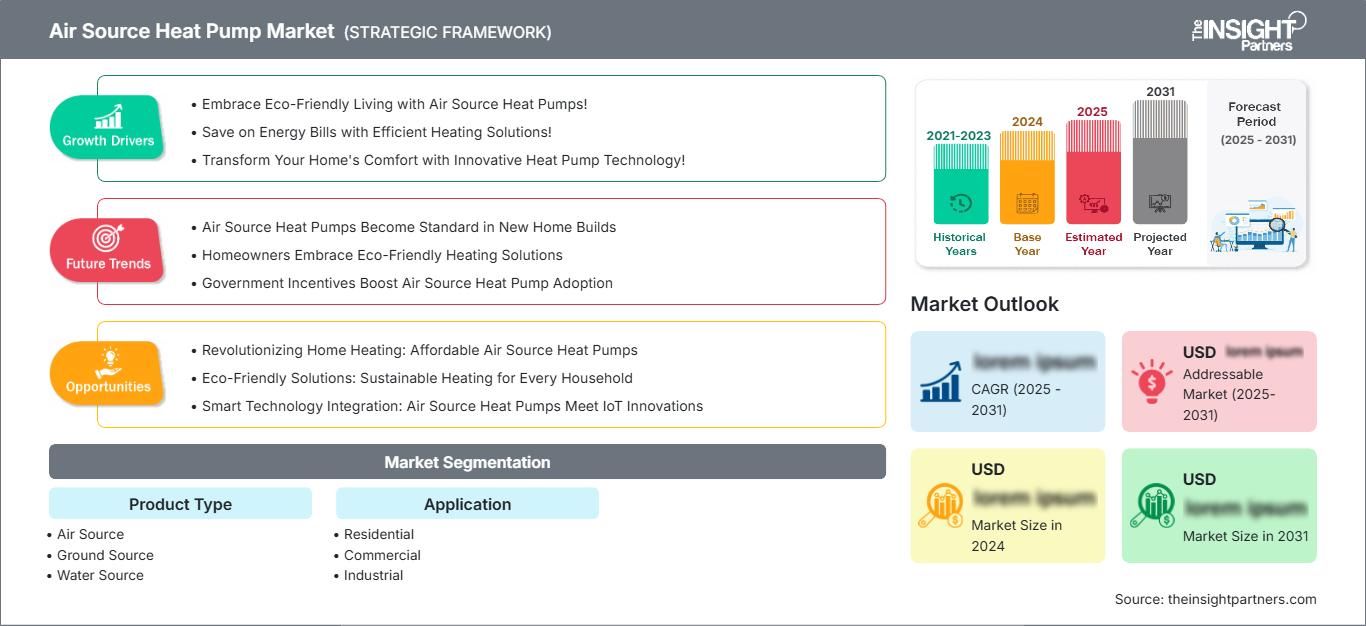
The air source heat pump market size was valued at US$ 65.58 Billion in 2025 and is projected to reach US$ 212.25 Billion by 2034; it is expected to register a CAGR of 13.94% during 2026–2034. The expansion reflects accelerating electrification of heating, cooling, and hot water systems across residential, commercial, and industrial applications, supported by stricter building-efficiency codes, low-carbon policy frameworks, and wider availability of high-performance heat pump equipment.
North America is expected to record an estimated CAGR range of 12.8–14.2% through 2026–2034, supported by retrofit incentives, building electrification mandates, and rising demand for cold-climate systems. The air source heat pump market size opportunity in the region is reinforced by utility demand-response programs and manufacturer investment in inverter compressors, A2L refrigerants, and contractor training capacity.
Air Source Heat Pump Market Assessment and Insights
- North America accounted for 24–27% of the air source heat pump market share in 2025 and is projected to grow at a CAGR range of 12.8–14.2% during 2026–2034, led by electrification incentives, weatherization funding, and cold-climate product adoption.
- US represented 78–82% of North America in 2025 and is expected to grow at 12.6–14.0% CAGR, supported by residential replacements and commercial retrofits.
- Europe held 28–31% share in 2025 and is forecast to expand at 13.2–14.6% CAGR, with Germany, the UK, France, Italy, and Spain shaping demand through building decarbonization programs.
- Asia Pacific captured 34–38% share in 2025 and is projected to grow at 14.1–15.5% CAGR, led by China, Japan, South Korea, India, and Australia.
- Largest Segment Residential held 61–65% market share in 2025 and is expected to grow at 13.4–14.8% CAGR, reflecting broad replacement demand and household electrification.
- High Growth Segment Commercial held 22–26% market share in 2025 and is expected to grow at 14.5–16.0% CAGR, driven by offices, hotels, schools, and healthcare facilities.
- Key companies analyzed in detail: Bard Manufacturing Company, Inc.; Bosch Thermotechnology GmbH; Carrier Global Corporation; Daikin Industries, Ltd.; Danfoss A/S; Glen Dimplex Group; Modine Manufacturing Company; NIBE Industrier AB; Stiebel Eltron GmbH and Co. KG; Trane Technologies plc; Vaillant Group; Viessmann Climate Solutions SE.
Source: The Insight Partners' analysis based on proprietary research, government publications, company annual reports, investor presentations, industry databases, and expert interviews.
In the context of technology developments, there has been a move from basic air-to-air technology towards integrated air-to-water, hybrid, and high-temperature models that can serve both new buildings and preexisting radiator heating infrastructure. In addition, production dynamics have begun to change through localizing assembly, designing with lower GWP refrigerant technology, and expanding testing facilities in the cold climate regions.
In the coming years, new regions will generate increased demand as policy support expands beyond Europe, which was an initial adopter of heat pumps. Investments are expected to focus on installation training, localized parts, and integration with digital energy management. Tailwinds from building performance standards, carbon pricing systems, and incentives for homes that are heat pump ready should increase market visibility.
Air Source Heat Pump Market Report Scope
| Report Attribute | Details |
|---|---|
| Market size in 2025 | US$ 65.58 Billion |
| Market Size by 2034 | US$ 212.25 Billion |
| Global CAGR (2026 - 2034) | 13.94% |
| Historical Data | 2021-2024 |
| Forecast period | 2026-2034 |
Air Source Heat Pump Market Analysis
Three main drivers are shaping the growth in the market for air-source heat pumps: the rising demands for efficiency, the need for boiler replacement in older buildings using fossil fuels, and the economics of electrifying the heating industry. The IEA found that there was growth in European heat pump sales in 2025, but that the US sales had softened because of refrigerant transition pressures and a housing cycle.
The supply chain comprises compressors, heat exchangers, refrigerants, electronic controls, installers, utilities, and building energy consultants. There is more favorable supply side economics for companies that have inverter technology, scale manufacturing, and support networks that can deal with the complexities of retrofitting buildings. Contractor availability is the bottleneck and needs addressing through training and kit design.
The competitive setting in the air source heat pump market report is consolidated, with Daikin Industries, Ltd., Carrier Global Corporation, Bosch Thermotechnology GmbH, Trane Technologies plc, Vaillant Group, and Viessmann Climate Solutions SE driving air source heat pumps by exploring low-GWP refrigerants, smart controls, and increasing regional manufacturing. Experts such as NIBE Industrier AB, Stiebel Eltron GmbH and Co. KG, and Modine Manufacturing Company enhance expertise in hydronics, commercial, and applications.
Investment focus areas include cold weather adaptation, modularity of the indoor unit, tank integration, and energy management systems to mitigate operational cost risk. Bard Manufacturing Company, Inc., Danfoss A/S, and Glen Dimplex Group offer differentiated positioning in commercial packaged products, controls, and residential heating products. Positioning is becoming more focused on installer ecosystems and compliance.
● REPORT CUSTOMIZATION
Tailor This Report To Align With Your Specific Business Requirements
This report can be customized to align precisely with your business objectives, scope, and target markets. Customization options include tailored segmentation, geography, competitive analysis, and strategic insights to support informed decision-making.
Customize This Report →WHAT YOU CAN ADJUST
- ● Segmentations
- ● Geography
- ● Competitive Analysis
- ● Language Preferences
Air Source Heat Pump Market: Strategic Insights
Regional Insights
North America Air Source Heat Pump Market
North America accounted for 24–27% of global revenue in 2025 and is forecast to expand at 12.8–14.2% CAGR during 2026–2034. The regional air source heat pump market share is anchored by electrification rebates, state-level building codes, and greater availability of cold-climate systems that address performance concerns in northern states and Canadian provinces.
Structural growth is also tied to utility load-management programs and the replacement of aging central air conditioners with reversible heat pump systems. Commercial adoption is broadening in schools, multifamily buildings, hospitality assets, and light industrial facilities, where owners seek lower fuel exposure and compliance with emissions-performance standards.
U.S. Air Source Heat Pump Market
The US represented 78–82% of North America in 2025 and is projected to grow at 12.6–14.0% CAGR through 2034. Federal tax credits, state clean-heating programs, and utility rebates support replacements in single-family homes, while A2L refrigerant transitions are reshaping product portfolios and inventory timing across distributors.
Carrier Global Corporation, Bosch Thermotechnology GmbH, Trane Technologies plc, Bard Manufacturing Company, Inc., and Modine Manufacturing Company maintain strong US-facing portfolios. Application trends favor ducted residential systems, packaged commercial units, and hybrid configurations for colder regions, especially where contractors must balance comfort, installation cost, and electrical-panel constraints.
Europe Air Source Heat Pump Market
Europe held 28–31% share in 2025 and is expected to grow at 13.2–14.6% CAGR during 2026–2034. Germany leads this market, backed by the policy on boiler replacement and revival in demand momentum. The UK is becoming a success story due to grants for retrofits, installation of heating systems, even as grid readiness and home insulation are critical adoption factors.
France, Italy, and Spain add value to the demand base with their unique strengths. France enjoys the benefit of well-established air-to-water adoption and replacement policy; Italy gets benefit from renovation-driven energy efficiency; while Spain offers demand from the reversible cooling-heating system due to its favorable climate conditions.
APAC Air Source Heat Pump Market
APAC accounted for 34–38% share in 2025 and is projected to grow at 14.1–15.5% CAGR through 2034, with China leading on installed base and manufacturing scale. Japan and South Korea contribute mature residential demand, while India and Australia add momentum through urbanization, cooling-led adoption, and electrification policy.
Industrial and commercial drivers include factory decarbonization, heat recovery, hotels, healthcare, and public buildings. Localized supply chains, inverter compressor expertise, and national efficiency labels make APAC a production and demand center, although affordability and installer skills vary sharply by country.
Middle East & Africa Air Source Heat Pump Market
Middle East and Africa is expected to grow at 11.4–12.8% CAGR during 2026–2034, led by the UAE and Saudi Arabia, where district cooling, hospitality, and energy-efficiency standards influence specification. South Africa adds retrofit potential through commercial facilities seeking resilient heating and cooling systems.
Rest of MEA demand is concentrated in premium residential developments, healthcare, and institutional infrastructure. Adoption remains selective because cooling loads dominate, but reversible systems gain relevance where hot water, shoulder-season heating, and lower operating emissions are procurement priorities.
Segmentation Analysis
Product Type
Product Type is expected to grow at 13.7–15.0% CAGR during 2026–2034. The air source heat pump market scope across product categories is widening as buyers evaluate installation complexity, site constraints, and lifecycle operating costs. Air source systems dominate retrofits because they avoid drilling or water access, while ground and water source technologies remain relevant for high-efficiency institutional and district-scale applications.
- Air Source systems lead demand because outdoor units are comparatively easier to install, support both heating and cooling, and fit residential and commercial retrofits with limited civil works.
- Ground Source systems serve projects prioritizing stable efficiency and long operating life, especially campuses, high-performance buildings, and properties with sufficient land or borehole access.
- Water Source systems remain strategically important for dense facilities, district energy networks, and sites with usable water loops where high seasonal efficiency offsets design complexity.
Application
Application is expected to grow at 13.5–15.2% CAGR during 2026–2034. Residential demand leads because households replace boilers, furnaces, and air conditioners with reversible systems. Commercial buildings show faster growth as owners address energy intensity, emissions reporting, and tenant comfort. Industrial use remains smaller but gains attention where low-temperature process heat and hot-water recovery are feasible.
- Residential applications dominate because single-family and multifamily buildings require scalable heating, cooling, and hot-water solutions that align with consumer incentives and replacement cycles.
- Commercial applications are expanding in offices, hotels, schools, healthcare facilities, and retail assets where energy-performance standards increasingly affect operating budgets and asset value.
- Industrial applications target low-temperature heating, washdown water, drying, and heat recovery, with adoption strongest where electricity prices and decarbonization commitments support payback.
Opportunity Snapshot
| Segment Name | Revenue Contribution | Trend Tag | Adoption Stage |
| Residential | High | Home Retrofit | Scaling |
| Commercial | Medium | Building Codes | Scaling |
| Industrial | Low | Process Heat | Emerging |
Air Source Heat Pump Market Growth Drivers and Impact Analysis
Building Electrification Policy Moves from Targets to Procurement
Government initiatives are now moving away from general climate policies toward procurement guidelines and performance requirements for buildings. Such changes affect equipment choice because there is a need to show reduced emissions when operating. According to the 2026 review of the IEA, renewed European interest in 2025 proved that clarity in policies could lead to a revival of adoption after a period of weak performance in cycles. There would be market impact if incentives were combined with installer training and financing options, since cost is the key challenge in this cycle.
Cold-Climate Performance Expands Addressable Replacement Demand
Inverter compressor advances, improved vapor injection techniques, control systems, and refrigerants are broadening the potential range of operations of air source heat pumps. With Bosch Home Comfort IDS Ultra, intended for cold zones, capable of providing the maximum heating capacity at temperatures up to -25 degrees Celsius, technology helps overcome past obstacles in northern environments. It is important for the industry because people who made replacements in cold zones tended to install either furnaces or a combined system. This means that confidence increases and utilities or regulators can view heat pumps as primary heating appliances, not as supplementary devices.
Low-GWP Refrigerants Reshape Product Development and Compliance
The transition to new refrigerants is fast becoming a strategic tool as firms design their products based on R290, R32, and A2L refrigerants. This is evident in the case of Daikin's ISH 2025 portfolio and the launch of new R290 products by Vaillant. However, the consequences are not only in the environmental aspect but in terms of refrigerant availability, technician certification, and requirement for safety zones. Firms that handle the compliance early will have lesser disruptions and create more confidence among distributors. They can grab projects where there is preference for future-proof products.
Air Source Heat Pump Market Future Trends
Integrated Energy Platforms Will Redefine System Value
The air source heat pump market trends are moving toward integrated energy platforms that connect heating, cooling, hot water, solar generation, batteries, EV charging, and dynamic electricity tariffs. Future value will depend less on the standalone unit and more on optimization across the building. Viessmann Climate Solutions SE and E.ON’s cooperation around home energy management indicates how equipment suppliers may partner with utilities and energy-service companies. This trend can improve payback by shifting operation to lower-cost periods, supporting grid flexibility, and reducing peak loads. It also creates recurring software, service, and maintenance opportunities for manufacturers and installers.
Commercial Retrofits Will Demand Modular, Faster-Install Systems
Future commercial adoption will favor modular systems that minimize downtime, fit constrained mechanical spaces, and integrate with existing distribution infrastructure. Schools, clinics, hotels, and offices often require phased installations because heating and cooling continuity is operationally critical. Manufacturers are expected to emphasize packaged controls, prefabricated hydraulic modules, and remote commissioning tools. The market impact will be strongest in retrofit-heavy cities where carbon-performance standards apply to existing buildings. Suppliers that reduce engineering complexity and contractor labor hours can improve conversion rates, especially where building owners compare heat pumps with conventional chiller-boiler replacements.
Air Source Heat Pump Market Opportunities
Retrofit Financing and Contractor Enablement
An important opportunity is to integrate the financing, installation, and performance guarantee aspects of retrofitting together in bundles. The households and small business owners find it sensible that the electric heating system would lower operating costs but hold off because of the capital cost, uncertainty regarding the condition of the buildings and lack of contractors. The air source heat pump market forecast suggest that the rate of change will be quicker when rebates are combined with low-cost financing options, standardized surveys and installer network.
Hybrid Systems for Hard-to-Electrify Buildings
Hybrid systems provide a viable solution to existing structures that have less insulation, radiator problems, or limitations on electric supply. Instead of forcing buildings to become fully electrified at once, hybrid systems will use heat pumps to generate heat for most of the hours in a year and rely on backup systems for extreme cold. In this way, there will be an investable asset in areas where the energy supply is lagging behind policies. The vendor can create value by having control solutions that manage fuels, emissions, and costs. For the utilities, it will be possible to lower winter peak demands while cutting emissions.
Recent Developments
- May 2026: Viessmann Climate Solutions SE — introduced the Vitocal 200-A intelligent energy monoblock heat pump and One Base Intelligence platform, emphasizing European manufacturing, design recognition, and integrated energy management for residential applications. The launch strengthens Carrier’s European heating portfolio and supports installers seeking lower-complexity monoblock systems.
- March 2025: Vaillant Group — presented an updated and expanded heat pump portfolio at ISH 2025, including new air-water and geothermal models using R290 refrigerant. The company highlighted quieter operation, simplified installation, digital services, and aroTHERM perform models for large, detached homes and apartment buildings
- March 2025: Daikin Industries, Ltd. — showcased the Daikin Altherma 4 generation and CO2 VRV solutions at ISH 2025 while outlining its refrigerant strategy for Europe. The company emphasized long-term heat pump growth, EU decarbonization alignment, and low-carbon heating and cooling across residential, commercial, and industrial buildings
Frequently Asked Questions

- Comprehensive Market Sizing and Forecast Analysis
- Detailed Segmentation Analysis
- In-Depth Market Dynamics Assessment
- Regional and Country-Level Insights
- Competitive Landscape and Company Benchmarking
- Strategic Business Intelligence
Recent Reports
Testimonials

The Insight Partners' SCADA System Market report is comprehensive, with valuable insights on current trends and future forecasts. The team was highly professional, responsive, and supportive throughout. We are very satisfied and highly recommend their services.
RAN KEDEM Partner, Reali Technologies LTDs
I requested a report on a very specific software market and the team produced the report in a few days. The information was very relevant and well presented. I then requested some changes and additions to the report. The team was again very responsive and I got the final report in less than a week.
JEAN-HERVE JENN Chairman, Future Analytica
We worked with The Insight Partners for an important market study and forecast. They gave us clear insights into opportunities and risks, which helped shape our plans. Their research was easy to use and based on solid data. It helped us make smart, confident decisions. We highly recommend them.
PIYUSH NAGPAL Sr. Vice President, High Beam Global
The Insight Partners delivered insightful, well-structured market research with strong domain expertise. Their team was professional and responsive throughout. The user-friendly website made accessing industry reports seamless. We highly recommend them for reliable, high-quality research services
YUKIHIKO ADACHI CEO, Deep Blue, LLC.
This is the first time I have purchased a market report from The Insight Partners.While I was unsure at first, I visited their web site and felt more comfortable to take the risk and purchase a market report.I am completely satisfied with the quality of the report and customer service. I had several questions and comments with the initial report, but after a couple of dialogs over email with their analyst I believe I have a report that I can use as input to our strategic planning process.Thank you so much for taking the extra time and making this a positive experience.I will definitely recommend your service to others and you will be my first call when we need further market data.
JOHN SUZUKI President and Chief Executive Officer, Board Director, BK Technologies
I wish to appreciate your support and the professionalism you displayed in the course of attending to my request for information regarding to infectious disease IVD market in Nigeria. I appreciate your patience, your guidance, and the fact that you were willing to offer a discount, which eventually made it possible for us to close a deal. I look forward to engaging The Insight Partners in the future, all thanks to the impression you have created in me as a result of this first encounter.
DR CHIJIOKE ONYIA MANAGING DIRECTOR, PineCrest Healthcare Ltd.Reason to Buy
- Informed Decision-Making
- Understanding Market Dynamics
- Competitive Analysis
- Identifying Emerging Markets
- Customer Insights
- Market Forecasts
- Risk Mitigation
- Boosting Operational Efficiency
- Strategic Planning
- Investment Justification
- Tracking Industry Innovations
- Aligning with Regulatory Trends





 Get Free Sample for