
Aircraft Defibrillators Market Trends, Share & Demand by 2034
Coverage: By : Type (Automatic, Semi-Automatic, Manual); Application (Airliner, General Aviation, Business Aircraft, Others), and Geography (North America, Europe, Asia Pacific, and South and Central America)
- Status : Data Released
- Report Code : TIPRE00014220
- Category : Life Sciences
- No. of Pages : 150
- Available Report Formats :


- Last update date : July 10, 2026


2025 Market Size
US$ 903.13 Mn
Base year value
2034 Forecast
US$ 1,636.00 Mn
Projected by 2034
CAGR 2026-2034
6.82 %
Growth rate
Addressable Market
US$ 11,469.33 Mn
(2026-2034)
The Aircraft Defibrillators Market focuses on the development, integration, and adoption of emergency cardiac care devices designed for aviation environments. In 2025, the market had a value of US$ 903.13 Million and is forecasted to grow up to US$ 1,636.00 Million by 2034 at a CAGR of 6.82% between 2026 and 2034. Drivers of market growth include rising aviation safety standards, better medical preparedness in the air, and improvements in the technology of portable defibrillators.
North America would continue being a key region for the industry thanks to the well-developed aviation infrastructure, focus on passenger safety, and extensive use of advanced emergency medical equipment. The region will register a CAGR of 6.9–7.4% between 2026 and 2034 driven by innovations in commercial airliners' fleets.
Aircraft Defibrillators Market Assessment and Insights
- North America North America is estimated to hold a 36–40% share in 2025, supported by advanced aviation networks and strict safety practices. The region is expected to grow at a CAGR range of 6.9–7.4% between 2026–2034 due to fleet upgrades.
- US The US represents approximately 78–82% of North America’s market in 2025, supported by major airlines, aviation regulations, and healthcare preparedness initiatives. The country is projected to grow at a CAGR range of 7.0–7.5% during 2026–2034.
- Europe is projected to account for a 28–32% share in 2025, with Germany, the UK, France, Italy, and Spain contributing significantly. The region is anticipated to register a CAGR range of 6.4–6.9% due to aviation safety investments.
- Asia Pacific Asia Pacific is expected to capture a 20–24% share in 2025, driven by China, Japan, India, South Korea, and Australia. The region is forecast to expand at a CAGR range of 7.1–7.6% as airline fleets increase.
- Largest Segment Automatic defibrillators are expected to dominate with a 55–59% market share in 2025 and a CAGR range of 7.0–7.5% due to simplified operation and emergency usability.
- High Growth Segment Business Aircraft application is projected to represent a 18–22% share in 2025, expanding at a CAGR range of 7.4–7.9% due to premium aviation safety adoption.
- Key companies analyzed in detail: Metrax GmbH, ZOLL Medical Corporation, Legend Aerospace, Koninklijke Philips N.V., Stryker Corporation, Mindray Medical International Limited, Nihon Kohden Corporation, Shenzhen Mindray Bio-Medical Electronics Co., Ltd., Schiller AG, Defibtech, LLC.
Source: The Insight Partners' analysis based on proprietary research, government publications, company annual reports, investor presentations, industry databases, and expert interviews.
Changes within the Aircraft Defibrillators Market size can be attributed to advancements in design of smaller medical devices, automated response solutions, and the creation of aviation-specific equipment. There has been the development of lighter, more user-friendly units that can be used under conditions of minimal access to medical facilities in an aircraft environment. Advancements in battery technology, monitoring features, and automated assistance features have contributed to developments in the market and purchasing decisions for airlines.
Development within the market in the future will be influenced by growth of commercial aviation, modernization of aircrafts, and concern about passenger safety. The development of aviation within Asia Pacific and the Middle East regions will provide opportunities within the market.
Aircraft Defibrillators Market Report Scope
| Report Attribute | Details |
|---|---|
| Market size in 2025 | US$ 903.13 Million |
| Market Size by 2034 | US$ 1,636.00 Million |
| Global CAGR (2026 - 2034) | 6.82% |
| Historical Data | 2021-2024 |
| Forecast period | 2026-2034 |
Aircraft Defibrillators Market Analysis
The market is driven by growing demand for emergency response on board along with the increasing importance of urgent cardiac care services during flights. Airlines, aircraft manufacturers, and aviation service providers constitute an interconnected ecosystem including the players like device manufacturers, maintenance services, regulators, and healthcare technology vendors. Increasing numbers of passengers and extended duration of flights have been driving the market participants to improve their emergency preparedness.
The aviation medical equipment value chain involves research and development, manufacture of the components, certification of the devices, their distribution, and even maintenance services. The suppliers are concentrating on reliable electronic parts, durability of design, and compliance with aviation standards. The industry is affected by the purchasing cycles of the airlines and the replacement of aging devices.
According to the Aircraft Defibrillators Market analysis, competition among manufacturers is influenced by product reliability, regulatory compliance, technological integration, and global reach. ZOLL Medical Corporation, Koninklijke Philips N.V., Stryker Corporation, and Metrax GmbH continue to develop emergency cardiac care equipment for aviation use. They stress on design, ease of operation, and high performance of devices.
Investments made by the firm have been strategically aimed at increasing the range of product portfolio, enhancing cooperation in the field of aviation and increasing access to emergency healthcare services. Legend Aerospace caters to the unique needs of aviation equipment, whereas firms such as Nihon Kohden Corporation, Schiller AG, Defibtech, LLC, Mindray Medical International Limited, and Shenzhen Mindray Bio-Medical Electronics Co., Ltd., play their roles in terms of medical devices.
● REPORT CUSTOMIZATION
Tailor This Report To Align With Your Specific Business Requirements
This report can be customized to align precisely with your business objectives, scope, and target markets. Customization options include tailored segmentation, geography, competitive analysis, and strategic insights to support informed decision-making.
Customize This Report →WHAT YOU CAN ADJUST
- ● Segmentations
- ● Geography
- ● Competitive Analysis
- ● Language Preferences
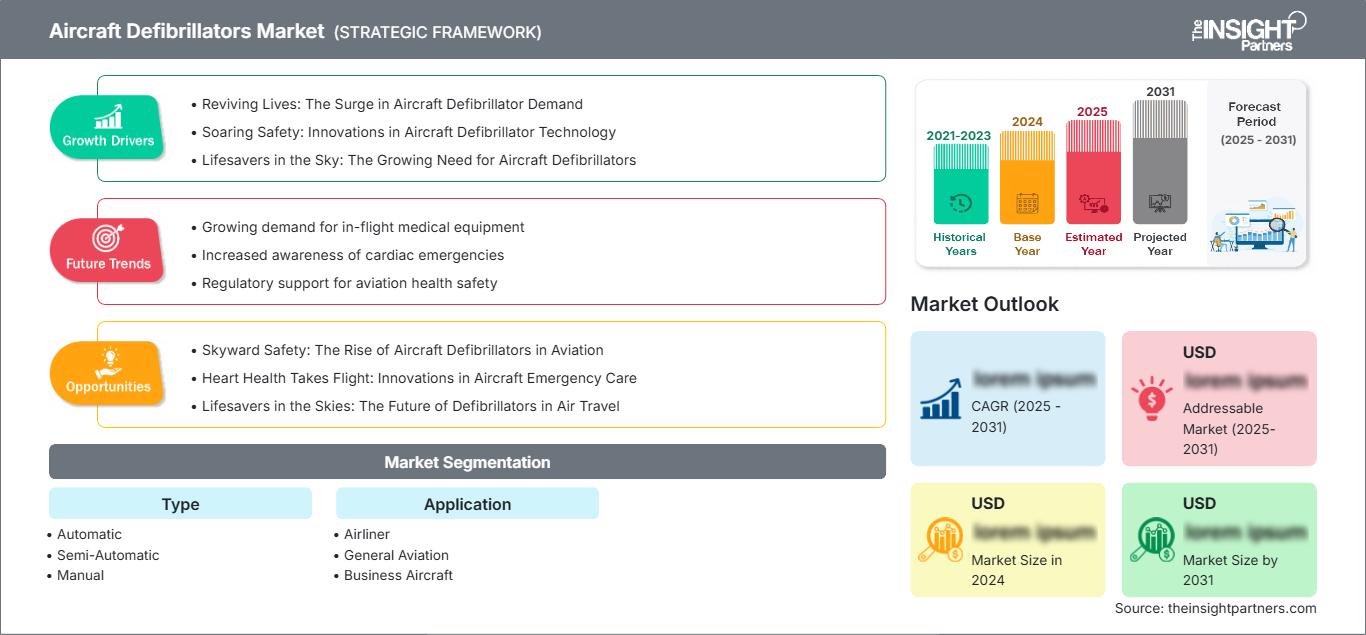
Aircraft Defibrillators Market: Strategic Insights
Regional Insights
North America Aircraft Defibrillators Market
North America is estimated to account for a 36–40% share of the market in 2025 and is projected to expand at a CAGR range of 6.9–7.4% during 2026–2034. The region benefits from extensive commercial aviation activity, established airport infrastructure, and strong adoption of onboard emergency equipment. The US remains the largest contributor due to significant airline operations and regulatory attention toward passenger safety.
North American airlines are becoming more interested in state-of-the-art cabin interiors and emergency medical equipment. Canada is making its contribution in terms of aviation safety programs and expanded air connectivity. Manufacturers are reinforcing their distribution systems for regional distribution needs. Awareness of cardiac emergencies in-flight has resulted in airlines ensuring that they have sophisticated defibrillator systems on board.
U.S. Aircraft Defibrillators Market
The US accounts for approximately 78–82% of North America’s Aircraft Defibrillators Market share in 2025, supported by a large commercial aviation sector, extensive aircraft fleets, and established medical device adoption. The country is expected to register a CAGR range of 7.0–7.5% from 2026–2034 as airlines continue upgrading emergency equipment.
Key aviation players and providers of medical technologies play an important role in developing the market because of their purchasing activity and technological innovations. The key companies operating in the US market of emergency medical devices include ZOLL Medical Corporation, Stryker Corporation, and Koninklijke Philips N.V. An increased importance of rapid response, cabin safety, and passenger readiness is constantly impacting the market.
Europe Aircraft Defibrillators Market
In 2025, Europe is forecasted to hold a 28-32% market share and have a CAGR of 6.4-6.9% in the period of 2024-2034. The United Kingdom market enjoys an already existing airline network and aviation practices aimed at ensuring safety and having proper airport infrastructure. Germany is making important contributions to this industry due to its advanced capabilities in aerospace and manufacturing of medical technology.
France, Italy, and Spain are making significant progress in aviation emergency preparation through expansion of airline networks and modernization projects. More often European airlines use compact and dependable defibrillator equipment in order to increase safety during flights. Standardization of regulations for the whole European aviation market ensures that equipment will be used consistently.
APAC Aircraft Defibrillators Market
Asia Pacific is estimated to hold a 20–24% share in 2025 and is expected to grow at a CAGR range of 7.1–7.6% during 2026–2034. China, Japan, South Korea, India, and Australia are key markets driven by airline fleet expansion and increasing aviation investments.
China is projected to remain a leading contributor as developments in the aviation industry progress. Government interventions and an increase in passenger numbers have resulted in the development of a modern aircraft fleet and the need for emergency equipment.
Middle East & Africa Aircraft Defibrillators Market
Growth in the Middle East & Africa region will be steady because of investments in aviation infrastructure and in terms of international aviation connectivity. Countries like Saudi Arabia and the UAE are working towards enhancing their airlines' capacities through fleet upgrades and airport upgrades, and South Africa plays a role in this via their aviation industry.
It is anticipated that the market will grow with a CAGR range of 6.0-6.5% in the period 2026-2034. Some of the key factors driving growth include increase in the deployment of aircrafts, preparations for healthcare, and an increasing focus on passenger safety. One of the key markets in this region is UAE.
Segmentation Analysis
Type
The Type segment of the market includes Automatic, Semi-Automatic, and Manual devices. This segment is expected to grow at a CAGR of 6.70–7.10% during 2026–2034, supported by airline preference for reliable emergency response equipment. Automated technologies are gaining attention because they simplify operation, reduce response delays, and improve usability for trained crew members during in-flight medical situations. The Aircraft Defibrillators Market scope is influenced by advancements in device portability, battery efficiency, and aviation-specific design requirements.
- Automatic: Automatic defibrillators represent the leading category due to their ease of operation and reduced user intervention requirements. These systems provide guided emergency procedures and are increasingly preferred by airlines seeking efficient onboard medical solutions.
- Semi-Automatic: Semi-automatic devices maintain demand among operators requiring controlled intervention during emergency response. Their balance between automated guidance and user decision-making supports adoption in various aircraft environments.
- Manual: Manual defibrillators are utilized primarily in specialized settings where trained medical personnel are available. Their usage remains relevant for applications requiring greater control over emergency treatment procedures.
Application
Application is one of the segments that comprises three types of categories such as Airliner, General Aviation, and Business Aircraft. These segments are expected to witness growth in the forecast period from 2026-2034 at a rate of 6.50-7.00%. Aircraft deliveries, passenger safety, and modernizing programs in the aviation industry play a crucial role in the adoption of emergency equipment in application segments.
- Airliner: Airliner applications represent the largest demand category due to extensive passenger capacity and regulatory emphasis on onboard emergency preparedness. Airlines prioritize durable and certified devices suitable for frequent operational use.
- General Aviation: General aviation adoption is supported by increasing awareness of passenger safety requirements and improvements in private aircraft operational standards. Operators seek compact solutions suitable for diverse flight environments.
- Business Aircraft: Business aircraft represent a high-growth application area as operators increasingly invest in premium safety features and enhanced passenger care capabilities. Demand is supported by private aviation expansion and customization trends.
Opportunity Snapshot
| Segment Name | Revenue Contribution (High/Medium/Low) | Trend Tag (MAX 2 words, specific) | Adoption Stage (Emerging/Scaling/Mature) |
| Airliner | High | Fleet Safety | Mature |
| General Aviation | Medium | Safety Upgrades | Scaling |
| Business Aircraft | Medium | Premium Aviation | Scaling |
Aircraft Defibrillators Market Growth Drivers and Impact Analysis
Increasing Focus on In-Flight Medical Emergency Preparedness
With more attention being paid to sudden cardiac episodes among passengers during air travel, there is pressure on airlines to increase their preparedness for such situations through the use of appropriate emergency equipment. There is an increasing trend toward the provision of defibrillators among the medical kits used by airlines, especially long-haul and large capacity airlines. The pressure for aviation regulatory bodies and passenger safety is shaping the acquisition of such medical tools. With the availability of small automated equipment, it becomes possible for flight crew members to respond to situations without necessarily having any medical training.
Advancements in Portable Defibrillation Technologies
The advancement in technology through miniaturization of devices, battery power, and automation of guiding systems plays a major role in affecting adoption in the aviation industry. Current aircraft defibrillators are designed with features like voice commands, self-monitoring, better electrode technology, and easier process of operating. This eliminates difficulties involved in handling emergency cases when at high altitude. The airlines are considering devices in terms of their reliability, maintenance needs, and how compatible they are to the storage conditions in the aircrafts. Better portability of devices allows wide adoption to different classes of aircraft including commercial, general aviation, and business jets.
Expansion of Global Aircraft Fleet and Aviation Infrastructure
The growth in commercial aircraft fleets and enhancements to air transport network infrastructure will drive up the demand for emergency medical equipment. Airline companies in developing countries are purchasing new airplanes while ensuring that they have safety technology systems installed to comply with international operations. The rise in passenger traffic in the Asia Pacific, Middle East, and Latin America aviation industries is driving the need for medical response services. Collaboration between airplane companies, airlines, and equipment companies will result in the incorporation of safety technology in future airplanes.
Aircraft Defibrillators Market Future Trends
Integration of Smart Monitoring and Connectivity Features
Future Aircraft Defibrillators Market trends are expected to focus on integrating smart monitoring capabilities, wireless connectivity, and improved data management functions. Manufacturers are exploring technologies that enable real-time device status tracking, automated maintenance alerts, and improved operational visibility for airline operators. Connected systems may support better equipment management by allowing aviation teams to monitor device readiness before flights. These advancements are expected to improve reliability while reducing maintenance-related challenges. As airlines increasingly adopt digital aviation solutions, connected medical equipment is likely to become an important component of aircraft safety ecosystems. Future developments will emphasize seamless integration, enhanced diagnostics, and improved decision support during onboard emergencies.
Development of Lightweight and Energy-Efficient Systems
Aircraft operators are expected to increasingly demand lightweight defibrillation systems that reduce storage requirements while maintaining operational reliability. Future product development is likely to emphasize advanced battery technologies, compact construction, and improved energy efficiency. These characteristics are particularly important for aircraft applications where weight optimization directly influences operational efficiency. Manufacturers are investing in materials and engineering approaches that improve portability without compromising performance. Business aircraft and general aviation operators are expected to contribute significantly to this trend due to their preference for customized safety solutions. The shift toward smaller, durable, and energy-efficient devices will influence product innovation strategies across the aviation medical equipment sector.
Aircraft Defibrillators Market Opportunities
Expansion Across Emerging Aviation Markets
Emerging aviation markets provide significant opportunities as airlines expand fleets and strengthen safety infrastructure. Countries across Asia Pacific and the Middle East are increasing investments in aviation networks, creating demand for advanced onboard emergency equipment. Aircraft Defibrillators Market Forecasts indicate that growing passenger movement and modernization initiatives may encourage wider adoption among regional carriers. Manufacturers can capitalize on these opportunities by developing cost-effective solutions tailored to different operational requirements. Partnerships with airlines, aviation suppliers, and maintenance organizations can improve market penetration. Increasing emphasis on international safety standards will further encourage operators in developing regions to upgrade existing emergency medical equipment and adopt advanced defibrillation technologies.
Strategic Partnerships for Aviation Medical Equipment Integration
Collaboration between medical technology companies, aircraft operators, and aviation service providers represents an important opportunity for market participants. Strategic partnerships can support customized product development, efficient distribution networks, and improved training programs for flight personnel. Companies can strengthen their competitive position by offering complete solutions that combine equipment supply, maintenance support, and operational guidance. Increasing demand for integrated safety systems creates opportunities for manufacturers to expand beyond device sales into lifecycle service models. Airlines seeking reliable emergency preparedness solutions may prefer suppliers capable of providing comprehensive support throughout equipment deployment. These partnerships can accelerate adoption while improving long-term customer relationships within the aviation sector.
Recent Developments
- January 2026: ZOLL Medical Corporation introduced enhancements to its emergency medical device ecosystem by strengthening integration capabilities and improving operational efficiency across healthcare and emergency response applications. The company continues to support advanced defibrillation technologies with a focus on reliability, simplified operation, and improved response performance for professional and aviation-related emergency environments.
- September 2025: Koninklijke Philips N.V. expanded its focus on connected healthcare solutions through advancements in monitoring and emergency care technologies. The company continues developing compact and digitally enabled medical systems designed to support rapid intervention, equipment readiness, and improved emergency response capabilities across multiple application environments.
- March 2025: Stryker Corporation continued investments in medical technology innovation through its emergency care portfolio, supporting improvements in defibrillation equipment performance, usability, and workflow efficiency. The company’s Physio-Control solutions remain focused on providing reliable emergency response technologies for professional users and organizations requiring dependable life-saving equipment.
Frequently Asked Questions

- Comprehensive Market Sizing and Forecast Analysis
- Detailed Segmentation Analysis
- In-Depth Market Dynamics Assessment
- Regional and Country-Level Insights
- Competitive Landscape and Company Benchmarking
- Strategic Business Intelligence
Recent Reports
Testimonials

The Insight Partners' SCADA System Market report is comprehensive, with valuable insights on current trends and future forecasts. The team was highly professional, responsive, and supportive throughout. We are very satisfied and highly recommend their services.
RAN KEDEM Partner, Reali Technologies LTDs
I requested a report on a very specific software market and the team produced the report in a few days. The information was very relevant and well presented. I then requested some changes and additions to the report. The team was again very responsive and I got the final report in less than a week.
JEAN-HERVE JENN Chairman, Future Analytica
We worked with The Insight Partners for an important market study and forecast. They gave us clear insights into opportunities and risks, which helped shape our plans. Their research was easy to use and based on solid data. It helped us make smart, confident decisions. We highly recommend them.
PIYUSH NAGPAL Sr. Vice President, High Beam Global
The Insight Partners delivered insightful, well-structured market research with strong domain expertise. Their team was professional and responsive throughout. The user-friendly website made accessing industry reports seamless. We highly recommend them for reliable, high-quality research services
YUKIHIKO ADACHI CEO, Deep Blue, LLC.
This is the first time I have purchased a market report from The Insight Partners.While I was unsure at first, I visited their web site and felt more comfortable to take the risk and purchase a market report.I am completely satisfied with the quality of the report and customer service. I had several questions and comments with the initial report, but after a couple of dialogs over email with their analyst I believe I have a report that I can use as input to our strategic planning process.Thank you so much for taking the extra time and making this a positive experience.I will definitely recommend your service to others and you will be my first call when we need further market data.
JOHN SUZUKI President and Chief Executive Officer, Board Director, BK Technologies
I wish to appreciate your support and the professionalism you displayed in the course of attending to my request for information regarding to infectious disease IVD market in Nigeria. I appreciate your patience, your guidance, and the fact that you were willing to offer a discount, which eventually made it possible for us to close a deal. I look forward to engaging The Insight Partners in the future, all thanks to the impression you have created in me as a result of this first encounter.
DR CHIJIOKE ONYIA MANAGING DIRECTOR, PineCrest Healthcare Ltd.Reason to Buy
- Informed Decision-Making
- Understanding Market Dynamics
- Competitive Analysis
- Identifying Emerging Markets
- Customer Insights
- Market Forecasts
- Risk Mitigation
- Boosting Operational Efficiency
- Strategic Planning
- Investment Justification
- Tracking Industry Innovations
- Aligning with Regulatory Trends





 Get Free Sample for