
Alarm Clocks Market Trends, Demand & Growth by 2034
Coverage: By Type (Digital, Analog); Distribution Channel (Supermarkets and Hypermarkets, Specialty Stores, Online Retail, Others) , and Geography (North America, Europe, Asia Pacific, and South and Central America)
- Status : Data Released
- Report Code : TIPRE00024366
- Category : Consumer Goods
- No. of Pages : 150
- Available Report Formats :


- Last update date : August 10, 2026


2025 Market Size
US$ 2.86 Bn
Base year value
2034 Forecast
US$ 4.23 Bn
Projected by 2034
CAGR 2026-2034
4.45 %
Growth rate
Addressable Market
US$ 32.20 Bn
(2026-2034)
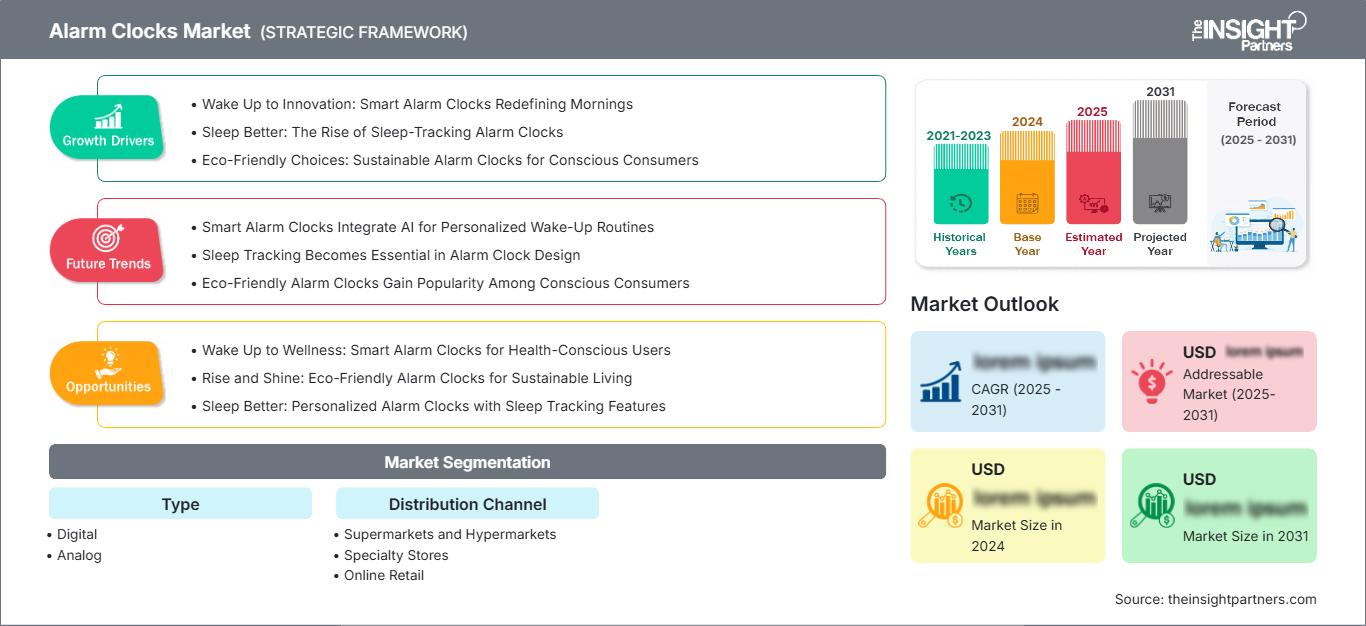
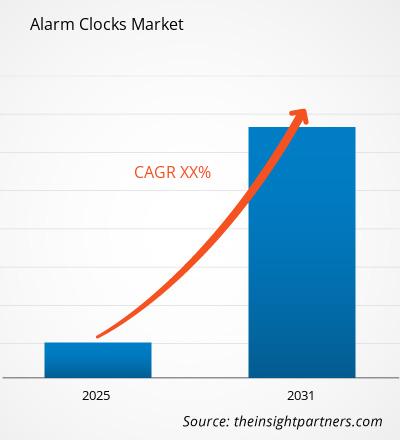
The alarm clocks market was valued at US$ 2.86 Billion in 2025 and is projected to reach US$ 4.23 Billion by 2034, expanding at a CAGR of 4.45% during 2026–2034. Demand remains supported by steady consumer replacement cycles, growing adoption of multifunction bedside devices, and continued product innovation combining timekeeping, sound management, lighting features, and smart connectivity across residential and travel applications.
Across North America, consumer preference for smart home integration, premium sleep-support products, and connected electronics continues to reinforce demand. The alarm clocks market size in the region benefits from strong retail penetration, elevated household spending on personal electronics, and expanding e-commerce channels. The market is estimated to grow at a CAGR of 3.8–4.4% through 2034, supported by product upgrades and strong brand presence.
Alarm Clocks Market Assessment and Insights
- North America: Accounted for 32–34% share in 2025 and is expected to grow at a CAGR of 3.8–4.4% during 2026–2034. Market performance is supported by smart home adoption, premium bedside electronics, and mature retail distribution networks.
- US: Represented 76–80% of North American demand in 2025 and is projected to expand at a CAGR of 3.9–4.5% during 2026–2034. Strong consumer electronics spending and broad product availability support growth.
- Europe: Held 27–29% share in 2025 and is anticipated to grow at a CAGR of 3.6–4.2% during 2026–2034. Germany, the UK, and France remain leading contributors driven by established consumer goods markets.
- Asia Pacific: Accounted for 29–31% share in 2025 and is expected to register a CAGR of 5.2–5.8% during 2026–2034. China, Japan, South Korea, and India are driving expansion through urbanization and digital device adoption.
- Largest Segment: Digital clocks represented 64–68% market share in 2025 and are expected to grow at a CAGR of 4.8–5.4% during 2026–2034, supported by smart features, LED displays, and multifunction capabilities.
- High Growth Segment: Online Retail accounted for 31–35% share in 2025 and is projected to expand at a CAGR of 6.0–6.8% during 2026–2034, benefiting from wider product visibility and direct-to-consumer channels.
- Key companies analyzed in detail: Chaney Instrument Co.; Elite Electronics Group Limited; Emerson Radio Corp.; Koninklijke Philips N.V.; La Crosse Technology Ltd.; Oregon Scientific; RHYTHM WATCH CO., LTD.; SDI Technologies, Inc.; Sonic Alert, Inc.; The WestClox Source LLC.
Source: The Insight Partners' analysis based on proprietary research, government publications, company annual reports, investor presentations, industry databases, and expert interviews.
Development in product features in the alarm clocks market has progressed from simple wake-up devices into comprehensive sleep management devices incorporating Bluetooth capability, USB charging capabilities, lighting options, weather updates, and compatibility with voice assistant applications. There remains a constant focus by manufacturers to ensure both affordability and added features while also being cost-effective in terms of sourcing components and choosing displays. The use of digital formats has been rising consistently, while analog models still find their relevance with certain consumers.
Future developments for the Alarm Clocks Market involve an increased focus on investment in Asian-Pacific production facilities and more advanced wellness devices. Consumer safety standards and energy-efficient electronics will encourage further developments in the field of power-saving displays and sustainable materials used in devices. Future development opportunities include online retail, smart home integration and young consumer demand.
Alarm Clocks Market Report Scope
| Report Attribute | Details |
|---|---|
| Market size in 2025 | US$ 2.86 Billion |
| Market Size by 2034 | US$ 4.23 Billion |
| Global CAGR (2026 - 2034) | 4.45% |
| Historical Data | 2021-2024 |
| Forecast period | 2026-2034 |
Alarm Clocks Market Analysis
The alarm clocks market growth trajectory is supported by growing consumer interest in sleep quality, time-management tools, and multifunction electronics. Higher awareness about sleep routine planning has made people opt for products that incorporate an alarm along with lights, radio, weather forecast, and charging features. The demand is especially strong among residential applications, where people still need dedicated items rather than smartphones, which are commonly available everywhere today.
The production process of such products is supported by the existing electronics manufacturing facilities located in Asia. The availability of components, LED display manufacturing and IC development are contributing to the efficient production process. The assortment of retailers includes not only supermarkets but also specialized electronics stores and online shops.
The alarm clocks market analysis indicates a moderately fragmented competitive landscape characterized by established timekeeping specialists and diversified consumer electronics companies. Organizations such as Koninklijke Philips N.V., Emerson Radio Corp., RHYTHM WATCH CO., LTD., and SDI Technologies, Inc. compete through product innovation, design differentiation, and distribution reach. Premium brands increasingly focus on wellness-oriented functions, while value-focused manufacturers compete through affordability and durability.
Strategic investments in the Alarm Clocks Market are being directed toward smart connectivity features, enhanced display technologies, and direct-to-consumer sales models. Companies are strengthening online merchandising capabilities and expanding partnerships with major e-commerce platforms. Competitive positioning increasingly depends on balancing advanced functionality with user-friendly interfaces, enabling manufacturers to capture demand across both traditional and smart-device consumer segments.
● REPORT CUSTOMIZATION
Tailor This Report To Align With Your Specific Business Requirements
This report can be customized to align precisely with your business objectives, scope, and target markets. Customization options include tailored segmentation, geography, competitive analysis, and strategic insights to support informed decision-making.
Customize This Report →WHAT YOU CAN ADJUST
- ● Segmentations
- ● Geography
- ● Competitive Analysis
- ● Language Preferences
Alarm Clocks Market: Strategic Insights
Regional Insights
North America alarm clocks market
North America accounted for 32–34% of the alarm clocks market share in 2025 and is expected to expand at a CAGR of 3.8–4.4% during 2026–2034. The advantages enjoyed include high adoption of consumer electronics, high purchasing power, and high penetration of connected devices in the area. There has been an increasing preference among consumers for alarm clocks that have Bluetooth speakers and wireless charging capabilities, along with sleep-inducing functions.
Diversification of the retail structure is another important structural factor, with the availability of products in large format retail, electronic stores, and even online. There has been increased demand for high-end bedside electronics due to the purchase of wellness-focused consumer products by households.
U.S. alarm clocks market
The United States represented 76–80% of North American demand in 2025 and is projected to grow at a CAGR of 3.9–4.5% during 2026–2034. Consumer spending on personal electronics remains a significant growth factor. Strong presence of established brands and extensive retail networks support market stability while encouraging ongoing product upgrades.
Wireless charging compatibility, sunrise simulation features, digital displays, and smart speakers integrated with alarm functionality are gaining attention among consumers. Online product discovery continues to influence purchase decisions, while specialty retailers provide opportunities for premium product positioning. Innovation focused on convenience and sleep management is expected to remain a central market theme.
Europe alarm clocks market
Europe held 27–29% market share in 2025 and is forecast to register a CAGR of 3.6–4.2% during 2026–2034. Germany is still the dominant national market because of the presence of a robust consumer electronics industry and a preference for long-lasting household items. The nation exhibits a stable demand for both conventional and digital media, owing to a well-developed retail network.
The United Kingdom has the advantage of having already adopted online shopping and an increased desire for multifunction bedside gadgets. Consumers now want products that can incorporate charging points, lighting controls, and digital screens. France, Italy, and Spain together provide considerable demand through household electronics sales, tourism-related retailing, and an increased appreciation of modern bedroom technology solutions.
APAC alarm clocks market
Asia Pacific accounted for 29–31% share in 2025 and is expected to expand at a CAGR of 5.2–5.8% during 2026–2034. China dominates regional production and consumption, whereas Japan and South Korea provide technological innovation. The demand for goods in India is increasing due to urbanization and more electronic purchases by consumers.
There is regional growth owing to manufacturing concentration, rising middle-class populations, and digital commerce adoption. In the region, Australia provides a premium consumer electronics demand, while the use of smart homes provides more differentiation opportunities.
Middle East & Africa alarm clocks market
The Middle East & Africa market is projected to grow at a CAGR of 4.1–4.7% during 2026–2034. Saudi Arabia and the UAE remain key demand centers owing to increasing consumer electronics expenditure and expanding organized retail infrastructure.
South Africa leads African demand, while the remainder of the region benefits from rising urban populations and improving access to electronic products. Infrastructure development and economic diversification initiatives continue to support broader consumer goods adoption and retail market modernization.
Segmentation Analysis
Type
The Type segment is expected to expand at a CAGR of 4.4–5.0% during 2026–2034. The alarm clocks market scope within this segment has broadened significantly due to the transition from simple timekeeping products toward connected and multifunction devices. Consumer preferences are increasingly favoring advanced displays, integrated charging, and enhanced usability features, supporting adoption across diverse age groups.
- Digital: Digital products maintain a leading market position due to advanced displays, programmable alarms, connectivity functions, and integration with charging technologies. Their versatility and convenience continue to attract a broad consumer base.
- Analog: Analog models retain relevance among users seeking straightforward operation, minimalist aesthetics, and dependable performance. These products continue to perform well in traditional retail environments and gift-oriented purchases.
Distribution Channel
The Distribution Channel segment is anticipated to grow at a CAGR of 4.8–5.4% during 2026–2034. Omnichannel purchasing behavior is reshaping market access, with manufacturers leveraging both offline visibility and digital engagement. Retail strategies increasingly focus on convenience, product comparison capabilities, and enhanced customer reach.
- Supermarkets and Hypermarkets: Large-format retail stores remain important for mass-market sales. Broad product assortments, promotional pricing strategies, and strong consumer footfall support continued relevance despite increasing digital competition.
- Specialty Stores: Specialty retailers attract customers interested in premium electronics and feature-rich devices. In-store product demonstrations and expert guidance enhance purchasing confidence for higher-value products.
- Online Retail: Online channels continue gaining importance through broad product selection, customer reviews, competitive pricing, and direct-to-consumer distribution strategies. Digital merchandising supports stronger visibility and market penetration.
Opportunity Snapshot
| Distribution Channel | Revenue Contribution | Trend Tag | Adoption Stage |
| Supermarkets and Hypermarkets | High | Retail Reach | Mature |
| Specialty Stores | Medium | Premium Displays | Scaling |
| Online Retail | High | Direct Commerce | Scaling |
Alarm Clocks Market Growth Drivers and Impact Analysis
Expansion of Sleep Wellness Consumer Spending
Increasing consumer awareness about sleep quality has boosted the need for devices that encourage good sleeping habits. There is an increasing tendency to see alarm clocks as health gadgets instead of mere devices for keeping track of time. Features like sunrise emulation, lighting, sound settings, and gradual waking up are in sync with the general health consciousness among consumers. By catering to these consumer preferences, companies can achieve higher average pricing and create better brands. As more and more consumers take an interest in wellness gadgets, there is more opportunity for alarm clock producers to leverage these emerging applications that go beyond the mere task of scheduling.
Growth of Smart Home Device Ecosystems
The continuous growth of smart homes is generating significant growth opportunities for producers of alarm clocks. The expectations of consumers have evolved to be more inclined toward integration between connected gadgets, such as speakers, light systems, voice assistants, and chargers. The products that feature smooth integration provide more convenience and higher functionality than separate ones. Manufacturers have started installing technologies of Bluetooth connection, wireless chargers, applications, and compatibility with smart assistants. This trend boosts consumers' interest and increases the usability of the gadgets. With the growing trend of connected living in developed and developing countries, integrated alarm clocks are expected to penetrate homes more widely.
Acceleration of Digital Retail Infrastructure
The e-commerce market has changed the buying pattern for all types of consumer electronics. The ability to search through products easily, customer feedback reviews, and efficient shipping networks makes it an ideal platform for selling alarm clocks. In addition, the manufacturers are able to interact directly with the consumers while at the same time promoting new products. Through the digital platforms, manufacturers will be able to target consumers effectively, manage inventories and launch promotional campaigns. Small manufacturers will find it easy to penetrate the market, while existing organizations will have additional opportunities to extend their geographical coverage.
Alarm Clocks Market Future Trends
Integration of AI-Enabled Personalization
The alarm clocks market trends increasingly reflect movement toward personalized user experiences driven by intelligent software capabilities. The future generation of devices will be capable of studying the sleep patterns, the time at which people prefer to be awoken, the environmental conditions and behavior patterns so as to enhance the performance of their alarm systems. The connectivity to the larger digital world would ensure that scheduling is done in a more flexible way. Device manufacturers who are willing to incorporate personalization features stand to benefit from increased consumer engagement and high margins.
Energy-Efficient and Sustainable Product Design
Sustainability has become an increasingly critical factor in buying consumer electronics. The future design of the alarm clocks will focus on reducing power use, using recyclable materials, extended lifespans, and using sustainable production processes. Consumers’ awareness and regulatory requirements are prompting companies to design efficient products without sacrificing their efficacy. Sustainable designs could guide decision-making about suppliers, packaging approaches, and designs of the product. Companies that manage to harmonize their environmental concerns with the functionality and cost-effectiveness of their products will be able to gain a competitive advantage.
Alarm Clocks Market Opportunities
Expansion Through Connected Bedroom Ecosystems
The growing convergence of lighting, audio, charging, and automation devices creates investment potential for integrated bedroom solutions. Manufacturers can enhance product relevance by developing platforms that serve as central interfaces within connected living environments. The ability to coordinate multiple household technologies increases perceived value and supports premium pricing strategies. alarm clocks market Forecasts indicate that products combining convenience, connectivity, and intuitive controls are likely to attract sustained consumer interest. Partnerships with smart-home technology providers may accelerate adoption, broaden distribution opportunities, and improve long-term competitive positioning for both established participants and emerging brands.
Premium Product Development for Younger Consumers
Younger consumers demonstrate a preference for multifunction devices that combine aesthetics, connectivity, and personalized experiences. This creates opportunities for brands to introduce premium offerings emphasizing design quality, advanced displays, wireless charging, and digital integration. Market participants can target urban households, students, and technology-oriented consumers through differentiated product portfolios. Direct-to-consumer sales strategies and social-commerce marketing provide efficient routes for engagement. Companies successfully aligning innovation with affordability and lifestyle preferences may achieve stronger margins while expanding their presence across high-growth demographic segments.
Frequently Asked Questions

- Comprehensive Market Sizing and Forecast Analysis
- Detailed Segmentation Analysis
- In-Depth Market Dynamics Assessment
- Regional and Country-Level Insights
- Competitive Landscape and Company Benchmarking
- Strategic Business Intelligence
Recent Reports
Testimonials

The Insight Partners provided valuable market intelligence that supported our global go-to-market strategy. Their team was professional, responsive, and attentive to our feedback, providing thoughtful analysis and helpful methodological clarifications throughout the project.
Junmo Kim Chief Financial Officer (CFO), Enertech Co., Ltd.
The Insight Partners' SCADA System Market report is comprehensive, with valuable insights on current trends and future forecasts. The team was highly professional, responsive, and supportive throughout. We are very satisfied and highly recommend their services.
RAN KEDEM Partner, Reali Technologies LTDs
I requested a report on a very specific software market and the team produced the report in a few days. The information was very relevant and well presented. I then requested some changes and additions to the report. The team was again very responsive and I got the final report in less than a week.
JEAN-HERVE JENN Chairman, Future Analytica
We worked with The Insight Partners for an important market study and forecast. They gave us clear insights into opportunities and risks, which helped shape our plans. Their research was easy to use and based on solid data. It helped us make smart, confident decisions. We highly recommend them.
PIYUSH NAGPAL Sr. Vice President, High Beam Global
The Insight Partners delivered insightful, well-structured market research with strong domain expertise. Their team was professional and responsive throughout. The user-friendly website made accessing industry reports seamless. We highly recommend them for reliable, high-quality research services
YUKIHIKO ADACHI CEO, Deep Blue, LLC.
This is the first time I have purchased a market report from The Insight Partners.While I was unsure at first, I visited their web site and felt more comfortable to take the risk and purchase a market report.I am completely satisfied with the quality of the report and customer service. I had several questions and comments with the initial report, but after a couple of dialogs over email with their analyst I believe I have a report that I can use as input to our strategic planning process.Thank you so much for taking the extra time and making this a positive experience.I will definitely recommend your service to others and you will be my first call when we need further market data.
JOHN SUZUKI President and Chief Executive Officer, Board Director, BK Technologies
I wish to appreciate your support and the professionalism you displayed in the course of attending to my request for information regarding to infectious disease IVD market in Nigeria. I appreciate your patience, your guidance, and the fact that you were willing to offer a discount, which eventually made it possible for us to close a deal. I look forward to engaging The Insight Partners in the future, all thanks to the impression you have created in me as a result of this first encounter.
DR CHIJIOKE ONYIA MANAGING DIRECTOR, PineCrest Healthcare Ltd.Reason to Buy
- Informed Decision-Making
- Understanding Market Dynamics
- Competitive Analysis
- Identifying Emerging Markets
- Customer Insights
- Market Forecasts
- Risk Mitigation
- Boosting Operational Efficiency
- Strategic Planning
- Investment Justification
- Tracking Industry Innovations
- Aligning with Regulatory Trends





 Get Free Sample for