
Anti-Fatigue Mats Market Demand, Share & Growth by 2034
Coverage: By Product (Dry Area Anti-Fatigue Mats, Wet Area Anti-Fatigue Mats); Material (Foam, Rubber, Gel, Others); Size (Small, Medium, Large, Customizable); End User (Residential, Commercial, Industrial); Distribution Channel (Online, Offline), and Geography (North America, Europe, Asia Pacific, and South and Central America)
- Status : Data Released
- Report Code : TIPRE00014339
- Category : Consumer Goods
- No. of Pages : 150
- Available Report Formats :


- Last update date : August 25, 2026


2025 Market Size
US$ 1.4 Bn
Base year value
2034 Forecast
US$ 1.98 Bn
Projected by 2034
CAGR 2026-2034
3.97 %
Growth rate
Addressable Market
US$ 15.39 Bn
(2026-2034)
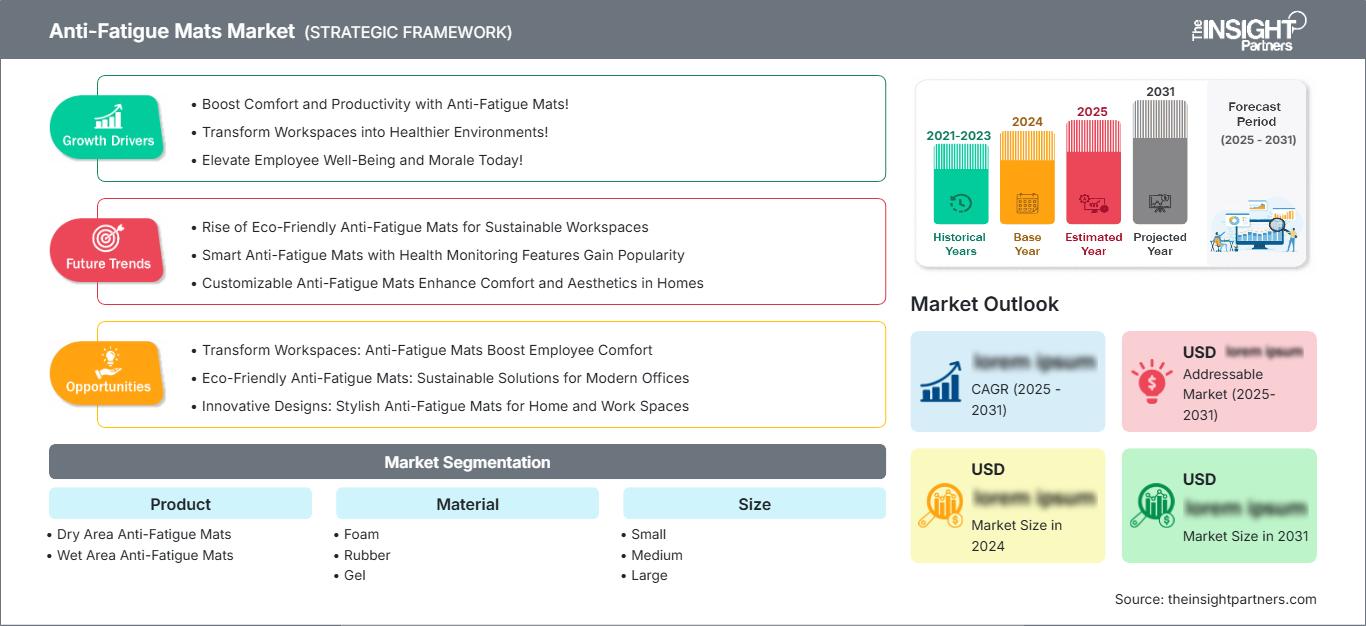
The anti-fatigue mats market was valued at US$ 1.4 Billion in 2025 and is projected to reach US$ 1.98 Billion by 2034, expanding at a CAGR of 3.97% during 2026–2034. Market expansion is supported by increasing workplace ergonomics awareness, occupational health initiatives, and growing adoption of standing workstations across industrial, commercial, and residential environments. Manufacturers continue to focus on material innovation, durability enhancement, and sustainability to address evolving end-user requirements across diverse workplace settings.
Across North America, continuous investments in employee wellness programs, warehouse modernization, and ergonomic workplace infrastructure are accelerating demand. The anti-fatigue mats market size in the region benefits from broad adoption in manufacturing plants, healthcare facilities, retail outlets, and food service establishments. North America is expected to expand at a CAGR of 3.5–4.5% through 2034, supported by workplace safety regulations and higher awareness regarding musculoskeletal disorder prevention.
Anti-Fatigue Mats Market Assessment and Insights
- North America: Strong industrial safety culture and widespread ergonomic product adoption support market leadership. Share in 2025: 34–38%; CAGR between 2026–2034: 3.5–4.5%.
- US: Large manufacturing and logistics sectors sustain demand for workplace comfort products. Share in 2025: 72–76% of North America; CAGR between 2026–2034: 3.6–4.6%.
- Europe: Germany, the UK, and France lead adoption through occupational safety standards and advanced industrial operations. Share in 2025: 27–31%; CAGR between 2026–2034: 3.2–4.2%.
- Asia Pacific: China, Japan, South Korea, and India drive expansion through industrialization and workplace modernization. Share in 2025: 24–28%; CAGR between 2026–2034: 4.6–5.6%.
- Largest Segment: Commercial end user segment accounts for a 38–42% market share in 2025 and is projected to register a 3.7–4.7% CAGR through 2034.
- High Growth Segment: Gel material segment holds a 16–20% market share in 2025 and is expected to expand at a 5.2–6.2% CAGR.
- Key companies analyzed in detail: Bardwell Safety Matting, Durable Corporation, Euronics Industries Private Ltd., Justrite Manufacturing Co., L.L.C., Let's Gel Inc., MatTek, Sheep Mats, Smart Cells International Ltd., Sublime Marketing Group, Wellness Mats.
Source: The Insight Partners' analysis based on proprietary research, government publications, company annual reports, investor presentations, industry databases, and expert interviews.
Production methods have been moving from basic rubber-based products to sophisticated ergonomic systems utilizing gel technology, high-density foam composites, antimicrobial materials, and recyclable materials. An increase in focus on workplace productivity and worker well-being has driven the development of superior quality products. There has been an increase in slip-resistant, antimicrobial coatings, and modularity in production for wide-scale use in industrial, healthcare, hospitality, and office settings.
Investments are now being driven into rising manufacturing economies with workplace improvement programs in place. A regulatory concern for workers' safety, combined with increased logistics infrastructure and e-commerce warehouses, will continue to drive demand. Increased usage in healthcare settings, food processing facilities, retail settings, and residential standing workstation usage has provided growth potential in the near term.
Anti-Fatigue Mats Market Report Scope
| Report Attribute | Details |
|---|---|
| Market size in 2025 | US$ 1.4 Billion |
| Market Size by 2034 | US$ 1.98 Billion |
| Global CAGR (2026 - 2034) | 3.97% |
| Historical Data | 2021-2024 |
| Forecast period | 2026-2034 |
Anti-Fatigue Mats Market Analysis
The anti-fatigue mats market growth trajectory is supported by increased recognition of workplace ergonomics and employee wellness. Anti-fatigue flooring is becoming more common in manufacturing, warehousing, health care, and retail industries to alleviate the pain experienced by workers due to standing for long periods of time. This leads to various advantages such as increased productivity of workers, reduced absenteeism, and occupational well-being. Increasing usage of standing desks at corporate workplaces also increases the application area of this product beyond its industrial uses.
The supply chain has become diversified with various products using foam, rubber, and gel materials made by both regional and international companies. Competitive advantage lies in the durability, ability to cushion, slip-resistance, and ease of cleaning of the products. While industrial customers seek high durability and chemical resistance of the products, commercial customers are more interested in their aesthetic appearance and ergonomic properties.
The competitive environment remains moderately fragmented. This anti-fatigue mats market analysis indicates that leading participants pursue differentiation through product innovation, customization capabilities, and specialized applications. The Justrite Manufacturing Co., L.L.C., is highly positioned industrially, while Wellness Mats and Let’s Gel Inc. are more oriented towards providing high-quality ergonomic solutions. Smart Cells International Ltd. specializes in highly sophisticated cellular cushioning technologies that solve problems related to tough working environments and high demands.
Strategic investments are currently aimed at geographic expansion and digitalization of the sales process. Among such companies that improve their distribution capabilities and customization of their products are Durable Corporation, Bardwell Safety Matting, Euronics Industries Private Ltd., MatTek, Sheep Mats, and Sublime Marketing Group. E-commerce channels become crucial as they provide better opportunities for residential and small business customers who need ergonomic workplace solutions.
● REPORT CUSTOMIZATION
Tailor This Report To Align With Your Specific Business Requirements
This report can be customized to align precisely with your business objectives, scope, and target markets. Customization options include tailored segmentation, geography, competitive analysis, and strategic insights to support informed decision-making.
Customize This Report →WHAT YOU CAN ADJUST
- ● Segmentations
- ● Geography
- ● Competitive Analysis
- ● Language Preferences
Anti-Fatigue Mats Market: Strategic Insights
Regional Insights
North America anti-fatigue mats market
North America accounted for approximately 34–38% share in 2025 and is projected to expand at a 3.5–4.5% CAGR through 2034. The region benefits from mature occupational safety frameworks, high workplace ergonomics awareness, and extensive adoption across manufacturing, logistics, retail, healthcare, and hospitality industries. Employers increasingly integrate fatigue-reduction solutions into wellness and productivity initiatives.
The region's anti-fatigue mats market share leadership is reinforced by substantial warehouse expansion associated with e-commerce growth and logistics modernization. Demand is particularly strong in food processing, automotive manufacturing, and healthcare facilities where employees remain standing for extended periods. Sustainability-focused procurement policies are also increasing demand for recyclable and environmentally conscious matting solutions among institutional buyers.
U.S. anti-fatigue mats market
The United States represents approximately 72–76% of North American demand and is forecast to register a 3.6–4.6% CAGR during 2026–2034. High uptake in warehouses, manufacturing plants, commercial kitchens, retail outlets, and health care facilities is aiding growth. Corporate spending on occupational safety and worker productivity improvement continues to be a key growth catalyst.
Large distributors have well-established distribution channels spread out all across the nation, making sure products are accessible to various user industries. The increased adoption of standing workstations in the office space is adding incremental sales. More applications are focusing on cushioning efficiency, slip-resistance, and hygiene features that can be used in the healthcare and food industry.
Europe anti-fatigue mats market
Europe held approximately 27–31% share in 2025 and is expected to record a 3.2–4.2% CAGR through 2034. Germany is still the top country-based market owing to the vast presence of the manufacturing industry and its focus on safety in the workplace, along with the application of ergonomics-based products in the workplace. There is continued growth in industrial automation that results in a sustained demand for comfort products for the workers.
The United Kingdom shows high usage in the logistics, health care, and retail segments. Germany gains from the automotive, engineering, and industrial manufacturing sectors, wherein standing work is a routine requirement. France, Italy, and Spain together provide high demand owing to service industries, food processing, and commercial workplace modernization.
APAC anti-fatigue mats market
Asia Pacific accounted for 24–28% share in 2025 and is anticipated to achieve a 4.6–5.6% CAGR, the fastest among major regions. China leads demand through manufacturing scale and workplace modernization investments. Japan and South Korea contribute through advanced industrial environments and stringent quality standards.
India and Australia are witnessing rising adoption within logistics, healthcare, and commercial facilities. Industrial development programs, manufacturing investments, and heightened awareness of occupational ergonomics support continued regional expansion. Growing local production capabilities further strengthen supply availability across major economies.
Middle East & Africa anti-fatigue mats market
The Middle East & Africa market continues expanding at a 4.0–5.0% CAGR through 2034. Saudi Arabia and the UAE contribute significant demand through infrastructure development, industrial diversification initiatives, and expanding logistics facilities. Occupational safety improvements are encouraging wider implementation of ergonomic workplace products.
South Africa remains an important market due to its mining, manufacturing, and commercial sectors. Across the broader region, industrial expansion, energy projects, and modernization of workplace practices are creating opportunities for suppliers offering durable and climate-resistant anti-fatigue flooring solutions.
Segmentation Analysis
Product
The product segment is projected to expand at a 3.8–4.8% CAGR during 2026–2034. The anti-fatigue mats market scope across product categories is expanding as end users increasingly seek environment-specific solutions. Manufacturers continue introducing specialized products for dry industrial floors and wet workplace conditions, improving safety, durability, and user comfort.
- Dry Area Anti-Fatigue Mats: Widely used in warehouses, retail environments, offices, and manufacturing facilities where moisture exposure is limited. Demand remains supported by ergonomic productivity initiatives and workplace wellness programs.
- Wet Area Anti-Fatigue Mats: Essential in food processing, commercial kitchens, laboratories, and healthcare environments. Their drainage capabilities and slip-resistant construction make them strategically important in safety-critical operations.
Material
The material segment is expected to register a 4.1–5.1% CAGR through 2034. Material selection significantly influences performance characteristics, maintenance requirements, durability, and cost efficiency. Continued innovation is improving comfort levels while meeting increasingly stringent safety and sustainability expectations.
- Foam: Popular for lightweight applications requiring economical cushioning and ergonomic support. Adoption remains significant across offices, retail locations, and light-duty commercial settings.
- Rubber: Favored for durability, chemical resistance, and industrial performance. Strong demand continues in heavy-duty manufacturing environments and logistics operations.
- Gel: Premium ergonomic solution delivering enhanced pressure distribution and comfort. Increasing acceptance among healthcare facilities and commercial workplaces supports market relevance.
Size
The size segment is estimated to grow at a 3.6–4.6% CAGR over the forecast period. Diverse workplace layouts require flexible sizing options that address operational requirements and installation constraints. Demand increasingly favors configurable products capable of supporting specialized applications.
- Small: Commonly utilized at point-of-sale stations, cashier locations, and individual workstations where space efficiency is critical.
- Medium: Represents a balanced solution for commercial and light industrial environments requiring broader worker coverage without extensive customization.
- Large: Suitable for assembly lines, warehouse operations, and manufacturing facilities where continuous standing occurs across wide operational zones.
- Customizable: Growing preference among industrial customers seeking tailored dimensions and layouts compatible with unique workplace configurations.
End User
The end-user segment is projected to expand at a 4.0–5.0% CAGR during 2026–2034. Adoption patterns vary significantly according to workplace environment, employee exposure duration, safety requirements, and productivity objectives. Commercial and industrial sectors remain primary demand generators.
- Residential: Demand is increasing alongside standing desk adoption and home-office ergonomics awareness among remote and hybrid workers.
- Commercial: Largest revenue contributor due to widespread deployment across retail, hospitality, healthcare, offices, and service-oriented workplaces.
- Industrial: Strong demand originates from manufacturing, warehousing, automotive, and processing facilities focused on worker comfort and operational efficiency.
Opportunity Snapshot
| Segment Name | Revenue Contribution | Trend Tag | Adoption Stage |
| Residential | Low | Home Office | Scaling |
| Commercial | High | Workplace Wellness | Mature |
| Industrial | High | Smart Warehousing | Scaling |
Anti-Fatigue Mats Market Growth Drivers and Impact Analysis
Expansion of Workplace Ergonomics Programs
There is an increasing realization of the connection between the comfort level of employees, their efficiency, and organizational performance. Standing for prolonged periods results in fatigue, discomfort, and inefficiency in factories, hospitals, kitchens, retail stores, and warehouses. With the growing inclination towards the implementation of ergonomic workplace strategies by organizations, the requirement for anti-fatigue mats and similar solutions is rising. These solutions not only provide comfort but are also seen by organizations as part of their holistic approach towards improving the overall performance at the workplace. The growing emphasis on ergonomics within the scope of occupational health policies will continue to drive the use of innovative products.
Growth of Warehousing and Logistics Infrastructure
The rapid growth of distribution centers and fulfillment centers has created considerable opportunities for ergonomic floors. People working in logistics spend long hours standing, moving around, and performing repetitive tasks. The managers in warehouses are paying more attention to anti-fatigue measures to ensure the efficiency of their work. Major automation processes require ergonomic measures from people controlling machines and taking care of quality control procedures. As e-commerce becomes more prominent in distribution worldwide, investments in large warehouses will continue to grow. In such an atmosphere, it makes sense to implement anti-fatigue mats in packing, sorting, assembly, and shipping stations.
Rising Focus on Occupational Safety Compliance
Governments, industry groups, and businesses have begun paying increasing attention to the issue of workplace safety and employee health. Compliance measures have been broadening from the simple act of accident prevention into issues such as fatigue prevention and the minimization of musculoskeletal risk factors. Anti-fatigue mats are an excellent example of a practical solution for ensuring safe and healthy workplaces. The need for anti-fatigue mats can be seen especially in the food processing, healthcare, manufacturing, and hospitality industries, where standing for long periods of time is a necessity. It is hoped that this trend will increase the demand for products while also spurring innovation.
Anti-Fatigue Mats Market Future Trends
Advanced Material Engineering
Future product development will increasingly focus on engineered materials capable of delivering enhanced cushioning, pressure distribution, durability, and sustainability. Manufacturers are exploring hybrid foam-gel constructions, antimicrobial technologies, and recyclable designs that meet evolving workplace requirements. The anti-fatigue mats market trends increasingly indicate movement toward multifunctional products combining ergonomic performance with environmental responsibility. Emerging innovations are expected to improve lifespan, reduce maintenance requirements, and strengthen adoption in specialized industrial and healthcare applications. Material science advancements will remain a critical competitive differentiator over the coming decade.
Integration with Smart Workplace Strategies
Workplace modernization efforts have provided a platform for the introduction of ergonomically advanced products that meet the broader operational needs. Anti-fatigue products will become a component of employee well-being packages and productivity enhancement measures. Some possible developments in the future could be sensors for workplace monitoring and ergonomic analysis based on data collected from sensors. Growth of the hybrid working model, flexibility of the facility, and employee-oriented workplace design should result in wider use of such products both in commercial and residential workplaces.
Anti-Fatigue Mats Market Opportunities
Expansion into Emerging Industrial Economies
Industrial investment across Asia, the Middle East, and selected African economies provides significant growth potential. Manufacturing development, logistics infrastructure expansion, and occupational safety improvements are increasing awareness of ergonomic workplace products. Companies capable of establishing localized distribution networks and cost-effective product portfolios can benefit from rising adoption rates. Market participants are increasingly evaluating these regions as long-term strategic growth destinations. The availability of new industrial facilities creates opportunities for specification-driven sales and large-volume procurement contracts. According to current anti-fatigue mats market Forecasts, emerging economies are expected to contribute an increasing proportion of incremental demand through the forecast period.
Premiumization Through Specialized Solutions
End users increasingly seek differentiated products tailored to industry-specific requirements. Healthcare facilities require hygienic surfaces, manufacturing plants prioritize durability, and commercial offices focus on aesthetics and ergonomic effectiveness. Suppliers can capitalize on premiumization trends by developing specialized offerings addressing these distinct needs. Customized designs, environmentally responsible materials, and advanced comfort technologies enhance value propositions while supporting margin expansion. Strategic investment in research and development can help manufacturers establish competitive advantages and foster stronger customer relationships. The premium segment is expected to attract increasing attention as organizations place greater emphasis on workplace experience and employee well-being.
Frequently Asked Questions

- Comprehensive Market Sizing and Forecast Analysis
- Detailed Segmentation Analysis
- In-Depth Market Dynamics Assessment
- Regional and Country-Level Insights
- Competitive Landscape and Company Benchmarking
- Strategic Business Intelligence
Recent Reports
Testimonials

The Insight Partners provided valuable market intelligence that supported our global go-to-market strategy. Their team was professional, responsive, and attentive to our feedback, providing thoughtful analysis and helpful methodological clarifications throughout the project.
Junmo Kim Chief Financial Officer (CFO), Enertech Co., Ltd.
The Insight Partners' SCADA System Market report is comprehensive, with valuable insights on current trends and future forecasts. The team was highly professional, responsive, and supportive throughout. We are very satisfied and highly recommend their services.
RAN KEDEM Partner, Reali Technologies LTDs
I requested a report on a very specific software market and the team produced the report in a few days. The information was very relevant and well presented. I then requested some changes and additions to the report. The team was again very responsive and I got the final report in less than a week.
JEAN-HERVE JENN Chairman, Future Analytica
We worked with The Insight Partners for an important market study and forecast. They gave us clear insights into opportunities and risks, which helped shape our plans. Their research was easy to use and based on solid data. It helped us make smart, confident decisions. We highly recommend them.
PIYUSH NAGPAL Sr. Vice President, High Beam Global
The Insight Partners delivered insightful, well-structured market research with strong domain expertise. Their team was professional and responsive throughout. The user-friendly website made accessing industry reports seamless. We highly recommend them for reliable, high-quality research services
YUKIHIKO ADACHI CEO, Deep Blue, LLC.
This is the first time I have purchased a market report from The Insight Partners.While I was unsure at first, I visited their web site and felt more comfortable to take the risk and purchase a market report.I am completely satisfied with the quality of the report and customer service. I had several questions and comments with the initial report, but after a couple of dialogs over email with their analyst I believe I have a report that I can use as input to our strategic planning process.Thank you so much for taking the extra time and making this a positive experience.I will definitely recommend your service to others and you will be my first call when we need further market data.
JOHN SUZUKI President and Chief Executive Officer, Board Director, BK Technologies
I wish to appreciate your support and the professionalism you displayed in the course of attending to my request for information regarding to infectious disease IVD market in Nigeria. I appreciate your patience, your guidance, and the fact that you were willing to offer a discount, which eventually made it possible for us to close a deal. I look forward to engaging The Insight Partners in the future, all thanks to the impression you have created in me as a result of this first encounter.
DR CHIJIOKE ONYIA MANAGING DIRECTOR, PineCrest Healthcare Ltd.Reason to Buy
- Informed Decision-Making
- Understanding Market Dynamics
- Competitive Analysis
- Identifying Emerging Markets
- Customer Insights
- Market Forecasts
- Risk Mitigation
- Boosting Operational Efficiency
- Strategic Planning
- Investment Justification
- Tracking Industry Innovations
- Aligning with Regulatory Trends





 Get Free Sample for