
Creatine Monohydrate Market Growth, Demand & Size by 2034
Coverage: By Type (Pharmaceutical Grade, Food Grade, Cosmetic Grade); Application (Sport Nutrition, Functional Food, Dietary Supplements, Pharmaceutical, Others); Distribution Channel (Hospital Pharmacies, Retail Pharmacies, Others), and Geography (North America, Europe, Asia Pacific, and South and Central America)
- Status : Data Released
- Report Code : TIPRE00021683
- Category : Life Sciences
- No. of Pages : 150
- Available Report Formats :


- Last update date : August 05, 2026


2025 Market Size
US$ 751.17 Mn
Base year value
2034 Forecast
US$ 1,258.76 Mn
Projected by 2034
CAGR 2026-2034
6.67 %
Growth rate
Addressable Market
US$ 9,466.96 Mn
(2026-2034)
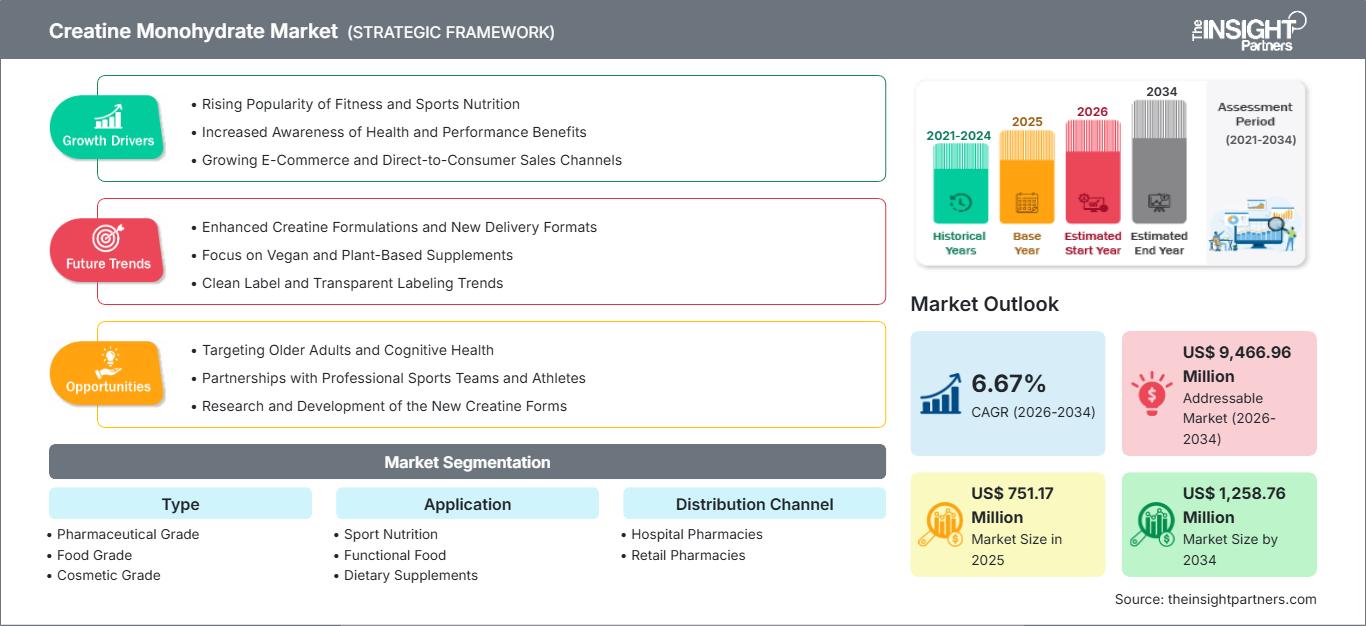
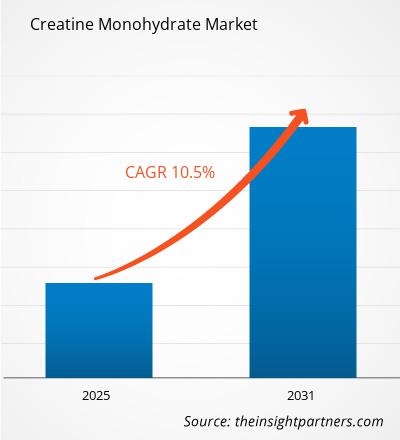
The Creatine Monohydrate Market is valued at US$ 751.17 Million in 2025 and is projected to reach US$ 1,258.76 Million by 2034, growing at a CAGR of 6.67% during 2026–2034. The market expansion is supported by increasing demand for performance nutrition products, wider adoption of dietary supplements, and rising applications across sports, healthcare, and wellness sectors.
North America remains a significant contributor, supported by established sports nutrition consumption patterns, advanced supplement distribution networks, and growing awareness of evidence-based ingredients. The Creatine Monohydrate Market size is influenced by expanding consumer interest in fitness products, clinical research supporting creatine applications, and increasing availability through online and specialty retail channels, with regional growth estimated at a CAGR range of 6.20–7.10% during 2026–2034.
Creatine Monohydrate Market Assessment and Insights
- North America holds a prominent position with a Share in 2025 estimated at 34–38% and is expected to grow at a CAGR between 2026–2034 of 6.20–7.10%, driven by supplement penetration and sports performance applications.
- US represents the leading country-level contributor, accounting for 28–32% Share in 2025 within the global market and expanding at a CAGR of 6.30–7.20% due to fitness adoption and product innovation.
- Europe demonstrates steady development with a Share in 2025 of 25–29% and a CAGR between 2026–2034 of 6.00–6.90%, supported by Germany, the UK, France, Italy, and Spain.
- Asia Pacific shows accelerated adoption with a Share in 2025 of 24–28% and a CAGR between 2026–2034 of 7.00–8.00%, led by China, Japan, India, and South Korea through expanding health awareness.
- Largest Segment: Sport Nutrition maintains a market share of 38–42% in 2025 and is projected to grow at a CAGR of 6.50–7.30% due to athlete and fitness consumer demand.
- High Growth Segment: Pharmaceutical Grade demonstrates a market share of 18–22% in 2025 and is expected to expand at a CAGR of 7.20–8.10% through healthcare applications.
- Key companies analyzed in detail: NutraBio, AlzChem AG, Jiangsu Yuanyang, Zibo Lanjian, Shanghai Baosui, Shanghai Biosundrug, N and R Industries, Tianjin Tiancheng, Taicang Xinyue, and additional active industry participants.
Source: The Insight Partners' analysis based on proprietary research, government publications, company annual reports, investor presentations, industry databases, and expert interviews.
Production technologies, quality certification requirements, and ingredient traceability systems are reshaping the Creatine Monohydrate Market as manufacturers focus on purity levels and application-specific formulations. Synthesis technology improvements have enhanced product uniformity, and the need of sports nutrition companies has helped manufacturers to fine-tune their manufacturing facilities. The growing regulatory concerns about the safety of supplements and labeling practices continue to shape the product development initiatives of firms operating in various markets worldwide.
The future potential lies in the pharmaceutical uses of the compound, the personal nutrition concepts, and expanding usage in developing countries. Companies are developing their production technologies and establishing distribution partnerships to cater to the demand of varied end users. Regulations regarding the use of dietary components and health care industry are expected to impact the commercialization process.
Creatine Monohydrate Market Report Scope
| Report Attribute | Details |
|---|---|
| Market size in 2025 | US$ 751.17 Million |
| Market Size by 2034 | US$ 1,258.76 Million |
| Global CAGR (2026 - 2034) | 6.67% |
| Historical Data | 2021-2024 |
| Forecast period | 2026-2034 |
Creatine Monohydrate Market Analysis
Growing consumer participation in fitness activities, increasing awareness of muscle health, and rising preference for scientifically supported supplements are major contributors to Creatine Monohydrate Market growth. The ecosystem consists of suppliers of raw materials, manufacturers, formulators, distributors, and retail outlets that have an effect on availability and pricing. The supply chain is becoming increasingly structured as the industry prioritizes testing of products, adherence to certifications, and dependable sourcing.
Value chains consist of specialized chemical processes, testing laboratories, packaging firms, and international distribution systems. Manufacturers are adjusting their production methods to satisfy the needs of companies producing sports nutrition, drugs, and functional foods. There is increasing demand for clean-label supplements and clear ingredient sourcing, which drives suppliers to increase efficiency and comply with regulations.
The Creatine Monohydrate Market analysis highlights a competitive environment shaped by established ingredient producers, specialty nutrition companies, and regional manufacturers. Companies such as AlzChem AG, NutraBio, and Jiangsu Yuanyang continue strengthening their positions through production expertise and supply capabilities. Other participants, including Zibo Lanjian, Shanghai Baosui, Shanghai Biosundrug, N and R Industries, Tianjin Tiancheng, and Taicang Xinyue, contribute through regional manufacturing networks.
Investment activity is focused on production expansion, quality enhancement, and application diversification. Companies are exploring opportunities across the pharmaceutical, dietary supplement, and functional food sectors to reduce dependency on traditional sports nutrition demand. Strategic positioning increasingly depends on certification capabilities, manufacturing scalability, and partnerships with global distributors seeking consistent ingredient supply.
● REPORT CUSTOMIZATION
Tailor This Report To Align With Your Specific Business Requirements
This report can be customized to align precisely with your business objectives, scope, and target markets. Customization options include tailored segmentation, geography, competitive analysis, and strategic insights to support informed decision-making.
Customize This Report →WHAT YOU CAN ADJUST
- ● Segmentations
- ● Geography
- ● Competitive Analysis
- ● Language Preferences
Creatine Monohydrate Market: Strategic Insights
Regional Insights
North America Creatine Monohydrate Market
North America represents a leading regional market with an estimated share in 2025 of 34–38% and is expected to register a CAGR of 6.20–7.10% during 2026–2034. Strong consumer spending on sports supplements, advanced retail infrastructure, and widespread gym participation support regional expansion. The United States remains the primary contributor due to established nutrition brands and high supplement adoption. The Creatine Monohydrate Market share remains significant in the region, supported by strong consumer awareness, expanding fitness culture, and broad product availability across online and offline distribution channels.
Formulation innovation, e-commerce, and science-based nutritional products will be greatly advantageous to the regional ecosystem. The contributions of both Canada and Mexico have been through the creation of awareness of an active lifestyle and preventive health. There have also been enhanced partnerships for product distribution between manufacturers and specialty retail stores, as well as online and medical channels.
U.S. Creatine Monohydrate Market Market
The U.S. contributes approximately 28–32% of the global market in 2025 and represents around 82–86% of the North American market share. The country is projected to grow at a CAGR of 6.30–7.20% during 2026–2034, supported by sports nutrition demand and expanding consumer health awareness. According to the Creatine Monohydrate Market report, the United States remains a key growth hub due to the presence of established nutrition brands, extensive retail distribution networks, and increasing consumer focus on fitness and performance-enhancing supplements.
Leading corporations and ingredient providers have a strong footprint through their manufacturing capabilities, distribution networks, and brand partnerships. Applications are trending from professional sports persons to fitness enthusiasts, older individuals, and health-conscious people. Increased availability through online channels and nutrition specialty stores is enhancing access. Innovation in products such as combination supplements and formulation is anticipated to drive further growth in the market throughout the nation.
Europe Creatine Monohydrate Market
Europe accounts for an estimated share in 2025 of 25–29% and is projected to expand at a CAGR of 6.00–6.90% during 2026–2034. Germany represents the leading European contributor, supported by strong sports nutrition consumption, established supplement regulations, and advanced distribution systems. Key Creatine Monohydrate Market trends include increasing demand for performance-enhancing supplements, growing penetration of e-commerce distribution channels, rising consumer focus on fitness and wellness, and continued product innovation in formulation and delivery formats.
Influences on the UK market include growing fitness activity and the desire for performance-driven products, and Germany has the advantage of knowledge in pharmaceuticals and food ingredients. France, Italy, and Spain have witnessed slow but steady uptake driven by wellness trends and retail availability. European producers focus on quality, ingredient certification, and adherence to food supplements legislation in the region. Growing preventive health care awareness and functional nutrition interest are anticipated to maintain demand in Europe's leading economies.
APAC Creatine Monohydrate Market
Asia Pacific holds an estimated Share in 2025 of 24–28% and is expected to achieve a CAGR of 7.00–8.00% during 2026–2034. China leads regional production and consumption due to its manufacturing capabilities and expanding domestic demand.
Japan, South Korea, India, and Australia are experiencing increasing adoption through fitness culture expansion and health-conscious consumers. Industrial development, rising disposable income, and broader supplement availability support regional growth. The government's focus on nutrition awareness and sports development initiatives further contributes to market expansion. Manufacturers are increasing local partnerships to improve accessibility and address diverse consumer requirements.
Middle East & Africa Creatine Monohydrate Market
The Middle East and Africa region is estimated to expand at a CAGR of 5.80–6.80% during 2026–2034, supported by rising fitness investments and developing wellness infrastructure. Saudi Arabia and the UAE represent important contributors due to growing sports initiatives and premium nutrition consumption.
South Africa remains a key African market, while other Middle Eastern and African countries are gradually adopting supplements through retail development and digital commerce. Infrastructure investments, economic diversification programs, and increasing interest in active lifestyles influence demand patterns. Manufacturers are exploring regional distribution networks to improve product availability and strengthen market penetration.
Segmentation Analysis
Type
The Type segment includes Pharmaceutical Grade, Food Grade, and Cosmetic Grade. This segment is expected to grow at a CAGR of 6.30–7.10% during 2026–2034. The Creatine Monohydrate Market scope within this category is shaped by purity requirements, application-specific manufacturing, and increasing demand for certified ingredients across the nutrition and healthcare industries.
- Pharmaceutical Grade products are gaining importance due to stringent quality standards and increasing exploration of creatine applications in healthcare-related formulations. Demand is supported by manufacturers seeking high-purity ingredients.
- Food Grade products maintain strong demand because of widespread use in sports nutrition, functional foods, and dietary supplements requiring reliable quality and cost-effective production.
- Cosmetic Grade products serve specialized formulations where creatine is incorporated into personal care products. Adoption remains linked to innovation in skincare and wellness applications.
Application
The Application segment covers Sport Nutrition, Functional Food, Dietary Supplements, and Pharmaceutical applications. This segment is projected to grow at a CAGR of 6.50–7.30% during 2026–2034. Increasing research into creatine benefits and expanding consumer usage across multiple health categories are supporting segment development.
- Sport Nutrition remains a major application area due to strong demand from athletes, fitness enthusiasts, and performance-focused consumers seeking established supplementation solutions.
- Functional Food applications are expanding as manufacturers incorporate nutritional ingredients into convenient products designed for health-conscious consumers and active lifestyle preferences.
- Dietary Supplements continue gaining adoption through broader retail availability, online sales channels, and consumer interest in preventive wellness strategies.
- Pharmaceutical applications are developing through research initiatives exploring creatine-related benefits in specialized healthcare formulations.
Distribution Channel
The Distribution Channel segment includes Hospital Pharmacies and Retail Pharmacies. This segment is anticipated to grow at a CAGR of 5.90–6.80% during 2026–2034. Distribution development is influenced by increasing healthcare awareness and expanding access to supplement-based products.
- Hospital Pharmacies support controlled access for healthcare-related applications where professional guidance and regulated distribution channels are important for product usage.
- Retail Pharmacies represent a broader consumer channel supported by convenience, increasing supplement visibility, and growing demand for accessible nutrition products.
Opportunity Snapshot
| Application | Revenue Contribution | Trend Tag | Adoption Stage |
| Sport Nutrition | High | Athlete Performance | Mature |
| Functional Food | Medium | Nutrition Fortification | Scaling |
| Dietary Supplements | High | Wellness Adoption | Mature |
| Pharmaceutical | Medium | Clinical Research | Emerging |
Creatine Monohydrate Market Growth Drivers and Impact Analysis
Rising Participation in Fitness and Sports Activities
Growth in participation in fitness, sports, and strength training activities has resulted in an ongoing demand for nutrition products that help enhance performance. There has been an increasing popularity in the number of gyms, online fitness programs, and fitness-related communities, resulting in a widening the consumer base to include not only professional athletes but also general consumers. This trend is leading companies to innovate formulations that are affordable for all user types, such as active adults and health-conscious consumers. This is evident in greater availability, product diversity, and increased acceptance of science-backed supplements.
Growing Demand for Preventive Health and Nutritional Support
The emphasis on preventive care and good muscle health among consumers is affecting demand for nutrients that have a scientific background. Awareness about healthy aging, fitness, and well-being is driving greater usage across diverse customer groups. Healthcare practitioners and nutritionists are now seeing the need to include the role of evidence-based supplements as part of the wellness conversation, thus opening more avenues for manufacturers. This has translated to entry into new functional nutrition categories, better product positioning, and increased research in formulations among others. Companies are therefore coming up with various products that cater to varied customers while improving quality systems.
Expansion of Advanced Manufacturing and Quality Standards
Technological advances in manufacturing processes, along with higher quality standards, affect production approaches throughout the ingredient supply chain. Companies are working on developing purification, testing, and certification systems for preserving quality in their products. This is crucial for modern times since buyers from all over the world tend to assess suppliers' traceability and production stability. It results in higher supply reliability, more efficient international cooperation, and more confidence among supplement and pharmaceutical companies. Those producers who have manufacturing facilities that can be scaled up will be able to produce products for various purposes, such as sports nutrition, dietary supplements, and healthcare-specific products.
Creatine Monohydrate Market Future Trends
Personalized Nutrition and Targeted Supplement Formulations
It is believed that personalized nutrition will affect the future development of products because there is an increasing need for supplementation that caters to individual health and fitness targets. Developments in consumer health information, digital wellness technologies, and nutritional knowledge can possibly make brands develop more personalized forms of creatine. The future will see more developments in terms of customization of the combination of ingredients and delivery systems, as well as targeting of specific consumer segments. It will make brands consider partnerships with suppliers of ingredients, nutrition companies, and technology developers. Also, they can carry out research projects related to creatine use by different demographics.
Integration of Creatine Into Diverse Wellness Categories
Future developments of the market are likely to be characterized by further penetration of creatine in other types of product categories that go beyond conventional sports supplements. Creatine may find its way in functional foods and beverages, and health-focused products as people show more interest in multi-functional nutrition. Such a shift may allow companies to experiment with different product formats and even partner up with food and wellness companies. Regulatory aspects and consumer awareness are going to be key determinants of future developments. Companies capable of successfully adapting to changes in consumers' preferences are likely to benefit from that.
Creatine Monohydrate Market Opportunities
Increasing Adoption in Emerging Economies
Emerging economies present opportunities through rising disposable incomes, expanding fitness infrastructure, and increasing awareness of nutritional supplementation. Countries across Asia Pacific, Latin America, and selected Middle Eastern markets are experiencing gradual shifts toward preventive health and active lifestyles. Companies can strengthen market presence by developing region-specific distribution strategies, improving affordability, and partnering with local retailers. The Creatine Monohydrate Market Forecasts indicate that future opportunities will depend on improving accessibility, strengthening consumer education, and addressing diverse purchasing preferences. Investment in regional supply networks and localized marketing approaches can support sustainable expansion while enabling manufacturers to reach previously underserved customer segments.
Innovation Through New Delivery Formats
Innovation in product design using alternative delivery systems can prove to be an important area of growth for firms looking for differentiation. Powder products have been dominating the market so far, but the need for convenience in consumption might spur the development of capsules, soluble forms, and combinations of ingredients. Firms that invest in formulation technology can meet the demands of consumers regarding portability and ease of use. The cooperation between ingredient suppliers and final product makers can speed up the commercialization process for innovative products. Other possibilities may arise in the pharmaceutical and functional nutrition industries where certain specific formulations are required.
Recent Developments
- June 2025: AlzChem AG expanded its strategic focus on specialty chemicals and nutritional ingredients by strengthening production capabilities and maintaining quality-focused supply systems for creatine-based applications. The company continues supporting global customers through established manufacturing expertise and regulated ingredient production processes.
- April 2025: NutraBio introduced updated supplement product initiatives focused on ingredient transparency, quality testing, and consumer-focused nutrition solutions. The company continued emphasizing clinically supported formulations and detailed product information to address increasing demand for performance and wellness products.
- February 2025: Thermo Fisher Scientific enhanced its analytical and laboratory solutions portfolio supporting nutritional ingredient testing, quality control, and research applications across healthcare and life science industries. The company continues providing technologies that enable accurate analysis and regulatory compliance.
Frequently Asked Questions

- Comprehensive Market Sizing and Forecast Analysis
- Detailed Segmentation Analysis
- In-Depth Market Dynamics Assessment
- Regional and Country-Level Insights
- Competitive Landscape and Company Benchmarking
- Strategic Business Intelligence
Recent Reports
Testimonials

The Insight Partners' SCADA System Market report is comprehensive, with valuable insights on current trends and future forecasts. The team was highly professional, responsive, and supportive throughout. We are very satisfied and highly recommend their services.
RAN KEDEM Partner, Reali Technologies LTDs
I requested a report on a very specific software market and the team produced the report in a few days. The information was very relevant and well presented. I then requested some changes and additions to the report. The team was again very responsive and I got the final report in less than a week.
JEAN-HERVE JENN Chairman, Future Analytica
We worked with The Insight Partners for an important market study and forecast. They gave us clear insights into opportunities and risks, which helped shape our plans. Their research was easy to use and based on solid data. It helped us make smart, confident decisions. We highly recommend them.
PIYUSH NAGPAL Sr. Vice President, High Beam Global
The Insight Partners delivered insightful, well-structured market research with strong domain expertise. Their team was professional and responsive throughout. The user-friendly website made accessing industry reports seamless. We highly recommend them for reliable, high-quality research services
YUKIHIKO ADACHI CEO, Deep Blue, LLC.
This is the first time I have purchased a market report from The Insight Partners.While I was unsure at first, I visited their web site and felt more comfortable to take the risk and purchase a market report.I am completely satisfied with the quality of the report and customer service. I had several questions and comments with the initial report, but after a couple of dialogs over email with their analyst I believe I have a report that I can use as input to our strategic planning process.Thank you so much for taking the extra time and making this a positive experience.I will definitely recommend your service to others and you will be my first call when we need further market data.
JOHN SUZUKI President and Chief Executive Officer, Board Director, BK Technologies
I wish to appreciate your support and the professionalism you displayed in the course of attending to my request for information regarding to infectious disease IVD market in Nigeria. I appreciate your patience, your guidance, and the fact that you were willing to offer a discount, which eventually made it possible for us to close a deal. I look forward to engaging The Insight Partners in the future, all thanks to the impression you have created in me as a result of this first encounter.
DR CHIJIOKE ONYIA MANAGING DIRECTOR, PineCrest Healthcare Ltd.Reason to Buy
- Informed Decision-Making
- Understanding Market Dynamics
- Competitive Analysis
- Identifying Emerging Markets
- Customer Insights
- Market Forecasts
- Risk Mitigation
- Boosting Operational Efficiency
- Strategic Planning
- Investment Justification
- Tracking Industry Innovations
- Aligning with Regulatory Trends





 Get Free Sample for