
Defibrillator Analyzers Market Share, Demand & Growth by 2034
Coverage: By Modularity Type (Portable Defibrillator Analyzers, Desk Defibrillator Analyzers); End-Users (Hospitals, Prehospital, Public Access, Homecare) , and Geography (North America, Europe, Asia Pacific, and South and Central America)
- Status : Data Released
- Report Code : TIPRE00008453
- Category : Life Sciences
- No. of Pages : 150
- Available Report Formats :


- Last update date : August 17, 2026


2025 Market Size
US$ 223.65 Mn
Base year value
2034 Forecast
US$ 566.31 Mn
Projected by 2034
CAGR 2026-2034
10.87 %
Growth rate
Addressable Market
US$ 3,492.89 Mn
(2026-2034)
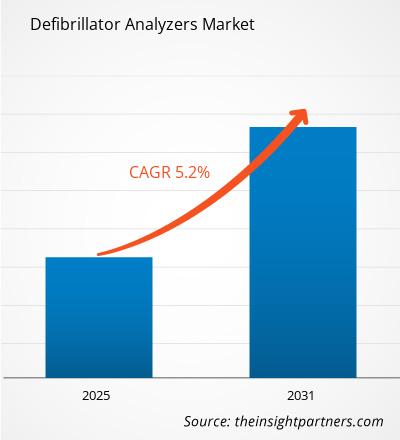
The Defibrillator Analyzers Market is positioned as a specialized medical testing equipment market supporting performance verification of defibrillation systems, AEDs, and related cardiac-resuscitation equipment. The market is estimated to be worth US$ 223.65 Million in 2025 and will grow to reach US$ 566.31 Million by 2034, growing at a CAGR of 10.87% during the period 2026-2034. Growth in the market will be driven by needs for preventative maintenance, increased deployment of AEDs, updating equipment and focusing on accuracy of test results.
In North America, Defibrillator Analyzers Market size is driven by presence of well-established departments of biomedical engineering, robust emergency care facilities, and need for calibration. This region is forecasted to experience growth at a CAGR of about 9.8-10.6% during 2026-2034. High installed base of defibrillators and adoption of digital test documentation will drive the demand.
Defibrillator Analyzers Market Assessment and Insights
- North America: North America is expected to retain a leading position, with a modelled 2025 share of 32–36% and a CAGR of 9.8–10.6% between 2026–2034, supported by mature clinical engineering and preventive-maintenance practices.
- US: The US is estimated to represent 68–73% of North America's 2025 share, expanding at a CAGR of 9.7–10.5% between 2026–2034 as AED coverage and equipment compliance programs broaden.
- Europe: Europe is modelled at a 27–31% share in 2025, with Germany, the UK, France, and Italy supporting demand and the region growing at 10.1–10.9% CAGR between 2026–2034.
- Asia Pacific: Asia Pacific is estimated at a 22–26% share in 2025 and a 12.0–13.0% CAGR between 2026–2034, led by China, Japan, India, South Korea, and Australia as healthcare capacity expands.
- Largest Segment: Portable Defibrillator Analyzers hold a modelled 61–66% market share in 2025 and are expected to grow at 10.5–11.3% CAGR through 2034, reflecting field-testing requirements.
- High Growth Segment: Public Access is modelled at a 15–20% market share in 2025 and is expected to record 13.0–14.0% CAGR through 2034 as AED programs expand beyond hospitals.
- Key companies analyzed in detail: GMC-Instruments GmbH, Seaward Electronic Ltd, Datrend Systems Inc., Fluke Corporation, BC Group International, Inc., Helix India Private Limited, Netech Corporation, Pronk Technologies, Inc., Gossen Metrawatt GmbH, RIGEL Medical.
Source: The Insight Partners' analysis based on proprietary research, government publications, company annual reports, investor presentations, industry databases, and expert interviews.
The market has moved on from initial devices that only verify energy delivery, through to systems which integrate waveform measurement, ECG simulation, automated routines, data storage, and connection capabilities. Innovation efforts have increasingly focused on small form factor, rechargeable power supplies, adjustable loads, computer aided documentation, and interoperability with different defibrillation modalities. This enables the biomedical engineer to more closely inspect equipment near the point of use, while also saving on transcription and improving traceability for preventive maintenance.
Future growth will likely be driven by the increased adoption of AEDs, updating of hospital fleets, and greater desire for measuring equipment readiness. Incremental growth may also come through emerging healthcare markets, with maturing clinical engineering departments and purchase of analyzers alongside other test instruments. Increased regulatory pressures for medical device maintenance, calibration, and verification should drive investment in analyzers which can produce documentation.
Defibrillator Analyzers Market Report Scope
| Report Attribute | Details |
|---|---|
| Market size in 2025 | US$ 223.65 Million |
| Market Size by 2034 | US$ 566.31 Million |
| Global CAGR (2026 - 2034) | 10.87% |
| Historical Data | 2021-2024 |
| Forecast period | 2026-2034 |
Defibrillator Analyzers Market Analysis
Market Growth of Defibrillator Analyzers is directly related to the installed base of life-sustaining devices, along with the need to confirm the energy delivered, timing, waveform, and readiness. Market participants include manufacturers of analyzers, OEM defibrillator manufacturers, biomedical engineers, calibration laboratories, hospital purchasing agents, distributors, and third-party service providers. Supply is highly specialized as the instruments contain precise measurement capabilities, controlled loads, software, calibration facilities, and interface solutions.
Hospitals are the primary source of demand due to the distribution of defibrillators in emergency rooms, intensive care settings, operating theaters, ambulances, and specialty clinics. Prehospital facilities have the requirement of compact instruments capable of moving from vehicle to vehicle and from site to site, while public access programs are creating the distributed test market.
Positioning strategy for Defibrillator Analyzers Market Report is not dependent on mass production, but rather on measurement accuracy, waveforms availability, automation, services, interoperability, and lifecycle management. Fluke Corporation offers an extensive range of biomedical test equipment, while Datrend Systems Inc. provides expertise in biomedical maintenance processes. The companies such as GMC-Instruments GmbH, Seaward Electronic Ltd, and RIGEL Medical have experience with measuring and calibration systems in Europe. BC Group International, Inc., Helix India Private Limited, and Netech Corporation offer alternative solutions based on biomedical engineering process, while Pronk Technologies, Inc. offers portable and workflow-based test equipment. Gossen Metrawatt GmbH is a part of the measurement environment, which creates possibilities for cross-selling of medical test equipment.
Investment preferences are more and more focused on digital reports, connectivity, modularity, and services instead of pure hardware only.
● REPORT CUSTOMIZATION
Tailor This Report To Align With Your Specific Business Requirements
This report can be customized to align precisely with your business objectives, scope, and target markets. Customization options include tailored segmentation, geography, competitive analysis, and strategic insights to support informed decision-making.
Customize This Report →WHAT YOU CAN ADJUST
- ● Segmentations
- ● Geography
- ● Competitive Analysis
- ● Language Preferences
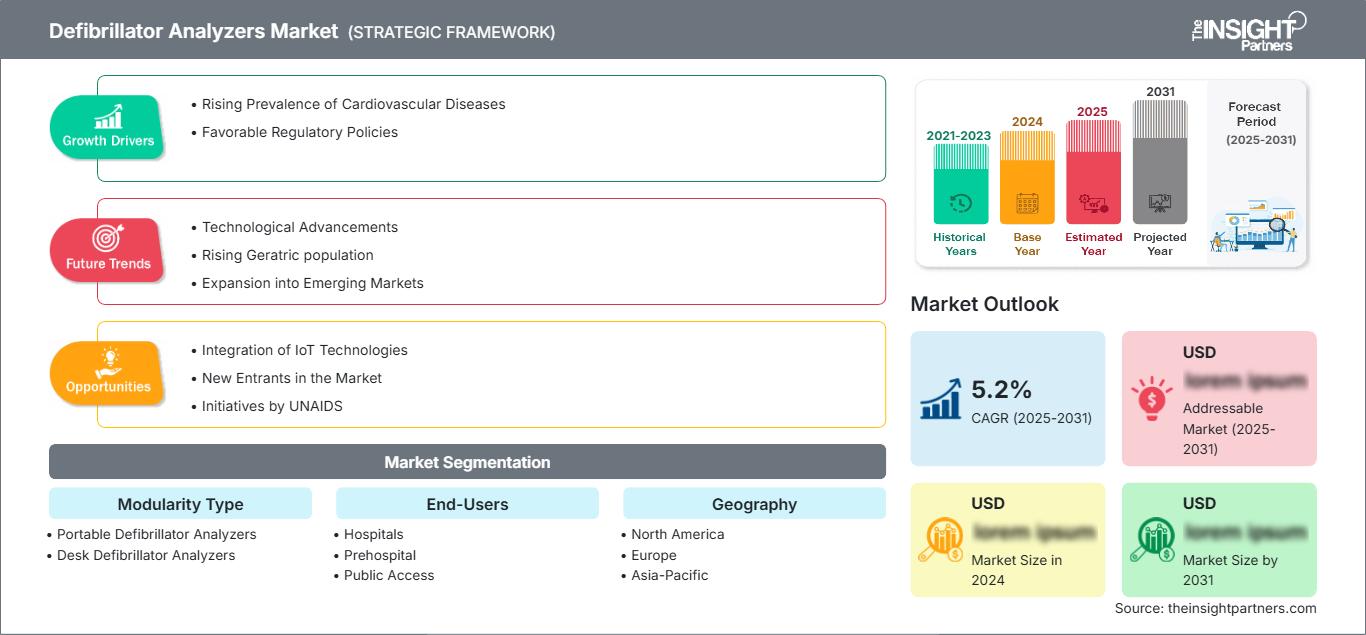
Defibrillator Analyzers Market: Strategic Insights
Regional Insights
North America Defibrillator Analyzers Market
It is expected that North America will capture 32% to 36% of the Defibrillator Analyzers Market share in 2025 and grow at 9.8% to 10.6% CAGR till 2034. North America has mature hospital biomedical engineering departments, well-established calibration process, advanced EMS services, and higher installed base of AED and professional defibrillator.
USA holds the key to the region due to the increasing focus on equipment preparedness, preventive maintenance and emergency response in healthcare facilities. Canada has its contribution through hospital modernization projects and provincial emergency care projects and Mexico is expected to provide growth opportunities due to private hospitals and emergency services upgrading their equipment base. Measurement traceability also has an impact on demand.
U.S. Defibrillator Analyzers Market
The US is estimated to represent 68–73% of North America's 2025 market and grow at 9.7–10.5% CAGR through 2034. Approximately 350,000 out-of-hospital cardiac arrests occur annually in the country, reinforcing the operational importance of reliable resuscitation equipment and maintenance systems.
Hospital laboratories, emergency medical services, public access agencies, and biomedical service companies serve as the primary customers. There is a clear presence of Fluke Corporation, Datrend Systems Inc., BC Group International, Inc., and Netech Corporation in the domain of biomedical testing. Application demand continues to shift towards portable devices for decentralization purposes, while large hospitals still use desk-based testing systems.
Europe Defibrillator Analyzers Market
The Europe region is scaled at 27–31% of the 2025 market and forecast to grow at 10.1–10.9% CAGR until 2034. Germany dominates as the major player based on medical-device manufacturing capability, calibration facilities, and stringent technical standards. The UK, France, Italy, and Spain make significant contributions through hospital equipment upgrade and emergency care investment.
The UK brings expertise in biomedical engineering combined with advanced public-access AED systems. Germany focuses on technical standards and standards-based testing combined with technical manufacturing, whereas France and Italy benefit from hospital equipment upgrade and services. Spain provides modest opportunities through modernization of emergency response and public access systems. In the region, buyers give equal importance to traceability, software documentation, calibration capabilities, and compatibility besides pricing.
APAC Defibrillator Analyzers Market
APAC is estimated at 22–26% of the 2025 market and is expected to expand at 12.0–13.0% CAGR, making it the fastest-growing major region. China is the leading market, followed by Japan, India, South Korea, and Australia. Growth is supported by hospital construction, emergency-care expansion, and localization of medical-device supply chains.
Incremental opportunity for the greatest benefit is provided by China and India since the needs and demands for healthcare and biomedical engineering are increasing. Japan and South Korea can help through the advanced technological ecosystem, and Australia benefits from the availability of the AED program. Incremental opportunity should be helped by regional industry policy and investment in infrastructure.
Middle East & Africa Defibrillator Analyzers Market
The Middle East & Africa region is forecast to grow at a CAGR of around 11.5% – 12.5% up to 2034. Saudi Arabia will be the major market due to the investment in healthcare infrastructure, whereas the UAE will benefit from its highly advanced hospital infrastructure and medical tourism infrastructure. South Africa will remain the major market in sub-Saharan Africa.
In other countries of the region, the adoption will be influenced by hospital modernization, distributors' competencies, calibration services availability, and the availability of skilled biomedical engineers. Investments in energy and infrastructure in Gulf countries could provide advanced test environments, whereas in Africa, there will be longer cycle opportunities connected to tertiary care expansion and emergency response initiatives.
Segmentation Analysis
Modularity Type
Modularity Type is expected to grow at 10.7–11.4% CAGR from 2026–2034. Portable systems dominate because biomedical engineers increasingly test equipment across emergency departments, ambulances, clinics, and public-access locations. Desk systems remain important for centralized engineering departments requiring repeatable bench workflows, higher throughput, and broader accessory configurations. Defibrillator Analyzers Market scope therefore increasingly favors modular portability without eliminating established laboratory-style systems.
- Portable Defibrillator Analyzers: Portable units address decentralized testing requirements, combining battery operation, compact form factors, measurement functions, and field usability. Their strategic importance increases as defibrillator fleets become distributed across hospitals, ambulances, clinics, and public-access locations.
- Desk Defibrillator Analyzers: Desk systems remain relevant where biomedical departments manage larger fleets and require repeatable bench procedures, extensive connectivity, controlled testing environments, and integration with broader equipment-maintenance workflows.
End-Users
End-Users are expected to expand at 10.9–11.7% CAGR from 2026–2034. Hospitals remain the principal demand center because they operate multiple categories of defibrillation equipment and maintain formal biomedical engineering programs. Prehospital, public-access, and homecare applications broaden the installed base and create demand for simpler portable testing approaches, supporting a more distributed service ecosystem.
- Hospitals: Hospitals provide the largest recurring requirement because emergency, critical-care, operating-room, and cardiac units depend on reliable defibrillator readiness and documented preventive maintenance procedures.
- Prehospital: Ambulance and emergency-response organizations prioritize compact analyzers capable of supporting mobile servicing, rapid verification, and consistent equipment checks across geographically distributed vehicles.
- Public Access: Public-access programs create a growing requirement for practical maintenance verification as AEDs move into airports, schools, workplaces, sports venues, and community facilities.
- Homecare: Homecare represents an emerging use environment where compact testing solutions can support specialized devices and service organizations managing distributed equipment outside conventional hospital engineering departments.
Opportunity Snapshot
| End-Users | Revenue Contribution (High/Medium/Low) | Trend Tag (MAX 2 words) | Adoption Stage (Emerging/Scaling/Mature) |
| Hospitals | High | Fleet Testing | Mature |
| Prehospital | Medium | Mobile Testing | Scaling |
| Public Access | Medium | AED Networks | Scaling |
| Homecare | Low | Remote Service | Emerging |
Defibrillator Analyzers Market Growth Drivers and Impact Analysis
Expansion of AED and Emergency-Response Infrastructure
The expansion of AED networks directly enlarges the installed equipment base requiring inspection, calibration, and documented performance verification. In the US, approximately 350,000 out-of-hospital cardiac arrests occur each year, while survival remains low, strengthening the operational rationale for rapid access to functioning resuscitation equipment. As governments, employers, transport facilities, schools, and community organizations increase AED availability, responsibility shifts toward maintaining dispersed assets rather than simply purchasing devices. This creates recurring demand for portable analyzers, service agreements, and simplified reporting tools. The market impact is particularly significant for suppliers capable of supporting multi-site programs because distributed AED fleets require standardized procedures, technician mobility, and reliable records across numerous locations.
Greater Emphasis on Preventive Maintenance and Traceability
Preventive maintenance is becoming more structured as healthcare organizations seek evidence that critical devices remain within manufacturer specifications throughout their operating life. Analyzer demand therefore extends beyond measuring energy output to include waveform assessment, synchronization verification, ECG simulation, data storage, and automated documentation. This transition increases the value of instruments that can integrate with maintenance software and generate repeatable test records. For hospitals, standardized documentation can reduce administrative effort while supporting internal audits and equipment-management policies. For third-party service providers, connected workflows allow technicians to manage larger equipment fleets without proportional increases in manual reporting. The commercial effect is a gradual shift from one-time instrument purchases toward lifecycle ecosystems combining hardware, software, calibration, accessories, and technical support.
Modernization of Biomedical Engineering Workflows
Biomedical engineering departments are modernizing from paper-based inspection routines toward digital, mobile, and automated workflows. The shift is particularly relevant for organizations managing equipment across multiple campuses, ambulances, outpatient facilities, and public-access locations. Modern analyzers can support automated procedures, electronic records, waveform capture, and connectivity, reducing the risk of transcription errors and improving consistency between technicians. The resulting demand favors suppliers that combine measurement performance with workflow integration. Smaller healthcare organizations can also benefit because portable instruments reduce the need to transport equipment to centralized laboratories. Over time, this modernization should increase replacement opportunities for older analyzers that lack connectivity, flexible test sequences, or efficient data-management capabilities, creating a technology-refresh cycle alongside underlying demand for preventive maintenance.
Defibrillator Analyzers Market Future Trends
Connected Test Records and Automated Compliance Workflows
Connected testing is likely to become a defining product direction as biomedical departments seek unified records for equipment maintenance, calibration, and service history. Defibrillator Analyzers Market Trends are expected to connect more seamlessly with tablets, cloud platforms, computerized maintenance management systems, and hospital asset databases. Automated test sequences can reduce technician interaction while improving repeatability across device fleets. Wireless transfer may also allow test results to be attached directly to asset records, eliminating manual transcription. Suppliers that combine measurement hardware with software ecosystems could therefore gain greater customer retention than vendors offering isolated instruments. The trend should also encourage subscription-based software, remote support, firmware management, and analytics services, creating recurring revenue opportunities around the analyzer installed base.
More Compact Instruments for Distributed Testing
The next generation of testing equipment is likely to prioritize lower weight, longer battery operation, intuitive interfaces, and broader compatibility with defibrillation technologies. These characteristics align with the geographic dispersion of AEDs and the increasing role of mobile biomedical technicians. Smaller instruments can reduce travel burden while allowing verification at the point of installation, particularly for ambulances, clinics, workplaces, and public facilities. Product designers are also likely to integrate additional simulation and measurement functions so technicians can carry fewer separate instruments. As hospitals pursue leaner maintenance operations, compact multifunction platforms could become preferable to larger single-purpose equipment. This direction creates opportunities for manufacturers with expertise in precision electronics, battery management, software interfaces, and ruggedized medical test equipment.
Defibrillator Analyzers Market Opportunities
Expansion Through Emerging Healthcare Service Networks
Emerging healthcare systems provide an opportunity to establish analyzer distribution and calibration networks alongside hospital and emergency-care expansion. Suppliers can target countries where new hospitals, ambulance fleets, and public-access AED programs are increasing faster than local biomedical engineering capacity. Partnerships with regional distributors, calibration laboratories, and technical training organizations can reduce service barriers and improve equipment utilization. Defibrillator Analyzers Market Forecasts should therefore consider not only direct instrument sales but also the availability of after-sales infrastructure. Vendors that establish localized training and calibration capability can improve customer confidence and shorten service cycles. The opportunity is particularly relevant in Asia Pacific, the Middle East, and selected African markets where healthcare investment is expanding but specialized testing expertise remains unevenly distributed.
Integrated Calibration and Lifecycle Service Models
Manufacturers can create additional value by combining analyzer sales with calibration, preventive-maintenance contracts, software support, accessories, and equipment-management services. Such models are particularly attractive to hospitals and third-party service organizations managing diverse defibrillator fleets. Instead of treating the analyzer as an isolated capital purchase, suppliers can position it as part of a recurring quality-assurance workflow. Defibrillator Analyzers Report strategies that emphasize asset lifecycle support can also improve visibility into replacement timing, calibration intervals, and service utilization. Investment in regional calibration centers, remote technical assistance, and digital reporting platforms could strengthen customer retention. Vendors with established biomedical measurement portfolios are well positioned to cross-sell these services because customers often prefer standardized equipment and support relationships across multiple medical-device categories.
Recent Developments
- April 2026: Datrend Systems Inc. announced a new authorized dealer partnership with Mongolian Medical Device, extending access to its biomedical testing solutions in Mongolia. The development illustrates the continuing expansion of specialist testing-equipment distribution into emerging healthcare markets and supports localized access to maintenance technologies.
- February 2026: Fluke Health Solutions presented its biomedical testing portfolio at World Health Expo Dubai, highlighting products including the Impulse 7000DP, OneQA workflow automation, ESA700 Series, IDA-6, and ProSim platforms. The event reinforced the company's focus on integrated medical-device testing and workflow technologies.
- April 2025: GMC-Instruments GmbH highlighted its European manufacturing and service structure, emphasizing development and production activities across Germany, Switzerland, and the UK, together with accredited calibration capabilities. The announcement underscores the importance of localized manufacturing, technical support, and traceable calibration within professional measurement markets.
Frequently Asked Questions

- Comprehensive Market Sizing and Forecast Analysis
- Detailed Segmentation Analysis
- In-Depth Market Dynamics Assessment
- Regional and Country-Level Insights
- Competitive Landscape and Company Benchmarking
- Strategic Business Intelligence
Recent Reports
Testimonials

The Insight Partners' SCADA System Market report is comprehensive, with valuable insights on current trends and future forecasts. The team was highly professional, responsive, and supportive throughout. We are very satisfied and highly recommend their services.
RAN KEDEM Partner, Reali Technologies LTDs
I requested a report on a very specific software market and the team produced the report in a few days. The information was very relevant and well presented. I then requested some changes and additions to the report. The team was again very responsive and I got the final report in less than a week.
JEAN-HERVE JENN Chairman, Future Analytica
We worked with The Insight Partners for an important market study and forecast. They gave us clear insights into opportunities and risks, which helped shape our plans. Their research was easy to use and based on solid data. It helped us make smart, confident decisions. We highly recommend them.
PIYUSH NAGPAL Sr. Vice President, High Beam Global
The Insight Partners delivered insightful, well-structured market research with strong domain expertise. Their team was professional and responsive throughout. The user-friendly website made accessing industry reports seamless. We highly recommend them for reliable, high-quality research services
YUKIHIKO ADACHI CEO, Deep Blue, LLC.
This is the first time I have purchased a market report from The Insight Partners.While I was unsure at first, I visited their web site and felt more comfortable to take the risk and purchase a market report.I am completely satisfied with the quality of the report and customer service. I had several questions and comments with the initial report, but after a couple of dialogs over email with their analyst I believe I have a report that I can use as input to our strategic planning process.Thank you so much for taking the extra time and making this a positive experience.I will definitely recommend your service to others and you will be my first call when we need further market data.
JOHN SUZUKI President and Chief Executive Officer, Board Director, BK Technologies
I wish to appreciate your support and the professionalism you displayed in the course of attending to my request for information regarding to infectious disease IVD market in Nigeria. I appreciate your patience, your guidance, and the fact that you were willing to offer a discount, which eventually made it possible for us to close a deal. I look forward to engaging The Insight Partners in the future, all thanks to the impression you have created in me as a result of this first encounter.
DR CHIJIOKE ONYIA MANAGING DIRECTOR, PineCrest Healthcare Ltd.Reason to Buy
- Informed Decision-Making
- Understanding Market Dynamics
- Competitive Analysis
- Identifying Emerging Markets
- Customer Insights
- Market Forecasts
- Risk Mitigation
- Boosting Operational Efficiency
- Strategic Planning
- Investment Justification
- Tracking Industry Innovations
- Aligning with Regulatory Trends





 Get Free Sample for