
Positive Displacement Blowers Market Size, Growth & Trends by 2034
Coverage: By Product (Twin Lobe, Tri Lobe); End-user (Oil and Gas, Water and Wastewater Treatment, Aquaculture, Chemical, Power Generation, Others) , and Geography (North America, Europe, Asia Pacific, and South and Central America)
- Status : Data Released
- Report Code : TIPRE00014564
- Category : Manufacturing and Construction
- No. of Pages : 150
- Available Report Formats :


- Last update date : September 07, 2026


2025 Market Size
US$ 3.09 Bn
Base year value
2034 Forecast
US$ 4.82 Bn
Projected by 2034
CAGR 2026-2034
5.06 %
Growth rate
Addressable Market
US$ 35.88 Bn
(2026-2034)
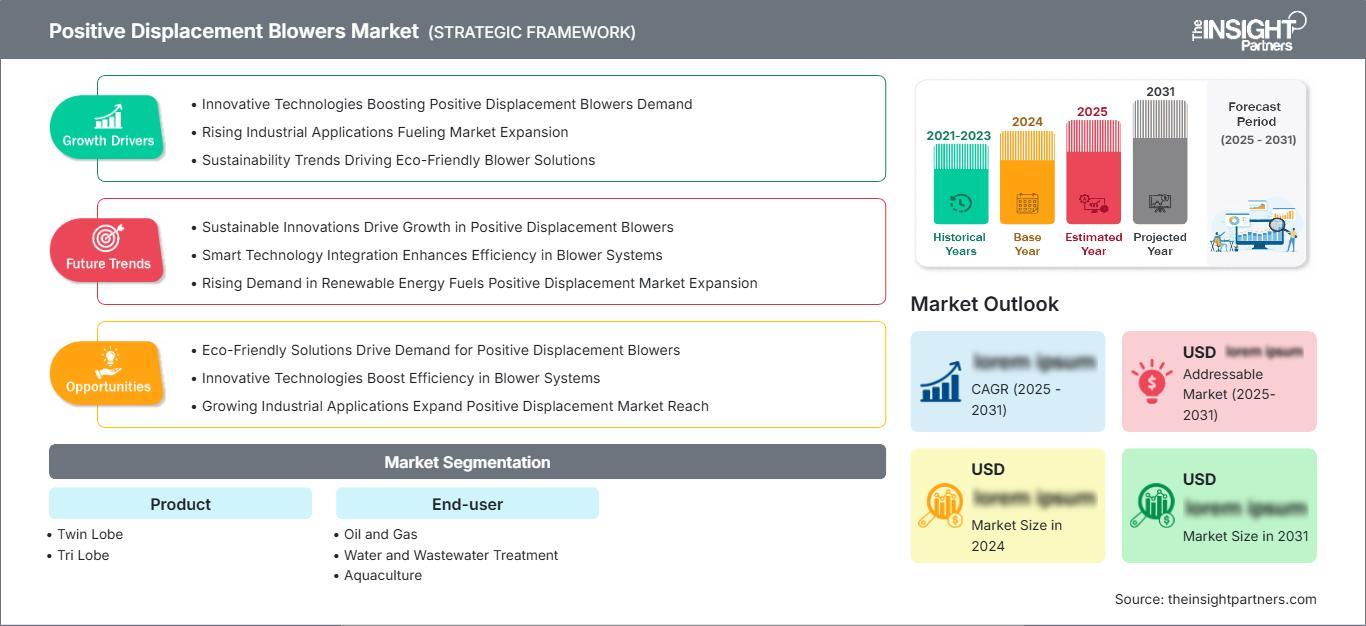
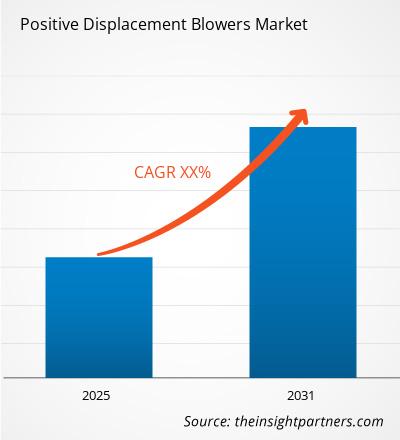
The positive displacement blowers market is projected to grow from US$ 3.09 Billion in 2025 to US$ 4.82 Billion by 2034, registering a CAGR of 5.06% during 2026–2034. These blowers deliver a fixed air or gas volume through rotary lobe action and are used across oil and gas, water and wastewater treatment, aquaculture, chemicals, and power generation applications requiring dependable low-pressure air movement.
In North America, the positive displacement blowers market size expansion is supported by wastewater aeration upgrades, industrial energy-efficiency programs, and the replacement of older pneumatic conveying systems. The region is expected to grow at a CAGR range of 4.6–5.2% during 2026–2034 as municipal utilities and process industries prioritize reliable air delivery, lower lifecycle cost, and digital monitoring for rotating equipment.
Positive Displacement Blowers Market Assessment and Insights
- North America: The region accounted for 26–29% share in 2025 and is projected to grow at a CAGR range of 4.6–5.2% during 2026–2034, supported by wastewater infrastructure investment and industrial retrofit demand.
- US: The U.S. represented 76–80% of North America demand in 2025 and is expected to grow at a CAGR range of 4.7–5.3% through 2034.
- Europe: Europe held 22–25% share in 2025 and is likely to expand at a CAGR range of 4.3–4.9%, led by Germany, the UK, France, Italy, and Spain.
- Asia Pacific: Asia Pacific accounted for 36–40% share in 2025 and is forecast to grow at 5.5–6.2% CAGR, with China, India, Japan, South Korea, and Australia leading adoption.
- Largest Segment: Twin Lobe held 53–57% market share in 2025 and is expected to grow at a 4.7–5.3% CAGR because of cost effectiveness, simple maintenance, and broad installed use.
- High Growth Segment: Tri Lobe held 43–47% share in 2025 and is projected to grow at 5.4–6.0% CAGR as users prefer lower pulsation, quieter operation, and higher efficiency.
- Key companies analyzed in detail: AERZEN Maschinenfabrik GmbH, AMCL Machinery Limited, BLOWVACC Transmission Private Limited, Eurus Blower, Inc., Gardner Denver, Greatech Machinery Industrial Co., Ltd., Howden Group, HR Blowers UK Ltd., KPT Blowers, and pdblowers, Inc.
Source: The Insight Partners' analysis based on proprietary research, government publications, company annual reports, investor presentations, industry databases, and expert interviews.
Technology evolution in the positive displacement blowers market is being shaped by energy optimization, noise reduction, oil-free air demand, and controls integration. The older twin lobe blowers are prevalent due to their reliability and cost-effectiveness, though the tri-lobe models are slowly being preferred due to their low vibrations and smooth delivery of air. There is an increased need for engineered systems, silencers, variable frequency drives, and condition monitoring in production.
Future demand will see the highest growth in the Asia-Pacific region, the Middle East, and North American municipalities where there is high retrofittable growth. Growth will be driven by wastewater treatment regulations, aquaculture growth, capacity expansions in chemicals, and maintenance in power plants. Future customers will look for manufacturers who are able to provide reliable blower stages with engineered systems and other added services.
Positive Displacement Blowers Market Report Scope
| Report Attribute | Details |
|---|---|
| Market size in 2025 | US$ 3.09 Billion |
| Market Size by 2034 | US$ 4.82 Billion |
| Global CAGR (2026 - 2034) | 5.06% |
| Historical Data | 2021-2024 |
| Forecast period | 2026-2034 |
Positive Displacement Blowers Market Analysis
The demand for these blowers is fueled by the requirement for consistent low-pressure air flow irrespective of pressure fluctuation in the system. The wastewater treatment facilities make use of such blowers for aeration and filter backwash, whereas industrial applications require them for pneumatic conveying, combustion air, gas boosters, and vacuum duty. The ecosystem comprises manufacturers of rotors, motors, package providers, distributors, servicing companies, and engineering firms.
Market study reveals that the supply decision is based upon factors including flow rate, pressure range, lubrication mechanism, noise control, size, serviceability, and total energy consumption. The trend towards lifecycle costing as opposed to initial cost in comparing the blower packages becomes increasingly more important. This gives an advantage to those blowers having efficient drive mechanisms, optimal inlet/outlet designs, and monitoring capabilities for predictive maintenance.
Competition is wide-ranging, including AERZEN Maschinenfabrik GmbH, Gardner Denver, Howden Group, Eurus Blower, Inc., AMCL Machinery Limited, KPT Blowers, HR Blowers UK Ltd., Greatech Machinery Industrial Co., Ltd., BLOWVACC Transmission Private Limited, and pdblowers, Inc.
Positioning strategies have moved towards package sales and value-adding services. In terms of global manufacturers, differentiation is based on engineering capability, digitization, and high-performance platforms, whereas regional players compete by means of customization, shorter delivery times, and local after-sales service. Tri lobe and hybrid technologies are also getting investments to minimize pulsation, noise, and energy consumption at continuous duty facilities.
● REPORT CUSTOMIZATION
Tailor This Report To Align With Your Specific Business Requirements
This report can be customized to align precisely with your business objectives, scope, and target markets. Customization options include tailored segmentation, geography, competitive analysis, and strategic insights to support informed decision-making.
Customize This Report →WHAT YOU CAN ADJUST
- ● Segmentations
- ● Geography
- ● Competitive Analysis
- ● Language Preferences
Positive Displacement Blowers Market: Strategic Insights
Regional Insights
North America positive displacement blowers market
North America held 26–29% positive displacement blowers market share in 2025 and is expected to grow at a CAGR range of 4.6–5.2% during 2026–2034. Demand is supported by municipal wastewater upgrades, food processing, chemicals, oil and gas services, and industrial retrofits where dependable airflow protects plant uptime.
Municipal aeration remains a major replacement driver because blower energy consumption is closely linked to treatment cost. Industrial users are also installing packaged systems with silencers, variable speed drives, and monitoring to reduce maintenance risk. Distributor networks and rental support improve adoption across mid-sized plants.
U.S. positive displacement blowers Market
The U.S. represented 76–80% of North America demand in 2025 and is projected to grow at a CAGR range of 4.7–5.3% during 2026–2034. Applications include wastewater aeration, pneumatic conveying, bulk transport, aquaculture, power plant service air, and chemical processing.
Gardner Denver, AERZEN Maschinenfabrik GmbH, Howden Group, and pdblowers, Inc. maintain strong channel presence through equipment packages, service support, and replacement components. U.S. buyers prioritize efficiency, noise control, and fast parts availability because downtime in municipal and industrial systems can quickly affect compliance and production.
Europe positive displacement blowers Market
Europe accounted for 22–25% share in 2025 and is forecast to grow at a CAGR range of 4.3–4.9%. Demand is generated through chemicals, wastewater treatment, food processing, and precision engineering in Germany, along with UK's replacement demand in utilities, manufacturing, and services.
France, Italy, and Spain contribute to the market through water treatment, aquaculture, cement, and process industries. Europeans place a strong focus on energy-efficient, noise-compliant, oil-free compressed air and compact packaged solutions. AERZEN Maschinenfabrik GmbH, Howden Group, HR Blowers UK Ltd., and Gardner Denver are some of the companies that benefit from the engineering and servicing network in the region.
APAC positive displacement blowers Market
APAC represented 36–40% share in 2025 and is expected to grow at a CAGR range of 5.5–6.2%. China leads adoption through wastewater investment, chemicals, cement, and manufacturing scale. India is expanding the use of effluent treatment, aquaculture, and industrial air systems.
Japan and South Korea support premium demand through process efficiency and low-noise plant requirements, while Australia adds mining, water, and aquaculture applications. Regional positive displacement blowers market trends include local package manufacturing, VFD integration, and stronger adoption of tri lobe systems.
Middle East & Africa positive displacement blowers Market
The Middle East and Africa are projected to grow at a CAGR range of 4.9–5.6% during 2026–2034. Saudi Arabia and the UAE lead demand through wastewater, desalination-linked utilities, petrochemicals, and industrial zones requiring reliable compressed air and gas movement.
South Africa and the rest of MEA contribute through mining, water treatment, power generation, and chemical processing. Growth is project-led, but aftermarket demand is improving as operators seek rugged packages capable of handling dust, heat, continuous duty, and limited maintenance windows.
Segmentation Analysis
Product
Product is expected to grow at a CAGR range of 4.9–5.5% during 2026–2034. The market scope includes twin lobe and tri lobe designs selected according to pressure requirement, noise tolerance, maintenance preference, airflow stability, and lifecycle cost. Product selection remains highly application-specific because wastewater aeration, pneumatic conveying, and gas boosting impose different operating profiles.
- Twin Lobe: Twin lobe blowers remain widely used because they offer durable construction, straightforward maintenance, and attractive cost for standard wastewater, conveying, aquaculture, and industrial air applications.
- Tri Lobe: Tri lobe blowers are gaining share where users require lower pulsation, quieter operation, smoother discharge flow, and improved performance in continuous-duty or noise-sensitive environments.
End-user
End-user is expected to grow at a CAGR range of 5.0–5.7%. Water and wastewater treatment provides the strongest revenue base because aeration systems require continuous airflow and measurable energy efficiency. Oil and gas, aquaculture, chemical, and power generation users add demand through gas movement, oxygen transfer, process air, and maintenance applications.
- Oil and Gas: Oil and gas users deploy blowers for vapor recovery, gas boosting, combustion support, and field services where reliability, sealing, and rugged operation matter under demanding conditions.
- Water and Wastewater Treatment: Water and wastewater treatment facilities rely on blowers for aeration and biological treatment, making energy efficiency, uptime, and control precision central procurement priorities.
- Aquaculture: Aquaculture operators use blowers to maintain dissolved oxygen and pond circulation, with demand linked to intensive fish farming, shrimp production, and reliable low-pressure air delivery.
- Chemical: Chemical plants require oil-free and controlled air or gas movement for conveying, oxidation, agitation, and process support across corrosive or safety-sensitive operating environments.
- Power Generation: Power generation users adopt blowers for combustion air, ash handling, vacuum systems, and auxiliary processes where stable airflow helps maintain plant availability.
Opportunity Snapshot
| End-user | Revenue Contribution | Trend Tag | Adoption Stage |
| Oil and Gas | Medium | Gas Boosting | Scaling |
| Water and Wastewater Treatment | High | Aeration Retrofit | Mature |
| Aquaculture | Medium | Oxygen Transfer | Scaling |
| Chemical | Medium | Process Air | Mature |
| Power Generation | Low | Ash Handling | Mature |
Positive Displacement Blowers Market Growth Drivers and Impact Analysis
Wastewater Aeration Modernization
The reason why wastewater treatment plants are installing upgraded aeration systems is due to biological treatment requiring a constant flow of oxygen and the fact that aeration consumes a large percentage of electrical power in the plant. Positive displacement blowers offer a constant flow of air in basins, filters and sludge systems where pressure will vary depending on the depth and state of diffusers. The engine drives create replacement demand for efficient packaged blowers that include silencers and variable drives.
Industrial Demand for Reliable Pneumatic Conveying
Facilities such as powder handling, granules, cement, chemicals, food products, and plastics utilize pneumatic conveyors, which require controlled airflow in order to move materials without being contaminated or overly degraded. Positive displacement blowers would be perfect for these applications due to their constant flow irrespective of changes in pressure. Due to industrial growth and automation, there is an increased need for blower systems, which come with silencing devices as well as filter systems specific to the intended application.
Rising Focus on Energy and Noise Performance
Energy efficiency, vibration, and noise have become crucial factors in the purchase decision for blowers. Old lobe machines might be reliable, but they may use extra energy and have higher noise levels compared to modern packages that offer optimization features. That is why users opt for triple-lobe designs, variable speed drives, refined rotor designs, improved pulsation reduction features, and noise enclosures. The key value proposition of this driver is that the reduced cost of operation can compensate for higher upfront costs.
Positive Displacement Blowers Market Future Trends
Smart Blower Packages with Predictive Monitoring
The positive displacement blowers market trends will increasingly emphasize connected packages that track vibration, temperature, pressure, airflow, and motor load. Operators want early warnings before bearing wear, filter blockage, belt issues, or process changes create failures. Predictive monitoring will be valuable in wastewater, chemicals, and power plants where continuous airflow is essential. Suppliers that integrate sensors, controls, and service analytics can shift from equipment supply toward reliability partnerships and longer-term maintenance agreements.
Higher Adoption of Tri Lobe and Hybrid Designs
Tri-lobe and hybrid blower designs will gain wider adoption as users seek lower pulsation, quieter operation, and improved efficiency without compromising ruggedness. These systems are likely to replace older twin lobe units in noise-sensitive plants, upgraded wastewater basins, and industrial conveying lines that require smoother flow. The trend will favor manufacturers offering broad product ranges, application engineering, and retrofit packages that help users justify replacement through energy savings and reduced mechanical stress.
Positive Displacement Blowers Market Opportunities
Retrofit Programs for Municipal Utilities
The Positive displacement blowers market forecasts indicate a strong opportunity in municipal retrofit programs where older aeration equipment is costly to operate and difficult to monitor. Vendors can offer packaged replacements combining blowers, motors, drives, silencers, and controls sized to existing basins. This approach reduces engineering complexity and shortens downtime. Utilities benefit from lower electricity use, improved process control, and easier maintenance planning. Suppliers with local service teams and financing support can capture multi-site replacement programs.
Packaged Solutions for Aquaculture Expansion
Aquaculture growth creates an opportunity for compact blower packages that maintain oxygen transfer in ponds, raceways, hatcheries, and recirculating systems. Farmers need reliable low-pressure air delivery because oxygen instability can quickly affect stock health and yield. Manufacturers can target this segment with corrosion-resistant packages, simple controls, low-noise operation, and service kits suited to remote sites. Demand will rise where seafood consumption, export farming, and intensive production systems increase the need for controlled aeration infrastructure.
Frequently Asked Questions

- Comprehensive Market Sizing and Forecast Analysis
- Detailed Segmentation Analysis
- In-Depth Market Dynamics Assessment
- Regional and Country-Level Insights
- Competitive Landscape and Company Benchmarking
- Strategic Business Intelligence
Recent Reports
Testimonials

The Insight Partners' SCADA System Market report is comprehensive, with valuable insights on current trends and future forecasts. The team was highly professional, responsive, and supportive throughout. We are very satisfied and highly recommend their services.
RAN KEDEM Partner, Reali Technologies LTDs
I requested a report on a very specific software market and the team produced the report in a few days. The information was very relevant and well presented. I then requested some changes and additions to the report. The team was again very responsive and I got the final report in less than a week.
JEAN-HERVE JENN Chairman, Future Analytica
We worked with The Insight Partners for an important market study and forecast. They gave us clear insights into opportunities and risks, which helped shape our plans. Their research was easy to use and based on solid data. It helped us make smart, confident decisions. We highly recommend them.
PIYUSH NAGPAL Sr. Vice President, High Beam Global
The Insight Partners delivered insightful, well-structured market research with strong domain expertise. Their team was professional and responsive throughout. The user-friendly website made accessing industry reports seamless. We highly recommend them for reliable, high-quality research services
YUKIHIKO ADACHI CEO, Deep Blue, LLC.
This is the first time I have purchased a market report from The Insight Partners.While I was unsure at first, I visited their web site and felt more comfortable to take the risk and purchase a market report.I am completely satisfied with the quality of the report and customer service. I had several questions and comments with the initial report, but after a couple of dialogs over email with their analyst I believe I have a report that I can use as input to our strategic planning process.Thank you so much for taking the extra time and making this a positive experience.I will definitely recommend your service to others and you will be my first call when we need further market data.
JOHN SUZUKI President and Chief Executive Officer, Board Director, BK Technologies
I wish to appreciate your support and the professionalism you displayed in the course of attending to my request for information regarding to infectious disease IVD market in Nigeria. I appreciate your patience, your guidance, and the fact that you were willing to offer a discount, which eventually made it possible for us to close a deal. I look forward to engaging The Insight Partners in the future, all thanks to the impression you have created in me as a result of this first encounter.
DR CHIJIOKE ONYIA MANAGING DIRECTOR, PineCrest Healthcare Ltd.Reason to Buy
- Informed Decision-Making
- Understanding Market Dynamics
- Competitive Analysis
- Identifying Emerging Markets
- Customer Insights
- Market Forecasts
- Risk Mitigation
- Boosting Operational Efficiency
- Strategic Planning
- Investment Justification
- Tracking Industry Innovations
- Aligning with Regulatory Trends





 Get Free Sample for