
Residential Boiler Market Demand, Size & Forecast by 2034
Coverage: By Fuel (Natural Gas, Oil, Others); Technology (Condensing, Non-Condensing) , and Geography (North America, Europe, Asia Pacific, and South and Central America)
- Status : Data Released
- Report Code : TIPRE00019476
- Category : Manufacturing and Construction
- No. of Pages : 150
- Available Report Formats :


- Last update date : September 21, 2026


2025 Market Size
US$ 86. Bn
Base year value
2034 Forecast
US$ 152.31 Bn
Projected by 2034
CAGR 2026-2034
6.56 %
Growth rate
Addressable Market
US$ 1,077.81 Bn
(2026-2034)
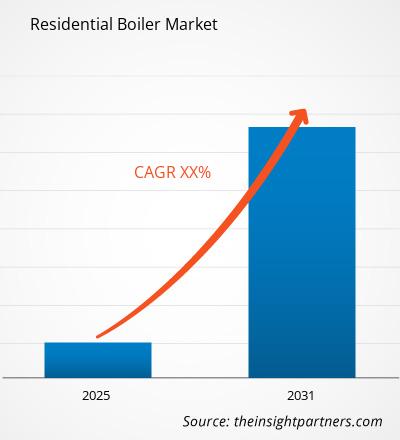
The residential boiler market is projected to expand from US$ 86.00 Billion in 2025 to US$ 152.31Billion by 2034, reflecting a CAGR of 6.56% during 2026–2034. The market covers residential heating equipment differentiated by fuel and technology, with replacement cycles, efficiency requirements, and household heating needs shaping demand. Condensing designs and established gas infrastructure remain important influences on purchasing decisions across mature and developing heating markets.
Across North America, residential boiler market size dynamics are supported by the replacement of aging heating equipment, cold-climate demand, and efficiency-focused building policies. The regional market is expected to grow at a CAGR of 8.4–8.8% from 2026–2034. Gas distribution networks, contractor familiarity, and demand for high-efficiency replacements provide structural support, while hybrid heating increasingly influences system selection.
Residential Boiler Market Assessment and Insights
- North America: North America accounted for a 2025 share of 28% and is expected to expand at a CAGR of 8.4–8.8% between 2026–2034, supported by replacement demand, cold-weather heating loads, and efficiency-led upgrades.
- US: The US represented 84% of North America in 2025 and is expected to grow at a CAGR of 8.6–9.0% between 2026–2034, led by replacement activity.
- Europe: Europe held a 2025 share of 36% and is projected to grow at a CAGR of 7.6–8.1% between 2026–2034, with Germany, the UK, Italy, France, and Spain shaping regional demand through renovation and efficiency requirements.
- Asia Pacific: Asia Pacific represented 26% of global demand in 2025 and is expected to grow at a CAGR of 8.5–9.2% between 2026–2034, led by China, Japan, South Korea, India, and Australia.
- Largest Segment: Natural Gas held a 2025 market share of 49–52% and is expected to grow at a CAGR of 6.2–6.7% during 2026–2034, supported by established distribution networks.
- High Growth Segment: Condensing technology held a 2025 market share of 58–61% and is expected to grow at a CAGR of 7.1–7.7% during 2026–2034, driven by efficiency priorities.
- Key companies analyzed in detail: A. O. Smith Corporation, Ariston Holding N.V., Bosch Thermotechnology Corp., Bradford White Corporation, Carrier Corporation, Lennox International Inc., NTI Boilers Inc., Viessmann Climate Solutions GmbH & Co. KG, Weil-McLain, WOLF GmbH.
Source: The Insight Partners' analysis based on proprietary research, government publications, company annual reports, investor presentations, industry databases, and expert interviews.
The residential boiler market has evolved from conventional heat-generation equipment toward higher-efficiency condensing architectures, compact wall-mounted formats, intelligent controls, and hybrid configurations. Modulation, higher-efficiency heat exchangers, lower emissions through advanced combustion, and remote diagnostics are becoming standard. In production, there is a transition to more standardized modular platforms using common parts across various heating capabilities to help manufacturers cope with localization needs and reduce time-to-market and installation training complexity.
Going forward, the uptake will depend on how the dynamics of the interplay of retrofit payback, fuel access, and decarbonization policy play out. New markets may provide demand through new urban construction and increasing household penetration of heating, whereas existing markets will focus on replacement and suitability for low-carbon solutions. Thus, the investment focus will be on adaptable platforms, installer networks, services, and technologies that can run in tandem with heat pumps or other energy sources.
Residential Boiler Market Report Scope
| Report Attribute | Details |
|---|---|
| Market size in 2025 | US$ 86. Billion |
| Market Size by 2034 | US$ 152.31 Billion |
| Global CAGR (2026 - 2034) | 6.56% |
| Historical Data | 2021-2024 |
| Forecast period | 2026-2034 |
Residential Boiler Market Analysis
Demand is increasingly replacement-led in mature housing stocks, while new residential construction adds selective volume in colder regions. The residential boiler market growth is reinforced by aging equipment, seasonal heating requirements, and consumer preference for predictable thermal performance. Value chains extend across combustion parts, heat exchangers, controls, pumps, valves, distributors, installers, and after-sales service providers. Dynamics of supply involve the use of steel, copper, electronics, castings, and burner components. The fuel is an essential aspect of the ecosystem as well. Natural gas has the advantage of the developed distribution network in North America and Europe, while oil is still significant for some retrofit markets, lacking the gas distribution network. Condensing boilers need proper flue installation and condensate disposal. Thus, manufacturers fight not only for equipment efficiency but also for ease of installation and serviceability of their products.
Competitive positioning centers on portfolio breadth, contractor relationships, technology depth, and the ability to combine boilers with heat pumps and controls. A. O. Smith Corporation, Bradford White Corporation, Carrier Corporation, and Lennox International Inc. provide strong North American channel reach, while Bosch Thermotechnology Corp., Ariston Holding N.V., Viessmann Climate Solutions GmbH & Co. KG, and WOLF GmbH emphasize European engineering and high-efficiency heating portfolios.
Investment in strategic resources tends to focus on hybrid solutions, low emissions combustion, connectivity and manufacturing flexibility. While NTI Boilers Inc. and Weil-McLain are specialists in hydronics technology, Bosch, Viessmann, Ariston and WOLF are specialists in system integration. Competitive pressure is also influenced by the availability of installers, replacement times, regulations and retrofit economics. Scale enhances the efficiency of purchasing, but service network density is crucial for differentiation.
● REPORT CUSTOMIZATION
Tailor This Report To Align With Your Specific Business Requirements
This report can be customized to align precisely with your business objectives, scope, and target markets. Customization options include tailored segmentation, geography, competitive analysis, and strategic insights to support informed decision-making.
Customize This Report →WHAT YOU CAN ADJUST
- ● Segmentations
- ● Geography
- ● Competitive Analysis
- ● Language Preferences
Residential Boiler Market: Strategic Insights

Regional Insights
North America residential boiler market
North America held a 28% share of the residential boiler market in 2025 and is expected to grow at a CAGR of 8.4–8.8% through 2034. The region has an extensive base of hydronic heaters installed, particularly in the Northeast, Midwest, and Canada. The focus on replacement continues to be important due to the homeowner preference for fuel infrastructure, reliability in winter conditions, and efficiency of the heating system. Standards and utilities' programs promote upgrading to the condensing boilers.
The U.S. represents 84% of demand, while Canada is the key secondary market in the region. The availability of distribution channels, contractor expertise, and wholesalers facilitates replacement cycles. Home renovation offers the opportunity for new equipment installation, taking into account the current construction of buildings rather than the old heating load. The manufacturers focus on the marketing of boilers as part of the home comfort systems that include controls, heat pumps, storage tanks, and domestic water heaters. The residential boiler market share remains concentrated in mature cold-weather applications.
U.S. residential boiler Market
The US represented 84% of North American demand in 2025 and is projected to expand at a CAGR of 8.6–9.0% through 2034, according to the residential boiler market report. The demand occurs in colder regions, especially in the Northeast and Midwest regions, where hydronic heating systems are already in use. Replacement purchases make up the bulk of the purchases, and the contractors are looking for items that will match their venting, piping, and distribution systems while increasing seasonal efficiencies.
A. O. Smith Corporation, Bradford White Corporation, Carrier Corporation, Lennox International Inc., NTI Boilers Inc., and Weil-McLain operate in various segments of the supply chain, while Bosch Thermotechnology Corp. and Viessmann Climate Solutions GmbH & Co. KG are competing through system efficiencies. The applications involve condensing boilers, modulating controls, compact systems, and hybrid-ready systems. Home renovations and equipment breakdowns are more significant than the fast penetration of new housing markets.
Europe residential boiler Market
Europe represented a 36% share of the residential boiler market in 2025 and is expected to grow at a CAGR of 7.6–8.1% through 2034. Germany remains a leading national market, while the UK, Italy, France, and Spain contribute substantial replacement and renovation demand. The regional trajectory is shaped by efficiency rules, building renovation, fuel-price sensitivity, and competition from electrified heating.
The UK still matters because of its large installed base and need for replacement, even though the policy direction is toward low-carbon heating. Germany is characterized by a large installed base and heavy decarbonization pressure, so hybrid solutions and efficient replacements are vital. France, Italy, and Spain demonstrate distinct adoption patterns due to differences in climate, building types, gas infrastructure, and incentives. European manufacturers thus focus on flexible heating platforms, control systems, and integration with low-carbon technologies. Germany is the leader for these reasons.
APAC residential boiler Market
Asia Pacific held a 26% share of the residential boiler market in 2025 and is expected to grow at a CAGR of 8.5–9.2% through 2034. China dominates the regional demand market, but Japan, South Korea, India, and Australia have unique growth opportunities. Factors like urbanization, residential construction, heating requirements for cold weather, and efficiency upgrades will favor acceptance.
China enjoys the advantage of extensive housing and infrastructure eco-systems; Japan and South Korea rely on compact and efficient heating technologies; India provides a select growth opportunity for increased household comfort demands; and Australia continues with replacement and efficiency. The industrial policy and appliance standards guide technology selection. There is increased competition among local players and international brands using localized products and heating systems.
Middle East & Africa residential boiler Market
The Middle East and Africa are expected to grow at a CAGR of 4.5–5.2% through 2034, with Saudi Arabia and the UAE representing important demand centers and South Africa anchoring southern African adoption. Energy-intensive housing, hospitality-related residential construction, and infrastructure construction result in selective heating equipment opportunities.
Saudi Arabia dominates the region due to the construction and high-end residential construction taking place, while the UAE stands out due to high specification construction taking place. South Africa has a retrofitting-focused country profile, whereas the rest of MEA is fragmented due to different climatic conditions and income levels. Availability of gas and oil impacts the choice of product, while efficiency and electrification impact premium installation. Growth is limited only to places where hot water systems can be installed.
Segmentation Analysis
Fuel
Fuel remains a central purchasing criterion because residential heating economics depend on availability, infrastructure, storage requirements, and operating cost. The segment is expected to grow at a CAGR of 6.2–6.7% from 2026–2034. Natural gas retains structural advantages in connected markets, while oil remains relevant where distribution networks or retrofit constraints limit alternatives. The residential boiler market scope therefore, varies substantially by local fuel infrastructure.
- Natural Gas: Natural gas remains the largest fuel category, supported by established pipelines, familiar installer practices, and efficient combustion equipment. Replacement demand sustains its importance across mature residential heating markets.
- Oil: Oil continues to serve homes outside gas networks and selected retrofit applications. Demand is concentrated where existing storage, burners, and hydronic distribution make replacement with comparable equipment economically practical.
Technology
Technology increasingly determines lifecycle economics, installation compliance, and fuel utilization. The segment is expected to grow at a CAGR of 6.9–7.5% from 2026–2034. Condensing systems gain preference where efficiency standards and fuel savings justify higher upfront costs, while non-condensing products retain relevance in replacement situations with technical or budget constraints.
- Condensing: Condensing boilers capture additional heat from flue gases, improving seasonal efficiency. Their strategic importance is increasing as homeowners and installers prioritize fuel savings, lower emissions, and compliance with tightening efficiency requirements.
- Non-Condensing: Non-condensing boilers remain relevant in legacy replacement environments where venting, condensate drainage, system design, or upfront budget constraints limit adoption of newer architectures.
Opportunity Snapshot
| Fuel Type | Revenue Contribution (High/Medium/Low) | Trend Tag (Max 2 Words) | Adoption Stage |
|---|---|---|---|
| Natural Gas | High | Gas Retrofit | Mature |
| Oil | Medium | Oil Replacement | Mature |
Residential Boiler Market Growth Drivers and Impact Analysis
Replacement of aging residential heating equipment
A large installed base of older boilers creates recurring replacement demand because equipment failures, declining efficiency, spare-parts availability, and changing household requirements eventually force purchasing decisions. Replacement projects are particularly attractive when homeowners can retain existing radiators, pipework, and distribution arrangements while upgrading the heat generator. This favors manufacturers with compatible footprints, broad capacity ranges, and strong installer support. The impact extends beyond unit sales because replacement activity creates opportunities for controls, pumps, valves, flue components, and service contracts. Contractors also influence technology selection, making channel education a meaningful competitive lever. As renovation continues, manufacturers that simplify retrofit design and reduce installation disruption can capture demand even where consumers remain cautious about major expenditures.
Efficiency regulation and household operating-cost pressure
Boiler designs will now be more influenced by efficiency due to the fact that both regulators and consumers measure boilers according to their efficiency, emissions, and costs, rather than just the capacity of heat generated in a single cycle. Condensing boilers are favored in this aspect because they make use of the heat that would normally go to waste through flue gas emissions in traditional boilers. Efficiency-related utility programs, renovation programs, and government efficiency standards can speed up the replacement process if the economics are clear. This has an especially strong effect on countries where the demand for heat or fuel prices is very high.
Expansion of hybrid and connected home heating systems
Hybrid heating is acting as a transitional solution between traditional boilers and fully electrified solutions. A boiler can perform as a source for peak-load or backup heating, whereas a heat pump performs at lower temperature conditions. This way, a system is able to reduce reliance on a particular technology and also enable consumers to gradually invest in hybrid systems. Smart thermostats, remote diagnostics, and automatic controls also help with better integration by taking into account weather conditions, occupancy level, and the price of energy. It will have a huge impact on the business side as the companies will be able to sell integrated systems, rather than separate boilers. Hybrid systems are opening up a lot of retrofitting opportunities in places where a full conversion into a heat pump is not feasible.
Residential Boiler Market Future Trends
Digital commissioning and predictive service ecosystems
The residential boiler market trends are moving toward digital commissioning, remote diagnostics, and predictive service models that reduce installation errors and improve lifecycle management. Future systems will increasingly transmit operating data through connected controls, allowing technicians to identify abnormal cycling, pressure changes, temperature deviations, and component deterioration before breakdown. Manufacturers can use this information to optimize maintenance schedules and parts availability while contractors improve first-time fix rates. Digital commissioning will also become important as boilers integrate with heat pumps, smart thermostats, thermal storage, and dynamic electricity tariffs. Competitive advantage will shift from hardware efficiency alone toward software quality, installer interfaces, cybersecurity, and service ecosystems. These capabilities can create recurring revenue opportunities while improving customer experience and equipment reliability.
Low-carbon fuels and hydrogen-ready combustion platforms
Future product development will increasingly examine combustion platforms capable of operating with lower-carbon gases, including hydrogen blends where infrastructure and regulation permit. Manufacturers are likely to prioritize burner flexibility, materials compatibility, flame-control algorithms, and safety certification so products can adapt to evolving fuel standards without complete equipment replacement. This direction does not imply uniform hydrogen adoption because infrastructure readiness, policy, fuel economics, and appliance standards differ by country. Instead, manufacturers are likely to develop modular architectures that preserve optionality across gas pathways. For investors and buyers, the strategic question will be whether platforms can accommodate future fuel changes while maintaining serviceability and competitive lifecycle costs. Such flexibility can protect installed-base value and reduce technology obsolescence.
Residential Boiler Market Opportunities
Retrofit packages for difficult-to-electrify homes
The residential boiler market scope is expanding around retrofit packages designed for homes where full electrification is constrained by building-envelope limitations, electrical capacity, hydronic distribution, or homeowner economics. Suppliers can develop standardized packages combining high-efficiency boilers, weather-compensating controls, pumps, thermostats, and optional heat-pump interfaces. Such solutions reduce design complexity for installers and allow households to improve efficiency without replacing every heating component. The opportunity is strongest in older detached and multifamily properties where renovation decisions are fragmented and downtime must be minimized. Manufacturers that provide packaged sizing tools, financing support, installer training, and lifecycle calculations can improve conversion rates. Partnerships with utilities, distributors, housing renovators, and property managers can widen access to replacement projects while creating repeatable routes to market.
Regional manufacturing and installer-network localization
Residential boiler market forecasts indicate that localized manufacturing and service ecosystems can become important competitive assets as demand fragments across regulatory regimes and building types. Producing selected components closer to end markets can reduce logistics exposure, improve responsiveness, and support regional product certification. Equally important, expanding installer networks can address the practical constraint that technically superior equipment may not be selected if trained contractors are unavailable. Companies can invest in regional training centers, digital sizing platforms, technical helplines, and distributor inventory programs to strengthen channel conversion. In emerging markets, localized assembly can support price-sensitive segments without sacrificing core safety and efficiency specifications. Strategic localization should combine production, certification, technical support, and after-sales coverage rather than treating manufacturing expansion as an isolated cost-reduction initiative.
Frequently Asked Questions

- Comprehensive Market Sizing and Forecast Analysis
- Detailed Segmentation Analysis
- In-Depth Market Dynamics Assessment
- Regional and Country-Level Insights
- Competitive Landscape and Company Benchmarking
- Strategic Business Intelligence
Recent Reports
Testimonials

The Insight Partners provided valuable market intelligence that supported our global go-to-market strategy. Their team was professional, responsive, and attentive to our feedback, providing thoughtful analysis and helpful methodological clarifications throughout the project.
Junmo Kim Chief Financial Officer (CFO), Enertech Co., Ltd.
The Insight Partners' SCADA System Market report is comprehensive, with valuable insights on current trends and future forecasts. The team was highly professional, responsive, and supportive throughout. We are very satisfied and highly recommend their services.
RAN KEDEM Partner, Reali Technologies LTDs
I requested a report on a very specific software market and the team produced the report in a few days. The information was very relevant and well presented. I then requested some changes and additions to the report. The team was again very responsive and I got the final report in less than a week.
JEAN-HERVE JENN Chairman, Future Analytica
We worked with The Insight Partners for an important market study and forecast. They gave us clear insights into opportunities and risks, which helped shape our plans. Their research was easy to use and based on solid data. It helped us make smart, confident decisions. We highly recommend them.
PIYUSH NAGPAL Sr. Vice President, High Beam Global
The Insight Partners delivered insightful, well-structured market research with strong domain expertise. Their team was professional and responsive throughout. The user-friendly website made accessing industry reports seamless. We highly recommend them for reliable, high-quality research services
YUKIHIKO ADACHI CEO, Deep Blue, LLC.
This is the first time I have purchased a market report from The Insight Partners.While I was unsure at first, I visited their web site and felt more comfortable to take the risk and purchase a market report.I am completely satisfied with the quality of the report and customer service. I had several questions and comments with the initial report, but after a couple of dialogs over email with their analyst I believe I have a report that I can use as input to our strategic planning process.Thank you so much for taking the extra time and making this a positive experience.I will definitely recommend your service to others and you will be my first call when we need further market data.
JOHN SUZUKI President and Chief Executive Officer, Board Director, BK Technologies
I wish to appreciate your support and the professionalism you displayed in the course of attending to my request for information regarding to infectious disease IVD market in Nigeria. I appreciate your patience, your guidance, and the fact that you were willing to offer a discount, which eventually made it possible for us to close a deal. I look forward to engaging The Insight Partners in the future, all thanks to the impression you have created in me as a result of this first encounter.
DR CHIJIOKE ONYIA MANAGING DIRECTOR, PineCrest Healthcare Ltd.Reason to Buy
- Informed Decision-Making
- Understanding Market Dynamics
- Competitive Analysis
- Identifying Emerging Markets
- Customer Insights
- Market Forecasts
- Risk Mitigation
- Boosting Operational Efficiency
- Strategic Planning
- Investment Justification
- Tracking Industry Innovations
- Aligning with Regulatory Trends





 Get Free Sample for