
Wood Chippers Market Size, Trends & Growth by 2034
Coverage: By Type (High-Torque Roller, Drum Chipper, Disc Chipper, Screw Chipper); Product Type (Electric Driven, PTO Driven, Gasoline Engine, Diesel Engine); Verticals (Construction, Timber Factory, Sawmill, Furniture Factory, Others) , and Geography (North America, Europe, Asia Pacific, and South and Central America)
- Status : Data Released
- Report Code : TIPMC00002534
- Category : Manufacturing and Construction
- No. of Pages : 150
- Available Report Formats :


- Last update date : September 30, 2026


2025 Market Size
US$ 392.24 Mn
Base year value
2034 Forecast
US$ 536.42 Mn
Projected by 2034
CAGR 2026-2034
3.54 %
Growth rate
Addressable Market
US$ 4,217.80 Mn
(2026-2034)
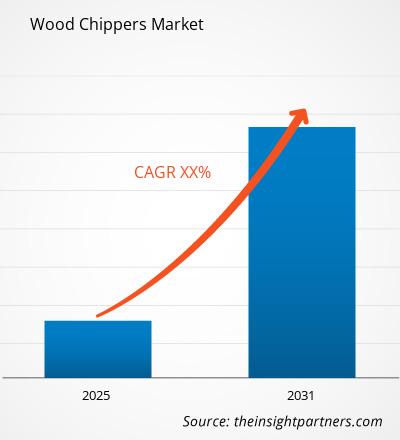
The wood chippers market is valued at US$ 392.24 Million in 2025 and is projected to reach US$ 536.42 Million by 2034, registering a CAGR of 3.54% during 2026–2034. The market encompasses equipment used to reduce branches, logs, brush, and woody residues into chips for landscaping, biomass handling, forestry operations, sawmills, and manufacturing applications, with purchasing decisions increasingly shaped by throughput, mobility, maintenance, safety, and fuel configuration.
North America is expected to record an estimated 3.7–4.5% CAGR through 2034, supported by municipal storm-debris programs, commercial tree-care activity, land clearing, and established biomass logistics. The wood chippers market size is also influenced by replacement demand, tighter operator-safety practices, contractor preference for transportable machines, and growing interest in equipment that can convert low-value woody residues into saleable mulch or fuel feedstock.
Wood Chippers Market Assessment and Insights
- North America: North America is estimated to account for 31–35% wood chippers market share in 2025 and is projected to expand at a 3.7–4.5% CAGR between 2026–2034, supported by arboriculture, municipal debris management, land clearing, and mature equipment distribution networks.
- US: The US is estimated to represent 68–73% of North America's 2025 share, with a projected 3.8–4.6% CAGR between 2026–2034, reflecting replacement demand, storm recovery, landscaping, and commercial forestry applications.
- Europe: Europe is estimated to hold 26–30% share in 2025 and grow at a 3.2–4.0% CAGR between 2026–2034, led by Germany, the UK, France, Italy, and Spain, where biomass utilization and professional arboriculture support equipment demand.
- Asia Pacific: Asia Pacific is estimated at 24–28% share in 2025, with a 4.0–4.9% CAGR between 2026–2034. China, Japan, India, South Korea, and Australia are key markets as mechanized forestry, sawmilling, and biomass utilization expand.
- Largest Segment: The Drum Chipper segment is estimated to command 34–38% market share in 2025, advancing at a 3.8–4.5% CAGR between 2026–2034, supported by high-throughput commercial processing.
- High Growth Segment: Electric Driven equipment is estimated at 9–13% share in 2025, with a 6.0–7.5% CAGR between 2026–2034, benefiting from low-emission urban and professional tree-care applications.
- Key companies analyzed in detail: Avant Tecno Oy; Caravaggi S.r.l.; EMB MFG Inc.; UNTHA shredding technology GmbH; ZANON S.r.l.; Terex Corporation; Salsco, Inc.; Changzhou LEFA Industry Co., Ltd.; Trelan Manufacturing Corporation; Timberwolf Ltd.; Vermeer Corporation; Bandit Industries, Inc.; GreenMech Ltd.; and Morbark, LLC.
Source: The Insight Partners' analysis based on proprietary research, government publications, company annual reports, investor presentations, industry databases, and expert interviews.
The wood chippers market is moving away from mechanical cutters and towards application-oriented machines which integrate controlled feeding, advanced rotor design, hydraulics, mobility, and maintainability. Differentiation will occur in terms of chips quality, feed rate, weight-to-power ratio, discharge management, and longevity of parts. Economies of production will change as contractors look for machines which streamline their operations and generate maximum output from branches, logs, and debris.
In the coming years, the wood chippers market is set to experience robust growth thanks to investments in compact equipment, electric power, telematics solutions, and decentralized biomass equipment. Emerging market segments include Asia-Pacific and certain Latin American nations due to increasing mechanization of forestry and wood processing activities. In addition, the need for efficient use of wood residues in Europe will result from sustainability measures, and replacement cycles in North America will fuel demand for highly productive equipment.
Wood Chippers Market Report Scope
| Report Attribute | Details |
|---|---|
| Market size in 2025 | US$ 392.24 Million |
| Market Size by 2034 | US$ 536.42 Million |
| Global CAGR (2026 - 2034) | 3.54% |
| Historical Data | 2021-2024 |
| Forecast period | 2026-2034 |
Wood Chippers Market Analysis
Wood chippers market growth is driven by the growing need for processing wood debris near its place of origin. Tree trimming services, landscaping firms, cities, logging businesses, and saw mills require chippers to reduce the size of raw materials and decrease the need for transportation. Therefore, the demand is related to logging, urban tree maintenance, post-storm cleanup, clearing of rights-of-way, and preparation for construction sites. Manufacturers of wood chippers operate within an ecosystem that includes engine manufacturers, suppliers of hydraulic components, cutting tool makers, dealers, maintenance service providers, and biomass consumers. Selection of machinery depends on feed size, expected daily throughput, requirements for chips, mobility, source of power, and maintenance capability.
Current supply trends increasingly favor the use of flexible equipment platform capable of performing various tasks with minimal modification. Roller systems focus on controlled feeding, whereas drum and disc setups target different requirements of daily capacity and chip quality. Power take-off driven chipper continues to be popular among agricultural and contracting business, because power is supplied by a tractor already owned. Diesel and gas powered machines prevail in mobile applications, while electric models are becoming more prominent in the case of noise or emission concerns or indoors/outdoors requirements.
The wood chipper forecast reveals that the industry will operate in an intensely competitive environment characterized by machinery manufacturers, arboricultural products manufacturers, local equipment manufacturers, and industrial corporations. Terex Corporation will be competing with its highly capacity process equipment and material processing capability, while Timberwolf Ltd. has a dominant presence in professional arboriculture. Vermeer Corporation and Bandit Industries, Inc. have focused on forestry, tree care, and clearing equipment. Avant Tecno Oy and Caravaggi S.r.l. are focused on compact and specialized uses, while ZANON S.r.l. and EMB MFG Inc. offer their services in agricultural, municipal, and material processing needs.
The current investment emphasis is placed on engine efficiency, ergonomics for the operator, durability of the components, digitalization, and portability of the product. The importance of having efficient distribution and service channels has also increased due to the relationship between uptime and economics of the contractor. As a result, competitive positioning of the equipment will move away from equipment cost towards total cost of ownership, servicing capability, residual value, fuel consumption, maintenance frequency, and performance in different conditions.
● REPORT CUSTOMIZATION
Tailor This Report To Align With Your Specific Business Requirements
This report can be customized to align precisely with your business objectives, scope, and target markets. Customization options include tailored segmentation, geography, competitive analysis, and strategic insights to support informed decision-making.
Customize This Report →WHAT YOU CAN ADJUST
- ● Segmentations
- ● Geography
- ● Competitive Analysis
- ● Language Preferences
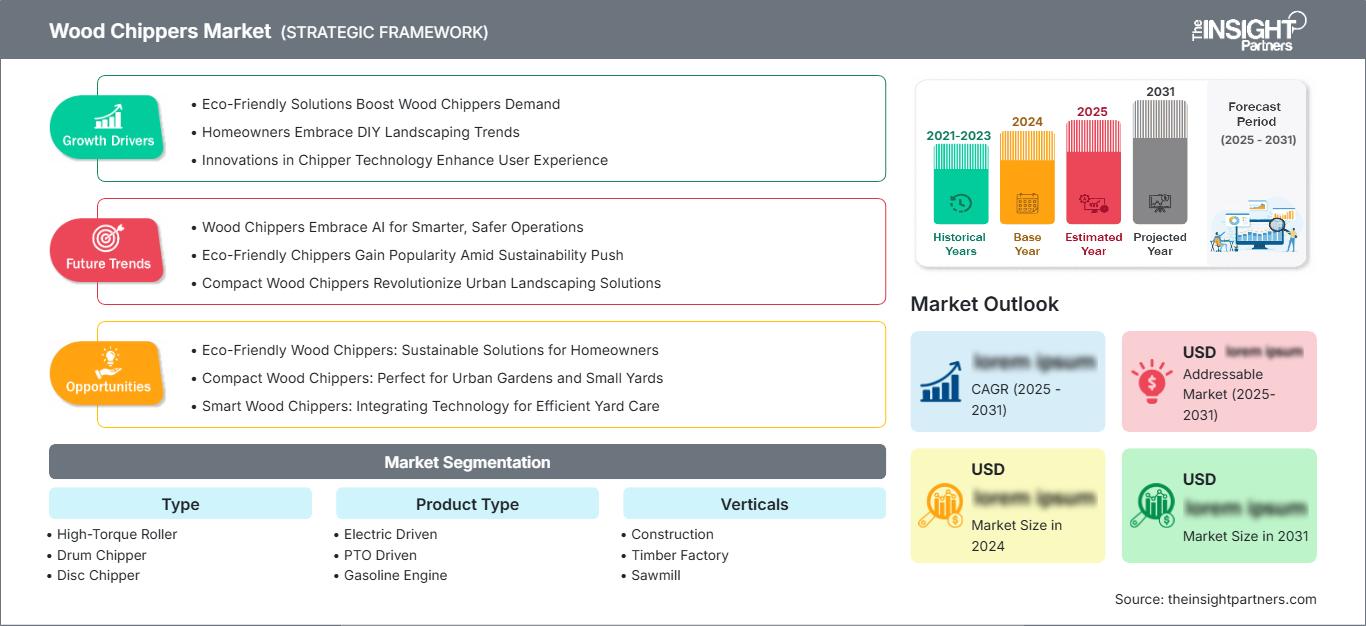
Wood Chippers Market: Strategic Insights
Regional Insights
North America wood chippers market
North America is estimated to represent 31–35% share in 2025 and is projected to expand at a 3.7–4.5% CAGR through 2034. There is the presence of an advanced commercial tree care industry, foresting, municipal vegetation management, and periodic storm damage cleanup and recovery operations. American tree care professionals increasingly look for machines that allow quick relocation between various sites while the Canadians need machines adapted for forestry applications, clearing operations, and remote operation conditions. Additionally, dealer presence and financing mechanisms are helpful for replacement purchases.
The wood chippers market forecast shows that other factors driving the local demand include safety considerations, availability of labor, and cost of transporting raw wood material. High capacity drum and disc machines are critical for commercial users, while compact chippers are utilized by arborists and landscaping businesses. The municipalities and utility contractors are other segments of the market demand. The regional market is stable as replacement demand helps balance low periods of investment in new equipment while storm damage clean-up and land management activities provide periods of increased utilization.
U.S. wood chippers market
The US accounts for an estimated 68–73% of North America's 2025 share and is projected to grow at a 3.8–4.6% CAGR through 2034. Demands will be met by means of arboriculture, landscaping, utility vegetation management, construction clearing, forestry operations, and municipal storm response operations. There will be an advantage created through a wide distribution network of dealerships and equipment rental services available in the market.
The current trends in the application of chippers show preference for those which will offer mobility in tandem with larger feed capacity. In terms of equipment evaluation, contractors assess their performance on the basis of labor productivity, fuel consumption, accessibility of maintenance, and chip discharge capability. Companies like Terex Corporation, Timberwolf Ltd., Vermeer Corporation, Bandit Industries, Inc., Salsco, Inc., and others will be exposed to various elements of the professional equipment environment. Issues of safety are of great importance for the purchase of chippers due to the training and guarding needs as well as chip discharge capabilities.
Europe wood chippers market
Europe is estimated to hold 26–30% share in 2025 and is expected to expand at a 3.2–4.0% CAGR through 2034. This market has been created by professional arboriculture, forestry management, landscaping, sawmilling, biomass usage, and increasing requirements on the performance and emissions of equipment. Germany is one of the strongest markets due to its well-developed forestry, woodworking, and machinery industry, including demand for compact contractor machines and large processing equipment.
The United Kingdom has good demand among arborists, landscaping contractors, local authorities, and vegetation management companies where towable and reliable equipment is preferred. The French market comprises forestry, agricultural, municipal, and landscaping applications resulting in high demand for tractor-mounted and dedicated equipment. The Italian equipment manufacturing industry is developed enough for forestry, agricultural, and landscaping applications, while in Spain, there is demand due to forestry management, municipal vegetation control, and land clearing. Germany is supposed to become the leading European country due to its industrial sector and professional users' network.
APAC wood chippers market
APAC is estimated to account for 24–28% share in 2025 and is projected to grow at a 4.0–4.9% CAGR through 2034. China is a good market because of the increase in manufacturing and forestry-processing capabilities. Japan and South Korea favor smaller and more compact machinery, whereas India holds the longer-term promise of mechanization in forestry, saw-milling, landscaping, and biomass operations.
There are good demands for land clearing, arboricultural, and forestry machinery in Australia. In the region, developments in industry, landscaping, agriculture, and waste utilization could expand the application of equipment. Local manufacturing and pricing are significant, especially in developing countries, but experienced buyers want better durability and performance.
Middle East & Africa wood chippers market
Middle East and Africa is estimated to represent the remaining global share and is expected to expand at approximately 2.8–3.7% CAGR through 2034. Saudi Arabia and the UAE are supported by urban landscaping, infrastructure development, municipal vegetation programs, and large-scale environmental projects. South Africa has comparatively established forestry, landscaping, and timber-processing activity.
Outside the UAE, demand will be more driven by projects, and centered on municipalities, construction firms, plantations, and landscapers. Diversification of energy sources and interest in useful biomass residues can help in some of these applications, but water availability, operational conditions, costs of imports, and after-sales service are key factors influencing procurement. Saudi Arabia will continue to be a major market in the region due to urban landscaping needs.
Segmentation Analysis
Type
Type is a central determinant of throughput, chip consistency, maintenance requirements, and suitability for different feedstocks. The segment is projected to expand at a 3.4–4.2% CAGR from 2026–2034, with commercial buyers increasingly selecting equipment according to feed diameter, daily utilization, transport requirements, and desired chip characteristics. The wood chippers market scope across type categories therefore remains broad.
- High-Torque Roller: High-torque roller systems provide controlled material feeding and are strategically important where operators process irregular branches, mixed woody residues, or demanding feedstocks requiring consistent movement into the cutting mechanism.
- Drum Chipper: Drum chippers are positioned strongly in high-throughput operations because their rotating cutting configuration supports continuous processing and efficient handling of substantial material volumes in forestry and commercial land-clearing environments.
- Disc Chipper: Disc chippers remain important where uniform chip production, robust cutting performance, and dependable operation are priorities. They serve forestry, sawmill, biomass, and municipal applications requiring repeatable processing.
- Screw Chipper: Screw chippers address specialized processing requirements and can provide controlled material movement through the cutting zone. Their strategic role is strongest where application-specific feed handling and compact configurations are valued.
Product Type
Product Type is projected to expand at a 3.8–4.8% CAGR from 2026–2034, reflecting differences in operating environment, available power infrastructure, mobility requirements, and emissions considerations. Buyers increasingly compare lifetime operating economics rather than initial purchase price, particularly in professional fleets.
- Electric Driven: Electric-driven machines are gaining attention in noise-sensitive and emission-constrained environments. They are particularly relevant for urban tree care, facilities with available electrical infrastructure, and applications where predictable operating costs matter.
- PTO Driven: PTO-driven equipment remains strategically relevant for agricultural and mixed-use contractors because tractors can provide the required power source. This configuration can reduce the need for a separate engine platform.
- Gasoline Engine: Gasoline-powered equipment remains suitable for compact and mobile applications where relatively simple refueling, transportability, and accessible equipment design are valued by smaller contractors and landscaping operators.
- Diesel Engine: Diesel engines remain important for high-utilization commercial equipment because they support sustained power output and demanding forestry or land-clearing operations where machine uptime and fuel efficiency are major procurement considerations.
Verticals
Verticals is expected to register a 3.5–4.4% CAGR from 2026–2034, with adoption determined by feedstock availability, utilization rates, operating scale, and the downstream value of processed chips. The segment illustrates how the wood chippers market connects equipment investment with material recovery and production efficiency.
- Construction: Construction companies use chippers during site preparation, vegetation removal, and land clearing. Equipment mobility and rapid processing are strategically important because clearing activities often occur before subsequent construction phases.
- Timber Factory: Timber factories require reliable material-processing equipment that can handle production residues and support internal material flow. Chipping can improve residue handling while creating useful secondary material streams.
- Sawmill: Sawmills generate branches, slabs, bark, and other woody residues that require efficient handling. Chippers support residue conversion and can improve plant logistics where chip output has a defined downstream use.
- Furniture Factory: Furniture factories generally handle smaller volumes than large forestry operations but can benefit from compact systems for wood-residue management. Equipment selection depends on residue characteristics, available space, and reuse opportunities.
Opportunity Snapshot
| Verticals | Revenue Contribution (High/Medium/Low) | Trend Tag | Adoption Stage |
|---|---|---|---|
| Construction | High | Site Clearing | Scaling |
| Timber Factory | High | Residue Processing | Mature |
| Sawmill | High | Chip Recovery | Mature |
| Furniture Factory | Medium | Shop Residues | Emerging |
Wood Chippers Market Growth Drivers and Impact Analysis
Rising Need for Distributed Woody-Residue Processing
Increasing volumes of branches, logs, storm debris, and forestry residues are encouraging operators to process material closer to its source. Transportation of unprocessed woody material can consume considerable truck capacity because low-density residues occupy substantial physical volume before size reduction. Chippers therefore provide an operational bridge between vegetation removal and downstream material utilization. Municipalities can reduce debris stockpiles after storms, contractors can improve site productivity, and forestry operators can prepare material for biomass or industrial users. The impact is strongest where transportation distances are long or disposal costs are rising. Equipment manufacturers can capture this demand by developing machines with high feed capacity, efficient discharge systems, and flexible chip sizing. Such features directly influence utilization rates and the economics of decentralized residue management.
Expansion of Professional Arboriculture and Vegetation Management
Urban tree populations, utility corridors, commercial landscaping programs, and municipal vegetation management create recurring requirements for mobile processing equipment. Professional contractors increasingly need machines that can move between jobsites, operate efficiently within constrained spaces, and process branches without requiring extensive manual handling. This favors compact and mid-sized equipment alongside larger production systems. The impact extends across the equipment ecosystem because higher utilization encourages fleet replacement, rental demand, preventive maintenance, and aftermarket parts consumption. Manufacturers that improve feed ergonomics, transport dimensions, discharge control, and operator visibility can strengthen their position among professional users. Service accessibility is equally important because contractors often measure equipment value through productive hours rather than nominal machine specifications. The resulting procurement pattern supports dependable machines with predictable maintenance requirements and strong dealer coverage.
Stronger Focus on Equipment Efficiency and Operator Safety
Safety and efficiency are becoming increasingly interconnected in equipment purchasing decisions. Controlled feeding, accessible emergency controls, guarding, maintenance access, and operator training can reduce operational interruptions while supporting safer work practices. Buyers are also examining fuel consumption, hydraulic efficiency, cutting-tool life, and service intervals because these factors influence total ownership cost. The effect is particularly relevant for fleet operators managing several machines across geographically dispersed jobsites. Manufacturers are responding through improved machine layouts, easier inspection points, more durable components, and increasingly sophisticated monitoring systems. Electric and lower-emission configurations may gain additional traction in urban applications where noise and exhaust considerations are important. As procurement becomes more lifecycle-oriented, manufacturers able to demonstrate dependable productivity, serviceability, and safety-oriented engineering can differentiate themselves without relying solely on purchase-price competition.
Wood Chippers Market Future Trends
Electrification and Low-Noise Equipment Platforms
The wood chippers market trends are expected to increasingly include electric powertrains for applications where emissions, noise, and local operating restrictions influence equipment selection. Early adoption is likely to concentrate on compact professional machines rather than the largest forestry platforms because smaller equipment requires less stored energy and can operate closer to buildings, residential areas, parks, and urban streets. Battery technology, charging infrastructure, and duty-cycle management will determine the pace of adoption. Hybrid architectures may provide an intermediate pathway for contractors that require longer operating periods but also want reduced idling and lower local emissions. Manufacturers are likely to emphasize interchangeable battery systems, simplified maintenance, regenerative functions, and intelligent power management. Over time, electric models could become more competitive where operating hours are predictable and charging access is integrated into fleet scheduling.
Connected Fleet Management and Predictive Maintenance
Digital connectivity is expected to move from premium functionality toward a more practical fleet-management tool. Sensors can monitor engine performance, operating hours, fuel or energy consumption, hydraulic conditions, temperature, vibration, and service requirements. For contractors managing multiple machines, this information can improve maintenance scheduling and reduce unexpected downtime. Manufacturers can also use aggregated operating data to understand component performance and refine future designs. Remote diagnostics may become particularly valuable in regions with limited specialist technicians because service teams can identify probable issues before travelling to a jobsite. Telematics can additionally support rental companies by improving utilization tracking and maintenance planning. The next phase of development is likely to combine equipment data with automated service alerts, digital inspection records, parts planning, and operator-performance information, creating a stronger link between machine design and lifecycle economics.
Wood Chippers Market Opportunities
Compact Professional Equipment for Urban Contractors
A significant opportunity exists in compact machines designed for arborists, landscaping businesses, municipalities, and vegetation-management contractors working in densely populated environments. These customers often value maneuverability, transport flexibility, low noise, simple controls, and reliable processing more than maximum industrial throughput. Product developers can target this segment through lightweight frames, compact turning dimensions, rapid setup, improved discharge control, and electric or low-emission power options. Leasing and rental models could further reduce acquisition barriers for smaller contractors with variable workloads. Manufacturers can also create differentiated packages combining the chipper with trailers, collection systems, maintenance plans, and operator training. The opportunity is attractive because compact professional equipment can address frequent jobsite requirements while allowing manufacturers to broaden their customer base beyond large forestry and industrial operators.
Integrated Biomass and Residue-Recovery Solutions
Another opportunity lies in connecting chipping equipment with downstream biomass, mulch, landscaping, and material-recovery systems. Instead of treating wood residues solely as disposal material, operators can design processing chains that classify, transport, store, and deliver chips according to end-user requirements. Equipment manufacturers can support this shift through adjustable chip sizing, improved discharge systems, conveyors, screening compatibility, and digital monitoring. Partnerships with biomass users, sawmills, landscaping suppliers, municipalities, and waste-management contractors could create more stable demand for processed material. Investment in integrated systems may be particularly attractive where transport distances are high and residue volumes are concentrated. Suppliers that understand the complete material flow can differentiate themselves by reducing handling steps rather than selling an isolated machine, improving the economic value generated from each processing cycle.
Frequently Asked Questions

- Comprehensive Market Sizing and Forecast Analysis
- Detailed Segmentation Analysis
- In-Depth Market Dynamics Assessment
- Regional and Country-Level Insights
- Competitive Landscape and Company Benchmarking
- Strategic Business Intelligence
Recent Reports
Testimonials

The Insight Partners provided valuable market intelligence that supported our global go-to-market strategy. Their team was professional, responsive, and attentive to our feedback, providing thoughtful analysis and helpful methodological clarifications throughout the project.
Junmo Kim Chief Financial Officer (CFO), Enertech Co., Ltd.
The Insight Partners' SCADA System Market report is comprehensive, with valuable insights on current trends and future forecasts. The team was highly professional, responsive, and supportive throughout. We are very satisfied and highly recommend their services.
RAN KEDEM Partner, Reali Technologies LTDs
I requested a report on a very specific software market and the team produced the report in a few days. The information was very relevant and well presented. I then requested some changes and additions to the report. The team was again very responsive and I got the final report in less than a week.
JEAN-HERVE JENN Chairman, Future Analytica
We worked with The Insight Partners for an important market study and forecast. They gave us clear insights into opportunities and risks, which helped shape our plans. Their research was easy to use and based on solid data. It helped us make smart, confident decisions. We highly recommend them.
PIYUSH NAGPAL Sr. Vice President, High Beam Global
The Insight Partners delivered insightful, well-structured market research with strong domain expertise. Their team was professional and responsive throughout. The user-friendly website made accessing industry reports seamless. We highly recommend them for reliable, high-quality research services
YUKIHIKO ADACHI CEO, Deep Blue, LLC.
This is the first time I have purchased a market report from The Insight Partners.While I was unsure at first, I visited their web site and felt more comfortable to take the risk and purchase a market report.I am completely satisfied with the quality of the report and customer service. I had several questions and comments with the initial report, but after a couple of dialogs over email with their analyst I believe I have a report that I can use as input to our strategic planning process.Thank you so much for taking the extra time and making this a positive experience.I will definitely recommend your service to others and you will be my first call when we need further market data.
JOHN SUZUKI President and Chief Executive Officer, Board Director, BK Technologies
I wish to appreciate your support and the professionalism you displayed in the course of attending to my request for information regarding to infectious disease IVD market in Nigeria. I appreciate your patience, your guidance, and the fact that you were willing to offer a discount, which eventually made it possible for us to close a deal. I look forward to engaging The Insight Partners in the future, all thanks to the impression you have created in me as a result of this first encounter.
DR CHIJIOKE ONYIA MANAGING DIRECTOR, PineCrest Healthcare Ltd.Reason to Buy
- Informed Decision-Making
- Understanding Market Dynamics
- Competitive Analysis
- Identifying Emerging Markets
- Customer Insights
- Market Forecasts
- Risk Mitigation
- Boosting Operational Efficiency
- Strategic Planning
- Investment Justification
- Tracking Industry Innovations
- Aligning with Regulatory Trends





 Get Free Sample for