
Abrasive Blasting Nozzle Market Trends, Size & Growth by 2034
Coverage: By Type (Venturi Nozzle, Straight Bore Nozzle, Wide Throat Nozzle, Others); Material (Steel Tips, Ceramic Tips, Carbide Tips); Bore Size (5/16 Inch, 3/8 Inch, 7/16 Inch, Others); End-user (Automotive, Construction, Marine, Others), and Geography (North America, Europe, Asia Pacific, and South and Central America)
- Status : Data Released
- Report Code : TIPRE00014549
- Category : Manufacturing and Construction
- No. of Pages : 150
- Available Report Formats :


- Last update date : July 10, 2026


2025 Market Size
US$ 331.57 Mn
Base year value
2034 Forecast
US$ 532.32 Mn
Projected by 2034
CAGR 2026-2034
5.40 %
Growth rate
Addressable Market
US$ 3,917.58 Mn
(2026-2034)
The Abrasive Blasting Nozzle market size is forecast to reach USD 532.32 Million by 2034, up from USD 331.57 Million in 2025. The market is estimated to record a CAGR of 5.40% for the period 2026–2034. Abrasive Blasting Nozzles remain essential consumables in surface preparation systems for cleaning, de-coating, corrosion protection, and finishing applications.
According to the Abrasive Blasting Nozzle market report, North America is projected to grow at a 4.8-5.2% CAGR during 2026–2034, driven by industrial maintenance budgets, shipyard renovation, and the requirement for safe and durable blasting consumables. Demand for replacing wear-prone nozzles in aerospace, metal fabrication, infrastructure repairs, and coating preparation provides regular revenue opportunities. In addition, North America gets an edge from its distributors, safety-focused procurement strategies, and usage of carbide and venturi types.
Abrasive Blasting Nozzle Market Assessment and Insights
- North America: Share in 2025 is estimated at 31–34%, growing at a CAGR between 2026–2034 of 4.8–5.2%, driven by high replacement demand in shipyards, fabrication shops, bridges, and heavy equipment maintenance.
- US: Share in 2025 is estimated at 75–79% of North America, growing at a CAGR between 2026–2034 of 4.7–5.1%, supported by aerospace MRO, marine repair, and industrial coating contractors.
- Europe: Share in 2025 is estimated at 24–27%, growing at a CAGR between 2026–2034 of 4.4–4.8%, with Germany, the UK, France, Italy, and Spain leading demand through manufacturing and marine maintenance.
- Asia Pacific: Abrasive Blasting Nozzle market Share in 2025 is estimated at 29–32%, growing at a CAGR between 2026–2034 of 6.0–6.5%, led by China, India, Japan, South Korea, and Australia across shipbuilding, construction, and metalworking.
- Largest Segment: Venturi Nozzle held a market share of 43–47% in 2025 and is projected to grow at a CAGR range of 5.2–5.6% during 2026–2034 due to productivity gains.
- High Growth Segment: Carbide Tips held a market share of 38–42% in 2025 and are projected to grow at a CAGR range of 6.1–6.6% during 2026–2034 as buyers prioritize wear life.
- Key companies analyzed in detail: Airblast B.V., BlastOne International, Burwell Technologies Pty Ltd., Clemco Industries Corp., Elcometer Limited, Everblast Inc., Kennametal Inc., Manus Abrasive Systems Inc., NLB Corporation, Sponge-Jet Inc.
Source: The Insight Partners' analysis based on proprietary research, government publications, company annual reports, investor presentations, industry databases, and expert interviews.
The Abrasive Blasting Nozzle Market has transformed from basic steel nozzle outlets into specialized engineering of venturi-type, carbide-lined, and custom-designed nozzles to minimize abrasive loss and regulate velocity. The manufacturing process is moving towards the development of accurate machining, robust liners, and distributor-led customizations, since nozzle wear directly affects compressor performance and surface uniformity. Manufacturers market their products based on life-cycle costs rather than individual costs, whereas buyers evaluate nozzle geometry, bore diameter, and material composition against productivity, safety, and longevity.
Future trends would be determined by the creation of new ship repair centers, infrastructure rebuilding, and high demand for coating quality in the energy and transportation industries, and in fabricated assets. Investment will probably go into carbide nozzles, dust-managed blasting, and robotic or semi-automatic cabinets compatible with nozzles. Government infrastructure projects, the need for fleet maintenance, and industrial safety regulations will expand abrasive blasting nozzle applications from manual blasting to surface-preparation-based productivity measurement.
Abrasive Blasting Nozzle Market Report Scope
| Report Attribute | Details |
|---|---|
| Market size in 2025 | US$ 331.57 Million |
| Market Size by 2034 | US$ 532.32 Million |
| Global CAGR (2026 - 2034) | 5.40% |
| Historical Data | 2021-2024 |
| Forecast period | 2026-2034 |
Abrasive Blasting Nozzle Market Analysis
Carbide, ceramic, and steel tip manufacturers, nozzle manufacturers, industrial distributors, equipment rental firms, coating contractors, and end users comprise the value chain. An analysis of the abrasive blasting nozzle market indicates that availability, threading compatibility, bore size, and technical support are key factors in purchase decisions. Fragmentation characterizes supply, but specialization offers a competitive advantage for specific applications requiring liners, bent nozzles, wet blasting, or restricted-access cleaning.
The competitive environment in the abrasive blasting nozzle market comprises specialty blasting brands and diversified wear-part makers. Kennametal Inc. relies on its carbide wear know-how, while Clemco Industries Corp., Airblast B.V., BlastOne International, Elcometer Limited, and Sponge-Jet Inc. offer nozzles as part of their larger blasting machinery line. Burwell Technologies Pty Ltd., Everblast Inc., Manus Abrasive Systems Inc., and NLB Corporation enhance geographic proximity and applicability.
Material investment is expected to include components that extend maintenance intervals and shapes that boost operator efficiency. Training, nozzle assessment, and total operational costs have been gaining importance among distributors, as a worn-out bore can increase compressor load and lead to wasteful abrasive consumption. Strategic positioning will be dictated by distribution network reach, availability of spare parts, and servicing for automobile refinishing, bridge repair, marine paint, and construction equipment.
● REPORT CUSTOMIZATION
Tailor This Report To Align With Your Specific Business Requirements
This report can be customized to align precisely with your business objectives, scope, and target markets. Customization options include tailored segmentation, geography, competitive analysis, and strategic insights to support informed decision-making.
Customize This Report →WHAT YOU CAN ADJUST
- ● Segmentations
- ● Geography
- ● Competitive Analysis
- ● Language Preferences
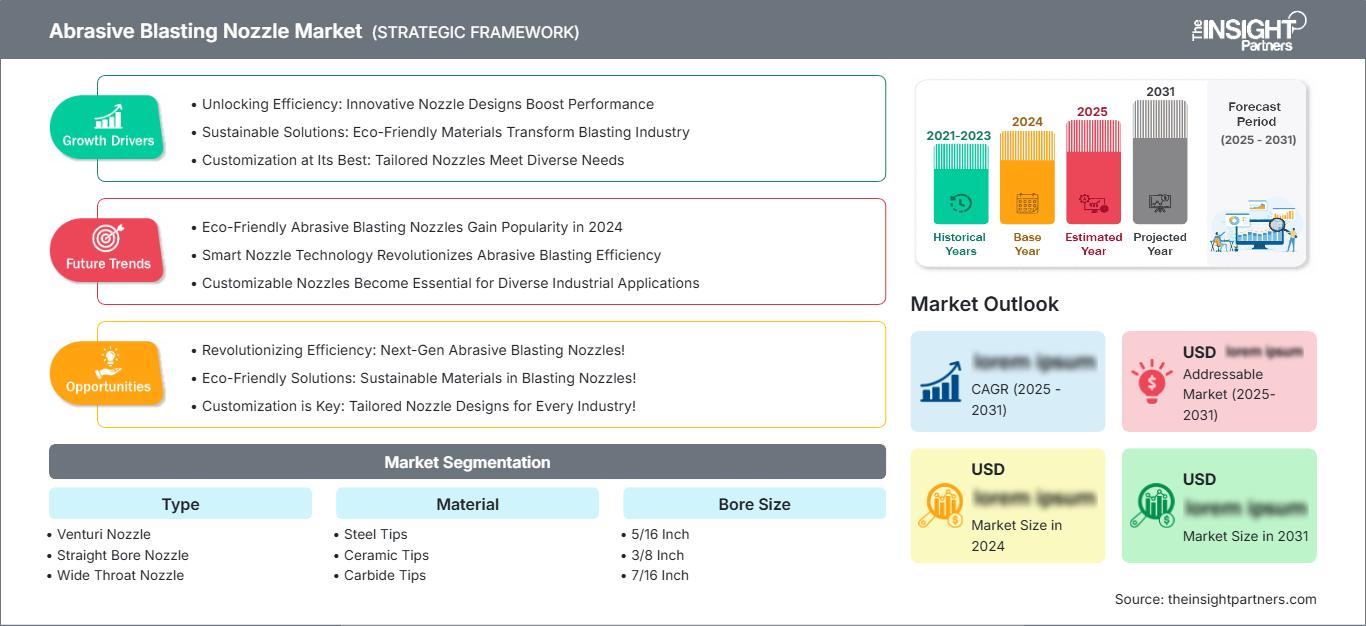
Abrasive Blasting Nozzle Market: Strategic Insights
Regional Insights
North America abrasive blasting nozzle
The North American abrasive blasting nozzle market accounted for 31-34% of the share in 2025 and is forecast to grow at a 4.8-5.2% CAGR from 2026 to 2034. Industrial maintenance, bridge restoration, ship repairs, rail equipment maintenance, and coating preparation for heavy machinery make up the key demand applications. In June 2025, according to IATA, 30,300 commercial aircraft were in service.
Efficiency, safety, and reliability are among the factors customers in the region consider when it comes to replacement. For large areas, venturi nozzles remain preferred, while demand for carbide tips is increasing due to hourly operating costs among contractors. Safety procedures, including OSHA regulations, also ensure a stable demand for abrasive blasting nozzles.
U.S. abrasive blasting nozzle Market
The U.S. represented 75–79% of North America in 2025 and is projected to expand at a 4.7–5.1% CAGR from 2026 to 2034. The country’s demand base includes shipyards, defense maintenance, aircraft component repair, refinery turnaround activity, road equipment refurbishment, and bridge coating projects. Company presence is reinforced by national distributors and technical service networks.
In terms of application trends, there is increased use of long venturi, wet-blast, and carbide-lined nozzles, as contractors seek uniformity of the anchor pattern and reduced downtime. The US abrasive blasting nozzle market finds favor due to its repair-oriented nature and existing stock of blasting machines. The purchase decision is now made considering the nozzle's longevity, compressor efficiency, and ease of operation, apart from the initial cost.
Europe abrasive blasting nozzle Market
The abrasive blasting nozzle Market in Europe accounted for a 24–27% share in 2025 and is anticipated to grow at a 4.4–4.8% CAGR until 2034. The UK market is driven by maritime repairs, offshore services, railway maintenance, and coating of infrastructures, where there is a need for durable nozzles that ensure a reduction in wastage of abrasives and quality surface preparation.
Germany dominates the abrasive blasting nozzle market in Europe owing to the presence of the machinery, automotive, metalworking, and coating industries. Buyers' needs include engineered carbide and ceramic nozzles that help maintain dimensional accuracy with increased use. The differentiation among suppliers is based on the quality of materials, technical documentation, and suitability for blasting in automation/enclosures.
France, Italy, and Spain bring additional demand for ship repair, maintenance of construction equipment, aerospace parts, and infrastructure upgrades. Environmental regulations and requirements concerning worker safety increase demand for wet blasting and dust management systems. Thus, trends in abrasive blasting nozzles in Europe will be oriented towards lifecycle efficiency, productivity, and compliance.
APAC abrasive blasting nozzle Market
The abrasive blasting nozzle market in APAC accounted for 29–32% share in 2025 and is forecast to grow at a 6.0–6.5% CAGR, the fastest regional pace. China leads due to shipbuilding, steel fabrication, construction machinery, and industrial repair.
Japan and South Korea provide support in shipyards, automotive manufacturing, and metal finishing, all of which require dimensionally consistent components and clean surfaces. India is making its way through infrastructure construction and rail equipment repairs.
Australia brings expertise in mining equipment maintenance and marine coatings application. Infrastructure development driven by policies, manufacturing of incentives, and coating contractors makes the area of abrasive blasting nozzle sizing attractive.
Middle East & Africa abrasive blasting nozzle Market
The abrasive blasting nozzle market in Middle East & Africa is projected to grow at a 5.3–5.8% CAGR during 2026–2034. Saudi Arabia is the leading country, supported by oil and gas asset integrity, desalination plants, and industrial construction.
The UAE contributes through marine repair, ports, fabrication yards, and offshore maintenance. South Africa adds mining equipment refurbishment, infrastructure renewal, and general industrial blasting demand.
Rest of MEA demand is tied to pipeline coatings, storage tanks, and construction steelwork. Energy Institute guidance on external protective coatings reinforces the role of surface preparation in asset integrity programs.
Segmentation Analysis
Type
Type is projected to grow at a 5.1–5.5% CAGR during 2026–2034. Selection is driven by blast pattern, stand-off distance, surface area, and compressor capacity. Venturi designs dominate broad surface cleaning, while straight bore and wide throat products serve precision, access, and high-throughput needs. Buyers increasingly match nozzle type with abrasive media and coating specification.
- Venturi Nozzle delivers high velocity and wider blast patterns, making it the preferred choice for ship hulls, tanks, bridges, and large fabricated structures where productivity determines contractor margins.
- Straight Bore Nozzle supports focused cleaning in confined areas, weld seams, corners, and small components, giving contractors better control where broad patterns would waste abrasive or damage adjacent surfaces.
- Wide Throat Nozzle improves abrasive-air flow and supports higher production blasting, particularly when paired with adequate compressor capacity and larger hoses in construction, marine, and fabrication environments.
Material
Material is expected to advance at a 5.4–5.9% CAGR during 2026–2034. Tip material determines wear rate, bore stability, nozzle weight, and suitability for aggressive abrasives. Carbide tips gain preference for high-duty environments, ceramic tips support cost-sensitive applications, and steel tips remain relevant where impact resistance and lower initial cost are priorities.
- Steel Tips are used where affordability, availability, and rugged handling matter, particularly in intermittent construction tasks and lower-duty workshops that replace components based on project cycles.
- Ceramic Tips serve medium-duty blasting and controlled environments, offering a balance between cost and wear resistance for maintenance shops, cabinet blasting, and less abrasive media combinations.
- Carbide Tips provide longer wear life and stable bore geometry, making them strategically important for shipyards, bridge contractors, and high-utilization industrial coating operations.
Bore Size
Bore Size is projected to grow at a 5.0–5.4% CAGR during 2026–2034. Bore selection affects abrasive volume, air demand, cleaning rate, and operating pressure. Contractors choose sizes by balancing available compressor capacity with target productivity, surface profile needs, and mobility. Regular bore inspection is increasingly important because wear increases air consumption and reduces blasting efficiency.
- 5/16 Inch bores are suited to moderate air capacity and controlled cleaning, making them practical for maintenance workshops, automotive parts, and localized corrosion removal.
- 3/8 Inch bores balance productivity and compressor requirements, supporting broad adoption among contractors handling structural steel, construction machinery, tanks, and general fabrication work.
- 7/16 Inch bores are used for high-production blasting where large compressors, skilled operators, and heavy-duty hoses support rapid surface preparation on extensive assets.
End-user
End-user demand is expected to grow at a 5.2–5.7% CAGR during 2026–2034. Automotive, construction, and marine users apply nozzles differently, but all prioritize surface cleanliness, coating adhesion, and operating uptime. Replacement demand is strongest where abrasive blasting is embedded in scheduled maintenance, repair, refurbishment, or production workflows, making end-user mix central to abrasive blasting nozzle trends.
- Automotive demand comes from restoration, refinishing, component cleaning, and paint removal, where precision nozzles help avoid substrate damage while improving coating preparation consistency.
- Construction users rely on blasting nozzles for steel structures, bridges, equipment refurbishment, and concrete surface preparation, making product durability important for jobsite efficiency.
- Marine end users require robust nozzles for hull cleaning, ship repair, offshore structures, and corrosion removal, where salt exposure and coating standards create recurring replacement needs.
Opportunity Snapshot
| Segment Name | Revenue Contribution | Trend Tag | Adoption Stage |
| Automotive | Medium | Refinish Prep | Mature |
| Construction | High | Bridge Rehab | Scaling |
| Marine | High | Hull Renewal | Mature |
Abrasive Blasting Nozzle Market Growth Drivers and Impact Analysis
Infrastructure Rehabilitation and Coating Renewal
Owners of infrastructure are making their structures more durable by prolonging the lifespan of bridges, tanks, rail assets, ports, and public works, which results in higher need for surface preparation before coating with protective materials. According to World Steel Association statistics, steel remains vital for infrastructure and industrial assets, whereas corrosion protection requires proper surface cleaning before coating. Such a trend leads to higher replacement sales volumes due to nozzle deterioration, affecting profile performance, cleaning speed, and the amount of abrasives used. The market effect is a rise in repeat purchasing from maintenance budgets.
Industrial Maintenance and Asset Integrity Programs
Producers of energy, marine, manufacturing, and transportation services are implementing asset integrity management programs to minimize downtime caused by corrosion. Pipelines, storage tanks, and offshore structures require continuous maintenance; therefore, nozzle use is a quantifiable factor in productivity. The Energy Institute’s coating application guidelines have placed emphasis on condition assessment and the implementation of repair campaigns for protective coatings; hence, increasing blasting activities. From an operational perspective, asset integrity programs shift surface preparation from repair to maintenance, thereby increasing market resilience for abrasive blasting nozzles.
Shift Toward High-Life Carbide and Engineered Designs
As the costs of labor, compressor power consumption, and abrasive media become more significant, users are transitioning from low-cost replacement to total cost of ownership. Special carbide-tipped nozzles, elongated venturis, and dedicated angle or wet-blast nozzles may minimize downtime and deliver high blast velocity. Supplier education on nozzle wear measurements is part of the equation because a larger bore requires more air, reducing efficiency. The result is a change in product mix towards premium items, particularly for marine and construction applications.
Abrasive Blasting Nozzle Market Future Trends
Nozzles Designed for Automated and Robotic Blasting
Automation is expected to be one of the significant Abrasive Blasting Nozzle market trends. It will affect nozzle design as enclosed booths, robotic armatures, and blasting cells become more popular in the manufacturing and maintenance industries. An automated process requires consistent wear, stable flow rates, consistent geometry, and the ability to fit fixtures or to use water-based dust suppression. This development will create a need for precision-machined nozzles that deliver consistent surface profiles over extended periods of time. Automation may also benefit those who provide technical services, as opposed to those who only sell their products from catalogs.
Dust Reduction and Wet Blasting Compatibility
The demands on health, safety, and the environment are driving surface preparation toward dust-managed systems, particularly in enclosed working areas, urban infrastructure construction, and maintenance yards. Nozzles suitable for wet blasting, water injection, and controlled abrasive feeding will be particularly useful when contractors need to minimize dust without compromising the coating’s readiness. The Abrasive Blasting Nozzle market forecast indicates that It will serve as an addition to the regulations protecting the operators and customer demands for cleaner construction sites. Companies that manufacture nozzles and seals, and provide advice on dust reduction systems, will profit from this.
Abrasive Blasting Nozzle Market Opportunities
Distributor-Led Nozzle Lifecycle Programs
Distribution opportunities include providing inspection gauges, replacement planning, operator training, and productivity evaluations, as well as the sale of nozzles. Contractors tend to overlook the hidden costs of running old nozzles, which include higher abrasive usage, slower cleaning, and inefficient compressors. The lifecycle program transforms the hidden costs into quantifiable buying arguments. Suppliers can offer carbide upgrades, bore-size selection, and application guidance for automotive, construction, and marine users. This distribution strategy is an asset for customer loyalty and margin improvements because consumers buy the assurance behind the product.
Emerging Market Ship Repair and Infrastructure Hubs
Asia-Pacific and Middle Eastern emerging markets are developing port and shipyard facilities, rail transportation networks, bridges, and industrial complexes. All these facilities require protective coatings and maintenance, thus presenting an extended runway for blasting consumables. There is potential to focus on distribution channels, rental fleets, and contractor education to foster early loyalty in such markets. Lifecycle cost savings will justify purchasing premium nozzles despite initial price objections that contractors may raise.
Recent Developments
- April 2026: Clemco Industries Corp. — Clemco International announced the HSP-200 Performance, a reengineered dust-free blasting system intended to improve mobility, productivity, and efficiency in demanding blasting environments. The development indicates continued investment in equipment platforms that influence nozzle utilization, dust control, and contractor productivity.
- June 2024: Kennametal Inc. — Blast Abrasives Supply highlighted the Kennametal Blast Ninja Pro quiet blast nozzle, a product positioned to reduce noise while supporting surface cleaning and profiling applications. The listing reflects supplier emphasis on operator conditions and specialized nozzle geometry for demanding abrasive blasting tasks.
- November 2024: Airblast B.V. — Airblast updated its abrasive blast nozzle portfolio page featuring boron carbide abrasive blast nozzles for industrial blasting applications. The update reinforces market movement toward long-life liner materials and product visibility for contractors comparing nozzle durability, weight, and replacement economics.
Frequently Asked Questions

- Comprehensive Market Sizing and Forecast Analysis
- Detailed Segmentation Analysis
- In-Depth Market Dynamics Assessment
- Regional and Country-Level Insights
- Competitive Landscape and Company Benchmarking
- Strategic Business Intelligence
Recent Reports
Testimonials

The Insight Partners provided valuable market intelligence that supported our global go-to-market strategy. Their team was professional, responsive, and attentive to our feedback, providing thoughtful analysis and helpful methodological clarifications throughout the project.
Junmo Kim Chief Financial Officer (CFO), Enertech Co., Ltd.
The Insight Partners' SCADA System Market report is comprehensive, with valuable insights on current trends and future forecasts. The team was highly professional, responsive, and supportive throughout. We are very satisfied and highly recommend their services.
RAN KEDEM Partner, Reali Technologies LTDs
I requested a report on a very specific software market and the team produced the report in a few days. The information was very relevant and well presented. I then requested some changes and additions to the report. The team was again very responsive and I got the final report in less than a week.
JEAN-HERVE JENN Chairman, Future Analytica
We worked with The Insight Partners for an important market study and forecast. They gave us clear insights into opportunities and risks, which helped shape our plans. Their research was easy to use and based on solid data. It helped us make smart, confident decisions. We highly recommend them.
PIYUSH NAGPAL Sr. Vice President, High Beam Global
The Insight Partners delivered insightful, well-structured market research with strong domain expertise. Their team was professional and responsive throughout. The user-friendly website made accessing industry reports seamless. We highly recommend them for reliable, high-quality research services
YUKIHIKO ADACHI CEO, Deep Blue, LLC.
This is the first time I have purchased a market report from The Insight Partners.While I was unsure at first, I visited their web site and felt more comfortable to take the risk and purchase a market report.I am completely satisfied with the quality of the report and customer service. I had several questions and comments with the initial report, but after a couple of dialogs over email with their analyst I believe I have a report that I can use as input to our strategic planning process.Thank you so much for taking the extra time and making this a positive experience.I will definitely recommend your service to others and you will be my first call when we need further market data.
JOHN SUZUKI President and Chief Executive Officer, Board Director, BK Technologies
I wish to appreciate your support and the professionalism you displayed in the course of attending to my request for information regarding to infectious disease IVD market in Nigeria. I appreciate your patience, your guidance, and the fact that you were willing to offer a discount, which eventually made it possible for us to close a deal. I look forward to engaging The Insight Partners in the future, all thanks to the impression you have created in me as a result of this first encounter.
DR CHIJIOKE ONYIA MANAGING DIRECTOR, PineCrest Healthcare Ltd.Reason to Buy
- Informed Decision-Making
- Understanding Market Dynamics
- Competitive Analysis
- Identifying Emerging Markets
- Customer Insights
- Market Forecasts
- Risk Mitigation
- Boosting Operational Efficiency
- Strategic Planning
- Investment Justification
- Tracking Industry Innovations
- Aligning with Regulatory Trends





 Get Free Sample for