
Access Control Terminal Market Size, Share, and Growth Analysis by 2034
Coverage: by Type (Discretionary Access Control (DAC) Terminal, Mandatory Access Control (MAC) Terminal, Role-Based Access Control (RBAC) Terminal); Application (Defense, Government, BFSI, Healthcare, Telecom, Others), and Geography (North America, Europe, Asia Pacific, and South and Central America)
- Status : Data Released
- Report Code : TIPRE00003641
- Category : Technology, Media and Telecommunications
- No. of Pages : 150
- Available Report Formats :


- Last update date : August 07, 2026


2025 Market Size
US$ 8.37 Bn
Base year value
2034 Forecast
US$ 17.44 Bn
Projected by 2034
CAGR 2026-2034
8.5 %
Growth rate
Addressable Market
US$ 115.80 Bn
(2026-2034)
The access control terminal market was valued at US$ 8.37 Billion in 2025 and is projected to reach US$ 17.44 Billion by 2034, expanding at a CAGR of 8.5% during 2026–2034. Rising emphasis on physical security modernization, integration of identity management systems, and expanding deployment of intelligent authentication technologies across public and private infrastructure continue to support market expansion. Organizations are increasingly implementing advanced credential verification platforms to improve security governance, operational efficiency, and compliance management across distributed facilities.
Across North America, demand remains supported by continued investment in critical infrastructure protection, enterprise security modernization, and hybrid workforce access management. The region benefits from a mature cybersecurity ecosystem, early adoption of biometric authentication systems, and regulatory focus on identity assurance. The access control terminal market size in North America is supported by expanding deployments within government agencies, healthcare institutions, and financial organizations, contributing to an estimated regional CAGR of 7.8–8.4% through the forecast period.
Access Control Terminal Market Assessment and Insights
- North America: Share in 2025 estimated at 36–40%, supported by large-scale enterprise security investments, critical infrastructure modernization, and biometric deployment initiatives. CAGR between 2026–2034: 7.8–8.4%.
- US: Represents approximately 75–79% of North American demand in 2025 due to advanced enterprise security spending and government modernization programs. CAGR between 2026–2034: 7.9–8.5%.
- Europe: Share in 2025 estimated at 25–29%, led by Germany, the UK, and France. Adoption is driven by compliance requirements, smart building deployments, and digital identity programs. CAGR between 2026–2034: 7.5–8.1%.
- Asia Pacific: Share in 2025 estimated at 24–28%, supported by China, Japan, India, South Korea, and Australia. Infrastructure digitization and urban expansion encourage deployment. CAGR between 2026–2034: 9.5–10.2%.
- Largest Segment: Role-Based Access Control Terminal holds a 42–46% market share in 2025 due to its suitability for enterprise-wide identity governance and policy management. CAGR between 2026–2034: 8.4–9.0%.
- High Growth Segment: Healthcare accounts for 13–17% share in 2025 and is projected to record a CAGR of 10.2–10.9% during 2026–2034 due to patient-data security requirements and facility access monitoring needs.
- Key companies analyzed in detail: Auconet GmbH, Avaya LLC, Cisco Systems, Inc., Extreme Networks, Inc., Forescout Technologies, Inc., Hewlett Packard Enterprise Company, Impulse Point LLC, Portnox Ltd., Pulse Secure LLC, SecureAuth Corporation, Zucchetti S.p.A.
Source: The Insight Partners' analysis based on proprietary research, government publications, company annual reports, investor presentations, industry databases, and expert interviews.
Enterprise security architectures are evolving from standalone physical access platforms toward integrated identity ecosystems that combine authentication, monitoring, analytics, and policy enforcement capabilities. Organizations increasingly seek unified solutions capable of supporting mobile credentials, biometric verification, and centralized administration across multiple facilities. Simultaneously, modernization of commercial real estate, industrial campuses, transportation hubs, and government buildings is creating sustained demand for advanced terminal technologies capable of supporting dynamic security requirements and network-connected operations.
Looking ahead, access control terminal market growth opportunities are expected to emerge across Southeast Asia, the Middle East, and selected African economies where infrastructure modernization initiatives continue to accelerate. Government-led digital transformation programs, investments in smart cities, and stricter regulatory frameworks related to facility security are expected to encourage broader deployment. Increasing convergence between physical security and cybersecurity disciplines will further strengthen adoption throughout the forecast period.
Access Control Terminal Market Report Scope
| Report Attribute | Details |
|---|---|
| Market size in 2025 | US$ 8.37 Billion |
| Market Size by 2034 | US$ 17.44 Billion |
| Global CAGR (2026 - 2034) | 8.5% |
| Historical Data | 2021-2024 |
| Forecast period | 2026-2034 |
Access Control Terminal Market Analysis
The access control terminal market growth trajectory is increasingly influenced by organizations adopting layered security frameworks to address evolving operational and cyber-physical threats. Across sectors such as government, defense, healthcare, and finance, access control terminals are becoming central components of security governance programs. Demand is supported by rising adoption of biometric authentication, contactless credentialing, and cloud-managed security environments. These developments enable organizations to strengthen security while improving user convenience and administrative efficiency.
Supply dynamics continue to benefit from advancements in semiconductor technologies, edge processing capabilities, artificial intelligence, and networked security platforms. Vendors are enhancing product compatibility with enterprise identity systems, workforce management platforms, and security information management solutions. As interoperability becomes increasingly important, value-chain participants are focusing on open architectures that facilitate integration across diverse security ecosystems.
The access control terminal market analysis indicates that competitive differentiation increasingly depends on software intelligence, identity orchestration capabilities, and centralized management tools rather than hardware performance alone. Companies are pursuing platform-based strategies that connect physical access management with broader cybersecurity frameworks. This shift is encouraging recurring revenue models and long-term customer engagement through subscription-based software and security services.
Key industry participants including Cisco Systems, Inc., Hewlett Packard Enterprise Company, Extreme Networks, Inc., Forescout Technologies, Inc., and Portnox Ltd. continue expanding portfolio capabilities through platform integration and security analytics enhancements. Meanwhile, Auconet GmbH, SecureAuth Corporation, Pulse Secure LLC, Impulse Point LLC, Avaya LLC, and Zucchetti S.p.A. are strengthening specialized offerings focused on identity governance, authentication workflows, and enterprise access administration. Strategic investments are increasingly directed toward cloud deployment models and AI-assisted access management functionalities.
● REPORT CUSTOMIZATION
Tailor This Report To Align With Your Specific Business Requirements
This report can be customized to align precisely with your business objectives, scope, and target markets. Customization options include tailored segmentation, geography, competitive analysis, and strategic insights to support informed decision-making.
Customize This Report →WHAT YOU CAN ADJUST
- ● Segmentations
- ● Geography
- ● Competitive Analysis
- ● Language Preferences
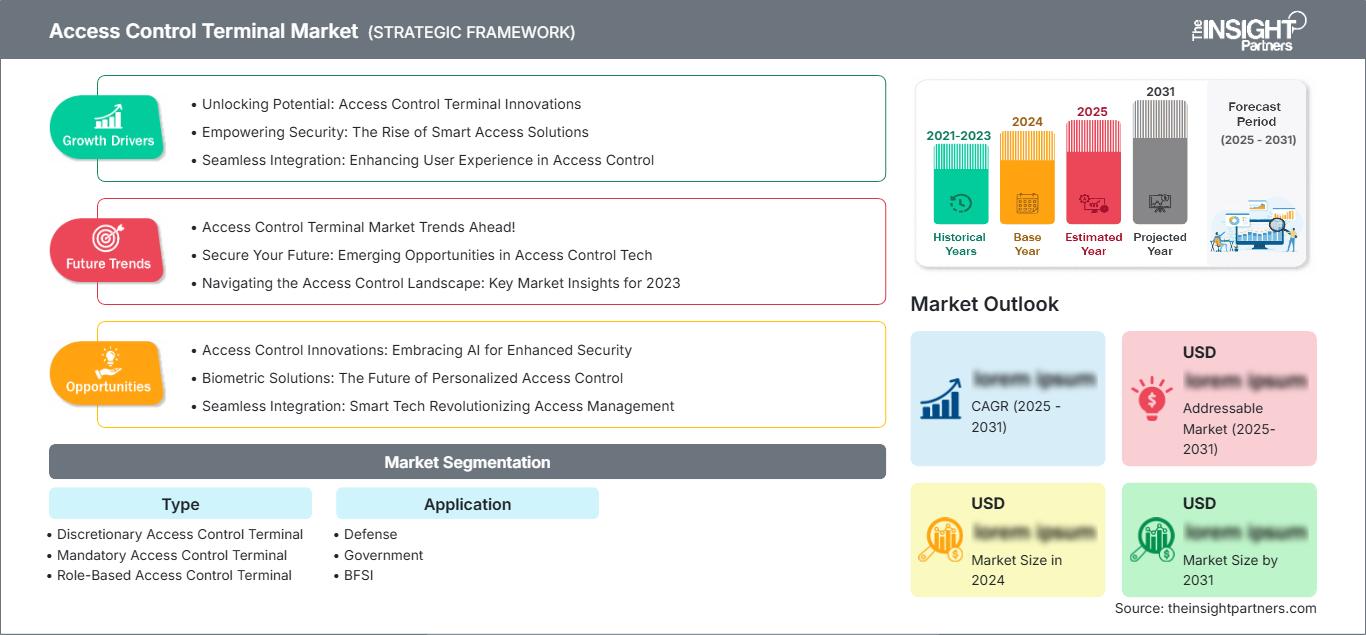
Access Control Terminal Market: Strategic Insights
Regional Insights
North America Access Control Terminal Market
North America accounted for an estimated 36–40% access control terminal market share in 2025, making it the leading regional market. Continued investment in critical infrastructure protection, data center security, healthcare facility modernization, and government security programs contributes to sustained demand. Enterprise organizations increasingly deploy integrated identity management solutions that combine physical entry controls with cybersecurity frameworks. The region is projected to expand at a CAGR of 7.8–8.4% through 2034.
Strong technology adoption rates and mature security procurement practices continue supporting implementation of advanced authentication technologies. Growing utilization of biometric verification, mobile credentials, and cloud-based administration platforms has increased demand for scalable terminal solutions. Regulatory emphasis on privacy, security governance, and infrastructure resilience further reinforces market expansion across commercial and public-sector environments.
U.S. Access Control Terminal Market
The US accounted for approximately 75-79% of the North American demand in 2025, underpinned by substantial enterprise deployment efforts and government modernization programs. Leading technology vendors operate large-scale operations in the country, enabling the rapid implementation of sophisticated authentication and identity management solutions. The national access control terminal market is projected to grow at a CAGR of 7.9-8.5%through the forecast period.
Defense organizations, financial organizations, healthcare facilities, and the federal government continue to invest in secure facility management technologies. Increasingly, such deployments are justified by the need for multi-factor authentication capabilities, visitor management system automation, and the implementation of access control policies. Integration of cybersecurity operations and physical security management is one of the major deployment trends in the country.
Europe Access Control Terminal Market
Europe held a share of about 25-29% in 2025 and is expected to grow with a CAGR of 7.5-8.1% during the forecast period of 2034. Germany is the regional leader owing to its advanced manufacturing facilities, enterprise digitization programs, and stringent industrial security measures. Demand is very high across smart buildings, transportation, and regulatory organizations, which need identity-based access management systems.
The United Kingdom access control terminal market continues to enjoy corporate expenditure on workplace transformation and digital identity programs. France shows increased adoption in healthcare, governmental, and public services institutions, whereas Italy and Spain continue to see consistent demand from the transportation, hospitality, and infrastructure sectors. Compliance, privacy, and facility security needs of the region will keep the adoption levels growing.
APAC Access Control Terminal Market
Asia Pacific captured an approximate 24–28% share in 2025 and is the fastest-growing regional market with a CAGR of 9.5–10.2%. China dominates the regional market owing to extensive construction activity and security applications across transport and public infrastructure.
Japan, South Korea, India, and Australia are progressively adopting the technology through smart city projects, digital transformation initiatives, and the modernization of workplace security solutions. Growth can be attributed to industrial growth and investments in technology through government-backed schemes.
Middle East & Africa Access Control Terminal Market
The Middle East and Africa access control terminal market is anticipated to grow with a CAGR of 8.8-9.4% during the forecast period 2026-2034. Saudi Arabia and the UAE will continue to be major growth drivers due to investments made in smart infrastructures and transportation networks.
South Africa continues to contribute consistently by modernizing enterprise security solutions and infrastructure, while the broader region reaps the benefits of digitization initiatives in the public sector. Investments in energy and industrial assets and urban development projects continue to drive the adoption of access control solutions.
Segmentation Analysis
Type
The Type segment category remains an important classification in the market and is expected to register a CAGR of 8.3-8.9% from 2026 to 2034. Deployments will be driven more by corporate security policies, regulatory requirements, and identity management schemes. The market scope for access control terminals is broadening as companies look to deploy scalable infrastructure that offers both flexibility and centralization. There is a growing demand for access control terminals that can operate in hybrid scenarios, support multi-site operations, and adapt to changing access policies across diverse operational facilities.
- Discretionary Access Control Terminal – Widely deployed across commercial organizations where administrators require flexibility to grant and revoke privileges efficiently. The sub-segment supports dynamic workforce environments and remains important for decentralized operational structures.
- Mandatory Access Control Terminal – Primarily adopted within highly regulated sectors, including defense and government institutions. Strong policy enforcement capabilities and structured access hierarchies contribute to demand across high-security environments.
- Role-Based Access Control Terminal – Maintains a leading position due to simplified identity governance, efficient permission management, and alignment with enterprise compliance requirements. Adoption is particularly strong among large organizations managing extensive user populations.
Application
The Application segment category is expected to witness a CAGR of 8.8-9.4% for 2026-2034 in the access control terminal market, owing to increasing usage in critical infrastructure and regulated sectors. Rising physical security risks and the need for identity and cybersecurity continue to drive enterprises towards installing more advanced access control solutions. Compliance and investments in facility upgrades are supporting demand across various end-use segments.
- Defense – Defense organizations prioritize stringent authentication requirements, secure facility access, and operational resilience. Demand is supported by modernization programs focused on strengthening asset protection and personnel verification capabilities.
- Government – Government agencies increasingly deploy integrated identity management solutions to improve facility security and support digital transformation programs. Centralized management and audit capabilities remain key procurement considerations.
- BFSI – Financial institutions implement advanced access systems to safeguard sensitive operational areas, data centers, and critical infrastructure. Multi-factor authentication and compliance-driven security strategies support continued investment.
- Healthcare – Healthcare providers represent the fastest-expanding application group due to increasing regulatory oversight, protection of sensitive patient environments, and demand for secure access management across facilities.
- Telecom – Telecommunications operators utilize access control terminals to secure network infrastructure, data processing resources, and operational centers. Continued network expansion supports ongoing deployment activity.
Opportunity Snapshot
| Application | Revenue Contribution | Trend Tag | Adoption Stage |
| Defense | High | Facility Security | Mature |
| Government | High | Identity Control | Mature |
| BFSI | High | Multi-Factor | Mature |
| Healthcare | Medium | Patient Security | Scaling |
| Telecom | Medium | Network Protection | Scaling |
Access Control Terminal Market Growth Drivers and Impact Analysis
Expansion of Integrated Identity Security Architectures
Firms are adopting identity-centric solutions to meet their security needs, which can manage physical and logical access under unified policies. Nowadays, access control terminals serve as strategic endpoints in the overall security ecosystem, integrating authentication, monitoring, analysis, and compliance management. The increasing need for firms to have better visibility into employee and visitor movements and access permissions is especially pronounced in sectors such as finance, government organizations, healthcare, and infrastructure providers, where auditability is vital. As more companies are required to adopt integrated security solutions, the need for advanced terminals capable of centralized enforcement and policy-based management will grow during the forecast period.
Rising Infrastructure Modernization Across Public and Private Facilities
Increasing numbers of large-scale renovation and modernization programs are driving demand for sophisticated access control technology in commercial buildings, transport facilities, manufacturing plants, educational institutions, and government establishments. Access control technologies from the past are usually not compatible with current-day standards for authentication and management systems. Thus, companies look forward to installing systems that will enable them to improve efficiency while protecting themselves against potential intrusions and credential misuse. Moreover, the advent of smart building concepts will facilitate deployment, as organizations seek connected facilities that integrate occupancy and security management with automation systems. Further investments in infrastructure in developed and developing nations will drive ongoing procurement, encouraging the installation of sophisticated terminal devices.
Growing Adoption of Contactless and Biometric Authentication
The demand for a smooth, seamless, yet secure experience drives further development of biometrics and contactless credential systems. Fingerprint identification, face recognition, mobile credentials, and digital identity technologies help companies build stronger security while reducing overhead associated with traditional access management systems. Companies find solutions that provide users with a convenient experience while remaining compliant with regulations. Hospitals, transport companies, airports, and corporate campuses have the highest activity in adopting these solutions, as they involve large numbers of people and require security upgrades. With improving quality and decreasing costs of implementing biometric systems, access control terminals that include them should see increased investment from organizations.
Access Control Terminal Market Future Trends
Artificial Intelligence Enabled Access Intelligence Platforms
The access control terminal market trends landscape is expected to be increasingly shaped by artificial intelligence integration. In addition to the basic authentication features, future access platforms will offer behavior analysis, anomaly detection, predictive monitoring, and risk assessment services. In terms of security, access platforms will offer improved visibility into access trends and will reduce reaction time when faced with new risks. Context-based authentication is expected to be achieved through AI technologies. The need for proactive security management is becoming crucial for organizations, and an intelligent access management solution could become a critical competitive advantage for service providers.
Cloud-Managed Access Ecosystems for Distributed Enterprises
The cloud deployment model is expected to revolutionize access infrastructure administration for operations spanning geographic distances. Companies need visibility into their offices, manufacturing plants, hospitals, retail outlets, and government buildings, and these needs are increasingly driving organizations towards cloud-managed infrastructures that scale up, can be remotely configured and upgraded, offer standardized policies, and interoperate better with other systems. It is anticipated that the vendors will introduce new subscription models that include analytics, identity governance, and access administration. This move will increase the scope of generating recurring revenue while ensuring the adoption of such solutions by enterprises.
Access Control Terminal Market Opportunities
Healthcare Security Infrastructure Modernization
The trend in the healthcare industry toward increased investment in digital transformation projects has created significant business opportunities for companies offering access management services. Hospitals, specialized clinics, laboratories, and other research facilities have become increasingly concerned with establishing secure access infrastructure to safeguard patients, staff, property, and confidential data. The growing adoption of connected medical devices and smart healthcare facilities has spurred the adoption of identity-centric security models. The access control terminal market Forecasts indicate attractive long-term potential for vendors capable of providing integrated biometric authentication, mobile credential support, and compliance-oriented administration tools. Strategic partnerships with healthcare technology vendors, facility operators, and systems integrators could provide additional opportunities for market penetration and help address emerging regulatory and operational needs.
Smart Infrastructure and Urban Development Programs
Large-scale investments in smart cities have created numerous business opportunities for manufacturers and software vendors in the security market. Governments and infrastructure providers are demanding smart security systems to support transportation sites, government structures, utility installations, educational institutions, and large business projects. Such projects need platforms that have credential management, surveillance technologies, visitor management, and intelligence-based monitoring capabilities. The vendors that emphasize interoperability, cloud management, and AI-based administration will benefit from increasing procurement of such solutions. There is significant potential in emerging markets across Asia Pacific, the Middle East, and selected African countries, which present especially attractive opportunities as infrastructure modernization projects continue to accelerate and security requirements become increasingly sophisticated.
Frequently Asked Questions

- Comprehensive Market Sizing and Forecast Analysis
- Detailed Segmentation Analysis
- In-Depth Market Dynamics Assessment
- Regional and Country-Level Insights
- Competitive Landscape and Company Benchmarking
- Strategic Business Intelligence
Recent Reports
Testimonials

The Insight Partners provided valuable market intelligence that supported our global go-to-market strategy. Their team was professional, responsive, and attentive to our feedback, providing thoughtful analysis and helpful methodological clarifications throughout the project.
Junmo Kim Chief Financial Officer (CFO), Enertech Co., Ltd.
The Insight Partners' SCADA System Market report is comprehensive, with valuable insights on current trends and future forecasts. The team was highly professional, responsive, and supportive throughout. We are very satisfied and highly recommend their services.
RAN KEDEM Partner, Reali Technologies LTDs
I requested a report on a very specific software market and the team produced the report in a few days. The information was very relevant and well presented. I then requested some changes and additions to the report. The team was again very responsive and I got the final report in less than a week.
JEAN-HERVE JENN Chairman, Future Analytica
We worked with The Insight Partners for an important market study and forecast. They gave us clear insights into opportunities and risks, which helped shape our plans. Their research was easy to use and based on solid data. It helped us make smart, confident decisions. We highly recommend them.
PIYUSH NAGPAL Sr. Vice President, High Beam Global
The Insight Partners delivered insightful, well-structured market research with strong domain expertise. Their team was professional and responsive throughout. The user-friendly website made accessing industry reports seamless. We highly recommend them for reliable, high-quality research services
YUKIHIKO ADACHI CEO, Deep Blue, LLC.
This is the first time I have purchased a market report from The Insight Partners.While I was unsure at first, I visited their web site and felt more comfortable to take the risk and purchase a market report.I am completely satisfied with the quality of the report and customer service. I had several questions and comments with the initial report, but after a couple of dialogs over email with their analyst I believe I have a report that I can use as input to our strategic planning process.Thank you so much for taking the extra time and making this a positive experience.I will definitely recommend your service to others and you will be my first call when we need further market data.
JOHN SUZUKI President and Chief Executive Officer, Board Director, BK Technologies
I wish to appreciate your support and the professionalism you displayed in the course of attending to my request for information regarding to infectious disease IVD market in Nigeria. I appreciate your patience, your guidance, and the fact that you were willing to offer a discount, which eventually made it possible for us to close a deal. I look forward to engaging The Insight Partners in the future, all thanks to the impression you have created in me as a result of this first encounter.
DR CHIJIOKE ONYIA MANAGING DIRECTOR, PineCrest Healthcare Ltd.Reason to Buy
- Informed Decision-Making
- Understanding Market Dynamics
- Competitive Analysis
- Identifying Emerging Markets
- Customer Insights
- Market Forecasts
- Risk Mitigation
- Boosting Operational Efficiency
- Strategic Planning
- Investment Justification
- Tracking Industry Innovations
- Aligning with Regulatory Trends





 Get Free Sample for