
Acoustic Neuroma Market Report 2034 by Segments, Geography, Dynamics, Recent Developments, and Strategic Insights
Coverage: By Type (Unilateral Vestibular Schwannomas, Bilateral Vestibular Schwannomas); Drug Class (Anticonvulsants, Corticosteroids, Osmotic Diuretics, Pain Killers, Others); Distribution Channel (Hospitals Pharmacies, Retail Pharmacies) , and Geography (North America, Europe, Asia Pacific, and South and Central America)
- Status : Data Released
- Report Code : TIPRE00005552
- Category : Life Sciences
- No. of Pages : 150
- Available Report Formats :


- Last update date : July 15, 2026


2025 Market Size
US$ 2.36 Bn
Base year value
2034 Forecast
US$ 4.88 Bn
Projected by 2034
CAGR 2026-2034
8.4 %
Growth rate
Addressable Market
US$ 32.48 Bn
(2026-2034)
The Acoustic neuroma market size was valued at US$ 2.36 Billion in 2025 and is projected to reach US$ 4.88 Billion by 2034, expanding at a CAGR of 8.4% during 2026–2034. The market has seen an increased clinical need for diagnosis, follow-up, surgery-related care, radiosurgery planning, and symptom management in cases of unilateral as well as bilateral vestibular schwannomas.
The acoustic neuroma market size in North America is backed up by the prevalence of MRI scans, referral systems in neurotology, and stereotactic radiosurgery techniques. This region is expected to grow at a CAGR of 8.4% to 8.8% in 2026–2034 due to early diagnosis, aging population, and involvement of ENT specialists and oncology centers.
Acoustic Neuroma Market Assessment and Insights
- North America: The Acoustic neuroma market share in 2025 is estimated at 38–40%, with CAGR between 2026–2034 at 8.4–8.8%, supported by MRI density, neurotology centers, radiosurgery access, and structured follow-up.
- US: Share in 2025 is estimated at 82–86% of North America, with CAGR between 2026–2034 at 8.3–8.7%, reflecting strong hospital networks and advanced imaging reimbursement.
- Europe: Share in 2025 is estimated at 27–29%, with CAGR between 2026–2034 at 7.7–8.1%; Germany, the UK, France, Italy, and Spain lead through mature neurosurgical and ENT pathways.
- Asia Pacific: Share in 2025 is estimated at 22–24%, with CAGR between 2026–2034 at 9.2–9.6%; China, Japan, India, South Korea, and Australia drive expansion through imaging investment and specialist access.
- Largest Segment: Unilateral Vestibular Schwannomas held a market share range of 88–92% in 2025, with CAGR between 2026–2034 at 7.0–7.4%, due to dominant sporadic case incidence.
- High Growth Segment: Bilateral Vestibular Schwannomas held a market share range of 8–12% in 2025, with CAGR between 2026–2034 at 8.1–8.5%, supported by genetic surveillance and NF2-related care.
- Key companies analyzed in detail: GE HealthCare Technologies Inc., Siemens Healthineers AG, Koninklijke Philips N.V., Shimadzu Corporation, Canon Medical Systems Corporation, F. Hoffmann-La Roche Ltd, Merck & Co., Inc., Novartis AG, Pfizer Inc., AstraZeneca PLC.
Source: The Insight Partners' analysis based on proprietary research, government publications, company annual reports, investor presentations, industry databases, and expert interviews.
The technological progression in the market for acoustic neuromas is changing the focus from intervention in late stages of the tumor to early diagnosis by way of MRI, hearing preservation, and radiosurgery planning. The manufacturing trends are dominated by sophisticated imaging devices, neurosurgical systems, pharmaceuticals used for symptoms management during surgical procedure, and hospital drugs applied to reduce pain, swelling, and seizure probability.
Future developments are anticipated to be driven by new geographic regions with low penetrations of MRI technology, development of private hospitals, and referral networks. Regulation will be supportive of the use of imaging based on artificial intelligence, medical devices, and oncology drug safety monitoring. Investments are planned in workflow optimization, high-field MRI, radiation treatment planning software, and hospital pharmacies rather than in disease specific drugs only.
Acoustic Neuroma Market Report Scope
| Report Attribute | Details |
|---|---|
| Market size in 2025 | US$ 2.36 Billion |
| Market Size by 2034 | US$ 4.88 Billion |
| Global CAGR (2026 - 2034) | 8.4% |
| Historical Data | 2021-2024 |
| Forecast period | 2026-2034 |
Acoustic Neuroma Market Analysis
The demand for the products and services is based on better diagnostic visibility, where the incidence of vestibular schwannomas is usually presented at the rate of 3 to 5 cases per 100,000 people years in contemporary scientific sources. The expanding market of acoustic neuromas becomes possible due to the application of MRI that is capable of detecting small tumors and necessitating subsequent examinations, such as imaging, hearing tests, and treatment.
The supply side differs from traditional pharmaceutical markets due to the heavy reliance on imaging technology during diagnosis and treatment planning. MRI devices, imaging reconstruction software, and radio surgery planning tools provide significant entry points, while drug categories include medications for symptom control, such as edema, pain, seizures, and perioperative care. The procurement process by hospitals thus involves capital purchases along with pharmacy purchases and procedure-based expenditures.
According to the acoustic neuroma market report, there is an environment characterized by a mix of players whereby GE HealthCare Technologies Inc., Siemens Healthineers AG, Koninklijke Philips N.V., Shimadzu Corporation, and Canon Medical Systems Corporation influence imaging processes. F. Hoffmann-La Roche Ltd, Merck & Co., Inc., Novartis AG, Pfizer Inc., and AstraZeneca PLC are pertinent because of their oncology, corticosteroid, pain relief, and hospital medicine offerings which are relevant to the care pathway.
Strategic positioning revolves around incorporating the process into the clinical workflow rather than the provision of a curative medication. Imaging firms focus on speedy scanning, motion correction, AI reconstruction, and reduced need for helium. The pharmaceutical firms compete on account of having access to the formularies of hospitals, evidence of safety, and diverse portfolios of medications.
● REPORT CUSTOMIZATION
Tailor This Report To Align With Your Specific Business Requirements
This report can be customized to align precisely with your business objectives, scope, and target markets. Customization options include tailored segmentation, geography, competitive analysis, and strategic insights to support informed decision-making.
Customize This Report →WHAT YOU CAN ADJUST
- ● Segmentations
- ● Geography
- ● Competitive Analysis
- ● Language Preferences
Acoustic Neuroma Market: Strategic Insights
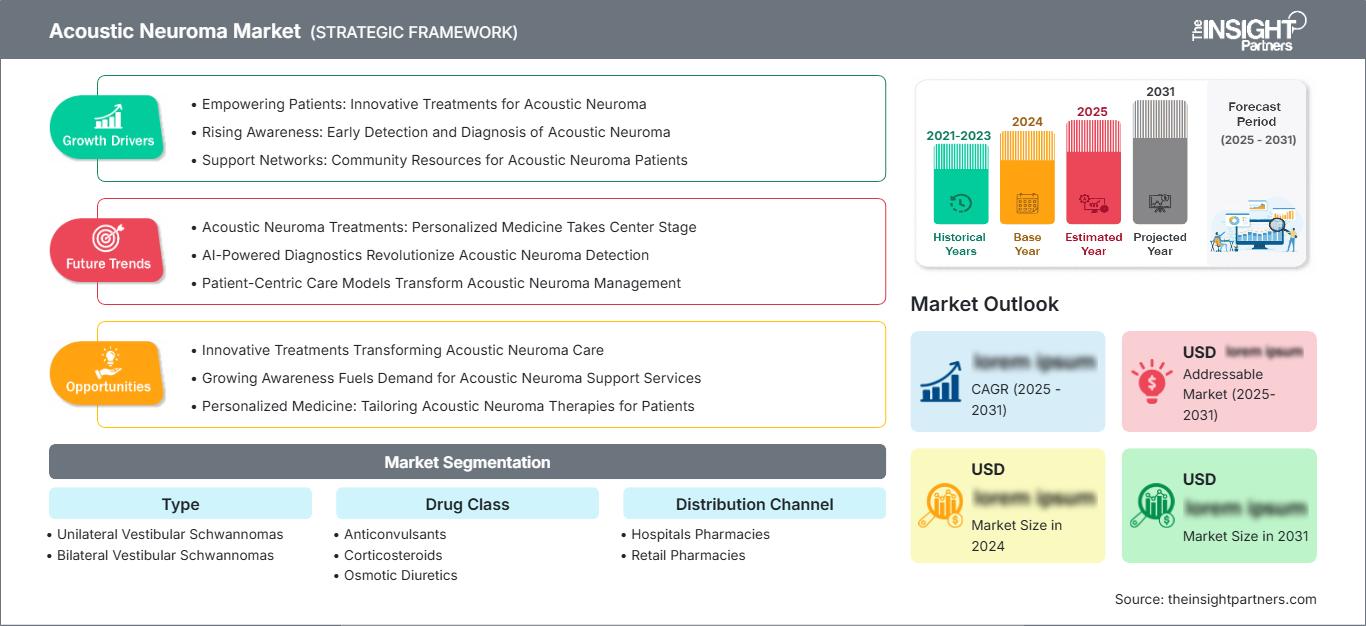
Regional Insights
North America Acoustic neuroma market
North America accounted for an estimated 38–40% share in 2025 and is projected to grow at a 8.4–8.8% CAGR during 2026–2034. MRI use is high in the region, there are many neurosurgery practices, stereotactic radiosurgery treatment facilities, and surveillance procedures are in place for small-sized tumors. Early diagnosis results in higher costs of repeat scanning and follow-ups.
Market share of the acoustic neuroma in North America is additionally driven by the high number of academic hospitals, private imaging facilities, and neurotology programs in the USA. Canada's contribution comes from the presence of publicly funded treatment paths and specialty referrals. The highest adoption is seen in coordinated assessment, including audiology, contrast MRI, surgery, vestibular therapy, and hospital pharmacy drugs.
U.S. Acoustic neuroma market
The U.S. represented 82–86% of North America in 2025 and is expected to expand at a 8.3–8.7% CAGR through 2034. The demand is bolstered by the use of improved imaging diagnostics, increased specialists' numbers, and more widespread observation of small tumors. The repeat MRI screening cycle provides continuous value generation despite the postponement of surgery or radiosurgery operations.
Corporate presence is robust in imaging and hospital distribution chains. The key competitors GE HealthCare Technologies Inc., Siemens Healthineers AG, Koninklijke Philips N.V., and Canon Medical Systems Corporation are striving for MRI acquisitions, while key pharmaceutical manufacturers provide perioperative management solutions. The application trends include unilateral tumors' monitoring, planning of surgery in cases of large tumors, and radiosurgery assessment.
Europe Acoustic neuroma market
Europe held an estimated 27–29% share in 2025 and is forecast to grow at a 7.7–8.1% CAGR during 2026–2034. The UK has advantages with respect to the NHS referral system, central skull-base centers, and clear imaging protocols. Germany is the leader, owing to solid hospital infrastructures, widespread availability of MRI facilities, and multidisciplinary neurosurgical services.
France, Italy, and Spain add with mature ENT and radiology organizations, as developments are associated with increasing age-related populations and improved tumor detection. The focus in Europe is on conservative surveillance, hearing conservation, and scientific comparison of microsurgical and radiosurgical treatment approaches. The procurement process is disciplined, and vendors have to provide workflow improvement, total cost of ownership, and service excellence.
APAC Acoustic neuroma market
APAC accounted for an estimated 22–24% share in 2025 and is projected to expand at an 9.2–9.6% CAGR during 2026–2034. China is the top market for patients. Japan and South Korea are the best markets for high uptake of advanced imaging.
India and Australia contribute additional growth opportunities via private hospitals, referral from ENTs, and access to neurosurgical treatments. Industrial dynamics are related to MRI fleet growth, network of diagnostic centers, and software productivity. Policy dynamics, such as insurance and hospital development, indirectly contribute to early diagnosis and follow-up.
Middle East & Africa Acoustic neuroma market
Middle East & Africa is expected to grow at a 6.4–6.8% CAGR during 2026–2034, led by Saudi Arabia. The UAE, South Africa, and Rest of MEA contribute through tertiary hospital development, imported imaging equipment, and expanding specialist care access.
Energy-backed hospital investment in Gulf countries supports MRI procurement, radiosurgery access, and international treatment partnerships. South Africa remains the most developed subregional hub for specialist neurosurgical care. Import dependency, service contracts, and workforce availability remain critical constraints, making vendor support and training important selection factors.
Segmentation Analysis
Type
The Type segment is expected to grow at a 7.1–7.5% CAGR during 2026–2034, reflecting the clinical dominance of sporadic unilateral tumors and specialized management of bilateral disease. The acoustic neuroma market scope across this segment is shaped by tumor laterality, genetic status, hearing function, and treatment intent. Long-term imaging surveillance is central because many tumors grow slowly and require staged decision-making.
- Unilateral Vestibular Schwannomas: This sub-segment represents the dominant clinical pool because most cases are sporadic, detected in adults, and managed through observation, microsurgery, radiosurgery, or hearing-focused monitoring.
- Bilateral Vestibular Schwannomas: This sub-segment is strategically important due to its association with NF2-related schwannomatosis, requiring genetic evaluation, repeated imaging, hearing preservation planning, and complex multidisciplinary care.
Drug Class
The Drug Class segment is projected to grow at a 6.8–7.2% CAGR during 2026–2034. Drug demand is supportive rather than curative, because acoustic neuroma care is mainly driven by imaging, observation, surgery, and radiosurgery. Pharmaceutical use is concentrated around perioperative edema control, pain relief, seizure management in selected neurological cases, and symptom support during hospital-based interventions.
- Anticonvulsants: This sub-segment has selective use in patients with neurological complications, perioperative seizure risk, or associated cranial pathology requiring specialist oversight and hospital pharmacy availability.
- Corticosteroids: This sub-segment is important around edema control, postoperative inflammation, and acute symptom management, making it relevant in neurosurgical and radiation-associated treatment pathways.
- Osmotic Diuretics: This sub-segment is mainly used in controlled hospital settings where intracranial pressure management is required, especially during complex neurosurgical care.
- Pain Killers: This sub-segment supports postoperative recovery, headache management, and symptom relief, with demand linked to surgical volumes, radiosurgery-related discomfort, and outpatient follow-up needs.
Distribution Channel
The Distribution Channel segment is forecast to grow at a 7.0–7.4% CAGR during 2026–2034, supported by hospital-centered diagnosis and treatment. Hospital pharmacies dominate because surgery, radiosurgery, contrast imaging, and acute symptom management occur in specialist facilities. Retail pharmacies remain relevant for pain medicines, corticosteroid tapering, and ongoing supportive prescriptions after discharge or outpatient consultation.
- Hospitals Pharmacies: This sub-segment holds the strongest strategic position because acoustic neuroma management is concentrated in tertiary hospitals, skull-base centers, neurosurgery units, and radiation oncology programs.
- Retail Pharmacies: This sub-segment supports continuity after discharge, especially for pain management, steroid courses, and prescribed supportive medicines used during outpatient recovery and monitoring.
Opportunity Snapshot
| Distribution Channel | Revenue Contribution | Trend Tag | Adoption Stage |
| Hospitals Pharmacies | High | Perioperative Care | Mature |
| Retail Pharmacies | Medium | Recovery Support | Scaling |
Acoustic Neuroma Market Growth Drivers and Impact Analysis
Rising MRI Detection of Small Vestibular Schwannomas
MRI-driven diagnosis is the most powerful structural factor because many tumors are detected early, small, and even incidentally during the investigation of deafness, tinnitus, vertigo, and other neurological complaints. It transforms the business model from a single procedure to regular monitoring, audiologic testing, and consulting visits. The effect on the market can be seen through MRI procedures, contrast imaging, software reconstruction, and follow-up at hospitals. Early diagnosis leads to increased observation treatment, which postpones surgical treatment but still keeps expenditures on the path. The imaging companies gain from the need for faster protocols, good visualization of the internal auditory canal, and motion-free imaging.
Expansion of Multidisciplinary Skull-Base Care
Management now relies on ENT surgeons, neurosurgeons, neuroradiologists, radiation oncologists, audiologists, genetic counselors, and rehabilitation professionals. This is a multidisciplinary management that enables decision making regarding the selection of procedures according to the size of the tumor, age, symptoms, hearing condition, and choice of the patient. The commercial implications of this are the wider use of imaging procedures, surgeries, radiosurgery, hospital medications, and follow-up services. Skull base centers help in improving referrals, leading to demand for sophisticated MRI, neuronavigation, and hospital pharmacy. It becomes easier for centers to keep patients if they are capable of offering observation, microsurgery, and radiosurgery through one pathway.
Growing Attention to Hearing Preservation and Quality of Life
Today's care is more focused on hearing preservation, facial nerve function, balance, and quality of life than tumor control. This is one of the drivers of technological adaptation since doctors need imaging, accurate quantification of the tumor, and functional tests to decide on either observation, radiosurgery, or microsurgery treatment plan. Market implications include increased demand for MRI scanning protocols, audiometric follow-up, rehabilitation procedures, corticosteroids before and after the procedure, and surgery planning. Small tumors usually go under observation, thus repeat scanning becomes very important from the commercial perspective. As patients become more aware, the need for counseling will increase.
Acoustic Neuroma Market Future Trends
AI-Enabled Imaging and Longitudinal Tumor Monitoring
The Acoustic neuroma market trends will focus more and more on AI-based MRI reconstruction, automation of measurements, and comparison of tumors longitudinally. They have the potential to decrease reporting variation and allow clinicians to see even small changes in tumor size between images. In the long run, such technology could be used to make personalization of observation periods, timing of radiosurgery, and hearing preservation decisions. Hospitals will favor technology that minimizes acquisition time without losing high resolution near the internal auditory canal. However, it is not just a technological matter but a capacity issue as well, as shorter image acquisition time helps hospitals decrease waitlists.
Greater Role for Molecular and Gene-Based Research
The research on anti-VEGF strategies, NF2 biology, and local gene-delivery systems may impact future treatment strategies. Although surgery, observation, and radiosurgery continue to dominate, experimental methods may help provide alternative strategies to those patients suffering from progressive lesions or with no hearing preservation option. Such a development may affect referrals through integration of otoneurology, genetics, oncology, and clinical trials programs. The commercial implications will be slow in coming as starting with clinical trial setup, imaging endpoints, and biomarkers becomes more relevant. Selective companies with oncology, biologic, and targeted therapy expertise may benefit.
Acoustic Neuroma Market Opportunities
Integrated Imaging Platforms for Specialist Hospitals
MRI facilities may consider investing in integrated MRI systems with capabilities such as high-definition imaging of cranial nerves, artificial intelligence reconstruction of images, motion correction, and structured reporting. In terms of acoustic neuroma market forecast, there is greater potential for value creation if imaging capability is directly associated with skull base centers and radiosurgery planning. The vendors must pay attention to the development of service bundles, protocols, and training of internal auditory canal imaging. Asia Pacific and Gulf regions are ideal destinations for targeting as there is a fast-growing tertiary care network in these regions along with faster equipment replacements.
Clinical Pathway Partnerships Across Diagnosis and Follow-Up
Differentiated Pathways can be achieved through a consolidation of diagnostic imaging, audiology, neurosurgical assessment, radiosurgery assessment, pharmacy, and rehabilitation services under an umbrella service. This is an entrepreneurial venture that is most applicable in the hospital and ambulatory care setting where experience and continuity are competitive strengths. Follow-up in such an approach helps ensure that surveillance scans are not overlooked, and early intervention is possible should growth occur. The pharmaceutical companies would get their chance in perioperative medicine and recovery products, while imaging companies would help provide measurement tools. Scheduling and remote consultation technology companies would come in handy for those patients in remote areas.
Recent Developments
- January 2026: Siemens Healthineers AG received U.S. FDA clearance for the 70 cm bore Magnetom Flow platform, a 1.5T MRI system using DryCool technology with only 0.7 liters of liquid helium and AI-supported workflows to improve imaging throughput and sustainability for neurological and whole-body applications.
- November 2025: GE HealthCare Technologies Inc. announced next-generation SIGNA MRI technologies at RSNA 2025, including SIGNA Bolt and SIGNA Sprint with Freelium, both submitted for U.S. FDA 510(k) review and designed to improve precision diagnostics, workflow efficiency, and sustainability in advanced MR imaging.
- February 2025: Koninklijke Philips N.V. launched SmartSpeed Precise, an MRI solution powered by Dual-AI engines, across its 1.5T and 3.0T scanner portfolio. The company stated the technology is intended to accelerate scans, improve image quality, and support higher MRI throughput at healthcare facilities.
Frequently Asked Questions

- Comprehensive Market Sizing and Forecast Analysis
- Detailed Segmentation Analysis
- In-Depth Market Dynamics Assessment
- Regional and Country-Level Insights
- Competitive Landscape and Company Benchmarking
- Strategic Business Intelligence
Recent Reports
Testimonials

The Insight Partners' SCADA System Market report is comprehensive, with valuable insights on current trends and future forecasts. The team was highly professional, responsive, and supportive throughout. We are very satisfied and highly recommend their services.
RAN KEDEM Partner, Reali Technologies LTDs
I requested a report on a very specific software market and the team produced the report in a few days. The information was very relevant and well presented. I then requested some changes and additions to the report. The team was again very responsive and I got the final report in less than a week.
JEAN-HERVE JENN Chairman, Future Analytica
We worked with The Insight Partners for an important market study and forecast. They gave us clear insights into opportunities and risks, which helped shape our plans. Their research was easy to use and based on solid data. It helped us make smart, confident decisions. We highly recommend them.
PIYUSH NAGPAL Sr. Vice President, High Beam Global
The Insight Partners delivered insightful, well-structured market research with strong domain expertise. Their team was professional and responsive throughout. The user-friendly website made accessing industry reports seamless. We highly recommend them for reliable, high-quality research services
YUKIHIKO ADACHI CEO, Deep Blue, LLC.
This is the first time I have purchased a market report from The Insight Partners.While I was unsure at first, I visited their web site and felt more comfortable to take the risk and purchase a market report.I am completely satisfied with the quality of the report and customer service. I had several questions and comments with the initial report, but after a couple of dialogs over email with their analyst I believe I have a report that I can use as input to our strategic planning process.Thank you so much for taking the extra time and making this a positive experience.I will definitely recommend your service to others and you will be my first call when we need further market data.
JOHN SUZUKI President and Chief Executive Officer, Board Director, BK Technologies
I wish to appreciate your support and the professionalism you displayed in the course of attending to my request for information regarding to infectious disease IVD market in Nigeria. I appreciate your patience, your guidance, and the fact that you were willing to offer a discount, which eventually made it possible for us to close a deal. I look forward to engaging The Insight Partners in the future, all thanks to the impression you have created in me as a result of this first encounter.
DR CHIJIOKE ONYIA MANAGING DIRECTOR, PineCrest Healthcare Ltd.Reason to Buy
- Informed Decision-Making
- Understanding Market Dynamics
- Competitive Analysis
- Identifying Emerging Markets
- Customer Insights
- Market Forecasts
- Risk Mitigation
- Boosting Operational Efficiency
- Strategic Planning
- Investment Justification
- Tracking Industry Innovations
- Aligning with Regulatory Trends





 Get Free Sample for