
Adsorption Equipment Market Size, Share & Growth by 2034
Coverage: By Capacity (Less than 10,000 CFM, 10,000-50,000 CFM, More than 50,000 CFM); End-Use Industry (Automotive Paints, Chemical, Semiconductor, Printing, Others) , and Geography (North America, Europe, Asia Pacific, and South and Central America)
- Status : Data Released
- Report Code : TIPRE00005056
- Category : Manufacturing and Construction
- No. of Pages : 150
- Available Report Formats :


- Last update date : July 10, 2026


2025 Market Size
US$ 504.79 Mn
Base year value
2034 Forecast
US$ 802.97 Mn
Projected by 2034
CAGR 2026-2034
5.29 %
Growth rate
Addressable Market
US$ 5,931.01 Mn
(2026-2034)
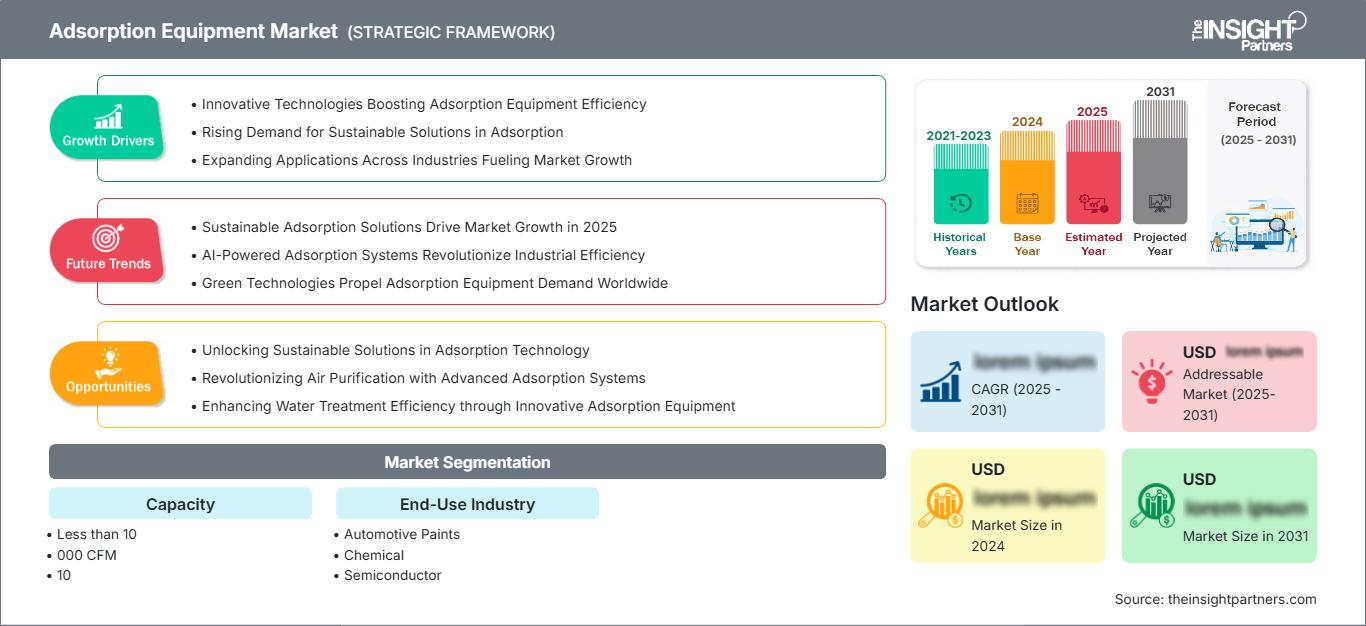
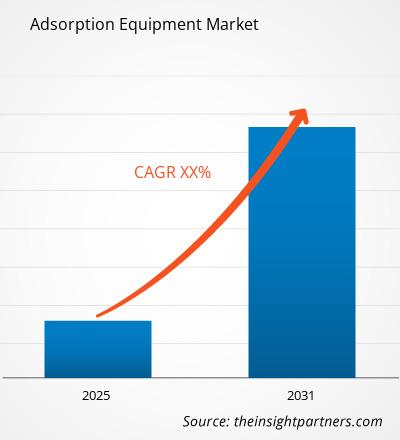
The global adsorption equipment market size is anticipated to rise from US$ 504.79 Million in 2025 to US$ 802.97 Million in 2034. The market is anticipated to grow at a rate of 5.29% during 2026-2034. The adsorption equipment Market is propelled by stringent emissions standards, cost-effectiveness of solvent recovery systems, and deployment in automotive paint shops, chemical, semiconductor, and printing industries.
According to the adsorption equipment market report, North America is projected to grow at a 4.9%-5.3% CAGR until 2034, led by VOC emissions compliance initiatives under EPA regulations, the rescaling of semiconductor fabs in North America, and the routine upgrading of obsolete air pollution control equipment. The US leads in demand for modular adsorption units, carbon concentrator, and adsorption/oxidation hybrid units.
Adsorption Equipment Market Assessment and Insights
- North America: The region held 29–32% share in 2025 and is growing at a CAGR of 4.9–5.3% during 2026–2034, led by VOC compliance, chemical modernization, and semiconductor cleanroom investments.
- US: The country represented 78–82% of North America in 2025 and is growing at a CAGR of 5.0–5.4% during 2026–2034, supported by coating, chipmaking, and solvent recovery demand.
- Europe: Europe accounted for 23–26% share in 2025 and is growing at a CAGR of 4.4–4.8% during 2026–2034; Germany, the UK, France, Italy, and Spain remain leading adopters.
- Asia Pacific: Asia Pacific held 34–37% share in 2025 and is growing at a CAGR of 5.9–6.3% during 2026–2034, with China, Japan, South Korea, and India leading installations.
- Largest Segment: 10,000-50,000 CFM systems held 42–46% market share in 2025 and are growing at a CAGR of 5.1–5.5% during 2026–2034 due to balanced capacity economics.
- High Growth Segment: Semiconductor held 18–21% market share in 2025 and is growing at a CAGR of 6.2–6.7% during 2026–2034 as fabs require reliable solvent and acid-gas control.
- Key companies analyzed in detail: CECO Environmental Corp., CTP Chemisch Thermische Prozesstechnik GmbH, Dürr CTS GmbH, Eisenmann GmbH, Environmental C & C Inc., Xylem Inc., Gulf Coast Environmental Systems LLC, Monroe Environmental Corp., Taikisha Ltd., TIGG LLC.
Source: The Insight Partners' analysis based on proprietary research, government publications, company annual reports, investor presentations, industry databases, and expert interviews.
The market has evolved from individual activated carbon units to more integrated technology solutions that incorporate both adsorption, desorption, heat recovery, and subsequent oxidation processes. Manufacturers are adopting standardized modular skid solutions, corrosion-resistant housings, and control systems to reduce installation time. There is also an increased use of adsorbents, from traditional carbon-based adsorbents to zeolites and other specialty adsorbents, driven by the need to treat different types of solvents, moisture, and diluted exhaust streams from advanced production lines.
In the future, demand will increase mainly in new manufacturing areas in Asia, Mexico, Eastern Europe, and the Gulf region, where industrial permitting becomes more complicated. The investment trend is moving towards the equipment solutions that provide reduced energy consumption, solvent reuse, and monitoring capabilities. There are new regulations concerning hazardous air pollutants, occupational exposure, and wastewater discharge, expanding the application of adsorption equipment from air pollution control to broader industrial resource recovery.
Adsorption Equipment Market Report Scope
| Report Attribute | Details |
|---|---|
| Market size in 2025 | US$ 504.79 Million |
| Market Size by 2034 | US$ 802.97 Million |
| Global CAGR (2026 - 2034) | 5.29% |
| Historical Data | 2021-2024 |
| Forecast period | 2026-2034 |
Adsorption Equipment Market Analysis
Demand is driven by industrial applications involving emissions of volatile organic compounds, odors, and solvent vapors at levels that cannot be discharged directly into the environment. Automotive paint lines have high-volume requirements, while chemical facilities require media suitable for highly variable flows, and semiconductor clean rooms emphasize reliability and cleanliness. The Adsorption Equipment Market can grow as customers evaluate the costs of fines, solvents, and energy against the savings achieved through recovery equipment.
The industry value chain comprises adsorbent manufacturers, fabrication shops, fan and control systems suppliers, system integration firms, construction contractors, and service providers. Supply dynamics are affected by the availability of activated carbon, the price of stainless steel, and design capabilities. Customers are now demanding guarantees, diagnostic services, and replacement media agreements since the cost of downtime in coating, printing, and wafer fabrication is often greater than the cost of servicing the equipment.
The competitive environment is divided between large-scale environmental technology firms and specialized regional fabricators. Competition in the industry among CECO Environmental Corp., Dürr CTS GmbH, Taikisha Ltd., and Xylem Inc. is based on comprehensive offerings, whereas CTP Chemisch Thermische Prozesstechnik GmbH, Environmental C & C Inc., Monroe Environmental Corp., Gulf Coast Environmental Systems LLC, TIGG LLC, and Eisenmann GmbH are application-specific.
Investments tend to be made in smaller concentrators, regenerative carbon absorbers, and combinations, reducing natural gas use. Positioning in this industry requires mention in the automotive paints, semiconductors, and solvent printing sectors. Based on the analysis of the adsorption equipment market, service support, compliance, and destruction/recovery efficiencies are becoming key factors alongside acquisition cost.
● REPORT CUSTOMIZATION
Tailor This Report To Align With Your Specific Business Requirements
This report can be customized to align precisely with your business objectives, scope, and target markets. Customization options include tailored segmentation, geography, competitive analysis, and strategic insights to support informed decision-making.
Customize This Report →WHAT YOU CAN ADJUST
- ● Segmentations
- ● Geography
- ● Competitive Analysis
- ● Language Preferences
Adsorption Equipment Market: Strategic Insights
Regional Insights
North America adsorption equipment
In North America, the market share was 29-32% in 2025 and is projected to grow by a CAGR of 4.9-5.3% between 2026 and 2034. The market share growth will be sustained by the demand structure consisting of EPA VOC standards, state air quality permits, and automation of carbon beds in North America.
The other aspect that has created new demand is semiconductor reshoring, which requires treatment of solvent- and acid-laden exhaust. In the US and Canada, buyers value reliability, fast response to service requests, and compliance with requirements. The adsorption equipment market share in North America is set to hold on, owing to the permits.
U.S. adsorption equipment Market
The US accounted for 78–82% of North America in 2025 and is advancing at a 5.0–5.4% CAGR during 2026–2034. Demand is concentrated in automotive paint shops, chemical processing clusters, and semiconductor fabs receiving federal and state incentives. Users seek adsorption systems that can be validated under Clean Air Act operating permits.
Company presence is strong, with CECO Environmental Corp., Monroe Environmental Corp., Gulf Coast Environmental Systems LLC, Environmental C & C Inc., TIGG LLC, and Xylem Inc. supporting domestic projects. Adsorption equipment market trends include applications such as skid-mounted carbon adsorbers for small streams, concentrators for paint booths, and regenerable systems where solvent reuse improves payback.
Europe adsorption equipment Market
The adsorption equipment market forecast indicates that in 2025, Europe held a market share of 23-26%, and it is estimated to grow at a 4.4-4.8% CAGR. The UK market is influenced by permitting requirements for printing, coatings, and specialty manufacturing, where manufacturers prefer compact units that do not cause odor complaints or solvent emissions and require few building modifications.
Germany leads the European region due to the requirements of its automotive, chemical, machinery, and engineered materials companies for high-duty adsorption and solvent recovery. Dürr CTS GmbH, CTP Chemisch Thermische Prozesstechnik GmbH, and Eisenmann GmbH meet market requirements by offering extensive engineering expertise in thermal and sorptive exhaust treatments.
France, Italy, and Spain participate in the European market through their packaging, surface coating, pharmaceuticals, and industrial chemical segments. The southern European market offers a steady replacement business as facilities become more energy-efficient and meet integrated pollution prevention criteria. Purchasers tend to evaluate growth options for adsorption technology against oxidizer-only systems, in which solvent concentrations change due to production shifts.
APAC adsorption equipment Market
APAC held 34–37% share in 2025 and is expanding at a 5.9–6.3% CAGR, the fastest regional pace. China leads installations through electronics, chemicals, and coating capacity, while Japan and South Korea add demand from semiconductor and precision manufacturing.
India is scaling adoption as state pollution boards tighten approvals for solvent-using plants and industrial corridors attract chemical and automotive investment. Australia remains smaller but stable, supported by mining services, industrial coating, and water-treatment applications.
Policy drivers include clean-air programs, localized odor limits, and incentives for advanced manufacturing. Taikisha Ltd. has a strong regional role in paint systems, while global suppliers partner with local fabricators to reduce delivery lead times.
Middle East & Africa adsorption equipment Market
Middle East & Africa is expected to grow at a 4.6–5.0% CAGR through 2034. Saudi Arabia leads regional demand as petrochemical diversification, coatings, and industrial-city permitting require stronger emission treatment.
The UAE adds demand from infrastructure coatings, packaging, and manufacturing zones, where compact adsorption equipment trends align with space-constrained facilities. South Africa contributes through chemicals, mining services, and industrial wastewater polishing.
Rest of MEA adoption remains project-based, often linked to energy, refining, and industrial-park investments. Buyers prioritize rugged designs, media availability, and serviceability in high-temperature operating environments.
Segmentation Analysis
Capacity
The capacity segment is projected to grow at a 5.0–5.4% CAGR during 2026–2034 as buyers match airflow, contaminant loading, and pressure drop to process needs. Medium-capacity units dominate because they fit common coating, printing, and chemical exhaust lines while allowing modular expansion. Large systems gain traction where paint booths and fabs need centralized treatment.
- Less than 10,000 CFM units serve laboratories, pilot lines, small coating booths, and localized odor-control points where low capital cost, simple media replacement, and compact footprints are decisive.
- 10,000-50,000 CFM systems represent the core installed base because they balance airflow coverage, energy use, and maintenance cost for automotive component painting, printing, and chemical process vents.
- More than 50,000 CFM systems are strategically important for centralized paint booths, high-volume semiconductor exhaust, and large chemical complexes requiring robust fans, staged adsorption, and integrated controls.
End-Use Industry
The end-use industry segment is forecast to grow at a 5.4–5.8% CAGR from 2026 to 2034. Adoption is tied to solvent intensity, compliance risk, and production continuity. Automotive paints remain a major installed base, chemicals provide recurring replacement demand, semiconductors drive high-specification growth, and printing values adsorption for solvent capture and odor control.
- Automotive Paints require reliable VOC capture from booths and ovens, making adsorption concentrators important for reducing oxidizer load, stabilizing emissions, and supporting high-throughput coating operations.
- Chemical facilities use adsorption equipment for process vents, tank emissions, and solvent recovery, with demand shaped by media compatibility, corrosion resistance, and documentation for permit compliance.
- Semiconductor facilities need high-uptime systems for solvent and specialty chemical exhaust, making redundancy, monitoring, and low-contamination designs central to procurement decisions.
- Printing plants apply adsorption to flexible packaging, publishing, and converting lines where solvent vapors fluctuate by ink type, press speed, and production schedule.
Opportunity Snapshot
| End-Use Industry | Revenue Contribution | Trend Tag | Adoption Stage |
| Automotive Paints | High | Paint VOC | Mature |
| Chemical | High | Solvent Recovery | Scaling |
| Semiconductor | Medium | Fab Exhaust | Scaling |
| Printing | Medium | Ink Solvents | Mature |
Adsorption Equipment Market Growth Drivers and Impact Analysis
Tighter VOC and Hazardous Air Pollutant Compliance
Regulatory pressure is the most direct force because adsorption units will convert air quality requirements into capital projects. Facilities emitting VOCs, odors, and hazardous air pollutants must demonstrate capture efficiency, maintain records of their emissions, and avoid production interruptions due to permit violations. The most promising prospects for the development of adsorption units are in places where there is a link between permits and continuous emissions monitoring.
Solvent Recovery and Energy Cost Reduction
Increasing energy and solvent prices are making adsorption equipment an investment in efficiency rather than a compliance expense. Carbon and zeolite regeneration systems may be used either to concentrate organic vapor emissions, reducing fuel usage at the oxidizer, or to recover reusable solvents. Lifecycle calculations incorporating media changeout, fan power, steam usage, solvent recovery value, and reduced natural gas usage have become important to buyers in the printing, chemical, and coatings industries.
Expansion of Semiconductor and Advanced Manufacturing Capacity
Projects in semiconductor, battery, and precision manufacturing are creating more demand for higher-grade adsorption systems. These factories employ solvents, photoresists, specialty gases, and cleaning chemistries that require reliable abatement before release. Unlike other forms of manufacturing, fabs appreciate redundancy, minimal leakage, data logging, and fast service, as downtime will interrupt their high-value processes. The adsorption equipment Market benefits as governments fund domestic chip capacity and advanced manufacturing clusters specify environmental systems during greenfield design rather than retrofitting later.
Adsorption Equipment Market Future Trends
Digital Monitoring of Media Performance
Future systems will increasingly utilize sensors, programmable controls, and analytics to monitor breakthrough potential, pressure drops, temperature, humidity, and desorption efficiency. This will minimize the need for scheduled media replacement and allow replacement of adsorbents only when the actual loading is measured. This will enable auditing documentation of emissions reporting and predictive maintenance agreements. Vendors that can combine hardware, controls, and service data will strengthen differentiation as customers seek lower downtime and more defensible emissions documentation.
Hybrid Adsorption and Oxidation Architectures
Hybrid architectures will gain adoption where pollutant loads fluctuate and direct thermal treatment is inefficient. Adsorption concentrators can collect dilute VOCs from large airflow streams and feed a smaller, richer stream into an oxidizer, improving fuel efficiency and equipment sizing. The trend is particularly relevant for paint booths, flexible packaging, and electronics exhaust. Over the forecast period, system integrators will package adsorption, heat recovery, and oxidation as coordinated platforms rather than separate compliance assets.
Adsorption Equipment Market Opportunities
Retrofitting Aging Industrial Emission-Control Assets
A large installed base of older carbon beds, oxidizers, and scrubbers creates retrofit opportunities for suppliers with audit, engineering, and field-service capabilities. Many plants need better capture efficiency but cannot stop production for long installations. Modular adsorption skids, preassembled ductwork, and controls upgrades can deliver compliance improvements with shorter shutdown windows. This opportunity favors vendors able to diagnose process variability, reuse existing infrastructure, and provide staged implementation plans for automotive, chemical, and printing facilities.
Localized Manufacturing and Service Partnerships
Regional service depth is becoming a decisive commercial opportunity as buyers prioritize fast media replacement, emergency troubleshooting, and compliance support. International suppliers can expand adsorption equipment Market access by partnering with local fabricators, controls specialists, and maintenance contractors in India, Southeast Asia, Mexico, and the Gulf. Localized assembly reduces freight cost and project lead time, while global engineering standards preserve performance assurance. This model is especially attractive for mid-capacity systems serving industrial parks.
Recent Developments
- August 2025: Saltworks Technologies — The company announced he release of Xtract, a modular ion exchange and adsorption system engineered for selective ion removal and recovery from industrial waters. Xtract is a flexible, open-platform technology that allows for the selection of optimal internal media and process controls tailored to specific applications. Xtract is delivered as a fully integrated, pre-commissioned modular package with advanced controls and remote monitoring for minimal operator intervention. It pairs with Saltworks’ SelectNF, XtremeRO, and FusionRO systems to deliver complete treatment solutions
- May 2025: CECO Environmental Corp. — The company showcased clean-air solutions for flexographic printing and packaging, including Adwest RTO systems and HEE-Duall activated carbon systems for low-concentration VOC and odor abatement. The portfolio emphasized installed references, high destruction efficiency, modular design, and turnkey integration for converters
- May 2023: Xylem Inc. — Xylem completed the acquisition of Evoqua Water Technologies Corp. in an all-stock transaction valued at approximately US$7.5 billion, creating a broader water-technology platform with carbon, resin, and treatment services relevant to industrial adsorption applications.
Frequently Asked Questions

- Comprehensive Market Sizing and Forecast Analysis
- Detailed Segmentation Analysis
- In-Depth Market Dynamics Assessment
- Regional and Country-Level Insights
- Competitive Landscape and Company Benchmarking
- Strategic Business Intelligence
Recent Reports
Testimonials

The Insight Partners provided valuable market intelligence that supported our global go-to-market strategy. Their team was professional, responsive, and attentive to our feedback, providing thoughtful analysis and helpful methodological clarifications throughout the project.
Junmo Kim Chief Financial Officer (CFO), Enertech Co., Ltd.
The Insight Partners' SCADA System Market report is comprehensive, with valuable insights on current trends and future forecasts. The team was highly professional, responsive, and supportive throughout. We are very satisfied and highly recommend their services.
RAN KEDEM Partner, Reali Technologies LTDs
I requested a report on a very specific software market and the team produced the report in a few days. The information was very relevant and well presented. I then requested some changes and additions to the report. The team was again very responsive and I got the final report in less than a week.
JEAN-HERVE JENN Chairman, Future Analytica
We worked with The Insight Partners for an important market study and forecast. They gave us clear insights into opportunities and risks, which helped shape our plans. Their research was easy to use and based on solid data. It helped us make smart, confident decisions. We highly recommend them.
PIYUSH NAGPAL Sr. Vice President, High Beam Global
The Insight Partners delivered insightful, well-structured market research with strong domain expertise. Their team was professional and responsive throughout. The user-friendly website made accessing industry reports seamless. We highly recommend them for reliable, high-quality research services
YUKIHIKO ADACHI CEO, Deep Blue, LLC.
This is the first time I have purchased a market report from The Insight Partners.While I was unsure at first, I visited their web site and felt more comfortable to take the risk and purchase a market report.I am completely satisfied with the quality of the report and customer service. I had several questions and comments with the initial report, but after a couple of dialogs over email with their analyst I believe I have a report that I can use as input to our strategic planning process.Thank you so much for taking the extra time and making this a positive experience.I will definitely recommend your service to others and you will be my first call when we need further market data.
JOHN SUZUKI President and Chief Executive Officer, Board Director, BK Technologies
I wish to appreciate your support and the professionalism you displayed in the course of attending to my request for information regarding to infectious disease IVD market in Nigeria. I appreciate your patience, your guidance, and the fact that you were willing to offer a discount, which eventually made it possible for us to close a deal. I look forward to engaging The Insight Partners in the future, all thanks to the impression you have created in me as a result of this first encounter.
DR CHIJIOKE ONYIA MANAGING DIRECTOR, PineCrest Healthcare Ltd.Reason to Buy
- Informed Decision-Making
- Understanding Market Dynamics
- Competitive Analysis
- Identifying Emerging Markets
- Customer Insights
- Market Forecasts
- Risk Mitigation
- Boosting Operational Efficiency
- Strategic Planning
- Investment Justification
- Tracking Industry Innovations
- Aligning with Regulatory Trends





 Get Free Sample for