
Aerospace Titanium Market Growth, Trends & Demand by 2034
Coverage: By Type (Commercially Pure Titanium, Titanium Alloys); Application (Structural Airframes, Engines, Others) , and Geography (North America, Europe, Asia Pacific, and South and Central America)
- Status : Data Released
- Report Code : TIPRE00021919
- Category : Chemicals and Materials
- No. of Pages : 150
- Available Report Formats :


- Last update date : July 20, 2026


2025 Market Size
US$ 4.19 Bn
Base year value
2034 Forecast
US$ 7.88 Bn
Projected by 2034
CAGR 2026-2034
7.28 %
Growth rate
Addressable Market
US$ 54.47 Bn
(2026-2034)
The global aerospace titanium market size stood at US$ 4.19 Billion in 2025, which is projected to grow to reach US$ 7.88 Billion by 2034, exhibiting a CAGR of 7.28% over the forecast period from 2026 to 2034. The growth in the market can be attributed to factors such as rising production of commercial aircraft, continuous procurement of defense aircraft, and use of lightweight and high-strength materials that ensure efficient fuel consumption along with fulfilling safety requirements.
The North American region remains the most developed regional market due to its integrated aerospace manufacturing facilities, processing capabilities of titanium, and presence of OEMs of aircraft. During the forecast period, the region is likely to witness growth at a CAGR of 6.9–7.4%. Growth in the aerospace titanium market is driven by factors such as increased demand for titanium-based aircraft and growing forging and machining capabilities of aerospace-grade titanium products.
Aerospace Titanium Market Assessment and Insights
- North America: Accounted for 36–40% aerospace titanium market share in 2025 and is anticipated to grow at a CAGR of 6.9–7.4% during 2026–2034. Strong aircraft manufacturing, extensive aerospace supply chains, and high defense expenditure continue supporting demand for aerospace-grade titanium products across structural and propulsion applications.
- US: Represented 74–78% of the North American market in 2025 and is projected to register a CAGR of 7.0–7.5% during 2026–2034, driven by large commercial aircraft production programs, defense modernization, and robust titanium processing infrastructure.
- Europe: Held 24–28% share in 2025 while advancing at a CAGR of 6.8–7.3% during 2026–2034. Germany, France, and the United Kingdom remain key contributors through advanced aerospace manufacturing, engine production, and aerostructure development.
- Asia Pacific: Captured 28–32% share in 2025 and is forecast to record the highest CAGR of 8.0–8.6% during 2026–2034, supported by expanding indigenous aircraft manufacturing, increasing aircraft deliveries, and strategic investments across China, India, Japan, and South Korea.
- Largest Segment: Titanium Alloys accounted for 79–83% market share in 2025 and is expected to grow at a CAGR of 7.4–7.9% during 2026–2034, supported by widespread adoption in structural components, landing gear, fasteners, and engine systems.
- High Growth Segment: Engines represented 43–47% market share in 2025 and is projected to expand at a CAGR of 7.8–8.4% during 2026–2034, reflecting increasing demand for lightweight, heat-resistant titanium alloys in next-generation aircraft propulsion systems.
- Key companies analyzed in detail: Acnis International, Supra Alloys, Bralco Metals, Kobe Steel, Ltd. (KOBELCO Group), Precision Castparts Corp., Gould Alloys Limited, Metalweb plc, RTI International Metals, Inc., VSMPO-AVISMA Corporation, Titanium Metals Corporation (TIMET).
Source: The Insight Partners' analysis based on proprietary research, government publications, company annual reports, investor presentations, industry databases, and expert interviews.
The use of titanium has been rendered inevitable due to the necessity of lightweight constructions, high resistance to corrosion, and excellent strength-to-weight ratio for current aerospace vehicles. The development of modern methods of melting, forging, additively manufactured parts, and near-net-shape fabrication techniques has increased production efficiency and minimized material waste. Moreover, further usage of titanium alloys in the construction of airframes, engines, landing gears, and fasteners of an aircraft will ensure its lightness and increased fuel efficiency. Furthermore, advancements in digital manufacturing and automated machining technologies will contribute to the stability of the process and tightness of dimensional tolerances needed for the next generation of aerospace vehicles.
Market growth will be driven by increasing investments in the aerospace industry in the Asia Pacific region, localization of titanium production facilities, and more governmental support for the manufacture of national aerospace vehicles. Increasing production of fuel-efficient commercial airplanes, expansion of military aviation fleet, and growing demand for aerospace engine components will keep increasing titanium consumption.
Aerospace Titanium Market Report Scope
| Report Attribute | Details |
|---|---|
| Market size in 2025 | US$ 4.19 Billion |
| Market Size by 2034 | US$ 7.88 Billion |
| Global CAGR (2026 - 2034) | 7.28% |
| Historical Data | 2021-2024 |
| Forecast period | 2026-2034 |
Aerospace Titanium Market Analysis
An expansion in the production of aircraft, replacement of fleets, and constant improvements in aerospace engineering are contributing to the growth of demand for titanium-based products with high performance. The development of the market for aerospace titanium is driven by an increased use of titanium in composite-intensive aircraft due to galvanic corrosion resistance and structure compatibility benefits. The growing need for fuel-efficient aircraft and increased temperatures in contemporary engines contribute to encouraging the use of advanced titanium alloys that can guarantee a long life cycle of operation.
The titanium aerospace value chain includes manufacturers of titanium sponge, ingots, forgings, rolling, machining facilities, aerospace parts manufacturers, aircraft OEMs, engine manufacturers, and maintenance organizations. Advances in the field of vacuum melting, precision forging, additive manufacturing, and machining result in better-quality products and faster time-to-market. An increasing trend of localization of aerospace material supply chains enhances the resilience to the risk of disruption of raw materials' availability due to geopolitical challenges.
The competition in the analysis of the aerospace titanium market is further escalating as companies are increasing production capacity, developing new alloy grades, and forging strong long-term relationships with aircraft OEMs and engine manufacturers. These companies include VSMPO-AVISMA Corporation, Precision Castparts Corp., Titanium Metals Corporation (TIMET), Kobe Steel, Ltd., RTI International Metals, Inc., Acnis International, Supra Alloys, Bralco Metals, Metalweb plc, and Gould Alloys Limited.
Companies are increasingly investing in recycling, powder metallurgy, additive manufacturing raw materials, and high-performance alloys for the next generation of aircraft, defense equipment, and engines. Investments are being made not only for developing such alloys but also for building distribution channels and technical capabilities in different regions in view of rising demands from new aerospace manufacturing centers.
● REPORT CUSTOMIZATION
Tailor This Report To Align With Your Specific Business Requirements
This report can be customized to align precisely with your business objectives, scope, and target markets. Customization options include tailored segmentation, geography, competitive analysis, and strategic insights to support informed decision-making.
Customize This Report →WHAT YOU CAN ADJUST
- ● Segmentations
- ● Geography
- ● Competitive Analysis
- ● Language Preferences
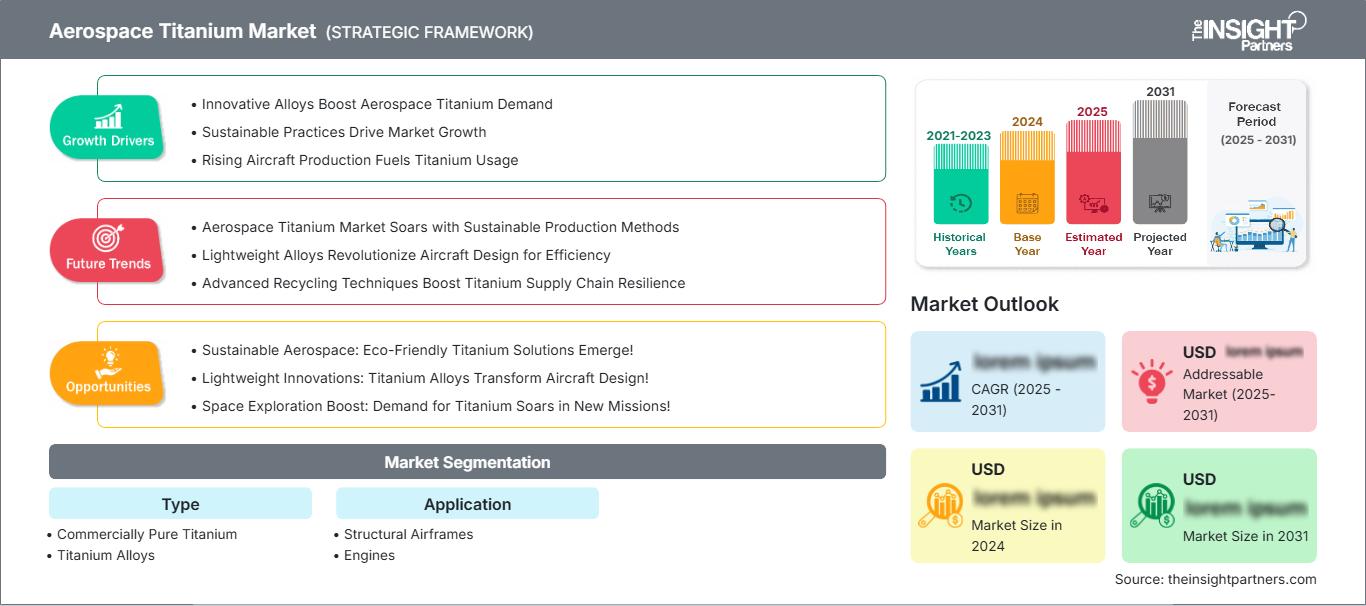
Aerospace Titanium Market: Strategic Insights
Regional Insights
North America Aerospace Titanium Market
The North American aerospace titanium market is anticipated to grow at a CAGR of 6.9–7.4% during 2026–2034 while occupying 36–40% of the global market share in 2025. The main factors boosting the market in the North American region include the availability of a complete ecosystem of aerospace manufacturing facilities, titanium melting and forging processes, as well as presence of major commercial aircraft and defense manufacturers. Demand for aerospace titanium will be driven by long-term efforts to enhance fleets through the development of engines and next-generation military aircraft.
In addition, the US and Canada actively invest in manufacturing technologies including advanced additive manufacturing, precision machining, and titanium recycling that allow improving titanium material efficiency and reliability of its supply chain. Long-term programs for the purchase of commercial aircraft and military platforms along with increasing MRO activity contribute to the stable consumption of titanium materials across the entire aerospace value chain. Cooperation between titanium processors, component manufacturers, scientific organizations, and aircraft OEMs helps to speed up alloy innovations and production process.
U.S. Aerospace Titanium Market
The US had a market share of 74-78% in 2025 and is estimated to have a CAGR of 7.0-7.5% up to 2034. America has one of the world's biggest manufacturing bases for aerospace equipment due to the presence of commercial aircraft manufacturers, defense companies, engine makers, and specialized titanium suppliers. Demand for lightweight structural elements, components of turbine engines, and aerospace fasteners continues growing and stimulates titanium usage.
Advancements in manufacturing with the use of forging, electron beam melting, additive manufacturing, and precise machining improve the process while lowering the time needed for production. Procurement of new generation fighter aircraft, transports, rotorcraft, and spacecraft expands the application potential of titanium alloys. Stringent requirements for suppliers along with long-term agreements with producers and OEMs support the leading position of the country in the international aerospace titanium market.
Europe Aerospace Titanium Market
In 2025, Europe occupied 24–28% of the worldwide market, and it is estimated to grow at a CAGR of 6.8–7.3% from 2026 to 2034. Germany leads in regional demand owing to its superior aerospace engineering and aerospace part manufacturing. Constant innovation and investments in aircraft lightweight construction and sustainable aviation help increase the use of titanium in various aerospace applications.
The UK has strong demand owing to engine production, defense aerospace programs, and advanced materials to support future propulsion systems. France provides substantial demand due to the manufacture of commercial aircraft and aerostructures, whereas Italy and Spain keep increasing their share in aerospace parts production, forgings, and European aerospace programs. Increasing use of 3D printing and titanium recycling will help in improving efficiency and reducing costs in regional aerospace production.
APAC Aerospace Titanium Market
The Asia Pacific region accounted for 28–32% of the global market share in 2025, and is expected to exhibit the highest CAGR of 8.0–8.6% from 2026 to 2034. This growth can be attributed to the increased production of indigenous aircraft in China and titanium processing capacity in both China and Japan and South Korea, which are leading suppliers of aerospace materials and engineered components.
India is building its aerospace manufacturing industry through government-sponsored localization policies, military procurement activities, and production of aircraft. The country of Australia is contributing through titanium processing and defense aviation applications.
Middle East & Africa Aerospace Titanium Market
The Middle East & Africa market is expected to grow at a CAGR of 6.2–6.8% during 2026–2034. Saudi Arabia and the UAE continue investing in aerospace manufacturing capabilities, aircraft maintenance infrastructure, and defense industrial development to diversify national economies beyond hydrocarbons.
South Africa remains an important regional contributor through specialized aerospace manufacturing and titanium mineral resources, while the Rest of MEA benefits from expanding aviation infrastructure and fleet modernization. Increasing government investments in aerospace industrialization are expected to strengthen regional demand for aerospace-grade titanium products.
Segmentation Analysis
Type
Titanium type selection is primarily influenced by structural performance, corrosion resistance, manufacturability, and operating temperature requirements across aerospace applications. While commercially pure titanium remains suitable for corrosion-sensitive components, titanium alloys dominate high-performance aircraft structures and propulsion systems because of their superior mechanical properties. The aerospace titanium market scope continues expanding as advanced alloy development enables greater weight reduction, improved fatigue performance, and compatibility with increasingly complex aircraft designs. The segment is projected to grow at a CAGR of 7.2–7.7% during 2026–2034.
- Commercially Pure Titanium: Preferred for applications requiring exceptional corrosion resistance, biocompatibility, and formability. Its excellent durability supports hydraulic systems, tubing, heat exchangers, and selected airframe components operating in aggressive aerospace environments.
- Titanium Alloys: Represent the dominant material category because of outstanding strength-to-weight ratio, fatigue resistance, fracture toughness, and elevated-temperature performance. These alloys are extensively used in airframes, engines, landing gear, structural fasteners, and rotating engine components.
Application
Application demand continues increasing alongside global aircraft production, fleet modernization, and engine efficiency improvements. Structural airframes account for substantial titanium consumption owing to widespread use in composite-intensive aircraft, while engine applications are expanding rapidly as manufacturers pursue higher operating temperatures and lower fuel consumption. The application segment is anticipated to register a CAGR of 7.5–8.0% during 2026–2034.
- Structural Airframes: Titanium provides exceptional structural strength, corrosion resistance, and compatibility with carbon-fiber composites, making it indispensable for fuselage structures, wing assemblies, landing gear, and primary load-bearing aircraft components.
- Engines: Increasing engine operating temperatures and efficiency requirements continue driving titanium adoption in compressor blades, discs, casings, and other critical propulsion components requiring superior mechanical strength and thermal stability.
Opportunity Snapshot
| Application | Revenue Contribution | Trend Tag | Adoption Stage |
|---|---|---|---|
| Structural Airframes | High | Composite Airframes | Mature |
| Engines | High | Efficient Propulsion | Scaling |
Aerospace Titanium Market Growth Drivers and Impact Analysis
Increasing production of fuel-efficient commercial aircraft
Commercial aircraft manufacturers continue increasing production rates to address substantial order backlogs and long-term fleet replacement requirements. Titanium plays a critical role in modern aircraft because its high strength-to-weight ratio, corrosion resistance, and compatibility with carbon-fiber composite structures enable significant weight reduction without compromising structural integrity. Airlines increasingly prioritize fuel-efficient aircraft to reduce operating costs and meet evolving environmental targets, encouraging OEMs to expand the use of titanium across fuselage sections, wing structures, landing gear, pylons, and engine components. Continuous investments in next-generation narrow-body and wide-body aircraft programs are strengthening demand for aerospace-grade titanium products throughout the supply chain. Rising global passenger traffic and increasing aircraft deliveries are expected to sustain long-term material consumption while encouraging additional investment in titanium processing, forging, and precision machining capabilities.
Growing demand for advanced military aviation platforms
Defense modernization programs across North America, Europe, and Asia Pacific continue increasing procurement of advanced fighter aircraft, transport aircraft, helicopters, unmanned aerial systems, and military engine platforms. These aircraft operate under demanding mechanical and thermal conditions that require lightweight materials capable of maintaining structural integrity throughout extended service lives. Titanium alloys offer excellent fatigue resistance, fracture toughness, and corrosion protection, making them indispensable for structural components and propulsion systems. Governments are simultaneously investing in domestic aerospace manufacturing capabilities to strengthen supply chain resilience and reduce dependence on imported strategic materials. As military fleets continue expanding and modernization programs accelerate, titanium consumption across defense aerospace manufacturing is expected to increase steadily throughout the forecast period.
Expansion of additive manufacturing for aerospace titanium components
Additive manufacturing is transforming aerospace titanium production by enabling complex geometries, lower material waste, shorter production cycles, and greater design flexibility compared with conventional machining methods. Aircraft manufacturers increasingly utilize titanium powder-based additive manufacturing for brackets, structural components, engine parts, and customized aerospace assemblies where weight optimization is essential. Improved process control, qualification standards, and powder metallurgy technologies are supporting broader commercialization of additive manufacturing across aerospace applications. The technology also reduces buy-to-fly ratios, improves raw material utilization, and enables localized production for specialized components. Continued investments in advanced manufacturing technologies are expected to improve supply chain efficiency while increasing the competitiveness of titanium suppliers serving commercial, defense, and space industries.
Aerospace Titanium Market Future Trends
Greater adoption of recycled titanium within aerospace manufacturing
Sustainability objectives are encouraging aircraft manufacturers and titanium processors to expand the use of recycled titanium feedstock while maintaining strict aerospace quality standards. The aerospace titanium market trends increasingly reflect investments in closed-loop recycling systems, advanced remelting technologies, and digital traceability platforms that improve raw material utilization without compromising metallurgical performance. Recycling initiatives help reduce production costs, lower energy consumption, and strengthen supply chain resilience against raw material volatility. As aerospace manufacturers continue pursuing carbon reduction targets, recycled titanium is expected to become an increasingly important source of certified aerospace-grade material throughout the forecast period.
Development of next-generation high-performance titanium alloys
Material innovation is expected to accelerate as aircraft manufacturers pursue lighter structures, higher engine operating temperatures, and improved fatigue performance. Research organizations and titanium producers are developing advanced alloy compositions that provide enhanced creep resistance, fracture toughness, corrosion resistance, and manufacturability. These materials are expected to support next-generation commercial aircraft, advanced military platforms, hypersonic systems, and space applications. Continued collaboration between alloy developers, aircraft OEMs, engine manufacturers, and research institutions will further expand the performance envelope of aerospace titanium products while supporting increasingly demanding aerospace engineering requirements.
Aerospace Titanium Market Opportunities
Localization of titanium processing and aerospace supply chains
Governments and aerospace manufacturers are increasing investments in regional titanium processing capabilities to improve supply chain security and reduce dependence on geographically concentrated raw material sources. Aerospace titanium market Forecasts indicate that localized melting, forging, machining, and finishing facilities will become increasingly important as commercial aircraft production expands globally. Companies establishing regional processing centers, strategic inventory hubs, and long-term partnerships with aircraft OEMs are expected to benefit from shorter delivery cycles, improved customer responsiveness, and greater resilience against geopolitical disruptions. Expansion into emerging aerospace manufacturing hubs also creates opportunities to strengthen local supplier ecosystems while supporting industrial development initiatives.
Expansion of titanium applications in advanced propulsion systems
Future aircraft propulsion technologies are expected to require increasingly sophisticated titanium solutions capable of operating under higher temperatures and more demanding mechanical loads. Advanced gas turbine engines, hybrid-electric propulsion architectures, hydrogen-powered aircraft, and reusable space launch systems will require materials offering superior strength, thermal stability, and corrosion resistance. Titanium producers investing in proprietary alloy development, precision manufacturing technologies, and collaborative engineering programs with engine manufacturers will be well positioned to capture new revenue opportunities. Continuous innovation in aerospace propulsion is therefore expected to expand titanium demand beyond traditional structural applications while supporting long-term market diversification.
Recent Developments
- July 31, 2025: ATI Inc. announced the extension and expansion of its long-term titanium products agreement with The Boeing Company. The agreement strengthens ATI's position as a strategic supplier of aerospace-grade titanium materials for Boeing's commercial aircraft programs and supports increasing production rates for next-generation aircraft. This development reinforces the growing demand for high-performance titanium products across the aerospace value chain.
- May 28, 2025: ATI Inc. signed a multi-year guaranteed-share titanium supply agreement with Airbus, significantly increasing its supply of aerospace titanium products for Airbus commercial aircraft programs. The agreement supports Airbus' production ramp-up strategy while strengthening supply chain resilience for critical aerospace titanium materials.
Frequently Asked Questions

- Comprehensive Market Sizing and Forecast Analysis
- Detailed Segmentation Analysis
- In-Depth Market Dynamics Assessment
- Regional and Country-Level Insights
- Competitive Landscape and Company Benchmarking
- Strategic Business Intelligence
Recent Reports
Testimonials

The Insight Partners' SCADA System Market report is comprehensive, with valuable insights on current trends and future forecasts. The team was highly professional, responsive, and supportive throughout. We are very satisfied and highly recommend their services.
RAN KEDEM Partner, Reali Technologies LTDs
I requested a report on a very specific software market and the team produced the report in a few days. The information was very relevant and well presented. I then requested some changes and additions to the report. The team was again very responsive and I got the final report in less than a week.
JEAN-HERVE JENN Chairman, Future Analytica
We worked with The Insight Partners for an important market study and forecast. They gave us clear insights into opportunities and risks, which helped shape our plans. Their research was easy to use and based on solid data. It helped us make smart, confident decisions. We highly recommend them.
PIYUSH NAGPAL Sr. Vice President, High Beam Global
The Insight Partners delivered insightful, well-structured market research with strong domain expertise. Their team was professional and responsive throughout. The user-friendly website made accessing industry reports seamless. We highly recommend them for reliable, high-quality research services
YUKIHIKO ADACHI CEO, Deep Blue, LLC.
This is the first time I have purchased a market report from The Insight Partners.While I was unsure at first, I visited their web site and felt more comfortable to take the risk and purchase a market report.I am completely satisfied with the quality of the report and customer service. I had several questions and comments with the initial report, but after a couple of dialogs over email with their analyst I believe I have a report that I can use as input to our strategic planning process.Thank you so much for taking the extra time and making this a positive experience.I will definitely recommend your service to others and you will be my first call when we need further market data.
JOHN SUZUKI President and Chief Executive Officer, Board Director, BK Technologies
I wish to appreciate your support and the professionalism you displayed in the course of attending to my request for information regarding to infectious disease IVD market in Nigeria. I appreciate your patience, your guidance, and the fact that you were willing to offer a discount, which eventually made it possible for us to close a deal. I look forward to engaging The Insight Partners in the future, all thanks to the impression you have created in me as a result of this first encounter.
DR CHIJIOKE ONYIA MANAGING DIRECTOR, PineCrest Healthcare Ltd.Reason to Buy
- Informed Decision-Making
- Understanding Market Dynamics
- Competitive Analysis
- Identifying Emerging Markets
- Customer Insights
- Market Forecasts
- Risk Mitigation
- Boosting Operational Efficiency
- Strategic Planning
- Investment Justification
- Tracking Industry Innovations
- Aligning with Regulatory Trends





 Get Free Sample for