
Agriculture IoT Market Size, Share & Forecast by 2034
Coverage: By Offering (Hardware, Software, Services); Agriculture Type (Precision Farming, Precision Forestry, Livestock Monitoring, Fish Farm Monitoring, Smart Greenhouse, Others) , and Geography (North America, Europe, Asia Pacific, and South and Central America)
- Status : Data Released
- Report Code : TIPRE00017532
- Category : Electronics and Semiconductor
- No. of Pages : 150
- Available Report Formats :


- Last update date : July 16, 2026


2025 Market Size
US$ 31.4 Bn
Base year value
2034 Forecast
US$ 85.45 Bn
Projected by 2034
CAGR 2026-2034
11.77 %
Growth rate
Addressable Market
US$ 513.54 Bn
(2026-2034)
The Agriculture IoT Market is projected to grow from US$ 31.4 Billion in 2025 to US$ 85.45 Billion by 2034, registering a CAGR of 11.77% during 2026–2034. Adoption is widening as farms combine connected sensors, automation, cloud analytics, and machine guidance to improve input efficiency, livestock visibility, and controlled-environment production across commercial agriculture systems.
North America remains a structurally advanced market, supported by large-scale mechanized farms, established precision agriculture service networks, and strong equipment replacement cycles. The region is estimated to expand at a CAGR of 10.8–11.6% through 2034, as growers prioritize yield protection, lower chemical use, labor substitution, and connected machinery interoperability across row crops, dairy, specialty crops, and greenhouse operations, according to the Agriculture IoT Market Report.
Agriculture IoT Market Assessment and Insights
- North America: Share in 2025 is estimated at 34–37%, with CAGR between 2026–2034 of 10.8–11.6%, reflecting connected machinery penetration, dealer-led service coverage, and high-value crop automation.
- US: Share in 2025 represents 78–82% of North America, growing at a CAGR between 2026–2034 of 10.6–11.4% as large farms accelerate guidance, telemetry, and livestock analytics.
- Europe: Share in 2025 is estimated at 22–25%, with CAGR between 2026–2034 of 10.2–11.0%; Germany, France, the UK, Italy, and Spain lead adoption across dairy, vineyards, orchards, and regulated input management.
- Asia Pacific: Share in 2025 is estimated at 25–28%, with CAGR between 2026–2034 of 12.8–13.6%; China, India, Japan, South Korea, and Australia drive connected irrigation, greenhouse, and aquaculture deployments.
- Largest Segment: Hardware holds a market share of 46–50% in 2025 and records a CAGR of 10.5–11.3% as sensors, controllers, gateways, drones, and guidance units anchor field-level digitization.
- High Growth Segment: Smart Greenhouse accounts for 10–13% market share in 2025 and grows at a CAGR of 13.5–14.3%, supported by climate automation, fertigation control, and urban horticulture.
- Key companies analyzed in detail: Ag Leader Technology, AGCO Corporation, Deere & Company, DeLaval International AB, eFarmer B.V., emlix GmbH, Farmers Edge Inc., Field Group AS, CNH Industrial N.V., Trimble Inc., and Topcon Corporation.
Source: The Insight Partners' analysis based on proprietary research, government publications, company annual reports, investor presentations, industry databases, and expert interviews.
The Agriculture IoT Market has progressed from using standalone farm sensors to adopting integrated operating systems with machinery, weather data, soil information, irrigation controls, livestock tracking, and enterprise planning. Changes in production dynamics will come in the form of quantifiable benefits arising from variable rate application, predictive maintenance, and automated equipment usage. Leading suppliers are no longer those providing stand-alone devices but providers of hardy hardware, software packages for agriculture, dealer networks, and data services.
Further growth of the market will depend on the development of food security policies in Asia and the Middle East, mandatory water efficiency, and investments in controlled agriculture. The policy side is geared towards combining digital agriculture and climate change resilience, whereas agribusiness is investing in data platforms used for traceability and sustainability reporting. Therefore, Agriculture IoT encompasses more than farm productivity.
Agriculture IoT Market Report Scope
| Report Attribute | Details |
|---|---|
| Market size in 2025 | US$ 31.4 Billion |
| Market Size by 2034 | US$ 85.45 Billion |
| Global CAGR (2026 - 2034) | 11.77% |
| Historical Data | 2021-2024 |
| Forecast period | 2026-2034 |
Agriculture IoT Market Analysis
Demand is rising because farms must produce more output from constrained land, water, labor, and input budgets. FAO food security projections and national climate programs reinforce the need for yield improvement without proportional resource expansion. Connected soil probes, weather stations, GNSS receivers, livestock sensors, and automated irrigation nodes give growers the field intelligence required for practical Agriculture IoT analysis and day-to-day decisions.
The Agriculture IoT Market share is supported by an ecosystem that includes equipment OEMs, sensor manufacturers, connectivity providers, cloud platforms, agronomists, dealers, insurers, and farm operators. Vendor supply favors firms able to integrate machines in diversified fleets, maintain high data quality, and ensure service availability in planting, spraying, harvesting, and milking seasons, where interruptions have a direct economic impact on farms.
The industry has been concentrating its efforts on full-stack precision platforms. Deere & Company specializes in machine integration and automation; AGCO Corporation and Trimble Inc. develop retrofit precision solutions; CNH Industrial N.V. merges precision functions of Raven; DeLaval International AB specializes in milk analysis; Farmers Edge Inc. offers managed digital agriculture services; and Ag Leader Technology, Topcon Corporation, eFarmer B.V., emlix GmbH, and Field Group AS focus on specific guidance, software, embedded, and remote sensing solutions.
The Agriculture IoT Market size is being shaped by investment moving toward AI-enabled agronomy, autonomous equipment, resilient positioning, and enterprise software that converts field data into financial and compliance outcomes. Strategic positioning increasingly depends on recurring software revenue, dealer enablement, agronomic credibility, and open integration. This favors platforms that improve Agriculture IoT growth while reducing adoption friction for mid-size and large commercial farms.
● REPORT CUSTOMIZATION
Tailor This Report To Align With Your Specific Business Requirements
This report can be customized to align precisely with your business objectives, scope, and target markets. Customization options include tailored segmentation, geography, competitive analysis, and strategic insights to support informed decision-making.
Customize This Report →WHAT YOU CAN ADJUST
- ● Segmentations
- ● Geography
- ● Competitive Analysis
- ● Language Preferences
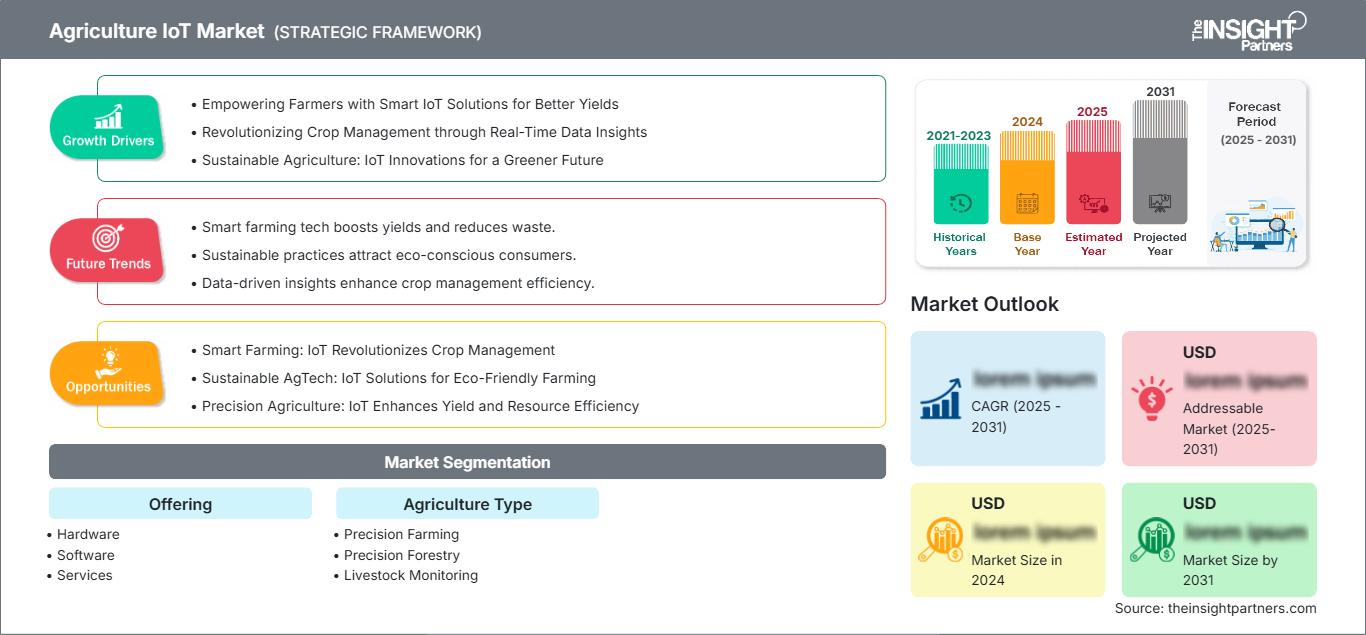
Agriculture IoT Market: Strategic Insights
Regional Insights
North America Agriculture IoT Market
North America holds a 34–37% share in 2025 in the Agriculture IoT Market Forecast and is forecast to expand at a 10.8–11.6% CAGR through 2034. Adoption is concentrated in row crops, dairy, and specialty crops, where growers already use GPS guidance, yield mapping, variable-rate application, and connected irrigation. The Agriculture IoT Market is reinforced by equipment financing, dealer networks, and high labor costs.
Structural drivers include farm consolidation, drought management, and demand for verifiable sustainability data from processors and retailers. Canada contributes through grain and livestock operations, while Mexico adds controlled-environment agriculture and water-saving irrigation demand. Regional buyers prioritize reliability, service availability, and compatibility with existing machinery fleets.
U.S. Agriculture IoT Market
The U.S. accounts for 78–82% of North America in 2025 and is expected to grow at a 10.6–11.4% CAGR during 2026–2034. Large corn, soybean, wheat, cotton, dairy, and specialty crop operations create strong demand for connected planters, sprayers, guidance displays, and livestock monitoring systems.
Company presence is deep, with Deere & Company, AGCO Corporation, Ag Leader Technology, Trimble Inc., CNH Industrial N.V., and Farmers Edge Inc. serving growers through dealers, software platforms, and managed services. Application trends favor autonomy-ready retrofit kits, input optimization, insurance analytics, and data-led sustainability reporting, reflecting key developments in Agriculture IoT Market Trends.
Europe Agriculture IoT Market
Europe holds a 22-25% market share in 2025 and is expected to grow at a CAGR of 10.2-11.0%. In the UK, the main drivers include labor shortage, input management, and integration of livestock and crop farms to improve traceability. The farmers also deploy connected weather, irrigation, and field mapping solutions to handle climate volatility and compliance issues.
The main driver in Germany includes advanced machine manufacturing, good cooperatives, and earlier adoption of precision agriculture practices in grains, oilseeds, dairy, and biogas-based agriculture. The Germans look for interoperable equipment, high-quality services, and chemical and fertilizer reduction.
France, Italy, and Spain create additional demand via their vineyards, orchards, greenhouse vegetables, and drought-prone agriculture. In France, there is a focus on agronomy data and wide acreage optimization; in Italy, the emphasis is on specialty crop automation; in Spain, irrigation efficiency and greenhouse climate control.
APAC Agriculture IoT Market
APAC region captures 25-28% market share in 2025, and it is the fastest growing region with a CAGR of 12.8%-13.6%. China is leading due to the digitization of smart greenhouses, livestock, and machinery. On the other hand, Japan and South Korea are leading in robotics, controlled environment, and precision monitoring owing to aging farmers.
The drivers behind India’s Agriculture IoT trends are due to the aggregation of smallholder farmers, smart irrigation, weather advisories, and government-led digital agriculture infrastructure. Additionally, Australia includes telematics and guidance systems in large farming operations and water management in agricultural operations.
The policy drivers are due to food security, digitalization in rural areas, water conservation, and supply chain traceability. The industrial drivers are due to reduced sensor cost, satellite connectivity and platform development.
Middle East & Africa Agriculture IoT Market
Middle East & Africa, although comparatively small in size, plays a strategic role with its CAGR lying between 11.4-12.2%. Adoption in the Middle East region has been led by Saudi Arabia using controlled environment farming, water-saving irrigation, and food security measures. The United Arab Emirates' adoption revolves around smart greenhouses, vertical farming, and automation of fertigation to decrease import dependency.
Adoption in the rest of MEA is uneven due to variability in infrastructure and connectivity. Availability of energy, desalination, agriculture, and food security programs would be key for future adoption.
Segmentation Analysis
Offering
The Offering segment is projected to grow at an 11.2–12.0% CAGR during 2026–2034 as farms combine connected devices, analytics subscriptions, and implementation support. Hardware remains the spending anchor, but software and services are gaining importance because users need decision-ready dashboards, data integration, cybersecurity, and remote diagnostics to convert sensor readings into operational improvement.
- The hardware is the biggest spending pool since sensors, controllers, gateways, drones, GNSS systems, tags, and machinery components need to be implemented before the analytics can deliver farm value.
- The software market is growing since farms combine weather, crop, livestock, irrigation, and equipment information into dashboards that enable prescriptions, alerts, traceability, and enterprise planning.
- Services are critical since installation, calibration, agronomic consultancy, network management, and training minimize the risks of adoption for farms that do not have dedicated digital agriculture departments.
Agriculture Type
The Agriculture Type segment is forecast to grow at an 11.7–12.5% CAGR during 2026–2034. Precision farming remains the broadest application, while livestock monitoring, fish farm monitoring, precision forestry, and smart greenhouse systems create specialized demand. Adoption is shaped by asset intensity, production risk, labor availability, and the economic value of real-time monitoring in each agricultural environment.
- Precision Farming is first because of connected machines, soil sensing, yield mapping, and variable rate prescriptions, which impact seed, fertilizer, crop protection, fuel, and labor economics.
- Precision Forestry is becoming relevant because of the use of remote sensing, telematics, and environmental sensors to enhance harvesting planning, asset management, compliance, and monitoring of forest health.
- Livestock Monitoring helps improve animal health, fertility, efficiency of food consumption, and their location using wearables, cameras, milking sensors, and analytics platforms used by dairy and meat companies.
- Fish Farm Monitoring is critical for improving water quality, oxygen regulation, optimization of food intake, biomass monitoring, and minimizing the chances of diseases within aquaculture firms operating under increasing demands for productivity and sustainability.
- Smart Greenhouse systems utilize sensors, LED lights, heating, ventilation, air conditioning, and climate monitoring to regulate yield and reduce water consumption in greenhouses for high-value vegetables, flowers, and seedlings.
Opportunity Snapshot
| Agriculture Type | Revenue Contribution | Trend Tag | Adoption Stage |
| Precision Farming | High | Variable Rate | Mature |
| Precision Forestry | Low | Remote Mapping | Emerging |
| Livestock Monitoring | Medium | Herd Analytics | Scaling |
| Fish Farm Monitoring | Medium | Water Quality | Scaling |
| Smart Greenhouse | Medium | Climate Control | Scaling |
Agriculture IoT Market Growth Drivers and Impact Analysis
Rising Need for Input Efficiency and Yield Stability
Connective farming can now become an effective solution to changing fertilizer, water, energy, and labor prices. Irrigation, soil moisture, weather stationing, and variable rate technologies make it possible to use any resource only when there is a need for it on the ground. The effect is most significant in water-scarce zones and mechanized operations, where any reduction, even in percentages, will contribute to improving margins. When food processors and retailers ask for the sustainability of supplies, agricultural data can be considered as business information as well.
Automation Demand from Labor Constraints
Agricultural labor availability remains structurally tight in developed markets and increasingly uneven in emerging regions. IoT platforms help automate repetitive monitoring, reduce manual field scouting, and support autonomous or semi-autonomous equipment. In dairy, connected milking and animal health systems reduce dependence on constant human observation. In crop production, machine telemetry and guidance improve utilization during short planting and harvesting windows. The market impact is a stronger business case for retrofits, service contracts, and connected equipment upgrades, especially where farms cannot expand acreage or herd size without technology-enabled productivity gains.
Policy Support for Sustainable and Traceable Farming
Governments and food sector players have started associating agricultural investment with reductions in emissions, water savings, and traceability. Data generated by the Internet of Things devices can be used to manage nutrients, ensure animal welfare, manage pesticides, participate in carbon initiatives, and validate crop insurance. This creates a need beyond productivity for farms, as the data will help in improving market access and lowering the burden of audits. The greatest potential lies in solutions that transform sensor-generated data into credible and standardized reports. With increasing climate risks, policy-backed digital agriculture will drive the Agriculture IoT Market growth.
Agriculture IoT Market Future Trends
AI-Orchestrated Farm Operating Systems
The next phase of Agriculture IoT Market development will center on farm operating systems that blend agronomic models, machine data, weather forecasting, imagery, and financial planning. Instead of separate dashboards for irrigation, planting, spraying, livestock, and inventory, growers will expect decision engines that recommend tasks, quantify trade-offs, and trigger equipment workflows. AI will not replace agronomists; it will improve their scale by converting continuous field data into prioritized actions. Vendors that earn trust through transparent recommendations, data ownership controls, and measurable outcomes will shape future Agriculture IoT trends.
Resilient Connectivity for Remote Production Zones
Connectivity is going to be the key strategic discriminator as sensors are deployed in increasing numbers on remote farms, forests, pastures, aquaculture facilities, and greenhouses. The deployment of low-power wide-area networks, private networking technologies, satellites, and edge computing will lower the dependency on uninterrupted broadband connections. In the future, there would be an increase in processing of data closer to the field device, whereby only alerts and analytics will be transferred to the cloud platform. The significance of this issue lies in the fact that high-value farms do not have access to terrestrial networks.
Agriculture IoT Market Opportunities
Retrofit Solutions for Mixed-Fleet Farms
Many farms operate equipment from different brands and cannot justify replacing entire fleets to access digital features. Retrofit guidance, sensing, autonomy, and data modules, therefore, represent a scalable opportunity. Suppliers that can install across mixed machinery, maintain compatibility with existing implements, and provide local service can reach growers who are technologically interested but capital-constrained. The investment priority is modular architecture supported by dealer training and financing. This opportunity can widen Agriculture IoT Market penetration because it lowers the adoption threshold while still generating recurring software and service revenue.
Data Services for Insurers, Lenders, and Food Companies
Farm-level IoT data has value beyond operational decisions. Insurers can improve risk assessment and claims validation; lenders can evaluate production resilience; and food companies can verify sustainability, origin, and quality attributes. The opportunity is to build consent-based data services that aggregate field evidence without undermining farmer control. Providers with agronomic credibility, secure architecture, and clear value sharing will be positioned to monetize analytics across the wider agricultural ecosystem. This approach strengthens Agriculture IoT Market resilience by diversifying revenue beyond hardware sales cycles.
Recent Developments
- May 2026: DeLaval has expanded its BioSensors portfolio with Milk Solids Analysis, a new biosensor for the DeLaval VMS V300. Using near‑infrared spectroscopy, the system automatically measures fat, protein, and lactose during milking with high accuracy and without the need for manual sampling or consumables such as chemicals or test reagents.
- March 2025: Trimble and PTx Trimble announced the availability of Trimble IonoGuard for the precision agriculture industry. IonoGuard is a next-generation technology engineered to enhance RTK GNSS signal tracking and hardware positioning performance. IonoGuard helps ensure more reliable and accurate positioning by reducing the risk of signal loss and maintaining signal integrity during challenging ionospheric conditions.
- February 2025: Farmers Edge, a premier agricultural technology provider, announced its role in powering Conduit’s online platform. Conduit is connecting customers with solutions that optimize profitability across the ag supply chain. Through its Managed Technology Services, Farmers Edge provides the back-end technology essential to the creation, functionality, and scalability of the platform. Launched in April 2024, Conduit aims to transform ag financing and provide technological solutions to its customers to increase their profitability.
Frequently Asked Questions

- Comprehensive Market Sizing and Forecast Analysis
- Detailed Segmentation Analysis
- In-Depth Market Dynamics Assessment
- Regional and Country-Level Insights
- Competitive Landscape and Company Benchmarking
- Strategic Business Intelligence
Recent Reports
Testimonials

The Insight Partners' SCADA System Market report is comprehensive, with valuable insights on current trends and future forecasts. The team was highly professional, responsive, and supportive throughout. We are very satisfied and highly recommend their services.
RAN KEDEM Partner, Reali Technologies LTDs
I requested a report on a very specific software market and the team produced the report in a few days. The information was very relevant and well presented. I then requested some changes and additions to the report. The team was again very responsive and I got the final report in less than a week.
JEAN-HERVE JENN Chairman, Future Analytica
We worked with The Insight Partners for an important market study and forecast. They gave us clear insights into opportunities and risks, which helped shape our plans. Their research was easy to use and based on solid data. It helped us make smart, confident decisions. We highly recommend them.
PIYUSH NAGPAL Sr. Vice President, High Beam Global
The Insight Partners delivered insightful, well-structured market research with strong domain expertise. Their team was professional and responsive throughout. The user-friendly website made accessing industry reports seamless. We highly recommend them for reliable, high-quality research services
YUKIHIKO ADACHI CEO, Deep Blue, LLC.
This is the first time I have purchased a market report from The Insight Partners.While I was unsure at first, I visited their web site and felt more comfortable to take the risk and purchase a market report.I am completely satisfied with the quality of the report and customer service. I had several questions and comments with the initial report, but after a couple of dialogs over email with their analyst I believe I have a report that I can use as input to our strategic planning process.Thank you so much for taking the extra time and making this a positive experience.I will definitely recommend your service to others and you will be my first call when we need further market data.
JOHN SUZUKI President and Chief Executive Officer, Board Director, BK Technologies
I wish to appreciate your support and the professionalism you displayed in the course of attending to my request for information regarding to infectious disease IVD market in Nigeria. I appreciate your patience, your guidance, and the fact that you were willing to offer a discount, which eventually made it possible for us to close a deal. I look forward to engaging The Insight Partners in the future, all thanks to the impression you have created in me as a result of this first encounter.
DR CHIJIOKE ONYIA MANAGING DIRECTOR, PineCrest Healthcare Ltd.Reason to Buy
- Informed Decision-Making
- Understanding Market Dynamics
- Competitive Analysis
- Identifying Emerging Markets
- Customer Insights
- Market Forecasts
- Risk Mitigation
- Boosting Operational Efficiency
- Strategic Planning
- Investment Justification
- Tracking Industry Innovations
- Aligning with Regulatory Trends





 Get Free Sample for