
Air Cargo Security and Screening Systems Market Growth Opportunities and Forecast by 2034
Coverage: By Cargo Size (Small Parcel, Break and Pallet Cargo, and Oversized Cargo), Technology [X-ray systems, ETD (explosives trace detection), EDS (explosive detection system), and Others], Application (Narcotics detection, Explosive detection, Metal and contraband detection, and Others), and Geography
- Status : Data Released
- Report Code : TIPRE00016484
- Category : Electronics and Semiconductor
- No. of Pages : 150
- Available Report Formats :


- Last update date : July 15, 2026


2025 Market Size
US$ 929.59 Mn
Base year value
2034 Forecast
US$ 1,452.23 Mn
Projected by 2034
CAGR 2026-2034
5.1 %
Growth rate
Addressable Market
US$ 10,817.41 Mn
(2026-2034)
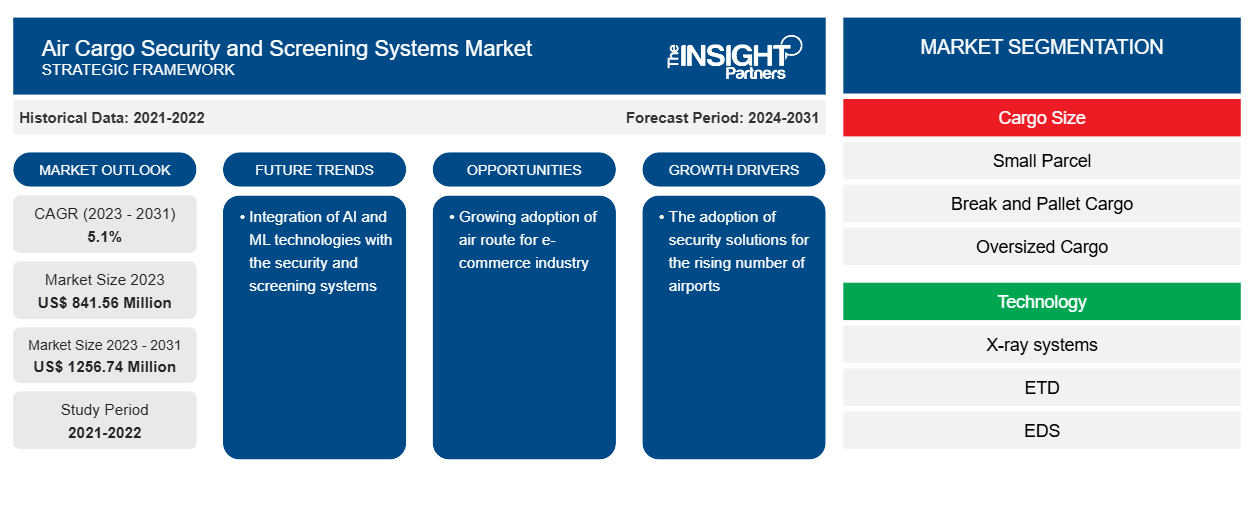
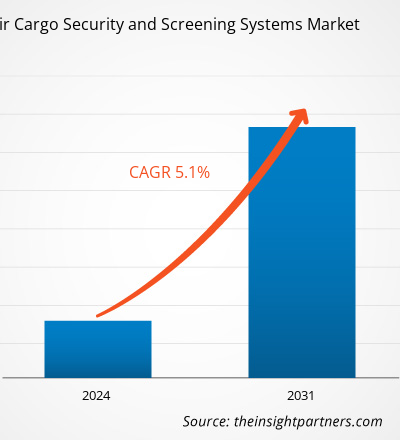
The Air Cargo Security and Screening Systems Market was valued at US$ 929.59 Million in 2025 and is projected to reach US$ 1,452.23 Million by 2034, advancing at a CAGR of 5.1% from 2026 to 2034. The Air Cargo Security and Screening Systems Market is being shaped by certified screening mandates, wider airfreight use, and adoption of X-ray systems, ETD, and EDS technologies across regulated cargo networks.
North America is expected to remain a major revenue base, with an estimated CAGR of 4.7%–5.4% during 2026–2034. Demand is supported by TSA-led compliance, high express-parcel density, passenger-aircraft cargo screening requirements, and modernization of certified cargo screening facilities. The region also benefits from established service networks and procurement discipline among airports, freight forwarders, integrators, and third-party logistics operators. The Air Cargo Security and Screening Systems Market report highlights these factors as key contributors to sustained demand and technology adoption across the region.
Air Cargo Security and Screening Systems Market Assessment and Insights
- North America and US: 31%–36% share, 4.7%–5.4% CAGR, US 80%–86% of region, 4.8%–5.6% CAGR, driven by TSA compliance and express hubs.
- Europe: 22%–27% share, 4.4%–5.1% CAGR, Germany, UK, France lead certified airport and regulated-agent upgrades.
- Asia Pacific: 28%–34% share, 5.8%–6.6% CAGR, China, Japan, India benefit from e-commerce, exports, and airport expansion.
- Largest Segment: Break and Pallet Cargo, 4.9%–5.6% CAGR, driven by consolidated freight and high-penetration screening requirements.
- High Growth Segment: EDS, 6.1%–6.9% CAGR, supported by CT-based automation and stricter explosive detection assurance.
- Key companies analyzed in detail: Astrophysics Inc.; Dhonaadhi Hitec Innovations Pvt. Ltd.; Krystalvision Image Systems Pvt. Ltd.; Nuctech Company Limited; Rapiscan Systems, Inc.; Safran S.A.; EAS Envimet Analytical Systems Ges.m.b.H.; Safeway Inspection System Limited; Smiths Detection Group Ltd.; OSI Systems, Inc.
Source: The Insight Partners' analysis based on proprietary research, government publications, company annual reports, investor presentations, industry databases, and expert interviews.
The Air Cargo Security and Screening Systems Market has moved from stand-alone inspection lanes toward layered, data-enabled screening ecosystems. Operators now assess tunnel dimensions, penetration power, material discrimination, false-alarm performance, operator workload, and integration with warehouse flows. IATA reported record 2025 cargo volumes after a 3.4% demand increase, reinforcing pressure on systems that preserve throughput while meeting aviation security rules. Production is shifting toward modular CT, dual-view X-ray, trace detection, and service-led lifecycle support.
Forward demand will be strongest in APAC and the Middle East, where cargo cities, airport privatization, and free-trade logistics zones are expanding inspection capacity. Regulators are expected to demand stronger explosive detection evidence, traceability, and digital audit trails, encouraging the replacement of legacy assets. The Air Cargo Security and Screening Systems Market growth outlook also reflects investment in remote screening, AI-assisted image review, and integrated workflows that reduce cargo dwell time without weakening detection confidence.
Air Cargo Security and Screening Systems Market Report Scope
| Report Attribute | Details |
|---|---|
| Market size in 2025 | US$ 929.59 Million |
| Market Size by 2034 | US$ 1,452.23 Million |
| Global CAGR (2026 - 2034) | 5.1% |
| Historical Data | 2021-2024 |
| Forecast period | 2026-2034 |
Air Cargo Security and Screening Systems Market Analysis
Demand is driven by express parcels, international mail, pharmaceuticals, electronics, perishables, and high-value cargo moving through passenger and freighter networks. IATA’s 2025 cargo demand increase and continued yield premium versus 2019 support screening investment because higher volumes expose bottlenecks in acceptance, consolidation, and release processes. The Air Cargo Security and Screening Systems Market size is therefore tied to throughput, compliance assurance, and the ability to inspect mixed freight without excessive unpacking.
The ecosystem includes equipment manufacturers, X-ray source suppliers, software developers, regulators, airport operators, freight forwarders, handlers, integrators, customs authorities, and maintenance partners. Supply dynamics favor vendors that can certify systems, provide spare parts, train screeners, and document detection performance. Competitive intensity is rising as buyers evaluate lifecycle cost, uptime, tunnel size, image clarity, alarm resolution, and compatibility with automated cargo handling.
The competitive landscape includes global specialists and regional manufacturers. Smiths Detection Group Ltd. and Rapiscan Systems, Inc. compete through certified aviation platforms, while OSI Systems, Inc. benefits from broad inspection and service contracts. Nuctech Company Limited, Astrophysics Inc., Safran S.A., Safeway Inspection System Limited, EAS Envimet Analytical Systems Ges.m.b.H., Krystalvision Image Systems Pvt. Ltd., and Dhonaadhi Hitec Innovations Pvt. Ltd. address different prices, technology, and localization requirements. The Air Cargo Security and Screening Systems Market forecast indicates continued demand for advanced screening technologies, automation, regulatory compliance, and cargo inspection solutions as global air freight volumes and security requirements increase.
Investment trends favor CT-based EDS, high-energy dual-view X-ray, nonradioactive ETD, remote image review, and AI-supported operator assistance. Strategic positioning increasingly depends on proof of compliance, measurable false-alarm reduction, and service responsiveness. The Air Cargo Security and Screening Systems Market forecast indicates that vendors selling integrated screening workflows, not only equipment, will capture stronger replacement and greenfield opportunities.
● REPORT CUSTOMIZATION
Tailor This Report To Align With Your Specific Business Requirements
This report can be customized to align precisely with your business objectives, scope, and target markets. Customization options include tailored segmentation, geography, competitive analysis, and strategic insights to support informed decision-making.
Customize This Report →WHAT YOU CAN ADJUST
- ● Segmentations
- ● Geography
- ● Competitive Analysis
- ● Language Preferences
Air Cargo Security and Screening Systems Market: Strategic Insights
Regional Insights
North America Air Cargo Security and Screening Systems Market
North America holds an estimated 31%–36% share in 2025 and is projected to grow at 4.7%–5.4% through 2034. Demand is anchored in TSA-certified cargo screening, integrator hubs, cross-border trade, pharmaceutical logistics, and high express-parcel density. Buyers emphasize certified systems, maintenance coverage, and screening lanes that protect shipment service levels.
The region also shows a high replacement component because many operators must upgrade legacy X-ray assets to improve penetration, image review, and auditability. The Air Cargo Security and Screening Systems Market share in North America is supported by established suppliers, airport cargo redevelopment, and regulated agent networks that require dependable screening for parcels, pallets, and dense freight.
U.S. Air Cargo Security and Screening Systems Market
The U.S. is responsible for about 80%–86% of demand from North America and will experience a growth of 4.8%–5.6%. Growth factors include security regulations for cargo transported on passenger aircraft, express superhubs, airport cargo facility modernization, and freight forwarders who screen consolidated cargo before forwarding it to the airlines.
Company representation is well established in Rapiscan Systems, Inc., Astrophysics Inc., Smiths Detection Group Ltd., and OSI Systems, Inc. Application focus areas include explosive detection systems, drug interdiction, metal and contraband detection, and remote image analysis. Decisions on purchase now emphasize certified throughput, field service, training of operators, and software alarm resolution.
Europe Air Cargo Security and Screening Systems Market
Europe holds an estimated 22%–27% share in 2025 and is likely to grow at 4.4%–5.1%. Germany leads because of industrial exports, airport cargo scale, automotive logistics, and disciplined security compliance. Buyers prioritize ECAC-aligned systems, upgrade routes, and stable service support.
The UK benefits from dense international freight links, Heathrow-area logistics, pharmaceuticals, and express parcels. Its operators are focused on resilient screening capacity, lower false alarms, and continuity during peak cargo cycles. Replacement demand is strongest where older equipment limits digital records or efficient alarm escalation. The Air Cargo Security and Screening Systems Market is supported by these requirements as operators continue upgrading screening infrastructure and compliance capabilities.
France, Italy, and Spain contribute through aerospace corridors, luxury goods, perishables, and gateway cargo flows. France emphasizes secure logistics around Paris and aviation manufacturing supply chains. Italy requires flexible systems for high-value exports, while Spain benefits from trade connections with Latin America and North Africa.
APAC Air Cargo Security and Screening Systems Market
APAC holds an estimated 28%–34% share and is forecast to grow at 5.8%–6.6%, the highest regional range. China leads through large cargo airports, manufacturing exports, cross-border e-commerce, and domestic equipment capacity, represented by Nuctech Company Limited.
Japan and South Korea emphasize reliable inspection for electronics, automotive parts, pharmaceuticals, and express shipments. India and Australia add momentum through airport privatization, logistics parks, and customs modernization. The Air Cargo Security and Screening Systems Market trends in APAC favor compact X-ray, pallet systems, and trace detection workflows.
Middle East & Africa Air Cargo Security and Screening Systems Market
MEA growth rate forecast is estimated at 4.9%-5.7%, where the UAE will lead in technology adoption across the region. Saudi Arabia and the UAE will be growing their airport facilities, logistics parks, and energy-based cargo corridors, which would create opportunities for pallet scanners, EDS, ETD, and cargo security solutions.
In South Africa and other MEA countries, selective modernization efforts will take place around the major airports, improved customs procedures, and multinational logistics providers. Funding concerns can hamper wide-scale implementation, but trade facilitation, infrastructure projects, and security issues will drive long-term implementation. Availability of services and training is a key procurement driver.
Segmentation Analysis
Cargo Size
Cargo Size is projected to grow at 4.8%–5.5% during 2026–2034 as operators adapt screening lanes to parcel density, pallet consolidation, and irregular freight. Selection depends on tunnel size, penetration power, floor space, and handling design. The Air Cargo Security and Screening Systems scope across cargo size is strongest where freight profiles shift daily between express parcels, consolidated pallets, and oversized industrial shipments.
- Small Packages: The demand for this segment is influenced by the growth of e-commerce, security of the mail, and couriers who require rapid X-ray examination, image enhancement, and portable units to enable effective sorting operations.
- Break and Pallet Cargo: The sub-segment holds a dominant position due to the need for consolidated cargo that requires large tunnels, high penetrability, and consistent scanning without having to break down loads.
- Oversized Cargo: Systems have been created for project cargo, aerospace components, and other irregular cargo.
Technology
Technology is expected to grow at 5.0%–5.8% as buyers combine rapid imaging with trace confirmation and automated explosive detection. X-ray systems remain the installed-base backbone, while ETD supports secondary checks, and EDS adds higher assurance for dense cargo. Procurement increasingly weighs software capability, certification status, operator productivity, and integration with remote image review.
- X-ray systems: The use of X-ray systems is still prevalent due to their ability to quickly image, discriminate materials, and scale systems for parcel, pallet, and mixed load scanning applications.
- ETD: ETD is helpful in resolving alarms or performing targeted sampling of trace explosives or narcotics. This system can be useful when there is a need for follow-up imaging.
- EDS: EDS systems are gaining popularity where there is a need for CT automated systems, explosives detection assurance, and improved auditability of dense cargo traffic.
Application
Application is projected to grow at 5.1%–5.9%, reflecting the need to detect explosives, narcotics, metals, and prohibited goods without delaying cargo release. Explosive detection remains the compliance anchor, while narcotics and contraband screening are gaining strategic weight in parcels and cross-border freight. The segment outlook depends on integrated workflows that combine imaging, trace detection, and risk-based inspection.
- Narcotics detection: Adoption is increasing in express parcels, mail, and cross-border shipments where operators combine X-ray interpretation, ETD sampling, and intelligence-led inspection.
- Explosive detection: This remains the highest-priority application because aviation security mandates require dependable identification of threat materials before cargo enters aircraft operations.
- Metal and contraband detection: Demand supports customs enforcement, supply-chain security, and prevention of prohibited items moving through high-speed cargo and postal networks.
Opportunity Snapshot
| Application | Revenue Contribution | Trend Tag | Adoption Stage |
| Narcotics detection | Medium | Parcel interdiction | Scaling |
| Explosive detection | High | Certified EDS | Mature |
| Metal and contraband detection | Medium | Customs screening | Scaling |
Air Cargo Security and Screening Systems Market Growth Drivers and Impact Analysis
Stricter Aviation Cargo Security Compliance
This factor has the greatest influence since the security of air cargo is closely tied to the safety of passengers, the resilience of airports, and the sustainability of international business operations. More screening mandates focus on certified equipment, proven methodologies, skilled operators, and audited acceptance of cargo. There is thus a regular need for X-ray machines, ETDs, EDS enhancements, maintenance contracts, and operator training among airports, forwarders, handlers, and regulated agents. The consequence for the market is that purchasers will be focused on approvals, compliance assistance, and upgrades. Vendors that are able to show fewer false positives, solid detection results, and reliable service will have an advantage.
E-Commerce Parcels Raise Screening Throughput Needs
Cross-border e-commerce has affected the workload of screening by bringing more small consignment shipments, composite shipments, returned goods, and urgent shipments across air freight networks. The shipment flow needs fast scanning but without causing any delays for couriers, postal carriers, and airport freight centers. One can see that from the growing interest in compact X-ray scanners, automated image analysis, ETD sample handling, and warehouse-specific layout designs. Shoppers now consider the overall scanning capacity, not just scanning performance, since any delay of shipment would have an impact on the commitment made by carriers.
Technology Upgrades Improve Threat Detection Confidence
Technological advancements will keep increasing due to the challenges faced by traditional methods of scanning, due to high density, hidden threats, and the operator's tiredness. Technology such as dual view imaging, high energy X-ray system, CT-based EDS, threat recognition system, and trace detection system assist the operator in being able to detect explosives, drugs, metals, and other contraband in a consistent manner. The benefit of this in practical terms is lower manual unpacking, less time taken to resolve alarms, and more efficient use of manpower. For cargo operations, increased auditability will also be achieved.
Air Cargo Security and Screening Systems Market Future Trends
AI-Assisted Image Interpretation Becomes Operationally Relevant
The use of artificial intelligence for the interpretation of images is evolving from an idea to a practical application due to the increase in the volume of cargo and the lack of scalability of skilled operators. This technology will be useful to detect anomalies, help to filter images, and increase shift consistency, particularly in parcel and pallet situations where the content may be different. The adoption of such technology will be dependent upon regulatory approval, explainability, quality of training datasets, and reductions in false positives. This trend will not replace human decisions any time soon; it will simply enhance operator productivity and oversight.
Remote Screening and Networked Cargo Security Expand
Remote screening is becoming increasingly popular since there is a need for flexible staff, high-quality decision-making, and centralized management in various lanes or facilities. With networked screening, it becomes possible to analyze images from a different place from the scanning site, making it easier to deal with peaks while not being entirely reliant on local staff presence. The development will rely on cybersecurity, image data retention policy, latency, and the willingness of regulators to accept remote workflows.
Air Cargo Security and Screening Systems Market Opportunities
Modernization of Aging Cargo Screening Assets
An important business opportunity is the replacement of older cargo screening equipment put in place to meet previous rounds of compliance requirements and less complex cargo. There are many facilities running old scanning technology that may lack deep-penetration capabilities, have slow image processing times, require frequent maintenance, or simply fail to integrate well with existing processes. This presents the potential for improved accuracy, fewer system disruptions, and expedited cargo clearance without increasing space requirements. The vendor community needs to focus on audits of installed bases, trade-ins, financing, and phased replacements while maintaining operations through the process.
Integrated Screening Solutions for Logistics Hubs
Logistics hubs provide a valuable opportunity as integrated screening solutions since there is an overlap between the issues related to cargo security and automation of warehouses, customs data, and commitments of carriers. For big logistics hubs, one requires systems that would be able to screen cargo as well as provide feedback regarding the status of such cargo to be shown on the dashboards of operations. Funding should go to packages consisting of X-ray machines, ETD, EDS, software, operator training, and maintenance services, rather than separate pieces of hardware.
Recent Developments
- June 2026: OSI Systems, Inc. — received an approximately US$ 50 million North American services order covering maintenance for Rapiscan inspection systems used to screen baggage, cargo, and vehicles, with continued support for the CertScan platform. The award reinforces lifecycle service demand for installed security inspection fleets.
- October 2025: Smiths Detection Group Ltd. launched the SDX 10080 SCT, a modular hold baggage and air cargo screening solution using dual-energy CT with an optional dual-view line scanner. The system is designed for evolving ECAC and TSA requirements and supports more than 1,800 items per hour.
- May 2025: OSI Systems, Inc. received an approximately US$ 36 million contract to deploy and service aviation security systems at a prominent Middle East airport, including Orion 935DX for air cargo and pallets and Itemizer 5X for trace explosives and narcotics detection.
Frequently Asked Questions

- Comprehensive Market Sizing and Forecast Analysis
- Detailed Segmentation Analysis
- In-Depth Market Dynamics Assessment
- Regional and Country-Level Insights
- Competitive Landscape and Company Benchmarking
- Strategic Business Intelligence
Recent Reports
Testimonials

The Insight Partners' SCADA System Market report is comprehensive, with valuable insights on current trends and future forecasts. The team was highly professional, responsive, and supportive throughout. We are very satisfied and highly recommend their services.
RAN KEDEM Partner, Reali Technologies LTDs
I requested a report on a very specific software market and the team produced the report in a few days. The information was very relevant and well presented. I then requested some changes and additions to the report. The team was again very responsive and I got the final report in less than a week.
JEAN-HERVE JENN Chairman, Future Analytica
We worked with The Insight Partners for an important market study and forecast. They gave us clear insights into opportunities and risks, which helped shape our plans. Their research was easy to use and based on solid data. It helped us make smart, confident decisions. We highly recommend them.
PIYUSH NAGPAL Sr. Vice President, High Beam Global
The Insight Partners delivered insightful, well-structured market research with strong domain expertise. Their team was professional and responsive throughout. The user-friendly website made accessing industry reports seamless. We highly recommend them for reliable, high-quality research services
YUKIHIKO ADACHI CEO, Deep Blue, LLC.
This is the first time I have purchased a market report from The Insight Partners.While I was unsure at first, I visited their web site and felt more comfortable to take the risk and purchase a market report.I am completely satisfied with the quality of the report and customer service. I had several questions and comments with the initial report, but after a couple of dialogs over email with their analyst I believe I have a report that I can use as input to our strategic planning process.Thank you so much for taking the extra time and making this a positive experience.I will definitely recommend your service to others and you will be my first call when we need further market data.
JOHN SUZUKI President and Chief Executive Officer, Board Director, BK Technologies
I wish to appreciate your support and the professionalism you displayed in the course of attending to my request for information regarding to infectious disease IVD market in Nigeria. I appreciate your patience, your guidance, and the fact that you were willing to offer a discount, which eventually made it possible for us to close a deal. I look forward to engaging The Insight Partners in the future, all thanks to the impression you have created in me as a result of this first encounter.
DR CHIJIOKE ONYIA MANAGING DIRECTOR, PineCrest Healthcare Ltd.Reason to Buy
- Informed Decision-Making
- Understanding Market Dynamics
- Competitive Analysis
- Identifying Emerging Markets
- Customer Insights
- Market Forecasts
- Risk Mitigation
- Boosting Operational Efficiency
- Strategic Planning
- Investment Justification
- Tracking Industry Innovations
- Aligning with Regulatory Trends





 Get Free Sample for