
Cyber Security Deal Tracker Market Size, Demand & Growth by 2034
Cyber Security Deal Tracker Market Size and Forecasts (2021–2034), Global and Regional Share, Trends, and Growth Opportunity Analysis Report Coverage : By Type (Network Security, Endpoint & IoT Security, Cloud Security, Application Security);Vertical (Government, BFSI, Healthcare & Lifesciences, Aerospace & Defense, Retail & eCommerce, Manufacturing, Energy & Utilities, Telecommunication, Transportation & Logistics, Media & Entertainment, Others)
- Status : Data Released
- Report Code : TIPRE00039802
- Category : Technology, Media and Telecommunications
- No. of Pages : 150
- Available Report Formats :


- Last update date : August 04, 2026


2025 Market Size
US$ 219.25 Bn
Base year value
2034 Forecast
US$ 408. Bn
Projected by 2034
CAGR 2026-2034
7.14 %
Growth rate
Addressable Market
US$ 2,830.11 Bn
(2026-2034)
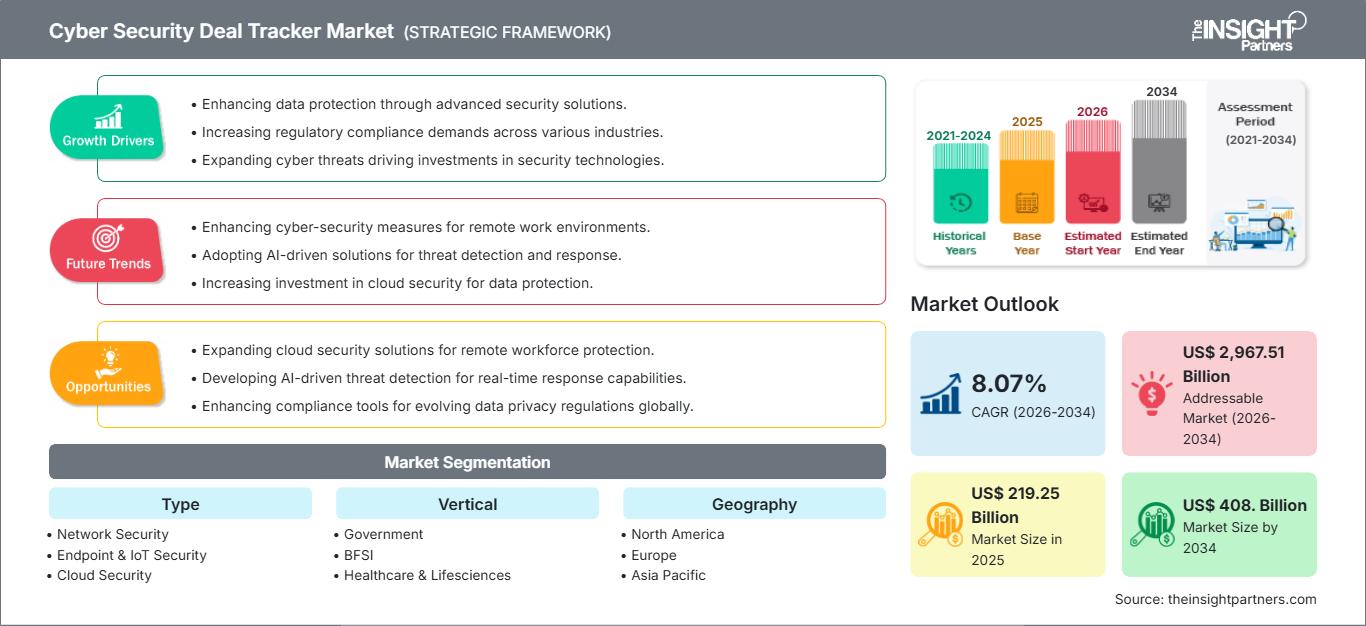
The Cyber Security Deal Tracker market was valued at US$ 219.25 billion in 2025 and is expected to reach US$ 408 billion by 2034; it is estimated to record a CAGR of 7.14% during 2026-2034.
Cyber Security Deal Tracker Market Assessment and Insights
- North America: Led with a 37–40% share in 2025, growing at a CAGR of 7.4–8.6% between 2026 and 2034, driven by regulatory mandates, vendor concentration, and sustained M&A activity.
- US: Contributed approximately 80–83% of North America's share in 2025, expanding at a CAGR of 7.2–8.0% between 2026 and 2034, led by federal zero-trust adoption.
- Europe: Held a 24–27% share in 2025, growing at a CAGR of 7.8–8.9% between 2026 and 2034, led by the UK, Germany, and France, where regulatory enforcement accelerates adoption.
- Asia Pacific: Accounted for a 19–22% share in 2025, expanding at a CAGR of 9.0–10.5% between 2026 and 2034, led by China, Japan, and India, as digital infrastructure growth drives adoption.
- Largest Segment: Network Security held a 26–29% share in 2025, advancing at a CAGR of 7.6–8.5% between 2026 and 2034, supported by continued perimeter-defense modernization.
- High Growth Segment: Cloud Security held a 20–23% share in 2025, advancing at a CAGR of 9.8–11.2% between 2026 and 2034, driven by multi-cloud adoption.
- Key companies analyzed in detail: IBM Corporation, Cisco Systems, Inc., Microsoft Corporation, Palo Alto Networks, Inc., Fortinet, Inc., Check Point Software Technologies Ltd., Trend Micro Incorporated, Oracle Corporation, Accenture plc, CyberArk Software Ltd.
Source: The Insight Partners' analysis based on proprietary research, government publications, company annual reports, investor presentations, industry databases, and expert interviews.
Enterprise adoption of consolidated deal-tracking and threat intelligence platforms has evolved considerably, as highlighted in the Cyber Security Deal Tracker Market Report. From isolated alerting mechanisms to API-integrated ecosystems that can correlate funding events, product introductions, and mergers, the vendor landscape has evolved. Whereas earlier offerings relied heavily on curatorial efforts from analysts, modern offerings increasingly leverage machine learning models that ingest transaction filings and vendor partnership announcements. The trend has been driven by heightened interest in cybersecurity from private equity players, forcing vendors to incorporate deal flow analysis into wider governance, risk, and compliance platforms for enterprise customers.
In the future, use cases are anticipated to expand from North America and Western Europe to include GCC countries and Southeast Asia financial centers, where governments will be allocating more resources to the security sector. In this context, regulatory headwinds, such as increased merger notification thresholds and cross-border data transfer policies, will force vendors to build jurisdictional modules. Further venture investments in niche specialist vendors will help diversify the competitive landscape tracked through 2034.
Cyber Security Deal Tracker Market Report Scope
| Report Attribute | Details |
|---|---|
| Market size in 2025 | US$ 219.25 Billion |
| Market Size by 2034 | US$ 408. Billion |
| Global CAGR (2026 - 2034) | 7.14% |
| Historical Data | 2021-2024 |
| Forecast period | 2026-2034 |
Cyber Security Deal Tracker Market Analysis
Cyber security deal tracker market growth is being propelled by mounting enterprise demand for centralized intelligence on vendor consolidation, given that security leaders must continuously reassess supplier viability amid frequent mergers and funding events. CISOs depend on such platforms to identify any potential roadmap risks related to acquisitions before entering into long-term agreements. This particular ecosystem comprises data aggregators, financial filing service providers, and specific analytics providers who license their transactional feeds to the security operations platforms. While the supply side remains dominated by the incumbents providing data, new players providing more precise vertical coverage have become increasingly important to the buyers.
Competitive intensity within the cybersecurity deal tracker market analysis space continues to rise as established vendors extend platform capabilities through acquisition rather than organic development. IBM Corporation and Microsoft Corporation have broadened threat-intelligence portfolios via targeted purchases, while Cisco Systems, Inc. and Oracle Corporation integrate deal-tracking signals into broader governance suites, reinforcing platform stickiness among multinational customers.
Specialist vendors pursue differentiated positioning in the Cyber Security Deal Tracker Market. Palo Alto Networks, Inc. and Fortinet, Inc. emphasize unified security operations tied to acquisition intelligence, while Check Point Software Technologies Ltd. and Trend Micro Incorporated focus on cross-border regulatory tracking. Accenture plc layers advisory services atop raw data, and CyberArk Software Ltd. concentrates on privileged-access implications tied to vendor transitions, demonstrating how competitive positioning increasingly depends on workflow integration rather than data breadth alone.
● REPORT CUSTOMIZATION
Tailor This Report To Align With Your Specific Business Requirements
This report can be customized to align precisely with your business objectives, scope, and target markets. Customization options include tailored segmentation, geography, competitive analysis, and strategic insights to support informed decision-making.
Customize This Report →WHAT YOU CAN ADJUST
- ● Segmentations
- ● Geography
- ● Competitive Analysis
- ● Language Preferences
Cyber Security Deal Tracker Market: Strategic Insights
Regional Insights
North America Cyber Security Deal Tracker Market
North America commands the largest cyber security deal tracker market share, supported by a dense concentration of headquartered vendors, private equity firms, and institutional investors reshaping the regional competitive landscape. The region is estimated to hold a 37–40% share of the global market in 2025, expanding at a CAGR between 7.4% and 8.6% from 2026 to 2034. Sustained boardroom emphasis on vendor risk management, combined with frequent funding rounds among mid-sized startups, keeps demand for consolidated deal-intelligence tooling elevated.
Drivers include government-mandated zero-trust procurement policies, increased cyber-insurance underwriting requirements requiring vendor stability checks, and increased awareness regarding supply chain risk due to recent security breaches. Canada makes a gradual contribution to regional vendor tracking through government modernization initiatives, while nearshoring trends in Mexico have created a gradual demand from manufacturing companies.
U.S. Cyber Security Deal Tracker Market
The United States represents the dominant share within North America, accounting for approximately 80–83% of the region's cyber security deal tracker market in 2025. The country is projected to grow at a CAGR between 7.2% and 8.0% from 2026 to 2034, supported by concentrated headquarters presence of leading vendors, including IBM Corporation, Cisco Systems, Inc., Microsoft Corporation, and Palo Alto Networks, Inc., each maintaining active acquisition pipelines that these platforms continuously monitor.
Trends in application use are moving toward integration with governance, risk, and compliance software for BFSI and federal contracting organizations, where procurement departments need to know the history of stability for vendors before renewals can be made. More usage by the health care and defense contractor industries is expanding its applicability, since it is becoming an expected part of third-party risk management.
Europe Cyber Security Deal Tracker Market
Europe held a 24–27% share in the Cyber Security Deal Tracker Market in 2025, advancing at a CAGR between 7.8% and 8.9% from 2026 to 2034, with the United Kingdom retaining its position as the region's leading market. The UK enjoys a mature fintech environment and post-Brexit regulatory divergence, which has given rise to unique compliance tracking requirements, leading the financial services and public sectors in adopting vendor-consolidation solutions before other nearby jurisdictions, reinforcing London’s status as the regional center.
Germany is not far behind, with strict data protection compliance enforcement in national NIS2 implementation and an increasing number of manufacturing companies as targets for industrial espionage, driving Mittelstand businesses to consolidate their vendor risk management platforms. France, Italy, and Spain combined represent a relatively small yet growing market share through public digital transformation initiatives and venture investments in regional cybersecurity firms.
APAC Cyber Security Deal Tracker Market
Asia Pacific accounted for a 19–22% share in the Cyber Security Deal Tracker Market in 2025, expanding at the fastest regional CAGR of 9.0% to 10.5% between 2026 and 2034. China leads regional demand, supported by domestic technology self-sufficiency policies, while Japan and South Korea contribute through government-backed cybersecurity modernization targeting manufacturing infrastructure.
India is emerging as a high-growth contributor, driven by expanding digital payments infrastructure and venture funding into homegrown vendors, while Australia strengthens demand through critical infrastructure mandates under recent legislative reforms.
Middle East & Africa Cyber Security Deal Tracker Market
The Middle East and Africa region is estimated to grow at a CAGR between 8.5% and 9.8% from 2026 to 2034, with the UAE leading adoption through Dubai's positioning as a regional financial and technology hub, attracting vendor and investor activity.
Saudi Arabia follows closely, propelled by Vision 2030 infrastructure investment and expanding energy-sector mandates protecting oil and gas assets, while South Africa and the Rest of MEA contribute through maturing financial-services programs and telecommunications investment.
Segmentation Analysis
Type
The Type segment defines the cyber security deal tracker market scope, encompassing network, endpoint, cloud, and application-layer coverage areas. Growing convergence between infrastructure and application security has expanded platform requirements, as buyers expect unified visibility across previously siloed categories, growing at a CAGR between 7.8% and 9.2% from 2026 to 2034, driven by consolidation among point-solution vendors.
- Network Security: Network Security remains the most established category, valued for perimeter defense and traffic monitoring, and attracts the highest concentration of vendor consolidation activity.
- Endpoint & IoT Security: Endpoint & IoT Security addresses rising device proliferation across enterprise environments, with buyers prioritizing unified endpoint management alongside device-level threat detection.
- Cloud Security: Cloud Security demand is accelerating as multi-cloud and hybrid architectures become standard, pushing enterprises toward consistent policy enforcement across distributed infrastructure.
- Application Security: Application Security is gaining importance as software supply-chain risks intensify, prompting teams to embed vendor-tracking intelligence within deployment pipelines.
Vertical
The Vertical segment reflects differentiated adoption across regulated and infrastructure-intensive industries, where vendor-risk exposure varies by compliance obligation. Adoption is strongest among sectors managing sensitive data or critical infrastructure, expanding at a CAGR between 7.9% and 9.0% from 2026 to 2034 as regulatory reporting requirements broaden.
- Government: Government agencies prioritize consolidated vendor intelligence to meet procurement-security mandates amid rising nation-state threat activity targeting public-sector infrastructure.
- BFSI: BFSI institutions maintain the highest compliance-driven demand, leveraging deal-tracking platforms to satisfy regulatory vendor-risk disclosure across banking and insurance operations.
- Healthcare & Lifesciences: Healthcare & Lifesciences organizations increasingly track vendor consolidation to safeguard patient data continuity as health-record and device security vendors change ownership.
- Aerospace & Defense: Aerospace & Defense buyers require stringent vendor-vetting given classified program sensitivities, driving structured adoption of tracking tools tied to procurement frameworks.
- Retail & eCommerce: Retail & eCommerce enterprises rely on vendor-tracking intelligence to protect payment infrastructure, particularly when third-party platform stability affects revenue continuity.
- Manufacturing: Manufacturing operators increasingly monitor industrial control system vendor stability, given growing exposure to supply-chain attacks targeting operational technology.
- Energy & Utilities: Energy & Utilities operators prioritize critical infrastructure vendor oversight, reflecting scrutiny following recent grid-targeting incidents affecting power distribution.
- Telecommunication: Telecommunication providers track vendor consolidation closely given their foundational role in digital infrastructure, where supplier stability carries systemic risk.
- Transportation & Logistics: Transportation & Logistics companies are expanding adoption as connected fleet systems introduce new vendor dependencies requiring continuous verification.
- Media & Entertainment: Media & Entertainment firms increasingly monitor content-delivery vendor stability as streaming platforms consolidate infrastructure providers.
Opportunity Snapshot
| Industry Vertical | Revenue Contribution | Trend Tag | Adoption Stage |
| Government | High | Zero Trust Mandates | Scaling |
| BFSI | High | Compliance Tracking | Mature |
| Healthcare & Lifesciences | Medium | Data Continuity | Scaling |
| Aerospace & Defense | Medium | Classified Vetting | Scaling |
| Retail & eCommerce | Medium | Payment Security | Scaling |
| Manufacturing | Medium | OT Protection | Emerging |
| Energy & Utilities | High | Grid Resilience | Scaling |
| Telecommunication | Medium | Network Consolidation | Scaling |
| Transportation & Logistics | Low | Fleet Connectivity | Emerging |
| Media & Entertainment | Low | Content Delivery | Emerging |
Cyber Security Deal Tracker Market Growth Drivers and Impact Analysis
Regulatory Reporting Obligations Driving Vendor Oversight
An increasing number of regulatory frameworks covering the financial services sector, healthcare, and critical infrastructures are making it mandatory for enterprises to report on the stability of third-party vendors as part of risk disclosure regulations. Regulation frameworks like the EU's NIS2 directive and emerging frameworks governing U.S. federal procurements make it necessary for enterprises to keep records regarding any ownership change, financing events, and mergers involving their security stack. The need has made it essential for enterprises, especially those operating in the BFSI and healthcare sectors, to use deal tracking solutions not just as analyst tools but as regulatory compliance infrastructure.
Rising Private Equity Activity Reshaping Vendor Landscapes
The sustained interest by private equity and venture capital firms in cybersecurity companies has contributed to the rise in merger and acquisition deals as well as funding deals within the vendor ecosystem. These transactions have created a situation of continued uncertainty on the part of corporate buyers due to frequent changes in ownership that may result in disruptions to the roadmap and pricing of products. In an effort to gain real-time insights into ongoing transactions in order to decide whether or not to extend a relationship with vendors, procurement and security leaders are demanding access to deal-tracking platforms.
Growing Complexity of Multi-Cloud Security Ecosystems
The advent of multi-cloud and hybrid architectures has raised the number of security suppliers that an enterprise needs to juggle at one time, making it even more important to have comprehensive deal tracking insights. Enterprises using multiple clouds are more susceptible in cases where the components used are acquired by someone else, since there could be dependency issues that arise and would need some prior knowledge of these transactions. This challenge has made it necessary for procurement departments to adopt solutions that help correlate transaction activities with dependency mapping. This trend is expected to drive growth going forward till 2034.
Cyber Security Deal Tracker Market Future Trends
AI-Driven Predictive Deal Intelligence
Emerging cyber security deal tracker market trends point toward growing integration of predictive machine learning models capable of forecasting likely acquisition targets before formal announcements occur. Vendors are increasingly training models on patent filings, executive movement patterns, and funding signals to generate early-warning indicators for buyers. This shift is expected to reduce reliance on manual analyst review, enabling procurement teams to proactively reassess vendor relationships ahead of public disclosure. As predictive accuracy improves, enterprises are likely to embed these signals within automated vendor-risk scoring frameworks used across renewal workflows.
Vertical-Specific Intelligence Modules Gaining Traction
Platforms are beginning to shift their emphasis from transaction feeds that are generic in nature to modules that are customized to particular sectors, such as health care, energy, and financial services. With such customization, buyers have the ability to filter deal intelligence according to the compliance requirements in each sector. This means that the analysts would not have to spend much time screening transactions that do not apply. Vendors are responding by forming partnerships with companies that offer sector-specific data as well as dashboards that fit specific reporting formats.
Cyber Security Deal Tracker Market Opportunities
Expansion into Mid-Market Enterprise Segments
Vendors have a substantial opportunity to extend platform reach beyond large enterprises into mid-market organizations that face similar vendor-consolidation risks but lack dedicated procurement-intelligence resources. Simplified, lower-cost subscription tiers tailored to smaller security teams could unlock a meaningfully underserved base, particularly across manufacturing and retail sectors experiencing rising digital exposure. Cyber security deal tracker market Forecasts through 2034 suggest continued fragmentation among security vendors, reinforcing demand for accessible, mid-market-oriented tools supporting leaner internal teams without extensive dedicated analyst headcount.
Strategic Partnerships with Cyber-Insurance Underwriters
An increasing degree of convergence of vendor risk documentations and cyber insurance underwriting standards provides a very good chance for platform providers to build direct data-sharing relations with insurance companies. Underwriters are now demanding the provision of proof of stability and history of ownership of vendors as part of the underwriting process, thus creating an ideal platform for integrating deal tracking intelligence into the insurance processes. Vendors that incorporate their feeds directly into the underwriting process can create long-term revenue streams for themselves.
Frequently Asked Questions

- Comprehensive Market Sizing and Forecast Analysis
- Detailed Segmentation Analysis
- In-Depth Market Dynamics Assessment
- Regional and Country-Level Insights
- Competitive Landscape and Company Benchmarking
- Strategic Business Intelligence
Recent Reports
Testimonials

The Insight Partners provided valuable market intelligence that supported our global go-to-market strategy. Their team was professional, responsive, and attentive to our feedback, providing thoughtful analysis and helpful methodological clarifications throughout the project.
Junmo Kim Chief Financial Officer (CFO), Enertech Co., Ltd.
The Insight Partners' SCADA System Market report is comprehensive, with valuable insights on current trends and future forecasts. The team was highly professional, responsive, and supportive throughout. We are very satisfied and highly recommend their services.
RAN KEDEM Partner, Reali Technologies LTDs
I requested a report on a very specific software market and the team produced the report in a few days. The information was very relevant and well presented. I then requested some changes and additions to the report. The team was again very responsive and I got the final report in less than a week.
JEAN-HERVE JENN Chairman, Future Analytica
We worked with The Insight Partners for an important market study and forecast. They gave us clear insights into opportunities and risks, which helped shape our plans. Their research was easy to use and based on solid data. It helped us make smart, confident decisions. We highly recommend them.
PIYUSH NAGPAL Sr. Vice President, High Beam Global
The Insight Partners delivered insightful, well-structured market research with strong domain expertise. Their team was professional and responsive throughout. The user-friendly website made accessing industry reports seamless. We highly recommend them for reliable, high-quality research services
YUKIHIKO ADACHI CEO, Deep Blue, LLC.
This is the first time I have purchased a market report from The Insight Partners.While I was unsure at first, I visited their web site and felt more comfortable to take the risk and purchase a market report.I am completely satisfied with the quality of the report and customer service. I had several questions and comments with the initial report, but after a couple of dialogs over email with their analyst I believe I have a report that I can use as input to our strategic planning process.Thank you so much for taking the extra time and making this a positive experience.I will definitely recommend your service to others and you will be my first call when we need further market data.
JOHN SUZUKI President and Chief Executive Officer, Board Director, BK Technologies
I wish to appreciate your support and the professionalism you displayed in the course of attending to my request for information regarding to infectious disease IVD market in Nigeria. I appreciate your patience, your guidance, and the fact that you were willing to offer a discount, which eventually made it possible for us to close a deal. I look forward to engaging The Insight Partners in the future, all thanks to the impression you have created in me as a result of this first encounter.
DR CHIJIOKE ONYIA MANAGING DIRECTOR, PineCrest Healthcare Ltd.Reason to Buy
- Informed Decision-Making
- Understanding Market Dynamics
- Competitive Analysis
- Identifying Emerging Markets
- Customer Insights
- Market Forecasts
- Risk Mitigation
- Boosting Operational Efficiency
- Strategic Planning
- Investment Justification
- Tracking Industry Innovations
- Aligning with Regulatory Trends





 Get Free Sample for