
Digital Security Control Market Size, Share & Forecast by 2034
Coverage: by Component (Hardware, Software, Service); Application (Mobile Security and Telecommunication, Finance and Banking, Healthcare, Commercial, Other) , and Geography (North America, Europe, Asia Pacific, and South and Central America)
- Status : Data Released
- Report Code : TIPRE00012287
- Category : Electronics and Semiconductor
- No. of Pages : 150
- Available Report Formats :


- Last update date : August 05, 2026


2025 Market Size
US$ 27.29 Bn
Base year value
2034 Forecast
US$ 44.78 Bn
Projected by 2034
CAGR 2026-2034
6.38 %
Growth rate
Addressable Market
US$ 338.90 Bn
(2026-2034)
The Digital Security Control Market size is expected to rise from US$ 27.29 Billion in 2025 to reach US$ 44.78 Billion by 2034 at a CAGR of 6.38% during 2026-2034. The factors driving market growth include secure digital identity, multi-factor authentication, biometrics verification, and secure access controls in telecommunications, banking, health care, and business environments.
North America continues to be a key market as businesses upgrade identity access systems, with the market aided by an estimated regional CAGR of 5.8-6.4% till 2034. Increasing cloud migrations, zero trust initiatives, health care information security, and financial fraud prevention measures are contributing to rising demand for hardware tokens, software authentication, and managed security services.
Digital Security Control Market Assessment and Insights
- North America held 34–36% share in 2025 and is expected to grow at a 5.8–6.4% CAGR during 2026–2034, supported by banking modernization, healthcare compliance, and enterprise zero-trust rollouts.
- US represented 78–82% of North America in 2025 and is projected to grow at a 5.7–6.3% CAGR as cloud identity and payment authentication deployments expand.
- Europe accounted for 25–27% share in 2025 and is forecast to grow at a 5.6–6.2% CAGR, led by Germany, the UK, France, Italy, and Spain.
- Asia Pacific captured 23–25% share in 2025 and is expected to register a 7.1–7.8% CAGR, with China, Japan, India, South Korea, and Australia driving deployments.
- Largest Segment Software held 42–45% market share in 2025 and is projected to grow at a 6.6–7.2% CAGR as authentication platforms replace fragmented controls.
- High Growth Segment Service held 24–27% market share in 2025 and is expected to grow at a 7.4–8.1% CAGR as managed identity programs scale.
- Key companies analyzed in detail: Thales DIS France SAS, Trellix, IDEMIA France SAS, SafeNet, Inc., RSA Security LLC, OneSpan Inc., 3M Company, NEC Corporation, HID Global Corporation, and ASSA ABLOY AB.
Source: The Insight Partners' analysis based on proprietary research, government publications, company annual reports, investor presentations, industry databases, and expert interviews.
Digital credentialing technology has evolved from a purely perimeter-based approach to an identity-centric approach that relies on biometrics, smart cards, encryption keys, and risk-based access software. Moreover, production models have been altered by integrating secure elements, identity chips, and software authentication engines into lifecycle services. The Digital Security Control Market is developing due to the transition from isolated solutions to holistic trust models across mobile networks, healthcare records, financial transactions, and business access.
Between now and 2034, the investments will focus on cloud identity orchestration, reusable credentials, biometric liveness detection, and secure access management solutions for digital services that are subject to regulation. New geographies will be fueled by national programs of digital ID, secure payments, and customer identity verification within the telecommunications industry. Hardware-based solution providers are transitioning to software and service offerings.
Digital Security Control Market Report Scope
| Report Attribute | Details |
|---|---|
| Market size in 2025 | US$ 27.29 Billion |
| Market Size by 2034 | US$ 44.78 Billion |
| Global CAGR (2026 - 2034) | 6.38% |
| Historical Data | 2021-2024 |
| Forecast period | 2026-2034 |
Digital Security Control Market Analysis
Drivers include high-value transactions in the digital world, remote onboarding, mobile connectivity, and increasing data security standards. There is an increasing need for enhanced customer authentication from banks, SIM/device authenticity checks from telecom operators, and secure patient identity management in hospitals. The supply chain includes secure chips, biometrics devices, authentication software, encryption software, fraud detection, system integrators, and managed services.
Supply trends are biased towards providers that can deliver both certified hardware and software along with their deployment services. Availability of components, compliance certification, interoperability, and compatibility with cloud identity platforms play important roles in the decision-making process regarding purchase cycles. With customers becoming more concerned about consolidating their security suites, the Digital Security Control Market analysis is becoming more focused on cost of ownership, assurance level, usability, and ability to fight identity fraud.
Competitiveness is described by identity and access industry vendors, cybersecurity platform providers, and physical credential vendors extending to digital trust. The main competitors of Thales DIS France SAS include IDEMIA France SAS, HID Global Corporation, NEC Corporation, RSA Security LLC, OneSpan Inc., Trellix, 3M Company, SafeNet, Inc., and ASSA ABLOY AB.
The market dynamics will be affected by strategic positioning on subscription identity services, artificial intelligence-driven fraud detection, and managed authentication services. Identity and access vendors are focusing on developing solutions for passwordless access, biometric match verification, cryptographic keys, and compliance packages for industries. Strategic partnerships with cloud providers, financial institutions, telecom operators, and government bodies will influence account retention because customers will prefer integrated systems with assurance and region-specific data sovereignty.
● REPORT CUSTOMIZATION
Tailor This Report To Align With Your Specific Business Requirements
This report can be customized to align precisely with your business objectives, scope, and target markets. Customization options include tailored segmentation, geography, competitive analysis, and strategic insights to support informed decision-making.
Customize This Report →WHAT YOU CAN ADJUST
- ● Segmentations
- ● Geography
- ● Competitive Analysis
- ● Language Preferences
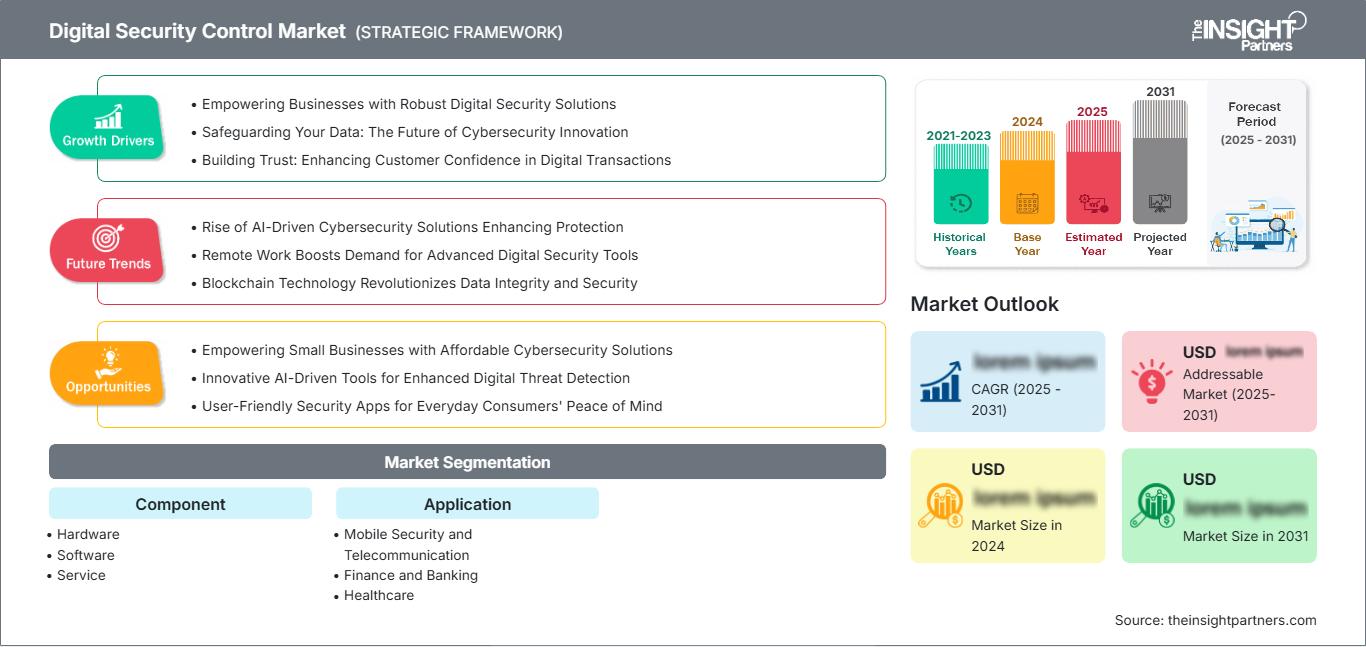
Digital Security Control Market: Strategic Insights
Regional Insights
North America Digital Security Control Market
North America had a market share of 34–36% in 2025 and is predicted to grow at a rate of 5.8–6.4% CAGR during 2026–2034. Digital Security Control Market Share is due to the prevalence of cloud implementation, regulated financial sector, data privacy needs in healthcare, and movement towards identity-based security architecture in enterprises.
Regional demand arises in areas where payment authentication, patient information access, privileged identity management, and mobile customer onboarding processes overlap. Customers favor technologies which offer integration with zero trust architectures, endpoint protection, and compliance management capabilities. The availability of big budgets for cybersecurity and dedicated vendors makes this region an early adopter of passwordless access, behavioral analysis, and managed authentication.
U.S. Digital Security Control Market
The United States is considered to account for 78-82% of North America in 2025 and is expected to register growth at a 5.7-6.3% CAGR up until 2034. Adoption is supported by the need to prevent financial fraud, manage healthcare identity, implement federal cybersecurity mandates, and provide authentication for transactions on large cloud applications.
There are multiple companies active in the market – RSA Security LLC, HID Global Corporation, Trellix, 3M Company, and OneSpan Inc. among others. The main trends include mobile banking log-in security, privileged access management, authentication of healthcare portals, and securing credentials of hybrid workforce.
Europe Digital Security Control Market
Share of Europe was estimated at 25-27% in 2025 and is anticipated to expand at CAGR of 5.6%-6.2% during 2026-2034. Germany is the major country here owing to industrial security, banking compliance, and eID solutions. In the UK, focus is on financial verification, telecom security, and government ID assurance, whereas in France, expertise in credential issuance adds an advantage.
Italy and Spain are implementing digital controls through the transformation of banking, health care data, and citizen service delivery. The region tends to give preference to privacy, certification, and interoperability rather than cheapest price for procurement purposes. Companies like Thales DIS France SAS, IDEMIA France SAS, ASSA ABLOY AB, and NEC Corporation are supporting demand through ID documents, biometric systems, and secure access solutions.
APAC Digital Security Control Market
Share of APAC in 2025 was 23–25% and it is forecasted to post a 7.1–7.8% CAGR over 2034. China is the largest country in terms of regional footprint; meanwhile Japan and South Korea focus on high assurance of identity for telecommunication, banking, and governmental services. Digital public infrastructure in India and cybersecurity projects in Australia expand the opportunities for regional players.
Industrial digitization, mobile transactions, cross-border commerce, and governmental programs related to identity become structural drivers of the region. The need of biometric verification, SIM protection, fraud detection, and managed identity solutions becomes more evident. Regional integration projects involving global IT vendors find their space in the region due to compliance regulations and localization issues.
Middle East & Africa Digital Security Control Market
MEA is forecast to experience growth at CAGRs of 6.4 to 7.1% for the period from 2026 to 2034, with Saudi Arabia being the regional front-runner in adoption. Other major markets are the UAE for government digitization projects, banks, and smart infrastructures; South Africa in enterprise and finance sectors on behalf of Africa.
Energy, transportation, port authorities, healthcare, and public services offer high-assurance applications where compromising identity is problematic. Rest of MEA spending on identity and access management solutions is somewhat erratic but growing thanks to mobile finance solutions, national ID card initiatives, and telecommunications. Managed services are popular due to lack of expertise and complicated integrations.
Segmentation Analysis
Component
The component segment is expected to grow at a 6.4–7.0% CAGR during 2026–2034 as buyers combine secure devices, authentication platforms, and integration services. The Digital Security Control Market scope is broadening from hardware issuance to continuous identity assurance, especially where enterprises require device-bound credentials, encrypted transaction workflows, and managed lifecycle controls.
- Hardware remains important for smart cards, tokens, biometric readers, and secure elements, particularly in banking, telecom, and government-linked identity environments requiring tamper-resistant authentication.
- Software leads adoption because enterprises need scalable identity orchestration, policy enforcement, fraud analytics, and passwordless workflows that integrate with cloud and on-premises systems.
- Service is expanding as organizations outsource deployment, compliance tuning, monitoring, and lifecycle management to address skill shortages and reduce implementation risk.
Application
The application segment is projected to grow at a 6.5–7.2% CAGR during 2026–2034, reflecting wider use of identity assurance in digital transactions and protected information flows. The Digital Security Control Market supports mobile operators, banks, healthcare providers, and commercial enterprises as they secure customers, employees, devices, portals, and connected infrastructure.
- Mobile Security and Telecommunication benefits from SIM protection, device authentication, subscriber verification, and fraud control as operators secure mobile banking, eSIM provisioning, and customer identity workflows.
- Finance and Banking remains a high-value application because strong customer authentication, transaction signing, anti-fraud monitoring, and regulatory compliance directly influence digital trust and operational risk.
- Healthcare adoption is rising as providers secure patient portals, clinical systems, connected devices, and staff access while protecting sensitive records from credential misuse.
- Commercial demand is shaped by workforce access, visitor management, payment acceptance, building security, and cloud application protection across retail, offices, logistics, and service operations.
Opportunity Snapshot
| Application | Revenue Contribution | Trend Tag | Adoption Stage |
| Mobile Security and Telecommunication | High | eSIM Trust | Scaling |
| Finance and Banking | High | Transaction Signing | Mature |
| Healthcare | Medium | Patient Identity | Scaling |
| Commercial | Medium | Workforce Access | Scaling |
Digital Security Control Market Growth Drivers and Impact Analysis
Identity Fraud Raises Authentication Investment
Organizations are shifting budgets toward stronger identity controls because compromised credentials remain a common path into financial, healthcare, telecom, and commercial systems. Multi-factor authentication, biometric checks, transaction signing, and device-bound credentials reduce dependence on passwords and help verify users during onboarding, payments, and privileged access. The market impact is visible in procurement criteria that now require fraud analytics, adaptive risk scoring, audit evidence, and integration with identity governance platforms. Vendors that combine high assurance with low user friction are positioned to win larger enterprise contracts.
Regulated Digital Services Require Stronger Controls
Banks, insurers, hospitals, telecom operators, and public agencies face stricter expectations for protecting personal data and validating access to sensitive services. Compliance requirements are pushing buyers from basic login protection toward auditable security architectures that include encrypted credentials, certified authentication devices, policy controls, and managed monitoring. This creates recurring revenue opportunities for software and service providers while sustaining demand for secure hardware. The Digital Security Control Market benefits when regulatory audits translate into measurable security investments rather than discretionary technology upgrades.
Mobile and Cloud Workflows Expand Access Points
Digital services now operate across smartphones, cloud applications, partner portals, connected devices, and hybrid work environments, increasing the number of identity events that must be secured. Telecom operators need subscriber and device assurance, banks need safe mobile transactions, and commercial enterprises need workforce access that follows users across locations. This broadens demand for authentication orchestration, identity proofing, API security, and lifecycle management. Suppliers able to support both customer-facing and employee-facing use cases can capture larger wallet share across multi-year transformation programs.
Digital Security Control Market Future Trends
Reusable Credentials and Wallet-Based Identity
Reusable digital credentials will reshape Digital Security Control Market trends as governments, banks, telecom operators, and healthcare platforms seek faster verification without repeatedly collecting sensitive documents. Wallet-based identity can reduce onboarding friction, improve consent management, and support cross-service trust when backed by cryptographic proof and strong device binding. Adoption will depend on interoperability, privacy-preserving standards, and acceptance by relying parties. Vendors that support issuance, verification, revocation, and policy enforcement across multiple sectors will be better placed than firms offering single-purpose authentication tools.
AI-Assisted Risk Scoring Becomes Standard
Risk-based authentication will move from optional enhancement to baseline capability as enterprises analyze device posture, behavioral signals, transaction context, and anomaly patterns in real time. AI models can help identify suspicious activity before step-up authentication or transaction blocking is triggered, improving security without forcing every user through the same challenge. The main requirement will be explainability, especially in regulated sectors where decisions must be auditable. Providers combining analytics with certified authentication controls will gain strategic relevance.
Digital Security Control Market Opportunities
Managed Identity Services for Mid-Market Buyers
Mid-sized banks, hospitals, telecom distributors, and commercial enterprises often need strong authentication but lack internal teams to design, monitor, and update complex identity controls. Managed services create an opportunity to package deployment, policy configuration, compliance reporting, and incident response into predictable contracts. Digital Security Control Market Forecasts indicate that service-led models can unlock demand where hardware and software purchases alone would stall. Providers should prioritize modular offerings, sector templates, and integration with widely used cloud identity platforms to shorten sales cycles.
Sector-Specific Authentication Bundles
Vendors can increase adoption by building targeted bundles for finance, healthcare, telecom, and commercial access rather than selling generic controls. Banking packages can include transaction signing and fraud analytics, healthcare bundles can emphasize patient portal and clinician access, while telecom offerings can address SIM, eSIM, and subscriber verification. Bundled solutions help buyers link security outcomes to operational metrics such as fraud reduction, audit readiness, onboarding speed, and user experience. This approach also supports differentiated pricing and stronger channel partnerships.
Recent Developments
- July 2026: Microsoft unveiled its new cybersecurity AI model, MAI-Cyber-1-Flash, and Project Perception agentic security platform to help organizations identify, prioritize, and remediate software vulnerabilities faster. The AI-powered security system combines specialized cyber models with autonomous agents to enhance threat detection, vulnerability analysis, and cyber defense operations while improving efficiency for security teams.
- March 2026: Check Point Software Technologies launched the AI Defense Plane, a unified AI security control platform designed to secure enterprise AI adoption by providing governance, visibility, runtime protection, and continuous validation across employee AI usage, AI applications, and agentic AI systems. The platform enables organizations to manage AI risks, protect autonomous workflows, and strengthen security controls as enterprises scale AI-driven operations.
- November 2025: Quick Heal Technologies introduced new cybersecurity initiatives focused on strengthening digital protection through AI-driven security solutions, advanced threat intelligence, and enhanced malware detection capabilities. The company continued expanding its portfolio to address evolving cyber threats across consumer, enterprise, and government environments.
Frequently Asked Questions

- Comprehensive Market Sizing and Forecast Analysis
- Detailed Segmentation Analysis
- In-Depth Market Dynamics Assessment
- Regional and Country-Level Insights
- Competitive Landscape and Company Benchmarking
- Strategic Business Intelligence
Recent Reports
Testimonials

The Insight Partners' SCADA System Market report is comprehensive, with valuable insights on current trends and future forecasts. The team was highly professional, responsive, and supportive throughout. We are very satisfied and highly recommend their services.
RAN KEDEM Partner, Reali Technologies LTDs
I requested a report on a very specific software market and the team produced the report in a few days. The information was very relevant and well presented. I then requested some changes and additions to the report. The team was again very responsive and I got the final report in less than a week.
JEAN-HERVE JENN Chairman, Future Analytica
We worked with The Insight Partners for an important market study and forecast. They gave us clear insights into opportunities and risks, which helped shape our plans. Their research was easy to use and based on solid data. It helped us make smart, confident decisions. We highly recommend them.
PIYUSH NAGPAL Sr. Vice President, High Beam Global
The Insight Partners delivered insightful, well-structured market research with strong domain expertise. Their team was professional and responsive throughout. The user-friendly website made accessing industry reports seamless. We highly recommend them for reliable, high-quality research services
YUKIHIKO ADACHI CEO, Deep Blue, LLC.
This is the first time I have purchased a market report from The Insight Partners.While I was unsure at first, I visited their web site and felt more comfortable to take the risk and purchase a market report.I am completely satisfied with the quality of the report and customer service. I had several questions and comments with the initial report, but after a couple of dialogs over email with their analyst I believe I have a report that I can use as input to our strategic planning process.Thank you so much for taking the extra time and making this a positive experience.I will definitely recommend your service to others and you will be my first call when we need further market data.
JOHN SUZUKI President and Chief Executive Officer, Board Director, BK Technologies
I wish to appreciate your support and the professionalism you displayed in the course of attending to my request for information regarding to infectious disease IVD market in Nigeria. I appreciate your patience, your guidance, and the fact that you were willing to offer a discount, which eventually made it possible for us to close a deal. I look forward to engaging The Insight Partners in the future, all thanks to the impression you have created in me as a result of this first encounter.
DR CHIJIOKE ONYIA MANAGING DIRECTOR, PineCrest Healthcare Ltd.Reason to Buy
- Informed Decision-Making
- Understanding Market Dynamics
- Competitive Analysis
- Identifying Emerging Markets
- Customer Insights
- Market Forecasts
- Risk Mitigation
- Boosting Operational Efficiency
- Strategic Planning
- Investment Justification
- Tracking Industry Innovations
- Aligning with Regulatory Trends





 Get Free Sample for