
Air Pollution Control Systems Market Share, Growth & Demand by 2034
Coverage: by Product Type (Indoor, Ambient); Pollutant Type (Gas, Volatile organic compounds (VOCs), Others); End-User (Energy and Power, Mining, Agriculture, Semiconductor, Medical and Pharma, Transportation, Others) , and Geography (North America, Europe, Asia Pacific, and South and Central America)
- Status : Data Released
- Report Code : TIPRE00007292
- Category : Manufacturing and Construction
- No. of Pages : 150
- Available Report Formats :


- Last update date : July 15, 2026


2025 Market Size
US$ 108.74 Bn
Base year value
2034 Forecast
US$ 181.65 Bn
Projected by 2034
CAGR 2026-2034
5.87 %
Growth rate
Addressable Market
US$ 1,315.82 Bn
(2026-2034)
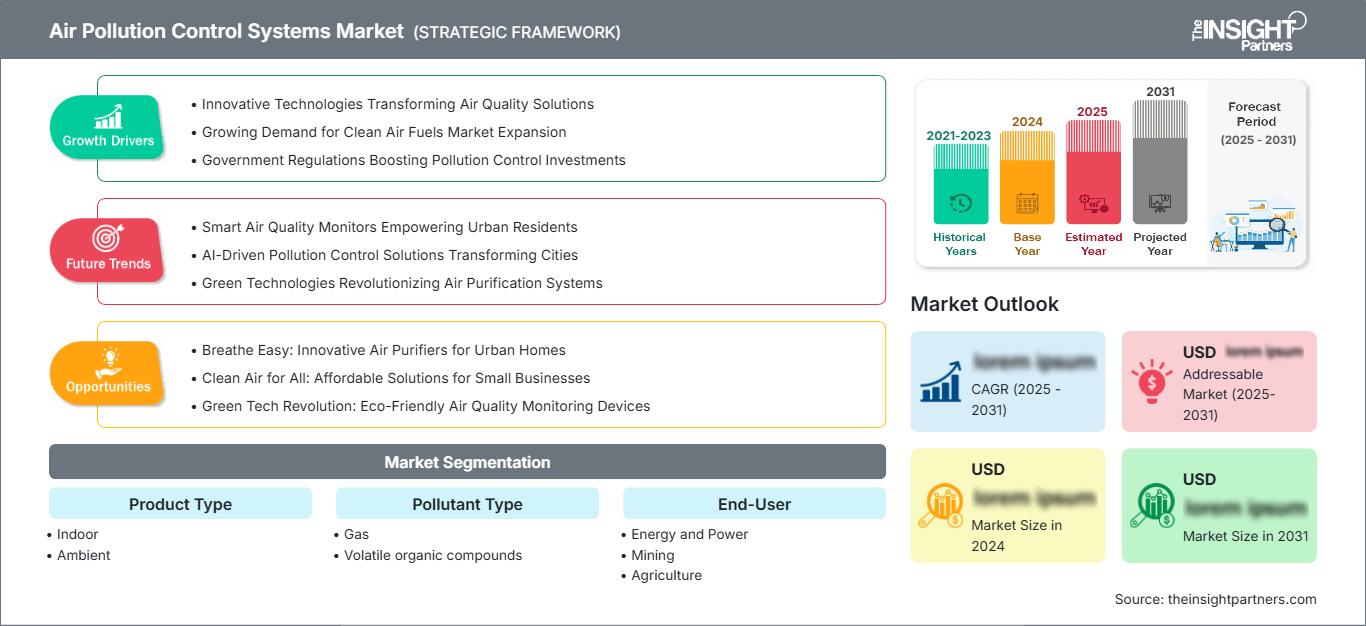
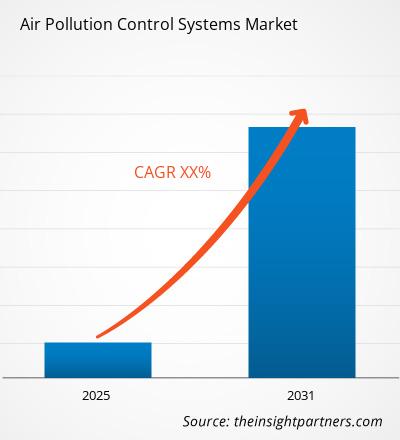
The air pollution control systems market is projected to grow from US$ 108.74 Billion in 2025 to US$ 181.65 Billion by 2034, registering a CAGR of 5.87% during 2026–2034. The market indicates growth in investment in industries that control emissions from industrial activities, manage air quality indoors, and treat multiple pollutants in sectors such as energy, mining, healthcare and pharmaceuticals, semiconductors, transport, and agriculture.
North America remains a high-value demand center, with an estimated CAGR range of 5.4–5.9% supported by stricter stationary-source permitting, replacement of aging abatement assets, and indoor air quality upgrades in commercial buildings. The air pollution control systems market size in the region is reinforced by power reliability needs, semiconductor capacity additions, and retrofit spending tied to federal and state-level emissions enforcement.
Air Pollution Control Systems Market Assessment and Insights
- North America accounted for 28–31% share in 2025 and is growing at a CAGR range of 5.4–5.9% during 2026–2034, supported by utility retrofits and indoor air rules.
- US represented 78–82% of North America in 2025 and is expanding at 5.5–6.0% CAGR during 2026–2034 due to power, semiconductor, and medical demand.
- Europe held 24–27% air pollution control systems market share in 2025 and is growing at 5.0–5.5% CAGR during 2026–2034, led by Germany, the UK, France, Italy, and Spain.
- Asia Pacific captured 32–35% share in 2025 and is advancing at 6.3–6.8% CAGR during 2026–2034, led by China, India, Japan, South Korea, and Australia.
- Largest Segment Gas pollutant control held 56–60% air pollution control systems market share in 2025 and is growing at 5.6–6.1% CAGR during 2026–2034, driven by NOx, SOx, and acid gas limits.
- High Growth Segment Semiconductor end-user applications held 8–10% market share in 2025 and are growing at 7.0–7.6% CAGR during 2026–2034, supported by fab exhaust treatment.
- Key companies analyzed in detail: Babcock & Wilcox Enterprises, Inc.; Daikin Industries, Ltd.; Donaldson Company, Inc.; ELEX AG; GEA Group Aktiengesellschaft; General Electric Company; Hamon Group; MANN+HUMMEL International GmbH & Co. KG; Mitsubishi Heavy Industries, Ltd.; Thermax Limited.
Source: The Insight Partners' analysis based on proprietary research, government publications, company annual reports, investor presentations, industry databases, and expert interviews.
Technology adoption has shifted from single-device particulate capture toward integrated gas treatment, sorbent injection, catalytic reduction, and digital monitoring. Power plants, refineries, mining sites, fabs, and hospitals increasingly specify modular platforms that combine filtration, scrubbing, and sensor-led compliance reporting. Production dynamics are also changing in air pollution system market as suppliers standardize components, localize fabrication, and design retrofit-ready systems to reduce shutdown time and improve lifecycle service margins.
Future demand will be shaped by Asia Pacific capacity expansion, North American replacement cycles, and European industrial decarbonization rules. Investment is moving toward high-efficiency VOC capture, low-pressure-drop filters, and hybrid systems that support both compliance and energy optimization. Emerging geographies are expected to adopt packaged solutions as regulators increase stack monitoring requirements and multinational manufacturers align supplier facilities with global environmental standards.
Air Pollution Control Systems Market Report Scope
| Report Attribute | Details |
|---|---|
| Market size in 2025 | US$ 108.74 Billion |
| Market Size by 2034 | US$ 181.65 Billion |
| Global CAGR (2026 - 2034) | 5.87% |
| Historical Data | 2021-2024 |
| Forecast period | 2026-2034 |
Air Pollution Control Systems Market Analysis
Technology adoption has shifted from single-device particulate capture toward integrated gas treatment, sorbent injection, catalytic reduction, and digital monitoring. Power plants, refineries, mining sites, fabs, and hospitals increasingly specify modular platforms that combine filtration, scrubbing, and sensor-led compliance reporting. Production dynamics are also changing in air pollution system market as suppliers standardize components, localize fabrication, and design retrofit-ready systems to reduce shutdown time and improve lifecycle service margins.
Future demand will be shaped by Asia Pacific capacity expansion, North American replacement cycles, and European industrial decarbonization rules. Investment is moving toward high-efficiency VOC capture, low-pressure-drop filters, and hybrid systems that support both compliance and energy optimization. Emerging geographies are expected to adopt packaged solutions as regulators increase stack monitoring requirements and multinational manufacturers align supplier facilities with global environmental standards.
● REPORT CUSTOMIZATION
Tailor This Report To Align With Your Specific Business Requirements
This report can be customized to align precisely with your business objectives, scope, and target markets. Customization options include tailored segmentation, geography, competitive analysis, and strategic insights to support informed decision-making.
Customize This Report →WHAT YOU CAN ADJUST
- ● Segmentations
- ● Geography
- ● Competitive Analysis
- ● Language Preferences
Air Pollution Control Systems Market: Strategic Insights
Regional Insights
North America Air Pollution Control Systems Market
North America held 28–31% share in 2025 and is expected to grow at a CAGR range of 5.4–5.9% during 2026–2034. The North America air pollution control systems market share is supported by power plant retrofit demand, chemical processing compliance, data center-related power generation, and indoor air quality upgrades across institutional facilities.
Regional purchasers have a preference for filtration certification, low-emission combustion assistance, and continuous monitoring capability. Utilities need new scrubbers and baghouses, while the semiconductor industry and medical facilities need reliable exhaust filtration systems. Demand continues to be mainly in the US; however, demand from Canada and Mexico is coming through mining and manufacturing.
U.S. Air Pollution Control Systems Market
The US accounted for 78–82% of North America in 2025 and is projected to grow at a CAGR range of 5.5–6.0% during 2026–2034. Demand is concentrated in energy and power, semiconductor fabrication, medical and pharma manufacturing, transportation depots, and mining operations requiring verifiable emissions control.
Company coverage is extensive, involving Babcock & Wilcox Enterprises, Inc., Donaldson Company, Inc., General Electric Company, Daikin Industries, Ltd., and MANN+HUMMEL International GmbH & Co. KG. Users are calling for remote monitoring, skid systems, and maintenance contracts in order to avoid downtime risks.
Europe Air Pollution Control Systems Market
Europe represented 24–27% share in 2025 and is growing at a CAGR range of 5.0–5.5% during 2026–2034. Germany leads regional demand through chemicals, machinery, and energy retrofits, while the UK market is supported by waste treatment, pharmaceutical production, and commercial indoor air quality upgrades.
Cement, transport, medical manufacturing, and food-industrial emissions reduction activities in France, Italy, and Spain continue to build up their adoption levels. Energy efficiency and the circular economy drive EU procurements; there is a strict permitting regime for industries in place, and highly efficient filters, catalytic systems, and scrubbers are preferred.
APAC Air Pollution Control Systems Market
APAC held 32–35% share in 2025 and is projected to grow at a CAGR range of 6.3–6.8% during 2026–2034. China remains the leading country due to heavy industrial output, power assets, and pollution enforcement across manufacturing clusters.
Semiconductor manufacturing facilities, mining, transportation, and drug manufacturing facilities are contributing from Japan, South Korea, India, and Australia. The policies related to air quality improvement and manufacturing facilities for exports are driving the implementation of VOCs capturing, gas scrubbing, electrostatic precipitators, and indoor filters.
Middle East & Africa Air Pollution Control Systems Market
Middle East & Africa is expected to grow at a CAGR range of 5.2–5.7% during 2026–2034. Saudi Arabia leads demand through energy, petrochemical, mining, and infrastructure projects requiring stack emissions control and worker exposure management.
The UAE has been focusing on industrial zones and health care facilities. On the other hand, South Africa is encouraging demand via mining sector improvements and energy sector improvements. Adoption within RoMEA is project-oriented, with package scrubbers, filters, and monitoring being preferred.
Segmentation Analysis
Product Type
The product type segment is projected to grow at a CAGR range of 5.5–6.0% during 2026–2034. The air pollution control systems market scope across indoor and ambient products reflects expanding demand for building-level filtration, industrial stack treatment, and site-wide air quality management. Buyers are selecting products based on pollutant load, airflow, maintenance access, and integration with monitoring systems.
- Indoor products address commercial buildings, hospitals, laboratories, and fabs where occupant exposure, VOC removal, and infection-risk mitigation influence purchasing. Demand is strongest for high-efficiency filtration and smart ventilation compatibility.
- Ambient systems serve broader site and outdoor emission control needs, including industrial exhaust, dust suppression, and perimeter air quality management. Their strategic value rises where regulators require documented community-level pollution reduction.
Pollutant Type
The pollutant type segment is expected to grow at a CAGR range of 5.7–6.2% during 2026–2034. Gas treatment remains the largest requirement because power, mining, transportation, and process industries must manage NOx, SOx, acid gases, and hazardous exhaust. VOC controls are gaining priority as semiconductor, pharma, coating, and solvent-intensive facilities face tighter monitoring expectations.
- Gas control systems dominate spending because industrial sources require continuous treatment of combustion and process emissions. Scrubbers, catalytic systems, and sorbent-based platforms remain central to compliance strategies.
- Volatile organic compounds solutions are increasingly strategic in fabs, laboratories, pharma plants, and transportation facilities. Adoption is supported by odor control, worker protection, solvent recovery, and stricter air permitting.
End-User
The end-user segment is forecast to grow at a CAGR range of 5.8–6.3% during 2026–2034. Energy and power remain core buyers due to large emission volumes, while semiconductor, medical and pharma, and transportation facilities are accelerating adoption of specialized exhaust and indoor air treatment. Mining and agriculture demand is tied to dust, gas, and odor management.
- Energy and Power facilities require multi-pollutant systems for baseload assets, peaking plants, and industrial boilers. Retrofit demand is sustained by permitting, grid reliability, and lifecycle service requirements.
- Mining operations use dust collectors, scrubbers, and ventilation-linked systems to manage particulate exposure and process emissions. Demand rises where underground safety and community air quality standards converge.
- Agriculture applications focus on odor, ammonia, particulate, and bioaerosol management across storage, processing, and controlled-environment facilities. Adoption is moving from basic ventilation to engineered air treatment.
- Semiconductor facilities require high-specification VOC, acid gas, and particulate controls for cleanroom exhaust streams. Fab expansion makes this the high growth end-user segment.
- Medical and Pharma users prioritize validated air handling, solvent emission control, and contamination management. Demand is supported by biologics, sterile manufacturing, laboratories, and hospital infrastructure modernization.
- Transportation applications include tunnels, depots, ports, rail facilities, and maintenance hubs. Systems target particulate, gas, and indoor exposure reduction as fleets and infrastructure become more regulated.
Opportunity Snapshot
| Segment Name | Revenue Contribution | Trend Tag | Adoption Stage |
| Energy and Power | High | Retrofit Control | Mature |
| Mining | Medium | Dust Capture | Scaling |
| Agriculture | Low | Odor Control | Emerging |
| Semiconductor | Medium | Fab Exhaust | Scaling |
| Medical and Pharma | Medium | Clean Air | Scaling |
| Transportation | Medium | Tunnel Filtration | Emerging |
Air Pollution Control Systems Market Growth Drivers and Impact Analysis
Tighter Industrial Emissions Compliance
The regulation is tightening stack emissions limits, ambient air monitoring, and compliance requirements in power, chemicals, metals, mining, and waste-related sectors. This has created an increased need for retrofitting scrubbers, baghouses, catalytic equipment, and continuous monitoring integration. There is more effect on the market when old facilities are unable to comply with new regulations without significant retrofit solutions. There is now a preference for equipment that can capture multiple pollutants using one treatment train, thus reducing the risk of non-compliance and easing monitoring. For the vendor, the driver creates a demand for aftermarket services.
Expansion of High-Purity Manufacturing
Contamination of air by semiconductor, medical, and pharma applications becomes an issue in today’s world because the production process needs to be less affected by particulate, VOCs, and acid gases. Semiconductor fabrication uses exhaust equipment for wet benching, etching, deposition, and cleanroom recirculation; whereas pharmaceutical companies deal with solvents and bio-containment. It results in altering the buyer’s perspective from basic pollution control to performance validation and redundancy along with traceability of data. The players who have an option to offer modular and corrosion-resistant systems can benefit from it.
Lifecycle Cost and Energy Efficiency Pressure
More and more industrial companies are assessing air filtration systems on the basis of their power requirements, pressure drops, chemical usage, maintenance needs, and downtime periods. Energy-saving fans, effective ductwork design, modern media, and control systems could lower operation costs without decreasing efficiency of pollutant removal. This factor is most important in large-scale operations, which involve constant operation and energy losses on an annual basis. The effect of the market driver is the shift towards purchase based on performance, diagnostic tools, and preventive maintenance.
Air Pollution Control Systems Market Future Trends
Sensor-Led Compliance Platforms
The most visible air pollution control systems market trends will center on sensor-led compliance platforms that combine equipment controls, emissions data, maintenance alerts, and audit-ready reporting. Facilities will move from periodic testing toward continuous performance assurance, especially in regulated industrial clusters. Vendors will embed analytics into scrubbers, filters, and oxidizers to predict media saturation, catalyst degradation, fan imbalance, and abnormal pollutant spikes. This trend should strengthen recurring software and service revenue while reducing unplanned downtime for buyers. It also supports multi-site operators seeking standardized environmental reporting across regions.
Hybrid Indoor-Industrial Air Management
As buildings and laboratories become more sophisticated in their air handling technology, there will be increasing convergence of indoor air quality management and emissions controls. Hybrids will use filtration, VOC adsorption, heat recovery, and intelligent ventilation to meet the needs of worker safety, compliance, and energy efficiency. This represents a future increase in addressable market for HVAC-related professionals and providers of industrial filters. There may also be new technologies emerging that can handle both aspects of emissions controls and exposure reduction.
Air Pollution Control Systems Market Opportunities
Retrofit Programs for Aging Power and Industrial Assets
Retrofit programs offer attractive returns because many emission-intensive assets remain operational while facing stricter permits and higher reliability expectations. Equipment providers can target utilities, captive power plants, refineries, cement operations, and mining processors with modular upgrades that reduce outage duration. The air pollution control systems market forecasts indicate that service-led retrofits will be more resilient than greenfield projects during capital spending cycles. Vendors should package audits, engineering, installation, and performance verification to shorten buyer decision time. Financing and long-term maintenance contracts can further convert compliance pressure into recurring revenue.
Specialized Solutions for Semiconductor and Pharma Facilities
Semiconductor and pharma facilities represent a premium opportunity because air treatment failure can disrupt high-value production, regulatory validation, and product quality. Suppliers can invest in corrosion-resistant materials, redundant fan trains, cleanroom-compatible controls, and VOC or acid gas capture modules tailored to process exhaust. Sales success will depend on early engagement with facility designers, EPC firms, and environmental managers. Standardized product families for fabs and validated pharma environments can shorten qualification cycles. Aftermarket filters, sensors, and calibration services add durable revenue after commissioning.
Recent Developments
- June 2026: Babcock & Wilcox Enterprises, Inc. — announced support for TerraSpark’s planned 1.6 GW coal-fired power plant project in West Virginia, a development relevant to emissions control demand for new baseload power infrastructure and associated environmental technologies.
- November 2025: Daikin Industries, Ltd. — through Daikin Applied Americas, acquired an exclusive North American license to Sorbent Ventilation Technology from enVerid Systems, adding air-cleaning capability for VOCs, ozone, and carbon dioxide in commercial HVAC applications.
- December 2025: Babcock & Wilcox Enterprises, Inc. — received limited notice to proceed for engineering and procurement of a SolveBright post-combustion carbon capture system for a US power plant, designed to capture more than 550,000 tons of carbon dioxide annually
Frequently Asked Questions

- Comprehensive Market Sizing and Forecast Analysis
- Detailed Segmentation Analysis
- In-Depth Market Dynamics Assessment
- Regional and Country-Level Insights
- Competitive Landscape and Company Benchmarking
- Strategic Business Intelligence
Recent Reports
Testimonials

The Insight Partners' SCADA System Market report is comprehensive, with valuable insights on current trends and future forecasts. The team was highly professional, responsive, and supportive throughout. We are very satisfied and highly recommend their services.
RAN KEDEM Partner, Reali Technologies LTDs
I requested a report on a very specific software market and the team produced the report in a few days. The information was very relevant and well presented. I then requested some changes and additions to the report. The team was again very responsive and I got the final report in less than a week.
JEAN-HERVE JENN Chairman, Future Analytica
We worked with The Insight Partners for an important market study and forecast. They gave us clear insights into opportunities and risks, which helped shape our plans. Their research was easy to use and based on solid data. It helped us make smart, confident decisions. We highly recommend them.
PIYUSH NAGPAL Sr. Vice President, High Beam Global
The Insight Partners delivered insightful, well-structured market research with strong domain expertise. Their team was professional and responsive throughout. The user-friendly website made accessing industry reports seamless. We highly recommend them for reliable, high-quality research services
YUKIHIKO ADACHI CEO, Deep Blue, LLC.
This is the first time I have purchased a market report from The Insight Partners.While I was unsure at first, I visited their web site and felt more comfortable to take the risk and purchase a market report.I am completely satisfied with the quality of the report and customer service. I had several questions and comments with the initial report, but after a couple of dialogs over email with their analyst I believe I have a report that I can use as input to our strategic planning process.Thank you so much for taking the extra time and making this a positive experience.I will definitely recommend your service to others and you will be my first call when we need further market data.
JOHN SUZUKI President and Chief Executive Officer, Board Director, BK Technologies
I wish to appreciate your support and the professionalism you displayed in the course of attending to my request for information regarding to infectious disease IVD market in Nigeria. I appreciate your patience, your guidance, and the fact that you were willing to offer a discount, which eventually made it possible for us to close a deal. I look forward to engaging The Insight Partners in the future, all thanks to the impression you have created in me as a result of this first encounter.
DR CHIJIOKE ONYIA MANAGING DIRECTOR, PineCrest Healthcare Ltd.Reason to Buy
- Informed Decision-Making
- Understanding Market Dynamics
- Competitive Analysis
- Identifying Emerging Markets
- Customer Insights
- Market Forecasts
- Risk Mitigation
- Boosting Operational Efficiency
- Strategic Planning
- Investment Justification
- Tracking Industry Innovations
- Aligning with Regulatory Trends





 Get Free Sample for