
Air Preheaters Market Trends, Size & Growth by 2034
Coverage: By Type (Regenerative Air Preheater, Tubular Air Preheater); Industry (Power Generation, Oil and Gas, Chemical and Petrochemical, Cement, Steel, Pharmaceutical, Food, Others), and Geography (North America, Europe, Asia Pacific, and South and Central America)
- Status : Data Released
- Report Code : TIPRE00014717
- Category : Manufacturing and Construction
- No. of Pages : 150
- Available Report Formats :


- Last update date : July 13, 2026


2025 Market Size
US$ 1.29 Bn
Base year value
2034 Forecast
US$ 1.92 Bn
Projected by 2034
CAGR 2026-2034
4.46 %
Growth rate
Addressable Market
US$ 14.53 Bn
(2026-2034)
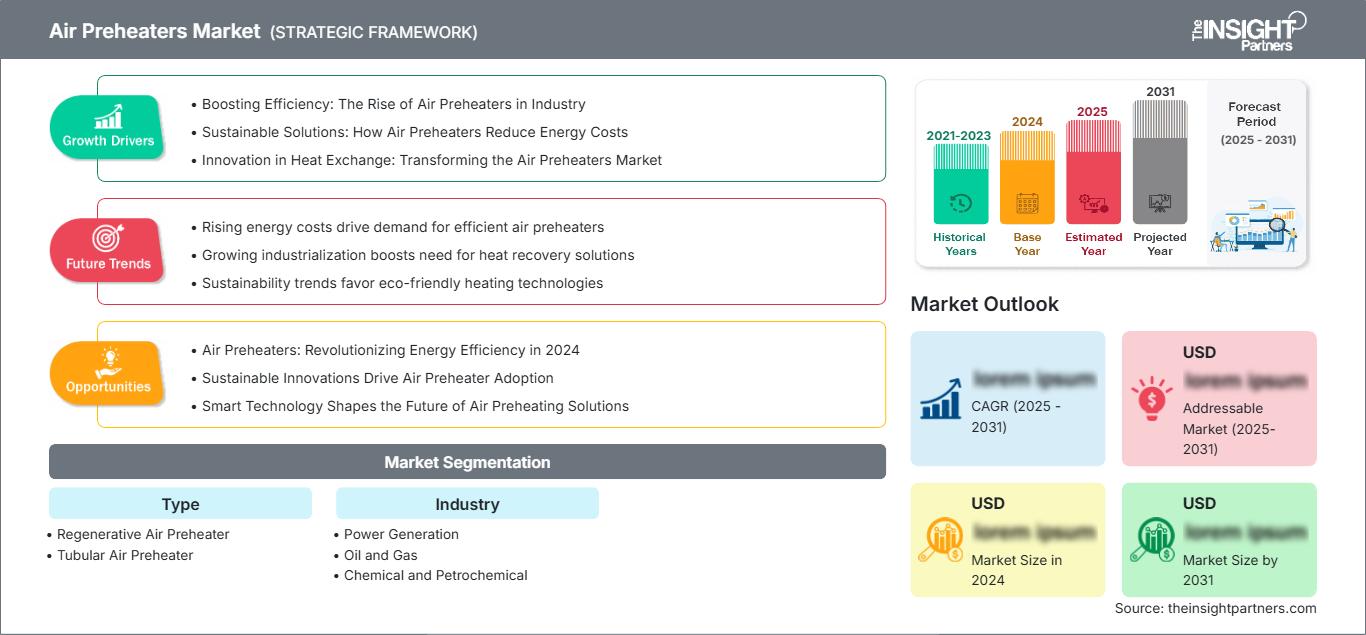
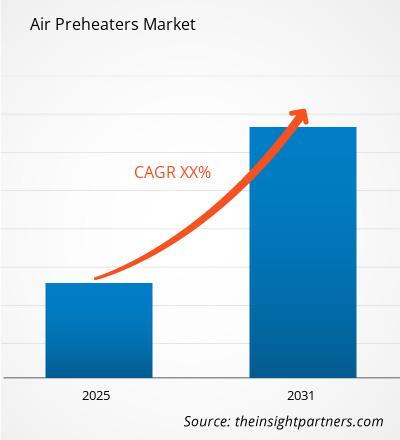
The air preheaters market is projected to grow from US$ 1.29 Billion in 2025 to US$ 1.92 Billion by 2034, registering a CAGR of 4.46% during 2026–2034. Demand is linked to industrial heat recovery, boiler refurbishment, and fuel efficiency demands in power generation, oil & gas, chemical, cement, steel, pharmaceutical, and food processing plants.
North American demand driven by replacements drives consistent growth in the air preheaters market size at a CAGR of 3.8%-4.3% up to 2034. The adoption of air preheaters is gaining traction due to utility boiler retrofits, decarbonization initiatives in refineries, and emissions regulation compliance, with purchasers considering low leakage rate and corrosion-resistance properties.
Air Preheaters Market Assessment and Insights
- North America: Share in 2025 is estimated at 28–31%, growing at a CAGR between 2026–2034 of 3.8–4.3%, supported by boiler retrofits and refinery heat recovery.
- US: Share in 2025 accounts for 72–76% of North America, with CAGR between 2026–2034 of 3.9–4.4%, led by utilities and petrochemical plants.
- Europe: Share in 2025 is estimated at 23–26%, with CAGR between 2026–2034 of 3.6–4.1%; Germany, the UK, France, Italy, and Spain lead retrofit activity.
- Asia Pacific: Share in 2025 is estimated at 34–38%, growing at a CAGR between 2026–2034 of 5.0–5.6%, led by China, India, Japan, and South Korea.
- Largest Segment: Regenerative Air Preheater holds 57–61% air preheaters market share in 2025 and records CAGR between 2026–2034 of 4.2–4.7%, driven by large boiler systems.
- High Growth Segment: Chemical and Petrochemical holds 13–16% market share in 2025 and records CAGR between 2026–2034 of 5.1–5.7%, supported by process heat optimization.
- Key companies analyzed in detail: Arvos Ljungström LLC, Kelvion Holding GmbH, Geurts Heat Exchangers B.V., Thermodyne Engineering Systems, Kamal Encon Industries Ltd., Thermin Power Systems Pvt. Ltd., SGM Tech Co., Ltd., Urjatherm Industries Pvt. Ltd., Dehu Engineering (India) Pvt. Ltd., and Youyetech Development Ltd.
Source: The Insight Partners' analysis based on proprietary research, government publications, company annual reports, investor presentations, industry databases, and expert interviews.
The development of equipment has evolved from simple heat exchanger functionality to a more sophisticated performance management concept, as seen in sealing technology, enameling of components, optimization of soot blowing, and module baskets. The production process is highly engineering-driven due to the differences between individual facilities in regard to heat load, flue gas composition, ash content, and facility layout.
From now until 2034, the drivers of demand will be the regions of emerging Asia, the Middle East, and selective retrofit corridors of North America. Regulatory pressure on industrial emissions, higher fuel-cost volatility, and grid reliability needs favor air preheaters adoption ultimately driving the air preheaters market.
Air Preheaters Market Report Scope
| Report Attribute | Details |
|---|---|
| Market size in 2025 | US$ 1.29 Billion |
| Market Size by 2034 | US$ 1.92 Billion |
| Global CAGR (2026 - 2034) | 4.46% |
| Historical Data | 2021-2024 |
| Forecast period | 2026-2034 |
Air Preheaters Market Analysis
Demand is anchored in fuel conservation, boiler efficiency, and emissions control. The IEA notes coal-fired power generation reached 10,700 TWh in 2024 and still represented 35% of global electricity, keeping thermal efficiency upgrades relevant for aging fleets. The air preheaters market growth is also supported by cement, steel, and chemical producers seeking lower specific energy consumption.
The value chain comprises alloy suppliers, heat transfer surface manufacturers, drive manufacturers, boiler OEMs, engineering contractors, and field service professionals. The dynamics of the supply chain tend to benefit vendors with regional fabrication services and outage services due to short shutdown periods. Leakage, pressure drop, corrosion resistance, and cleaning cycles are some of the factors considered by buyers.
The competitive field is fragmented but technically specialized. The air preheaters market analysis shows Arvos Ljungström LLC and Kelvion Holding GmbH competing on global engineering depth, while Geurts Heat Exchangers B.V., Thermodyne Engineering Systems, Kamal Encon Industries Ltd., and regional Asian suppliers address customized industrial projects, faster delivery, and localized maintenance requirements.
Investments are being made in technologies that will allow digital monitoring, after-market refurbishing, and the use of corrosion-resistant alloys, instead of simply installing new technologies. Positioning strategy requires references for difficult-to-handle flue gas conditions, fast availability of replacement parts, and capability of retrofits for restricted locations. Suppliers with a complete package of inspection, thermal modeling, and guarantee are in a much stronger position.
● REPORT CUSTOMIZATION
Tailor This Report To Align With Your Specific Business Requirements
This report can be customized to align precisely with your business objectives, scope, and target markets. Customization options include tailored segmentation, geography, competitive analysis, and strategic insights to support informed decision-making.
Customize This Report →WHAT YOU CAN ADJUST
- ● Segmentations
- ● Geography
- ● Competitive Analysis
- ● Language Preferences
Air Preheaters Market: Strategic Insights
Regional Insights
North America air preheaters
North America accounts for 28–31% share in 2025 and is expected to grow at a CAGR of 3.8–4.3% during 2026–2034. The air preheaters market share is supported by coal and gas boiler retrofits, refinery heater efficiency programs, and strict emissions management under federal and state permitting frameworks.
Utilities are extending thermal fleet flexibility to balance renewable intermittency, while industrial operators pursue measurable fuel savings. Demand concentrates in replacement baskets, seals, enamel-coated elements, and tubular systems for process heaters. Short maintenance windows make domestic service capability a differentiator for established suppliers and specialist fabricators.
U.S. air preheaters Market
United States constitutes 72-76% of North America’s share in 2025, and has an estimated growth rate of CAGR 3.9-4.4% for the period until 2034. Applications include power generation, refining, petrochemical, cement, and food processing industries, wherein heat recovery units are retrofitted without overhauling the whole combustion system.
Company coverage is prominent in utility-based service territories, Gulf Coast process industries, and Midwestern manufacturing clusters. Kelvion Holding GmbH and Arvos Ljungström LLC leverage their installed base, while Indian and Chinese companies have competition in packaged systems and replacement components.
Europe air preheaters Market
The European region commands 23-26% market share in 2025 and records a CAGR of 3.6-4.1%, with Germany being the major country. In the UK, factors driving the air preheater market include waste to energy, biomass processing, and refining plant renovations where heat recovery can help in meeting emission reduction targets without compromising industrial competitiveness.
In Germany, the chemical industry, cement and high efficiency boilers renovations provide impetus to the air preheater market. Process heat applications, district heating connections and industrial decarbonization funds in France, Italy and Spain add to the market growth drivers. Corrosion prevention, minimal leakages and documentation become key in air preheater purchases.
APAC air preheaters Market
Share of APAC ranges between 34-38% in 2025 and experiences growth at a CAGR of 5.0-5.6%. It is the fastest growing region in terms of air preheater market share. China dominates because of its large capacity for thermal power plants, steel production, cement manufacturing, and chemical processing.
Japan and South Korea are into high specification retrofits, emission reduction, and reliability improvements. Australia gets its share from its mining associated processing and power facilities. The policies supporting energy conservation together with the high energy consumption in heavy industries keep the air preheaters demand stable.
Middle East & Africa air preheaters Market
Middle East & Africa grows at a CAGR of 4.1–4.7% through 2034, led by Saudi Arabia. Demand is tied to refinery heaters, petrochemical complexes, desalination-linked power assets, and cement production where high-temperature combustion efficiency directly affects operating cost.
Demand support in UAE through industrial infrastructure and district energy, while in South Africa there is the refurbishment requirement due to aging thermal and mining process equipment. Rest of MEA depends on project financing, fuel costs, and local service provision for air preheaters maintenance.
Segmentation Analysis
Type
The Type segment is forecast to grow at a CAGR of 4.1–4.6% during 2026–2034. The air preheaters market scope across type selection depends on boiler size, gas-side fouling, pressure drop limits, and maintenance access. Regenerative systems dominate large utility and industrial boilers, while tubular systems remain important for process heaters and smaller duties.
- Regenerative Air Preheater: This sub-segment holds the strongest position in large boilers because rotating heat transfer elements recover significant exhaust heat while enabling compact installation and proven utility-scale performance.
- Tubular Air Preheater: Demand remains stable in process industries requiring simpler construction, lower maintenance complexity, and reliable heat exchange where gas contamination or space constraints make fixed-tube designs practical.
Industry
The Industry segment is expected to grow at a CAGR of 4.4–5.0% during 2026–2034. Adoption reflects different heat intensity, fuel use, and uptime priorities across end markets. Power generation remains the largest user, but chemical and petrochemical plants, cement kilns, and steel facilities increasingly evaluate air preheaters as efficiency upgrades within broader decarbonization programs.
- Power Generation: Utilities prioritize leakage reduction, combustion efficiency, and outage-based replacement because thermal plants require flexible operation, lower auxiliary losses, and dependable heat recovery during variable load cycles.
- Oil and Gas: Refineries and gas processing plants use air preheaters to improve fired heater efficiency, lower fuel gas consumption, and maintain stable process temperatures under continuous operating conditions.
- Chemical and Petrochemical: Producers adopt engineered systems for steam generation, process heaters, and emissions compliance, making this sub-segment strategically important for high-growth, energy-intensive manufacturing clusters.
- Cement: Cement plants deploy air preheaters around kiln and boiler systems to reduce thermal energy consumption, support clinker production efficiency, and manage high-dust operating environments.
- Steel: Steel facilities use heat recovery to improve furnace and boiler performance, especially where fuel-cost exposure and carbon reporting encourage upgrades in coke, sinter, and rolling operations.
- Pharmaceutical: Demand is selective but quality-sensitive, focused on controlled process heat, steam systems, and reliable thermal equipment that supports continuous compliance in regulated production environments.
- Food: Food processors use compact heat recovery equipment for boilers, dryers, and ovens, balancing hygiene requirements, fuel savings, and stable thermal performance across distributed manufacturing sites.
Opportunity Snapshot
| Segment Name | Revenue Contribution | Trend Tag | Adoption Stage |
| Power Generation | High | Boiler Retrofit | Mature |
| Oil and Gas | Medium | Fired Heaters | Scaling |
| Chemical and Petrochemical | High | Process Heat | Scaling |
| Cement | Medium | Kiln Efficiency | Scaling |
| Steel | Medium | Furnace Recovery | Scaling |
| Pharmaceutical | Low | Clean Steam | Emerging |
| Food | Low | Thermal Ovens | Emerging |
Air Preheaters Market Growth Drivers and Impact Analysis
Industrial Fuel Efficiency and Emissions Compliance
The increasing price instability of fuels as well as carbon emission restrictions are encouraging operators to extract greater amounts of heat from the flue gases before their discharge from the boilers or process heaters. An efficient air-side preheating leads to better fuel combustion and fuel saving, and this, in turn, has a direct effect on the margin of operations in the cement, steel, refineries and power plants. The effect will be especially pronounced for plants that have high operating time per year, since even small increases in efficiency translate into fuel savings.
Aging Boiler Fleets and Retrofit Economics
A considerable number of assets in the thermal power generation, refineries, and industrial boilers segment continue to be in use past their original design assumptions, providing for a continuous market for retrofit activities. The ability to upgrade baskets, seals, tubes, and drive trains will help enhance efficiency more quickly than developing new combustion facilities. Retrofit economics make business sense due to reduced downtime, low capital investment, and predictability of savings through fuel cost reductions. Retrofit projects have significant economic appeal wherever owners of such assets incur penalties due to unreliability and forced outages.
Expansion of Energy-Intensive Manufacturing
The increase in industrial capacity installations in Asia, the Middle East, and some parts of Africa is growing the base of demand for high temperature equipment. New cement kilns, petrochemical plants, steel mills, and captive power stations need heat recovery to reduce fuel intensity since the very beginning of their operations. The government support to manufacture domestically and capital expenditures for the development of infrastructure increase the need for heat recovery because energy costs affect the competitiveness of a company. Air preheaters will be in demand if there is a design for heat recovery in the initial phase of the project.
Air Preheaters Market Future Trends
Sensor-Enabled Predictive Maintenance
air preheaters market trends are moving toward continuous monitoring of leakage, differential pressure, gas outlet temperature, vibration, and soot-blowing effectiveness. Predictive maintenance will help operators identify basket fouling, seal degradation, corrosion risk, and rotor imbalance before efficiency losses become outage events. This shift supports longer maintenance intervals and better outage planning, especially in utilities and refineries operating under strict availability targets. Digital service models may also change vendor relationships, with suppliers offering performance diagnostics, remote advisory support, and condition-based spare parts. Over time, monitoring data will influence design improvements and strengthen aftermarket revenue visibility.
Materials Designed for Lower-Temperature Operation
As plants reduce stack temperatures to ensure efficient heat recovery, the risk of corrosion and fouling becomes higher, especially when sulfur, chlorides, or ash exist in the flue gases. In future, manufacturers will increasingly use enamel coatings, corrosion-resistant alloys, proper element design, and enhanced washability. This development will be crucial in biomass co-firing, waste incineration, refineries, and cement production, among others. Those that can prove longevity and pressure drops of elements will win favor. Consequently, material development will determine total cost of ownership just as thermal efficiency.
Air Preheaters Market Opportunities
Aftermarket Refurbishment Platforms
Aftermarket service offers one of the clearest investment routes because installed equipment requires recurring inspections, seal upgrades, basket replacements, washing systems, and performance audits. Suppliers can build regional refurbishment hubs near thermal power, refining, cement, and steel clusters to reduce lead times and capture repeat work. Air preheaters market forecasts indicate retrofit demand will remain resilient even where new coal capacity slows, because existing assets must meet efficiency and reliability requirements. Companies that combine engineered parts with outage planning, digital diagnostics, and guaranteed performance recovery can improve margins while deepening customer relationships.
Industrial Heat Recovery in Emerging Manufacturing Hubs
Emerging manufacturing hubs present opportunities for suppliers that can balance engineering quality with local cost structures. India, Southeast Asia, the Gulf, and parts of Africa are adding process industries where fuel efficiency is becoming a procurement criterion. Early engagement with EPC contractors can position air preheaters within boiler packages, refinery heaters, and cement plant designs before specifications are locked. Partnerships with local fabricators may help global firms meet delivery expectations while protecting proprietary heat transfer expertise. Financing models tied to energy savings could further accelerate adoption among mid-sized industrial buyers.
Recent Developments
- June 2026: Kelvion Holding GmbH — The company was recognized as a Best Managed Company for the second consecutive year, reinforcing governance, strategic execution, and operational discipline across its heat exchange and cooling portfolio. The recognition supports customer confidence in complex thermal projects, including industrial heat recovery applications.
- January 2026: Kelvion Holding GmbH — The company launched K°Focus Carbon Capture & Storage, an online platform supporting selection of thermal solutions for carbon capture applications. While focused on CCS, the development reflects growing demand for specialized heat exchange design tools across decarbonizing industrial systems.
- August 2025: Kelvion Holding GmbH — Apollo-managed funds agreed to acquire a majority stake in Kelvion from Triton, with closing expected between late 2025 and early 2026. The transaction strengthens Kelvion’s access to energy transition and industrial technology capital.
Frequently Asked Questions

- Comprehensive Market Sizing and Forecast Analysis
- Detailed Segmentation Analysis
- In-Depth Market Dynamics Assessment
- Regional and Country-Level Insights
- Competitive Landscape and Company Benchmarking
- Strategic Business Intelligence
Recent Reports
Testimonials

The Insight Partners provided valuable market intelligence that supported our global go-to-market strategy. Their team was professional, responsive, and attentive to our feedback, providing thoughtful analysis and helpful methodological clarifications throughout the project.
Junmo Kim Chief Financial Officer (CFO), Enertech Co., Ltd.
The Insight Partners' SCADA System Market report is comprehensive, with valuable insights on current trends and future forecasts. The team was highly professional, responsive, and supportive throughout. We are very satisfied and highly recommend their services.
RAN KEDEM Partner, Reali Technologies LTDs
I requested a report on a very specific software market and the team produced the report in a few days. The information was very relevant and well presented. I then requested some changes and additions to the report. The team was again very responsive and I got the final report in less than a week.
JEAN-HERVE JENN Chairman, Future Analytica
We worked with The Insight Partners for an important market study and forecast. They gave us clear insights into opportunities and risks, which helped shape our plans. Their research was easy to use and based on solid data. It helped us make smart, confident decisions. We highly recommend them.
PIYUSH NAGPAL Sr. Vice President, High Beam Global
The Insight Partners delivered insightful, well-structured market research with strong domain expertise. Their team was professional and responsive throughout. The user-friendly website made accessing industry reports seamless. We highly recommend them for reliable, high-quality research services
YUKIHIKO ADACHI CEO, Deep Blue, LLC.
This is the first time I have purchased a market report from The Insight Partners.While I was unsure at first, I visited their web site and felt more comfortable to take the risk and purchase a market report.I am completely satisfied with the quality of the report and customer service. I had several questions and comments with the initial report, but after a couple of dialogs over email with their analyst I believe I have a report that I can use as input to our strategic planning process.Thank you so much for taking the extra time and making this a positive experience.I will definitely recommend your service to others and you will be my first call when we need further market data.
JOHN SUZUKI President and Chief Executive Officer, Board Director, BK Technologies
I wish to appreciate your support and the professionalism you displayed in the course of attending to my request for information regarding to infectious disease IVD market in Nigeria. I appreciate your patience, your guidance, and the fact that you were willing to offer a discount, which eventually made it possible for us to close a deal. I look forward to engaging The Insight Partners in the future, all thanks to the impression you have created in me as a result of this first encounter.
DR CHIJIOKE ONYIA MANAGING DIRECTOR, PineCrest Healthcare Ltd.Reason to Buy
- Informed Decision-Making
- Understanding Market Dynamics
- Competitive Analysis
- Identifying Emerging Markets
- Customer Insights
- Market Forecasts
- Risk Mitigation
- Boosting Operational Efficiency
- Strategic Planning
- Investment Justification
- Tracking Industry Innovations
- Aligning with Regulatory Trends





 Get Free Sample for