
Air Springs Market Share, Growth Opportunities & Demand by 2034
Coverage: By Product Type (Single Convolute, Multi Convolute, Sleeve, Rolling Lobe and Conical Beads, Others); Vehicle Type (Passenger Vehicles, Commercial Vehicles, Heavy Commercial Vehicles, Others) , and Geography (North America, Europe, Asia Pacific, and South and Central America)
- Status : Data Released
- Report Code : TIPRE00020865
- Category : Automotive and Transportation
- No. of Pages : 150
- Available Report Formats :


- Last update date : August 12, 2026


2025 Market Size
US$ 7.07 Bn
Base year value
2034 Forecast
US$ 11.69 Bn
Projected by 2034
CAGR 2026-2034
5.75 %
Growth rate
Addressable Market
US$ 85.03 Bn
(2026-2034)
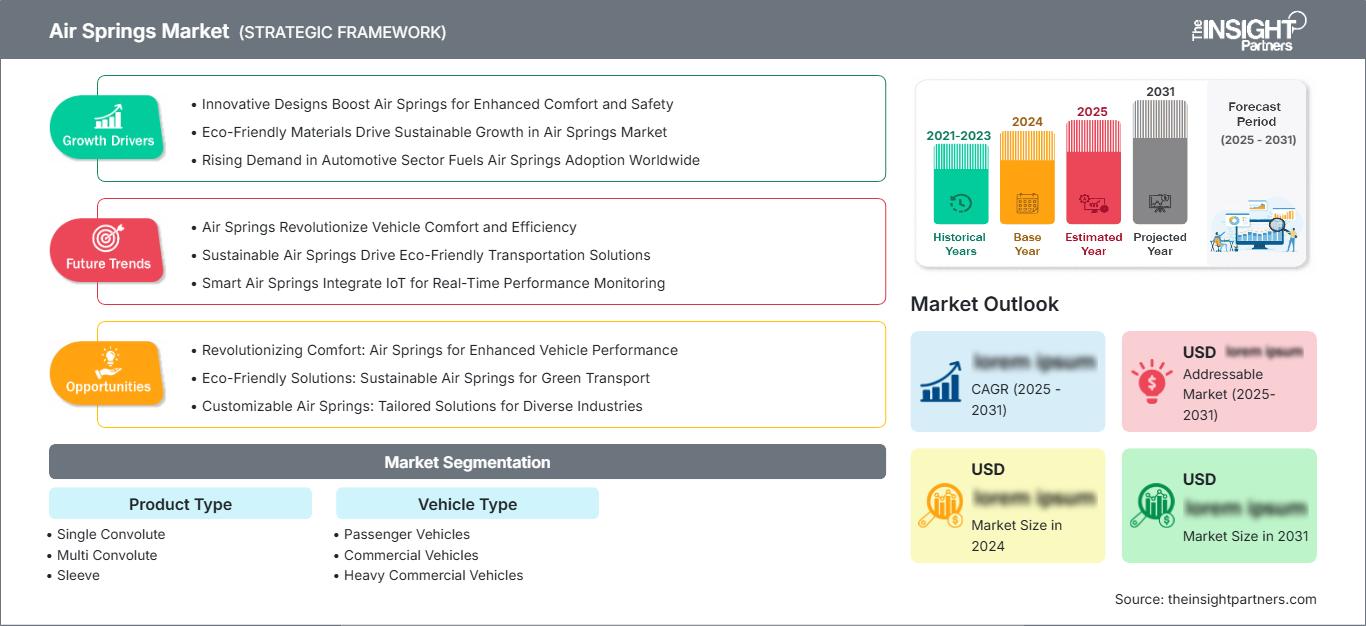
The air springs market is projected to grow from US$ 7.07 Billion in 2025 to US$ 11.69 Billion by 2034, registering a CAGR of 5.75% during 2026–2034. Demand is supported by the shift from conventional steel suspension toward pneumatic systems that improve ride comfort, load leveling, axle protection, and vehicle stability across passenger vehicles, commercial vehicles, and heavy commercial vehicles.
North America remains a strategically important region as fleet operators, trailer manufacturers, and premium vehicle platforms prioritize suspension durability and operating efficiency. The air springs market size in the region is supported by higher adoption in long-haul trucking, aftermarket replacement cycles, and electronically controlled suspension systems. Regional growth is estimated in the 5.2–5.8% CAGR range during 2026–2034.
Air Springs Market Assessment and Insights
- North America: Accounted for an estimated 22–25% share in 2025 and is expected to grow at a CAGR of 5.2–5.8% during 2026–2034, supported by truck fleet modernization and premium suspension replacement demand.
- US: Represented around 72–76% of North American demand in 2025 and is projected to expand at a CAGR of 5.3–5.9% during 2026–2034.
- Europe: Held an estimated 26–29% share in 2025 and is forecast to grow at a CAGR of 5.0–5.6%, led by Germany, France, Italy, Spain, and the UK.
- Asia Pacific: Represented an estimated 39–43% share in 2025 and is expected to grow at a CAGR of 6.0–6.6%, led by China, Japan, South Korea, and India.
- Largest Segment: Commercial Vehicles held an estimated 43–47% market share in 2025 and is projected to grow at a CAGR of 5.6–6.2% during 2026–2034.
- High Growth Segment: Heavy Commercial Vehicles held an estimated 29–33% market share in 2025 and is projected to grow at a CAGR of 6.1–6.8% during 2026–2034.
- Key companies analyzed in detail: Goodyear Air Springs by Infinity Engineered Products, Arnott Industries, LLC, Ksport USA, Firestone Airide, Helix Suspension Brakes and Steering, Air Lift Company, Suncore Industries, VIAIR Corporation, RideTech, and Hellwig Products Company, Inc.
Source: The Insight Partners' analysis based on proprietary research, government publications, company annual reports, investor presentations, industry databases, and expert interviews.
Technology development in the market has moved from simple rubber bellows toward engineered suspension modules that combine reinforced elastomers, rolling-lobe geometry, height sensors, and electronic control units. According to the Air Springs Market Report, production dynamics are also changing as OEMs require lighter, longer-life components capable of supporting heavier axle loads, electric powertrain packaging requirements, and higher-duty-cycle commercial transport operations. Changing expectations of performance are fueling innovations in both automobile manufacturing and the construction of suspension systems.
Progress is anticipated in the areas of production of Asian commercial vehicles, emissions and safety of European vehicles, and demand for North American replacements. Resources are being directed at the development of modular air suspensions that minimize vibration, preserve cargo, and make driving more comfortable.
Air Springs Market Report Scope
| Report Attribute | Details |
|---|---|
| Market size in 2025 | US$ 7.07 Billion |
| Market Size by 2034 | US$ 11.69 Billion |
| Global CAGR (2026 - 2034) | 5.75% |
| Historical Data | 2021-2024 |
| Forecast period | 2026-2034 |
Air Springs Market Analysis
The air springs market growth is anchored in the need for ride control across vehicles carrying variable loads. Pneumatic suspensions are used by commercial vehicles to keep ride height constant, alleviate stress on the chassis, and ensure the safety of goods transported over long distances. Use in passenger cars is less common, but increasing among luxury SUVs and electric vehicles, where weight management and differentiation become essential.
The supply chain includes suppliers of rubber compounds, producers of fabric reinforcements, manufacturers of crimped metal end-caps, compressors, valves, sensors, and distributors of aftermarket products. The market dynamics reward players who offer a product that is backed by testing, has wide fitment, and offers durable construction in challenging environments.
The air springs market analysis shows a competitive landscape split between global suspension specialists, branded aftermarket suppliers, and niche performance suspension companies. Both Goodyear Air Springs from Infinity Engineered Products and Firestone Airide have maintained their association with heavy-duty commercial vehicles, while Arnott Industries and Air Lift Company stress replacement and upgrade applications for both passenger and light commercial vehicles.
Positioning strategies now require deep product catalogs, application engineering capability, strong distribution capabilities, and product verification. Ksport USA, RideTech, Helix Suspension Brakes and Steering, VIAIR Corporation, Suncore Industries, and Hellwig Products Company, Inc., have targeted specific aftermarket applications, such as performance tuning, compressors, conversion kits, and load assist products for trucks and SUVs.
● REPORT CUSTOMIZATION
Tailor This Report To Align With Your Specific Business Requirements
This report can be customized to align precisely with your business objectives, scope, and target markets. Customization options include tailored segmentation, geography, competitive analysis, and strategic insights to support informed decision-making.
Customize This Report →WHAT YOU CAN ADJUST
- ● Segmentations
- ● Geography
- ● Competitive Analysis
- ● Language Preferences
Air Springs Market: Strategic Insights
Regional Insights
North America air springs market
North America is estimated to hold 22–25% air springs market share in 2025, supported by the high use of air suspension in trucks, trailers, buses, and premium passenger vehicles. Demand is tied to fleet uptime, cargo protection, and aftermarket replacement, particularly where heavy payloads and long operating distances increase suspension wear.
The region is projected to grow at a CAGR of 5.2–5.8% during 2026–2034. Electrified delivery vehicles, premium pickup upgrades, and electronically controlled systems are broadening adoption. Supplier advantage is expected to favor companies with fast replacement availability, OE-equivalent fitment, and strong installer networks.
U.S. air springs Market
The US accounted for an estimated 72–76% of North American demand in 2025, reflecting its large trailer, truck, bus, pickup, and recreational vehicle base. Fleet operators use air springs to reduce vibration damage, support variable loads, and improve driver comfort over long routes.
The country is projected to grow at a CAGR of 5.3–5.9% during 2026–2034. Aftermarket activity is particularly strong because older vehicles require bellows, compressors, and height-control replacements. Company presence from Goodyear Air Springs, Air Lift Company, RideTech, and Hellwig supports broad distribution coverage.
Europe air springs Market
Europe held an estimated 26–29% share in 2025 and is forecast to grow at a CAGR of 5.0–5.6% during 2026–2034. Germany remains the leading country due to strong commercial vehicle engineering, premium passenger platforms, and supplier networks, while France and Italy contribute through trailer, bus, and replacement demand.
The UK market is driven by logistics fleets, coach operators, and premium vehicle replacement channels. Germany benefits from OEM engineering depth and advanced suspension validation. France, Italy, and Spain show steady adoption in regional freight, public transport, and aftermarket service networks where ride comfort and load stability remain purchasing priorities.
APAC air springs Market
APAC represented an estimated 39–43% share in 2025 and is projected to grow at a CAGR of 6.0–6.6% during 2026–2034. Demand is led by China with commercial vehicle manufacturing, logistics, and electric bus adoption, whereas Japan and South Korea facilitate innovative suspension system development.
Australia and India contribute to growth via freight services, mining logistics, and HDV replacements. The market gains from increased vehicle manufacturing, cost-effective fleet upgrade, and policies favoring clean buses and commercial mobility that require stable suspension under heavier batteries and payloads.
Middle East & Africa air springs Market
Middle East & Africa is expected to grow at a CAGR of 4.7–5.3% during 2026–2034, with Saudi Arabia and the UAE leading demand through infrastructure, logistics, energy transport, and premium vehicle service channels. Harsh operating conditions increase the need for durable suspension components.
South Africa supports regional demand through commercial fleet maintenance and mining-related transport, while the rest of MEA remains more aftermarket-led. Adoption is expected to rise gradually as road freight modernization and construction activity increase requirements for load stability, ride quality, and component longevity.
Segmentation Analysis
Product Type
Product Type is expected to grow at a CAGR of 5.4–6.0% during 2026–2034. The air springs market scope across product designs reflects varying load capacity, packaging needs, and durability requirements. Rolling lobe and sleeve types support broad vehicle use, while convolute designs remain relevant where compact packaging and high load isolation are required.
- Single Convolute products serve compact load-support applications where vertical travel is limited and vibration isolation is essential. Demand is concentrated in auxiliary suspension, industrial, and selected light vehicle uses.
- Multi Convolute designs offer higher load support and greater deflection capability, making them relevant for heavy-duty suspension, lift axle systems, and applications requiring robust cushioning under variable loads.
- Sleeve air springs are valued for smooth ride characteristics and compact construction. They are used in passenger vehicles, light commercial platforms, and aftermarket air suspension kits.
- Rolling Lobe air springs dominate many commercial vehicle applications because they provide consistent load leveling, long travel, and durability under trailer, truck, and bus operating cycles.
- Conical Beads support specialized mounting needs and packaging constraints, helping suppliers address vehicle-specific geometry where conventional bead plates may not fit efficiently.
Vehicle Type
Vehicle Type is projected to grow at a CAGR of 5.7–6.3% during 2026–2034. Demand differs by ride comfort, payload profile, and replacement frequency. Commercial vehicles remain the largest revenue contributor, while heavy commercial vehicles are the fastest-growing group due to electrification, logistics intensity, and higher axle-load requirements.
- Passenger Vehicles use air springs mainly in premium cars, SUVs, and performance aftermarket platforms where comfort, adjustable ride height, and controlled body movement strengthen product appeal.
- Commercial Vehicles generate the greatest demand because vans, buses, trucks, and trailers require suspension systems that support load variation, cargo protection, and driver comfort.
- Heavy Commercial Vehicles show the strongest growth as long-haul trucks, heavy buses, and specialized transport fleets require durable suspension for heavier payloads and electrified platforms.
Opportunity Snapshot
| Vehicle Type | Revenue Contribution | Trend Tag | Adoption Stage |
| Passenger Vehicles | Medium | Premium Comfort | Scaling |
| Commercial Vehicles | High | Fleet Uptime | Mature |
| Heavy Commercial Vehicles | High | Battery Loads | Scaling |
Air Springs Market Growth Drivers and Impact Analysis
Commercial Fleet Modernization and Load Stability Demand
The fleets have started incorporating the use of air suspension in an effort to ensure consistent performance, minimize damage to the cargo and increase the lifespan of components of the trucks, buses, and trailers. The use of air suspensions ensures that the vehicle remains at the same level despite the varying loads. Air suspension plays an important role in terms of vehicle performance since the suspension determines the uptime and cost of maintenance.
Electrification of Trucks, Buses, and Premium Vehicles
New suspension demands arise due to the additional weights and changed load distribution that occur in electric cars because of their batteries. Air suspensions contribute to ensuring proper height adjustment and prevent batteries, cargo, and passengers from vibrations. Their implementation has gained popularity in electric buses, luxurious SUVs, delivery vans, and commercial prototype electric cars. This driver broadens the scope of the air suspension market from comfort needs to suspension system integration into the vehicle design.
Aftermarket Replacement and Vehicle-Specific Suspension Upgrades
Aftermarket replacement is a tough but dependable revenue stream due to the nature of how these air springs, compressors, and valves wear out after being exposed to harsh conditions. Vehicles that are older or customized need to have the right components for the vehicle for better load-bearing. Suppliers who can offer comprehensive catalogs with fast delivery will be able to capitalize on this revenue stream. This revenue stream works best in North America and Europe.
Air Springs Market Future Trends
Electronically Controlled Suspension Integration
The air springs market trends are moving toward electronically controlled suspension systems that use height sensors, control modules, and adaptive valves to adjust ride height in real time. This technology helps increase the stability, aerodynamics and comfort level of high-end passenger cars and commercial vehicles. The future success of this technology would depend on the reliability of the components, calibration and integration with assistance features for the drivers. Supply chains that integrate air spring technology along with compressors, sensors and compatible modules would have an advantage.
Durable Materials and Lower-Maintenance Designs
Materials development is anticipated to play a role in determining the future of the product development cycle. Use of reinforced rubber mixes, better bead sealing systems, anti-corrosion end plates, and enhanced geometry of the rolling lobes are ways that could minimize failure rates under severe transport conditions. This trend will be more relevant in cases where vehicles are operated at high mileage rates, high temperatures, or in rough road conditions.
Air Springs Market Opportunities
Electrified Commercial Vehicle Suspension Platforms
The air springs market Forecasts indicate a strong opportunity in electric buses, delivery trucks, and regional freight vehicles because these platforms need suspension systems that manage heavier batteries without compromising ride quality. Suppliers can develop kits and OE modules calibrated for battery placement, axle loading, and urban duty cycles. The opportunity is investment-oriented because early platform integration can create long-term supply positions, aftermarket replacement demand, and service revenue as electrified fleets scale across North America, Europe, and APAC.
Aftermarket Coverage for Aging Premium and Fleet Vehicles
Replacement of aging premium vehicles and fleet vehicles provides a real chance for sales of air springs, compressors and kits. In this case, customers value precision of fitment, certainty of warranty, and prompt delivery more than just pricing. Manufacturers may diversify their product lineup, increase installer training, and develop online sales channels to benefit from the need for independent workshops and fleet maintenance crews.
Frequently Asked Questions

- Comprehensive Market Sizing and Forecast Analysis
- Detailed Segmentation Analysis
- In-Depth Market Dynamics Assessment
- Regional and Country-Level Insights
- Competitive Landscape and Company Benchmarking
- Strategic Business Intelligence
Recent Reports
Testimonials

The Insight Partners' SCADA System Market report is comprehensive, with valuable insights on current trends and future forecasts. The team was highly professional, responsive, and supportive throughout. We are very satisfied and highly recommend their services.
RAN KEDEM Partner, Reali Technologies LTDs
I requested a report on a very specific software market and the team produced the report in a few days. The information was very relevant and well presented. I then requested some changes and additions to the report. The team was again very responsive and I got the final report in less than a week.
JEAN-HERVE JENN Chairman, Future Analytica
We worked with The Insight Partners for an important market study and forecast. They gave us clear insights into opportunities and risks, which helped shape our plans. Their research was easy to use and based on solid data. It helped us make smart, confident decisions. We highly recommend them.
PIYUSH NAGPAL Sr. Vice President, High Beam Global
The Insight Partners delivered insightful, well-structured market research with strong domain expertise. Their team was professional and responsive throughout. The user-friendly website made accessing industry reports seamless. We highly recommend them for reliable, high-quality research services
YUKIHIKO ADACHI CEO, Deep Blue, LLC.
This is the first time I have purchased a market report from The Insight Partners.While I was unsure at first, I visited their web site and felt more comfortable to take the risk and purchase a market report.I am completely satisfied with the quality of the report and customer service. I had several questions and comments with the initial report, but after a couple of dialogs over email with their analyst I believe I have a report that I can use as input to our strategic planning process.Thank you so much for taking the extra time and making this a positive experience.I will definitely recommend your service to others and you will be my first call when we need further market data.
JOHN SUZUKI President and Chief Executive Officer, Board Director, BK Technologies
I wish to appreciate your support and the professionalism you displayed in the course of attending to my request for information regarding to infectious disease IVD market in Nigeria. I appreciate your patience, your guidance, and the fact that you were willing to offer a discount, which eventually made it possible for us to close a deal. I look forward to engaging The Insight Partners in the future, all thanks to the impression you have created in me as a result of this first encounter.
DR CHIJIOKE ONYIA MANAGING DIRECTOR, PineCrest Healthcare Ltd.Reason to Buy
- Informed Decision-Making
- Understanding Market Dynamics
- Competitive Analysis
- Identifying Emerging Markets
- Customer Insights
- Market Forecasts
- Risk Mitigation
- Boosting Operational Efficiency
- Strategic Planning
- Investment Justification
- Tracking Industry Innovations
- Aligning with Regulatory Trends





 Get Free Sample for