
Camera and Sensor Cleaning System Market Demand, Share & Growth by 2034
Coverage: By Vehicle Type (Passenger Cars, LCV, MCV, HCV, Trailers), Sensor Type (Camera, LiDAR, Ultrasonic, and Others), and Autonomous Level (Level 1, Level 2, Level 3, Level 4, and Level 5), and Geography (North America, Europe, Asia Pacific, Middle East and Africa, South and Central America)
- Status : Published
- Report Code : TIPRE00043134
- Category : Automotive and Transportation
- No. of Pages : 259
- Available Report Formats :


- Last update date : August 17, 2026


2025 Market Size
US$ 2.24 Bn
Base year value
2034 Forecast
US$ 4.24 Bn
Projected by 2034
CAGR 2026-2034
7.0 %
Growth rate
Addressable Market
US$ 28.71 Bn
(2026-2034)
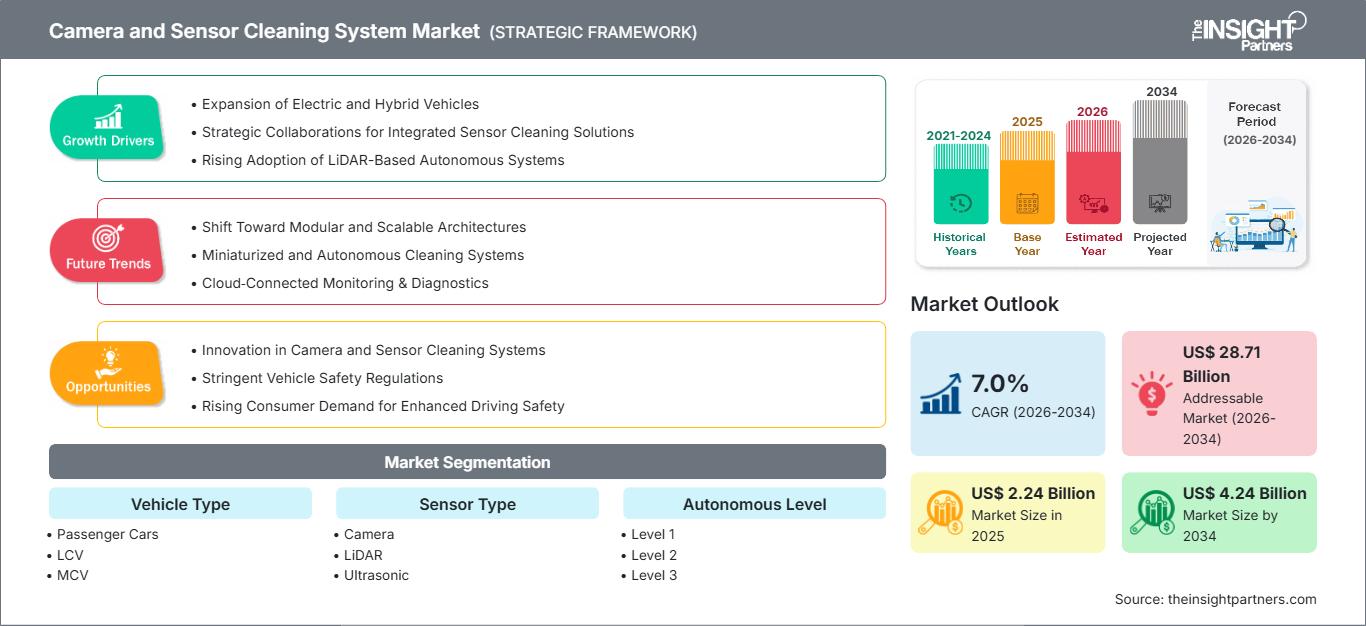
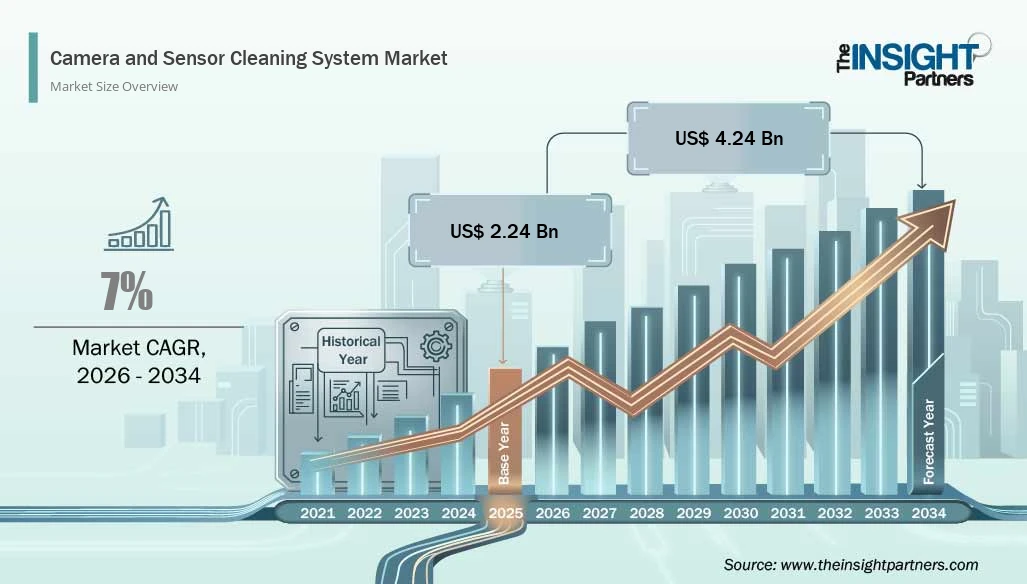
The Camera and Sensor Cleaning System Market size was valued at US$ 2.24 Billion in 2025 and is projected to reach US$ 4.24 Billion by 2034; it is expected to register a CAGR of 7.0% during 2026–2034. Growth is linked to rising integration of cameras, LiDAR, ultrasonic sensors, and higher autonomous driving levels across passenger cars, commercial vehicles, and trailers.
North America remains a strategically important demand center, with adoption supported by ADAS penetration, harsher weather-zone validation requirements, and OEM focus on sensor uptime. The Camera and Sensor Cleaning System Market size in the region is expected to benefit from a 5.59% CAGR range, as automakers prioritize cleaning modules for front, rear, surround-view, and LiDAR-enabled sensing architectures.
Camera and Sensor Cleaning System Market Assessment and Insights
- North America accounted for 31.17% share in 2025 and is projected to grow at a CAGR of 5.59% between 2026–2034, supported by safety regulation upgrades and premium vehicle ADAS fitment.
- US represented 67.50% of North America in 2025 and is projected to grow at a CAGR of 5.46% between 2026–2034, driven by Level 2 and Level 3 vehicle programs.
- Europe held 22.35% share in 2025 and is expected to grow at a CAGR of 7.80% between 2026–2034, led by Germany, France, the UK, Italy, and Spain.
- Asia Pacific captured 46.48% share in 2025 and is forecast to grow at a CAGR of 8.13% between 2026–2034, with China, Japan, South Korea, and India leading adoption.
- Largest Segment Passenger Cars held 46.85% market share in 2025 and is projected to grow at a CAGR of 9.77% during 2026–2034 as ADAS becomes mainstream.
- High Growth Segment LiDAR held 25.80% market share in 2025 and is projected to grow at a CAGR of 8.73% during 2026–2034 as higher autonomy programs scale.
- Key companies analyzed in detail: Valeo SE, AUMOVIO SE, Kautex Textron GmbH & Co. KG, Ficosa International, S.A., Röchling SE & Co. KG, ARaymond, Schaeffler AG, Cebi International S.A., AMK Automotive GmbH & Co. KG, Continental AG, and Vitesco Technologies Group AG.
Source: The Insight Partners' analysis based on proprietary research, government publications, company annual reports, investor presentations, industry databases, and expert interviews.
Vehicle perception has changed from using single rear camera sensors to using an array of cameras requiring continuous optical clarity. This way, the Camera and Sensor Cleaning System Market has evolved from washer accessories to become fully-fledged mechatronic products made up of fluidics, jetting, heating, triggering and packaging around bumpers, grilles, mirrors, roofs and tailgates. Dynamics in manufacturing are changing in favor of platforms as OEMs seek solutions which are scalable for passenger cars, light commercial vehicles, heavy trucks and robotaxis.
Demand during the forecast period is expected to expand from being driven by premium vehicle models to include the need for good safety ratings, validation of autonomous driving capabilities and weather resilient sensor operation. Up-and-coming geographical regions are likely to focus their investments in localized vehicle electronics and electric mobility platforms, commercial fleet safety and other applications where compact, low fluid, energy-efficient cleaning systems can be used. Regulations emphasizing ADAS reliability will further fuel adoption in different regions with varying road contamination and precipitation levels.
Camera and Sensor Cleaning System Market Report Scope
| Report Attribute | Details |
|---|---|
| Market size in 2025 | US$ 2.24 Billion |
| Market Size by 2034 | US$ 4.24 Billion |
| Global CAGR (2026 - 2034) | 7.0% |
| Historical Data | 2021-2024 |
| Forecast period | 2026-2034 |
Camera and Sensor Cleaning System Market Analysis
Factors contributing to the Camera and Sensor Cleaning System Market include an increasing number of outside sensing points on each vehicle as surround-view systems, lane assistance, emergency breaking, and automatic parking systems have become standard features on newer vehicles. These cleaning systems safeguard the camera and LiDAR vision from mud, insects, salt, rain, and snow and avoid sensor blindness and false detections.
The market ecosystem comprises of washer reservoir suppliers, nozzle and actuator suppliers, thermal components manufacturers, electronic controls experts, and Tier 1s. Supplier dynamics lean towards those who can provide packaging that is small while consuming less liquid in order to meet the challenge of balancing sensor effectiveness, vehicle weight, costs, and serviceability on a climatically consistent basis for cleaning.
Positioning of players in the Camera and Sensor Cleaning System Market is determined by manufacturing readiness, supplier relationships, and performance under real world conditions of contamination. Valeo SE provides comprehensive sensor and camera cleaning solutions for optical sensors. On the other hand, Continental AG and Vitesco Technologies Group AG help in providing sensing and electronics ecosystems.
Kautex Textron GmbH & Co. KG, Ficosa International, S.A., Cebi International S.A., Röchling SE & Co. KG, Schaeffler AG, ARaymond, AUMOVIO SE, and AMK Automotive GmbH & Co. KG are positioned around fluid handling, actuation, electronics, fastening, and vehicle integration. Investment is moving toward predictive cleaning, heated nozzles, LiDAR-specific cleaning, and lower-resource designs.
● REPORT CUSTOMIZATION
Tailor This Report To Align With Your Specific Business Requirements
This report can be customized to align precisely with your business objectives, scope, and target markets. Customization options include tailored segmentation, geography, competitive analysis, and strategic insights to support informed decision-making.
Customize This Report →WHAT YOU CAN ADJUST
- ● Segmentations
- ● Geography
- ● Competitive Analysis
- ● Language Preferences
Camera and Sensor Cleaning System Market: Strategic Insights
Regional Insights
North America Camera and Sensor Cleaning System Market
North America held 31.17% of global demand in 2025 and is projected to expand at a 5.59% CAGR during 2026–2034. Market share for Camera and Sensor Cleaning System Market in the region can be attributed to high presence of safety features, cold weather testing requirements, and greater acceptance of automation in parking, highways, and safety of fleet vehicles.
The region is used as a validation platform by OEMs and Tier 1 suppliers for the efficacy of cleaning systems under different conditions such as snow, slush, dust, and highway sprays. Heavy-duty vehicles including pickup trucks, SUVs, and commercial vehicles need better sensor cleaning due to height of the vehicle front as well as trailer towing operation.
U.S. Camera and Sensor Cleaning System Market
The U.S. accounted for 67.50% of North America in 2025 and is forecast to grow at a 5.46% CAGR between 2026–2034. Demand will be driven by passenger vehicles, SUVs, electric vehicles, and commercial fleets equipped with driver assistance systems, automatic parking, and highway pilots based on camera technology that require clean sensor surfaces.
Business presence is augmented by worldwide manufacturers supporting local and foreign automobile manufacturers. Valeo SE, Continental AG, Ficosa International, S.A., and Kautex Textron GmbH & Co. KG support the market with their electronics, cleaning, visibility, and fluid systems. Trend applications include front camera, surround view module, LiDAR pod on roof, and rear camera exposed to winter grime.
Europe Camera and Sensor Cleaning System Market
Europe represented 22.35% share in 2025 and is projected to expand at a 7.80% CAGR during 2026–2034. Germany is still in the lead because of reliable perception needed for premium car platforms, L2 features, and verified L3 applications in rain, fog, snow, and motorway sprays.
The UK market is influenced by ADAS safety testing, electrification of fleets, and driver assistance adoption in premium cars and utilities. Germany is favored by OEM engineering capability and automated driving regulations. France, Italy, and Spain stimulate demand with compact cars' electrification, logistics, and suppliers' manufacturing hubs related to nozzles, electronics, and fluidic sub-systems.
APAC Camera and Sensor Cleaning System Market
Asia Pacific held 46.48% share in 2025 and is expected to record a 8.13% CAGR through 2034, making it the fastest-growing region. In demand, China is followed by Japan and South Korea through electronics and camera solutions; India and Australia contribute with market growth in terms of safety enhancements, tough road testing, and fleet replacement. The need for policy compliance and support regarding vehicle safety and electrification, alongside the high volume of manufacture, drives suppliers towards localizing sensor cleaning modules and decreasing costs.
Segmentation Analysis
Vehicle Type
The passenger cars segment is projected to grow at a 9.77% CAGR during 2026–2034. The Camera and Sensor Cleaning System Market scope is strongest in passenger cars, but commercial vehicles and trailers are becoming important as fleet operators adopt cameras, ultrasonic sensors, and blind-spot systems for safety and operational visibility.
- Passenger Cars dominate adoption as surround-view cameras, lane assistance, automated parking, and higher autonomy functions move from premium trims into mainstream vehicle platforms.
- LCV demand is rising as delivery fleets use rear, side, and forward cameras to improve urban maneuvering, driver assistance, and safety compliance.
- MCV applications focus on visibility around larger vehicle bodies, supporting camera monitoring, ultrasonic alerts, and sensor performance in commercial logistics operations.
- HCV deployment is tied to highway safety, blind-spot reduction, platooning readiness, and rugged cleaning systems that tolerate mud, rain, dust, and long operating cycles.
- Trailers represent a niche but strategic application, as rear visibility, coupling assistance, and fleet safety systems require camera clarity despite road spray and debris.
Sensor Type
The camera segment is expected to grow at a 7.59% CAGR during 2026–2034. Cameras remain the largest cleaning application because they are widely installed, externally exposed, and critical for visual perception. LiDAR systems are gaining strategic importance as automated driving programs require precision cleaning for optical windows and scanning surfaces.
- Camera applications lead demand due to high fitment in rear, front, surround-view, mirror-replacement, and parking systems that depend on uninterrupted image quality.
- LiDAR is strategically important because autonomous and premium ADAS programs require precise optical clarity, heated cleaning, and reliable operation at highway speeds.
- Ultrasonic cleaning needs are selective, but sensors positioned near bumpers benefit from contamination management in parking, low-speed maneuvering, and close-range detection environments.
Autonomous Level
The level 2 segment is projected to grow at a 7.74% CAGR during 2026–2034. Level 1 and Level 2 systems create volume demand, while Level 3 through Level 5 applications raise performance expectations because sensor obstruction can limit operational design domains, trigger handover requests, or reduce automated driving availability.
- Level 1 uses basic assistance features, creating entry-level demand for camera cleanliness in lane alerts, parking aids, and simple collision warning systems.
- Level 2 represents the largest near-term volume base because adaptive cruise, lane centering, and automated parking require dependable multi-camera and sensor visibility.
- Level 3 raises cleaning system importance as conditional automation must maintain perception confidence before handing control back to drivers in complex weather conditions.
- Level 4 adoption is linked to robotaxi, shuttle, and logistics pilots where sensor cleaning supports operational uptime without continuous human intervention.
- Level 5 remains early-stage, but it defines long-term requirements for self-maintaining sensor suites capable of consistent perception across routes and climates.
Opportunity Snapshot
| Sensor Type | Revenue Contribution | Trend Tag | Adoption Stage |
| Camera | High | Vision Clarity | Mature |
| LiDAR | Medium | Autonomy Optics | Scaling |
| Ultrasonic | Low | Parking Safety | Scaling |
| Others | Low | Sensor Fusion | Emerging |
Camera and Sensor Cleaning System Market Growth Drivers and Impact Analysis
ADAS Reliability Requirements Move Cleaning from Optional to Essential
The functionality of ADAS depends on the quality of the sensor data, and any form of contamination may hinder proper lane detection, automatic emergency braking, adaptive cruise control, and automated parking. With the increasing prevalence of camera and optical sensors on vehicles, the OEM is considering cleaning as an aspect of perception integrity rather than just a comfort function. This development makes it easy for the Camera and Sensor Cleaning System Market to benefit from the opportunity since manufacturers can tie cleaning systems directly to safety verification, reduced warranties, and system availability. The biggest impact will be felt in areas with snow, salt, dust, rain, and insects, which cause frequent perception degradation.
Higher Autonomy Levels Increase Sensor Uptime Expectations
Systems that have to sustain perception confidence for longer durations without depending on the driver’s intervention will be necessary at Levels 3 and 4 automated driving solutions. An occluded LiDAR sensor or camera lens can lead to reduced operational design domain and safety fallback, leading to restricted client satisfaction and fleet operation. The cleaning system will then become an enabler for automation rather than just a peripheral. It is essential for suppliers to have heated nozzles, air-liquid combination, small tanks, and specific LiDAR sensor cleaning features to fit in premium cars, robotaxis, and shuttles.
Commercial Fleet Safety Creates Durable Volume Demand
Fleet vehicles have a duty cycle that takes place in dirty conditions, including different kinds of weather; therefore, clarity of the sensors is an operational matter. Rear and side camera cleaning is important for light commercial vehicles to deliver in urban settings, and visibility from blind spots, trailers, loading areas, and highway routes is necessary for medium and heavy vehicles. The evaluation of safety technologies by fleet users is done through uptime, availability, and accident prevention capabilities. This use case is good for the Camera and Sensor Cleaning Systems Market since the fleet customers prefer reliable cleaning equipment that ensures the uninterrupted operation throughout the shift period.
Camera and Sensor Cleaning System Market Future Trends
Predictive Cleaning Linked to Sensor Health Software
In the future, camera and sensor cleaning systems will incorporate factors such as image quality, weather conditions, wipers position, temperature, speed of travel, and perception certainty in determining the need for cleaning. This is going to shape the Camera and Sensor Cleaning System Market as the cleaning process will transition from being based on scheduled spray to being software-driven. The advantages of predictive engagement include lower liquid consumption, elimination of unnecessary pumping cycles, and enabling diagnostics for servicing personnel. In addition, automakers could incorporate the condition of sensors into ADAS decision algorithms to change vehicle behavior where visibility restoration is not possible.
Low-Resource Cleaning Architectures for Electric Vehicles
The electric vehicle will force the cleaning systems providers to minimize fluid usage, power requirement, weight, and packaging. Electric vehicle platform design requires minimal space for the frunk, bumper, roof sensors, and thermal system, which means the cleaning systems should be small and efficient. The air-assist, centrifuge, hydrophobic, heat, and micro-nozzles technologies are likely to be adopted where traditional washing systems are too bulky and fluid-dependent. The Camera and Sensor Cleaning System Market will be defined by the technologies that help to maintain driving range and functionality of the camera and lidar. Sustainable development goals will prompt use of recyclable parts and less service fluids.
Camera and Sensor Cleaning System Market Opportunities
Localized Supply Programs for Asian Electric Vehicle Platforms
Opportunities in Asian electric vehicle initiatives include localization manufacturing, cost reduction, and fast platform development cycles. China, Japan, South Korea, and India are increasing ADAS content in mass-market vehicles, creating a need for camera and LiDAR cleaning modules with scalability. Modular assemblies, engineering locally, and flexibility to work with multiple sensors must be a priority for suppliers. The Camera and Sensor Cleaning System Market could take advantage of collaborations with local OEMs that have the need to validate their system rapidly under monsoon, dust, pollution, and winter conditions.
Retrofit and Service Kits for Fleet Safety Upgrades
Aftermarket or retrofit options can solve the problem of adding cameras, sensors, and driver assistance systems to fleets until full replacement cycles of the vehicles occur. Vehicles such as delivery vans, buses, construction trucks, mining trucks, trailers, etc., work in highly contaminated environments where cleaning takes too much time. Manufacturers of such devices can create kits consisting of nozzles, pumps, tanks, heaters, cables, and controllers for different types of vehicles' bodies. The problem arises when the owners of such fleets try to make their operations safer without using any OEM vehicles.
Recent Developments
- March 2026, Valeo, a global leader in automotive technology, broke ground on a new manufacturing facility in McAllen, Texas. The company is investing US$ 225 million over the next five years for a 337,000 square-foot facility that will create up to 500 new jobs in the region. Production will begin in late 2027. This new US footprint is being built to deliver one of the largest orders in Valeo’s history. It is fully aligned with Valeo’s “Elevate 2028” strategic plan and supports the industry’s transformation toward software-defined vehicles. Valeo McAllen will include production of General Motors’ central compute unit, which is a liquid-cooled system powered by next-generation processors. These units process vast amounts of data from multiple sensors and systems to control essential functions.
- May 2025: Valeo presents the first LiDAR cleaning system integrated on a level 3 vehicle at 21st Shanghai International Automobile Exhibition from April 23 to May 2, 2025. The company showcased its cutting-edge solutions, which are set to shape the future of mobility.
- August 2023: Cebi Group, a specialist in washer systems, and Vitesco Technologies, a leading international manufacturer of advanced powertrain technologies and electrification solutions, partnered to develop the Advanced Sensor Cleaning System (ASCS). The integrated all-in-one solution can keep more than 10 environmental sensors clean with water pressure of up to 7 bar, using just a single infrastructure.
Frequently Asked Questions

- Comprehensive Market Sizing and Forecast Analysis
- Detailed Segmentation Analysis
- In-Depth Market Dynamics Assessment
- Regional and Country-Level Insights
- Competitive Landscape and Company Benchmarking
- Strategic Business Intelligence
Recent Reports
Testimonials

The Insight Partners' SCADA System Market report is comprehensive, with valuable insights on current trends and future forecasts. The team was highly professional, responsive, and supportive throughout. We are very satisfied and highly recommend their services.
RAN KEDEM Partner, Reali Technologies LTDs
I requested a report on a very specific software market and the team produced the report in a few days. The information was very relevant and well presented. I then requested some changes and additions to the report. The team was again very responsive and I got the final report in less than a week.
JEAN-HERVE JENN Chairman, Future Analytica
We worked with The Insight Partners for an important market study and forecast. They gave us clear insights into opportunities and risks, which helped shape our plans. Their research was easy to use and based on solid data. It helped us make smart, confident decisions. We highly recommend them.
PIYUSH NAGPAL Sr. Vice President, High Beam Global
The Insight Partners delivered insightful, well-structured market research with strong domain expertise. Their team was professional and responsive throughout. The user-friendly website made accessing industry reports seamless. We highly recommend them for reliable, high-quality research services
YUKIHIKO ADACHI CEO, Deep Blue, LLC.
This is the first time I have purchased a market report from The Insight Partners.While I was unsure at first, I visited their web site and felt more comfortable to take the risk and purchase a market report.I am completely satisfied with the quality of the report and customer service. I had several questions and comments with the initial report, but after a couple of dialogs over email with their analyst I believe I have a report that I can use as input to our strategic planning process.Thank you so much for taking the extra time and making this a positive experience.I will definitely recommend your service to others and you will be my first call when we need further market data.
JOHN SUZUKI President and Chief Executive Officer, Board Director, BK Technologies
I wish to appreciate your support and the professionalism you displayed in the course of attending to my request for information regarding to infectious disease IVD market in Nigeria. I appreciate your patience, your guidance, and the fact that you were willing to offer a discount, which eventually made it possible for us to close a deal. I look forward to engaging The Insight Partners in the future, all thanks to the impression you have created in me as a result of this first encounter.
DR CHIJIOKE ONYIA MANAGING DIRECTOR, PineCrest Healthcare Ltd.Reason to Buy
- Informed Decision-Making
- Understanding Market Dynamics
- Competitive Analysis
- Identifying Emerging Markets
- Customer Insights
- Market Forecasts
- Risk Mitigation
- Boosting Operational Efficiency
- Strategic Planning
- Investment Justification
- Tracking Industry Innovations
- Aligning with Regulatory Trends





 Get Free Sample for