
Air Suspension Market Growth, Size & Forecast by 2034
Coverage: By Vehicle Type (Passenger Cars, LCV, MCV, HCV, and Trailers), Component (Compressors, Air Spring Assembly, Air Reservoir, Air Compressor, Electronic Control Unit, Sensors, Valves, and Others), System Type (Electronic and Non-Electronic), and Geography (North America, Europe, Asia Pacific, Middle East and Africa, South and Central America)
- Status : Published
- Report Code : TIPTE100000667
- Category : Automotive and Transportation
- No. of Pages : 220
- Available Report Formats :


- Last update date : August 17, 2026


2025 Market Size
US$ 19.86 Bn
Base year value
2034 Forecast
US$ 47.45 Bn
Projected by 2034
CAGR 2026-2034
10.16 %
Growth rate
Addressable Market
US$ 299.10 Bn
(2026-2034)
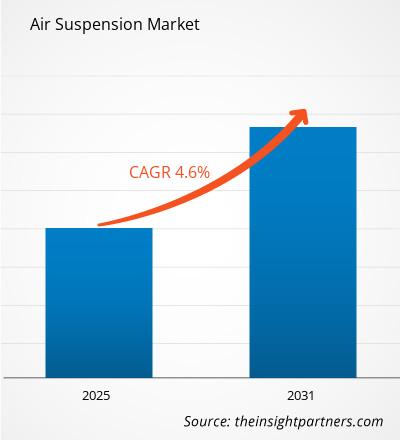
The air suspension market was valued at US$ 19.86 billion in 2025 and is expected to reach US$ 47.45 billion by 2034; it is estimated to record a CAGR of 10.16% during 2026-2034.
Air Suspension Market Assessment and Insights
- North America held 27.51% share in 2025 and is growing at a CAGR of 10.08% between 2026–2034, driven by Class 8 fleet renewal, trailer telematics, and premium light truck demand.
- US represented 81.18% of North America in 2025 and is growing at a CAGR of 9.73% between 2026–2034, supported by long-haul trucking and luxury SUV platforms.
- Europe accounted for 25.96% share in 2025 and is growing at a CAGR of 8.90% between 2026–2034, led by Germany, the UK, France, Italy, and Spain.
- Asia Pacific captured 46.52% share in 2025 and is growing at a CAGR of 46.52% between 2026–2034, with China, Japan, South Korea, and India leading volume adoption.
- Largest Segment Passenger Cars held 41.39% market share in 2025 and is growing at a CAGR of 10.82% between 2026–2034.
- High Growth Segment LCV type held 26.55% market share in 2025 and is growing at a CAGR of 11.66% between 2026–2034.
- Key companies analyzed in detail: Hendrickson Holding LLC, Cummins Inc., ZF Friedrichshafen AG, Continental AG, thyssenkrupp AG, SAF-HOLLAND SE, Hitachi Astemo Americas, Inc., BWI Group, Boss Air Suspension, and Arnott Suspension Products.
Source: The Insight Partners' analysis based on proprietary research, government publications, company annual reports, investor presentations, industry databases, and expert interviews.
Technology migration is changing how OEMs specify suspension architecture. Conventional pneumatic systems are being upgraded with compact actuators, pressure sensing, height sensors, and software-managed valves, reducing component count while improving ride control. Production dynamics are also shifting toward modular assemblies that serve trucks, buses, premium SUVs, and trailers with shared platforms. These changes support Air Suspension Market growth as suppliers compete on weight reduction, installation simplicity, and lifecycle maintenance economics.
Future demand will be shaped by electrified commercial vehicles, urban buses, and export-oriented trailer manufacturing in emerging economies. Regulatory focus on axle load compliance, road safety, and lower driver fatigue is expected to favor electronically controlled systems. Asia-based vehicle production scale, North American freight intensity, and European comfort standards will collectively expand addressable demand while aftermarket replacement grows with aging fleets.
Air Suspension Market Report Scope
| Report Attribute | Details |
|---|---|
| Market size in 2025 | US$ 19.86 Billion |
| Market Size by 2034 | US$ 47.45 Billion |
| Global CAGR (2026 - 2034) | 10.16% |
| Historical Data | 2021-2024 |
| Forecast period | 2026-2034 |
Air Suspension Market Analysis
Demand is growing as air suspension enhances comfort, cargo care, and stability for the vehicle under changing load conditions. The Air Suspension Market growth profile is intricately linked to high-end vehicle content, commercial fleet operating time limits and trailer load management. Statistically, plus VANS/Minivans/ Large Buses, populated large commercial vehicles that provide a sales base for the US China Canada India augmented by public vehicle data from OICA should cater to the addressable installed fleet for replacement and OEM systems. The supply chain is anticipated to include: suppliers of rubber compound compressors ECU manufacturers, axle experts and vehicle OEMs.
The importance of component integration is growing as electronic control reduces mechanical complexity and enables predictive diagnostics. Suppliers with capabilities in pneumatics, sensing and software can capture a higher value per vehicle. Aftermarket specialists gain from the presence of failure-prone compressors and air springs in aging premium vehicles.
The competitive niches are unevenly divided between the chassis specialists and the broad-based automotive technology groups. ZF Friedrichshafen AG is expanding ECAS architectures, Hendrickson Holding LLC specializes in durable commercial suspension, Continental AG has controls and material know-how, and SAF-HOLLAND SE supplies trailer and axle systems. The AIR SUSPENSION MARKET study shows that suppliers that can mix reliability electronics OEM cycles will retain pricing-power.
Investment is shifting toward high-performance small-diameter pneumatic struts and dampers, lightweight air suspension modules, and electronics control software that reduces vehicle integration time. Arnott Suspension Products and BOSS air suspension improve aftermarket access, while Hitachi, BWI Group, thyssenkrupp AG, and Cummins support car control, chassis, and vehicle system engineering adjacent capabilities. Success is bid platform wins, service footprint, and validated durability.
● REPORT CUSTOMIZATION
Tailor This Report To Align With Your Specific Business Requirements
This report can be customized to align precisely with your business objectives, scope, and target markets. Customization options include tailored segmentation, geography, competitive analysis, and strategic insights to support informed decision-making.
Customize This Report →WHAT YOU CAN ADJUST
- ● Segmentations
- ● Geography
- ● Competitive Analysis
- ● Language Preferences
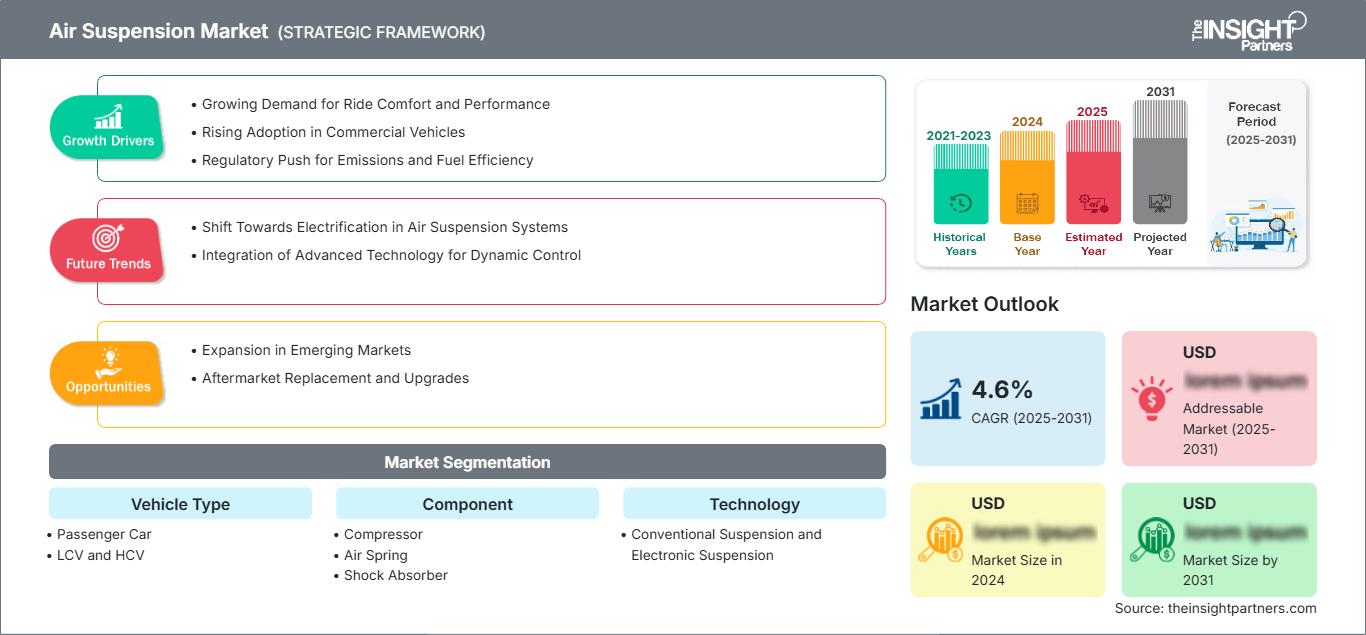
Air Suspension Market: Strategic Insights
Regional Insights
North America Air Suspension Market
North America held 27.51% share in 2025 and is expected to grow at a CAGR of 10.08% during 2026–2034. The region benefits from high commercial vehicle utilization, large trailer fleets, and replacement demand for compressors, air springs, and electronic height sensors. Air Suspension Market share is supported by freight operators seeking cargo protection and predictable axle load management.
OEM adoption is highest in heavy trucks buses luxury pickups and SUVs, where ride comfort and load leveling are factors influencing buyer decisions. OICA commercial vehicle sales figures show the size of installed base in the US and Canada. At the same time, e-commerce logistics is pushing trailers to work harder. OEMs with local manufacturing and service centres will likely be the first to get fleet orders, Mainly because operators are shifting from cheapest cost to higher availability and fewer breakdowns..
U.S. Air Suspension Market
The US accounted for 80–84% of North America in 2025 and is projected to grow at a CAGR of 9.5–9.10% from 2026–2034. Demand is concentrated in Class 8 tractors, vocational trucks, trailers, luxury SUVs, and performance aftermarket applications. Domestic fleet operators value electronically managed ride height because it improves loading, unloading, and stability across long-distance routes.
Hendrickson Holding LLC, Arnott Suspension Products Inc. and Hitachi Astemo Americas, Inc. have become known as visible regional brands in the OEM, trailer and replacement markets. Trends of applications cover a trailer tire monitoring feature integrated, premium vehicle repairs adaptively carried out, and suspension packages for emergency and specialty vehicles. In addition, the market gets a boost from the increased miles traveled by commercial vehicles as well as maintenance outsourcing by big national fleets..
Europe Air Suspension Market
Europe represented 25.96% share in 2025 and is forecast to grow at a CAGR of 8.90% through 2034. Germany is the leading country because premium OEM platforms, trailer engineering, and commercial vehicle exports support higher adoption. The UK is advancing through fleet renewal and bus accessibility programs, while France benefits from logistics corridors and urban transport modernization.
Italy and Spain are responsible for trailer manufacturing, coach transportation, cross-border freight networks, and related activities. European regulation on vehicle safety, emissions, and driver working conditions ultimately drives the demand for comfortable, stable, and efficient suspension system. Continental AG, ZF Friedrichshafen AG, thyssenkrupp AG, and SAF-HOLLAND SE contribute to a strong supplier community that the region houses. These companies enjoy close relationships with OEMs, and have in-depth engineering capabilities..
APAC Air Suspension Market
APAC held 46.52% share in 2025 and is expected to grow at a CAGR of 10.86% during 2026–2034. China leads due to commercial vehicle scale, EV output, and bus production, while Japan and South Korea contribute advanced passenger vehicle platforms and supplier technology.
India together with Australia, increase demand by way of expanded logistics, freight on the national highway, mining support vehicles, and sales of premium SUVs. From IEA's electric mobility dataset comes a picture of increasing EVs being deployed, that is prompting changes in suspension for battery weight and ride control. Policies supporting clean transport and local industrial production, have a reinforcing effect regional sourcing and system integration.
Segmentation Analysis
Vehicle Type
Vehicle Type, Passenger Cars is expected to grow at a CAGR of 10.82% during 2026–2034. The Air Suspension Market scope across vehicle categories is widening as OEMs adapt pneumatic systems to premium passenger comfort, LCV payload flexibility, HCV stability, and trailer cargo protection. Heavy-duty platforms remain the anchor, but SUVs and electrified vans are lifting content per vehicle.
- Passenger Cars show demand in luxury sedans, SUVs, and electric models where ride comfort, adjustable height, and brand differentiation justify higher system cost.
- Light Commercial Vehicles (LCV) use pneumatic support for variable payloads, last-mile delivery stability, and driver comfort across dense urban routes with frequent loading cycles.
- Heavy Commercial Vehicles (HCV) dominate adoption because long-haul trucks, buses, and vocational fleets require axle load control, reduced fatigue, and stronger cargo protection.
- Trailers rely on air suspension to protect freight, reduce vibration, improve dock height matching, and support telematics-enabled maintenance programs.
Component
Component, Air Spring Assembly is projected to grow at a CAGR of 10.38% from 2026–2034. Demand is moving from isolated replacement parts toward integrated modules combining compression, storage, sensing, and control. Suppliers gain margin when they package validated assemblies, while service networks benefit from wear-related replacement of air springs, compressors, reservoirs, valves, and sensors.
- Compressors are critical for pressure generation and remain replacement-intensive because duty cycles, contamination, and heat exposure affect long-term performance in premium and commercial vehicles.
- Air Spring Assembly carries core load-bearing value, with demand tied to durability, rubber reinforcement quality, and compatibility with electronic height-control systems.
- Air Reservoir supports pressure storage and faster leveling response, especially in buses, trailers, and trucks that face repeated loading and unloading events.
- Air Compressor demand is sustained by OEM fitment and aftermarket repair, where performance consistency directly affects ride height, comfort, and system reliability.
- Electronic Control Unit enables adaptive ride management, fault detection, and integration with stability systems, making it central to higher-value electronic architectures.
- Sensors measure height, pressure, acceleration, and load conditions, supporting real-time adjustments and predictive maintenance across commercial and premium vehicle applications.
- Valves regulate air flow between springs, reservoirs, and compressors, influencing response time, ride balance, and system efficiency under changing road conditions.
System Type
System Type, Non-Electronic is forecast to grow at a CAGR of 9.55% during 2026–2034. Electronic systems are gaining preference as OEMs seek software-defined ride behavior, better integration with safety controls, and diagnostic visibility. Non-electronic systems remain relevant where cost, ruggedness, and simpler serviceability are more important than adaptive performance.
- Electronic systems lead value creation by combining sensors, software, and actuators to deliver adaptive ride height, stability support, and fleet-level diagnostic intelligence.
- Non-Electronic systems retain demand in price-sensitive fleets, rugged trailers, and markets where repair simplicity and mechanical reliability outweigh advanced control features.
Opportunity Snapshot
| Vehicle Type | Revenue Contribution | Trend Tag | Adoption Stage |
| Passenger Cars | Medium | Luxury Ride | Scaling |
| Light Commercial Vehicles (LCV) | Medium | Payload Flex | Scaling |
| Heavy Commercial Vehicles (HCV) | High | Fleet Uptime | Mature |
| Trailers | High | Cargo Care | Scaling |
Air Suspension Market Growth Drivers and Impact Analysis
Fleet uptime and cargo protection economics
Commercial fleets are now evaluating the cost of use instead of just the price when considering their trucks. A suspension system made of air can protect palletized freight, refrigerated cargo, electronics, and valuable parcels from vibrations This way reducing damage and the carrier will be able to fulfill the service-level agreement. And, varying the ride level helps with aligning the truck with the dock and Because of this faster loading is possible In particular for trailers used in different kind of distributions. In countries with a very well developed logistics industry and still no signs of improvement in driver shortages, the ability of the truck to be more comfortable and the lack of driver tiredness have become reasons for keeping drivers. The result is that nowadays when they buy new trucks and trailers, they tend to go for air suspension sets compressors air tanks, valves, and so on, as well the need to do some replacements in the field after some years of vehicle use.
Electrification changes suspension design requirements
New mass distribution, underbody packaging and different ride behavior of battery packs are the main reasons why battery-electric vehicles bring new requirements for chassis. Thanks to pneumatic systems it is possible in some cases to compensate for weight differences between empty and loaded conditions. This helps keep vehicl eattitude constant and improves ride comfort by not only relying on conventional springs. Kneeling and curb alignment to improve passenger accessibility are reasons why electric vehicles are becoming popular Mostly for buses and vans. Mobility reports made by IEA show that electricity is replacing other modes of power in different types of vehicles including cars vans buses, and trucks. As a result Original Equipment Manufacturers are redesigning suspension systems to suit battery-powered vehicles better. As more and more companies go electric, a higher number of height-controlled and pressure regulating systems equipped with advanced ride comfort software will be required.
Premium comfort expectations move into broader vehicle classes
Air suspension was initially popular in luxury sedans and executive coaches, but lately, the demand for such features is transferring to SUVs, pickups, and performance-oriented crossovers. People nowadays equate adjustableness of the height of the car, smooth riding over bumps, and minimization of body sway with luxury price tags. While, at the same, manufacturers employ these features to make model trims different without the need of a total vehicle platform redesign. The combination of a pneumatic suspension with adaptive damping and electronic stability functions is now the standard. The change will result that the number of components and parts per car is increasing. That means, the need to replace compressor, air struts, valve blocks, or sensors will be a growing part of the independent repair services due to In reality older premium cars are now moving to such channels.
Air Suspension Market Future Trends
Software-defined ride and predictive suspension health
Air Suspension market trends will mainly be about software-defined tuning alongside hardware alone. Future suspensions will make the necessary adjustments with the help of data like pressure height acceleration, and road-input so that the ride experience can be changed not only with the terrain but also with the payload and driven in different modes of driving. Combinations of suspension diagnostics and telematics can help fleet operators detect problems in the compressor and leakage patterns, and how the valves are responding before roadside failure happens. OEMs can update the different ride characteristics during the life of a car by way of the software change which makes a space for differentiators based not only on products but also on the provision of services. This way, more and more, only the companies with embedded electronics, high degree of attention to cybersecurity, and well-proven control algorithms that can be executed reliably in high-vibration conditions of commercial environments will benefit.
Modular pneumatic platforms for multi-vehicle architectures
Suppliers should focus on developing modular pneumatic systems that truck bus van, SUV, and trailer platforms will all be able to benefit from with minimum engineering change. By having a shared compressor, using smart actuators, and having expandable or shrinking (up/down scaling) air tank, you end up with one platform that covers vehicle lines and families of different OEMs. The service market benefit also comes from not needing to hold different stocks. The service parts networks can cover more with fewer parts families. For international suppliers, having a modulaire platform makes easier production in a region and sourcing to meet local regulations. The main result will definitely be quicker platform deployment, lessening the risk through integration, and having more steady income through standardized replacement parts and diagnostics-based service programs.
Air Suspension Market Opportunities
Aftermarket digitization and premium vehicle repair networks
Independent repair channels can extract significant value from air suspensions by offering replacement components and diagnosis, training and application support. Air suspension-equipped luxury vehicles with air struts, compressors and ride-height sensors usually enter cost-conscious repair cycles after warranty expiry. Because of this, these vehicles need a dependable source of aftermarket spare components. Suppliers who offer technician training, fitment data and air compressor/valve/sensor kits enables local workshops to reduce installation-related warranty claims. E-commerce parts catalogs and regional distribution facilities further make component procurement convenient. The best opportunity would be for a firm that simplifies complicated air suspension repairs into ready-formed installation procedures for workshop or fleet service providers.
Localized systems for emerging commercial vehicle production
New production locations in Asia, Middle-East & selected African markets provide an opportunity for localized assembly of vehicles suited to local road conditions, service levels and price expectation. Original Equipment Manufacturers (OEMs) and fleets require systems that are tolerant of heat dust overloading and rough roads while enhancing the safety & comfort levels of vehicles. Cost-effective localized sourcing will enhance project economics by replacing imports and reducing time-to-market. Joint programs with trailer builders, bus OEMs and logistics fleets can deliver specifications in a fast timeframe. Suppliers that operate on a global engineering platform yet take advantage of regional cost structure can establish early platform positions before widespread electronic suspension penetration.
Recent Developments
- June 2026: Hendrickson Holding LLC highlighted its trailer air suspension solutions for modern fleets, emphasizing proven ride technologies for cargo protection, durability, and operational reliability in trailer applications. The update reinforced the company’s focus on fleet productivity and suspension systems for commercial transportation.
- June 2025: ZF’s Commercial Vehicle Solutions (CVS) division announced the series production of the latest, fifth generation of its market leading Electronically Controlled Air Suspension (ECAS) technology, OptiRide ECAS for Hyundai Motor Company (HMC). The series production for HMC follows the start of production for one of the leading European commercial vehicle manufacturers in 2024.
- March 2026: Arnott introduced two new air suspension compressors engineered for European luxury and performance models, including Audi, BMW, Bentley, Lamborghini, and Rolls-Royce. These OE-style replacements are built to restore proper system function, helping installers complete repairs and return vehicles to the road.
Frequently Asked Questions

- Comprehensive Market Sizing and Forecast Analysis
- Detailed Segmentation Analysis
- In-Depth Market Dynamics Assessment
- Regional and Country-Level Insights
- Competitive Landscape and Company Benchmarking
- Strategic Business Intelligence
Recent Reports
Testimonials

The Insight Partners provided valuable market intelligence that supported our global go-to-market strategy. Their team was professional, responsive, and attentive to our feedback, providing thoughtful analysis and helpful methodological clarifications throughout the project.
Junmo Kim Chief Financial Officer (CFO), Enertech Co., Ltd.
The Insight Partners' SCADA System Market report is comprehensive, with valuable insights on current trends and future forecasts. The team was highly professional, responsive, and supportive throughout. We are very satisfied and highly recommend their services.
RAN KEDEM Partner, Reali Technologies LTDs
I requested a report on a very specific software market and the team produced the report in a few days. The information was very relevant and well presented. I then requested some changes and additions to the report. The team was again very responsive and I got the final report in less than a week.
JEAN-HERVE JENN Chairman, Future Analytica
We worked with The Insight Partners for an important market study and forecast. They gave us clear insights into opportunities and risks, which helped shape our plans. Their research was easy to use and based on solid data. It helped us make smart, confident decisions. We highly recommend them.
PIYUSH NAGPAL Sr. Vice President, High Beam Global
The Insight Partners delivered insightful, well-structured market research with strong domain expertise. Their team was professional and responsive throughout. The user-friendly website made accessing industry reports seamless. We highly recommend them for reliable, high-quality research services
YUKIHIKO ADACHI CEO, Deep Blue, LLC.
This is the first time I have purchased a market report from The Insight Partners.While I was unsure at first, I visited their web site and felt more comfortable to take the risk and purchase a market report.I am completely satisfied with the quality of the report and customer service. I had several questions and comments with the initial report, but after a couple of dialogs over email with their analyst I believe I have a report that I can use as input to our strategic planning process.Thank you so much for taking the extra time and making this a positive experience.I will definitely recommend your service to others and you will be my first call when we need further market data.
JOHN SUZUKI President and Chief Executive Officer, Board Director, BK Technologies
I wish to appreciate your support and the professionalism you displayed in the course of attending to my request for information regarding to infectious disease IVD market in Nigeria. I appreciate your patience, your guidance, and the fact that you were willing to offer a discount, which eventually made it possible for us to close a deal. I look forward to engaging The Insight Partners in the future, all thanks to the impression you have created in me as a result of this first encounter.
DR CHIJIOKE ONYIA MANAGING DIRECTOR, PineCrest Healthcare Ltd.Reason to Buy
- Informed Decision-Making
- Understanding Market Dynamics
- Competitive Analysis
- Identifying Emerging Markets
- Customer Insights
- Market Forecasts
- Risk Mitigation
- Boosting Operational Efficiency
- Strategic Planning
- Investment Justification
- Tracking Industry Innovations
- Aligning with Regulatory Trends





 Get Free Sample for