
Albendazole Anthelmintic Drug Market Demand, Size & Forecast by 2034
Coverage: By Type (Tablets, Capsules, Others); Application (Human, Veterinary) , and Geography (North America, Europe, Asia Pacific, and South and Central America)
- Status : Data Released
- Report Code : TIPRE00022893
- Category : Life Sciences
- No. of Pages : 150
- Available Report Formats :


- Last update date : July 10, 2026


2025 Market Size
US$ 9.99 Bn
Base year value
2034 Forecast
US$ 15.65 Bn
Projected by 2034
CAGR 2026-2034
5.77 %
Growth rate
Addressable Market
US$ 120.27 Bn
(2026-2034)
The Albendazole anthelmintic drug market size was valued at US$ 9.99 Billion in 2025 and is projected to reach US$ 15.65 Billion by 2034, expanding at a CAGR of 5.77% during 2026–2034. The market growth is mainly fueled by the existing burden of worm infections throughout the world, the increasing number of MDA (Mass Drug Administration) programs, and the escalating requirements for the treatment of veterinary parasitic diseases.
Growth in North America is forecasted to be 5.3–5.8% owing to good veterinary health care infrastructure and regulations for the use of antiparasitic drugs in livestock management. Moreover, growing adoption of companion animals along with stringent guidelines set by the FDA has boosted the consistency of demand.
Albendazole Anthelmintic Drug Market Assessment and Insights
- North America: North America holds 28–32% of the albendazole anthelmintic drug market share in 2025, driven by structured veterinary healthcare systems, strong pharmaceutical distribution networks, and high companion animal ownership. The region is expected to grow at a CAGR of 5.3–5.8% (2026–2034), supported by regulatory compliance in livestock deworming and expanding preventive care adoption in pet healthcare markets.
- US: The United States accounts for 70–74% of North America share in 2025, with growth projected at a CAGR of 5.3–5.8%, driven by large-scale veterinary prescriptions, FDA-regulated antiparasitic approvals, and increasing demand for preventive deworming treatments in companion animals.
- Europe: Europe represents 22–26% share in 2025, growing at a CAGR of 5.1–5.6%, led by Germany, France, the UK, Italy, and Spain. Expansion is driven by livestock health regulations, zoonotic disease prevention programs, and coordinated veterinary pharmaceutical standards across the EU.
- Asia Pacific: Asia Pacific accounts for 30–34% share in 2025, expanding at a CAGR of 6.0–6.6%, led by India, China, Indonesia, Vietnam, and Australia. High parasite prevalence, large livestock populations, and government-led deworming campaigns are key growth catalysts.
- Largest Segment (Tablets): Tablets dominate with 60–65% share in 2025, growing at a CAGR of 5.6–6.0%, due to cost efficiency, ease of administration, and widespread use in both human and veterinary applications.
- High Growth Segment (Capsules): Capsules hold 35–40% share in 2025, expanding at a CAGR of 5.8–6.3%, supported by improved patient compliance, controlled dosing, and increasing pharmaceutical innovation.
- Key companies analyzed in detail: Amneal Pharmaceuticals Inc, Cipla Inc., Sun Pharmaceutical Industries Ltd, GlaxoSmithKline plc, Salius Pharma, Sequent Scientific Ltd, K.A. Malle Pharmaceuticals, Jiangsu Qihui Pharmaceutical Co., Supharma Chem, Fredun Pharmaceuticals Ltd
Source: The Insight Partners' analysis based on proprietary research, government publications, company annual reports, investor presentations, industry databases, and expert interviews.
From being an initial deworming agent, the market has developed into public health efforts with global collaboration. The early dependence on intermittent use has been replaced by preventive mass drug administration approaches that have been initiated through WHO activities. Large scale productions of these drugs have been achieved due to generic pharmaceutical manufacture of affordable drugs for developing and middle economies; quality regulation ensures efficacy and effectiveness in human and veterinary application.
The albendazole anthelmintic drug market forecast is influenced by an ecosystem approach to healthcare and veterinary medicine. Pharmaceutical industries are working towards increasing their supply chain capabilities to cater for the governmental deworming campaigns and veterinary medical services. Demand for albendazole drugs has expanded in hospitals as well as retail outlets. Veterinary clinics have become an important point for distribution of the anthelmintic drugs.
Albendazole Anthelmintic Drug Market Report Scope
| Report Attribute | Details |
|---|---|
| Market size in 2025 | US$ 9.99 Billion |
| Market Size by 2034 | US$ 15.65 Billion |
| Global CAGR (2026 - 2034) | 5.77% |
| Historical Data | 2021-2024 |
| Forecast period | 2026-2034 |
Albendazole Anthelmintic Drug Market Analysis
The demand for the albendazole anthelmintic drug product is very high, considering the continuous parasitic infection of soil-transmitted helminths in both human beings and animals. According to the World Health Organization, there are more than one billion people all around the world who are vulnerable to parasitic worm infections, mainly in the tropical and sub-tropical areas. The continuous disease burden ensures that the demand for pharmaceutical products remains consistent. Veterinary applications are an added advantage, mainly in countries that are highly reliant on livestock and whose productivity suffers because of the parasitic infections.
There is production of active pharmaceutical ingredients, formulation manufacture, and distribution through hospitals, retailers, and veterinarians. India and China lead in active pharmaceutical ingredients supply, while global pharmaceutical companies are involved in formulation and compliance with regulations. The Albendazole anthelmintic drug market report focuses on key players including Cipla, Sun Pharmaceutical Industries, and GlaxoSmithKline with their established distribution channels in emerging markets. The governments are very instrumental in procurement through public health deworming initiatives.
The competitive landscape is moderately concentrated, with generic producers controlling volume sales, while brands are concentrating on quality and regulations. Amneal Pharmaceuticals and Fredun Pharmaceuticals have increased their presence in the veterinary segment, while Sequent Scientific has expanded its animal health product range. Strategic initiatives are now being focused more on combination drugs and better bioavailability formulas. The pressure on pricing is strong due to generic competition, although there are still economies of scale and government tenders.
● REPORT CUSTOMIZATION
Tailor This Report To Align With Your Specific Business Requirements
This report can be customized to align precisely with your business objectives, scope, and target markets. Customization options include tailored segmentation, geography, competitive analysis, and strategic insights to support informed decision-making.
Customize This Report →WHAT YOU CAN ADJUST
- ● Segmentations
- ● Geography
- ● Competitive Analysis
- ● Language Preferences
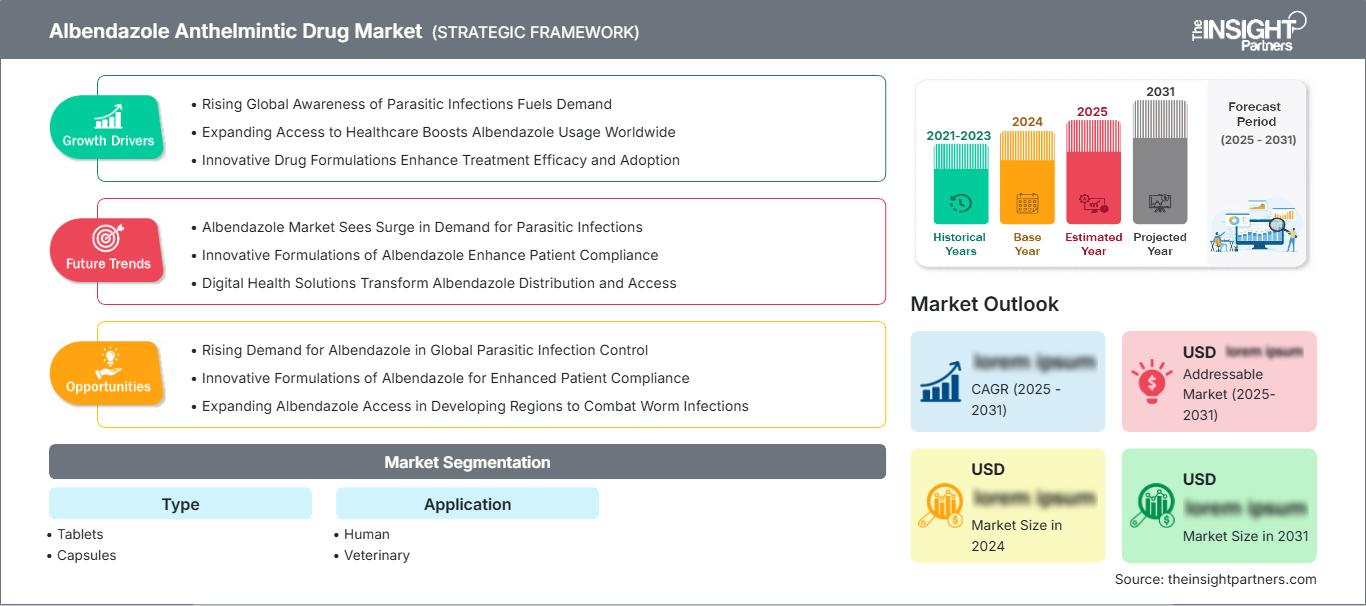
Albendazole Anthelmintic Drug Market: Strategic Insights
Regional Insights
North America albendazole anthelmintic drug market
North America occupies a favorable standing because of its developed health care systems, well-established distribution network for pharmaceuticals, and significant spending on veterinary health care. It is anticipated that the region will represent a 28–32% share of the global market in 2025 owing to livestock management, parasites control, and constant demand for generics. The regional CAGR is forecast to be 4.8-5.5% between 2026 and 2034.
The US and Canada are the major producers backed up by regulations and wide availability via pharmaceutical supply chains. The rising consciousness about zoonotic diseases and the importance of preventive veterinary services keeps adding to the demand for anthelmintic drugs. Pharmaceutical companies focus on sustaining supply, improving formulations, and optimizing distribution networks in the health and animal health sectors.
U.S. albendazole anthelmintic drug market
The US represents the leading contributor within North America, accounting for an estimated 70–75% share of the regional market in 2025. The country benefits from developed healthcare infrastructure, strong pharmaceutical manufacturing capabilities, and extensive veterinary service networks. The US market is expected to grow at a CAGR range of 4.9–5.6% between 2026 and 2034, supported by consistent demand for antiparasitic therapies.
The companies operating within the country focus on regulatory compliance, supply chain effectiveness, and product availability. The human healthcare application is sustained through the clinical application, while veterinary applications get a boost through the healthcare needs of livestock and companion animals. Increased focus on the preventive disease management process continues to affect procurement practices within healthcare facilities.
Europe albendazole anthelmintic drug market
Europe holds an estimated 24–28% share of the market in 2025, supported by mature healthcare infrastructure and established pharmaceutical regulations. The region is expected to register a CAGR range of 4.6–5.3% between 2026 and 2034. Germany represents a leading market due to pharmaceutical capabilities and strong healthcare expenditure.
Demand in the UK is driven by healthcare services and the use of medicines for animals, whereas Germany gains through sophisticated production and distribution channels. France, Italy, and Spain have a role to play with respect to their public healthcare services and the management of animal health.
APAC albendazole anthelmintic drug market
Asia Pacific is estimated to hold a 26–30% share of the market in 2025 and is projected to expand at a CAGR range of 6.0–6.8% between 2026 and 2034. China and India represent major contributors due to large populations and increasing healthcare access.
Japan, South Korea, and Australia contribute through advanced healthcare systems and veterinary applications. Industrial growth in pharmaceutical manufacturing, government health initiatives, and improving distribution networks support regional expansion. India remains a significant market due to generic medicine production capabilities and increasing availability of affordable treatments.
Middle East & Africa albendazole anthelmintic drug market
The Middle East & Africa region demonstrates developing opportunities due to healthcare infrastructure expansion and parasite control initiatives. The region is expected to record a CAGR range of 5.5–6.2% between 2026 and 2034, supported by increasing access to essential medicines and veterinary healthcare requirements.
Saudi Arabia and the UAE are supported by healthcare investments and modern distribution networks, while South Africa contributes through established pharmaceutical channels. Rest of MEA markets continue to experience demand from public health programs and livestock management needs. Increasing healthcare infrastructure development is expected to improve market penetration across emerging economies.
Segmentation Analysis
Type
The Type segment in the market is primarily divided into tablets and capsules, both widely used across human and veterinary applications. Tablets dominate due to cost efficiency, stability, and ease of mass distribution in large-scale deworming programs, while capsules are gaining traction in patient-centric and precision dosing environments. The segment is expected to grow at a CAGR of 5.6–6.1% (2026–2034), supported by expanding preventive healthcare programs and increasing pharmaceutical penetration in emerging economies where parasitic infections remain highly prevalent.
- Tablets: Tablets are the most widely used formulation due to affordability, long shelf life, and suitability for mass drug administration campaigns in public health programs.
- Capsules: Capsules are preferred for improved patient compliance, controlled dosing, and reduced gastrointestinal irritation, particularly in veterinary and specialized human treatments.
Application
The Application segment is divided into human and veterinary use cases, reflecting the dual therapeutic relevance of albendazole across healthcare systems. Human applications dominate due to large-scale deworming initiatives led by global health organizations, while veterinary applications are expanding rapidly with increasing livestock health management programs. The segment is projected to expand at a CAGR of 5.5–6.0% (2026–2034), driven by sustained parasitic disease prevalence, preventive healthcare adoption, and rising awareness of zoonotic infection control.
- Human: Human applications account for widespread use in treating soil-transmitted helminth infections, supported by mass school-based deworming and community health initiatives in endemic regions.
- Veterinary: Veterinary use is expanding due to rising livestock production needs, companion animal care, and government-led animal health programs aimed at improving productivity and disease control.
Opportunity Snapshot
| Application | Revenue Contribution | Trend Tag | Adoption Stage |
| Human | High | Public Health | Mature |
| Veterinary | Medium | Animal Health | Scaling |
Albendazole Anthelmintic Drug Market Growth Drivers and Impact Analysis
Rising Global Burden of Helminth Infections
The rise in cases of soil-transmitted helminth infections is the most notable factor that continues to drive the market. Health experts have estimated that there are more than a billion people who are vulnerable to parasite worm infections, especially in low and middle-income nations where sanitation facilities are inadequate. These diseases will keep the need for mass treatment programs and deworming treatments at a high level. The use of albendazole has been favored by public health officials because of its wide range and low costs. Large school-based deworming programs contribute to increased drug usage.
Expansion of Veterinary Parasitic Disease Management
Veterinary uses play an important role in albendazole anthelmintic drug market growth especially in countries where livestock is used heavily. Parasitic diseases among cattle, sheep, and poultry are a source of decreased efficiency, weight gain, and fertility, which causes great economic losses. Albendazole is commonly used in the veterinary sector due to its broad efficacy range and low cost. Government organizations and livestock companies are now increasingly encouraging deworming programs for prevention purposes. Global consumption of meat and dairy products is adding more demand to such drugs. Adoption of companion animals in urban areas is another factor that contributes to increased sales in the retail pharmacy sector.
Strong Growth in Generic Pharmaceutical Manufacturing
The emergence of generic pharmaceutical manufacturing is one of the main drivers of growth in the albendazole anthelmintic drug market forecast. India and China have emerged as two of the largest producers globally that manufacture affordable active pharmaceutical ingredients and formulations for use throughout the world. The scalable manufacturing processes have resulted in the cost-effective availability of albendazole anthelmintic drug products. Quality assurance measures by the regulatory bodies including the WHO and FDA ensure product quality that can be distributed across the globe. Large scale manufacturing has been utilized by companies such as Cipla and Sun Pharmaceutical Industries in their domestic as well as export markets.
Albendazole Anthelmintic Drug Market Future Trends
Integration of Combination Anthelmintic Therapies
An important emerging albendazole anthelmintic drug market trends involves the use of combination anthelmintic treatments, involving albendazole along with other effective agents. Such a development will improve the efficacy of treatment and extend the range of action to parasites that are resistant to the treatment and to different species of helminths. The pharmaceutical industry is concentrating on developing better formulations with reduced frequency of dosing and improved compliance with the treatment regimen. Combination therapy is especially significant in veterinary medicine, since mixed infections by parasites are quite common in animals. Such treatments are now increasingly being considered by regulatory authorities for public health programs because of greater efficacy.
Expansion of Preventive Mass Drug Administration Programs
Preventive mass drug administration (MDA) programs are becoming a central strategy in global parasitic disease control. Supported by international health organizations and national governments, these programs aim to reduce infection prevalence through periodic albendazole distribution. School-based deworming initiatives remain a primary channel for pediatric populations in endemic regions. The expansion of MDA programs is increasing bulk procurement volumes and strengthening pharmaceutical supply chains. Improved logistics, funding support, and public health awareness are enhancing program coverage. As elimination targets for soil-transmitted helminths become more ambitious, structured MDA expansion will remain a long-term demand driver.
Albendazole Anthelmintic Drug Market Opportunities
Expansion in Emerging Market Healthcare Access
Emerging economies present significant opportunities due to expanding healthcare infrastructure and improving pharmaceutical accessibility. Governments in Asia Pacific, Africa, and Latin America are increasing investments in primary healthcare and mass deworming programs. These initiatives are improving access to essential medicines, including albendazole, in rural and underserved populations. Local manufacturing incentives are reducing import dependency and lowering treatment costs. Pharmaceutical companies focusing on affordable generics and strong distribution networks can capture substantial market share. As universal healthcare coverage expands, demand for essential anthelmintic drugs is expected to grow steadily across public health systems and community healthcare programs.
Growth in Veterinary Pharmaceutical Innovation
The veterinary pharmaceutical segment offers strong growth potential through innovation in parasite control formulations. Increasing livestock productivity requirements are driving demand for more effective and long-lasting anthelmintic solutions. Pharmaceutical companies are investing in improved dosing formats, palatable formulations, and combination therapies to enhance animal compliance. Companion animal healthcare is also expanding in urban markets, supporting premium product demand. Regulatory support for animal health safety and food security is strengthening adoption. Companies such as Sequent Scientific and Fredun Pharmaceuticals are well-positioned to benefit from expanding veterinary healthcare ecosystems and rising global demand for protein-based food products.
Recent Developments
- February 2026: Sun Pharmaceutical Industries Ltd - Sun Pharma expanded its anthelmintic portfolio by increasing production capacity for albendazole formulations to support global deworming initiatives and strengthen supply reliability across emerging markets facing high parasitic disease prevalence.
- September 2025: Cipla Limited - Cipla enhanced its antiparasitic drug distribution network across Africa and Asia through expanded public health partnerships, improving access to albendazole-based treatments in large-scale mass drug administration programs.
- May 2025: GlaxoSmithKline plc - GSK continued its global neglected tropical disease initiatives, reinforcing albendazole donation and distribution programs under public health collaborations aimed at reducing soil-transmitted helminth infections.
Frequently Asked Questions

- Comprehensive Market Sizing and Forecast Analysis
- Detailed Segmentation Analysis
- In-Depth Market Dynamics Assessment
- Regional and Country-Level Insights
- Competitive Landscape and Company Benchmarking
- Strategic Business Intelligence
Recent Reports
Testimonials

The Insight Partners' SCADA System Market report is comprehensive, with valuable insights on current trends and future forecasts. The team was highly professional, responsive, and supportive throughout. We are very satisfied and highly recommend their services.
RAN KEDEM Partner, Reali Technologies LTDs
I requested a report on a very specific software market and the team produced the report in a few days. The information was very relevant and well presented. I then requested some changes and additions to the report. The team was again very responsive and I got the final report in less than a week.
JEAN-HERVE JENN Chairman, Future Analytica
We worked with The Insight Partners for an important market study and forecast. They gave us clear insights into opportunities and risks, which helped shape our plans. Their research was easy to use and based on solid data. It helped us make smart, confident decisions. We highly recommend them.
PIYUSH NAGPAL Sr. Vice President, High Beam Global
The Insight Partners delivered insightful, well-structured market research with strong domain expertise. Their team was professional and responsive throughout. The user-friendly website made accessing industry reports seamless. We highly recommend them for reliable, high-quality research services
YUKIHIKO ADACHI CEO, Deep Blue, LLC.
This is the first time I have purchased a market report from The Insight Partners.While I was unsure at first, I visited their web site and felt more comfortable to take the risk and purchase a market report.I am completely satisfied with the quality of the report and customer service. I had several questions and comments with the initial report, but after a couple of dialogs over email with their analyst I believe I have a report that I can use as input to our strategic planning process.Thank you so much for taking the extra time and making this a positive experience.I will definitely recommend your service to others and you will be my first call when we need further market data.
JOHN SUZUKI President and Chief Executive Officer, Board Director, BK Technologies
I wish to appreciate your support and the professionalism you displayed in the course of attending to my request for information regarding to infectious disease IVD market in Nigeria. I appreciate your patience, your guidance, and the fact that you were willing to offer a discount, which eventually made it possible for us to close a deal. I look forward to engaging The Insight Partners in the future, all thanks to the impression you have created in me as a result of this first encounter.
DR CHIJIOKE ONYIA MANAGING DIRECTOR, PineCrest Healthcare Ltd.Reason to Buy
- Informed Decision-Making
- Understanding Market Dynamics
- Competitive Analysis
- Identifying Emerging Markets
- Customer Insights
- Market Forecasts
- Risk Mitigation
- Boosting Operational Efficiency
- Strategic Planning
- Investment Justification
- Tracking Industry Innovations
- Aligning with Regulatory Trends





 Get Free Sample for