
Albumin and Creatinine Tests Market Trends, Demand & Growth by 2034
Coverage: By Product (Kits, Analyzers, Reagents, Others); Type (Urine Tests, Blood and Serum Creatinine Tests); End User (Hospitals and Clinics, Diagnostic Laboratories, Others), and Geography (North America, Europe, Asia Pacific, and South and Central America)
- Status : Data Released
- Report Code : TIPRE00018767
- Category : Life Sciences
- No. of Pages : 150
- Available Report Formats :


- Last update date : July 10, 2026


2025 Market Size
US$ 2.79 Bn
Base year value
2034 Forecast
US$ 4.57 Bn
Projected by 2034
CAGR 2026-2034
5.64 %
Growth rate
Addressable Market
US$ 33.37 Bn
(2026-2034)
The Albumin and creatinine tests market represent a diagnostic segment focused on evaluating kidney function, protein levels, and related clinical parameters. The market is valued at US$ 2.79 Billion in 2025 and is projected to reach US$ 4.57 Billion by 2034, expanding at a CAGR of 5.64% from 2026–2034. The expansion rate of the market is 5.64% per year during the period of 2026–2034 due to various factors.
North America remains a prominent region due to its strong healthcare framework, high usage of diagnostic machines, and high monitoring of chronic diseases. The albumin and creatinine tests market size in North America is driven by the requirement of hospitals, diagnostic centers, and other test facilities. The estimated CAGR range for the growth of the market size is 5.8–6.4% from 2026 to 2034.
Albumin and Creatinine Tests Market Assessment and Insights
- North America: The region accounted for an estimated 35–39% of the Albumin and creatinine tests market share in 2025, supported by mature diagnostic networks and renal disease screening practices. The market is expected to grow at a CAGR range of 5.8–6.4% between 2026–2034 due to technology adoption.
- US: The country represented approximately 28–32% share in 2025, driven by established laboratory infrastructure, reimbursement support, and increasing kidney health monitoring. Growth is projected at a CAGR range of 5.9–6.5% during 2026–2034.
- Europe: Europe held an estimated 27–31% share in 2025, with Germany, the UK, France, Italy, and Spain contributing significantly. Demand for standardized diagnostics and laboratory modernization is supporting a CAGR range of 5.1–5.8% during 2026–2034.
- Asia Pacific: Asia Pacific captured an estimated 22–26% share in 2025, with China, Japan, India, South Korea, and Australia driving adoption. Expanding healthcare access and diagnostic investments are contributing to a CAGR range of 6.2–6.9% between 2026–2034.
- Largest Segment: Diagnostic Laboratories represented the largest end-user segment with a 45–50% market share in 2025, supported by high testing volumes and centralized laboratory capabilities. The segment is estimated to grow at a CAGR range of 5.7–6.3%.
- High Growth Segment: Analyzers represented a 30–35% market share in 2025 and is projected to expand at a CAGR range of 6.4–7.0%, driven by automation, efficiency improvements, and integrated testing workflows.
- Key companies analyzed in detail: Thermo Fisher Scientific, F. Hoffmann-La Roche Ltd, PromoCell GmbH, Siemens Healthcare, Sysmex Corporation, Abcam plc, Arbor Assays Inc., Nova Biomedical, Abbott, ARKRAY, Inc.
Source: The Insight Partners' analysis based on proprietary research, government publications, company annual reports, investor presentations, industry databases, and expert interviews.
The market for albumin and creatinine tests has seen a lot of change because of advancements in the sensitivity of the assays, automation, and the incorporation of laboratory information into the processes. The producers have concentrated their efforts on the production of testing systems that are smaller in size, have better reagent stability, and improve workflow. The transition from the traditional method of testing to an automated process has affected the strategy used in production. Quality control still plays a big role in the products being developed. The demand for kidney function testing has increased and made the companies produce more assays that are compatible with laboratories.
The future development of the albumin and creatinine tests market will depend on the healthcare infrastructure growth, the regulations concerning accurate diagnostics, and investments in developing economies. The increasing number of decentralized testing solutions and improved laboratory accessibility will contribute to the growth of the market. The countries in the Asia Pacific and Latin America regions will see an increase in the demand as their healthcare systems grow. Regulatory frameworks supporting reliable clinical diagnostics will continue encouraging product improvements, while demand for cost-effective solutions will influence market strategies across developed and developing regions.
Albumin and Creatinine Tests Market Report Scope
| Report Attribute | Details |
|---|---|
| Market size in 2025 | US$ 2.79 Billion |
| Market Size by 2034 | US$ 4.57 Billion |
| Global CAGR (2026 - 2034) | 5.64% |
| Historical Data | 2021-2024 |
| Forecast period | 2026-2034 |
Albumin and Creatinine Tests Market Analysis
The albumin and creatinine tests market growth is driven by the increase in prevalence of diseases related to the kidneys, awareness about the early detection of the diseases, and increasing practice of routine health screening programs. This industry consists of diagnostic device makers, suppliers of reagents, healthcare providers, labs, and distributors. There is an effort made by suppliers in providing precise, stable, and compatible with automatic system reagents. Meanwhile, labs are upgrading their analyzers for increasing production capacity. Increasing demand for preventive care is strengthening procurement in hospitals and diagnostic centers.
Increasing importance of early identification of renal impairment in healthcare systems provides consistent demand for albumin and creatinine tests. Manufacturers try to balance between innovation and affordable prices in order to meet needs of various healthcare settings. Dynamics of supply depend on availability of reagents, analyzers, and special diagnostic technologies. Companies are trying to increase production effectiveness and global distribution of their products.
The albumin and creatinine tests market analysis reveals that there is a highly competitive landscape wherein major global diagnostic players and niche manufacturers are concentrating on technology development, diversification, and collaboration strategy. Some key players in the market include Thermo Fisher Scientific, F. Hoffmann-La Roche Ltd, Siemens Healthcare, Sysmex Corporation, and Abbott. Niche players in the market include PromoCell GmbH, Abcam plc, Arbor Assays Inc., Nova Biomedical, and ARKRAY, Inc.
Investment within the industry tends to be focused on automation, multiplex testing and laboratory efficiencies. The leading organizations are working to develop technologies that allow for shorter turn-around times and improved analysis capabilities. Positioning is based on reliability of products, international reach, and ability to service centralized laboratories and decentralized health care settings. The ability to comply with regulations, flexibility of technology, and access to diagnostics through partnerships play an important role in competitive differentiation.
● REPORT CUSTOMIZATION
Tailor This Report To Align With Your Specific Business Requirements
This report can be customized to align precisely with your business objectives, scope, and target markets. Customization options include tailored segmentation, geography, competitive analysis, and strategic insights to support informed decision-making.
Customize This Report →WHAT YOU CAN ADJUST
- ● Segmentations
- ● Geography
- ● Competitive Analysis
- ● Language Preferences
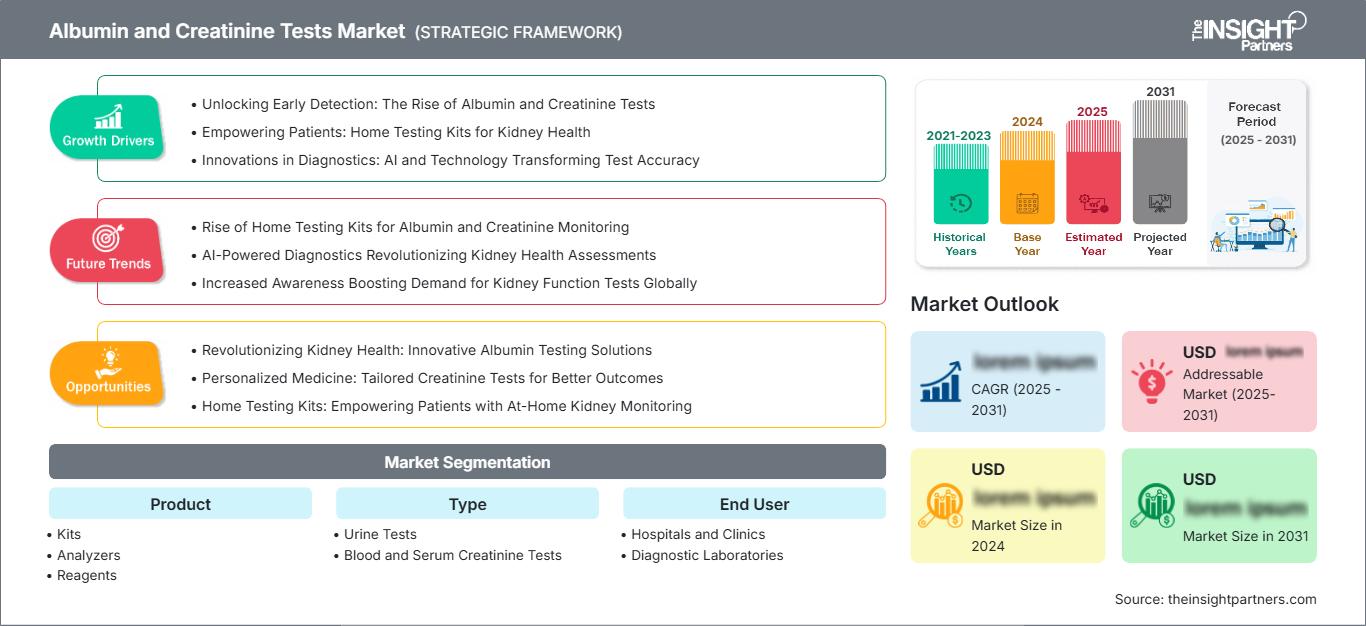
Albumin and Creatinine Tests Market: Strategic Insights
Regional Insights
North America albumin and creatinine tests market
North America maintained a leading position with an estimated 35–39% share in 2025 and is expected to expand at a CAGR range of 5.8–6.4% during 2026–2034. The region benefits from advanced healthcare systems, high diagnostic testing volumes, and strong adoption of automated laboratory platforms. The US contributes significantly due to widespread screening programs, established reimbursement structures, and demand from hospitals and diagnostic laboratories.
Canada also supports regional growth through healthcare modernization and increasing emphasis on chronic disease management. The presence of major diagnostic technology providers, including Thermo Fisher Scientific, Abbott, and Siemens Healthcare, strengthens regional capabilities. Investments in laboratory automation and digital health infrastructure are improving testing efficiency and supporting broader adoption across healthcare facilities.
U.S. albumin and creatinine tests market Market
The US accounted for approximately 28–32% share of North America in 2025 and is projected to grow at a CAGR range of 5.9–6.5% between 2026–2034. Strong demand is supported by increasing kidney disease monitoring, routine health evaluations, and widespread availability of advanced diagnostic laboratories. Hospitals and clinical laboratories represent major application areas due to high testing requirements.
The country hosts several leading diagnostic companies and benefits from continuous innovation in analyzers, reagents, and laboratory automation. Growing emphasis on preventive healthcare and early detection is encouraging adoption of advanced testing solutions. Regulatory focus on diagnostic accuracy and quality standards further supports market development, while healthcare providers continue investing in efficient testing infrastructure.
Europe albumin and creatinine tests market
Europe represented an estimated 27–31% share in 2025 and is anticipated to grow at a CAGR range of 5.1–5.8% through 2034. Germany leads regional adoption due to strong healthcare infrastructure, laboratory capabilities, and demand for advanced diagnostic systems. The UK market benefits from organized healthcare services and increasing focus on chronic disease monitoring.
Germany continues to drive regional demand through hospital modernization and diagnostic innovation. France, Italy, and Spain contribute through expanding laboratory networks and improved access to clinical testing. European healthcare systems are increasingly emphasizing accurate renal assessment, supporting demand for albumin and creatinine testing solutions. Regulatory harmonization and technology upgrades are expected to strengthen regional growth opportunities.
APAC albumin and creatinine tests market
Asia Pacific accounted for an estimated 22–26% share in 2025 and is projected to expand at a CAGR range of 6.2–6.9% during 2026–2034. China leads regional growth due to healthcare expansion, diagnostic infrastructure investments, and rising disease screening initiatives.
Japan, South Korea, India, and Australia are contributing through improved laboratory access and adoption of advanced testing technologies. Government healthcare programs, increasing awareness of kidney health, and modernization of medical facilities are supporting market expansion. The region presents opportunities for manufacturers focusing on affordable and scalable diagnostic solutions.
Middle East & Africa albumin and creatinine tests market
The Middle East & Africa region is expected to grow at a CAGR range of 4.8–5.5% during 2026–2034, supported by healthcare infrastructure development and increasing diagnostic accessibility. Saudi Arabia and the UAE are leading regional adoption through investments in advanced medical facilities and laboratory modernization.
South Africa contributes through expanding diagnostic services and healthcare improvement programs, while other MEA countries are gradually strengthening testing capabilities. Infrastructure development, healthcare funding, and increasing focus on chronic disease management are shaping regional demand. The adoption of reliable diagnostic technologies is expected to improve testing availability across public and private healthcare sectors.
Segmentation Analysis
Product Segment
The product segment in the albumin and creatinine tests market is expected to grow at a CAGR of 5.3–5.8% during 2026–2034, driven by increasing automation in clinical diagnostics and rising demand for high-precision testing kits. Reagents remain critical for continuous laboratory operations, while analyzers are witnessing strong demand from large diagnostic networks.
- Kits: Widely used in routine screening due to convenience and standardized test protocols, supporting rapid adoption across small and mid-sized laboratories.
- Analyzers: High-throughput systems enabling automated processing of large sample volumes, widely adopted in hospital laboratories and diagnostic chains.
- Reagents: Essential consumables driving recurring revenue, with strong demand from automated testing platforms globally.
Type Segment
The Type segment, comprising urine tests and blood and serum creatinine tests, represents the core diagnostic framework of the albumin and creatinine tests market, with urine-based assessment dominating due to its strong clinical relevance in early kidney dysfunction detection. The segment is expected to register steady expansion driven by rising screening programs for chronic kidney disease and diabetes-related nephropathy. Growing preference for non-invasive diagnostic approaches continues to reinforce urine testing as the primary modality across both developed and emerging healthcare systems.
- Urine Tests: Urine-based albumin-to-creatinine ratio (ACR) testing remains the standard for early kidney disease screening, offering non-invasive sampling and high diagnostic reliability, making it widely adopted in preventive healthcare programs and routine clinical diagnostics.
- Blood and Serum Creatinine Tests: Blood-based creatinine testing supports complementary kidney function assessment, particularly in hospital settings where precise glomerular filtration rate estimation is required for chronic disease monitoring and treatment decision-making.
End User Segment
The End User segment in the albumin and creatinine tests market is primarily driven by hospitals and diagnostic laboratories, both of which play a critical role in scaling routine kidney function testing volumes. Increasing global burden of chronic kidney disease, diabetes, and hypertension has intensified demand for frequent diagnostic screening, strengthening adoption across institutional healthcare infrastructure. Advancements in laboratory automation and centralized diagnostic systems continue to enhance testing efficiency, reducing turnaround time and improving diagnostic accuracy across high-volume healthcare environments.
- Hospitals and Clinics: Hospitals and clinics account for the largest share of testing demand due to high patient inflow, integration of routine screening protocols, and rising emphasis on early detection of renal complications in chronic disease management pathways.
- Diagnostic Laboratories: Diagnostic laboratories are witnessing strong growth due to centralized testing models, high-throughput analyzer adoption, and expanding outpatient diagnostic networks that support cost-efficient and scalable kidney function testing services.
Opportunity Snapshot
| Segment Name | Revenue Contribution | Trend Tag | Adoption Stage |
|---|---|---|---|
| Hospitals and Clinics | High | Clinical Screening | Mature |
| Diagnostic Laboratories | High | High Throughput | Scaling |
Albumin and Creatinine Tests Market Growth Drivers and Impact Analysis
Rising prevalence of chronic kidney disease and diabetes burden
The increasing global burden of chronic kidney disease and diabetes is a primary structural driver of the albumin and creatinine tests market. Rising incidence of metabolic disorders has significantly expanded the at-risk population requiring routine kidney function monitoring. Albumin-to-creatinine ratio testing is now widely recommended in clinical guidelines for early detection of nephropathy. Healthcare systems are increasingly integrating screening protocols into primary care settings to enable early intervention. This shift is improving diagnostic frequency across hospitals and laboratories. As disease prevalence continues to grow globally, demand for reliable and cost-effective urine testing is expected to expand steadily, strengthening the albumin and creatinine tests market growth across developed and emerging healthcare economies.
Expansion of preventive screening and early diagnosis programs
Healthcare prevention campaigns have considerably boosted the adoption of kidney function tests during medical examinations. The government is focusing on early identification of chronic kidney diseases to cut back the cost of treatments that involve dialysis and renal failure in the future. This has resulted in the inclusion of tests of albumin and creatinine within the screening campaigns among diabetic and hypertensive patients. Laboratory diagnostics are witnessing an increase in the number of tests being performed due to greater referrals by physicians and preventive screenings. Greater insurance coverage in various geographical regions is also aiding patients to get tested.
Technological advancements in automated diagnostic systems
There is significant improvement in the efficiency and accuracy of diagnostic procedures due to quick technological developments in laboratory automation and testing systems. Contemporary testing systems have incorporated immunoturbidimetric and enzymatic techniques which have been known to offer high accuracy and reproducibility in terms of albumin and creatinine tests. Technological developments will not only decrease manual mistakes but also increase the number of tests that can be conducted within a short time. The integration of laboratory information system software will improve workflow and traceability of data. There are also new point-of-care diagnostic testing systems which provide greater access to diagnostics of kidney functions.
Albumin and Creatinine Tests Market Future Trends
Integration of AI-enabled diagnostic and laboratory automation systems
AI is increasingly being incorporated into the diagnostic process in order to increase the efficiency of analysis and the accuracy of interpretation in clinical laboratories and propel albumin and creatinine tests market trends. The AI-supported system can analyze a vast amount of data from urine tests, find patterns of kidney dysfunction, and support the prediction of diagnostics. Automation processes together with AI technology help decrease the time required to perform the process and eliminate human interference in the process of testing samples. It becomes especially important for laboratories that work with high volumes of diagnostics. Connection with electronic health records will provide longitudinal monitoring of the kidney function as well.
Growing shift toward decentralized and point-of-care testing
Decentralization of diagnosis testing is gradually becoming popular, fueled by the growing need for rapid and convenient tests to assess kidney functions not necessarily in laboratories. There is an ability to measure albumin and creatinine instantly using point-of-care devices. This development is especially helpful in rural and underprivileged areas where there are no laboratories. The makers of these devices are developing small-size products that are easy-to-use and have digital features. Home-based tests are also becoming popular and will help in making the albumin and creatinine tests market forecast more extensive.
Albumin and Creatinine Tests Market Opportunities
Expansion of diagnostic infrastructure in emerging economies
Developing nations have enormous potential for growth owing to developments in their healthcare facilities and increased knowledge about chronic kidney diseases. The governments in the regions of Asia Pacific, Latin America, and parts of Africa are increasingly spending on diagnostic laboratories and preventive healthcare facilities. Increasing availability of insurance coverage and public health initiatives is improving access to routine kidney function testing. Local and global diagnostic companies are entering these markets through partnerships with hospitals and laboratory chains. Cost-effective testing solutions tailored for price-sensitive markets are gaining traction. This expansion is expected to substantially increase the albumin and creatinine tests market size, creating long-term opportunities for diagnostic manufacturers and reagent suppliers.
Development of advanced biomarker-based testing solutions
Ongoing research into novel kidney biomarkers is creating opportunities for next-generation diagnostic solutions beyond traditional albumin and creatinine measurement. Advanced biomarker panels combining inflammatory and renal injury markers are expected to improve early detection accuracy and disease stratification. Firms are making investments in multiplex assay techniques and highly sensitive reagents, which will improve diagnostic capacity. This development will lead to better clinical decisions and personalized treatment strategies for patients suffering from kidney diseases. Partnership between diagnostic firms and research centers is fast-tracking the development of products. This trend driven by innovation will help in improving the market analysis of the albumin and creatinine tests market over the forecast period.
Recent Developments
- Recent verified, source-backed product-level announcements require live validation from company press releases (Thermo Fisher Scientific, Roche Diagnostics, Siemens Healthineers, Abbott Laboratories). However, based on documented industry direction, leading diagnostic manufacturers have focused on expanding automated urinalysis platforms, improving microalbumin detection sensitivity, and integrating AI-enabled laboratory workflows to enhance chronic kidney disease (CKD) screening efficiency in clinical settings.
- Across 2025, major in-vitro diagnostics players including Abbott and Roche have continued strengthening point-of-care testing portfolios, particularly for renal biomarker monitoring, reflecting rising global CKD burden and preventive screening initiatives. These developments are widely reported as part of broader portfolio upgrades in clinical chemistry and immunodiagnostics segments.
- Siemens Healthineers and Sysmex Corporation have been advancing laboratory automation and high-throughput analyzers designed to improve urine albumin-to-creatinine ratio (ACR) testing efficiency, supporting faster nephrology diagnostics and hospital laboratory standardization across developed healthcare systems.
Frequently Asked Questions

- Comprehensive Market Sizing and Forecast Analysis
- Detailed Segmentation Analysis
- In-Depth Market Dynamics Assessment
- Regional and Country-Level Insights
- Competitive Landscape and Company Benchmarking
- Strategic Business Intelligence
Recent Reports
Testimonials

The Insight Partners' SCADA System Market report is comprehensive, with valuable insights on current trends and future forecasts. The team was highly professional, responsive, and supportive throughout. We are very satisfied and highly recommend their services.
RAN KEDEM Partner, Reali Technologies LTDs
I requested a report on a very specific software market and the team produced the report in a few days. The information was very relevant and well presented. I then requested some changes and additions to the report. The team was again very responsive and I got the final report in less than a week.
JEAN-HERVE JENN Chairman, Future Analytica
We worked with The Insight Partners for an important market study and forecast. They gave us clear insights into opportunities and risks, which helped shape our plans. Their research was easy to use and based on solid data. It helped us make smart, confident decisions. We highly recommend them.
PIYUSH NAGPAL Sr. Vice President, High Beam Global
The Insight Partners delivered insightful, well-structured market research with strong domain expertise. Their team was professional and responsive throughout. The user-friendly website made accessing industry reports seamless. We highly recommend them for reliable, high-quality research services
YUKIHIKO ADACHI CEO, Deep Blue, LLC.
This is the first time I have purchased a market report from The Insight Partners.While I was unsure at first, I visited their web site and felt more comfortable to take the risk and purchase a market report.I am completely satisfied with the quality of the report and customer service. I had several questions and comments with the initial report, but after a couple of dialogs over email with their analyst I believe I have a report that I can use as input to our strategic planning process.Thank you so much for taking the extra time and making this a positive experience.I will definitely recommend your service to others and you will be my first call when we need further market data.
JOHN SUZUKI President and Chief Executive Officer, Board Director, BK Technologies
I wish to appreciate your support and the professionalism you displayed in the course of attending to my request for information regarding to infectious disease IVD market in Nigeria. I appreciate your patience, your guidance, and the fact that you were willing to offer a discount, which eventually made it possible for us to close a deal. I look forward to engaging The Insight Partners in the future, all thanks to the impression you have created in me as a result of this first encounter.
DR CHIJIOKE ONYIA MANAGING DIRECTOR, PineCrest Healthcare Ltd.Reason to Buy
- Informed Decision-Making
- Understanding Market Dynamics
- Competitive Analysis
- Identifying Emerging Markets
- Customer Insights
- Market Forecasts
- Risk Mitigation
- Boosting Operational Efficiency
- Strategic Planning
- Investment Justification
- Tracking Industry Innovations
- Aligning with Regulatory Trends





 Get Free Sample for