
Alexipharmic Drugs Market Size, Growth & Trends by 2034
Alexipharmic Drugs Market Size and Forecasts (2021 - 2034), Global and Regional Share, Trends, and Growth Opportunity Analysis Report Coverage : by Application (Alcohol Overdose, Opioid Overdose, Benzodiazepine Overdose, Cyanide Poisoning, Lead Poisoning); Route of Administration (Oral, Injectable); Distribution Channel (Hospital pharmacies, Retail Pharmacies, Online Pharmacies); and Geography (North America, Europe, Asia Pacific, and South and Central America)
- Status : Data Released
- Report Code : TIPRE00040154
- Category : Life Sciences
- No. of Pages : 150
- Available Report Formats :


- Last update date : July 10, 2026


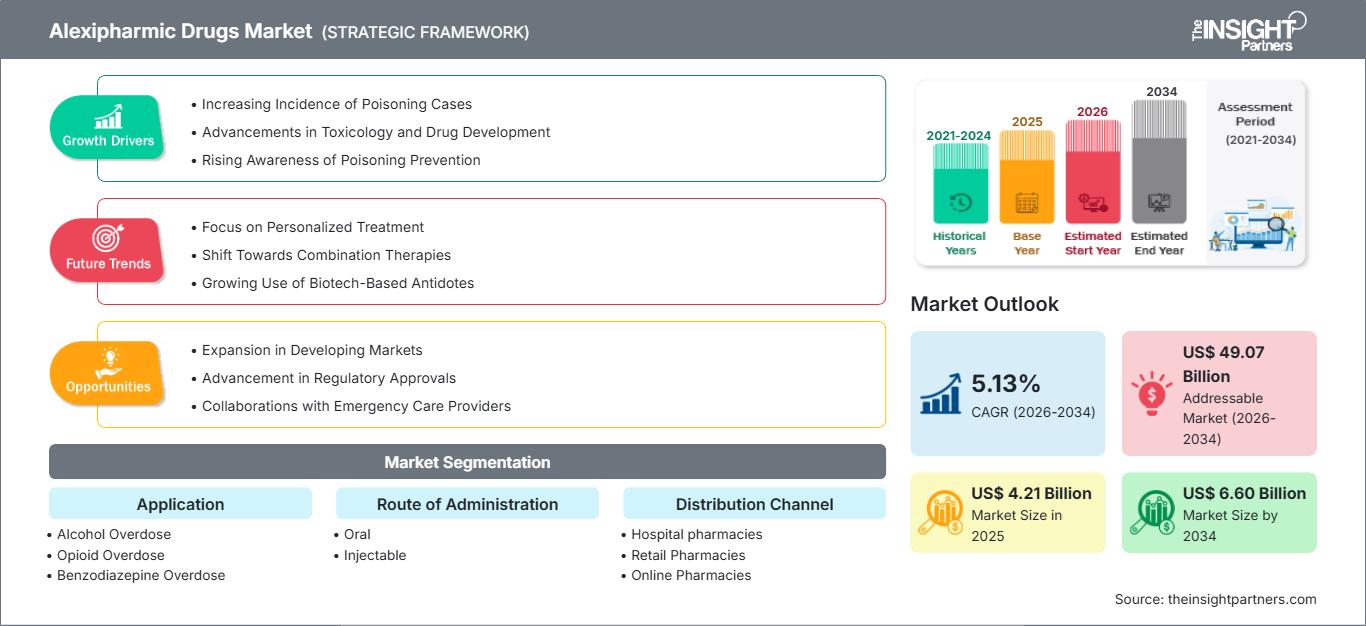
2025 Market Size
US$ 4.21 Bn
Base year value
2034 Forecast
US$ 6.60 Bn
Projected by 2034
CAGR 2026-2034
5.13 %
Growth rate
Addressable Market
US$ 49.07 Bn
(2026-2034)
The Alexipharmic Drugs Market size was valued at US$ 4.21 billion in 2025 and is forecast to grow to US$ 6.60 billion by 2034, indicating a CAGR of 5.13% for 2026-2034. The rising incidences of acute poisoning, increasing incidents of opioid overdose, developing infrastructure for emergency care, and availability of antidotes are some of the key factors propelling the market growth. Research in toxicology, improving protocols for handling emergencies, and the number of initiatives from the government to decrease the mortality rate due to poisoning are further boosting the demand for alexipharmic drugs globally.
North America is likely to continue being the leader in the market in terms of revenue growth over the forecast period, growing at an estimated CAGR of 5.0-5.4%. Factors contributing to regional market growth include high instances of drug overdose, developed poison control centers, favorable reimbursement scenario, and wide availability of emergency antidote therapies.
Alexipharmic Drugs Market Assessment and Insights
- North America: North America accounted for 39–43% share in 2025 and is projected to grow at a CAGR of 5.0–5.4% during 2026–2034. Advanced emergency healthcare infrastructure, increasing opioid poisoning cases, and strong availability of antidote therapies continue supporting regional market leadership.
- U.S.: The U.S. represented 81–85% of the North American market in 2025 and is expected to register a CAGR of 5.1–5.5% during 2026–2034, supported by expanding toxicology treatment capacity and favourable emergency healthcare spending.
- Europe: Europe held 26–30% market share in 2025 and is anticipated to expand at a CAGR of 4.8–5.2% during 2026–2034. Germany, the UK, and France remain leading contributors due to advanced hospital infrastructure and increasing poisoning management programs.
- Asia Pacific: Asia Pacific captured 22–26% Alexipharmic Drugs Market share in 2025 and is forecast to register a CAGR of 5.8–6.3% during 2026–2034. China, Japan, India, and South Korea continue driving regional demand through expanding emergency healthcare services and increasing healthcare expenditure.
- Largest Segment: Application – Opioid Overdose accounted for 35–39% market share in 2025 and is expected to grow at a CAGR of 5.4–5.8% during 2026–2034, supported by increasing opioid-related emergency interventions worldwide.
- High Growth Segment: Distribution Channel – Online Pharmacies represented 18–22% market share in 2025 and is anticipated to register a CAGR of 6.6–7.1% during 2026–2034, driven by expanding digital healthcare platforms and improving prescription fulfillment services.
- Key companies analyzed in detail: AdvaCare Pharma, American Regent, Inc., B. Braun SE, Bausch Health Companies Inc., Fresenius SE & Co. KGaA, Intelicure Lifesciences, Merck KGaA, Viatris Inc., SimSon Pharma Limited, Thermo Fisher Scientific Inc.
Source: The Insight Partners' analysis based on proprietary research, government publications, company annual reports, investor presentations, industry databases, and expert interviews.
Increased instances of accidental poisoning, opioid overdose cases, workplace exposure to toxic chemicals, and chemical poisoning have transformed the alexipharmic drugs market through increased development of antidotes and procedures for emergency treatment. Pharmaceutical manufacturers are producing fast-acting injectable antidotes, while hospitals are bolstering their preparedness for poisoning cases by better managing antidote inventories and implementing more standardized emergency treatment protocols. Improved manufacturing and the availability of regulatory support continue to boost access to antidotes worldwide, meeting changing needs in clinical practice.
Further growth in the market is anticipated due to rising healthcare investments in developing countries, the expansion of emergency medical care systems, and greater adoption of guidelines for the effective management of poisoning. Governments continue spending on poison control, emergency readiness programs, and the expansion of health care facilities. Ongoing research into new antidotes, growing public health awareness, and greater cooperation between pharmaceutical manufacturers and health care institutions will expand the potential of the alexipharmic drugs market and provide sustained business prospects.
Alexipharmic Drugs Market Report Scope
| Report Attribute | Details |
|---|---|
| Market size in 2025 | US$ 4.21 Billion |
| Market Size by 2034 | US$ 6.60 Billion |
| Global CAGR (2026 - 2034) | 5.13% |
| Historical Data | 2021-2024 |
| Forecast period | 2026-2034 |
Alexipharmic Drugs Market Analysis
There is a growing demand for alexipharmic drugs since the number of poisoning incidents related to opioids, alcohol, heavy metals, industrial substances, and prescription medicines is a major public health issue around the world. The increasing number of visits to emergency departments and better diagnoses of acute intoxications raise the need for antidote treatments. Increased access to healthcare services, greater awareness among physicians, and new treatment guidelines for poisoning ensure growth in the alexipharmic drug market across developed and developing healthcare systems.
Active ingredient suppliers, manufacturers of the finished products, contract manufacturers, pharmaceutical corporations, hospital pharmacies, retail pharmacies, online pharmacies, emergency healthcare organizations, poison control centers, and regulatory authorities are among the market participants. Stable production, improved cold chain management of injectable drugs, and consistent investments in quality assurance are contributing to increased supply chain reliability and market opportunities analysis.
In terms of competition, the situation is still dominated by the efforts of large pharmaceutical firms to build up their portfolio of antidotes by investing in research activities, manufacturing facilities, and regulatory approvals. Among these are such firms as B. Braun SE, Fresenius SE & Co. KGaA, Merck KGaA, Viatris Inc., American Regent, Inc., and Bausch Health Companies Inc. The other companies include AdvaCare Pharma, Intelicure Lifesciences, SimSon Pharma Limited, and Thermo Fisher Scientific Inc.
Current investment trends are inclined towards developing new-age antitoxins, better formulations for injection, collaborations for production and manufacturing, and the development of pharmaceutical distribution channels. Investment is being made to build partnerships for hospital procurement, develop digital inventory management techniques, and build regional manufacturing capacity to ensure the continuous availability of antitoxins.
● REPORT CUSTOMIZATION
Tailor This Report To Align With Your Specific Business Requirements
This report can be customized to align precisely with your business objectives, scope, and target markets. Customization options include tailored segmentation, geography, competitive analysis, and strategic insights to support informed decision-making.
Customize This Report →WHAT YOU CAN ADJUST
- ● Segmentations
- ● Geography
- ● Competitive Analysis
- ● Language Preferences
Alexipharmic Drugs Market: Strategic Insights
Regional Insights
North America Alexipharmic Drugs Market
North America accounted for 39–43% of the global market in 2025 and is projected to register a CAGR of 5.0–5.4% during 2026–2034. The region benefits from advanced emergency healthcare infrastructure, well-established poison control centers, and rapid access to antidote therapies. Increasing opioid overdose cases, accidental poisonings, and toxic chemical exposures continue driving demand for emergency antidote medications across hospitals and trauma centers. Government initiatives aimed at reducing overdose mortality and strengthening emergency preparedness further support regional market expansion.
The presence of leading pharmaceutical manufacturers, strong regulatory oversight, and widespread adoption of evidence-based toxicology protocols continue strengthening regional competitiveness. Continuous investments in emergency medicine, critical care services, and hospital pharmacy infrastructure are expected to sustain North America's leadership throughout the forecast period while supporting faster adoption of newly approved antidote therapies.
U.S. Alexipharmic Drugs Market
The U.S. represented 81–85% of the North American market in 2025 and is expected to expand at a CAGR of 5.1–5.5% during 2026–2034. Increasing opioid overdose emergencies, rising incidences of accidental poisoning, and extensive emergency healthcare infrastructure continue driving demand for antidote drugs. Strong government initiatives addressing substance abuse and expanding poison control services further strengthen market development across the country.
The presence of major pharmaceutical manufacturers, advanced hospital systems, and extensive emergency medical networks supports rapid access to life-saving antidotes. Growing investment in toxicology research, emergency preparedness, and hospital pharmacy modernization continues encouraging adoption of innovative poisoning treatment solutions while reinforcing the country's dominant regional position.
Europe Alexipharmic Drugs Market
Europe accounted for 26–30% of the global market in 2025 and is anticipated to register a CAGR of 4.8–5.2% during 2026–2034. Germany leads the regional market owing to its advanced healthcare infrastructure, strong emergency medicine capabilities, and widespread availability of hospital-based toxicology services. Continued investment in poison management programs and pharmaceutical innovation supports stable regional growth.
According to the Alexipharmic Drugs Market report, the United Kingdom continues witnessing constant market growth due to improvements in emergency response, increased awareness of opioid overdose management, and enhanced availability of hospital-based antidote treatments. Healthcare spending, along with poison surveillance programs, also plays an important role in the development of the market.
France, Italy, and Spain collectively play an important role in regional market growth due to increased healthcare spending, improved emergency department facilities, and the implementation of standard guidelines for treating poisoning cases. Continued investments in hospital pharmacies and emergency services will help sustain regional growth.
APAC Alexipharmic Drugs Market
Asia Pacific held 22–26% of the global market in 2025 and is projected to record a CAGR of 5.8–6.3% during 2026–2034. China leads regional demand through expanding emergency healthcare infrastructure, increasing pharmaceutical manufacturing capacity, and growing government investment in poisoning management programs.
Japan and South Korea continue supporting regional expansion through advanced healthcare systems, strong hospital networks, and increasing adoption of standardized toxicology treatment protocols.
India and Australia are witnessing rising demand due to expanding emergency medical services, improving healthcare accessibility, and increasing awareness regarding rapid poisoning management across hospitals and critical care facilities.
Middle East & Africa Alexipharmic Drugs Market
The Middle East & Africa market is expected to expand at a CAGR of 4.3–4.8% during 2026–2034, supported by improving emergency healthcare infrastructure, expanding hospital capacity, and increasing government investment in critical care services. Saudi Arabia remains the leading regional market through continued healthcare modernization initiatives.
The United Arab Emirates continues strengthening demand through investments in advanced emergency medicine, hospital expansion, and broader availability of critical care pharmaceuticals across public and private healthcare institutions.
South Africa and the Rest of the Middle East & Africa continue experiencing gradual market growth through improving healthcare accessibility, strengthening emergency response capabilities, and expanding hospital procurement of life-saving antidote therapies.
Segmentation Analysis
Application
The Alexipharmic Drugs Market forecast indicates that the Application segment is expected to register a CAGR of 5.2–5.6% during 2026–2034, supported by rising incidences of poisoning, growing emergency department admissions, and expanding availability of targeted antidote therapies. Increasing awareness regarding rapid poisoning intervention and improvements in toxicology treatment protocols continue supporting market expansion. Opioid overdose remains the dominant application owing to the sustained global burden of opioid-related emergencies.
- Alcohol Overdose: Alcohol poisoning treatment continues to generate stable demand owing to rising emergency admissions, increasing binge drinking incidents, and improved hospital protocols emphasizing timely antidote administration and supportive toxicology care.
- Opioid Overdose: This sub-segment maintains the leading market position due to increasing opioid misuse, expanding naloxone availability, government overdose prevention initiatives, and widespread deployment across emergency healthcare settings.
- Benzodiazepine Overdose: Growing prescription drug use and increasing accidental overdose cases continue supporting demand for targeted reversal therapies within hospital emergency departments and intensive care units.
- Cyanide Poisoning: Demand remains concentrated within industrial settings, mining operations, emergency response systems, and specialized healthcare facilities managing chemical exposure incidents requiring rapid antidote administration.
- Lead Poisoning: Increasing environmental monitoring, occupational health programs, and pediatric poisoning awareness continue supporting the use of chelation therapies across hospitals and specialized toxicology centers.
Route of Administration
The Route of Administration segment is projected to expand at a CAGR of 5.1–5.5% during 2026–2034. Injectable antidotes continue dominating emergency treatment because they provide rapid therapeutic action during life-threatening poisoning events, while oral formulations remain important for maintenance therapy and selected poisoning management protocols.
- Oral: Oral antidotes remain valuable for selected toxic exposures requiring prolonged treatment, offering convenient administration, improved patient compliance, and effective management in both hospital and outpatient settings.
- Injectable: Injectable therapies remain the preferred option during emergency poisoning management because of rapid onset of action, high clinical effectiveness, and extensive use within emergency departments and intensive care units.
Distribution Channel
The Distribution Channel segment is anticipated to register a CAGR of 5.4–5.9% during 2026–2034, supported by expanding pharmaceutical distribution networks, improving digital healthcare platforms, and increasing hospital procurement of emergency medicines. Hospital pharmacies continue accounting for the largest proportion of antidote distribution owing to the critical nature of poisoning treatment.
- Hospital Pharmacies: Hospital pharmacies remain the primary distribution channel because emergency antidotes require immediate availability, controlled storage conditions, and close integration with critical care and emergency medical services.
- Retail Pharmacies: Retail pharmacies continue expanding access to selected antidote therapies, supporting outpatient treatment, physician prescriptions, and improved patient convenience in regions with established pharmaceutical distribution systems.
- Online Pharmacies: Online pharmacies are witnessing increasing adoption through digital prescription fulfillment, expanding healthcare e-commerce, and improved access to pharmaceutical products across underserved geographic markets.
Opportunity Snapshot
| Segment Name | Revenue Contribution | Trend Tag | Adoption Stage |
| Hospital Pharmacies | High | Emergency Care | Mature |
| Retail Pharmacies | Medium | Community Access | Scaling |
| Online Pharmacies | Low | Digital Pharmacy | Emerging |
Alexipharmic Drugs Market Growth Drivers and Impact Analysis
Rising incidence of drug overdose and acute poisoning cases
Increased cases of opioid overdose, unintentional poisoning, chemical exposure, and toxic substances ingestion will keep on fueling the need for alexipharmic medicines around the globe. There have been persistent reports of an increased number of poisoning-related emergency admissions in hospitals, especially opioid, alcohol, and medication poisoning. Healthcare organizations are improving their emergency preparedness by stocking sufficient antidotes and enhancing poison control services. Governments are making more efforts in terms of investing in preventive programs against overdose as well as improving infrastructure to deal with emergencies. These trends will keep on aiding the alexipharmic medicines market growth through increased adoption of quick-acting antidotes as well as encouraging the pharmaceutical companies to increase production.
Expansion of emergency healthcare infrastructure
There is ongoing investment in emergency departments, intensive care units, and toxicology clinics to improve clinical outcomes for poisoning patients across the globe. The developing nations have been improving their emergency medicine systems and enhancing the acquisition of necessary antidotes and medicines. With the standardization of protocols for treating poisoning cases, proper training of physicians, and improved networks for emergency transport, diagnosis and treatment are faster. There is ongoing collaboration between drug companies and healthcare providers to provide a continuous supply of antidotes. This will further enhance the market analysis of alexipharmic drugs.
Increasing government focus on poison control and public health preparedness
Governments keep on rolling out national surveillance programs for poisoning cases, extending poison control centers, and enhancing their emergency response capacities. Awareness campaigns aimed at increasing public knowledge about early detection of poisoning symptoms and seeking timely medical attention have increased the rate of healthcare visits. Regulatory authorities are also facilitating broad access to essential antidotes through favorable approvals and stockpiling schemes. Disaster preparedness and chemical emergency response activities will also support hospitals and healthcare providers in acquiring antidotes.
Alexipharmic Drugs Market Future Trends
Development of next-generation targeted antidotes
Future pharmaceutical innovation is expected to focus on highly targeted antidotes capable of neutralizing specific toxins with improved safety profiles and faster therapeutic action. Advances in biotechnology, monoclonal antibodies, and precision medicine are encouraging development of antidotes with greater efficacy against emerging toxic substances and synthetic drugs. Research institutions and pharmaceutical companies continue investing in novel therapeutic platforms that reduce treatment complications while improving clinical outcomes. These innovations are expected to influence future alexipharmic drugs market trends by expanding treatment options and supporting broader adoption of advanced toxicology therapies across emergency healthcare settings.
Growing adoption of integrated toxicology management systems
Hospitals are increasingly integrating digital clinical decision-support systems, electronic poison databases, and real-time toxicology consultation platforms into emergency care workflows. These technologies enable faster identification of toxic substances, improve antidote selection, and support standardized treatment protocols. Artificial intelligence and predictive analytics are also expected to enhance poisoning diagnosis and emergency response efficiency. Increasing digitalization of emergency medicine will strengthen clinical decision-making while improving patient outcomes, creating favorable long-term opportunities for pharmaceutical companies supplying antidote therapies.
Alexipharmic Drugs Market Opportunities
Expansion across emerging healthcare markets
Rapid improvements in healthcare infrastructure across Asia Pacific, Latin America, the Middle East, and Africa present significant commercial opportunities for antidote manufacturers. Governments are increasing healthcare expenditure, expanding hospital capacity, and strengthening emergency medical services to improve poisoning management. Pharmaceutical companies can capitalize on these developments by expanding regional manufacturing, establishing distribution partnerships, and improving product accessibility. Localization of supply chains and stronger collaboration with public healthcare agencies are expected to improve market penetration while supporting long-term revenue growth across underserved healthcare markets.
Investment in innovative emergency pharmaceutical technologies
Growing investment in rapid-delivery drug formulations, auto-injector technologies, heat-stable antidotes, and portable emergency treatment systems presents attractive opportunities for manufacturers. Healthcare providers increasingly prefer products that simplify emergency administration and improve treatment efficiency in both hospital and pre-hospital settings. Companies investing in advanced formulation technologies, improved product stability, and user-friendly delivery devices are expected to strengthen their competitive position. Continued innovation will enhance clinical effectiveness while expanding the alexipharmic drugs market size through broader adoption across emergency medicine and critical care environments.
Recent Developments
- February 2026: Merck KGaA announced the expansion of its Life Science manufacturing capabilities for pharmaceutical raw materials and critical healthcare products through investments in its global production network, strengthening supply reliability for emergency and specialty medicines.
- October 2025: B. Braun SE expanded its portfolio of emergency and critical care injectable products through new manufacturing investments designed to improve hospital supply resilience and strengthen availability of life-saving medicines across global healthcare systems.
- July 2024: Viatris Inc. announced expanded availability of several complex injectable medicines across international markets while continuing investments in hospital pharmaceutical manufacturing to improve access to essential emergency treatments.
Frequently Asked Questions

- Comprehensive Market Sizing and Forecast Analysis
- Detailed Segmentation Analysis
- In-Depth Market Dynamics Assessment
- Regional and Country-Level Insights
- Competitive Landscape and Company Benchmarking
- Strategic Business Intelligence
Recent Reports
Testimonials

The Insight Partners' SCADA System Market report is comprehensive, with valuable insights on current trends and future forecasts. The team was highly professional, responsive, and supportive throughout. We are very satisfied and highly recommend their services.
RAN KEDEM Partner, Reali Technologies LTDs
I requested a report on a very specific software market and the team produced the report in a few days. The information was very relevant and well presented. I then requested some changes and additions to the report. The team was again very responsive and I got the final report in less than a week.
JEAN-HERVE JENN Chairman, Future Analytica
We worked with The Insight Partners for an important market study and forecast. They gave us clear insights into opportunities and risks, which helped shape our plans. Their research was easy to use and based on solid data. It helped us make smart, confident decisions. We highly recommend them.
PIYUSH NAGPAL Sr. Vice President, High Beam Global
The Insight Partners delivered insightful, well-structured market research with strong domain expertise. Their team was professional and responsive throughout. The user-friendly website made accessing industry reports seamless. We highly recommend them for reliable, high-quality research services
YUKIHIKO ADACHI CEO, Deep Blue, LLC.
This is the first time I have purchased a market report from The Insight Partners.While I was unsure at first, I visited their web site and felt more comfortable to take the risk and purchase a market report.I am completely satisfied with the quality of the report and customer service. I had several questions and comments with the initial report, but after a couple of dialogs over email with their analyst I believe I have a report that I can use as input to our strategic planning process.Thank you so much for taking the extra time and making this a positive experience.I will definitely recommend your service to others and you will be my first call when we need further market data.
JOHN SUZUKI President and Chief Executive Officer, Board Director, BK Technologies
I wish to appreciate your support and the professionalism you displayed in the course of attending to my request for information regarding to infectious disease IVD market in Nigeria. I appreciate your patience, your guidance, and the fact that you were willing to offer a discount, which eventually made it possible for us to close a deal. I look forward to engaging The Insight Partners in the future, all thanks to the impression you have created in me as a result of this first encounter.
DR CHIJIOKE ONYIA MANAGING DIRECTOR, PineCrest Healthcare Ltd.Reason to Buy
- Informed Decision-Making
- Understanding Market Dynamics
- Competitive Analysis
- Identifying Emerging Markets
- Customer Insights
- Market Forecasts
- Risk Mitigation
- Boosting Operational Efficiency
- Strategic Planning
- Investment Justification
- Tracking Industry Innovations
- Aligning with Regulatory Trends





 Get Free Sample for