
All-terrain Vehicle Market Statistics, Trends, Size, Share, and Key Players by 2034
Coverage: by Type (Utility ATV, Sport ATV); Drive Type (2-wheel drive, 4-wheel drive, All-wheel drive); Engine Capacity (<400 CC, 400 to 800 CC, > 800 CC); Fuel Type (Gasoline, Electric); Seating Capacity (One-Seat ATV, Two-Seat ATV); Application (Sports, Agriculture, Entertainment, Military and Defense, Others) , and Geography (North America, Europe, Asia Pacific, and South and Central America)
- Status : Data Released
- Report Code : TIPRE00006746
- Category : Automotive and Transportation
- No. of Pages : 150
- Available Report Formats :


- Last update date : August 27, 2026


2025 Market Size
US$ 5.07 Bn
Base year value
2034 Forecast
US$ 7.61 Bn
Projected by 2034
CAGR 2026-2034
4.6 %
Growth rate
Addressable Market
US$ 57.52 Bn
(2026-2034)
The all-terrain vehicle market was valued at US$ 5.07 Billion in 2025 and is projected to reach US$ 7.61 Billion by 2034, growing at a CAGR of 4.6% during 2026–2034. Demand is supported by recreation, agriculture, land management, defense mobility, and utility applications where compact off-road vehicles deliver maneuverability across unpaved, uneven, and remote terrain.
North America remains the anchor region for all-terrain vehicle market size, supported by strong trail networks, farm and ranch usage, hunting access, and established dealer coverage. The region is expected to expand at a CAGR of 4.2%–4.8% during 2026–2034 as replacement purchases, accessory-led customization, and high-capacity utility models offset maturity in recreational demand.
All-terrain Vehicle Market Assessment and Insights
- North America accounted for 45%–49% share in 2025 and is expected to grow at a CAGR of 4.2%–4.8% during 2026–2034, led by recreation, agriculture, ranching, and public land access.
- US represented 78%–82% of North America revenue in 2025 and is projected to grow at a CAGR of 4.1%–4.7% during 2026–2034.
- Europe held 20%–24% share in 2025 and is expected to grow at a CAGR of 3.8%–4.4%, with Germany, France, the UK, Italy, and Spain leading adoption.
- Asia Pacific captured 18%–22% share in 2025 and is forecast to grow at a CAGR of 5.2%–6.0%, supported by China, Japan, India, South Korea, and Australia.
- Largest Segment: Utility ATV held 58%–63% market share in 2025 and is expected to grow at a CAGR of 4.3%–4.9% during 2026–2034.
- High Growth Segment: Electric fuel type held 4%–7% market share in 2025 and is expected to grow at a CAGR of 9.5%–11.5% during 2026–2034.
- Key companies analyzed in detail: Arctic Cat Inc., BRP Inc., CFMOTO, Honda Motor Co., Ltd., Jiangsu Linhai Power Machinery Group Corp., Kawasaki Motors, Corp., U.S.A., Polaris Inc., Suzuki Motor USA, LLC, Taiwan Golden Bee Co., Ltd., and Yamaha Motor Corporation, U.S.A.
Source: The Insight Partners' analysis based on proprietary research, government publications, company annual reports, investor presentations, industry databases, and expert interviews.
Product development in the all-terrain vehicle market has moved from basic off-road mobility toward purpose-built platforms with higher payload capacity, improved suspension, electronic power steering, stronger drivetrains, and task-specific trims. Utility buyers prioritize durability, low-speed torque, towing capability, and service access, while sport users demand lighter chassis, responsive handling, and reliable braking. Production strategies are also shifting toward modular platforms that let manufacturers serve multiple use cases with controlled component complexity.
Forward-looking demand will be shaped by emerging rural economies, electrified low-noise models, and stronger compliance with safety and emissions expectations. According to the All-Terrain Vehicle Market Report, manufacturers are likely to invest in connected diagnostics, dealer training, and accessory ecosystems as customers seek lower total ownership costs. Asia Pacific and selected Middle East markets are expected to contribute incremental volume growth, while mature North American and European markets will continue to support premium replacement cycles and demand for advanced vehicle features.
All-terrain Vehicle Market Report Scope
| Report Attribute | Details |
|---|---|
| Market size in 2025 | US$ 5.07 Billion |
| Market Size by 2034 | US$ 7.61 Billion |
| Global CAGR (2026 - 2034) | 4.6% |
| Historical Data | 2021-2024 |
| Forecast period | 2026-2034 |
All-terrain Vehicle Market Analysis
The all-terrain vehicle market growth is being driven by outdoor recreation, farm mechanization, forestry, construction-site mobility, and defense patrol needs. Customers now consider ATVs as multi-use equipment and not as season-based ones, particularly in areas where there are no broad trails, poor terrain conditions, or difficult farming land for pick-up trucks. The supply side will depend on engines, transmissions, tires, suspensions, and electronics availability.
On the demand side, the factors include safety regulations, accessibility to the trails, and the cost of financing. Interest rates may deter customers from purchasing ATV equipment in case of recreation purposes, but the business segment continues to upgrade its old fleet as long as it is productive. The value chain in the industry comprises manufacturers, component makers, dealerships, rental providers, accessories companies, and repair shops.
The all-terrain vehicle market analysis shows a concentrated competitive landscape, with Polaris Inc., BRP Inc., Honda Motor Co., Ltd., Yamaha Motor Corporation, U.S.A., Kawasaki Motors, Corp., U.S.A., and CFMOTO competing across utility and performance categories. Differentiation depends on reliability, suspension calibration, dealer service, brand trust, and model breadth. Emerging challengers are using value pricing, expanding distribution, and feature-rich mid-capacity models to win customers in developing markets.
Trends in investments focus on electrification, premium trim utilities, youth segment bikes, rider assistance features, and accessories. The companies Arctic Cat Inc., Suzuki Motor USA, LLC, Taiwan Golden Bee Co., Ltd., and Jiangsu Linhai Power Machinery Group Corp. remain competitive by focusing on regional strengths and niches. It is becoming increasingly important for positioning in the market to be done on the basis of blending gasoline bikes with silent electric bikes.
● REPORT CUSTOMIZATION
Tailor This Report To Align With Your Specific Business Requirements
This report can be customized to align precisely with your business objectives, scope, and target markets. Customization options include tailored segmentation, geography, competitive analysis, and strategic insights to support informed decision-making.
Customize This Report →WHAT YOU CAN ADJUST
- ● Segmentations
- ● Geography
- ● Competitive Analysis
- ● Language Preferences
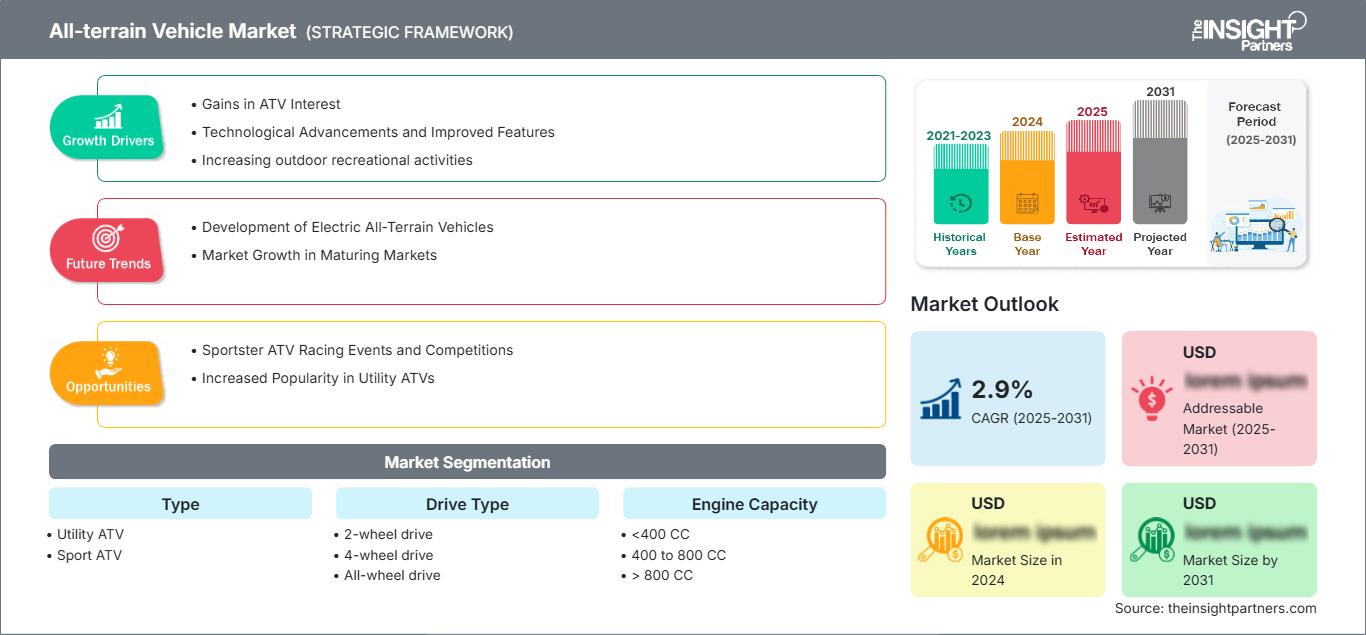
All-terrain Vehicle Market: Strategic Insights
Regional Insights
North America all-terrain vehicle market
North America accounted for 45%–49% all-terrain vehicle market share in 2025, reflecting high recreational participation, extensive trail systems, and strong farm and ranch use. The region is projected to grow at a CAGR of 4.2%–4.8% during 2026–2034. Replacement demand is supported by established dealers, accessories, financing programs, and premium models designed for mud, hunting, hauling, and trail riding.
Adoption is highest in the agricultural sector, forestry, public safety, and land management sectors, where ATVs help in minimizing travel time in difficult terrains. The maturity of the region restricts rapid volume growth; however, high selling prices, technological advancement, and the development of electricity utilities will help in increasing value growth. Canada makes contributions through the recreational and resource-based industries, while Mexico adds to utility demand.
U.S. all-terrain vehicle Market
The U.S. represented 78%–82% of North America revenue in 2025 and is projected to expand at a CAGR of 4.1%–4.7% through 2034. Demand is anchored by farms, ranches, hunting properties, off-road parks, and powersports enthusiasts. Dealer network strength ensures comparisons on engine displacement, drive types, accessories, warranty, and servicing before purchase.
Market presence is widespread with competition between Polaris Inc., Yamaha Motor Corporation, U.S.A., Honda Motor Co., Ltd., Kawasaki Motors, Corp., U.S.A., Suzuki Motor USA, LLC, and BRP Inc. in utility, sports, youth, and luxury vehicles. Trends point towards 400 to 800 CC vehicles for utility/recreational use and high-displacement models for mud, dunes, racing, and trails.
Europe all-terrain vehicle Market
Europe held 20%–24% share in 2025 and is forecast to grow at a CAGR of 3.8%–4.4% during 2026–2034. This area is influenced by agricultural estates, forestry, snow handling, municipal services, and recreation. German and French markets are leading the way thanks to land management of rural properties and utilities needs, and the British market maintains its level thanks to farms, estates, and work vehicles used outdoors.
Agriculture, tourism, and municipal operations help Italy and Spain, although regulations limiting off-road activity temper recreation. Europeans care about emissions, safety, homologation, and servicing. Electric and more silent petrol versions become popular in environmentally friendly areas, opening up new prospects for manufacturers offering compliance, range, payload and reliability through dealerships.
APAC all-terrain vehicle Market
APAC accounted for 18%–22% share in 2025 and is expected to record a CAGR of 5.2%–6.0% during 2026–2034. China is the leading production and growth market, supported by expanding domestic brands and exports. Japan contributes through established OEM technology, while Australia sustains demand across farms, mining support, tourism, and remote land access.
India and South Korea remain smaller but promising markets as adventure tourism, mechanized agriculture, and rural infrastructure improve. Within the All-Terrain Vehicle Market, price sensitivity keeps mid-capacity gasoline vehicles dominant, but electric models could gain traction in resorts, campuses, and controlled industrial sites due to their lower operating costs and reduced noise levels. Policy clarity regarding road use, registration requirements, safety standards, and emissions regulations will play an important role in determining the pace of regional market adoption and long-term growth opportunities.
Middle East & Africa all-terrain vehicle Market
The Middle East & Africa All-Terrain Vehicle Market is expected to grow at a CAGR of 4.6%–5.4% during 2026–2034, led by the UAE, Saudi Arabia, and South Africa. Demand is supported by desert recreation, tourism fleets, agriculture, utilities, energy-site access, and security applications. Harsh terrain increases the importance of cooling systems, dust protection, tire durability, and service support. Growing investments in tourism infrastructure and industrial projects are also expected to support long-term expansion of the market across the region.
The UAE leads premium recreational adoption through dunes, adventure operators, and affluent consumers, while Saudi Arabia offers long-term potential from tourism, infrastructure, and desert mobility programs. South Africa contributes through farming, wildlife management, and rural utility needs. The rest of MEA demand remains project-led, with procurement concentrated around mining, oil and gas, conservation, and public agencies.
Segmentation Analysis
Type
Type segmentation includes Utility ATV and Sport ATV, with the main segment expected to grow at a CAGR of 4.3%–4.9% during 2026–2034. The all-terrain vehicle market scope is widest in utility models because they serve farms, ranches, forestry teams, maintenance crews, and recreational riders needing cargo racks, towing, traction, and durability. Sport models remain strategically important for performance branding and enthusiast loyalty.
- Utility ATV leads demand because buyers need cargo capacity, towing ability, 4-wheel drive, winches, and practical ergonomics for fieldwork, trail maintenance, hunting, and property management.
- Sport ATV serves enthusiasts seeking acceleration, handling, suspension response, and lightweight agility, especially in dunes, trails, racing environments, and recreational riding communities.
Drive Type
Drive Type segmentation includes 2-wheel drive, 4-wheel drive, and All-wheel drive, with the main segment expected to grow at a CAGR of 4.4%–5.0% during 2026–2034. Buyers increasingly prefer traction flexibility as mixed-use applications require stable performance across mud, slopes, snow, gravel, and uneven ground. Drive selection influences price, maintenance, fuel use, and vehicle suitability.
- 2-wheel drive remains relevant for entry-level, sport, and lighter-duty use where lower cost, simpler maintenance, and reduced vehicle weight are more important than maximum traction.
- 4-wheel drive is preferred for utility work, hunting, agriculture, and rugged trails because it improves grip, pulling power, confidence, and control in difficult terrain.
- All-wheel drive appeals to premium users seeking automatic traction management, smoother handling, and improved stability during variable off-road conditions and changing surface grip.
Engine Capacity
Engine Capacity segmentation includes <400 CC, 400 to 800 CC, and > 800 CC, with the main segment expected to grow at a CAGR of 4.5%–5.1% during 2026–2034. Mid-capacity engines remain central because they balance purchase price, power, fuel consumption, handling, and work capability. Higher-output machines support performance and heavy-duty use, while smaller units serve youth and light utility needs.
- <400 CC models serve light-duty users, youth categories, price-sensitive buyers, and controlled recreational environments where manageable power and lower ownership cost are priorities.
- 400 to 800 CC platforms dominate broad utility and recreation because they provide sufficient torque, trail comfort, accessory compatibility, and practical value for most buyers.
- > 800 CC models target premium performance, mud riding, towing, and demanding terrain where high horsepower, ground clearance, and advanced suspension justify higher pricing.
Fuel Type
Fuel Type segmentation includes Gasoline and Electric, with the main segment expected to grow at a CAGR of 4.2%–4.8% during 2026–2034. Gasoline remains dominant because refueling infrastructure, range, service familiarity, and power density are well established. Electric models are emerging where quiet operation, lower local emissions, and reduced maintenance are valued in farms, parks, resorts, and conservation areas.
- Gasoline models dominate current demand because they offer established performance, broad dealer service, longer range, lower upfront familiarity barriers, and proven suitability for rugged use.
- Electric models are gaining strategic importance for noise-sensitive work, controlled fleets, tourism, and sustainability-focused buyers seeking instant torque and lower routine maintenance.
Opportunity Snapshot
| Fuel Type | Revenue Contribution | Trend Tag | Adoption Stage |
| Gasoline | High | Trail Utility | Mature |
| Electric | Low | Quiet Power | Emerging |
All-terrain Vehicle Market Growth Drivers and Impact Analysis
Rising Utility Demand Across Farms, Ranches, and Land Management
There has been an increase in the use of ATVs in agricultural, forestry, estate management and public utility works for the movement of people, equipment, food, fence materials and inspection equipment over areas where large equipment will not be economical. The use of utility ATV models with four-wheel drives, racks, winches and towing capacity makes tasks faster and easier in accessing distant parcels. This rider will be dealing with steady orders from professionals who depend on vehicle serviceability, economy and uptime rather than recreation alone. Increased investments in rural infrastructure and land management will contribute more to fleet growth. Improved performance through enhanced durability, fuel economy and safety, in addition to increased accessory options designed to meet commercial needs, are some of the initiatives by manufacturers.
Expansion of Outdoor Recreation and Trail-Based Tourism
The recreational demand will be boosted by trail networks, off-road parks, hunting land, tour services, and consumer preference towards outdoor mobility solutions. The riders prefer those vehicles that offer both comfort and great suspension, as well as power delivery and accessories customization. The tourism providers also use ATVs in their guided tours and adventures in deserts, forests, mountainous areas, and rural places. The market influence will be noticeable through premium versions, sport versions, mud versions, and accessories that increase the average selling prices even when the unit demand increases slightly. This trend is now used by ATV manufacturers through the development of accessory systems, better ride technologies, and safety options for both hardcore riders and newcomers.
Product Innovation in Powertrains, Safety, and Rider Comfort
Manufacturers are introducing their latest models with electronic power steering, better lighting, sturdier CVT, better suspension, adjustable drive modes, better braking, and improved protection systems. All these improvements promote replacement sales by enabling customers to convince themselves to move from their current cars to models that are better in terms of control, comfort, and longevity. Electric start features increase usability in environments where silence is an important factor. With innovation being seen more and more often, companies that have good dealership education programs and accessory products will be able to capitalize on technological advances and translate them into revenue. Moreover, connected car technology, diagnostics monitoring, and better maintenance services are enhancing the customer experience and decreasing downtime.
All-terrain Vehicle Market Future Trends
Electrification for Quiet Utility and Controlled Environments
The all-terrain vehicle market trends will increasingly include electric utility platforms designed for farms, resorts, parks, estates, and conservation areas where low noise matters. Electric all-terrain vehicles provide instant torque, ease of maintenance, and less pollution locally, but their deployment will depend on factors such as range, charging duration, capacity to carry loads, battery life span, and costs. Their initial application will probably be in fleets and institutions before wider consumer adoption. Original equipment manufacturers that integrate charging facilities, training in services, and accessories will be able to hasten deployment. Future improvements in battery design, energy management systems, and charging stations will enhance the overall performance of electric all-terrain vehicles and their economic viability. Initiatives by governments and corporations for environmental sustainability will aid adoption.
Connected Diagnostics and Accessory-Led Personalization
Future iterations will involve integration with digital displays, diagnostics, accessory power management, GPS-related functionality, and maintenance notifications. This makes it possible for dealerships to maximize service retention and allow users to minimize their vehicle downtime. Personalization will continue to be a key component as buyers customize their ATVs for use in hunting, snow plowing, agricultural work, mud terrain riding, trail riding, or for kids’ riding. As such, the trend is likely to change the nature of competition in the sector from being one based on vehicle components alone to becoming more holistic by considering the software, accessories, warranty, and dealership support that make up the ownership ecosystem of the vehicle.
All-terrain Vehicle Market Opportunities
Fleet Sales to Agriculture, Public Agencies, and Tourism Operators
The all-terrain vehicle market Forecasts indicate a strong opportunity in professional fleets that require dependable off-road mobility. Farms, municipalities, conservation bodies, resorts, security teams, and energy-site operators need standardized models, predictable maintenance, and accessories tailored to daily work. OEMs and dealers can expand revenue by offering bundled financing, service contracts, operator training, safety equipment, and fleet replacement programs. This approach reduces reliance on seasonal retail demand and creates stable, relationship-driven sales channels. Additional opportunities exist in fleet management solutions that provide usage tracking, maintenance scheduling, and operational reporting. As organizations seek greater efficiency and accountability, demand for integrated support services will increase. Vendors that deliver strong after-sales support, rapid parts availability, and customized fleet packages can strengthen customer retention and generate recurring long-term revenue streams.
Mid-Capacity Models for Emerging Markets
Emerging markets offer an opportunity for durable 400 to 800 CC models that balance affordability with utility. Rural infrastructure, adventure tourism, agriculture, and construction support adoption, but buyers require parts availability, financing, and practical after-sales support. Manufacturers can localize portfolios through rugged base models, simplified electronics, and high-use accessories such as racks, guards, and tow kits. Success will depend on distribution quality, regulatory compliance, and the ability to communicate lifecycle value rather than only upfront price. Growing investment in transportation networks and rural development programs is expected to further expand demand for versatile off-road vehicles. Manufacturers that build strong dealer networks, maintain reliable spare-parts supply chains, and offer flexible ownership solutions can improve market penetration, strengthen customer confidence, and establish long-term competitive positioning across developing regions.
Frequently Asked Questions

- Comprehensive Market Sizing and Forecast Analysis
- Detailed Segmentation Analysis
- In-Depth Market Dynamics Assessment
- Regional and Country-Level Insights
- Competitive Landscape and Company Benchmarking
- Strategic Business Intelligence
Recent Reports
Testimonials

The Insight Partners' SCADA System Market report is comprehensive, with valuable insights on current trends and future forecasts. The team was highly professional, responsive, and supportive throughout. We are very satisfied and highly recommend their services.
RAN KEDEM Partner, Reali Technologies LTDs
I requested a report on a very specific software market and the team produced the report in a few days. The information was very relevant and well presented. I then requested some changes and additions to the report. The team was again very responsive and I got the final report in less than a week.
JEAN-HERVE JENN Chairman, Future Analytica
We worked with The Insight Partners for an important market study and forecast. They gave us clear insights into opportunities and risks, which helped shape our plans. Their research was easy to use and based on solid data. It helped us make smart, confident decisions. We highly recommend them.
PIYUSH NAGPAL Sr. Vice President, High Beam Global
The Insight Partners delivered insightful, well-structured market research with strong domain expertise. Their team was professional and responsive throughout. The user-friendly website made accessing industry reports seamless. We highly recommend them for reliable, high-quality research services
YUKIHIKO ADACHI CEO, Deep Blue, LLC.
This is the first time I have purchased a market report from The Insight Partners.While I was unsure at first, I visited their web site and felt more comfortable to take the risk and purchase a market report.I am completely satisfied with the quality of the report and customer service. I had several questions and comments with the initial report, but after a couple of dialogs over email with their analyst I believe I have a report that I can use as input to our strategic planning process.Thank you so much for taking the extra time and making this a positive experience.I will definitely recommend your service to others and you will be my first call when we need further market data.
JOHN SUZUKI President and Chief Executive Officer, Board Director, BK Technologies
I wish to appreciate your support and the professionalism you displayed in the course of attending to my request for information regarding to infectious disease IVD market in Nigeria. I appreciate your patience, your guidance, and the fact that you were willing to offer a discount, which eventually made it possible for us to close a deal. I look forward to engaging The Insight Partners in the future, all thanks to the impression you have created in me as a result of this first encounter.
DR CHIJIOKE ONYIA MANAGING DIRECTOR, PineCrest Healthcare Ltd.Reason to Buy
- Informed Decision-Making
- Understanding Market Dynamics
- Competitive Analysis
- Identifying Emerging Markets
- Customer Insights
- Market Forecasts
- Risk Mitigation
- Boosting Operational Efficiency
- Strategic Planning
- Investment Justification
- Tracking Industry Innovations
- Aligning with Regulatory Trends





 Get Free Sample for