
Aluminium Scandium Alloy Market Trends, Demand & Growth by 2034
Coverage: by Product (2% Scandium, 1.5% Scandium, Other); Applications (Defense and Aerospace, Transportation, Consumer Goods, Other) , and Geography (North America, Europe, Asia Pacific, and South and Central America)
- Status : Data Released
- Report Code : TIPRE00012830
- Category : Chemicals and Materials
- No. of Pages : 150
- Available Report Formats :


- Last update date : August 14, 2026


2025 Market Size
US$ 104.9 Mn
Base year value
2034 Forecast
US$ 206.26 Mn
Projected by 2034
CAGR 2026-2034
8.82 %
Growth rate
Addressable Market
US$ 1,475.21 Mn
(2026-2034)
The aluminium scandium alloy market is projected to grow from US$ 104.9 million in 2025 to US$ 206.26 million by 2034, registering a CAGR of 8.82% during 2026–2034. Growing demand for lightweight and strong metallic materials in aerospace, defense, transportation, and advanced manufacturing industries helps drive the market growth. Better processing technologies for alloys, increased spending on scandium mining activities, and wider use in additive manufacturing enhance the commercial potential of aluminium scandium alloy materials over the coming years.
The North American region is important market in the aluminium scandium alloy market size due to growing production of aircraft, modernization programs in the defense industry, and investments into advanced metals manufacturing. The market value in the region is estimated to grow at a CAGR of 8.3–9.0% in 2026-2034 as aircraft manufacturers, space agencies, and military suppliers focus on the use of lightweight and durable materials for fuel efficiency and corrosion protection.
Aluminium Scandium Alloy Market Assessment and Insights
- North America: Accounted for 31–35% share in 2025 and is anticipated to grow at a CAGR of 8.3–9.0% during 2026–2034, supported by defense procurement, commercial aerospace manufacturing, additive manufacturing investments, and domestic critical mineral initiatives.
- U.S.: Represented approximately 76–80% of the North American market in 2025 and is projected to register a CAGR of 8.4–9.1% during 2026–2034, driven by aerospace innovation, military modernization, and expanding metal additive manufacturing capacity.
- Europe: Held 24–28% share in 2025 and is forecast to grow at a CAGR of 8.0–8.7% during 2026–2034, with Germany, France, and the UK leading adoption across aerospace, automotive engineering, and industrial manufacturing.
- Asia Pacific: Accounted for 30–34% share in 2025 and is expected to expand at a CAGR of 9.1–9.8% during 2026–2034, led by China, Japan, South Korea, and India owing to rapid industrialization, aerospace investments, and expanding alloy manufacturing capacity.
- Largest Segment – Applications (Defense and Aerospace): Held an estimated 48–52% market share in 2025 and is projected to grow at a CAGR of 9.0–9.6% during 2026–2034, supported by increasing aircraft production and lightweight structural component demand.
- High Growth Segment – Product (2% Scandium): Accounted for approximately 56–60% market share in 2025 and is anticipated to record a CAGR of 9.1–9.8% during 2026–2034, owing to superior strengthening efficiency and broader industrial adoption.
- Key companies analyzed in detail: American Elements, AMG Aluminum, Hunan Oriental Scandium Co., Ltd., KBM Master Alloys, Metallica Minerals Limited, Platina Resources Limited, United Company RUSAL IPJSC, Scandium International Mining Corp., Stanford Advanced Materials, Top Metal Materials Co., Ltd.
Source: The Insight Partners' analysis based on proprietary research, government publications, company annual reports, investor presentations, industry databases, and expert interviews.
Progress in metallurgical sciences has contributed greatly to the commercial prospects of aluminum scandium alloys by developing optimal alloy compositions, better casting, and advanced powder metallurgy processes. The rise in the application of electron beam melting and laser powder bed fusion technology has led to new possibilities of producing aerospace parts which demonstrate remarkable resistance to fatigue. At the same time, more effective techniques for scandium recovery from industrial by-products and laterites will allow for reinforcing the supply chain, decreasing reliance on conventional supplies of the material.
Market growth in the future will be supported by growing investments in critical minerals supply chains, governmental funding for advanced aerospace materials, and commercialization of scandium extraction technologies. Current projects aimed at scandium production in Australia, North America, and Europe will increase raw material availability, while the expansion of additive manufacturing and electric mobility will present further growth opportunities for manufacturers of aluminum scandium alloys.
Aluminium Scandium Alloy Market Report Scope
| Report Attribute | Details |
|---|---|
| Market size in 2025 | US$ 104.9 Million |
| Market Size by 2034 | US$ 206.26 Million |
| Global CAGR (2026 - 2034) | 8.82% |
| Historical Data | 2021-2024 |
| Forecast period | 2026-2034 |
Aluminium Scandium Alloy Market Analysis
Increasing demand for lightweight materials for various engineering purposes is further enhancing the expansion of the market for aluminium scandium alloys. Scandium aluminium alloys are widely used by industries to lower the weight of structures while retaining their excellent strength, weldability, and corrosion resistance. An increased degree of integration within the value chain is being observed, as scandium mining firms work together with alloy producers, powder producers, additive manufacturing firms, and aircraft manufacturers.
Market dynamics are transforming due to the construction of scandium extraction facilities which allow reducing the dependence on major production sources. The increased interest in the extraction of scandium from laterite ore, titanium residues, and red mud is becoming apparent. Furthermore, the emergence of the technology for recycling and efficient powder production makes it possible to effectively use scandium.
Competitive positioning in the aluminium scandium alloy market report becomes more and more defined through technological capabilities, access to raw materials and strategic partnerships. American Elements, United Company RUSAL IPJSC, Stanford Advanced Materials, and AMG Aluminum keep developing advanced alloy offerings, while KBM Master Alloys and Hunan Oriental Scandium Co., Ltd. are working on specialty master alloys for the aerospace industry and other customers.
All investments will continue to be oriented towards the production of scandium, the improvement of its alloys, and manufacturing powders. The activities of firms such as Platina Resources Limited, Metallica Minerals Limited, and Scandium International Mining Corp. continue to move forward in the area of extraction of scandium resources. Collaboration of mining companies, aerospace manufacturers, and research institutions will be advantageous for development of aluminum scandium alloys.
● REPORT CUSTOMIZATION
Tailor This Report To Align With Your Specific Business Requirements
This report can be customized to align precisely with your business objectives, scope, and target markets. Customization options include tailored segmentation, geography, competitive analysis, and strategic insights to support informed decision-making.
Customize This Report →WHAT YOU CAN ADJUST
- ● Segmentations
- ● Geography
- ● Competitive Analysis
- ● Language Preferences
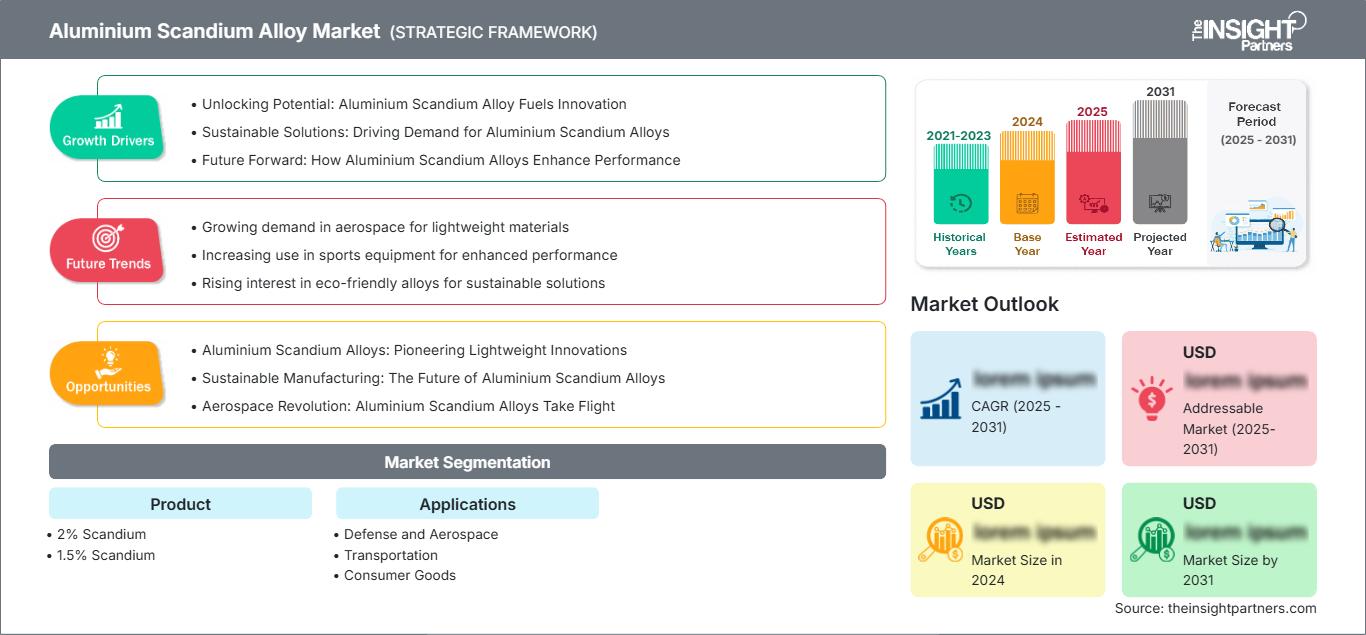
Aluminium Scandium Alloy Market: Strategic Insights
Regional Insights
North America Aluminium Scandium Alloy Market
North America held 31-35% of the aluminium scandium alloy market share in 2025 and is projected to exhibit a CAGR of 8.3-9.0% from 2026 to 2034. Continued investment in aerospace manufacturing, defense upgrades, space exploration, and additive manufacturing are driving demand in the region. Government initiatives for securing domestic critical mineral supply chain and minimizing dependence on foreign strategic materials aid the commercialization of alloys with scandium. Rising use of lightweight structural parts in commercial and military airplanes is also propelling demand.
The US continues to be the key contributor in the region, while Canada drives the growth by investing in critical minerals exploration and scandium resources. Increased investments in metal powder production and technological advancements are enhancing the competitive advantage of the region. The aerospace manufacturers are using more and more aluminium scandium alloys in the manufacture of structural assemblies, engines, and additive manufacturing.
U.S. Aluminium Scandium Alloy Market
The US accounted for about 76-80% of the North American market in 2025 and is estimated to grow at a CAGR of 8.4-9.1% during the forecast period. Major players in aerospace engineering, defense, research facilities, and additive manufacturing are continuously leading the market towards adoption. The federal support to manufacture critical metals and materials domestically is further adding to the investment confidence among all players along the value chain.
Lightweight alloys which contribute to fuel economy and increase structural performance by lowering maintenance cost are increasingly being preferred in aerospace projects of the US. Additive manufacturing firms are continuously using scandium-aluminum powder in their aerospace and defense end-use applications because of its high fatigue resistance and weldability. Good participation of companies like American Elements, Stanford Advanced Materials, and others in advanced manufacturing is a positive sign.
Europe Aluminium Scandium Alloy Market
Europe held 24–28% of the global market in 2025 and is anticipated to grow at a CAGR of 8.0–8.7% during 2026–2034. Germany remains the regional leader owing to its advanced aerospace engineering capabilities and strong industrial manufacturing base. The country continues investing in lightweight metallic materials that improve production efficiency, sustainability, and transportation performance while supporting advanced manufacturing initiatives.
There is more innovation in the aerospace industry in the UK in terms of production of airplanes, military ventures and advanced materials research. The total demand in France, Italy, and Spain is rising owing to the growth in commercial aerospace, auto industry, machinery and additive manufacturing. Policies for sustainable development within Europe that favor light-weight vehicles and low carbon emissions create a favorable environment for aluminum scandium alloy technology.
APAC Aluminium Scandium Alloy Market
The Asia Pacific region had a market share of 30-34% in 2025 and is projected to have the highest regional CAGR of 9.1-9.8% in 2026-2034. The region has the highest production capabilities due to increased aerospace manufacturing, metallurgy industries, and critical mineral processing in China. Countries like Japan and South Korea will focus on advanced lightweight materials used in transportation and precise engineering.
Through aerospace manufacturing, defense-related developments, and scandium deposits, India and Australia are making the future prospects of the region better. Scandium mining facilities in Australia are expected to increase the future availability of raw materials alongside government initiatives in advanced manufacturing and critical minerals.
Middle East & Africa Aluminium Scandium Alloy Market
The Middle East & Africa market is projected to expand at a CAGR of 7.5–8.2% during the forecast period. Saudi Arabia and the United Arab Emirates continue investing in aerospace manufacturing, industrial diversification, and advanced metals production as part of long-term economic development strategies. Infrastructure expansion and industrial modernization further stimulate demand for high-performance engineering materials.
The importance of South Africa continues to lie in its mining know-how and emphasis on strategic minerals, whereas Rest of MEA continues to increase its capability in industrial manufacturing. Government programs to develop mineral processing and industrial manufacturing are likely to help the region in future years.
Segmentation Analysis
Product
The Product segment is expected to register a CAGR of 8.8–9.4% during 2026–2034. The aluminium scandium alloy market scope continues expanding as manufacturers increasingly adopt optimized scandium concentrations that balance mechanical performance, weldability, and production economics. Product innovation remains focused on improving alloy consistency for aerospace structures, additive manufacturing powders, and transportation applications requiring superior fatigue resistance and lightweight performance.
- 2% Scandium: Represents the leading product category because it delivers exceptional grain refinement, improved weldability, and high mechanical strength, making it highly suitable for aerospace structures, defense systems, and advanced additive manufacturing components.
- 1.5% Scandium: Offers a balanced combination of performance and cost efficiency, supporting adoption across transportation, industrial manufacturing, and specialized engineering applications requiring moderate scandium loading with reliable structural characteristics.
Applications
The Applications segment is projected to record a CAGR of 8.9–9.5% during the forecast period. Expanding utilization across aerospace, transportation, and premium engineering industries continues driving market demand. Lightweight construction, improved corrosion resistance, enhanced fatigue performance, and compatibility with advanced manufacturing technologies remain key factors supporting wider commercial adoption.
- Defense and Aerospace: Maintains the dominant position because aircraft manufacturers increasingly utilize lightweight, high-strength aluminium scandium alloys for structural components, reducing aircraft weight while improving fuel efficiency, fatigue resistance, and operational performance.
- Transportation: Adoption continues increasing across rail, automotive, marine, and electric mobility applications where lightweight materials improve energy efficiency, structural durability, and lifecycle performance while supporting sustainability objectives.
- Consumer Goods: Premium sporting equipment, bicycles, electronics, and specialty products increasingly incorporate aluminium scandium alloys to achieve superior mechanical performance, lightweight construction, corrosion resistance, and extended product durability.
Opportunity Snapshot
| Application | Revenue Contribution | Trend Tag | Adoption Stage |
|---|---|---|---|
| Defense and Aerospace | High | Aircraft Lightweighting | Mature |
| Transportation | Medium | EV Structures | Scaling |
| Consumer Goods | Low | Premium Materials | Emerging |
Aluminium Scandium Alloy Market Growth Drivers and Impact Analysis
Growing aerospace demand for lightweight high-strength materials
Commercial aviation, defense modernization, and space exploration programs continue driving demand for aluminium scandium alloys because of their exceptional strength-to-weight ratio, weldability, and fatigue resistance. Aircraft manufacturers increasingly replace conventional aluminum grades with scandium-enhanced alloys to reduce structural weight while maintaining mechanical integrity. The expansion of satellite launches, reusable launch vehicles, and next-generation aircraft platforms further accelerates material adoption. Governments across the United States, Europe, China, and Japan continue increasing investments in aerospace manufacturing and advanced materials research, strengthening long-term procurement opportunities. As aircraft manufacturers pursue greater fuel efficiency and lower emissions, aluminium scandium alloys are expected to become increasingly important in structural airframes, fuselage components, and aerospace additive manufacturing applications.
Expansion of additive manufacturing across industrial sectors
The rapid commercialization of metal additive manufacturing is significantly increasing demand for premium aluminium scandium alloys. Scandium additions improve printability, minimize hot cracking, enhance weldability, and produce finer grain structures, making these alloys particularly suitable for complex aerospace, defense, medical, and industrial components. Manufacturers increasingly utilize powder-bed fusion and directed energy deposition technologies for lightweight components with reduced material waste. Continuous improvements in industrial-scale 3D printing equipment and metal powder production further support market expansion. As manufacturers seek customized, high-performance components with shorter production cycles, aluminium scandium alloys are expected to experience sustained demand across advanced manufacturing ecosystems worldwide.
Government support for critical mineral supply chain development
National strategies aimed at strengthening domestic critical mineral supply chains are encouraging investments in scandium extraction, refining, and downstream alloy production. Countries including Australia, the United States, Canada, and members of the European Union have introduced initiatives supporting critical minerals required for aerospace, clean energy, and advanced manufacturing industries. Increased exploration activities, public-private partnerships, and funding for mineral processing technologies are gradually improving scandium availability. These developments reduce long-term supply uncertainty while encouraging alloy manufacturers to expand production capacity. Enhanced supply chain resilience is expected to accelerate commercialization of aluminium scandium alloys across multiple high-value industrial sectors over the forecast period.
Aluminium Scandium Alloy Market Future Trends
Increasing commercialization of scandium-containing additive manufacturing powders
The aluminium scandium alloy market trends increasingly reflect commercialization of specialized metal powders designed for industrial additive manufacturing. Aerospace, defense, and industrial manufacturers continue investing in scandium-enhanced aluminum powders capable of delivering superior print quality, dimensional stability, and mechanical performance. Improvements in powder atomization technologies, quality control systems, and industrial-scale production capacities are expected to reduce manufacturing costs while expanding commercial availability. As additive manufacturing becomes integral to advanced production strategies, scandium-containing powders are likely to gain wider adoption across high-performance engineering applications requiring lightweight yet durable metallic components.
Integration into next-generation electric mobility platforms
Electric mobility manufacturers are increasingly evaluating aluminium scandium alloys for lightweight vehicle structures, battery enclosures, rail transportation, and high-performance mobility systems. Weight reduction remains essential for extending driving range, improving energy efficiency, and enhancing overall vehicle performance. Advanced alloy development continues focusing on improved weldability, corrosion resistance, and crash performance while supporting high-volume manufacturing. As electric transportation expands globally and lightweight engineering becomes increasingly important, aluminium scandium alloys are expected to gain broader acceptance beyond aerospace into premium automotive and advanced mobility applications.
Aluminium Scandium Alloy Market Opportunities
Expansion of scandium mining and refining capacity
Growing investments in scandium exploration and refining present significant commercial opportunities for mining companies, refiners, alloy manufacturers, and downstream component suppliers. The aluminium scandium alloy market forecast indicate that improving raw material availability will remain essential for supporting broader industrial adoption. New scandium recovery technologies utilizing laterite ores, bauxite residue, and other secondary resources can substantially improve supply security while reducing dependence on limited production sources. Companies investing in vertically integrated supply chains, advanced extraction technologies, and long-term customer agreements are expected to strengthen competitive positioning while supporting stable commercialization across aerospace, transportation, and industrial manufacturing applications.
Development of strategic partnerships across aerospace supply chains
Increasing collaboration between alloy producers, aircraft manufacturers, additive manufacturing companies, research institutions, and defense organizations creates substantial long-term growth opportunities. Joint development programs focused on advanced alloy formulations, qualification testing, and industrial certification accelerate commercialization while reducing technology adoption risks. Strategic partnerships also improve supply chain integration and facilitate commercialization of new high-performance materials for demanding engineering applications. Companies capable of delivering certified aerospace-grade aluminium scandium alloys with consistent quality, scalable production, and reliable raw material sourcing are expected to benefit from expanding procurement programs throughout the forecast period.
Recent Developments
- July 29, 2026: Scandium Canada Ltd. signed a memorandum of understanding (MOU) with the University of Windsor's CHARGE Lab to evaluate aluminum-scandium alloy wires for electric vehicle traction motor windings. The collaboration will assess electrical, thermal, and mechanical performance against conventional copper conductors while supporting commercialization of lightweight, high-strength alloy solutions for next-generation electric mobility applications.
- February 27, 2025: United Company RUSAL announced the construction of a pilot scandium oxide production facility with an annual capacity of 1.55 tonnes at its Bogoslovsky Aluminium Smelter. The project uses red mud from alumina production as feedstock and is intended to strengthen the supply of scandium for aluminium-scandium alloys used in aerospace, rail transportation, shipbuilding, and additive manufacturing.
Frequently Asked Questions

- Comprehensive Market Sizing and Forecast Analysis
- Detailed Segmentation Analysis
- In-Depth Market Dynamics Assessment
- Regional and Country-Level Insights
- Competitive Landscape and Company Benchmarking
- Strategic Business Intelligence
Recent Reports
Testimonials

The Insight Partners' SCADA System Market report is comprehensive, with valuable insights on current trends and future forecasts. The team was highly professional, responsive, and supportive throughout. We are very satisfied and highly recommend their services.
RAN KEDEM Partner, Reali Technologies LTDs
I requested a report on a very specific software market and the team produced the report in a few days. The information was very relevant and well presented. I then requested some changes and additions to the report. The team was again very responsive and I got the final report in less than a week.
JEAN-HERVE JENN Chairman, Future Analytica
We worked with The Insight Partners for an important market study and forecast. They gave us clear insights into opportunities and risks, which helped shape our plans. Their research was easy to use and based on solid data. It helped us make smart, confident decisions. We highly recommend them.
PIYUSH NAGPAL Sr. Vice President, High Beam Global
The Insight Partners delivered insightful, well-structured market research with strong domain expertise. Their team was professional and responsive throughout. The user-friendly website made accessing industry reports seamless. We highly recommend them for reliable, high-quality research services
YUKIHIKO ADACHI CEO, Deep Blue, LLC.
This is the first time I have purchased a market report from The Insight Partners.While I was unsure at first, I visited their web site and felt more comfortable to take the risk and purchase a market report.I am completely satisfied with the quality of the report and customer service. I had several questions and comments with the initial report, but after a couple of dialogs over email with their analyst I believe I have a report that I can use as input to our strategic planning process.Thank you so much for taking the extra time and making this a positive experience.I will definitely recommend your service to others and you will be my first call when we need further market data.
JOHN SUZUKI President and Chief Executive Officer, Board Director, BK Technologies
I wish to appreciate your support and the professionalism you displayed in the course of attending to my request for information regarding to infectious disease IVD market in Nigeria. I appreciate your patience, your guidance, and the fact that you were willing to offer a discount, which eventually made it possible for us to close a deal. I look forward to engaging The Insight Partners in the future, all thanks to the impression you have created in me as a result of this first encounter.
DR CHIJIOKE ONYIA MANAGING DIRECTOR, PineCrest Healthcare Ltd.Reason to Buy
- Informed Decision-Making
- Understanding Market Dynamics
- Competitive Analysis
- Identifying Emerging Markets
- Customer Insights
- Market Forecasts
- Risk Mitigation
- Boosting Operational Efficiency
- Strategic Planning
- Investment Justification
- Tracking Industry Innovations
- Aligning with Regulatory Trends





 Get Free Sample for