
Alzheimers Diagnosis and Drugs Market Growth, Trends & Forecast by 2034
Alzheimers Diagnosis and Drugs Market Size and Forecasts (2021–2034), Global and Regional Share, Trends, and Growth Opportunity Analysis Report Coverage : by Therapeutics (Cholinesterase Inhibitors, NMDA Receptor Antagonists, Other Therapeutics); Diagnostics (Brain Imaging, CFS Test for Alzheimer's Disease, Other Diagnostics); and Geography (North America, Europe, Asia Pacific, and South and Central America)
- Status : Data Released
- Report Code : TIPRE00040714
- Category : Life Sciences
- No. of Pages : 150
- Available Report Formats :


- Last update date : July 09, 2026


2025 Market Size
US$ 12.71 Bn
Base year value
2034 Forecast
US$ 25.77 Bn
Projected by 2034
CAGR 2026-2034
8.17 %
Growth rate
Addressable Market
US$ 172.91 Bn
(2026-2034)
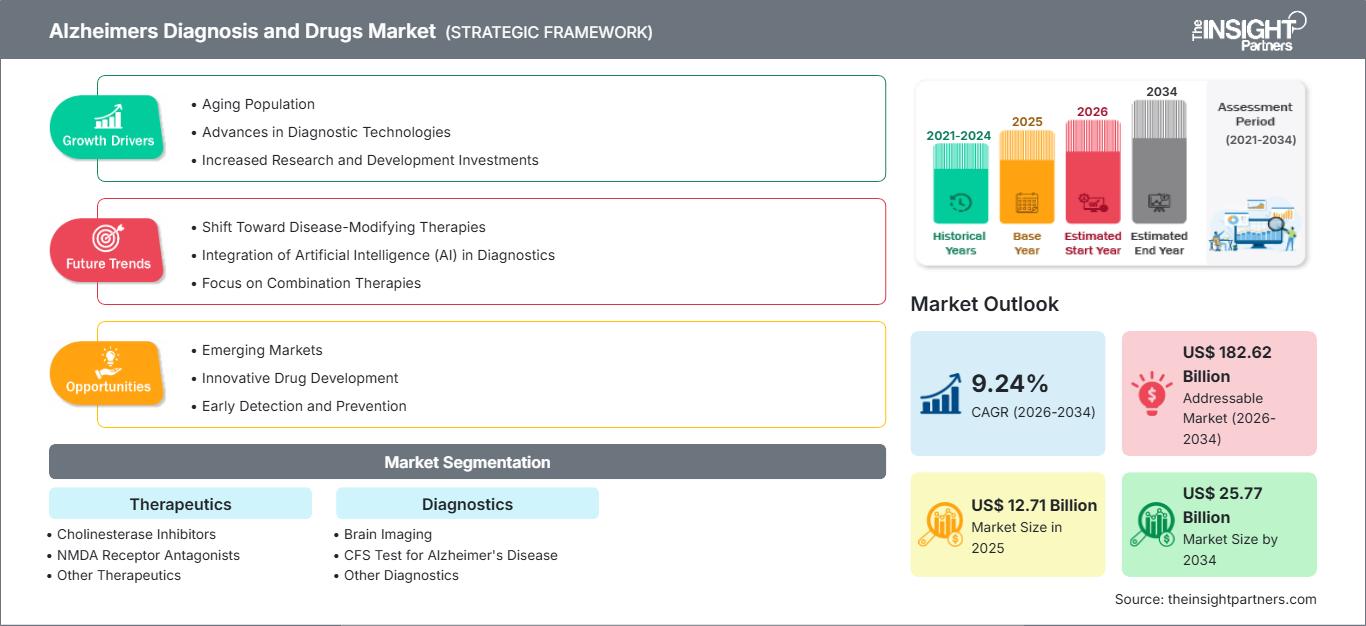
The Alzheimers Diagnosis and Drugs market was valued at US$ 12.71 billion in 2025 and is expected to reach US$ 25.77 billion by 2034; it is estimated to record a CAGR of 8.17% during 2026-2034.
Alzheimers Diagnosis and Drugs Market Assessment and Insights
- North America: North America holds approximately 38–42% of the Alzheimer's Diagnosis and Drugs Market share in 2025 and is projected to grow at a CAGR of 8.7–9.6% from 2026–2034. Strong neurodiagnostic infrastructure, early adoption of disease-modifying therapies, and high awareness levels support sustained regional dominance in the market.
- US: The US accounts for nearly 72–76% of North America’s 2025 share, expanding at a CAGR of 8.5–9.5% through 2034. High clinical trial density and rapid uptake of innovative therapeutics drive market maturity.
- Europe: Europe holds around 27–31% share in 2025, growing at 8.2–9.0% CAGR. Germany, UK, and France lead due to strong public healthcare systems, increasing dementia screening programs, and growing reimbursement coverage for neurodegenerative therapies.
- Asia Pacific: Asia Pacific contributes 22–26% share in 2025, expanding at 9.5–10.5% CAGR. China, Japan, and India are key markets driven by aging populations, improving diagnostic access, and expanding neurological care infrastructure.
- Largest Segment (Therapeutics): Therapeutics dominates with 58–62% share in 2025, growing at 8.8–9.4% CAGR. Increasing adoption of cholinesterase inhibitors and NMDA receptor antagonists supports treatment continuity across moderate Alzheimer’s cases.
- High Growth Segment (Diagnostics): Diagnostics holds 38–42% share in 2025 and grows at 9.8–10.6% CAGR. Brain imaging and CSF biomarker testing are accelerating early-stage detection and improving treatment initiation timelines.
- Key companies analyzed in detail: Eli Lilly and Company, Biogen Inc., F. Hoffmann-La Roche Ltd, Merck & Co., Inc., Novartis AG, Johnson & Johnson, Pfizer Inc., Eisai Co., Ltd., AstraZeneca plc, GlaxoSmithKline plc
Source: The Insight Partners' analysis based on proprietary research, government publications, company annual reports, investor presentations, industry databases, and expert interviews.
Continued innovation across diagnostics and therapeutics has transformed the competitive dynamics of the Alzheimers Diagnosis and Drugs market. Improvements in molecular imaging, cerebrospinal fluid biomarker analysis, and blood-based diagnostic assays have enhanced early disease identification, while disease-modifying therapies have shifted clinical focus toward slowing disease progression rather than solely managing symptoms. Pharmaceutical collaborations, biotechnology investments, and digital health integration continue strengthening the overall treatment ecosystem while supporting more personalized patient care.
Over the coming decade, emerging healthcare economies are expected to create significant commercial opportunities through expanded neurology infrastructure, rising healthcare expenditure, and broader access to innovative medicines. Regulatory agencies are increasingly encouraging accelerated development of breakthrough neurological therapies, while public and private investments continue supporting clinical trials, precision diagnostics, and artificial intelligence-assisted disease detection, positioning the industry for sustained long-term expansion.
Alzheimers Diagnosis and Drugs Market Report Scope
| Report Attribute | Details |
|---|---|
| Market size in 2025 | US$ 12.71 Billion |
| Market Size by 2034 | US$ 25.77 Billion |
| Global CAGR (2026 - 2034) | 8.17% |
| Historical Data | 2021-2024 |
| Forecast period | 2026-2034 |
Alzheimers Diagnosis and Drugs Market Analysis
The Alzheimer’s diagnosis and drugs market reports illustrate that the market is evolving rapidly due to rising global dementia burden and increasing reliance on early-stage diagnostic pathways. Demand is greatly impacted by demographic changes, where WHO suggests the steady increase of cases of neurodegenerative diseases in populations aged 65+. Demand value chain includes imaging technologies, biomarkers, and cognitive screening techniques, whereas supply value chain is dependent on CNS drug pipelines and hospital distribution networks. Wider reimbursement coverage in developed countries is positively impacting treatment uptake.
On the other hand, supply side is extremely research and development-driven, with large investments being made by pharmaceutical companies in biologics and disease modifying agents. Market entrance of Alzheimer’s breakthrough drugs is being facilitated by regulatory approvals. Competitive pressure is rising with companies diversifying their offerings in diagnostics and therapeutic areas. Collaborations of biotech firms and diagnostic imaging providers become an effective way to integrate the ecosystem further. Also, increased investment goes into AI-based diagnostic tools and precision neurology.
● REPORT CUSTOMIZATION
Tailor This Report To Align With Your Specific Business Requirements
This report can be customized to align precisely with your business objectives, scope, and target markets. Customization options include tailored segmentation, geography, competitive analysis, and strategic insights to support informed decision-making.
Customize This Report →WHAT YOU CAN ADJUST
- ● Segmentations
- ● Geography
- ● Competitive Analysis
- ● Language Preferences
Alzheimers Diagnosis and Drugs Market: Strategic Insights
Regional Insights
North America Alzheimer’s Diagnosis and Drugs Market
North America holds the leading market position with a market share of 38-42% in 2025, owing to its superior neuroscience infrastructure and high diagnosis rates. North America will record steady growth with a CAGR of 8.7-9.6% till 2034. The presence of robust reimbursement policies, early adoption of innovative therapies, and availability of extensive clinical trial facilities ensure continued growth. Rise in the incidence rate of Alzheimer’s disease among aged people adds impetus to the demand.
United States and Canada are at the forefront of regional adoption with the high usage of positron emission tomography (PET) imaging and biomarkers for diagnosis. Innovations in pharmaceuticals occur on account of large research and development facilities and academic centers. Incorporation of diagnostic platforms based on artificial intelligence and timely approvals of treatments from health agencies improve the accessibility of the treatments.
U.S. Alzheimer’s Diagnosis and Drugs Market
The United States represents 72–76% of North America’s market in terms of diagnosis and drug market share in 2025, growing at a CAGR of 8.5–9.5%. The market dominance is driven by healthy levels of healthcare expenditure, increased awareness about neurodegenerative diseases, and increased diagnosis penetration rate. FDA approval for new disease-modifying drugs boosts the market growth rate.
High levels of pharmaceutical investments and research activity ensure constant innovation in the therapeutic and diagnostic market. There are companies like Eli Lilly and Company and Biogen Inc., who are constantly developing their drug pipelines for Alzheimer’s disease. Increased insurance coverage and Medicare for cognitive testings makes the product available to more patients.
Europe Alzheimer’s Diagnosis and Drugs Market
Europe accounts for 27-31% market share in 2025 with CAGR of 8.2-9.0%. Factors that include robust public health system, geriatric population, and dementia screening programs favor regional penetration. Some of the major countries include UK, Germany, and France because of their advanced neurology care systems and increase in government led Alzheimer’s disease programs.
The UK stresses on early detection programs and dementia care pathway in NHS hospitals. Germany concentrates on growth of neurodiagnostic tests in hospitals and collaborations with pharmaceutical companies for innovations. The countries like France, Italy, and Spain have improved patient accessibility through public health insurance and specialist neurologists.
APAC Alzheimer’s Diagnosis and Drugs Market
Asia Pacific occupies 22-26% of the market share in 2025 and is expected to grow at a CAGR of 9.5%-10.5%, making it the fastest-growing regional market. Major contributors include China, Japan, South Korea, India, and Australia. Increased aging population, investment in the healthcare sector, and development of diagnostic infrastructure drive market growth.
Japan has been dominant in the adoption of neurodiagnostics, whereas China is developing neurology facilities in hospitals. India is making the drugs more affordable via generic CNS drugs and public health schemes. South Korea and Australia concentrate on imaging systems and digital healthcare. The government initiatives for increasing awareness about dementia and insurance coverage boost the market growth.
Middle East & Africa Alzheimer’s Diagnosis and Drugs Market
MEA represents a smaller but rising market share, experiencing growth with a CAGR of 7.8-8.6%. The market is dominated by Saudi Arabia and UAE due to the existence of sophisticated hospital facilities along with investment in neurology treatment. South Africa is enhancing its diagnostics capabilities, whereas the other MEA nations are steadily building up their healthcare infrastructure.
Saudi Arabia prioritizes modernization in its health care through its national transformation program. UAE is implementing artificial intelligence in diagnosis, as well as building specialized hospitals. South Africa is improving accessibility through public-private partnerships in neurological services. Shortage of specialists is still a problem but increasing investment in healthcare will enable construction of facilities for Alzheimer’s disease in MEA.
Segmentation Analysis
Therapeutics
The therapeutics segment is projected to grow at a CAGR of 8.8–9.4% during 2026–2034, owing to the rising dependence on medications to treat the symptoms and prevent the progression of the disease. The cholinesterase inhibitors and NMDA antagonists continue to be considered traditional methods of treatment; however, the drugs under the pipeline target the disease modification aspect.
- Cholinesterase Inhibitors: Widely used in early to moderate Alzheimer’s cases, these drugs improve cognitive function by increasing acetylcholine levels. Their established safety profile ensures continued demand across global healthcare systems.• NMDA Receptor Antagonists: These therapies help regulate glutamate activity, reducing neurotoxicity and supporting cognitive stabilization in moderate to severe stages of Alzheimer’s disease.
- Other Therapeutics: Includes emerging biologics and disease-modifying candidates targeting amyloid and tau proteins, representing the future of Alzheimer’s pharmacological innovation.
Diagnostics
The diagnostics segment is expected to grow at a CAGR of 9.8–10.6% during 2026–2034, driven by increasing emphasis on early detection and preventive care. Advancements in brain imaging technologies and biomarker-based CSF testing are improving diagnostic accuracy and enabling earlier therapeutic intervention. Expanding neurological screening programs further support adoption.
- Brain Imaging: PET and MRI-based imaging techniques enable visualization of brain structure and amyloid deposition, supporting early and accurate Alzheimer’s diagnosis in clinical settings.
- CSF Test for Alzheimer’s Disease: Cerebrospinal fluid analysis helps identify biomarkers associated with neurodegeneration, offering high diagnostic precision for early-stage detection.
- Other Diagnostics: Includes blood-based biomarkers and digital cognitive assessment tools that are gaining traction due to scalability and non-invasive testing advantages.
Opportunity Snapshot
| Segment Name | Revenue Contribution | Trend Tag | Adoption Stage |
| Therapeutics | High | Disease Modifying | Mature |
| Diagnostics | High | Early Detection | Scaling |
Alzheimers Diagnosis and Drugs Market Growth Drivers and Impact Analysis
Rising Global Alzheimer’s Prevalence
Growth in the number of Alzheimer’s patients across the world is the major factor that fuels the market. There has been an increase in aged people in developed nations, which leads to the growth in the patient base. Dementia rates have increased according to the WHO report because of increased longevity and certain risks associated with lifestyle. The growing prevalence rate is driving the need for effective diagnostics and treatments. Medical facilities face the requirement to improve their capabilities in detecting diseases at an early stage and treating them. With the growing prevalence rates, there has been an increase in R&D activities by pharmaceutical companies.
Advancements in Biomarker-Based Diagnostics
Technological development in the field of diagnostics based on biomarkers has become an important factor influencing the market. In this case, CSF and blood-based biomarkers have become effective tools for the accurate identification of patients at the early stages of disease and for their treatment at early stages of cognitive impairment. Currently, the application of imaging technologies such as PET scanning is becoming an integral part of molecular diagnostics. Diagnostic uncertainty has been eliminated and new personalized therapeutic strategies are being developed. The pharmaceutical and diagnostic companies are actively working to create integrated systems of diagnostics. Thus, the market scope of diagnosis and drugs for Alzheimer’s becomes wider.
Increasing Pharmaceutical Investment in CNS Drug Development
Increased investment in the research and development of CNS drugs is bringing innovations into the market. Firms are developing drugs that act as disease-modifiers and target amyloid plaques and tau protein build-up. Clinical trials by companies such as Eli Lilly and Company and Biogen Inc. are also changing the treatment approach to Alzheimer's. Venture capital investment and collaborations are also rising among biotechnology firms. This increases the drug discovery process and adds variety to the pipeline. With the rising innovations, the market analysis of the Alzheimer's diagnostics and drugs shows promising results in terms of commercialization.
Alzheimers Diagnosis and Drugs Market Future Trends
Shift Toward Disease-Modifying Therapies
The Alzheimer’s diagnosis and drugs market forecast highlight a clear shift from symptomatic treatment toward disease-modifying therapies. While conventional medications mainly treat the symptoms of dementia, new therapies intend to influence the progression of the disease by using approaches that affect amyloid and tau protein. These changes have been made possible owing to scientific breakthroughs in molecular biology and positive results from clinical trials. There is an increased emphasis on developing pipeline products in this field as pharmaceutical companies find high unmet medical needs in it. Authorities are approving therapies on the basis of biomarker endpoints more often than before.
Integration of Digital Cognitive Assessment Tools
Digital cognitive assessment tools are emerging as a key Alzheimer’s diagnosis and drugs Digital cognitive assessment tools are emerging as a key Alzheimer’s diagnosis and drugs market trend. There are mobile cognitive assessments and AI screening systems available that help in constant monitoring of cognitive performance. They offer greater access especially in those areas where there is a shortage of neurological experts. The combination with electronic health record systems facilitates a longitudinal measurement of the progression of the disease. More and more healthcare organizations are using hybrid diagnostic approaches incorporating technology, imaging, and biomarkers.
Alzheimers Diagnosis and Drugs Market Opportunities
Expansion of Early Screening Programs
Expanding early screening programs presents a major opportunity in the market. Governments and healthcare systems are increasingly focusing on population-level cognitive screening to identify high-risk individuals. Early detection enables timely intervention, improving treatment effectiveness and delaying disease progression. Integration of biomarker testing and digital cognitive tools enhances screening accuracy. Pharmaceutical companies benefit from earlier patient identification, increasing drug uptake rates. Public health initiatives supported by aging population policies are further strengthening screening adoption. This creates a significant expansion pathway for diagnostic providers and therapeutic developers, enhancing long-term market growth potential.
Growth of Personalized Neurology Treatment Pathways
Personalized neurology treatment pathways offer strong opportunities in the market. Advances in genomics and biomarker profiling are enabling patient-specific therapeutic strategies. This approach improves drug efficacy and reduces adverse effects by aligning treatments with individual disease biology. Healthcare systems are increasingly adopting precision medicine frameworks in neurology departments. Pharmaceutical companies are investing in companion diagnostics to support targeted therapy development. Integration of AI-driven predictive analytics further enhances personalization. As personalized medicine adoption expands, it is expected to redefine clinical standards and significantly increase value creation across the Alzheimer’s diagnosis and drugs market ecosystem.
Recent Developments
- July 2026: The National Institute on Aging of the National Institutes of Health has awarded a five-year grant initially worth $8.37 million for Weill Cornell Medicine researchers to study a new gene therapy for Alzheimer's disease in people who have a high genetic risk of developing the condition
- May 2026: Eli Lilly and Company announced expanded Phase 3 Alzheimer’s drug trials focusing on early-stage disease intervention using biomarker-guided patient selection, strengthening its disease-modifying therapy pipeline
- October 2025: Biogen Inc. reported progress in next-generation amyloid-targeting therapies and expanded real-world evidence programs across North America and Europe to improve treatment outcomes
Frequently Asked Questions

- Comprehensive Market Sizing and Forecast Analysis
- Detailed Segmentation Analysis
- In-Depth Market Dynamics Assessment
- Regional and Country-Level Insights
- Competitive Landscape and Company Benchmarking
- Strategic Business Intelligence
Recent Reports
Testimonials

The Insight Partners' SCADA System Market report is comprehensive, with valuable insights on current trends and future forecasts. The team was highly professional, responsive, and supportive throughout. We are very satisfied and highly recommend their services.
RAN KEDEM Partner, Reali Technologies LTDs
I requested a report on a very specific software market and the team produced the report in a few days. The information was very relevant and well presented. I then requested some changes and additions to the report. The team was again very responsive and I got the final report in less than a week.
JEAN-HERVE JENN Chairman, Future Analytica
We worked with The Insight Partners for an important market study and forecast. They gave us clear insights into opportunities and risks, which helped shape our plans. Their research was easy to use and based on solid data. It helped us make smart, confident decisions. We highly recommend them.
PIYUSH NAGPAL Sr. Vice President, High Beam Global
The Insight Partners delivered insightful, well-structured market research with strong domain expertise. Their team was professional and responsive throughout. The user-friendly website made accessing industry reports seamless. We highly recommend them for reliable, high-quality research services
YUKIHIKO ADACHI CEO, Deep Blue, LLC.
This is the first time I have purchased a market report from The Insight Partners.While I was unsure at first, I visited their web site and felt more comfortable to take the risk and purchase a market report.I am completely satisfied with the quality of the report and customer service. I had several questions and comments with the initial report, but after a couple of dialogs over email with their analyst I believe I have a report that I can use as input to our strategic planning process.Thank you so much for taking the extra time and making this a positive experience.I will definitely recommend your service to others and you will be my first call when we need further market data.
JOHN SUZUKI President and Chief Executive Officer, Board Director, BK Technologies
I wish to appreciate your support and the professionalism you displayed in the course of attending to my request for information regarding to infectious disease IVD market in Nigeria. I appreciate your patience, your guidance, and the fact that you were willing to offer a discount, which eventually made it possible for us to close a deal. I look forward to engaging The Insight Partners in the future, all thanks to the impression you have created in me as a result of this first encounter.
DR CHIJIOKE ONYIA MANAGING DIRECTOR, PineCrest Healthcare Ltd.Reason to Buy
- Informed Decision-Making
- Understanding Market Dynamics
- Competitive Analysis
- Identifying Emerging Markets
- Customer Insights
- Market Forecasts
- Risk Mitigation
- Boosting Operational Efficiency
- Strategic Planning
- Investment Justification
- Tracking Industry Innovations
- Aligning with Regulatory Trends





 Get Free Sample for