
Ambulatory Surgical Centers Market Size, Growth & Trends by 2034
Coverage: By Ambulatory Surgical Centers Market covers analysis By Type (Hospital-Based Ambulatory Surgery Centers and Free-Standing Ambulatory Surgery Centers), Specialty (Single- Specialty Centers and Multispecialty Centers), Surgery (Obstetrics/Gynecology, Ophthalmology, Dental, Otolaryngology, Endoscopy, Orthopedic, and Others), and Geography (North America, Europe, Asia Pacific, Middle East & Africa, and South & Central America)
- Status : Data Released
- Report Code : TIPMD00002616
- Category : Life Sciences
- No. of Pages : 150
- Available Report Formats :


- Last update date : July 22, 2026


2025 Market Size
US$ 47.75 Bn
Base year value
2034 Forecast
US$ 79.78 Bn
Projected by 2034
CAGR 2026-2034
5.87 %
Growth rate
Addressable Market
US$ 577.80 Bn
(2026-2034)
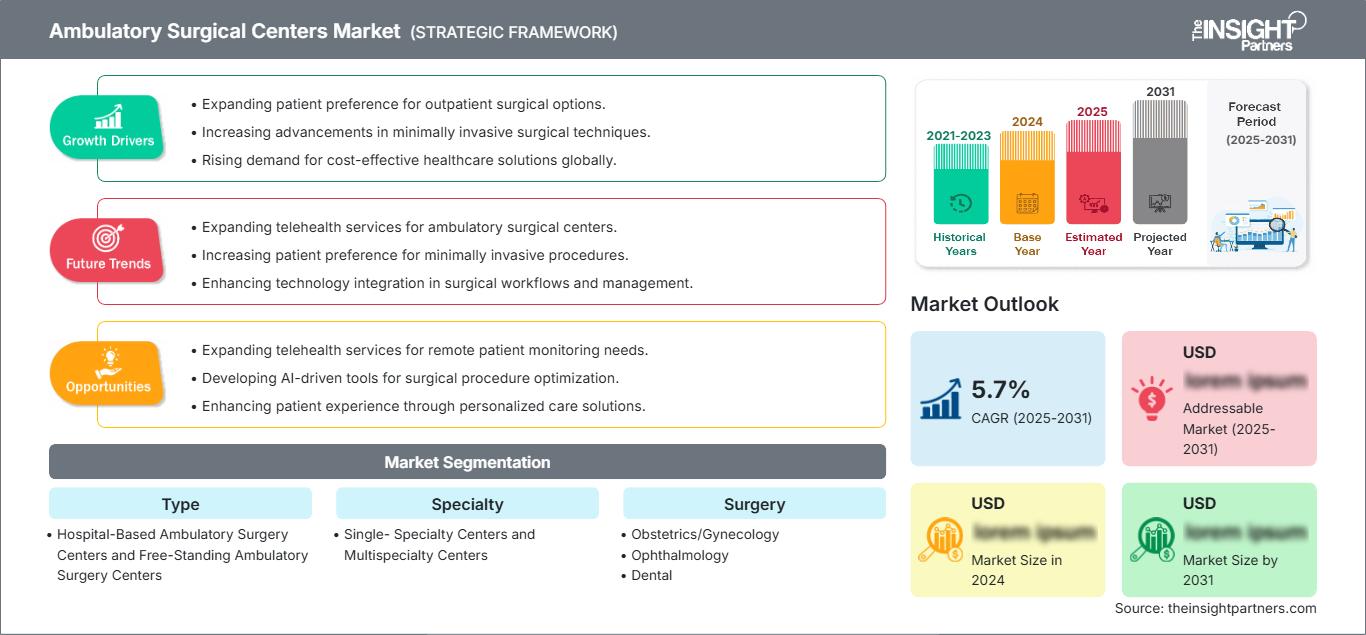
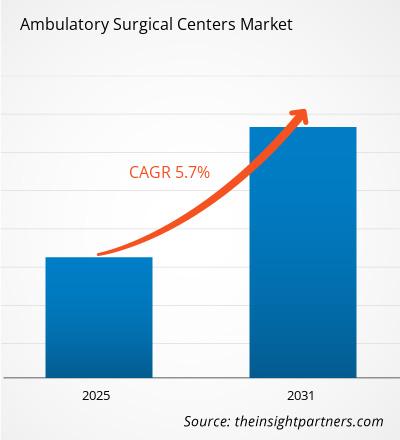
The Ambulatory Surgical Centers Market Size is projected to increase from US$ 47.75 Billion in 2025 to US$ 79.78 Billion by 2034, recording a CAGR of 5.87% during 2026–2034. It represents the structural shift in the movement of appropriate care procedures from inpatient settings to outpatient surgery centers due to controlled payment by the payers, minimally invasive technology, improved anesthesia, and increased patient preference for same-day discharge facilities.
North America will be driven by established reimbursement models, high physician ownership participation, and increasing payer approval of outpatient procedures. This region is expected to see a CAGR of 5.2% - 5.8% between 2026 and 2034. The major drivers for usage of ASCs will be orthopedic, ophthalmology, gastroenterology, and pain procedures.
Ambulatory Surgical Centers Market Assessment and Insights
- North America held a 39–42% of the Ambulatory Surgical Centers Market share in 2025 and is projected to grow at a CAGR of 5.2–5.8% during 2026–2034, driven by payer-led site-of-care shifts and advanced multispecialty networks.
- US accounted for 82–86% of North America in 2025 and is expected to expand at a CAGR of 5.0–5.6% during 2026–2034 as procedure approvals widen.
- Europe represented a 24–27% share in 2025 and is forecast to grow at a CAGR of 4.8–5.4% during 2026–2034, led by the UK, Germany, France, Italy, and Spain.
- Asia Pacific captured a 21–24% share in 2025 and is projected to grow at a CAGR of 6.8–7.6% during 2026–2034, led by China, Japan, India, South Korea, and Australia.
- Largest Segment: Free-Standing Ambulatory Surgery Centers held a 63–67% market share in 2025 and are projected to grow at a CAGR of 5.6–6.2% during 2026–2034.
- High Growth Segment: Multispecialty Centers accounted for a 36–40% market share in 2025 and are expected to expand at a CAGR of 6.9–7.7% during 2026–2034.
- Key companies analyzed in detail: EBOS Group Limited, IntegraMed America, Inc., Nueterra Capital, Aspen Healthcare Limited, Medical Facilities Corporation, Tenet Healthcare Corporation, AMSURG, United Surgical Partners International, HealthCare Appraisers, Surgery Partners, Inc.
Source: The Insight Partners' analysis based on proprietary research, government publications, company annual reports, investor presentations, industry databases, and expert interviews.
Delivery services have evolved beyond basic outpatient surgeries and are now more inclined towards advanced surgical episodes owing to improved imaging capabilities, robotic support, anesthetic management and recovery process enhancements. Surgeons have been working on improving production dynamics through designs emphasizing throughput, sterilization capabilities, specialty-oriented staffing, and digital scheduling solutions. Hence, the global market is less likely to remain fragmented in developed countries due to network expansion by players bearing compliance costs and implementing efficient quality control systems.
In the forecast period, developing regions will see benefits of private hospitals spillover effect, increased middle-class insurance penetration and government efforts in reducing surgery wait times. Tailwinds in terms of regulations are present in regions where reimbursement organizations acknowledge outpatient surgery as a cost-cutting tool. Capital will be allocated for freestanding facilities, orthopedics platforms, endoscopy facilities and specialties collaborations which will allow increased reach without the need for inpatient infrastructure.
Ambulatory Surgical Centers Market Report Scope
| Report Attribute | Details |
|---|---|
| Market size in 2025 | US$ 47.75 Billion |
| Market Size by 2034 | US$ 79.78 Billion |
| Global CAGR (2026 - 2034) | 5.87% |
| Historical Data | 2021-2024 |
| Forecast period | 2026-2034 |
Ambulatory Surgical Centers Market Analysis
Increasing demand for efficient surgical treatments is the major driver for Ambulatory Surgical Centers Market. Health care delivery organizations need to ensure there is availability of space for complicated patients in their institutions, as payers encourage treatment of cataracts, endoscopies, dentistry, ear-nose-throat, and orthopedic surgeries in more economical facilities. Value chain comprises physicians, anesthesia group, device providers, payers, software providers, sterilization companies, and hospitals.
Supply factors include center licensing, physician recruiting, procedural mix, payer contracts, and local certificate of needs. Those centers which have reliable volume of operations are capable of negotiating more favorable prices on implants, lenses, instruments, and medications. That brings operating leverage into effect, but at the same time increases the significance of infection prevention, patient screening, and patient transfer after discharge.
The competitive environment continues to consolidate, with Ambulatory Surgical Centers Market report revealing an increasing disparity between scaled platforms and standalone institutions. Tenet Healthcare Corporation, United Surgical Partners International, AMSURG, and Surgery Partners, Inc. continue to expand their specialist network through acquisitions, partnerships, and de novo builds. Nueterra Capital and HealthCare Appraisers continue to matter by way of development, valuation, and consulting activities.
Market trends have led to investments in surgical centers capable of performing high acuity specialties without risking the discharge safety of patients. EBOS Group Limited provides for the distribution requirements of the healthcare industry, whereas Aspen Healthcare Limited and Medical Facilities Corporation show how the operators of private facilities make a difference in markets where elective capacity is limited.
● REPORT CUSTOMIZATION
Tailor This Report To Align With Your Specific Business Requirements
This report can be customized to align precisely with your business objectives, scope, and target markets. Customization options include tailored segmentation, geography, competitive analysis, and strategic insights to support informed decision-making.
Customize This Report →WHAT YOU CAN ADJUST
- ● Segmentations
- ● Geography
- ● Competitive Analysis
- ● Language Preferences
Ambulatory Surgical Centers Market: Strategic Insights
Regional Insights
North America Ambulatory Surgical Centers Market
North America accounted for a 39–42% share in 2025 and is projected to grow at a CAGR of 5.2–5.8% during 2026–2034. The region benefits from mature commercial insurance, Medicare-linked procedure migration, physician ownership models, and advanced anesthesia protocols. Ambulatory Surgical Centers Market share remains concentrated in procedure categories where same-day discharge is clinically validated.
The U.S. anchors regional expansion, while Canada’s growth is more selective due to provincial funding structures and capacity planning. Demand is strongest in orthopedics, ophthalmology, gastroenterology, and ENT. Regional operators are investing in robotics, digital patient intake, and revenue-cycle automation to improve throughput and protect margins as staffing and supply costs remain elevated.
U.S. Ambulatory Surgical Centers Market
The U.S. represented 82–86% of North America in 2025 and is expected to grow at a CAGR of 5.0–5.6% during 2026–2034. Market development is supported by payer preference for lower-cost settings, commercial bundled payments, and wider acceptance of outpatient total joints and spine-related procedures under strict patient-selection criteria.
Company presence is extensive, with United Surgical Partners International, AMSURG, Surgery Partners, Inc., Nueterra Capital, and HealthCare Appraisers influencing ownership, operations, valuation, and partnership structures. Application trends show stronger uptake in ophthalmology, endoscopy, orthopedics, dental implant procedures, and ENT. The U.S. also leads in multispecialty center development because payer contracts reward broader procedure capability.
Europe Ambulatory Surgical Centers Market
Europe held a 24–27% share in 2025 and is projected to grow at a CAGR of 4.8–5.4% during 2026–2034. The UK is the leading country, supported by waiting-list reduction programs, independent-sector partnerships, and increased day-case suitability for ophthalmology, endoscopy, orthopedics, and gynecology.
Germany is advancing more cautiously because inpatient reimbursement structures remain influential, yet demographic pressure and hospital efficiency targets are encouraging outpatient pathways. France, Italy, and Spain are expanding day-surgery capacity through private hospital groups and regional health-system planning. Across Europe, adoption depends on reimbursement redesign, surgeon incentives, digital follow-up systems, and public acceptance of non-overnight procedural care models.
APAC Ambulatory Surgical Centers Market
Asia Pacific accounted for a 21–24% share in 2025 and is forecast to grow at a CAGR of 6.8–7.6% during 2026–2034. China is the leading country by incremental opportunity, while Japan, South Korea, India, and Australia support demand through aging populations, private insurance growth, and medical technology adoption.
Industrial and policy drivers include hospital congestion, rising specialty clinics, medical tourism corridors, and public-private investment in surgical infrastructure. India and Southeast Asia offer strong white-space potential, although accreditation, surgeon availability, and payer maturity will determine the speed of scalable outpatient surgery adoption.
Middle East & Africa Ambulatory Surgical Centers Market
The Middle East & Africa region is expected to grow at a CAGR of 5.9–6.6% during 2026–2034, with Saudi Arabia emerging as the leading country. The UAE also supports adoption through private specialty clinics, medical tourism, and digitally enabled healthcare infrastructure.
South Africa remains the most structured African market, while the rest of MEA is developing gradually through private hospital networks and urban surgical capacity projects. Energy-sector investment, infrastructure modernization, and insurance expansion are improving access, but workforce availability and reimbursement clarity remain decisive adoption constraints.
Segmentation Analysis
Type
The Type segment is expected to grow at a CAGR of 5.6–6.2% during 2026–2034. The Ambulatory Surgical Centers Market forecast under this segment is shaped by ownership economics, payer contracting, facility location, and physician alignment. Freestanding models remain dominant due to lower overheads, while hospital-based centers benefit from integrated referral channels and clinical governance support.
- Hospital-Based Ambulatory Surgery Centers hold strategic relevance for health systems seeking to shift suitable procedures away from inpatient operating rooms while maintaining brand continuity, specialist access, and emergency backup.
- Free-Standing Ambulatory Surgery Centers lead adoption because they offer scheduling flexibility, focused staffing, efficient room turnover, and lower facility costs for procedures suited to same-day discharge.
Specialty
The Specialty segment is projected to grow at a CAGR of 6.1–6.8% during 2026–2034. Specialty structure determines equipment needs, surgeon recruitment, payer credentialing, and case-mix profitability. Single-specialty sites support procedural consistency, while multispecialty facilities are gaining strategic value by spreading fixed costs across service lines and attracting broader physician partnerships.
- Single- Specialty Centers remain important in ophthalmology, gastroenterology, dental, and ENT because repeatable workflows, standardized instruments, and focused clinical teams support high procedural efficiency.
- Multispecialty Centers are expanding fastest as operators combine orthopedics, endoscopy, pain, ophthalmology, and ENT to improve asset utilization, payer relevance, and referral network durability.
Surgery
The Surgery segment is forecast to grow at a CAGR of 5.8–6.5% during 2026–2034. Procedure migration depends on patient risk profiles, anesthesia safety, device availability, payer approval, and post-operative monitoring. Ophthalmology and endoscopy provide resilient volume, while orthopedics and selected gynecology procedures are increasingly central to revenue growth.
- Obstetrics/Gynecology procedures benefit from demand for minimally invasive interventions, shorter recovery periods, and patient preference for scheduled care in lower-intensity settings.
- Ophthalmology remains a core volume contributor because cataract and retinal procedures align well with standardized workflows, predictable discharge timelines, and aging-population demand.
- Dental procedures are strategically relevant where implant, oral surgery, and anesthesia-supported services require controlled environments beyond conventional dental offices.
- Otolaryngology demand is supported by pediatric and adult procedures that benefit from same-day discharge, specialized instruments, and efficient anesthesia coordination.
- Endoscopy contributes stable utilization through screening, diagnostic, and therapeutic procedures, with demand reinforced by colorectal cancer awareness and gastrointestinal disease management.
- Orthopedic surgery is gaining strategic importance as total joints, sports medicine, and selected spine procedures move toward outpatient sites with strict protocols.
Opportunity Snapshot
| Segment Name | Revenue Contribution | Trend Tag | Adoption Stage |
| Obstetrics/Gynecology | Medium | Minimally Invasive | Scaling |
| Ophthalmology | High | Cataract Volume | Mature |
| Dental | Medium | Implant Surgery | Scaling |
| Otolaryngology | Medium | ENT Access | Scaling |
| Endoscopy | High | Screening Hubs | Mature |
| Orthopedic | High | Total Joints | Scaling |
| Others | Low | Specialty Mix | Emerging |
Ambulatory Surgical Centers Market Growth Drivers and Impact Analysis
Expansion of Outpatient Reimbursement Pathways
Reimbursement is one of the main factors because it will determine the procedure coverage, physician willingness to perform the procedure, payer steering, and patient ability to pay. The effect of reimbursement is best seen in procedures for which there are established pathways of care, such as in orthopedics, ophthalmology, endoscopy, and ENT, when admissions can be avoided. The benefits for hospitals are the freeing up of OR time to handle complicated cases of inpatients. For physicians, the question is how they can show the equivalent or better results in terms of quality of care, infection prevention, transfer, and patient satisfaction with lower costs per episode.
Patient Preference for Convenient Same-Day Surgery
It becomes obvious that patients tend to select facilities that provide them with predictability regarding the process itself, less waiting periods, clear discharge instructions, and less interaction with hospital traffic. This becomes significant because apart from the surgeon’s recommendations, the patient will take into consideration how much he needs to pay, how much time he should travel, and how convenient it would be for him to recover. Such services as digital check-in, educational program before operation, and coordinated follow-up after discharge will contribute to the conversion rate. The market trend can be noticed in such operations as cataract surgery, colonoscopy, dental implants, and sports medicine since they have standard recovery protocols.
Physician Alignment and Specialty Platform Consolidation
Physician alignment will continue to be a key growth driver since surgeons impact referrals, operating room efficiency, and procedure mix quality. Through consolidation, physicians gain access to funding, payer contracting, compliance structure, and technology upgrade opportunities while retaining clinical input into the financial management of the centers. The large organizations have the ability to create standardized procurement processes, credentialing, coding, staffing, and reporting for their multiple locations. Such an approach allows for significant benefits as high acuity services, such as total joint replacement or advanced endoscopic procedures, are added. Nevertheless, consolidation needs to be carefully managed as physician independence and hospital relationships need to be managed.
Ambulatory Surgical Centers Market Future Trends
AI-Enabled Operational Navigation
One of the defining Ambulatory Surgical Centers Market trends will be deeper use of artificial intelligence to manage scheduling, staff allocation, claim denials, supply utilization, and patient follow-up. The future systems will take into consideration the scheduling of cases based on time of procedure, need for anesthesia, implants, and space available in the recovery room. The reason this will be important is that even small gains in efficiency will accumulate when done at very high volume hospitals. In addition, AI will aid in risk stratification and help hospitals determine which patients would benefit from being in the hospital.
Higher-Acuity Specialty Migration
Migration to high acuity will affect future center design as orthopedic, cardiovascular-related, spine, and complicated ENT cases become increasingly common in ambulatory environments. The second generation will call for greater recovery capacity, advanced anesthetic services, improved imaging technology, and emergency transfer arrangements. This development does not only mean more procedures but also protocols, insurance acceptance, and surgeon expertise. Those centers that can prove that they have very few complications and good patient outcomes will have more bargaining power. In the end, there will be a clear distinction between procedure centers and centers designed for complicated surgeries performed on the same day.
Ambulatory Surgical Centers Market Opportunities
Development of Multispecialty Regional Hubs
Multispecialty regional hubs offer a practical investment pathway for operators seeking resilient utilization across procedure cycles. Ambulatory Surgical Centers Market Forecasts indicate that investors can improve risk-adjusted returns by combining ophthalmology, endoscopy, orthopedics, ENT, and dental surgery within facilities designed for flexible room use. This approach supports payer negotiations because the center becomes relevant across several referral categories. It also improves equipment productivity and staffing continuity. The opportunity is strongest in suburban growth corridors, secondary cities, and regions where hospital operating rooms remain capacity constrained. Execution requires disciplined service-line sequencing, physician recruitment, and careful capital phasing.
Partnerships with Hospitals and Payers
Partnership models between centers, hospitals, and payers create opportunities to reduce total episode costs while preserving clinical accountability. Hospitals can use these partnerships to manage elective volumes without building expensive inpatient capacity, while payers can steer stable cases toward lower-cost environments. For operators, joint ventures provide referral stability, shared compliance infrastructure, and stronger local credibility. The most attractive opportunities involve bundled payments, employer-directed care, and specialty-specific networks for orthopedics, ophthalmology, and endoscopy. Success will depend on transparent quality metrics, aligned incentives, and governance models that prevent conflicts between inpatient revenue protection and outpatient efficiency..
Recent Developments
- June 2026: Ascension — completed its acquisition of AMSURG after regulatory review, adding a national ambulatory surgery platform and strengthening its outpatient care strategy. The transaction expanded Ascension’s reach across community-based surgical settings and highlighted continued health-system interest in scalable ASC assets.
- March 2026: The Aspen Group — reported 2025 results showing continued investment in digital modernization, clinical training, AI-enabled tools, and higher-acuity dental care capabilities across its consumer healthcare platform, including implant workflows relevant to ambulatory procedural care.
- October 2025: Tenet Healthcare Corporation — continued expanding United Surgical Partners International through acquisitions and de novo development, with reported interests in 530 ASCs and 26 surgical hospitals as of September 30, 2025, reinforcing its ambulatory-focused capital allocation strategy.
Frequently Asked Questions

- Comprehensive Market Sizing and Forecast Analysis
- Detailed Segmentation Analysis
- In-Depth Market Dynamics Assessment
- Regional and Country-Level Insights
- Competitive Landscape and Company Benchmarking
- Strategic Business Intelligence
Recent Reports
Testimonials

The Insight Partners' SCADA System Market report is comprehensive, with valuable insights on current trends and future forecasts. The team was highly professional, responsive, and supportive throughout. We are very satisfied and highly recommend their services.
RAN KEDEM Partner, Reali Technologies LTDs
I requested a report on a very specific software market and the team produced the report in a few days. The information was very relevant and well presented. I then requested some changes and additions to the report. The team was again very responsive and I got the final report in less than a week.
JEAN-HERVE JENN Chairman, Future Analytica
We worked with The Insight Partners for an important market study and forecast. They gave us clear insights into opportunities and risks, which helped shape our plans. Their research was easy to use and based on solid data. It helped us make smart, confident decisions. We highly recommend them.
PIYUSH NAGPAL Sr. Vice President, High Beam Global
The Insight Partners delivered insightful, well-structured market research with strong domain expertise. Their team was professional and responsive throughout. The user-friendly website made accessing industry reports seamless. We highly recommend them for reliable, high-quality research services
YUKIHIKO ADACHI CEO, Deep Blue, LLC.
This is the first time I have purchased a market report from The Insight Partners.While I was unsure at first, I visited their web site and felt more comfortable to take the risk and purchase a market report.I am completely satisfied with the quality of the report and customer service. I had several questions and comments with the initial report, but after a couple of dialogs over email with their analyst I believe I have a report that I can use as input to our strategic planning process.Thank you so much for taking the extra time and making this a positive experience.I will definitely recommend your service to others and you will be my first call when we need further market data.
JOHN SUZUKI President and Chief Executive Officer, Board Director, BK Technologies
I wish to appreciate your support and the professionalism you displayed in the course of attending to my request for information regarding to infectious disease IVD market in Nigeria. I appreciate your patience, your guidance, and the fact that you were willing to offer a discount, which eventually made it possible for us to close a deal. I look forward to engaging The Insight Partners in the future, all thanks to the impression you have created in me as a result of this first encounter.
DR CHIJIOKE ONYIA MANAGING DIRECTOR, PineCrest Healthcare Ltd.Reason to Buy
- Informed Decision-Making
- Understanding Market Dynamics
- Competitive Analysis
- Identifying Emerging Markets
- Customer Insights
- Market Forecasts
- Risk Mitigation
- Boosting Operational Efficiency
- Strategic Planning
- Investment Justification
- Tracking Industry Innovations
- Aligning with Regulatory Trends





 Get Free Sample for