
Amino Acid Analysis Market Share, Growth & Demand by 2034
Amino Acid Analysis Market Size and Forecasts (2021–2034), Global and Regional Share, Trends, and Growth Opportunity Analysis Report Coverage : by Application (Animal Feed, Food & Dietary Supplements, Pharmaceuticals); Animal Feed, Food & Dietary Supplements, Pharmaceuticals (Glutamic Acid, Lysine, Tryptophan, Methionine, Phenylalanine); and Geography (North America, Europe, Asia Pacific, and South and Central America)
- Status : Data Released
- Report Code : TIPRE00039935
- Category : Life Sciences
- No. of Pages : 150
- Available Report Formats :


- Last update date : July 22, 2026


2025 Market Size
US$ 1.87 Bn
Base year value
2034 Forecast
US$ 3.27 Bn
Projected by 2034
CAGR 2026-2034
7.24 %
Growth rate
Addressable Market
US$ 24.26 Bn
(2026-2034)
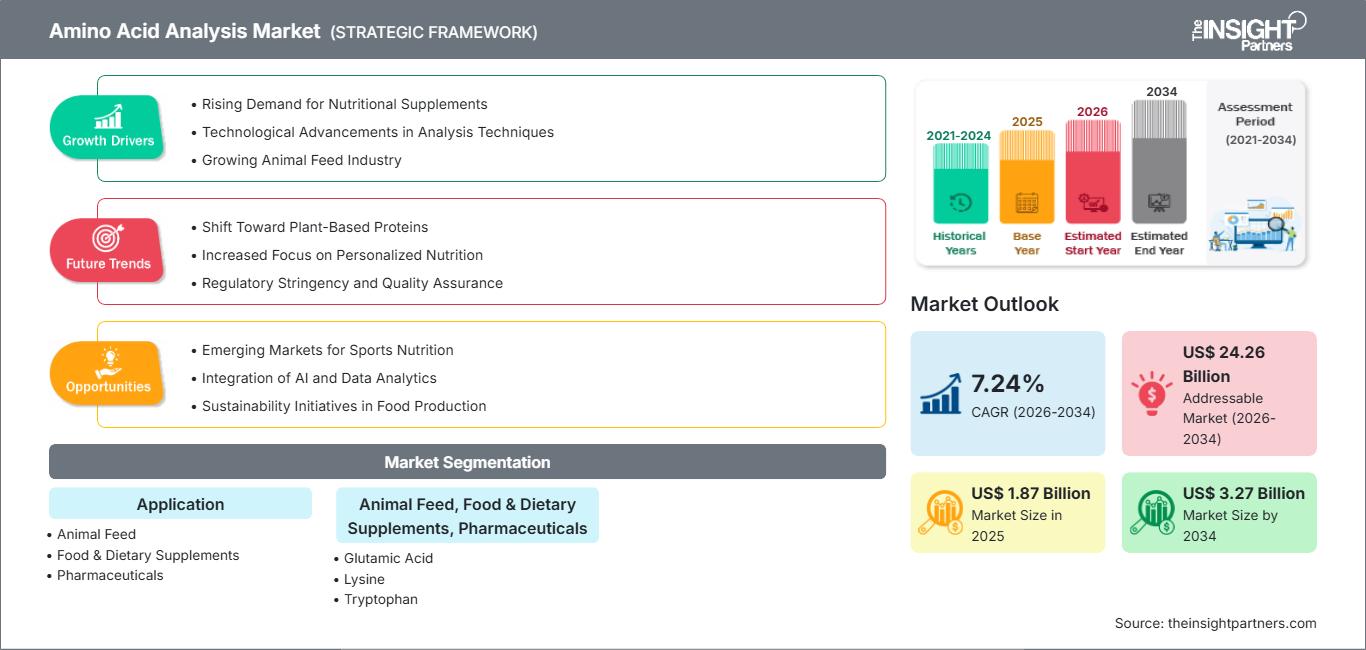
The Amino Acid Analysis Market Size is projected to grow from US$ 1.87 Billion in 2025 to US$ 3.27 Billion by 2034, registering a CAGR of 7.24% during 2026–2034. A rising need for measuring amino acids in food and pharmaceuticals makes this market more significant. It is due to the growing use of fermentation-based sources, stricter tests on the presence of impurities, and the increased focus on the protein-nutrition content of these industries.
Within North America, the Amino Acid Analysis market size is anticipated to grow at an approximate CAGR of 6.7–7.1% in 2026-2034. Market growth is attributed to precise nutrition of livestock, clinical nutrition analysis, and quality control in biologics manufacturing. The key factors that contribute to the increasing demand within the country include well-developed chromatography services, strong contract research capacities, and FDA regulations.
Amino Acid Analysis Market Assessment and Insights
- North America is estimated to account for 34–36% of the Amino Acid Analysis Market share in 2025 and grow at a CAGR between 6.7–7.1% during 2026–2034, supported by advanced analytical laboratories, feed formulation platforms, and pharmaceutical quality systems.
- US is estimated to represent 72–75% of North America in 2025 and grow at a CAGR between 6.8–7.2% during 2026–2034, led by biologics, dietary supplements, and animal nutrition testing.
- Europe is estimated to hold 25–27% share in 2025 and grow at a CAGR between 6.4–6.8% during 2026–2034, with Germany, France, the UK, Italy, and Spain leading adoption.
- Asia Pacific is estimated to capture 28–30% share in 2025 and grow at a CAGR between 8.0–8.4% during 2026–2034, driven by China, Japan, South Korea, India, and Australia.
- Largest Segment is Animal Feed, with an estimated market share range of 48–52% in 2025 and CAGR range of 6.8–7.2% during 2026–2034, reflecting amino acid-balanced feed adoption.
- High Growth Segment is Food & Dietary Supplements, with an estimated market share range of 28–31% in 2025 and CAGR range of 7.8–8.2% during 2026–2034, supported by protein fortification and sports nutrition.
- Key companies analyzed in detail: Ajinomoto Co., Inc., Evonik Industries AG, Cargill, Incorporated, Archer-Daniels-Midland Company, BASF SE, Fufeng Group Company Limited, Merck KGaA, Kyowa Hakko Bio Co., Ltd., Nutraceutical International Corporation, and Amino Acids Corporation.
Source: The Insight Partners' analysis based on proprietary research, government publications, company annual reports, investor presentations, industry databases, and expert interviews.
It has moved beyond the process of batch protein composition analysis and has become an analytical ecosystem that includes the application of chromatography, mass spectrometry, automated derivatization, and fermentation quality control. Manufacturers are using amino acid analysis as a way of maximizing yields in lysine, methionine, glutamic acid, tryptophan, and phenylalanine production while minimizing contaminants. Amino Acid Analysis helps in purchasing products since there is a need to know their purity, traceability, and bioavailability.
In the future, the increasing manufacturing centers in Asia, supplement companies in North America, and pharmaceuticals in Europe are likely to increase the need for testing. Regulatory windfalls can be seen in improved food labeling standards, efficient feed use, and biologics characterizations. Investments are shifting towards rapid sample preparation, automation, and lab information systems in order to decrease turnaround times and increase reproducibility of Amino Acid Analysis.
Amino Acid Analysis Market Report Scope
| Report Attribute | Details |
|---|---|
| Market size in 2025 | US$ 1.87 Billion |
| Market Size by 2034 | US$ 3.27 Billion |
| Global CAGR (2026 - 2034) | 7.24% |
| Historical Data | 2021-2024 |
| Forecast period | 2026-2034 |
Amino Acid Analysis Market Analysis
Growth of Amino Acid Analysis Market is influenced by protein demands, stringent quality controls, and quantitative formulation practices. Manufacturers of animal feed use amino acid information to reduce over consumption of crude protein to facilitate nitrogen management and reduce costs of feed. Food and dietary supplement makers depend on accurate amino acid information for making protein claims, sports nutrition labeling, and clinical diet formulations. Supply chain dynamics are sensitive to fermentation capabilities, prices of sugar raw materials, and energy prices, hence motivating manufacturers to enhance process yields and efficiency of analysis.
The market comprises amino acid producers, feed formulators, nutraceutical brands, pharmaceutical quality control labs, instrument makers, and third party testing firms. Demand is high where production capacity and regulatory compliance meet. The analysis process is increasingly integrated into digital batch record keeping and high performance liquid chromatography and mass spectrometry validation, thus enabling producers to reduce batch rejection chances and enhance customer and regulatory compliance.
The competition is fierce among firms which combine production experience with application expertise. Amino Acid Analysis Market Report highlights that Ajinomoto Co., Inc. and Kyowa Hakko Bio Co., Ltd. still dominate the market for amino acids derived through fermentation, while Evonik Industries AG and BASF SE feature as prominent players in the segment of feed amino acids. Cargill, Incorporated and Archer-Daniels-Midland Company apply their agricultural sourcing and nutrition strategies in order to improve commercial prospects. Merck KGaA supplies analytical reagents and laboratory materials.
The investments tend to flow into more stable regional supply chains and higher purity grades for applications where regulation is concerned. Fufeng Group Company Limited still features as an active player in large-scale fermentation operations, while Nutraceutical International Corporation and Amino Acids Corporation cater to the needs of nutritional segments. The strategic position of today relies on such factors as pricing control, product documentation, sustainability, and technical assistance of the customer.
● REPORT CUSTOMIZATION
Tailor This Report To Align With Your Specific Business Requirements
This report can be customized to align precisely with your business objectives, scope, and target markets. Customization options include tailored segmentation, geography, competitive analysis, and strategic insights to support informed decision-making.
Customize This Report →WHAT YOU CAN ADJUST
- ● Segmentations
- ● Geography
- ● Competitive Analysis
- ● Language Preferences
Amino Acid Analysis Market: Strategic Insights
Regional Insights
North America Amino Acid Analysis Market
North America is estimated to hold 34–36% share in 2025 and register a CAGR range of 6.7–7.1% during 2026–2034. The region benefits from mature analytical infrastructure, a large dietary supplement base, and strong integration between animal nutrition companies and contract laboratories. Amino Acid Analysis Market share is supported by commercial poultry, swine, dairy, and companion animal nutrition programs.
Structural demand is reinforced by pharmaceutical quality testing, biologics characterization, and protein nutrition claims. The US and Canada continue to invest in chromatography systems, automated sample preparation, and accredited laboratory capacity. Producers also use amino acid data to support nitrogen efficiency, reduce formulation waste, and validate imported ingredients. This makes the region a high-value market rather than only a volume-led testing base.
U.S. Amino Acid Analysis Market
The US is estimated to represent 72–75% of North America in 2025 and grow at a CAGR range of 6.8–7.2% during 2026–2034. The demand base consists of pharmaceutical labs, supplements companies, livestock integrators, and sports nutrition brands. The Amino Acid Analysis technique is commonly applied in checking protein content, proving labels, and balancing essential amino acid levels.
The client base is diverse and includes Cargill, Incorporated, Archer-Daniels-Midland Company, Merck KGaA, and Amino Acids Corporation that cater to feed, food, lab, and specialized nutrition processes. Trends in applications indicate higher application rates in balanced amino acid feeds, clinical nutrition, and quality control in imported raw materials. United States clients usually value validated techniques, fast results, and documents appropriate for regulatory/customer audits.
Europe Amino Acid Analysis Market
Europe is estimated to account for 25–27% share in 2025 and grow at a CAGR range of 6.4–6.8% during 2026–2034. Germany is the leading country due to its chemical manufacturing base, pharmaceutical laboratories, and feed efficiency programs. The UK emphasizes supplement verification and contract testing, while France supports animal nutrition and food quality systems.
Germany and the UK together anchor high-value Amino Acid Analysis Market demand through regulated pharmaceutical development, advanced analytical instrumentation, and protein nutrition innovation. German producers benefit from strong process engineering and specialty chemicals expertise, while UK laboratories serve branded supplements, clinical nutrition, and imported ingredient testing. These countries also influence method validation expectations across European buyers.
France, Italy, and Spain contribute through livestock production, dairy formulations, and food ingredient testing. France has strong feed and pharmaceutical quality demand, Italy supports specialty nutrition and sports supplements, and Spain’s animal protein sector reinforces amino acid-balanced feed programs. Regional growth remains steady as sustainability rules and labeling expectations increase the need for verified amino acid composition.
APAC Amino Acid Analysis Market
APAC is estimated to hold 28–30% share in 2025 and grow at a CAGR range of 8.0–8.4% during 2026–2034. China is the leading country because of fermentation capacity, feed amino acid production, and expanding quality control investment. Japan and South Korea contribute advanced food, pharmaceutical, and nutraceutical testing.
India and Australia are strengthening adoption through livestock productivity programs, supplement demand, and food safety modernization. Policy support for domestic manufacturing, rising protein consumption, and greater scrutiny of imported ingredients are increasing laboratory utilization. Amino Acid Analysis benefits from industrial scale in China and high-specification testing requirements in Japan, creating a balanced regional growth profile.
Middle East & Africa Amino Acid Analysis Market
The Middle East & Africa market is expected to grow at a CAGR range of 6.1–6.5% during 2026–2034. Saudi Arabia and the UAE lead demand through food security investments, imported feed quality checks, and expanding healthcare nutrition channels. South Africa remains the most developed testing base in the region.
Infrastructure spending, cold-chain development, and livestock modernization support gradual uptake across the Rest of MEA. Energy-linked chemical investment can improve regional laboratory capability, while feed import dependence keeps quality verification important. Growth remains smaller than other regions, but Amino Acid Analysis is increasingly relevant to poultry, dairy, sports nutrition, and hospital nutrition supply chains.
Segmentation Analysis
Animal Feed
Animal Feed segment in the Amino Acid Analysis Market is expected to grow at a CAGR range of 6.8–7.2% during 2026–2034. The segment leads demand because poultry, swine, aquaculture, and dairy producers use amino acid profiling to improve feed conversion, lower excess crude protein, and manage nitrogen output. Amino Acid Analysis Market scope in feed is expanding as integrators link laboratory data with least-cost formulation software and sustainability reporting.
- Glutamic Acid holds a strong position in taste and metabolic support applications, with demand tied to feed palatability, fermentation efficiency, and broader use in nutrition formulations.
- Lysine remains strategically important in monogastric feed because it is frequently the first limiting amino acid, making accurate quantification essential for performance-focused formulations.
- Tryptophan supports stress response, growth, and feed intake management, with demand shaped by precision nutrition programs in swine and poultry production.
- Methionine is critical in poultry and aquaculture diets, where balanced supplementation improves protein utilization, feathering, growth, and formulation economics.
- Phenylalanine occupies a smaller but relevant analytical position in protein characterization, specialty feed formulations, and quality checks for amino acid completeness.
Food & Dietary Supplements
Food & Dietary Supplements segment in the Amino Acid Analysis Market is expected to grow at a CAGR range of 7.8–8.2% during 2026–2034. Demand is rising as consumers seek protein quality, muscle recovery, healthy aging, and personalized nutrition products. Manufacturers use amino acid profiles to substantiate label claims, compare plant and animal protein sources, and support formulation precision. The segment also benefits from sports nutrition expansion and clinical diet innovation.
- Glutamic Acid is relevant in flavor enhancement, protein profiling, and umami-linked food applications, where analytical consistency supports consumer acceptance and formulation control.
- Lysine is increasingly important in plant protein fortification because many cereal-based formulations require amino acid balancing for improved nutritional completeness.
- Tryptophan is used in wellness-oriented formulations, with analytical verification supporting quality assurance for mood, sleep, and protein-composition positioning.
- Methionine helps assess protein quality in supplements and fortified foods, especially where plant-based proteins need balanced essential amino acid profiles.
- Phenylalanine supports specialized nutrition and protein characterization, with testing demand shaped by accurate composition data and controlled formulation standards.
Pharmaceuticals
Pharmaceuticals segment in the Amino Acid Analysis Market is expected to grow at a CAGR range of 7.1–7.5% during 2026–2034. The segment uses amino acid quantification in parenteral nutrition, cell culture media, peptide-related workflows, and biologics characterization. Testing requirements are generally stricter due to impurity control, method validation, and documentation standards. Growth is supported by expanded biopharmaceutical pipelines and higher demand for high-purity amino acid inputs.
- Glutamic Acid is analyzed in formulations and cell culture applications, where purity, stability, and excipient compatibility are central to pharmaceutical quality systems.
- Lysine supports biologics, peptide workflows, and parenteral nutrition, making validated quantification important for batch release and formulation reliability.
- Tryptophan requires careful testing because of stability sensitivity, analytical specificity, and its role in nutrition and pharmaceutical-grade formulations.
- Methionine is important in biologics and protein stability studies, where oxidation monitoring and accurate quantification affect quality control decisions.
- Phenylalanine is relevant to medical nutrition and metabolic disorder-related formulations, where precise measurement supports safety, labeling, and clinical use standards.
Opportunity Snapshot
| Application | Revenue Contribution | Trend Tag | Adoption Stage |
| Animal Feed | High | Precision Feed | Mature |
| Food & Dietary Supplements | High | Protein Claims | Scaling |
| Pharmaceuticals | Medium | Biologics QC | Scaling |
| Glutamic Acid | High | Umami Testing | Mature |
| Lysine | High | Feed Balance | Mature |
| Tryptophan | Medium | Wellness Formulas | Scaling |
| Methionine | High | Poultry Efficiency | Mature |
| Phenylalanine | Low | Medical Nutrition | Emerging |
Amino Acid Analysis Market Growth Drivers and Impact Analysis
Rising Precision Nutrition in Livestock Production
There is a trend for feed manufactures to switch from using crude protein formulation to digestible amino acids balancing in poultry, swine, aquaculture, and dairy diets. As a result, there is an increased need for accurate Amino Acid Analysis as producers have to measure lysine, methionine, tryptophan and many other amino acids in order to alter their ration. There is a real-life effect of this – proper amino acid balancing can help to cut down feed wastage, increase feed conversion and decrease nitrogen production. Integrators also need repeatable tests to deal with variability in soybean meal, corn, fish meal and fermented products used as feeds.
Expansion of Protein-Centric Food and Supplement Products
The growing importance of sports nutrition, medical nutrition, healthy aging products, and plant protein delivery systems is making amino acid validation more and more important. It is essential for companies to provide information on protein quality rather than merely protein content since consumers and wholesalers are more and more aware of the presence of essential amino acids in a balanced manner. Amino Acid Analysis Market allows producers to verify labeling claims, test different protein sources, and design blends that can help solve nutritional deficiencies caused by plant-based diets. The importance of such analysis in the marketplace is the growing necessity of testing in powder forms, ready-to-drink formulas, protein bars, capsules, and fortified products.
Stricter Pharmaceutical and Biologics Quality Requirements
Demand for pharmaceuticals will increase owing to the use of amino acids in parenteral nutrition, cell culture media, biologics manufacturing, and special products. Such application areas require high analysis reliability since impurities, degradation, or wrong amino acid content can influence process stability and patient safety. Amino Acid Analysis is used for batch release, stability testing, supplier qualification of raw materials, and documentation purposes. The effect is most pronounced on those organizations that manufacture biologics, sterile nutrition products, and pure amino acid sources. The labs are developing validated chromatography systems, mass spectrometry confirmatory analysis, and data integrity systems due to audits.
Amino Acid Analysis Market Future Trends
Automated Workflows and Digital Laboratory Integration
Amino Acid Analysis Market trends are moving toward automated sample preparation, integrated chromatography platforms, and digital records connected with enterprise quality systems. Laboratories need to analyze more samples in their facilities without sacrificing reproducibility, particularly while helping feed factories, supplement companies, and pharmaceutical releases. This solution will help minimize human error during derivatization processes, speed up the whole process, and allow standard reports to be made. Digital integration will also enable producers to compare past data about amino acids based on suppliers, regions, and batches. In the coming years, competitive advantage will be defined by fast processes, validated techniques, and reliable databases.
Shift Toward Fermentation-Derived and Traceable Inputs
A growing demand for amino acids from fermentation processes should arise when buyers assess carbon footprint, supply chain robustness, and purity profile. Manufacturers with controlled fermentation systems will be able to trace their origin and prove their sustainability better than scattered supply chains. In this case, there will be more analytical work involved throughout the whole process, from analysis of the fermentation broth to release of the ingredients. Traceability of feed and supplement products will become increasingly important for procurement departments who want to minimize risk of any quality issues. Thus, laboratories and manufacturers will have an opportunity to work together and use information about amino acids for their own benefit.
Amino Acid Analysis Market Opportunities
Regional Testing Hubs for Feed and Supplement Manufacturers
A strong opportunity exists to build regional Amino Acid Analysis Market Forecasts capability near feed mills, nutraceutical clusters, and import gateways. Many manufacturers still depend on centralized or overseas testing, which can delay batch release and increase inventory risk. Localized hubs offering validated amino acid profiling, rapid reports, and formulation support can serve poultry integrators, supplement brands, and ingredient distributors. The investment case is strongest in APAC, the Middle East, and selected African markets where protein demand is rising but laboratory density remains uneven. Providers that combine testing with technical interpretation can capture recurring revenue and become embedded in procurement workflows.
Premium Analytical Services for Biopharma and Clinical Nutrition
Niche laboratories could exploit high-margin areas in the biopharmaceutical QC testing, parenteral nutrition, and clinical nutrition formulation testing sectors. Testing in these areas requires validated methodologies, strict documentation controls, and increased sensitivity over regular food or animal feed testing. Service differentiation can be achieved through impurities analysis, stability testing, amino acid degradation analysis, and report packaging for audits. The potential is not only from the volume of tests but also from the development of the methodology, regulatory assistance, and quality contracts. With the growing pipelines in biologics and specialization of hospitals' nutrition services, there is a great potential to earn margins in premium amino acid analysis market.
Recent Developments
- June 2025: Evonik Industries AG — The company announced technical measures at its MetAMINO DL-methionine production sites in Singapore and Antwerp, including catalyst exchange, energy-efficiency improvements, and sustainability upgrades. The work required planned six-to-seven-week shutdowns in Q3 and Q4 2025 while supporting long-term supply security and lower production carbon footprint.
- March 2025: Cargill, Incorporated — At VIV Asia 2025 in Bangkok, Cargill showcased animal nutrition and health innovations, including science-based micronutrition solutions and digital tools for livestock producers. The company also formalized a strategic partnership with Cooperl for the China market, reinforcing its focus on precision nutrition and performance-oriented animal production systems.
- January 2025: Ajinomoto Co., Inc. — The company emphasized expansion of its AminoScience platform across healthcare, food and wellness, ICT, and green applications in its 2025 integrated reporting materials. The strategy highlights amino acid-based technologies for nutrition, biopharmaceutical materials, sustainable agriculture, and livestock efficiency, reinforcing broader commercial use of amino acid science.
Frequently Asked Questions

- Comprehensive Market Sizing and Forecast Analysis
- Detailed Segmentation Analysis
- In-Depth Market Dynamics Assessment
- Regional and Country-Level Insights
- Competitive Landscape and Company Benchmarking
- Strategic Business Intelligence
Recent Reports
Testimonials

The Insight Partners' SCADA System Market report is comprehensive, with valuable insights on current trends and future forecasts. The team was highly professional, responsive, and supportive throughout. We are very satisfied and highly recommend their services.
RAN KEDEM Partner, Reali Technologies LTDs
I requested a report on a very specific software market and the team produced the report in a few days. The information was very relevant and well presented. I then requested some changes and additions to the report. The team was again very responsive and I got the final report in less than a week.
JEAN-HERVE JENN Chairman, Future Analytica
We worked with The Insight Partners for an important market study and forecast. They gave us clear insights into opportunities and risks, which helped shape our plans. Their research was easy to use and based on solid data. It helped us make smart, confident decisions. We highly recommend them.
PIYUSH NAGPAL Sr. Vice President, High Beam Global
The Insight Partners delivered insightful, well-structured market research with strong domain expertise. Their team was professional and responsive throughout. The user-friendly website made accessing industry reports seamless. We highly recommend them for reliable, high-quality research services
YUKIHIKO ADACHI CEO, Deep Blue, LLC.
This is the first time I have purchased a market report from The Insight Partners.While I was unsure at first, I visited their web site and felt more comfortable to take the risk and purchase a market report.I am completely satisfied with the quality of the report and customer service. I had several questions and comments with the initial report, but after a couple of dialogs over email with their analyst I believe I have a report that I can use as input to our strategic planning process.Thank you so much for taking the extra time and making this a positive experience.I will definitely recommend your service to others and you will be my first call when we need further market data.
JOHN SUZUKI President and Chief Executive Officer, Board Director, BK Technologies
I wish to appreciate your support and the professionalism you displayed in the course of attending to my request for information regarding to infectious disease IVD market in Nigeria. I appreciate your patience, your guidance, and the fact that you were willing to offer a discount, which eventually made it possible for us to close a deal. I look forward to engaging The Insight Partners in the future, all thanks to the impression you have created in me as a result of this first encounter.
DR CHIJIOKE ONYIA MANAGING DIRECTOR, PineCrest Healthcare Ltd.Reason to Buy
- Informed Decision-Making
- Understanding Market Dynamics
- Competitive Analysis
- Identifying Emerging Markets
- Customer Insights
- Market Forecasts
- Risk Mitigation
- Boosting Operational Efficiency
- Strategic Planning
- Investment Justification
- Tracking Industry Innovations
- Aligning with Regulatory Trends





 Get Free Sample for