
Amla Extract Market Demand, Size & Forecast by 2034
Coverage: By Type (Powder, Pulp); End-User (Food and Beverages, Pharmaceuticals and Nutraceuticals, Personal Care, Others) , and Geography (North America, Europe, Asia Pacific, and South and Central America)
- Status : Data Released
- Report Code : TIPRE00024640
- Category : Food and Beverages
- No. of Pages : 150
- Available Report Formats :


- Last update date : August 19, 2026


2025 Market Size
US$ 48.25 Bn
Base year value
2034 Forecast
US$ 64.34 Bn
Projected by 2034
CAGR 2026-2034
3.66 %
Growth rate
Addressable Market
US$ 521.99 Bn
(2026-2034)
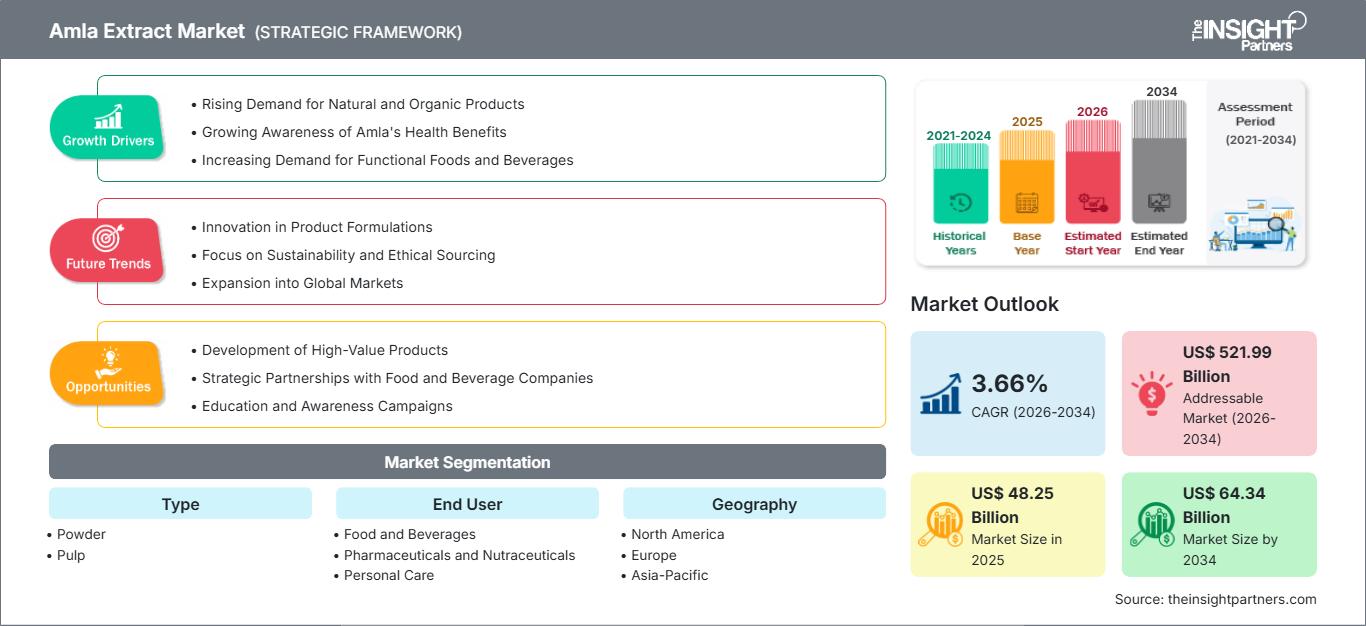
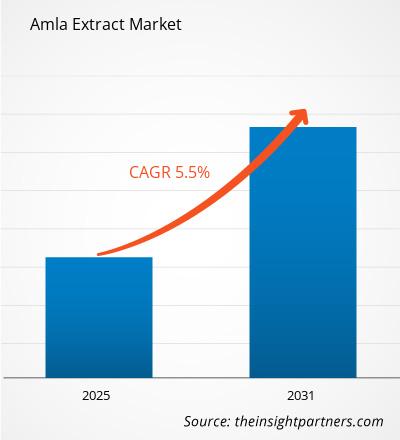
The amla extract market is projected to grow from US$ 48.25 Billion in 2025 to US$ 64.34 Billion by 2034, registering a CAGR of 3.66% during 2026–2034. Demand is supported by broader adoption of standardized botanical ingredients in food and beverages, pharmaceuticals and nutraceuticals, and personal care formulations, where amla is valued for antioxidant content, clean-label positioning, and compatibility with traditional wellness systems.
North America is expected to record steady demand as dietary supplement brands, functional beverage formulators, and natural personal care companies expand botanical ingredient portfolios. The amla extract market size in the region is shaped by premium nutraceutical positioning, rising interest in Ayurvedic ingredients, and greater preference for traceable plant-based actives across immune support, hair care, and skin health products.
Amla Extract Market Assessment and Insights
- North America: The region is estimated to account for 21–24% share in 2025 and grow at a CAGR range of 3.8–4.3% during 2026–2034, supported by supplement innovation and clean-label personal care adoption.
- US: The US is expected to represent 72–76% of North America demand in 2025 and grow at 3.9–4.4% CAGR, led by nutraceutical launches and premium botanical beauty products.
- Europe: Europe is projected to hold 18–21% share in 2025 and expand at 3.5–4.0% CAGR, with Germany, the UK, France, Italy, and Spain leading herbal supplement and natural cosmetics consumption.
- Asia Pacific: Asia Pacific is expected to hold 41–45% share in 2025 and grow at 3.9–4.5% CAGR, led by India, China, Japan, and South Korea through Ayurvedic, food, and beauty applications.
- Largest Segment: Powder is expected to hold 58–62% market share in 2025 and grow at 3.5–4.0% CAGR, supported by easier handling, formulation stability, and use in capsules and drink mixes.
- High Growth Segment: Personal Care is projected to hold 19–22% share in 2025 and grow at 4.1–4.7% CAGR due to rising use in hair strengthening, anti-aging, and natural skin care products.
- Key companies analyzed in detail: Ambe Phytoextracts Pvt. Ltd., Arjuna Natural Pvt Ltd., Biomax Life Sciences Ltd., Himalayan Herbaria Inc., Naturmed Scientific, Patanjali Ayurved Ltd., Risun Bio-Tech Inc., Sydler Group, Taiyo International, and Thangam Extracts.
Source: The Insight Partners' analysis based on proprietary research, government publications, company annual reports, investor presentations, industry databases, and expert interviews.
Processing methods have evolved from basic drying and milling toward standardized extraction, solvent control, spray drying, and bioactive preservation. This transition is improving consistency for buyers who require tannin, polyphenol, and vitamin C specifications. The amla extract market growth also reflects stronger integration between agricultural sourcing, botanical processing, and finished product development, particularly as brands seek cleaner ingredient decks.
According to the Amla Extract Market Report, future demand will be shaped by traceability, export quality documentation, and regional regulatory acceptance. Firms that offer sourcing at the farm level, testing, and formulation support would be well-positioned to cater to the needs of their nutraceutical and personal care customers. Capital is likely to flow into the creation of standardized powders and special extracts based on their effectiveness, consistency of batches, and documentation of the same. The rising tendency among consumers to use products that are natural and plant-based, along with an increasing demand for functional health products, should further contribute to the growth of the market.
Amla Extract Market Report Scope
| Report Attribute | Details |
|---|---|
| Market size in 2025 | US$ 48.25 Billion |
| Market Size by 2034 | US$ 64.34 Billion |
| Global CAGR (2026 - 2034) | 3.66% |
| Historical Data | 2021-2024 |
| Forecast period | 2026-2034 |
Amla Extract Market Analysis
The amla extract market growth is driven by preventive health positioning, botanical supplement demand, and the migration of Ayurvedic ingredients into mainstream wellness products. Functional food manufacturers employ amla for their antioxidant benefits, whereas nutraceutical companies rely on its compatibility with immunity, digestion, and cardiovascular formulations. The supply situation is still being affected by the availability of amla raw materials, the drying process, and export specifications.
The demand continues to rise because of the usage of amla extract in powdered form, pills, beverages, gummies, shampoos, serums, and creams. The powder dominates due to stability and ease of transportability, while the pulp is still relevant in beverages and traditional preparations. Residue and microbiology testing are becoming increasingly important for supplier qualification.
The market analysis has revealed a competitive market structure with Indian botanical extractors and specialty ingredients companies with export certification. Some of the companies competing in the market include Ambe Phytoextracts Pvt. Ltd., Arjuna Natural Pvt Ltd., Biomax Life Sciences Ltd., Patanjali Ayurved Ltd., Taiyo International, and Sydler Group. They compete based on quality management, branded ingredients, formula development expertise, and customers across different wellness segments.
Current investment patterns are towards extraction capabilities, internal laboratories, organic certifications, and product grades suitable for specific applications. Companies with good documentation and distribution networks around the globe stand a better chance of capturing high margins of profit in the markets of North America and Europe. Small regional companies will still play an important role in the consolidation of raw materials.
● REPORT CUSTOMIZATION
Tailor This Report To Align With Your Specific Business Requirements
This report can be customized to align precisely with your business objectives, scope, and target markets. Customization options include tailored segmentation, geography, competitive analysis, and strategic insights to support informed decision-making.
Customize This Report →WHAT YOU CAN ADJUST
- ● Segmentations
- ● Geography
- ● Competitive Analysis
- ● Language Preferences
Amla Extract Market: Strategic Insights
Regional Insights
North America amla extract market
North America is estimated to hold 21–24% amla extract market share in 2025, with a CAGR range of 3.8–4.3% during 2026–2034. Demand is concentrated in dietary supplements, herbal capsules, powdered drink mixes, and natural hair care, where brands use amla to support antioxidant, beauty-from-within, and clean-label positioning.
Ingredient buyers in the region are emphasizing validated origin, heavy metal testing, and supplier documentation. This favors established processors with export-ready quality systems and standardized extract grades. Growth remains steady rather than aggressive because amla competes with other botanical antioxidants, but Ayurveda-linked product storytelling supports premium positioning.
U.S. amla extract Market
The US is expected to represent 72–76% of North America's demand in 2025 and grow at a CAGR range of 3.9–4.4%. Dietary supplement manufacturers, specialty nutrition brands, and natural cosmetics companies are the primary buyers, particularly for powder extracts used in capsules, gummies, functional blends, and scalp-care formulations.
US demand is shaped by online supplement retail, private-label launches, and consumer interest in plant-based antioxidants. Company presence is strongest through ingredient distributors and importers working with Indian manufacturers. Regulatory scrutiny around claims and testing increases the value of suppliers with transparent specifications and repeatable batch quality.
Europe amla extract Market
Europe is projected to account for 18–21% share in 2025 and expand at a CAGR range of 3.5–4.0%. Germany and the UK lead in consumption of herbal supplements, while France, Italy, and Spain participate through the development of natural cosmetics, health foods, and botanical skincare products. The market is quality-driven and documentation-focused.
Germany prefers standardized ingredients for their herbal supplements, the UK has shown increasing interest in wellness products inspired by Ayurveda, and France, Italy, and Spain drive the market through high-quality formulations of hair and skin care. Supplier success is based on traceability, contaminant-free products, allergens’ documentation, and the ability to offer unique products without overpromising.
APAC amla extract Market
APAC is expected to hold 41–45% share in 2025 and grow at a CAGR range of 3.9–4.5%. India remains the leading country due to raw material availability, Ayurvedic manufacturing depth, and export processing capacity, while China, Japan, South Korea, and Australia support demand through nutraceutical and beauty applications.
Regional growth is supported by traditional medicine acceptance, expanding health retail, and rising interest in natural hair care. India’s processing ecosystem provides scale advantages, while Japan and South Korea emphasize product refinement and beauty positioning. China contributes through functional food and botanical supplement channels.
Middle East & Africa amla extract Market
The Middle East and Africa demand is smaller but developing, with a CAGR range of 3.2–3.8% during 2026–2034. Saudi Arabia and the UAE lead premium supplement and beauty retail, while South Africa supports herbal wellness demand through pharmacies, specialty stores, and online channels.
Growth is linked to wellness tourism, imported nutraceutical brands, and rising interest in natural personal care. Distribution partnerships remain important because local processing is limited. Suppliers that can provide halal documentation, stable powder grades, and clear origin records are better placed to expand in the region.
Segmentation Analysis
Type
Type is central to market scope because formulation requirements differ sharply between powder and pulp. The segment is expected to grow at a CAGR range of 3.6–4.1% during 2026–2034, with powder leading commercial demand due to stability, transport efficiency, and compatibility with tablets, capsules, sachets, and dry blends.
- Powder: Powder remains the preferred format for nutraceuticals and functional foods because it offers better shelf stability, dosing control, and lower handling complexity for capsules, tablets, drink mixes, and dry personal care premixes.
- Pulp: Pulp is used in beverages, traditional preparations, and selected cosmetic formulations where texture, fresh fruit positioning, and sensory attributes matter, although shorter shelf life and storage needs limit broader industrial adoption.
End User
End-user demand is expected to grow at a CAGR range of 3.7–4.3% during 2026–2034 as food and beverage, pharmaceuticals and nutraceuticals, and personal care brands use amla for differentiated natural positioning. Pharmaceuticals and nutraceuticals account for the largest commercial opportunity because standardized botanical ingredients fit preventive health formulations.
- Food and Beverages: Food and beverage companies use amla extract in functional drinks, fortified powders, wellness shots, and clean-label snacks, where antioxidant positioning and traditional ingredient familiarity help support differentiation.
- Pharmaceuticals and Nutraceuticals: This sub-segment leads demand through capsules, tablets, immunity blends, digestive formulations, and heart-health supplements that require standardized ingredient specifications and reliable supplier documentation.
- Personal Care: Personal care demand is rising in shampoos, oils, serums, anti-aging creams, and scalp products where botanical credibility, hair-strengthening associations, and natural beauty claims support premium formulations.
Opportunity Snapshot
| Segment Name | Revenue Contribution | Trend Tag | Adoption Stage |
| Food and Beverages | Medium | Functional Drinks | Scaling |
| Pharmaceuticals and Nutraceuticals | High | Immune Support | Mature |
| Personal Care | Medium | Hair Actives | Scaling |
Amla Extract Market Growth Drivers and Impact Analysis
Expansion of Preventive Health and Botanical Supplements
Preventive health investment is driving up the demand for plant ingredients that can position themselves on immune function, antioxidant action, and general wellness. The amla extract is favored by virtue of its traditional use properties and capsule, powder, tablet, and gummy formulations. Nutraceutical companies are increasingly preferring standardized extracts over raw powder formulations in order to achieve better consistency in formulations and reliable dosages. The effect of this driver is felt most strongly in North America, Europe, and urbanized Asia because consumers in these markets are willing to spend more on plant ingredients with an identifiable tradition and health positioning.
Clean-Label Beauty and Hair Care Formulation Demand
Brands within the personal care segment are leveraging amla extract to craft narratives around hair strengthening, scalp health, anti-aging, and antioxidation properties. The move from a predominantly synthetic approach to marketing products has created new opportunities for plant actives that can be used within the formulation of shampoos, oils, serums, masks, and creams. Amla extract presents an excellent opportunity for brands as it blends the tradition of hair care with clean beauty aspirations. This trend creates demand for cosmetic extracts that have consistent color, fragrance, solubility, and microbial properties. Those companies that can offer formulation support and high quality can command premium prices for their products.
Standardized Processing and Export-Ready Quality Systems
Enhancements in extraction, drying, and analysis are broadening the target market for amla extract. The demand for certification, residue management, microbial compliance, and traceability is growing among buyers in regulated markets. This trend is forcing suppliers to move away from the raw material trade to value-added ingredients. Standardized processing facilitates consistency in batches and enables the product’s use in formulations requiring consistency in both sensory attributes and actives. The underlying driver works in favor of organized manufacturers with lab facilities and certifications as well as export experience. The effect is structural as quality systems affect supplier selection, contract length, price negotiations, and multinational clients.
Amla Extract Market Future Trends
Clinically Positioned Botanical Ingredient Platforms
Amla extract market trends are expected to move toward branded ingredient platforms supported by defined specifications, application data, and targeted benefit positioning. Suppliers will increasingly compete based on tannin/polyphenols standardization, claims of clean extraction, and suitability for formulation with heart health, beauty from within, and immunity boosting. This will make it less dependent on commodity pricing and favor those who make investments in scientific research and marketing of their products. Consumers will go for ingredients that will ease product formulation and communication compliance.
Traceable and Sustainable Botanical Supply Chains
Traceability will be more important as brands work to address the problem of crop variability, risk of adulteration, and documentation issues. Amla processors are likely to develop their network of farmers, inspect raw materials, and trace their lots to help their exporting customers. Sustainable claims will be conservative, but their buyers will request origin information, proof of sustainable sourcing, and decreased waste during the process. The consolidation among dependable sources of supply will be stimulated, and there will be room for companies that prove their high quality throughout the entire process.
Amla Extract Market Opportunities
Premium Nutraceutical Formulations for Global Wellness Brands
Amla extract market Forecasts indicate attractive opportunities in premium nutraceutical products that combine traditional botanical positioning with modern dosage formats. Suppliers can target capsules, gummies, sachets, and combination blends for immunity, antioxidant support, digestive wellness, and cardiovascular wellness. The most actionable opportunity is to offer standardized powder grades with clear specifications, formulation guidance, and export documentation. This allows brand owners to reduce qualification time and launch differentiated products faster. Partnerships with contract manufacturers and private-label supplement companies can also expand reach into North America, Europe, and high-income Asian markets where consumers are receptive to plant-based wellness ingredients.
Cosmetic-Grade Extracts for Hair and Skin Applications
Personal care offers a strong opportunity for suppliers that can provide cosmetic-grade amla extract with controlled odor, color, particle size, and microbial quality. Brands are seeking botanical ingredients that support hair strength, scalp wellness, antioxidant skin care, and traditional beauty narratives. Producers can improve margins by developing water-dispersible, oil-compatible, or formulation-ready grades for shampoos, serums, masks, and creams. Technical support is essential because cosmetic formulators need predictable performance and sensory compatibility. The opportunity is especially relevant in clean beauty, Ayurveda-inspired hair care, and premium natural skin care lines sold through specialty retail and e-commerce.
Frequently Asked Questions

- Comprehensive Market Sizing and Forecast Analysis
- Detailed Segmentation Analysis
- In-Depth Market Dynamics Assessment
- Regional and Country-Level Insights
- Competitive Landscape and Company Benchmarking
- Strategic Business Intelligence
Recent Reports
Testimonials

The Insight Partners' SCADA System Market report is comprehensive, with valuable insights on current trends and future forecasts. The team was highly professional, responsive, and supportive throughout. We are very satisfied and highly recommend their services.
RAN KEDEM Partner, Reali Technologies LTDs
I requested a report on a very specific software market and the team produced the report in a few days. The information was very relevant and well presented. I then requested some changes and additions to the report. The team was again very responsive and I got the final report in less than a week.
JEAN-HERVE JENN Chairman, Future Analytica
We worked with The Insight Partners for an important market study and forecast. They gave us clear insights into opportunities and risks, which helped shape our plans. Their research was easy to use and based on solid data. It helped us make smart, confident decisions. We highly recommend them.
PIYUSH NAGPAL Sr. Vice President, High Beam Global
The Insight Partners delivered insightful, well-structured market research with strong domain expertise. Their team was professional and responsive throughout. The user-friendly website made accessing industry reports seamless. We highly recommend them for reliable, high-quality research services
YUKIHIKO ADACHI CEO, Deep Blue, LLC.
This is the first time I have purchased a market report from The Insight Partners.While I was unsure at first, I visited their web site and felt more comfortable to take the risk and purchase a market report.I am completely satisfied with the quality of the report and customer service. I had several questions and comments with the initial report, but after a couple of dialogs over email with their analyst I believe I have a report that I can use as input to our strategic planning process.Thank you so much for taking the extra time and making this a positive experience.I will definitely recommend your service to others and you will be my first call when we need further market data.
JOHN SUZUKI President and Chief Executive Officer, Board Director, BK Technologies
I wish to appreciate your support and the professionalism you displayed in the course of attending to my request for information regarding to infectious disease IVD market in Nigeria. I appreciate your patience, your guidance, and the fact that you were willing to offer a discount, which eventually made it possible for us to close a deal. I look forward to engaging The Insight Partners in the future, all thanks to the impression you have created in me as a result of this first encounter.
DR CHIJIOKE ONYIA MANAGING DIRECTOR, PineCrest Healthcare Ltd.Reason to Buy
- Informed Decision-Making
- Understanding Market Dynamics
- Competitive Analysis
- Identifying Emerging Markets
- Customer Insights
- Market Forecasts
- Risk Mitigation
- Boosting Operational Efficiency
- Strategic Planning
- Investment Justification
- Tracking Industry Innovations
- Aligning with Regulatory Trends





 Get Free Sample for