
Amyotrophic Lateral Sclerosis Treatment Market Trends, Share & Demand by 2034
Amyotrophic Lateral Sclerosis Treatment Market Size and Forecasts (2021–2034), Global and Regional Share, Trends, and Growth Opportunity Analysis Report Coverage : by Type (Sporadic Amyotrophic Lateral Sclerosis and Familial Amyotrophic Lateral Sclerosis); Treatment (Medication, Respiratory Therapy, Speech Therapy Physical Therapy, Chemotherapy, Stem Cell Therapy and Other Treatments); Distribution Channel (Hospital, Retail); and Geography (North America, Europe, Asia Pacific, and South and Central America)
- Status : Data Released
- Report Code : TIPRE00040110
- Category : Life Sciences
- No. of Pages : 150
- Available Report Formats :


- Last update date : July 30, 2026


2025 Market Size
US$ 761.32 Mn
Base year value
2034 Forecast
US$ 1,185.81 Mn
Projected by 2034
CAGR 2026-2034
5.05 %
Growth rate
Addressable Market
US$ 8,836.86 Mn
(2026-2034)
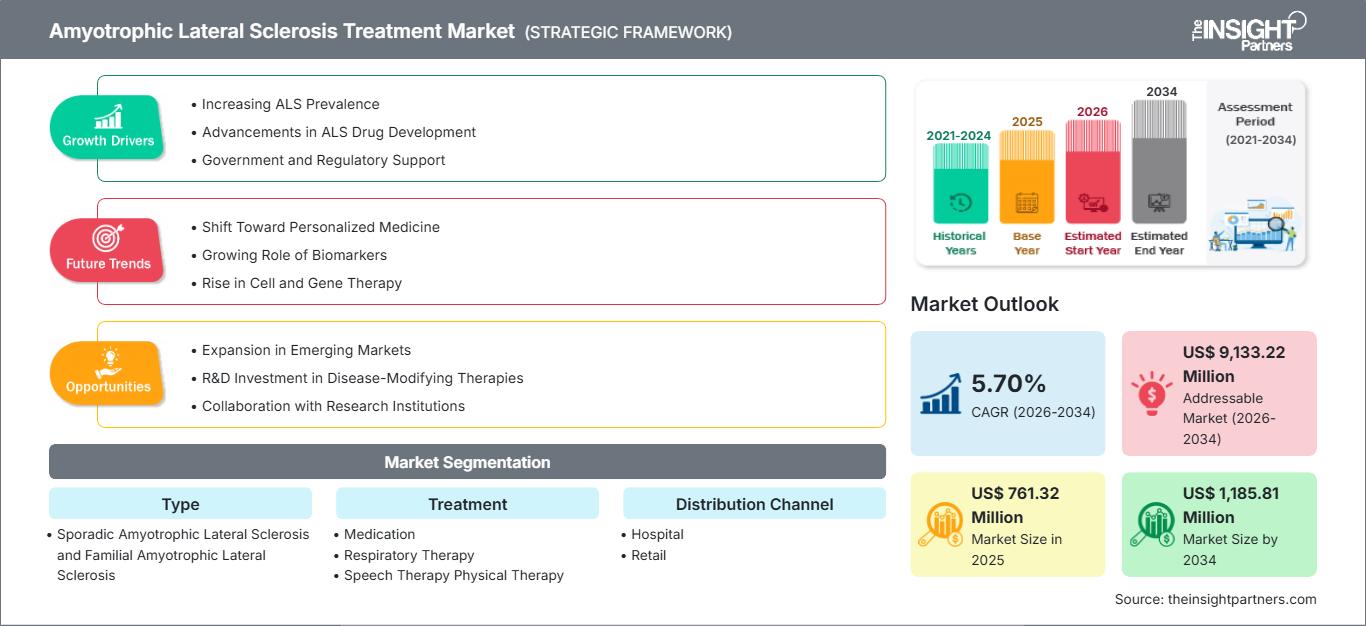
The Amyotrophic Lateral Sclerosis Treatment market was valued at US$ 761.32 million in 2025 and is expected to reach US$ 1185.81 million by 2034; it is estimated to record a CAGR of 5.05% during 2026-2034.
Amyotrophic Lateral Sclerosis Treatment Market Assessment and Insights
- North America held 43–46% share in 2025 and is projected to grow at a CAGR between 5.4–6.4% during 2026–2034, supported by rare disease reimbursement, specialty neurology centers, registries, and established access to approved therapies.
- US accounted for 86–90% of North America in 2025 and is forecast to grow at a CAGR between 5.5–6.5% during 2026–2034, led by specialty drug uptake and homecare services.
- Europe represented 27–30% share in 2025 and is projected to grow at a CAGR between 5.0–6.0% during 2026–2034, led by Germany, the UK, France, Italy, and Spain.
- Asia Pacific captured 18–21% share in 2025 and is expected to grow at a CAGR between 6.3–7.3% during 2026–2034, led by Japan, China, South Korea, India, and Australia.
- Largest Segment Medication held 48–51% market share in 2025 and is projected to grow at a CAGR between 5.6–6.6% during 2026–2034.
- High Growth Segment Familial Amyotrophic Lateral Sclerosis held 9–12% market share in 2025 and is projected to grow at a CAGR between 7.2–8.7% during 2026–2034.
- Key companies analyzed in detail: Biogen Inc., Meda Pharma GmbH & Co. KG, Sanofi S.A., NeuroTherapia, Inc., Amgen Inc., AbbVie Inc., Roche Holding AG, Orphazyme A/S, Cytokinetics, Incorporated, Mitsubishi Tanabe Pharma Corporation.
Source: The Insight Partners' analysis based on proprietary research, government publications, company annual reports, investor presentations, industry databases, and expert interviews.
Treatments have evolved from generalist supportive approaches to phenotype-driven treatments dependent on disease phenotype, respiratory function, swallowing, functional loss, and genetics. Medication is still key; however, care economics increasingly incorporate ventilation, speech, physiotherapy, nutrition, specialty pharmacy coordination, and caregiver services. The production paradigm itself is evolving into specialty distribution, evidence generation, patient registration and monitoring as well.
Looking forward, early diagnosis, genotype-specific treatments, and coordination of home-based care will all be advantages. New markets are increasing neurology capabilities, whereas existing markets are using rare disease economics, real-world evidence, and decentralization to improve continuity. Positive regulatory winds continue blowing hardest where biomarkers and function can prove treatment benefit in small numbers of patients.
Amyotrophic Lateral Sclerosis Treatment Market Report Scope
| Report Attribute | Details |
|---|---|
| Market size in 2025 | US$ 761.32 Million |
| Market Size by 2034 | US$ 1,185.81 Million |
| Global CAGR (2026 - 2034) | 5.05% |
| Historical Data | 2021-2024 |
| Forecast period | 2026-2034 |
Amyotrophic Lateral Sclerosis Treatment Market Analysis
Demand is supported by progressive disability, limited therapeutic options, and growing use of integrated multidisciplinary care. The amyotrophic lateral sclerosis treatment market growth is reinforced by projected US prevalence increases, as CDC-linked registry analysis estimated that ALS cases in the US could rise by more than 10% from 2022 to 2030.
The care ecosystem includes neurologists, ALS clinics, respiratory therapists, physical therapists, speech specialists, specialty pharmacies, homecare providers, payers, clinical trial networks, and patient advocacy organizations. Supply dynamics depend on specialty drug availability, payer authorization, home delivery coordination, infusion capacity, and durable medical equipment access for respiratory and mobility support.
Competition is shaped by clinical differentiation, route convenience, payer evidence, and service integration. The amyotrophic lateral sclerosis treatment market analysis shows that Biogen Inc. and Mitsubishi Tanabe Pharma Corporation hold visible treatment relevance, while Sanofi S.A., Cytokinetics, Incorporated, Roche Holding AG, NeuroTherapia, Inc., and Orphazyme A/S contribute pipeline, research, or neurodegeneration capabilities.
The large biopharmaceutical corporations like Amgen Inc., AbbVie Inc., Meda Pharma GmbH & Co. KG, and Roche Holding AG enhance the overall specialty treatment landscape via their scale of operations, manufacturing capabilities, and payer collaboration. The focus of investments is shifting towards biomarker-based research, oral therapies, and home-use compatible drugs and real-world evidence to validate their continuous use.
● REPORT CUSTOMIZATION
Tailor This Report To Align With Your Specific Business Requirements
This report can be customized to align precisely with your business objectives, scope, and target markets. Customization options include tailored segmentation, geography, competitive analysis, and strategic insights to support informed decision-making.
Customize This Report →WHAT YOU CAN ADJUST
- ● Segmentations
- ● Geography
- ● Competitive Analysis
- ● Language Preferences
Amyotrophic Lateral Sclerosis Treatment Market: Strategic Insights
Regional Insights
North America amyotrophic lateral sclerosis treatment market
North America held 43–46% share in 2025 and is projected to grow at a CAGR between 5.4–6.4% during 2026–2034. The region benefits from rare disease coverage, specialty neurology infrastructure, clinical trials, and home respiratory support. The amyotrophic lateral sclerosis treatment market share is concentrated in medication, respiratory therapy, specialty pharmacy, and homecare services.
Demand is strongest where multidisciplinary clinics coordinate neurologists, pulmonologists, therapists, dietitians, and social workers. CDC’s National ALS Registry dashboard projected 34,720 adults living with ALS in the US in 2026, supporting treatment planning, payer budgeting, and homecare capacity development. Buyers increasingly evaluate therapies alongside service models that reduce hospitalization and preserve daily function.
U.S. Amyotrophic Lateral Sclerosis Treatment Market
The U.S. accounted for 86–90% of North America in 2025 and is projected to grow at a CAGR between 5.5–6.5% during 2026–2034. The depth of the market depends on the availability of specialty drugs, insurance coverage of selected drugs used for the treatment of ALS disease, clinical trial networks, and specialty pharmacies.
Trends in the application of drugs involve early drug usage, identification of genetic subtypes, evaluation of breathing ability, speech therapy, noninvasive ventilation, ambulatory aid, and caregiver training. Some companies that are active in this market are Biogen Inc., Mitsubishi Tanabe Pharma Corporation, Cytokinetics, Incorporated, Sanofi S.A., and Roche Holding AG due to their respective products or neuroscience.
Europe Amyotrophic Lateral Sclerosis Treatment Market
Europe represented 27–30% share in 2025 and is expected to grow at a CAGR between 5.0–6.0% during 2026–2034. The UK is increasing pathways for motor neuron diseases, genetic medicines, and community support, while reimbursement reviews continue to be evidence-based. The public system places importance on functional gain, patient selection, and budget impact.
Germany takes the top spot owing to the presence of specialist centers of neurology, diagnosis, and an organized ALS care network. France, Italy, and Spain manage growing demand using hospital-based programs of neurology, rehabilitation, and rare diseases. European access is dependent on regulatory approvals, national reimbursements, and commitment from the manufacturers to provide real-world evidence.
APAC Amyotrophic Lateral Sclerosis Treatment Market
APAC captured 18–21% share in 2025 and is forecast to grow at a CAGR between 6.3–7.3% during 2026–2034. Japan is the leading country, followed by China, South Korea, India, and Australia, supported by aging populations, improving neurological diagnosis, and specialty therapy access.
Japan benefits from established ALS therapy use and structured care, while China is expanding tertiary neurology and rare disease policy attention. India shows gradual growth through urban specialty clinics and private diagnostics. Australia supports adoption through registries, homecare models, and coordinated multidisciplinary services.
Middle East & Africa amyotrophic lateral sclerosis treatment Market
The Middle East & Africa is projected to grow at a CAGR between 4.2–5.2% during 2026–2034. Saudi Arabia and the UAE lead adoption through tertiary hospital investment, medical tourism infrastructure, specialty neurology services, and rehabilitation capacity. South Africa remains the most developed African market, supported by private neurology practices and academic hospitals. The amyotrophic lateral sclerosis treatment Market in the region is gradually expanding as awareness of neurodegenerative disorders increases and access to specialized treatment centers improves. The rest of MEA growth is gradual because diagnosis delays, limited reimbursement, and specialist shortages constrain access. Near-term demand centers on respiratory support, mobility assistance, nutrition services, hospital-based neurological care, and multidisciplinary ALS management programs.
Segmentation Analysis
Type
Type is projected to grow at a CAGR between 5.8–6.8% during 2026–2034. Disease classification is becoming more commercially relevant as genetic testing connects familial cases with targeted research and potential precision therapies. The amyotrophic lateral sclerosis treatment market scope is widening because sporadic cases drive broad treatment volume, while familial cases create higher-value opportunities in genetic counseling, trial enrollment, and biomarker-informed care.
- Sporadic Amyotrophic Lateral Sclerosis represents the largest treated population, with demand driven by symptom control, respiratory support, medication access, rehabilitation, and long-term coordination across specialty clinics and homecare providers.
- Familial Amyotrophic Lateral Sclerosis is strategically important because genetic subtypes support targeted research, family counseling, precision treatment eligibility, and earlier identification of patients for specialized monitoring.
Treatment
Treatment is projected to grow at a CAGR between 5.5–6.5% during 2026–2034. Treatment demand reflects a combination of disease-modifying medication, rehabilitation, respiratory support, communication assistance, and investigational approaches. Medication leads revenue, but respiratory and speech-related interventions are essential because ALS progressively affects breathing, swallowing, speech clarity, mobility, and independence.
- Medication leads revenue contribution because approved and specialty therapies require neurologist oversight, payer authorization, monitoring, and distribution systems designed for rare progressive diseases.
- Respiratory Therapy is critical as respiratory decline is a major driver of morbidity, requiring monitoring, noninvasive ventilation, airway clearance, and home equipment support.
- Speech Therapy Physical Therapy supports communication, swallowing management, mobility preservation, fatigue management, positioning, and caregiver education across progressive functional decline.
- Chemotherapy has limited conventional relevance in ALS treatment, but immunomodulatory or cytotoxic concepts may appear in selected investigational or off-label research contexts.
- Stem Cell Therapy remains investigational, with interest driven by regenerative medicine, neuroprotection concepts, and clinical trial activity, although evidence and regulatory pathways remain challenging.
Distribution Channel
Distribution Channel is expected to grow at a CAGR between 5.3–6.3% during 2026–2034. Distribution reflects treatment complexity, payer control, and patient mobility limitations. Hospital channels remain essential for diagnosis, initiation, infusions, and acute complications, while retail and specialty pharmacy pathways support ongoing access to oral therapies, refills, counseling, adherence programs, and home delivery.
- Hospital distribution remains important because diagnosis, treatment initiation, infusion oversight, respiratory complications, gastrostomy referral, and complex care transitions are commonly managed through hospital-linked neurology services.
- Retail channels support long-term medication continuity, refill management, patient counseling, and home delivery, particularly where oral therapies and supportive medicines are used outside inpatient settings.
Opportunity Snapshot
| Treatment | Revenue Contribution | Trend Tag | Adoption Stage |
| Medication | High | Targeted Therapy | Scaling |
| Respiratory Therapy | High | Ventilation Support | Mature |
| Speech Therapy / Physical Therapy | Medium | Function Care | Scaling |
| Chemotherapy | Low | Investigational Use | Emerging |
| Stem Cell Therapy | Low | Cell Trials | Emerging |
| Other Treatments | Medium | Supportive Mix | Mature |
Amyotrophic Lateral Sclerosis Treatment Market Growth Drivers and Impact Analysis
Specialty Therapies Expand Treatable Patient Pathways
Specialty therapy is shaping market development through the advancement of ALS treatment from being merely supportive. The approved treatments and targeted therapies define a pathway of therapy that needs assessment by neurologists, approval, monitoring, and patient education. This will boost revenue from each patient under treatment and also increase the significance of early detection. The effects can be seen in specialist clinics where the right patients can be assessed, put on therapy, and monitored based on functional and respiratory indicators.
Respiratory Management Becomes a Core Care Priority
Breathing therapy is still an important driver, as breathing problems have strong impacts on survival rates, hospitalizations, caregiver burden, and quality of life. Non-invasive breathing, cough assistance, respiratory monitoring, and home respiratory services are now commonly used within the ALS treatment program. The spending thus goes beyond medications and involves recurrent expenses on medical devices, supplies, services, and technical support. Service providers that manage to tie together the referrals from the neurologists and visits from the respiratory therapists as well as home care provision, will minimize unnecessary use of acute care services.
Multidisciplinary Clinics Improve Treatment Continuity
The adoption of multidisciplinary ALS clinics is facilitated through the integration of diagnosis, drug administration, respiratory assessment, nutrition planning, rehabilitation, and caregiver counseling all within one setup. This approach enhances continuity of care and ensures non-dispersed decision-making since the disease develops rapidly. It also facilitates the conduct of clinical trials, especially with payers requiring functional evaluations prior to the administration of therapies. From a corporate perspective, these clinics are crucial since they facilitate the identification of appropriate patients and management of expectations on treatment.
Amyotrophic Lateral Sclerosis Treatment Market Future Trends
Biomarker-Guided and Genotype-Specific Care
The most important amyotrophic lateral sclerosis treatment market trends will involve biomarker-guided and genotype-specific care. Future therapies are expected to use genetics, neurofilament levels, and progression markers to select patients and monitor response. This will reshape trial design, payer evidence, and physician decision-making. Familial ALS subgroups are likely to receive greater commercial attention because targeted approaches can be matched to defined biology. Over time, treatment centers that combine genetic counseling, biomarker testing, specialty pharmacy coordination, and longitudinal outcomes tracking will become strategically important for both manufacturers and payers.
Decentralized Monitoring and Home-Based Treatment Support
Home-based assessment tools will become even more necessary with progressive disability because patients will find it increasingly challenging to visit the clinic regularly. Remote respiratory assessments, speech assessments, mobility assessments, tele-neurology, and caregiver feedback may assist clinicians in assessing deterioration between visits. Decentralized assessments may be helpful in improving adherence and collecting post-market approval evidence. This trend will reward service providers who are able to provide logistics, nursing services, data collection, and escalation protocols. The implementation will hinge on reimbursement, privacy measures, workflow integration by clinicians, and validation of digital endpoints.
Amyotrophic Lateral Sclerosis Treatment Market Opportunities
Integrated Access Programs for Specialty Medication
A strong opportunity exists in integrated access programs that connect diagnosis, payer authorization, specialty pharmacy dispensing, adherence support, and outcome documentation. The amyotrophic lateral sclerosis treatment market Forecasts suggest that moderate growth will depend on identifying suitable patients earlier and maintaining continuity despite disease progression. Manufacturers can invest in patient navigation, financial assistance, nurse education, and real-world evidence platforms. Health systems benefit when access programs reduce administrative burden and support consistent follow-up. The highest-value models will coordinate neurologists, payers, caregivers, and pharmacies around measurable functional and respiratory milestones.
Home Respiratory and Rehabilitation Service Networks
There is an actionable opportunity with home respiratory and rehabilitation networks because the progression of ALS will increasingly transfer care away from the hospital setting and into the home setting. The investment should focus on the provision of non-invasive ventilation assistance, cough assistance services, mobility assistance, swallow assistance, communication assistance, and caregiver assistance training. Companies that are able to collaborate with specialty centers can help to decrease emergency room visits and provide more continuous care. This opportunity is particularly pertinent in aging markets and areas where there are deficiencies in neurology capacity.
Recent Developments
- December 2025: Biogen Inc. announced that JAMA Neurology published long-term results from the Phase 3 VALOR study and open-label extension for QALSODY in SOD1-ALS. The company reported more than 3.5 years of follow-up, sustained neurofilament reductions, and observed benefits across function, strength, breathing, and survival-related measures.
- October 2025: Mitsubishi Tanabe Pharma America, Inc. announced that eight ALS research posters would be presented at the NEALS 2025 Annual Meeting, including RADICAVA ORS data, biomarker findings, pharmacovigilance analysis covering more than 12,000 U.S. patients, and digital health research involving at-home telespirometry.
- March 2025: Cytokinetics, Incorporated reported published results from the COURAGE-ALS randomized clinical trial of reldesemtiv in JAMA Neurology. The international Phase 3 trial enrolled 486 participants and was terminated for futility, providing important evidence for future skeletal muscle activator research strategies in ALS.
Frequently Asked Questions

- Comprehensive Market Sizing and Forecast Analysis
- Detailed Segmentation Analysis
- In-Depth Market Dynamics Assessment
- Regional and Country-Level Insights
- Competitive Landscape and Company Benchmarking
- Strategic Business Intelligence
Recent Reports
Testimonials

The Insight Partners' SCADA System Market report is comprehensive, with valuable insights on current trends and future forecasts. The team was highly professional, responsive, and supportive throughout. We are very satisfied and highly recommend their services.
RAN KEDEM Partner, Reali Technologies LTDs
I requested a report on a very specific software market and the team produced the report in a few days. The information was very relevant and well presented. I then requested some changes and additions to the report. The team was again very responsive and I got the final report in less than a week.
JEAN-HERVE JENN Chairman, Future Analytica
We worked with The Insight Partners for an important market study and forecast. They gave us clear insights into opportunities and risks, which helped shape our plans. Their research was easy to use and based on solid data. It helped us make smart, confident decisions. We highly recommend them.
PIYUSH NAGPAL Sr. Vice President, High Beam Global
The Insight Partners delivered insightful, well-structured market research with strong domain expertise. Their team was professional and responsive throughout. The user-friendly website made accessing industry reports seamless. We highly recommend them for reliable, high-quality research services
YUKIHIKO ADACHI CEO, Deep Blue, LLC.
This is the first time I have purchased a market report from The Insight Partners.While I was unsure at first, I visited their web site and felt more comfortable to take the risk and purchase a market report.I am completely satisfied with the quality of the report and customer service. I had several questions and comments with the initial report, but after a couple of dialogs over email with their analyst I believe I have a report that I can use as input to our strategic planning process.Thank you so much for taking the extra time and making this a positive experience.I will definitely recommend your service to others and you will be my first call when we need further market data.
JOHN SUZUKI President and Chief Executive Officer, Board Director, BK Technologies
I wish to appreciate your support and the professionalism you displayed in the course of attending to my request for information regarding to infectious disease IVD market in Nigeria. I appreciate your patience, your guidance, and the fact that you were willing to offer a discount, which eventually made it possible for us to close a deal. I look forward to engaging The Insight Partners in the future, all thanks to the impression you have created in me as a result of this first encounter.
DR CHIJIOKE ONYIA MANAGING DIRECTOR, PineCrest Healthcare Ltd.Reason to Buy
- Informed Decision-Making
- Understanding Market Dynamics
- Competitive Analysis
- Identifying Emerging Markets
- Customer Insights
- Market Forecasts
- Risk Mitigation
- Boosting Operational Efficiency
- Strategic Planning
- Investment Justification
- Tracking Industry Innovations
- Aligning with Regulatory Trends





 Get Free Sample for