
Anaphylaxis Treatment Market Share, Growth & Outlook 2034
Coverage: By Medication Type (Epinephrine, Antihistamines, Steroids, Beta-Agonist, and Others), Route of Administration (Oral, Parenteral, and Others), Allergy Type (Food Allergy, Medications, Insect Stings, and Others), and Distribution Channel (Hospital Pharmacies, Retail Sales, and Others)
- Status : Data Released
- Report Code : TIPRE00022791
- Category : Life Sciences
- No. of Pages : 150
- Available Report Formats :


- Last update date : December 12, 2025


2025 Market Size
US$ 3.72 Bn
Base year value
2034 Forecast
US$ 7.95 Bn
Projected by 2034
CAGR 2026-2034
8.80 %
Growth rate
Addressable Market
US$ 52.26 Bn
(2026-2034)
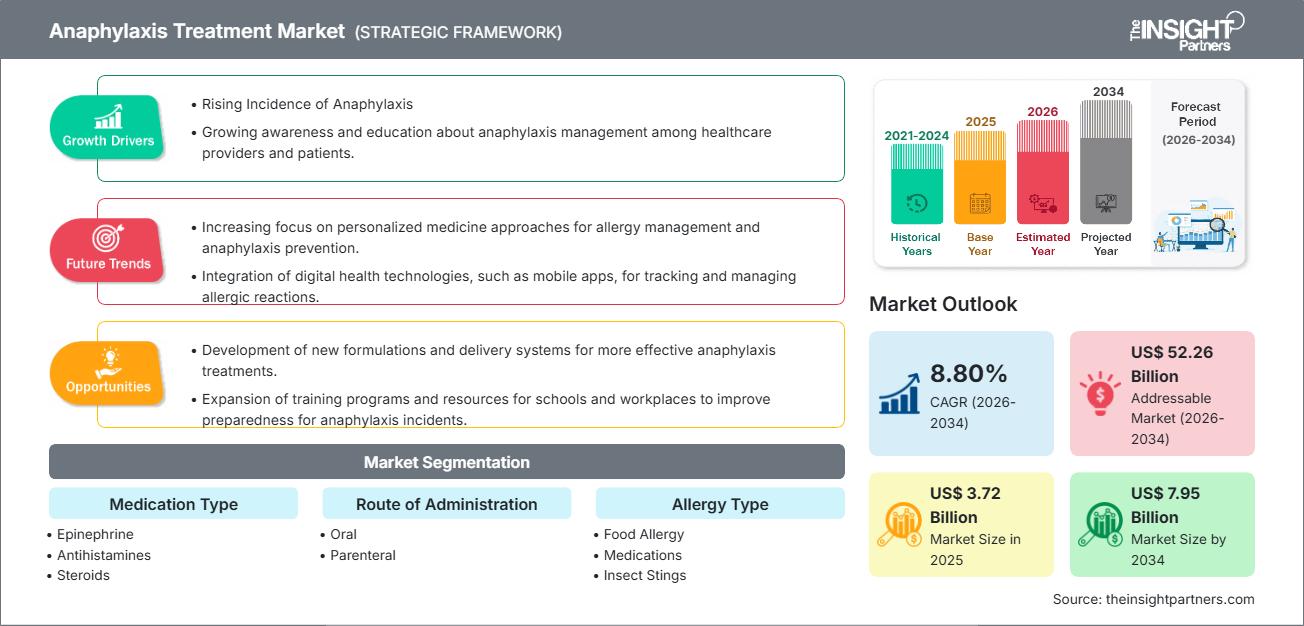
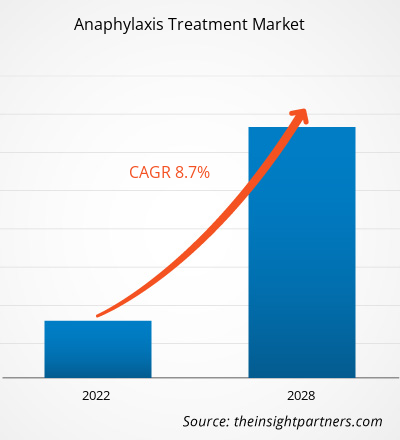
The Anaphylaxis Treatment Market size is expected to reach US$7.95 billion by 2034, registering substantial growth from US$3.72 billion in 2025. The market is anticipated to register a robust Compound Annual Growth Rate (CAGR) of 8.80% during the forecast period of 2026–2034.
Anaphylaxis Treatment Market Analysis
The global anaphylaxis treatment market forecast indicates strong growth, driven fundamentally by a documented rise in the global prevalence of severe allergic reactions, especially those to food, insect venom, and pharmaceuticals. Such market growth is heavily underpinned by increasing public and professional awareness concerning the urgency and standard approaches to anaphylactic emergency response. The emphasis remains on epinephrine as the life-saving first-line intervention, with high market demand channeled toward easy-to-use drug delivery systems-namely, sophisticated auto-injectors and prefilled syringes. Major players in the industry are investing aggressively in enhancing the affordability, accessibility, and shelf-stability of these life-saving medications while also engaging their efforts in conjunction with regulatory bodies to advance comprehensive initiatives of patient education and preparedness.
Anaphylaxis Treatment Market Overview
Anaphylaxis is defined as a rapid-onset, potentially fatal systemic hypersensitivity reaction that demands immediate and decisive medical intervention. This condition is managed with a market portfolio that spans various therapeutic classes: the essential vasoconstrictor epinephrine, supplementary medications such as antihistamines and corticosteroids (steroids), and respiratory aids including beta-agonists. These treatments are delivered mainly via parenteral-injection routes in cases of acute emergency and via the oral route for supportive care. The rising global incidence of triggers, especially common food allergies, adverse drug reactions, and venomous insect stings, is continually fueling the demand for reliable and effective emergency treatment options globally. The market environment is characterized by intense competition among major pharmaceutical and medical device companies, with a significant strategic emphasis on creating patient-centric, easy-to-use solutions to improve self-administration compliance.
Market Assessment and Insights
- Global market for Anaphylaxis Treatment was valued at US$ 3.72 Billion in 2025
- Annual market size is expected to reach US$ 7.95 Billion by 2034
- Total addressable market (TAM) during 2026-2034 is projected to reach approximately US$ 52.26 Billion
- Market is anticipated to register a CAGR of 8.8% during the forecast period
- The United States represents a key market, supported by Rising Incidence of Anaphylaxis, Growing awareness and education about anaphylaxis management among healthcare providers and patients., as well as evolving industry dynamics
- Market analysis covers North America, Europe, Asia-Pacific, South and Central America, Middle East and Africa, with growth evaluated across the forecast period
- Market opportunities such as Development of new formulations and delivery systems for more effective anaphylaxis treatments., Expansion of training programs and resources for schools and workplaces to improve preparedness for anaphylaxis incidents. are expected to influence market dynamics and addressable market
- Report profiles industry participants, including Amneal Pharmaceuticals Inc., Bioprojet, Mylan N.V., Adamis Pharmaceutical Corporation, Abbott, Pfizer Inc., Glaxosmithkline Plc.,, Merck And Co., Inc., Teva Pharmaceutical Industries Ltd., ALK-ABELL�, while analyzing competitive strategies and innovation developments
-
Source: The Insight Partners' analysis based on proprietary research, government publications, company annual reports, investor presentations, industry databases, and expert interviews.
● REPORT CUSTOMIZATION
Tailor This Report To Align With Your Specific Business Requirements
This report can be customized to align precisely with your business objectives, scope, and target markets. Customization options include tailored segmentation, geography, competitive analysis, and strategic insights to support informed decision-making.
Customize This Report →WHAT YOU CAN ADJUST
- ● Segmentations
- ● Geography
- ● Competitive Analysis
- ● Language Preferences
Anaphylaxis Treatment Market: Strategic Insights
-
Get Top Key Market Trends of this report.This FREE sample will include data analysis, ranging from market trends to estimates and forecasts.
Anaphylaxis Treatment Market Drivers and Opportunities
Market Drivers:
- Rising Global Prevalence of Food Allergies and Drug-Induced Anaphylaxis: The increasing frequency of food-related allergies (e.g., peanuts, tree nuts, shellfish) and allergic responses to commonly prescribed medications (e.g., antibiotics, NSAIDs) is steadily enlarging the addressable patient population requiring immediate access to prescribed emergency treatments.
- Increasing Awareness and Education on Emergency Treatment Protocols: Strong campaigns by public health bodies, patient advocacy groups, and pharmaceutical companies are improving awareness among patients, caregivers, and school personnel. This drive toward preparedness will directly translate into higher prescription rates for epinephrine auto-injectors in people at risk.
- Technological Advancements in Auto-Injector Devices: Continuous innovation in the design of epinephrine auto-injectors, such as smaller profiles, voice-guided instructions, needle-concealment features, and temperature stability improvements, boosts patient confidence, reduces hesitation in self-administration, and ensures drug viability in various environments.
Market Opportunities:
- Expansion in Emerging Markets with Growing Healthcare Infrastructure: Emerging economies in the Asia-Pacific and Latin American regions are witnessing improved healthcare access and diagnostic capabilities. This growing awareness of allergic disease burdens creates a significant untapped market for established, affordable, and government-supported epinephrine distribution programs.
- Development of Innovative Drug Delivery Systems for Rapid Response: A major opportunity lies in next-generation, non-needle-based delivery systems, such as nasal sprays or sublingual formulations of epinephrine. The development of such systems could significantly reduce psychological barriers to administration and broaden the range of first-response settings.
- Strategic Collaborations to Enhance Distribution and Patient Access: Partnerships between large pharmaceutical companies and governments, NGOs, and school systems have been very important avenues for expanding the global distribution network. Such collaborations are required for reducing treatment costs, providing subsidies, and ensuring the ready availability of emergency kits in community settings.
Anaphylaxis Treatment Market Report Segmentation Analysis
The anaphylaxis treatment market is analyzed across several distinct segments, providing a comprehensive understanding of the therapeutic landscape, the delivery mechanisms, and the underlying clinical triggers driving demand. Below is the standard segmentation approach used in most industry reports:
By Medication Type:
- Epinephrine
- Antihistamines
- Steroids (Corticosteroids)
- Beta-Agonists
By Route of Administration:
- Parenteral
- Oral
By Allergy Type:
- Food Allergy
- Medications (Drug-Induced Anaphylaxis)
- Insect Stings (Venom)
By Distribution Channel:
- Retail Sales
- Hospital Pharmacies
By Geography:
- North America
- Europe
- Asia Pacific
- South & Central America
- Middle East & Africa
Anaphylaxis Treatment Market Report Scope
| Report Attribute | Details |
|---|---|
| Market size in 2025 | US$ 3.72 Billion |
| Market Size by 2034 | US$ 7.95 Billion |
| Global CAGR (2026 - 2034) | 8.80% |
| Historical Data | 2021-2024 |
| Forecast period | 2026-2034 |
| Segments Covered |
By Medication Type
|
| Regions and Countries Covered |
North America
|
| Market leaders and key company profiles |
|
Anaphylaxis Treatment Market Players Density: Understanding Its Impact on Business Dynamics
The Anaphylaxis Treatment Market is growing rapidly, driven by increasing end-user demand due to factors such as evolving consumer preferences, technological advancements, and greater awareness of the product's benefits. As demand rises, businesses are expanding their offerings, innovating to meet consumer needs, and capitalizing on emerging trends, which further fuels market growth.
Anaphylaxis Treatment Market Share Analysis by Geography
The global distribution of the anaphylaxis treatment market is influenced by the differential prevalence of allergies, varying regulatory landscapes concerning auto-injector prescription, and the strength of local pharmaceutical supply chains.
North America
- Market Share: Holds the largest market share globally due to the high reported prevalence of food and drug allergies, established emergency care protocols, and the strong, competitive presence of major pharmaceutical firms.
- Key Drivers: High consumer awareness translates to higher market absorption.
- Trends: Continuous demand for novel, less-intrusive auto-injector designs and a focus on generic competition to address affordability concerns.
Europe
- Market Share: Possesses a significant market share, supported by robust public healthcare systems, consistent national guidelines for anaphylaxis management, and effective patient education programs across the EU and UK.
- Key Drivers: Favorable reimbursement models for emergency medications in core markets.
- Trends: Focus on improving the stability of epinephrine products under varying climatic conditions and expanding access in Eastern European markets.
Asia Pacific
- Market Share: Fastest-growing region, driven by rapid urbanization, changing dietary habits, introducing new allergens, and a significant expansion of the middle class seeking quality healthcare solutions.
- Key Drivers:
- Rising incidence of food allergies, particularly in countries including China and India.
- Government initiatives to improve emergency response systems.
- Trends: Strong potential for the growth of local manufacturing and distribution of cost-effective, regionally tailored epinephrine delivery solutions.
South and Central America
- Market Share: Emerging market with developing digital health adoption and growing awareness among medical professionals.
- Key Drivers: Increasing investment in both private clinics and emergency services.
- Trends: Cost-effective generics and government procurement programs for essential emergency medicines are gaining critical traction among healthcare providers.
Middle East and Africa
- Market Share: Developing market with high potential, particularly in GCC countries, supported by rising healthcare expenditure and specialized medical services.
- Key Drivers: Rising medical tourism requires standardized treatment protocols.
- Trends: Implementation of regional training programs to ensure the appropriate use and handling of auto-injectors in varied clinical and community settings.
Anaphylaxis Treatment Market Players Density: Understanding Its Impact on Business Dynamics
High Market Density and Competition
The market for anaphylaxis treatment, especially the epinephrine auto-injector segment, is characterized by intense price and innovation competition. Major pharmaceutical giants and specialized device manufacturers such as Mylan (now Viatris), Pfizer, and Teva dominate, with competition primarily focused on overcoming patient cost barriers and enhancing device usability.
This competitive environment pushes vendors to differentiate through:
- Affordability and Generic Access: The pressure to provide lower-cost alternatives is paramount, driving manufacturers such as Teva and Amneal to introduce bioequivalent generic auto-injectors to improve patient access and reduce the burden on healthcare systems.
- Enhanced Device Features: Differentiating factors include smaller, more discreet device sizes, simpler one-step activation mechanisms, audible/voice prompts for self-administration guidance, and features that make the injection process less intimidating for patients and lay rescuers.
- Comprehensive Educational Platforms: Investing in patient education tools, training videos, and online resources to ensure proper technique and timely use of the auto-injector during a genuine emergency.
Major Companies operating in the Anaphylaxis Treatment Market are:
- Amneal Pharmaceuticals Inc.
- Bioprojet
- Mylan N.V. (Viatris)
- Adamis Pharmaceutical Corporation
- Abbott
- Pfizer Inc.
- Glaxosmithkline Plc.
- Merck And Co., Inc.
- Teva Pharmaceutical Industries Ltd.
Disclaimer: The companies listed above are not ranked in any particular order.
Anaphylaxis Treatment Market News and Recent Developments
- Amneal Pharmaceuticals filed a BLA for its biosimilar to XOLAIR® (omalizumab), a monoclonal antibody indicated for allergic conditions associated with anaphylaxis risk. This move further extends Amneal's specialty portfolio and supports wider access to biologic therapies in severe allergic disorders.
- Bioprojet highlighted its ANAPEN® auto-injector range (0.15 mg, 0.30 mg, and 0.50 mg epinephrine doses) for immediate management of severe allergic reactions triggered by food, medications, insect stings, or idiopathic causes. The company continues to emphasize validated protocols for reducing anaphylaxis-related risks.
- Viatris, the manufacturer of EpiPen® and EpiPen Jr®, issued updates on product availability and expiration date extensions to ensure uninterrupted access for patients. The company also reaffirmed its commitment to maintaining compliance and safety standards for epinephrine auto-injectors amid fluctuating global demand.
Anaphylaxis Treatment Market Report Coverage and Deliverables
The "Anaphylaxis Treatment Market Size and Forecast (2021–2034)" report provides a detailed analysis of the market covering the following areas:
- Anaphylaxis Treatment Market size and forecast at global, regional, and country levels for all the key market segments covered under the scope
- Anaphylaxis Treatment Market trends, as well as market dynamics such as drivers, restraints, and key opportunities
- Detailed PEST and SWOT analysis
- Anaphylaxis Treatment Market analysis covering key market trends, global and regional framework, major players, regulations, and recent market developments
- Industry landscape and competition analysis covering market concentration, heat map analysis, prominent players, and recent developments in the Anaphylaxis Treatment Market
- Detailed company profiles
Frequently Asked Questions

- Comprehensive Market Sizing and Forecast Analysis
- Detailed Segmentation Analysis
- In-Depth Market Dynamics Assessment
- Regional and Country-Level Insights
- Competitive Landscape and Company Benchmarking
- Strategic Business Intelligence
Recent Reports
Testimonials

The Insight Partners' SCADA System Market report is comprehensive, with valuable insights on current trends and future forecasts. The team was highly professional, responsive, and supportive throughout. We are very satisfied and highly recommend their services.
RAN KEDEM Partner, Reali Technologies LTDs
I requested a report on a very specific software market and the team produced the report in a few days. The information was very relevant and well presented. I then requested some changes and additions to the report. The team was again very responsive and I got the final report in less than a week.
JEAN-HERVE JENN Chairman, Future Analytica
We worked with The Insight Partners for an important market study and forecast. They gave us clear insights into opportunities and risks, which helped shape our plans. Their research was easy to use and based on solid data. It helped us make smart, confident decisions. We highly recommend them.
PIYUSH NAGPAL Sr. Vice President, High Beam Global
The Insight Partners delivered insightful, well-structured market research with strong domain expertise. Their team was professional and responsive throughout. The user-friendly website made accessing industry reports seamless. We highly recommend them for reliable, high-quality research services
YUKIHIKO ADACHI CEO, Deep Blue, LLC.
This is the first time I have purchased a market report from The Insight Partners.While I was unsure at first, I visited their web site and felt more comfortable to take the risk and purchase a market report.I am completely satisfied with the quality of the report and customer service. I had several questions and comments with the initial report, but after a couple of dialogs over email with their analyst I believe I have a report that I can use as input to our strategic planning process.Thank you so much for taking the extra time and making this a positive experience.I will definitely recommend your service to others and you will be my first call when we need further market data.
JOHN SUZUKI President and Chief Executive Officer, Board Director, BK Technologies
I wish to appreciate your support and the professionalism you displayed in the course of attending to my request for information regarding to infectious disease IVD market in Nigeria. I appreciate your patience, your guidance, and the fact that you were willing to offer a discount, which eventually made it possible for us to close a deal. I look forward to engaging The Insight Partners in the future, all thanks to the impression you have created in me as a result of this first encounter.
DR CHIJIOKE ONYIA MANAGING DIRECTOR, PineCrest Healthcare Ltd.Reason to Buy
- Informed Decision-Making
- Understanding Market Dynamics
- Competitive Analysis
- Identifying Emerging Markets
- Customer Insights
- Market Forecasts
- Risk Mitigation
- Boosting Operational Efficiency
- Strategic Planning
- Investment Justification
- Tracking Industry Innovations
- Aligning with Regulatory Trends





 Get Free Sample for