
Anaplasmosis Treatment Market Size, Segments, and Growth by Forecast by 2034
Anaplasmosis Treatment Market Size and Forecasts (2021 - 2034), Global and Regional Share, Trends, and Growth Opportunity Analysis Report Coverage : by Species (Ixodes Scapularis, Ixodes Pacificus); Application (Humans, Livestock, Wildlife); Diagnosis (ELISA, IFA, PCR); Treatment (Vaccine, Antibiotics); and Geography (North America, Europe, Asia Pacific, and South and Central America)
- Status : Data Released
- Report Code : TIPRE00040194
- Category : Life Sciences
- No. of Pages : 150
- Available Report Formats :


- Last update date : August 04, 2026


2025 Market Size
US$ 8.43 Bn
Base year value
2034 Forecast
US$ 13.57 Bn
Projected by 2034
CAGR 2026-2034
5.44 %
Growth rate
Addressable Market
US$ 99.80 Bn
(2026-2034)
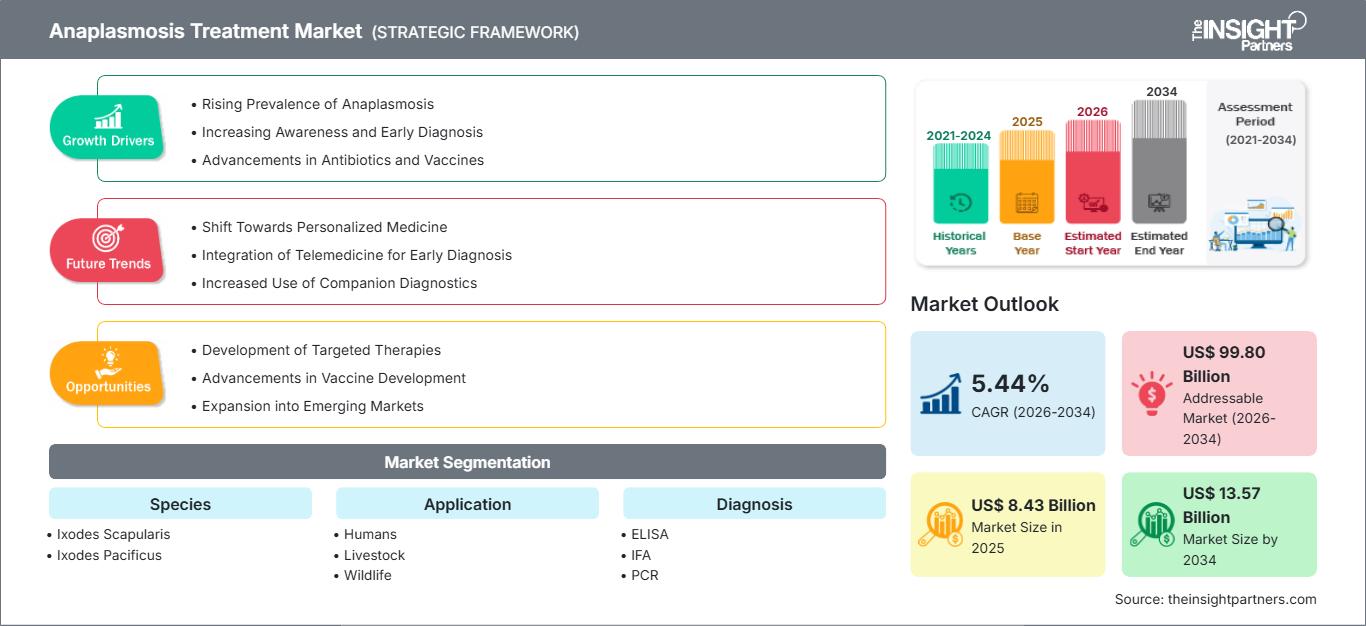
The anaplasmosis treatment market is projected to increase from US$ 8.43 Billion in 2025 to US$ 13.57 Billion by 2034, registering a CAGR of 5.44% during 2026–2034. The market reflects expanding demand for diagnostic confirmation, antimicrobial therapy, vaccination support, and vector control across human health, livestock management, and wildlife surveillance programs affected by tick-borne Anaplasma infections.
Across North America, the anaplasmosis treatment market size is supported by established tick-borne disease surveillance, high veterinary spending, and wider clinical recognition of febrile infections linked to Ixodes vectors. The region is expected to grow at a CAGR range of 5.0–5.5% during 2026–2034, driven by livestock herd protection programs, PCR-based diagnostics, and physician awareness in endemic states.
Anaplasmosis Treatment Market Assessment and Insights
- North America held 38–41% share in 2025 and is growing at a CAGR of 5.0–5.5% between 2026–2034, supported by endemic tick exposure, veterinary diagnostics, and strong antibiotic access.
- US accounted for 84–87% of North America in 2025 and is growing at a CAGR of 5.1–5.6% between 2026–2034, driven by surveillance and herd health investment.
- Europe held 24–27% share in 2025 and is growing at a CAGR of 4.7–5.2% between 2026–2034, led by Germany, the UK, France, Spain, and Italy.
- Asia Pacific held 22–25% share in 2025 and is growing at a CAGR of 6.1–6.7% between 2026–2034, with China, India, Japan, Australia, and South Korea expanding diagnostics.
- Largest Segment antibiotics held 61–65% market share in 2025 and is growing at a CAGR of 5.2–5.7% between 2026–2034 due to first-line clinical and veterinary use.
- High Growth Segment PCR held 24–28% market share in 2025 and is growing at a CAGR of 6.6–7.2% between 2026–2034 as early detection improves.
- Key companies analyzed in detail: Wyeth Pharmaceuticals LLC, Merck & Co., Inc., Boehringer Ingelheim International GmbH, Bristol Myers Squibb Company, GSK plc, Sanofi, Viatris Inc., Pfizer Inc., Teva Pharmaceutical Industries Ltd., Takeda Pharmaceutical Company Limited.
Source: The Insight Partners' analysis based on proprietary research, government publications, company annual reports, investor presentations, industry databases, and expert interviews.
Scientific understanding in the anaplasmosis treatment market has shifted from symptom-led treatment toward integrated diagnosis, vector ecology, and herd-level risk management. Production in the clinic continues to focus on doxycycline, tetracyclines, testing tools, and veterinary vaccine development, whereas supply is contingent on the presence of active ingredients and the regulations at play. The testing tools are also evolving from conventional serology to PCR testing, especially when early differentiation from other tick-borne diseases will enhance clinical decision-making.
Future demand for R. amblyommii products will depend on climate-driven tick spread, increasing importance of cattle productivity, and One Health models of disease surveillance that link human, livestock, and wild animal data. Developing countries are focusing on veterinary laboratories and rural health systems, whereas regulators are stressing proper antimicrobial use. These trends represent positive tailwinds for companies that are able to integrate therapy, diagnosis, vaccine discovery, and education efforts.
Anaplasmosis Treatment Market Report Scope
| Report Attribute | Details |
|---|---|
| Market size in 2025 | US$ 8.43 Billion |
| Market Size by 2034 | US$ 13.57 Billion |
| Global CAGR (2026 - 2034) | 5.44% |
| Historical Data | 2021-2024 |
| Forecast period | 2026-2034 |
Anaplasmosis Treatment Market Analysis
Factors influencing the anaplasmosis treatment market growth include increased incidence of tick-borne diseases, increased trade in livestock, and more testing of febrile disorders similar to Lyme disease, babesiosis, or ehrlichiosis. In relation to humans, the CDC guidelines recommend the use of PCR in the first week of the disease, while in animals, the tetracyclines are cited as important drugs used in ruminants. Demand includes physicians, veterinarians, public labs, diagnostic companies, distributors, and livestock producers.
The factors that affect the supply side of the market include antibiotic stewardship, lack of vaccines, and diagnostic facilities. While human therapy makes use of existing antibiotics, livestock management uses testing, tick management, biosecurity, and selected therapy.
The anaplasmosis treatment market analysis shows a competitive environment that includes broad pharmaceutical companies, animal health specialists, and generic medicine suppliers. The strengths of Merck & Co., Inc. and Boehringer Ingelheim International GmbH lie in their animal health platforms, while the antimicrobial and pharmaceutical capabilities can be found in Pfizer Inc., Viatris Inc., Teva Pharmaceutical Industries Ltd., Sanofi, GSK plc, and Bristol Myers Squibb Company.
It should be noted that strategic positioning today is becoming associated not so much with a dependence on a particular product but rather with disease prevention and partnerships, geographical coverage, and diagnostics. Wyeth Pharmaceuticals LLC is still important because of its legacy of antimicrobials, and Takeda Pharmaceutical Company Limited shows the ability to produce vaccines and infectious diseases.
● REPORT CUSTOMIZATION
Tailor This Report To Align With Your Specific Business Requirements
This report can be customized to align precisely with your business objectives, scope, and target markets. Customization options include tailored segmentation, geography, competitive analysis, and strategic insights to support informed decision-making.
Customize This Report →WHAT YOU CAN ADJUST
- ● Segmentations
- ● Geography
- ● Competitive Analysis
- ● Language Preferences
Anaplasmosis Treatment Market: Strategic Insights
Regional Insights
North America anaplasmosis treatment market
North America held 38–41% share in 2025 and is expected to grow at a CAGR of 5.0–5.5% during 2026–2034. The region benefits from a strong network of state laboratories, veterinary diagnostic services, and physician awareness in tick-endemic areas. These factors support the anaplasmosis treatment market share across human testing, livestock disease control, and companion animal surveillance.
The structural demand for the disease is supported by the value of cattle herd, pastoralism, and an increase in tick habitats due to warm season and the presence of wildlife as reservoir hosts. Early administration of doxycycline is emphasized by hospitals and clinics if there is clinical suspicion of the disease, while the veterinarian relies on ELISA, PCR, and herd history before intervention.
U.S. anaplasmosis treatment Market
The U.S. represented 84–87% of North America in 2025 and is projected to grow at a CAGR of 5.1–5.6% during 2026–2034. The demand for such products is highest in the Northeast, Upper Midwest, Pacific coast, and the cattle-producing regions owing to increased Ixodes exposure, livestock movement, and the presence of wildlife hosts. The country is also advanced in terms of reimbursement and laboratory support.
Competitors in the region are Merck & Co., Inc., Boehringer Ingelheim International GmbH, Pfizer Inc., Viatris Inc., and Teva Pharmaceutical Industries Ltd. in animal health, antimicrobials, and pharmaceuticals. Application of the products differs in various settings, depending on the end user with human application needing immediate identification, livestock having an economic focus, while wildlife surveillance helps determine risks.
Europe anaplasmosis treatment Market
Europe held 24–27% share in 2025 and is expected to expand at a CAGR of 4.7–5.2% during 2026–2034, with Germany leading demand. The UK maintains strong veterinary surveillance and livestock health programs, while human cases are assessed within broader tick-borne disease pathways. Pharmacy regulation keeps antibiotic usage controlled.
Germany benefits from advanced diagnostics, strong cattle health services, and established laboratory capacity. Demand is supported by clinician awareness of granulocytic anaplasmosis and veterinary concern over pasture-related exposure. France, Italy, and Spain show steady adoption because livestock density, Mediterranean tick ecology, and regional veterinary networks sustain testing and treatment needs. Across Europe, antimicrobial stewardship and EU veterinary medicine rules encourage targeted diagnosis before broad intervention.
APAC anaplasmosis treatment Market
APAC held 22–25% share in 2025 and is projected to grow at a CAGR of 6.1–6.7% during 2026–2034. China leads regional demand through dairy and beef herd expansion, laboratory investment, and broader veterinary modernization. Japan and South Korea emphasize quality diagnostics and companion animal care.
India and Australia add momentum through cattle health programs, tick control, and rural veterinary services. Policy support for domestic pharmaceutical manufacturing and disease surveillance improves access to antibiotics and diagnostics. Suppliers that combine affordable tests, registered therapies, and distributor training should gain traction in mixed farming systems.
Middle East & Africa anaplasmosis treatment Market
The Middle East & Africa is expected to grow at a CAGR of 5.4–6.0% during 2026–2034, led by Saudi Arabia. Growth is supported by livestock import controls, dairy farm expansion, veterinary infrastructure, and stronger food security investment across Gulf economies.
The UAE emphasizes premium animal health services, while South Africa remains important due to established cattle production and tick-borne disease expertise. The rest of MEA demand is uneven because diagnosis, cold-chain support, and antimicrobial access vary. Energy-funded healthcare and infrastructure programs improve laboratory capacity and livestock disease management.
Segmentation Analysis
Species
The Species segment is expected to grow at a CAGR of 5.1–5.7% during 2026–2034. Demand is shaped by vector distribution, local ecology, and the ability of laboratories to identify exposure patterns. The anaplasmosis treatment market scope is expanding as climate changes, outdoor activity, and livestock movement increase attention to both eastern and western tick vectors.
- Ixodes Scapularis remains the most strategically significant vector in North America because it is associated with multiple tick-borne pathogens, broad human exposure, and extensive surveillance in endemic states.
- Ixodes Pacificus supports targeted demand in western coastal areas, where regional tick ecology, outdoor recreation, companion animal exposure, and clinician awareness shape diagnostic and treatment decisions.
Application
The Application segment is expected to grow at a CAGR of 5.3–5.9% during 2026–2034. Human cases require rapid treatment to prevent progression, while livestock programs focus on productivity losses, anemia, mortality risk, and herd-level control. Wildlife surveillance is gaining importance because reservoirs influence tick distribution, pathogen persistence, and future risk mapping.
- Humans represent a clinically important application because early recognition of nonspecific fever, headache, myalgia, and tick exposure can determine whether timely antibiotic therapy prevents severe disease.
- Livestock generates strong economic demand as bovine anaplasmosis can reduce weight gain, milk yield, reproductive performance, and herd profitability when diagnosis and treatment are delayed.
- Wildlife supports epidemiological monitoring because deer, wild ruminants, and other reservoirs influence tick populations, pathogen circulation, and risk alerts for farms and nearby communities.
Diagnosis
The Diagnosis segment is expected to grow at a CAGR of 5.8–6.4% during 2026–2034. Diagnostic demand is rising because anaplasmosis can resemble other febrile, hemolytic, or tick-borne illnesses. ELISA and IFA remain useful for antibody detection, while PCR is gaining priority in early infection and livestock screening, where rapid confirmation supports targeted therapy.
- ELISA remains widely used in veterinary and surveillance settings because it supports scalable antibody detection, herd screening, and cost-efficient monitoring where infection exposure needs broad assessment.
- IFA is valuable for confirmatory serology in human and veterinary laboratories, particularly when paired acute and convalescent samples support the interpretation of the immune response.
- PCR is strategically important for early detection because it identifies pathogen DNA before antibody response is fully developed, improving treatment decisions and reducing diagnostic uncertainty.
Treatment
The Treatment segment is expected to grow at a CAGR of 5.0–5.6% during 2026–2034. Antibiotics remain the primary treatment option in humans and animals, especially doxycycline and tetracycline-class therapies. Vaccination has a more specialized role in livestock control, with adoption shaped by regional availability, herd risk, regulatory acceptance, and efficacy against circulating strains.
- Vaccine demand is concentrated in livestock prevention programs where herd-level protection can reduce clinical disease, treatment costs, and productivity losses in endemic production environments.
- Antibiotics account for the strongest treatment demand because established tetracycline-class therapies are used across human clinical care and veterinary intervention when anaplasmosis is suspected or confirmed.
Opportunity Snapshot
| Application | Revenue Contribution | Trend Tag | Adoption Stage |
| Humans | Medium | Early Testing | Scaling |
| Livestock | High | Herd Protection | Mature |
| Wildlife | Low | Reservoir Mapping | Emerging |
Anaplasmosis Treatment Market Growth Drivers and Impact Analysis
Expansion of Tick Habitats and Seasonal Exposure
More active ticks are widening the potential market in terms of testing, treatment, and prevention in both humans and animals. The expansion of the seasons, animal migrations, change in land use, and increased time spent outdoors are expanding the window of exposure in areas where health care providers rarely had to encounter such conditions. From a marketing perspective, there will be an increase in requests for differential diagnosis, physicians will start treating the disease early, and producers will start monitoring their herds. Marketers will gain if they are selling diagnostic kits, antibiotics, and training that fits the regional vector pattern.
Livestock Productivity Losses from Bovine Anaplasmosis
The direct economic effect of bovine anaplasmosis includes anemia, poor growth rates, decreased milk production, reproductive problems, the cost of treatment, and mortality in extreme cases. Therefore, farmers will be more ready to embrace testing and interventions where the herd has higher value or moving between regions poses the risk of contracting the disease. Economic influence on the industry is mostly felt in diagnostics, veterinary medicines, and health prevention, as one single carrier in the herd causes trouble. Veterinary companies can differentiate by offering solutions to screening, prudent use of antimicrobials, and tick control measures.
Rising Use of Molecular Diagnostics
PCR usage is increasingly facilitating early diagnosis, especially when symptoms are nonspecific or serology results are inconclusive. This will decrease diagnostic delays and enable physicians to differentiate between anaplasmosis, Lyme disease, babesiosis, ehrlichiosis, malaria-like bovine disorders, and other fever-inducing illnesses. The benefits to the market include increased laboratory revenue, improved antibiotic prescription practices, and increased quality in surveillance. In the veterinary arena, PCR tests may facilitate herd testing, epidemiological investigations, and identification of carriers. Suppliers of diagnostic kits and antibiotics gain when testing facilities are coupled with treatment guidelines. The major limitation at present still pertains to costs in rural settings.
Anaplasmosis Treatment Market Future Trends
One Health Surveillance Across Humans, Livestock, and Wildlife
Future disease control will increasingly connect clinical reporting, veterinary diagnostics, wildlife monitoring, and tick mapping into integrated surveillance systems. The anaplasmosis treatment market trends indicate that buyers will value solutions that support cross-sector decision-making rather than isolated case treatment. Public health agencies and livestock producers need shared visibility on vector movement, seasonal risk, and emerging hotspots. This will favor diagnostic providers, pharmaceutical companies, and animal health firms that can work with laboratories, universities, and government programs. Data interoperability, sample standardization, and regional risk dashboards are likely to become important differentiators.
More Targeted Antimicrobial and Vaccine Strategies
Treatment regimens are anticipated to become more selective as a result of antimicrobial stewardship, resistance threats, and herd economics in decision-making. For humans, rapid administration of doxycycline should continue to be critical in case of high suspicions, but diagnostics should play a more important role in confirming the diagnosis and monitoring. For livestock, work on vaccination, carrier detection, and tick control plans should diminish reliance on recurrent treatments. In the future, efforts will focus on herd risk screening, regional vaccination, and veterinary regulation. Firms that put emphasis on generating and implementing evidence will be better prepared as regulatory bodies require responsible antibiotic use alongside disease management.
Anaplasmosis Treatment Market Opportunities
Integrated Livestock Diagnostic and Treatment Programs
A strong opportunity exists in bundled programs that combine herd screening, veterinary consultation, tick control guidance, and access to registered therapies. The anaplasmosis treatment market Forecasts indicate stronger uptake where producers can directly link disease control to milk yield, weight gain, reproductive performance, and mortality reduction. Companies can act by partnering with veterinary networks, cooperatives, and diagnostic laboratories to provide practical protocols rather than single products. This model is particularly relevant in cattle-intensive regions of North America, Latin America, APAC, and Africa. Commercial success will depend on affordability, field training, and proof that early detection improves herd economics.
Regional PCR Capacity for Early Case Confirmation
The investment in PCR facilities would benefit both humans and animals with respect to healthcare and disease control in areas where laboratory availability is still limited. The benefits of local molecular diagnosis include shorter confirmation time, better decision-making regarding treatment and accurate monitoring of surveillance. Diagnostic manufacturers, distributors and public laboratories could jointly coordinate the process of sample handling, technical training and validated tests for the Anaplasma species. This would be an appealing venture in developing countries where there is a large concentration of livestock and ticks but testing facilities are available only in the cities.
Recent Developments
- November 2025: Takeda Pharmaceutical Company Limited announced seven-year Phase 3 data for QDENGA, reporting sustained dengue vaccine protection and 18.6 million doses distributed across 11 endemic countries. Although focused on dengue, the update demonstrates Takeda’s infectious disease vaccine manufacturing, global access, and public health partnership capabilities relevant to vector-borne disease prevention platforms.
- July 2025: Merck & Co., Inc., through Merck Animal Health, received FDA approval for BRAVECTO QUANTUM, an extended-release injectable fluralaner product for dogs. The product provides long-duration flea and tick control, including activity against black-legged ticks, reinforcing Merck’s role in vector management products that help reduce tick-borne disease exposure risk.
- April 2025: Boehringer Ingelheim Animal Health USA, Inc. received supplemental FDA approval for NexGard PLUS to prevent Borrelia burgdorferi infections by killing Ixodes scapularis vector ticks. The approval strengthens Boehringer Ingelheim’s tick-control portfolio and supports broader management of tick-related disease risk in companion animal health settings.
Frequently Asked Questions

- Comprehensive Market Sizing and Forecast Analysis
- Detailed Segmentation Analysis
- In-Depth Market Dynamics Assessment
- Regional and Country-Level Insights
- Competitive Landscape and Company Benchmarking
- Strategic Business Intelligence
Recent Reports
Testimonials

The Insight Partners' SCADA System Market report is comprehensive, with valuable insights on current trends and future forecasts. The team was highly professional, responsive, and supportive throughout. We are very satisfied and highly recommend their services.
RAN KEDEM Partner, Reali Technologies LTDs
I requested a report on a very specific software market and the team produced the report in a few days. The information was very relevant and well presented. I then requested some changes and additions to the report. The team was again very responsive and I got the final report in less than a week.
JEAN-HERVE JENN Chairman, Future Analytica
We worked with The Insight Partners for an important market study and forecast. They gave us clear insights into opportunities and risks, which helped shape our plans. Their research was easy to use and based on solid data. It helped us make smart, confident decisions. We highly recommend them.
PIYUSH NAGPAL Sr. Vice President, High Beam Global
The Insight Partners delivered insightful, well-structured market research with strong domain expertise. Their team was professional and responsive throughout. The user-friendly website made accessing industry reports seamless. We highly recommend them for reliable, high-quality research services
YUKIHIKO ADACHI CEO, Deep Blue, LLC.
This is the first time I have purchased a market report from The Insight Partners.While I was unsure at first, I visited their web site and felt more comfortable to take the risk and purchase a market report.I am completely satisfied with the quality of the report and customer service. I had several questions and comments with the initial report, but after a couple of dialogs over email with their analyst I believe I have a report that I can use as input to our strategic planning process.Thank you so much for taking the extra time and making this a positive experience.I will definitely recommend your service to others and you will be my first call when we need further market data.
JOHN SUZUKI President and Chief Executive Officer, Board Director, BK Technologies
I wish to appreciate your support and the professionalism you displayed in the course of attending to my request for information regarding to infectious disease IVD market in Nigeria. I appreciate your patience, your guidance, and the fact that you were willing to offer a discount, which eventually made it possible for us to close a deal. I look forward to engaging The Insight Partners in the future, all thanks to the impression you have created in me as a result of this first encounter.
DR CHIJIOKE ONYIA MANAGING DIRECTOR, PineCrest Healthcare Ltd.Reason to Buy
- Informed Decision-Making
- Understanding Market Dynamics
- Competitive Analysis
- Identifying Emerging Markets
- Customer Insights
- Market Forecasts
- Risk Mitigation
- Boosting Operational Efficiency
- Strategic Planning
- Investment Justification
- Tracking Industry Innovations
- Aligning with Regulatory Trends





 Get Free Sample for