
Anterior Uveitis Treatment Market Growth, Trends & Forecast by 2034
Coverage: By Therapeutic (Corticosteroids (prednisolone), Anti-inflammatory agents, Cycloplegics (atropine or homatropine), Antimetabolites (methotrexate), Anti-virals (aciclovir or valaciclovir), Anti-diabetic (metformin), Biologics (mAbs), Others); Distribution channel (Hospital pharmacies, Retail pharmacies, Online pharmacies) , and Geography (North America, Europe, Asia Pacific, and South and Central America)
- Status : Data Released
- Report Code : TIPRE00006723
- Category : Life Sciences
- No. of Pages : 150
- Available Report Formats :


- Last update date : August 13, 2026


2025 Market Size
US$ 472.20 Mn
Base year value
2034 Forecast
US$ 935.42 Mn
Projected by 2034
CAGR 2026-2034
7.89 %
Growth rate
Addressable Market
US$ 6,332.73 Mn
(2026-2034)
The anterior uveitis treatment market was valued at US$ 472.20 Million in 2025 and is projected to reach US$ 935.42 Million by 2034, registering a CAGR of 7.89% during 2026–2034. The market reflects demand for therapies used to control anterior chamber inflammation, reduce pain and photophobia, prevent recurrence, and limit complications such as glaucoma, cataract, posterior synechiae, and vision loss.
Across North America, the anterior uveitis treatment market size is supported by specialist ophthalmology access, payer coverage for prescription ocular therapies, and rising diagnosis of immune-mediated inflammatory eye disease. The region is estimated to expand at a CAGR range of 7.2–7.6% during 2026–2034, driven by biologic adoption and stronger referral links between rheumatology, optometry, and ophthalmology clinics.
Anterior Uveitis Treatment Market Assessment and Insights
- North America held 38–41% share in 2025 and is expected to grow at a CAGR between 2026–2034 of 7.2–7.6%, supported by ophthalmology networks, premium therapy access, and autoimmune disease screening.
- US accounted for 82–86% of North America in 2025 and is projected to grow at a CAGR between 2026–2034 of 7.1–7.5%, led by specialty prescribing and biologic reimbursement.
- Europe held 27–30% share in 2025 and is expected to grow at a CAGR between 2026–2034 of 6.8–7.2%, with Germany, the UK, France, Italy, and Spain leading structured care.
- Asia Pacific represented 22–25% share in 2025 and is expected to grow at a CAGR between 2026–2034 of 8.6–9.0%, led by Japan, China, India, South Korea, and Australia.
- Largest Segment Therapeutic held 83–87% market share in 2025 and is expected to grow at a CAGR range of 7.7–8.1% during 2026–2034, due to recurring prescription use.
- High Growth Segment Online pharmacies recorded 8–11% market share in 2025 and are projected to grow at a CAGR range of 10.2–10.6% during 2026–2034 as refill models improve.
- Key companies analyzed in detail: Novartis AG, Santen Pharmaceutical Co., Ltd., AbbVie Inc., Kiora Pharmaceuticals, Inc., Clearside Biomedical, Inc., Aldeyra Therapeutics, Inc., Aciont Inc., Sirion Therapeutics, Inc., UCB Pharma S.A., Lux Biosciences, Inc.
Source: The Insight Partners' analysis based on proprietary research, government publications, company annual reports, investor presentations, industry databases, and expert interviews.
Care provision is gradually progressing from a general treatment approach towards a differential approach to managing infections, autoimmune diseases, and idiopathic anterior inflammation. Production trends rely increasingly on preservative-free formulations, sterilized production processes, topical corticosteroid availability, immunomodulators, and biologicals. Anterior uveitis therapy will be positively impacted by better slit-lamp examination, OCT, and comorbidity assessments of eye inflammation in relation to immune diseases.
In the coming years, emerging markets will see increased uptake of therapies thanks to increasing private eye hospitals, online pharmacies, and specialized medication distributors. Favorable regulations stem from improved essential eye-care planning, together with an increase in people-centered eye care, as per WHO reports that there are 2.2 billion people with vision impairments worldwide, at least 1 billion of which could be prevented.
Anterior Uveitis Treatment Market Report Scope
| Report Attribute | Details |
|---|---|
| Market size in 2025 | US$ 472.20 Million |
| Market Size by 2034 | US$ 935.42 Million |
| Global CAGR (2026 - 2034) | 7.89% |
| Historical Data | 2021-2024 |
| Forecast period | 2026-2034 |
Anterior Uveitis Treatment Market Analysis
Recurrent inflammation, steroid response management, and systemic involvement are key drivers for market growth in anterior uveitis treatment. Prescribers need rapid onset topical steroids, cycloplegics for pain relief, antibiotics if an infection is suspected, and steroid-sparing agents in case of recurrence. The supply chain encompasses providers of active pharmaceutical ingredients, sterile ophthalmic product producers, hospital pharmacies, retail chains, online pharmacies, ophthalmologist offices, rheumatologists, and patient support initiatives.
Supply conditions depend on the quality of formulations, regulatory compliance, allocation of specialty biologic agents, and geography-related availability of eye doctors. Acute administration is done mostly at hospitals; continuing therapy relies mostly on retail and online pharmacies. Adherence to refills is critical due to the possibility of developing flares from a disrupted tapering process.
Analysis of the market for anterior uveitis treatments shows that the competitive landscape of the market is shared among established global leaders in ophthalmology and immunology as well as small players focusing on development of ophthalmic drugs. Novartis AG, Santen Pharmaceutical Co., Ltd. and AbbVie Inc. possess comprehensive ophthalmology/immunology capabilities whereas Clearside Biomedical, Inc., Kiora Pharmaceuticals, Inc., Aldeyra Therapeutics, Inc., Aciont Inc., Sirion Therapeutics, Inc., UCB Pharma S.A. and Lux Biosciences, Inc. constitute specialized involvement in the market.
Current investment trend in the area includes dose-reduction strategies, steroid sparing therapy, immune pathway targeting and differentiation in ocular delivery. Firms which manage to demonstrate the correlation of their clinical efficacy with compliance, intraocular pressure safety and payer favorability are better positioned in the market.
● REPORT CUSTOMIZATION
Tailor This Report To Align With Your Specific Business Requirements
This report can be customized to align precisely with your business objectives, scope, and target markets. Customization options include tailored segmentation, geography, competitive analysis, and strategic insights to support informed decision-making.
Customize This Report →WHAT YOU CAN ADJUST
- ● Segmentations
- ● Geography
- ● Competitive Analysis
- ● Language Preferences
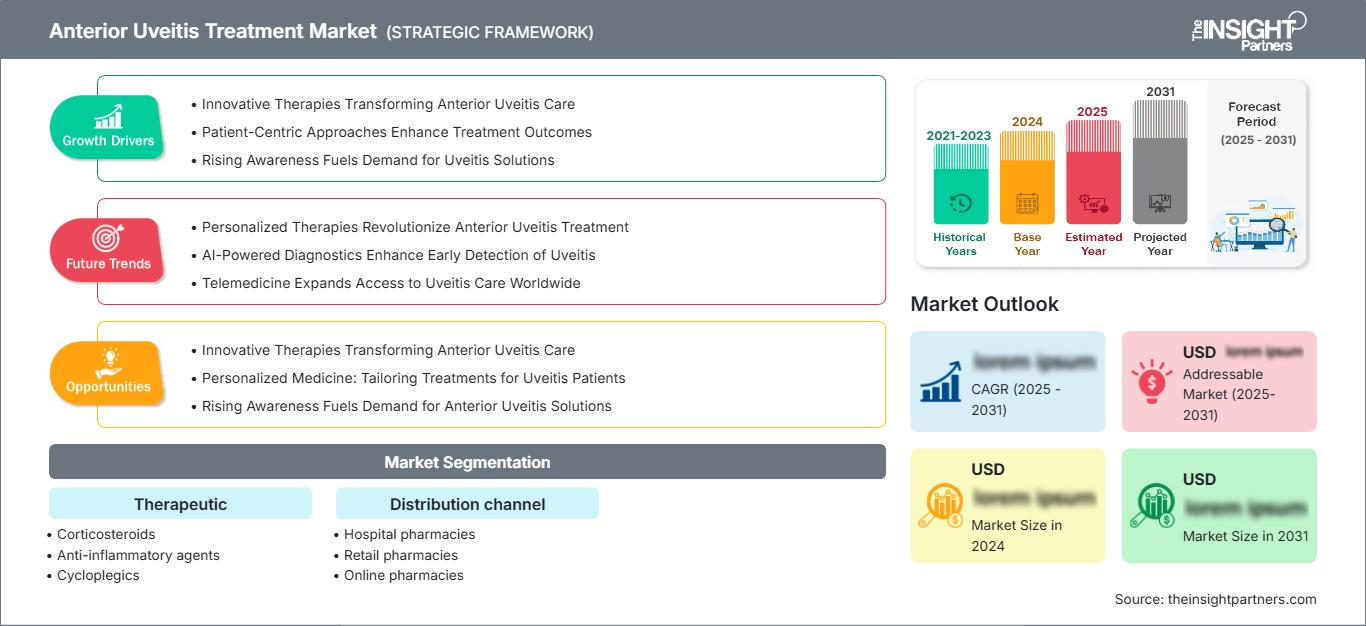
Anterior Uveitis Treatment Market: Strategic Insights
Regional Insights
North America anterior uveitis treatment market
North America held 38–41% share in 2025 and is projected to grow at a CAGR range of 7.2–7.6% during 2026–2034. The anterior uveitis treatment market share is supported by high ophthalmologist density, broad diagnostic access, and stronger use of immunology referral pathways when inflammation is recurrent or bilateral.
Specialty pharmacies and electronic prescribing improve continuity for corticosteroids, cycloplegics, biologics, and supportive therapies. Demand is concentrated in urban eye centers, academic hospitals, and multispecialty practices. Regional adoption is also shaped by payer prior authorization, steroid-monitoring protocols, and awareness that untreated inflammation may lead to avoidable visual impairment.
U.S. anterior uveitis treatment Market
The U.S. accounted for 82–86% of North America in 2025 and is forecast to grow at a CAGR range of 7.1–7.5% during 2026–2034. Prescribing is supported by high access to slit-lamp evaluation, specialty biologics, retinal imaging, and comanagement with rheumatology for HLA-B27-associated disease, juvenile idiopathic arthritis, sarcoidosis, and inflammatory bowel disease.
Company presence is strong across immunology, ophthalmology, and specialty distribution. AbbVie Inc. contributes biologic and immunology relevance, while Novartis AG and Santen Pharmaceutical Co., Ltd. strengthen ophthalmic therapy visibility. Online refill behavior is increasing, but initial flare management remains clinic-led because dosing, tapering, and intraocular pressure checks require professional supervision.
Europe anterior uveitis treatment Market
Market share in Europe stood at 27-30%, and is anticipated to expand at a CAGR of 6.8-7.2% during 2026-2034. Germany has a leadership position regionally based on ophthalmology network infrastructure, sickness fund payment and good use of biologics for systemic inflammatory disease.
The UK has a combination of hospital eye services and rheumatology referrals for patients requiring recurrence. France, Italy, and Spain have stable demand due to public hospital prescriptions, availability in community pharmacies and increased use of steroids-sparing therapies by specialists.
APAC anterior uveitis treatment Market
The APAC region maintained market shares of 22-25% in 2025 and is projected to record a CAGR of 8.6-9.0% from 2026-2034. The Japanese market dominates due to the presence of ophthalmic facilities and prescribed medicines, whereas China and India contribute to the volume due to increasing numbers of private hospitals and urban speciality clinics.
The South Korean and Australian markets benefit by having high diagnosis rates and biologic access. Policy drivers for growth include investment in ocular care, regulations on e-pharmacy operations, and chronic condition management improvement. Growth in sterile ophthalmic industrial production further aids in treatment availability.
Middle East & Africa anterior uveitis treatment Market
The Middle East & Africa is projected to grow at a CAGR range of 7.4–7.8% during 2026–2034. Saudi Arabia leads regional adoption through tertiary hospitals, ophthalmology centers, and specialist pharmacy investment, while the UAE supports premium private eye-care access and medical tourism-linked ophthalmology services.
South Africa remains the key sub-Saharan market, with demand centered on urban hospitals and retail pharmacies. Rest of MEA growth is constrained by specialist shortages, but public and private investment in healthcare infrastructure is improving diagnosis, referral, and medicine availability.
Segmentation Analysis
Therapeutic
The Therapeutic segment is projected to grow at a CAGR range of 7.7–8.1% during 2026–2034. The anterior uveitis treatment market scope within therapeutics is shaped by flare severity, recurrence pattern, infectious workup, and systemic immune involvement. Corticosteroids remain central, but steroid-sparing and targeted options are gaining relevance where repeated inflammation increases complication risk.
- Corticosteroids remain the foundation for rapid inflammation control, with demand shaped by acute flare frequency, tapering requirements, intraocular pressure monitoring, and physician familiarity.
- Anti-inflammatory agents support symptom control and adjunctive management, especially where clinicians seek broader inflammatory suppression while limiting exposure to stronger steroid regimens.
- Cycloplegics are strategically important for pain relief, photophobia reduction, and prevention of posterior synechiae during active anterior chamber inflammation.
- Antimetabolites serve recurrent or autoimmune-associated cases where steroid-sparing systemic control is needed and specialist oversight supports longer-term disease management.
- Anti-virals are critical when herpes simplex, varicella zoster, or cytomegalovirus involvement is suspected, reducing recurrence and limiting corneal or intraocular complications.
- Anti-diabetic therapies indirectly support outcomes where diabetic comorbidity complicates ocular inflammation, steroid response, infection risk, and follow-up intensity.
- Biologics are gaining strategic relevance in severe, recurrent, or systemic inflammatory disease-associated cases and align with broader immunology-based treatment pathways.
Distribution channel
The Distribution channel segment is projected to grow at a CAGR range of 8.0–8.4% during 2026–2034. Hospital pharmacies retain importance for acute prescriptions and specialist-initiated biologics, while retail outlets manage repeat dispensing. Online pharmacies are scaling as patients seek convenient refills for tapering schedules and chronic adjunct therapy, although clinical supervision remains essential.
- Hospital pharmacies support acute ophthalmology and emergency prescribing, particularly for severe inflammation, biologic initiation, infectious evaluation, and care coordinated within tertiary centers.
- Retail pharmacies remain the broadest access point for topical corticosteroids, cycloplegics, adjunct medicines, and repeated prescriptions issued after outpatient ophthalmology consultations.
- Online pharmacies are expanding through convenience, home delivery, price transparency, and digital refill reminders, especially for maintenance therapy and structured tapering regimens.
Opportunity Snapshot
| Segment Name | Revenue Contribution | Trend Tag | Adoption Stage |
|---|---|---|---|
| Hospital pharmacies | High | Acute Dispensing | Mature |
| Retail pharmacies | High | Refill Access | Mature |
| Online pharmacies | Medium | Digital Refills | Scaling |
Anterior Uveitis Treatment Market Growth Drivers and Impact Analysis
Higher recognition of recurrent ocular inflammation
Improved clinical recognition of red eye presentations is increasing referral for anterior chamber examination rather than symptomatic treatment alone. This is important to note since anterior uveitis mimics conjunctivitis but follows a unique approach to management that involves the use of corticosteroids, cycloplegics, assessment for infections, and intraocular pressure measurements. With optometrists, emergency rooms, and primary care practitioners improving their referral approaches, there will be an increase in the number of patients referred to specialists early on. This will result in increased prescription, increased follow-up, and demand for safe discontinuation drugs.
Growth in immune-mediated disease management
Anterior inflammation is frequently linked with systemic immune conditions, including spondyloarthritis, juvenile idiopathic arthritis, inflammatory bowel disease, sarcoidosis, and psoriasis-related immune dysregulation. As rheumatology use of biologics and immunomodulators expands, ophthalmology treatment decisions increasingly reflect systemic disease control rather than isolated eye-drop management. This strengthens the market for collaborative treatment protocols, steroid-sparing regimens, and specialty pharmacy coordination. The real-world impact is a broader prescriber ecosystem, longer therapy duration in recurrent cases, and more demand for evidence supporting inflammation control without cumulative steroid toxicity.
Expansion of specialty and digital pharmacy access
The distribution landscape is widening as specialty pharmacies, retail chains, and regulated online platforms improve access to ophthalmic prescriptions and immunology therapies. Patients experiencing recurrent episodes often require rapid refills, tapering adherence, and clear dosing instructions, making pharmacy support a practical growth driver. Digital prescription systems can reduce missed refills and improve visibility for clinicians monitoring steroid exposure. This driver benefits branded and generic therapies by improving continuity, while also supporting biologics where cold-chain, reimbursement, and patient education services are essential for sustained use.
Anterior Uveitis Treatment Market Future Trends
Steroid-sparing topical innovation
Steroid-sparing topical development is expected to become one of the most important anterior uveitis treatment market trends as clinicians seek inflammation control with lower risks of steroid-induced ocular hypertension, cataract progression, and recurrence after tapering. Future candidates will likely emphasize targeted immune modulation, faster symptom relief, and compatibility with outpatient follow-up. Adoption will depend on demonstrating noninferiority or superiority against established corticosteroids, plus a clear safety profile. Products that reduce monitoring burden while preserving rapid control could shift prescribing behavior in recurrent cases.
Personalized treatment by inflammatory phenotype
Future treatment pathways will increasingly segment patients by infectious status, autoimmune history, recurrence frequency, laterality, intraocular pressure response, and systemic comorbidity. This approach will move prescribing away from one-size-fits-all corticosteroid cycles toward tailored combinations of topical, systemic, antiviral, and biologic therapy. Digital records and laboratory integration will support faster identification of high-risk patients. The commercial effect will be stronger demand for diagnostic-supported therapy selection, patient stratification tools, and treatment protocols that improve long-term visual outcomes.
Anterior Uveitis Treatment Market Opportunities
Specialty pharmacy programs for recurrent patients
Manufacturers, pharmacy networks, and ophthalmology groups can build programs focused on recurring inflammation, adherence, refill timing, and safety monitoring. anterior uveitis treatment market Forecasts indicate stronger value creation where pharmacy services reduce interrupted tapering and support timely follow-up. Practical opportunities include digital reminders, pharmacist counseling, biologic coordination, and treatment-status reporting to ophthalmologists. Such programs can improve persistence, reduce acute relapse burden, and strengthen payer confidence. Companies that combine therapy access with measurable adherence data will gain an advantage in recurrent and systemic-disease-associated cases.
Partnerships linking ophthalmology and rheumatology
Regional care networks can invest in integrated clinics and referral protocols connecting eye inflammation specialists with rheumatologists, infectious disease physicians, and pediatric specialists. The opportunity is strongest in patients with bilateral, recurrent, or severe inflammation where systemic disease may be undiagnosed. Coordinated pathways can shorten diagnostic delays, improve biologic eligibility assessment, and reduce unnecessary steroid exposure. Commercially, this supports premium therapy uptake, clinical registry development, and outcome-based evidence. Providers and companies that align around multidisciplinary management can improve care quality while expanding addressable demand.
Recent Developments
- July 2026: Santen Pharmaceutical Co., Ltd. and KYORIN Pharmaceutical Co., Ltd. announced a joint marketing agreement in Japan for Alesion Eyelid Cream 0.5%, strengthening Santen’s domestic ophthalmology commercialization footprint and reinforcing its channel execution in prescription eye care, although the product targets allergic conjunctivitis rather than uveitis.
- March 2026: Aldeyra Therapeutics, Inc. received a Complete Response Letter from the U.S. FDA for the reproxalap New Drug Application in dry eye disease, with the agency citing lack of substantial evidence of efficacy while noting no safety or manufacturing concerns.
- July 2025: Clearside Biomedical, Inc. announced Health Canada approval for XIPERE for suprachoroidal use in uveitic macular edema, expanding availability beyond the US and supporting validation of its suprachoroidal injection platform and SCS Microinjector technology.
Frequently Asked Questions

- Comprehensive Market Sizing and Forecast Analysis
- Detailed Segmentation Analysis
- In-Depth Market Dynamics Assessment
- Regional and Country-Level Insights
- Competitive Landscape and Company Benchmarking
- Strategic Business Intelligence
Recent Reports
Testimonials

The Insight Partners' SCADA System Market report is comprehensive, with valuable insights on current trends and future forecasts. The team was highly professional, responsive, and supportive throughout. We are very satisfied and highly recommend their services.
RAN KEDEM Partner, Reali Technologies LTDs
I requested a report on a very specific software market and the team produced the report in a few days. The information was very relevant and well presented. I then requested some changes and additions to the report. The team was again very responsive and I got the final report in less than a week.
JEAN-HERVE JENN Chairman, Future Analytica
We worked with The Insight Partners for an important market study and forecast. They gave us clear insights into opportunities and risks, which helped shape our plans. Their research was easy to use and based on solid data. It helped us make smart, confident decisions. We highly recommend them.
PIYUSH NAGPAL Sr. Vice President, High Beam Global
The Insight Partners delivered insightful, well-structured market research with strong domain expertise. Their team was professional and responsive throughout. The user-friendly website made accessing industry reports seamless. We highly recommend them for reliable, high-quality research services
YUKIHIKO ADACHI CEO, Deep Blue, LLC.
This is the first time I have purchased a market report from The Insight Partners.While I was unsure at first, I visited their web site and felt more comfortable to take the risk and purchase a market report.I am completely satisfied with the quality of the report and customer service. I had several questions and comments with the initial report, but after a couple of dialogs over email with their analyst I believe I have a report that I can use as input to our strategic planning process.Thank you so much for taking the extra time and making this a positive experience.I will definitely recommend your service to others and you will be my first call when we need further market data.
JOHN SUZUKI President and Chief Executive Officer, Board Director, BK Technologies
I wish to appreciate your support and the professionalism you displayed in the course of attending to my request for information regarding to infectious disease IVD market in Nigeria. I appreciate your patience, your guidance, and the fact that you were willing to offer a discount, which eventually made it possible for us to close a deal. I look forward to engaging The Insight Partners in the future, all thanks to the impression you have created in me as a result of this first encounter.
DR CHIJIOKE ONYIA MANAGING DIRECTOR, PineCrest Healthcare Ltd.Reason to Buy
- Informed Decision-Making
- Understanding Market Dynamics
- Competitive Analysis
- Identifying Emerging Markets
- Customer Insights
- Market Forecasts
- Risk Mitigation
- Boosting Operational Efficiency
- Strategic Planning
- Investment Justification
- Tracking Industry Innovations
- Aligning with Regulatory Trends





 Get Free Sample for