
Anti-graffiti coatings Market Growth, Size & Forecast by 2034
Coverage: by Type (Sacrificial, Semi-Permanent.Permanent); Substrate (Metal, Wood, Others); End-user Industry (Construction, Transportation) , and Geography (North America, Europe, Asia Pacific, and South and Central America)
- Status : Data Released
- Report Code : TIPRE00005062
- Category : Chemicals and Materials
- No. of Pages : 150
- Available Report Formats :


- Last update date : August 27, 2026


2025 Market Size
US$ 95.81 Mn
Base year value
2034 Forecast
US$ 125.37 Mn
Projected by 2034
CAGR 2026-2034
3.03 %
Growth rate
Addressable Market
US$ 1,004.06 Mn
(2026-2034)
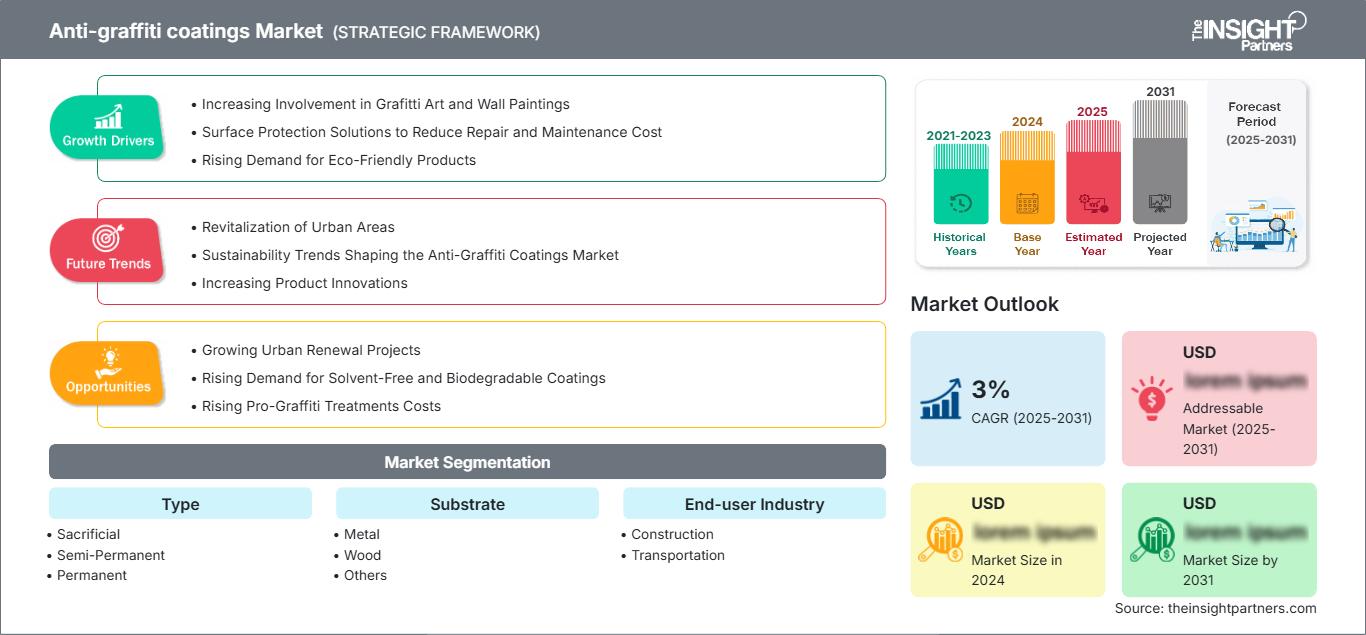
The anti-graffiti coatings market is valued at US$ 95.81 Million in 2025 and is projected to reach US$ 125.37 Million by 2034, expanding at a CAGR of 3.03% during 2026–2034. The demand will be driven by the need for infrastructure maintenance, protection of urban assets, and coating technologies that facilitate effective removal of graffiti without affecting the aesthetics of the substrate. The construction and transportation industries will continue to dominate, with the permanent systems becoming increasingly popular where multiple cleaning cycles are anticipated.
North America is likely to retain its leadership role, due to the need for infrastructure renovation, improvement of the transport system, and existing demand for coatings. North America Anti-Graffiti Coatings Market Size is expected to register a growth rate of 3.0–3.5% CAGR in 2026-2034. Strict VOC regulations are also stimulating the manufacturers to create environmentally friendly products for bridges, railways, and public buildings.
Anti-graffiti coatings Market Assessment and Insights
- North America: North America is estimated to hold a 39–43% share in 2025 and expand at a 3.0–3.5% CAGR between 2026–2034, supported by transit refurbishment, municipal maintenance, and established protective-coating procurement.
- U.S.: The U.S. represents approximately 70–74% of North American demand in 2025 and is projected to grow at a 3.0–3.4% CAGR between 2026–2034, led by infrastructure maintenance.
- Europe: Europe is estimated at a 27–31% share in 2025 and is projected to grow at a 2.8–3.3% CAGR during 2026–2034, with Germany, the UK, France, Italy, and Spain supporting demand.
- Asia Pacific: Asia Pacific is estimated to account for 20–24% of global demand in 2025 and grow at a 3.5–4.1% CAGR between 2026–2034, led by China, Japan, South Korea, India, and Australia.
- Largest Segment: Permanent coatings are estimated to command a 48–52% market share in 2025, with a 3.2–3.7% CAGR during 2026–2034, reflecting repeated-cleaning requirements.
- High Growth Segment: Transportation is estimated to represent 31–35% of demand in 2025 and expand at a 3.8–4.4% CAGR during 2026–2034, supported by rail and public infrastructure.
- Key companies analyzed in detail: 3M Company; Akzo Nobel N.V.; BASF SE; CSL Silicones Inc.; E. I. du Pont de Nemours and Company; Hydron Protective Coatings; Protective Coatings International Ltd.; The Sherwin-Williams Company; Sika AG; Valspar Corporation.
Source: The Insight Partners' analysis based on proprietary research, government publications, company annual reports, investor presentations, industry databases, and expert interviews.
Development has been from temporary surface protectants to durable and easy-to-clean surface systems. Silicone, siloxane, polyurethane, and combinations are emerging to offer adhesion, weathering, UV protection, and aesthetics together. Architectures of product are becoming substrate-specific to suit the specific needs of concrete, masonry, wood, coated metal, and transport surfaces.
Future growth is forecasted to increase as cities rejuvenate their transit and infrastructure assets in addition to meeting the demands of coating companies with respect to environmental concerns. Asia-Pacific region is set to add value due to expansion of infrastructure projects, while Europe will focus on low emission coatings and durable coatings. Growth will also be towards products that decrease cleaning frequency, substrate damage, and graffiti protection along with other protection properties.
Anti-graffiti coatings Market Report Scope
| Report Attribute | Details |
|---|---|
| Market size in 2025 | US$ 95.81 Million |
| Market Size by 2034 | US$ 125.37 Million |
| Global CAGR (2026 - 2034) | 3.03% |
| Historical Data | 2021-2024 |
| Forecast period | 2026-2034 |
Anti-graffiti coatings Market Analysis
Anti-Graffiti Coatings Market development is influenced by the amount of regular maintenance costs for buildings, bridges, railway equipment, public facilities, and other infrastructure assets. Value chain includes such components as resins, silicone, polyurethane, additives, pigments, solvent/water-based components, formulation, testing, packaging, distribution, and special application. End users are more concerned about the total lifecycle maintenance cost than just the cost of the coating material itself.
Supply chain depends on the availability of specialty resins, hydrophobic additives, curing agents, and formulation know-how. The competition in this industry is based on the adhesion, clarity, abrasion resistance, ultraviolet stability, cleanability, and compatibility with current protective systems. Contracting organizations and asset owners also define certain system specification because application process, surface treatment, cleaning and recoating interval can be a significant factor in the system performance.
Differentiation from competitors depends on the breadth of formulation and technical support. Anti-Graffiti Coatings Market Report shows that multinational coating firms can use existing distribution channels, while specialty manufacturers differentiate by formulating products specific to certain substrates. Examples of such firms are the Sherwin-Williams Company, Sika AG, Akzo Nobel N.V., and PPG Industries, Inc.
Investment in development is focused on water-based and low emission formulations, durable siloxanes, and coatings resistant to cleaning cycles. Among these players, the 3M Company is developing technologies of graffiti-resistant coatings, while Sika AG is developing permanent anti-graffiti coatings for concrete, masonry, wood, and other similar substrates. Similarly, Akzo Nobel N.V. and The Sherwin-Williams Company develop technologies needed for transportation and architectural needs.
● REPORT CUSTOMIZATION
Tailor This Report To Align With Your Specific Business Requirements
This report can be customized to align precisely with your business objectives, scope, and target markets. Customization options include tailored segmentation, geography, competitive analysis, and strategic insights to support informed decision-making.
Customize This Report →WHAT YOU CAN ADJUST
- ● Segmentations
- ● Geography
- ● Competitive Analysis
- ● Language Preferences
Anti-graffiti coatings Market: Strategic Insights
Regional Insights
North America anti-graffiti coatings market
North America is expected to comprise 39–43% of Anti-Graffiti Coatings Market Share in 2025 and is anticipated to grow at a rate of 3.0–3.5% CAGR during 2026-2034. The U.S. leads regional demand, aided by transportation systems, public buildings, bridges, railroads, and city maintenance projects. More emphasis is being placed on coatings that can be cleaned repeatedly without significant damage to the substrate material.
Canada is a contributor through infrastructure renewal, transit development, and maintenance of commercial properties. More regional standards include coatings with low VOC content, good adhesion, UV protection, and the ability to be applied on concrete, masonry, metal, and previously coated surfaces. The need to continually remove graffiti, combined with the availability of distribution channels for protective coatings, drives replacement demand.
U.S. anti-graffiti coatings Market
The U.S. represents approximately 70–74% of North American demand in 2025 and is expected to register a 3.0–3.4% CAGR through 2034. Demand is concentrated in transportation infrastructure, bridges, rail facilities, municipal buildings, schools, commercial properties, and public spaces. The Sherwin-Williams Company, 3M Company, Sika AG, and other coating suppliers serve varied infrastructure applications.
The process of procurement is starting to look at such aspects as the maintenance of the system, its cleaning frequency, VOC compliance, and compatibility with the substrates. Water-based polyurethane and siloxane systems have attracted much interest due to the fact that they are resistant to graffiti but flexible in their application and produce less emission.
Europe anti-graffiti coatings Market
Europe is expected to have a 27–31% market share in 2025 and is predicted to register a 2.8–3.3% CAGR during 2026-2034, wherein Germany will account for the dominant regional market. The UK, Germany, France, Italy, and Spain drive the market demand via infrastructure revamping, public transport, construction, and municipality asset management.
The UK maintains steady demands through rail stations, public buildings, bridge structures, and city redevelopment. Germany gains from industrial coating experience and transportation network whereas France, Italy, and Spain gain demand via construction renovation, rail renovation, tourist infrastructure development, and municipality asset management. European buyers are more interested in low emission formulas, durability, and standard-compliant protective coating.
APAC anti-graffiti coatings Market
Asia Pacific is estimated to account for 20–24% of global demand in 2025 and is projected to register a 3.5–4.1% CAGR through 2034, making it the fastest-growing major region. China leads regional consumption, followed by Japan, South Korea, India, and Australia. Infrastructure expansion supports new applications across transportation and construction.
Increased urban development, metro developments, improvements in the quality of public infrastructure, and increased focus on the maintenance of assets are all contributing to increased utilization. Increased local production of intermediate materials and increased technology levels are enhancing availability, while infrastructure-related policies encourage increased usage of long-lasting protection products. China continues to dominate the market, while India provides extra growth opportunities for the same.
Middle East & Africa anti-graffiti coatings Market
Demand in the Middle East & Africa region is predicted to witness a CAGR growth of about 2.6%-3.2% during the period 2026-2034. The key regional consumers of protective coatings will include Saudi Arabia and UAE along with South Africa through transportation and public facilities maintenance applications. The regional market is not as big as North America, Europe, and APAC regions.
The need for UV resistant, weather resistant and cleaning resistant coatings comes from major infrastructure projects, tourist projects, transportations, and tough climate. Saudi Arabia and UAE become critical in terms of market growth as there is a need to update the infrastructure which requires surface protection. Africa (excluding South Africa) is still an untapped market for protective coatings.
Segmentation Analysis
Type
The Type segment is projected to expand at a 2.9–3.6% CAGR during 2026–2034. Selection depends primarily on cleaning frequency, expected service life, substrate characteristics, and maintenance budgets. Permanent technologies command stronger preference where repeated graffiti removal is anticipated, while sacrificial systems remain relevant when straightforward recoating is economically preferable.
- Sacrificial: Sacrificial systems provide a removable protective layer that can be renewed after graffiti cleaning. They remain relevant where periodic recoating is acceptable and initial system simplicity is prioritized.
- Semi-Permanent: Semi-permanent coatings balance durability and maintenance flexibility, making them suitable for assets requiring multiple cleaning cycles without the full lifecycle commitment associated with permanent systems.
- Permanent: Permanent systems provide durable protection against repeated graffiti exposure and are strategically important for bridges, transit facilities, public buildings, and other assets where frequent recoating would disrupt operations.
Substrate
The Substrate segment is expected to register a 2.8–3.5% CAGR during 2026–2034. Performance varies according to porosity, surface energy, existing coatings, moisture movement, and preparation requirements, making substrate compatibility central to product selection and specification.
- Metal: Metal substrates require strong adhesion and resistance to cleaning chemicals, weathering, and corrosion-related deterioration. Demand is relevant for rail equipment, transport structures, signs, barriers, and architectural metalwork.
- Wood: Wood applications require coatings that maintain surface appearance while managing moisture movement and adhesion. Demand is concentrated in public amenities, architectural structures, recreational facilities, and treated exterior wood.
- Others: This category includes diverse surfaces outside the principal metal and wood classifications and requires formulation flexibility because surface porosity, finish, and maintenance conditions can vary considerably.
End-user Industry
The End-user Industry segment is forecast to grow at a 3.1–3.8% CAGR during 2026–2034. Infrastructure operators increasingly evaluate protective coatings as part of asset-management programs, linking surface protection with maintenance efficiency, appearance retention, and cleaning requirements.
- Construction: Construction represents the largest end-user environment, covering commercial buildings, public structures, bridges, facades, walls, and refurbishment projects where graffiti prevention can reduce recurring cleaning and repainting.
- Transportation: Transportation applications include rail infrastructure, stations, road structures, transit facilities, and related assets. The segment benefits from requirements for durable surfaces that can withstand repeated cleaning and environmental exposure.
Opportunity Snapshot
| Industry Vertical | Revenue Contribution | Trend Tag | Adoption Stage |
|---|---|---|---|
| Construction | High | Urban Protection | Mature |
| Transportation | Medium | Transit Protection | Scaling |
Anti-graffiti coatings Market Growth Drivers and Impact Analysis
Expansion of Urban and Public Transportation Infrastructure
Urban transportation expansion increases the number of exposed assets requiring protection from repeated vandalism and surface marking. Rail stations, bridges, retaining structures, transit shelters, road infrastructure, and public buildings create recurring demand because graffiti removal can require labor, cleaning equipment, traffic control, and subsequent repainting. Transportation authorities therefore increasingly evaluate protective coatings within broader asset-maintenance programs. The market impact extends beyond coating volumes because specifications can favor durable systems capable of repeated cleaning without substantial loss of adhesion or appearance. As metropolitan areas expand rail and public infrastructure, suppliers with established transportation references can gain access to larger specification-driven projects. This driver also supports demand for transparent and low-emission products suitable for visible architectural and infrastructure surfaces.
Greater Focus on Lifecycle Maintenance Costs
Infrastructure owners are increasingly evaluating coatings according to total maintenance requirements rather than purchase price alone. Repeated graffiti removal can damage conventional painted surfaces, increase labor requirements, and require repeated repainting. Durable anti-graffiti systems can alter this cost structure by allowing markings to be removed with less aggressive cleaning procedures. The economic effect is particularly relevant for assets with frequent vandalism exposure, where maintenance intervals influence operating budgets. Product selection consequently depends on cleaning-cycle performance, adhesion retention, weathering behavior, and compatibility with the underlying substrate. This lifecycle perspective encourages higher-value coating specifications and creates opportunities for suppliers capable of demonstrating performance through standardized testing, field trials, and documented maintenance outcomes across infrastructure environments.
Shift Toward Lower-Emission Protective Coating Technologies
Environmental requirements are influencing formulation strategies across protective coatings, particularly in densely populated urban areas where application emissions can affect worker and community exposure. Suppliers are increasingly developing waterborne polyurethane, silicone, siloxane, and hybrid systems that reduce solvent dependence while maintaining cleanability and weather resistance. The impact is strongest where public procurement incorporates environmental criteria or where local VOC restrictions affect product selection. Lower-emission formulations can also improve application conditions in enclosed or highly populated locations, including transit facilities and public buildings. However, performance requirements remain decisive because reduced VOC content must be balanced against adhesion, cure behavior, durability, and cleaning resistance. This chemistry transition is therefore encouraging formulation optimization rather than simply replacing one resin technology with another.
Anti-graffiti coatings Market Future Trends
Integration of Multifunctional Surface Protection
Future formulations are likely to combine graffiti resistance with additional protective functions such as hydrophobicity, corrosion resistance, UV protection, dirt repellency, and improved weathering. Multifunctional systems can reduce the number of coating layers required while simplifying maintenance specifications across complex infrastructure. Development priorities will increasingly focus on transparent finishes that preserve architectural appearance and maintain performance after repeated cleaning. Suppliers may also differentiate products through substrate-specific formulations rather than generic protection. The anti-graffiti coatings market trends therefore point toward coating systems designed around complete asset-protection requirements, particularly for rail, bridges, public buildings, and architectural surfaces where graffiti resistance is only one component of lifecycle performance.
Greater Use of Data-Driven Maintenance Specifications
Asset owners are expected to use maintenance records, cleaning frequency, and surface-condition data more systematically when selecting protective coatings. Instead of specifying products solely by chemistry, infrastructure operators can increasingly evaluate coating performance through cleaning cycles, service intervals, repair frequency, and total maintenance expenditure. Digital asset-management platforms can support comparisons between protected and unprotected surfaces, helping operators identify locations where durable coatings provide the strongest economic value. This approach could favor suppliers that provide standardized performance documentation and application guidance. Over time, procurement specifications may increasingly incorporate measurable lifecycle criteria, creating a clearer distinction between low-cost protective products and systems designed for demanding, repeated-maintenance environments.
Anti-graffiti coatings Market Opportunities
Targeted Expansion Across Emerging Transit Infrastructure
Rapid development of metro, rail, airport, and public-transport infrastructure creates opportunities for coating suppliers to establish specifications before projects reach procurement stages. Emerging markets can be particularly attractive where new infrastructure is being constructed alongside urban redevelopment because protective requirements can be integrated during design rather than retrofitted after graffiti incidents occur. The anti-graffiti coatings market Forecasts indicate that transportation should remain an important expansion area as infrastructure operators seek longer maintenance intervals. Suppliers can pursue opportunities through engineering consultants, contractors, coating applicators, and infrastructure owners. Systems combining graffiti resistance with corrosion, weather, or hydrophobic protection may offer stronger project relevance than standalone products, particularly for exposed structures subject to multiple environmental stresses.
Development of Substrate-Specific Sustainable Systems
A second opportunity lies in developing lower-emission products tailored to individual substrates and cleaning conditions. Concrete, masonry, wood, and metal differ substantially in porosity, moisture behavior, adhesion requirements, and tolerance to cleaning methods. Products engineered around these differences can reduce application failures and improve lifecycle performance. Sustainable formulations can strengthen the value proposition where procurement policies prioritize environmental performance, but development should preserve durability and cleaning resistance. Suppliers can also differentiate through primers, activators, and complete application systems rather than standalone topcoats. This approach may create higher-value specification opportunities by addressing surface preparation, coating compatibility, maintenance procedures, and long-term protection within one technical offering.
Recent Developments
- March 20, 2026: Evonik Industries AG launched Protectosil ECO-TRETE ANTIGRAFFITI, a new silane-based anti-graffiti solution with unintentionally added PFAS. The product is designed for durable facade protection and graffiti removal without residues and was presented at EUROCOAT 2026 in Paris. This is particularly relevant to the market because it directly reflects the shift toward PFAS-alternative chemistry and repeated-cleaning performance.
- January 17, 2025: Fosroc International Limited launched Nitocote AG at the Bridges Conference 2025 for infrastructure applications. The silicone-elastomer coating provides non-sacrificial protection against permanent markers and aerosol paints, with graffiti removable using cold water. Fosroc states that the coating can typically withstand up to 20 graffiti-removal cycles without compromising protection, making the development directly relevant to transportation infrastructure.
Frequently Asked Questions

- Comprehensive Market Sizing and Forecast Analysis
- Detailed Segmentation Analysis
- In-Depth Market Dynamics Assessment
- Regional and Country-Level Insights
- Competitive Landscape and Company Benchmarking
- Strategic Business Intelligence
Recent Reports
Testimonials

The Insight Partners' SCADA System Market report is comprehensive, with valuable insights on current trends and future forecasts. The team was highly professional, responsive, and supportive throughout. We are very satisfied and highly recommend their services.
RAN KEDEM Partner, Reali Technologies LTDs
I requested a report on a very specific software market and the team produced the report in a few days. The information was very relevant and well presented. I then requested some changes and additions to the report. The team was again very responsive and I got the final report in less than a week.
JEAN-HERVE JENN Chairman, Future Analytica
We worked with The Insight Partners for an important market study and forecast. They gave us clear insights into opportunities and risks, which helped shape our plans. Their research was easy to use and based on solid data. It helped us make smart, confident decisions. We highly recommend them.
PIYUSH NAGPAL Sr. Vice President, High Beam Global
The Insight Partners delivered insightful, well-structured market research with strong domain expertise. Their team was professional and responsive throughout. The user-friendly website made accessing industry reports seamless. We highly recommend them for reliable, high-quality research services
YUKIHIKO ADACHI CEO, Deep Blue, LLC.
This is the first time I have purchased a market report from The Insight Partners.While I was unsure at first, I visited their web site and felt more comfortable to take the risk and purchase a market report.I am completely satisfied with the quality of the report and customer service. I had several questions and comments with the initial report, but after a couple of dialogs over email with their analyst I believe I have a report that I can use as input to our strategic planning process.Thank you so much for taking the extra time and making this a positive experience.I will definitely recommend your service to others and you will be my first call when we need further market data.
JOHN SUZUKI President and Chief Executive Officer, Board Director, BK Technologies
I wish to appreciate your support and the professionalism you displayed in the course of attending to my request for information regarding to infectious disease IVD market in Nigeria. I appreciate your patience, your guidance, and the fact that you were willing to offer a discount, which eventually made it possible for us to close a deal. I look forward to engaging The Insight Partners in the future, all thanks to the impression you have created in me as a result of this first encounter.
DR CHIJIOKE ONYIA MANAGING DIRECTOR, PineCrest Healthcare Ltd.Reason to Buy
- Informed Decision-Making
- Understanding Market Dynamics
- Competitive Analysis
- Identifying Emerging Markets
- Customer Insights
- Market Forecasts
- Risk Mitigation
- Boosting Operational Efficiency
- Strategic Planning
- Investment Justification
- Tracking Industry Innovations
- Aligning with Regulatory Trends





 Get Free Sample for