
Anti-Icing Coating Market Growth, Trends & Forecast by 2034
Coverage: By Substrate (Metals, Glass, Concrete and Ceramics); End Use Industry (Automotive and Transportation, Renewable Energy, Communication Equipment, Construction, Others) , and Geography (North America, Europe, Asia Pacific, and South and Central America)
- Status : Data Released
- Report Code : TIPRE00006082
- Category : Chemicals and Materials
- No. of Pages : 150
- Available Report Formats :


- Last update date : August 28, 2026


2025 Market Size
US$ 2.00 Bn
Base year value
2034 Forecast
US$ 12.84 Bn
Projected by 2034
CAGR 2026-2034
22.95 %
Growth rate
Addressable Market
US$ 58.08 Bn
(2026-2034)
The Anti-Icing Coating Market is valued at US$ 2.00 Billion in 2025 and is projected to reach US$ 12.84 Billion by 2034, expanding at a 22.95% CAGR during 2026–2034. The demand for such coating materials will continue growing as more applications for wind turbine blades, vehicle sensors, aircraft-related surfaces, communication devices, and infrastructure subject to freezing temperatures emerge. The market is currently experiencing changes and evolving from the traditional approach to icing removal to new passive and multifunctional surface technologies.
North America is characterized as an existing base for technologies and applications, where anti-icing coating market size is driven by the presence of wind energy plants, transportation infrastructure, aerospace industry, and cold-resistant investments. It is projected to grow at a CAGR of 20.8%-22.4% during 2026-2034.
Anti-Icing Coating Market Assessment and Insights
- North America accounted for a modeled 31–35% share in 2025 and is estimated to grow at a 20.8–22.4% CAGR between 2026–2034, supported by renewable-energy assets, aerospace applications, vehicle sensor protection, and infrastructure exposed to freezing precipitation.
- US represented 76–80% of North American demand in 2025, with a modeled 20.5–22.1% CAGR during 2026–2034, supported by wind power, transportation, defense, and advanced materials development.
- Europe held a modeled 27–31% share in 2025 and is estimated to expand at a 21.7–23.4% CAGR during 2026–2034, led by Germany, the UK, France, Sweden, and Denmark through wind-energy deployment and winter infrastructure requirements.
- Asia Pacific represented 24–28% share in 2025 and is projected to register a 24.0–26.1% CAGR between 2026–2034, with China, Japan, South Korea, India, and Australia supporting demand through renewable energy, transportation, and advanced manufacturing.
- Largest Segment – Metals held a modeled 45–49% market share in 2025, growing at 22.1–23.8% CAGR during 2026–2034, reflecting extensive use across vehicles, turbines, communication equipment, and infrastructure.
- High Growth Segment – Renewable Energy represented 25–29% share in 2025, with a projected 25.0–27.2% CAGR during 2026–2034, driven by wind-turbine blade icing mitigation and increasing winter-weather exposure.
- Key companies analyzed in detail: Aerospace and Advanced Composites GmbH, CG2 Nanocoatings Inc., Cytonix LLC, Fraunhofer-Gesellschaft, Helicity Technologies, Kiss Polymers LLC, NEI Corporation, NeverWet, Oceanit, Opus Materials Technologies.
Source: The Insight Partners' analysis based on proprietary research, government publications, company annual reports, investor presentations, industry databases, and expert interviews.
Technological evolution is progressing beyond basic water repellency to more advanced icephobic architectures incorporating low surface energy, lubricating interfaces, photothermal properties, phase change materials, and increased substrate adhesion strength. New studies are additionally focusing on durability for repetitive icing and abrasion, while companies are currently developing their coatings for full-scale turbine blades and other transportation-related parts instead of merely testing laboratory contact angles. This will increase the applicability of passive anti-ice technologies.
Investments will continue to evolve to include multifunctional coatings with additional functionalities such as anti-corrosion, self-cleaning, abrasion resistance, and thermal management. Cold regions rich with wind energy will continue to be key commercialization areas, but sensors and communication devices, solar panels, and other infrastructure are additional applications. Concerns about the environment will also drive fluorine-free, water-based, low-VOC, and solvent-free formulations.
Anti-Icing Coating Market Report Scope
| Report Attribute | Details |
|---|---|
| Market size in 2025 | US$ 2.00 Billion |
| Market Size by 2034 | US$ 12.84 Billion |
| Global CAGR (2026 - 2034) | 22.95% |
| Historical Data | 2021-2024 |
| Forecast period | 2026-2034 |
Anti-Icing Coating Market Analysis
Anti-Icing Coating Market growth prospects are directly linked to the cost of downtime associated with icing on important equipment. The coatings producers offer polymeric binders, nanoparticles, silicones, fluorinated or fluorine-free modifiers, phase-change materials, and functional additives to formulators, who in turn produce application-specific formulations. The applicators, turbine maintenance firms, transportation companies, and infrastructure owners comprise the downstream market ecosystem.
The supply dynamics depend upon the level of formulation complexity. General purpose binders and additives may be supplied via traditional chemical networks, whereas the specialized nanomaterials, surface modifiers, and functional ingredients add a degree of differentiation to the equation. The demand is thus driven not only by the quantities of the coatings sold, but also by the necessary properties such as adhesion, ice detachment strength, abrasion resistance, UV stability, and compatibility with other protective coatings.
The economic drivers of the application of coatings to decrease need for ongoing heating, removal mechanically, or chemically become stronger. One of the examples of such applications is wind turbines, which might be affected by icing of blades. Another application niche lies in automotive area and concerns the development of solutions that will help with sensors, cameras, radar-related surfaces, and other external parts of vehicles where icing might impair their functionality. Communication infrastructure also becomes an example of a niche for such coatings.
The Anti-Icing Coating Market Report highlights competitive environment shows that it is fragmented and includes coating developers specializing in the area, nanotech companies, R&D facilities, and diversified materials producers. Among the players are Aerospace and Advanced Composites GmbH, CG2 Nanocoatings Inc., Cytonix LLC, Helicity Technologies, Kiss Polymers LLC, NEI Corporation, NeverWet, Oceanit, and Opus Materials Technologies – technology companies; Fraunhofer-Gesellschaft – R&D and testing company. Increasing importance of durability in competitive positioning shows that the investment is shifting toward products that would allow low ice adhesion to be achieved even after multiple freeze-thaw cycles, abrasions, UV radiation, and mechanical loads.
● REPORT CUSTOMIZATION
Tailor This Report To Align With Your Specific Business Requirements
This report can be customized to align precisely with your business objectives, scope, and target markets. Customization options include tailored segmentation, geography, competitive analysis, and strategic insights to support informed decision-making.
Customize This Report →WHAT YOU CAN ADJUST
- ● Segmentations
- ● Geography
- ● Competitive Analysis
- ● Language Preferences
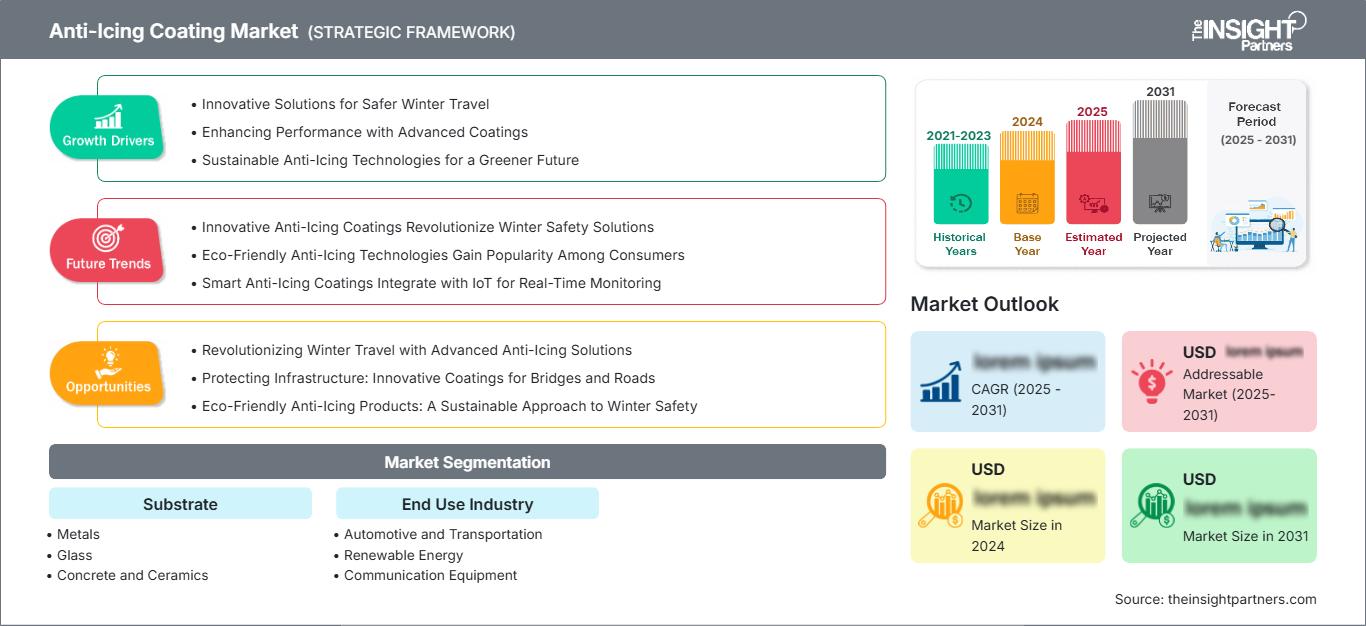
Anti-Icing Coating Market: Strategic Insights
Regional Insights
North America anti-icing coating market
North America holds a Anti-Icing Coating Market share of 31–35% in 2025 and is estimated to witness growth at 20.8–22.4% CAGR between 2026 and 2034. The US leads in regional consumption with its large wind assets, aerospace industry, transport infrastructure, and developments of icephobic surfaces. Canada provides its contribution with cold weather infrastructure, renewable energy sources, aviation, and utilities.
Increasing trend in regional demand includes development of passive technologies that would assist rather than replace heating and mechanical technologies. Wind-turbine users form an important customer category along with vehicle sensors and communication systems. The aerospace industry creates a need for coatings with specific surface properties, durability, and compatibility with deicing fluids. North American suppliers give additional emphasis to low-VOC and fluorine-free technologies.
U.S. anti-icing coating Market
The US represented 76–80% of North American demand in 2025 and is estimated to expand at 20.5–22.1% CAGR through 2034. Demand spans wind turbines, aircraft-related components, vehicles, communications infrastructure, and specialized industrial equipment. Technology development benefits from established materials research and a large installed base of assets operating across different winter climates.
The applications in the automotive industry have become popular due to the increasing dependence on external sensors and cameras for the development of advanced driver assistance systems. According to General Motors Company, it was revealed in January 2025 that anti-icing coatings for vehicle sensors and components have been patented, indicating the significance of anti-icing as a performance-affecting factor. The technology is based on the mixing of various phases of materials.
Europe anti-icing coating Market
In 2025, Europe had a modeled 27–31% share, with Germany being the leader in the region. The market is estimated to grow at a rate of 21.7–23.4% CAGR until 2034, thanks to offshore and onshore wind installations, aircraft, cold weather transport, and studies in surface engineering.
Examples of applications of importance for the region include the United Kingdom and Germany. The United Kingdom has many activities involving offshore wind farms, in addition to harsh marine weather conditions. Germany combines wind turbine manufacturing, vehicle manufacture, experience with coatings in industries, and research opportunities. Other countries include France, Italy, Spain, Sweden, and Denmark, which make their contributions through renewables, transportation, aerospace, and specialty materials.
European buyers are considering lifecycle performance, environmental compliance, and compatibility with the existing protective coatings.
APAC anti-icing coating Market
APAC held a modeled 24–28% share in 2025 and is expected to achieve the fastest regional expansion at 24.0–26.1% CAGR during 2026–2034. China leads, followed by Japan, South Korea, India, and Australia. Wind energy, transport, electronics, and cold-region infrastructure support adoption.
Combining renewables capacity installation with growing materials science and manufacturing is seen in China. Advanced electronics and transportation technology is favored in Japan and South Korea, whereas India and Australia present growth prospects in renewable energy and infrastructure areas. Public support for renewable power generation, materials science, and infrastructure enhances the addressable market applications.
Middle East & Africa anti-icing coating Market
Middle East & Africa presents another opportunity with a modeled CAGR of 11.0–14.0% from 2026 to 2034. Saudi Arabia and the UAE are constructing special infrastructure and renewable energy projects, whereas South Africa is contributing via wind power production, transportation and industry-related applications. High altitude and cold climate conditions generate local opportunities.
The Kingdom of Saudi Arabia continues to be an important regional investment destination, albeit with icing opportunities being limited to certain facilities and not dependent on climatic conditions. South Africa and certain African countries located in the northern and eastern parts of the continent are more relevant in terms of renewable energy facilities at high altitudes.
Segmentation Analysis
Substrate
Substrate selection determines coating adhesion, thermal behavior, surface preparation, durability, and compatibility with existing protective systems. The segment is estimated to expand at 21.8–23.7% CAGR during 2026–2034, with metals retaining the largest position because they are extensively used in vehicles, turbines, communication structures, and infrastructure.
- Metals – Metal substrates represent the leading demand base because aluminum and steel structures require protection from ice accumulation while retaining corrosion resistance, mechanical strength, and adhesion under repeated environmental exposure.
- Glass – Glass applications are concentrated in visibility-critical and communication-related surfaces where ice accumulation can impair transparency, optical performance, sensing, or signal transmission, increasing interest in thin, transparent functional coatings.
- Concrete and Ceramics – Concrete and ceramic substrates provide opportunities in infrastructure and specialized equipment, particularly where freezing conditions create adhesion, surface deterioration, or operational challenges requiring passive ice-release properties.
End Use Industry
The End Use Industry segment is projected to grow at 22.4–24.8% CAGR during 2026–2034, with renewable energy emerging as the most dynamic application area. Adoption depends on asset criticality, icing frequency, maintenance economics, and the ability to apply coatings without modifying core equipment.
- Automotive and Transportation – Demand centers on exposed sensors, cameras, external components, rail equipment, and transportation infrastructure where ice accumulation can affect visibility, sensing, aerodynamics, or operating reliability.
- Renewable Energy – Wind energy represents the principal opportunity, as blade icing can reduce aerodynamic efficiency, increase imbalance, raise maintenance requirements, and create operational interruptions during freezing weather.
- Communication Equipment – Antennas, communication structures, outdoor sensors, and related equipment require passive protection where ice can add weight, interfere with signal-related components, or increase maintenance frequency in cold climates.
- Construction – Construction applications include exposed structural components and specialized infrastructure in regions experiencing freezing precipitation, with adoption influenced by coating durability, surface preparation requirements, and lifecycle maintenance economics.
Opportunity Snapshot
| End Use Industry | Revenue Contribution | Trend Tag | Adoption Stage |
|---|---|---|---|
| Automotive and Transportation | High | Sensor Protection | Scaling |
| Renewable Energy | High | Blade Protection | Scaling |
| Communication Equipment | Medium | Antenna Protection | Emerging |
| Construction | Medium | Surface Protection | Emerging |
Anti-Icing Coating Market Growth Drivers and Impact Analysis
Expansion of Wind Power in Icing-Prone Regions
Wind power is a major structural driver because turbine blades lose aerodynamic efficiency when ice accumulates on leading edges and aerodynamic surfaces. Operators in Scandinavia, North America, China, and other cold regions increasingly evaluate passive ice mitigation alongside heating, detection, and mechanical removal. Coatings can be applied during scheduled maintenance, potentially reducing intervention requirements during winter events. Their commercial value is strongest where icing causes recurring generation losses and access to turbines is difficult or expensive. Field-oriented solutions are also becoming more practical as robotic application technologies improve consistency and reduce exposure of maintenance crews. This driver broadens demand beyond laboratory development toward lifecycle-based procurement decisions involving turbine owners, blade manufacturers, maintenance contractors, and coating suppliers.
Growing Need to Protect Automotive and Electronic Sensors
Modern vehicles increasingly rely on externally exposed cameras, radar-related components, ultrasonic sensors, and other systems that can be affected by ice and contamination. An anti-icing surface can help preserve sensor functionality without relying entirely on heating or manual cleaning. The opportunity is particularly relevant to advanced driver-assistance systems because degraded sensor performance can affect perception and automated functions. Coating developers therefore face requirements beyond simple water repellency, including optical compatibility, abrasion resistance, chemical resistance, and long-term adhesion. Automotive qualification cycles are demanding, but successful adoption could create high-volume applications compared with specialized industrial assets. The sector also encourages formulation development around thin films that preserve component geometry and optical characteristics.
Pressure to Reduce Energy-Intensive Ice Removal
Conventional ice mitigation can involve heating, mechanical removal, chemical treatments, or combinations of these approaches. These methods remain necessary for many applications, but passive coatings offer a complementary pathway for reducing ice adhesion before removal becomes necessary. This creates an economic incentive where electricity, labor, access equipment, or chemicals represent substantial operating costs. Renewable-energy operators are particularly sensitive to these expenses because winter icing can coincide with difficult site conditions and reduced accessibility. Coatings that function alongside existing heating systems can therefore gain acceptance without requiring complete infrastructure redesign. The strongest commercial propositions will combine measurable ice-adhesion reduction with durability, predictable reapplication intervals, and compatibility with established maintenance procedures.
Anti-Icing Coating Market Future Trends
Multifunctional Photothermal and Icephobic Surfaces
Future formulations are likely to combine passive icephobicity with photothermal or electrothermal functionality, allowing surfaces to delay ice formation and accelerate melting when energy is available. Research published in 2026 demonstrates coatings integrating superhydrophobic behavior with photothermal and electrothermal deicing, while other work combines corrosion protection with ice mitigation. This architecture could improve reliability for wind turbines, aircraft-related surfaces, vehicles, and exposed infrastructure. The Anti-Icing Coating Market trends will therefore move beyond a single performance metric toward multifunctional surface engineering. Developers will increasingly evaluate solar absorption, thermal response, ice adhesion, mechanical durability, and environmental stability together, creating differentiated systems for specific substrates and operating environments.
Fluorine-Free and Lower-Impact Formulations
Environmental requirements and material sustainability are expected to influence formulation choices as developers investigate fluorine-free polymers, waterborne systems, bio-derived components, and inorganic fillers. Recent research has demonstrated interest in sustainable icephobic architectures using waste-derived materials and low-impact processing routes. Commercial adoption will depend on whether these alternatives can reproduce the low surface energy, durability, and weather resistance historically associated with fluorinated chemistry. Future formulations may consequently use hybrid architectures that combine silicone, polyurethane, epoxy, inorganic particles, and photothermal components. This direction could reduce environmental concerns while maintaining the surface characteristics required for repeated freeze-thaw cycles, abrasion exposure, ultraviolet radiation, and long service intervals.
Anti-Icing Coating Market Opportunities
Retrofit Programs for Existing Wind Turbine Fleets
The installed base of wind turbines provides an opportunity for retrofit coating programs because operators can improve winter performance without replacing blades or redesigning turbine systems. Suppliers can target leading edges and other ice-prone areas during scheduled maintenance windows, integrating coating application with inspection, repair, and surface preparation. Robotic application can further reduce access requirements for large turbines. The opportunity is particularly relevant to older fleets located in icing-prone regions where recurring winter losses justify maintenance expenditure. Commercial models could combine coating supply, application, inspection, and reapplication services rather than relying solely on material sales. Such approaches may improve adoption by aligning procurement with measurable asset-performance outcomes.
Sensor and Communication Surface Protection
Vehicle sensors, outdoor cameras, communication equipment, antennas, and specialized optical surfaces offer opportunities for thin, transparent, or low-profile coatings. These applications require careful control of optical transmission, electromagnetic compatibility, adhesion, and surface cleanliness, creating opportunities for higher-value formulations rather than commodity protective coatings. Suppliers can differentiate through substrate-specific formulations that withstand abrasion, cleaning chemicals, ultraviolet exposure, and temperature cycling. The Anti-Icing Coating Market Forecasts indicate that commercialization is likely to progress first in applications where a small protected surface has disproportionate operational importance. Successful qualification in one sensor or communication platform could also enable adjacent applications with similar substrate and environmental requirements.
Recent Developments
- October 21, 2025: Akzo Nobel N.V. launched its IONOMY ecosystem through its Coil & Extrusion Coatings business to accelerate adoption of energy-curing technology for coil coaters and integrated steel manufacturers. The initiative brings together materials, curing systems, software, and hardware expertise, reflecting the shift toward functional coating systems that improve curing efficiency and production performance.
- February 28, 2024: Researchers at Graz University of Technology developed an icephobic gradient polymer coating using initiated chemical vapor deposition (iCVD), creating a gradual transition between a strongly adhesive primer and an ice-repellent surface. The coating demonstrated high abrasion resistance and adhesion across multiple substrates. The technology has potential applications in aircraft de-icing and weather-exposed sensors, where reduced ice adhesion can lower de-icing requirements.
Frequently Asked Questions

- Comprehensive Market Sizing and Forecast Analysis
- Detailed Segmentation Analysis
- In-Depth Market Dynamics Assessment
- Regional and Country-Level Insights
- Competitive Landscape and Company Benchmarking
- Strategic Business Intelligence
Recent Reports
Testimonials

The Insight Partners' SCADA System Market report is comprehensive, with valuable insights on current trends and future forecasts. The team was highly professional, responsive, and supportive throughout. We are very satisfied and highly recommend their services.
RAN KEDEM Partner, Reali Technologies LTDs
I requested a report on a very specific software market and the team produced the report in a few days. The information was very relevant and well presented. I then requested some changes and additions to the report. The team was again very responsive and I got the final report in less than a week.
JEAN-HERVE JENN Chairman, Future Analytica
We worked with The Insight Partners for an important market study and forecast. They gave us clear insights into opportunities and risks, which helped shape our plans. Their research was easy to use and based on solid data. It helped us make smart, confident decisions. We highly recommend them.
PIYUSH NAGPAL Sr. Vice President, High Beam Global
The Insight Partners delivered insightful, well-structured market research with strong domain expertise. Their team was professional and responsive throughout. The user-friendly website made accessing industry reports seamless. We highly recommend them for reliable, high-quality research services
YUKIHIKO ADACHI CEO, Deep Blue, LLC.
This is the first time I have purchased a market report from The Insight Partners.While I was unsure at first, I visited their web site and felt more comfortable to take the risk and purchase a market report.I am completely satisfied with the quality of the report and customer service. I had several questions and comments with the initial report, but after a couple of dialogs over email with their analyst I believe I have a report that I can use as input to our strategic planning process.Thank you so much for taking the extra time and making this a positive experience.I will definitely recommend your service to others and you will be my first call when we need further market data.
JOHN SUZUKI President and Chief Executive Officer, Board Director, BK Technologies
I wish to appreciate your support and the professionalism you displayed in the course of attending to my request for information regarding to infectious disease IVD market in Nigeria. I appreciate your patience, your guidance, and the fact that you were willing to offer a discount, which eventually made it possible for us to close a deal. I look forward to engaging The Insight Partners in the future, all thanks to the impression you have created in me as a result of this first encounter.
DR CHIJIOKE ONYIA MANAGING DIRECTOR, PineCrest Healthcare Ltd.Reason to Buy
- Informed Decision-Making
- Understanding Market Dynamics
- Competitive Analysis
- Identifying Emerging Markets
- Customer Insights
- Market Forecasts
- Risk Mitigation
- Boosting Operational Efficiency
- Strategic Planning
- Investment Justification
- Tracking Industry Innovations
- Aligning with Regulatory Trends





 Get Free Sample for