
Antibody Purification Services Market Trends, Demand & Growth by 2034
Coverage: by Type (Physiochemical Fractionation, Class Specific Affinity, and Antigen Specific Affinity); Application (Monoclonal Antibodies, and Polyclonal Antibodies); End Use (Pharmaceutical and Biotechnology Companies, Research Companies, and Others), and Geography (North America, Europe, Asia Pacific, and South and Central America)
- Status : Data Released
- Report Code : TIPRE00023190
- Category : Life Sciences
- No. of Pages : 150
- Available Report Formats :


- Last update date : August 21, 2026


2025 Market Size
US$ 1.43 Bn
Base year value
2034 Forecast
US$ 2.72 Bn
Projected by 2034
CAGR 2026-2034
7.41 %
Growth rate
Addressable Market
US$ 18.71 Bn
(2026-2034)
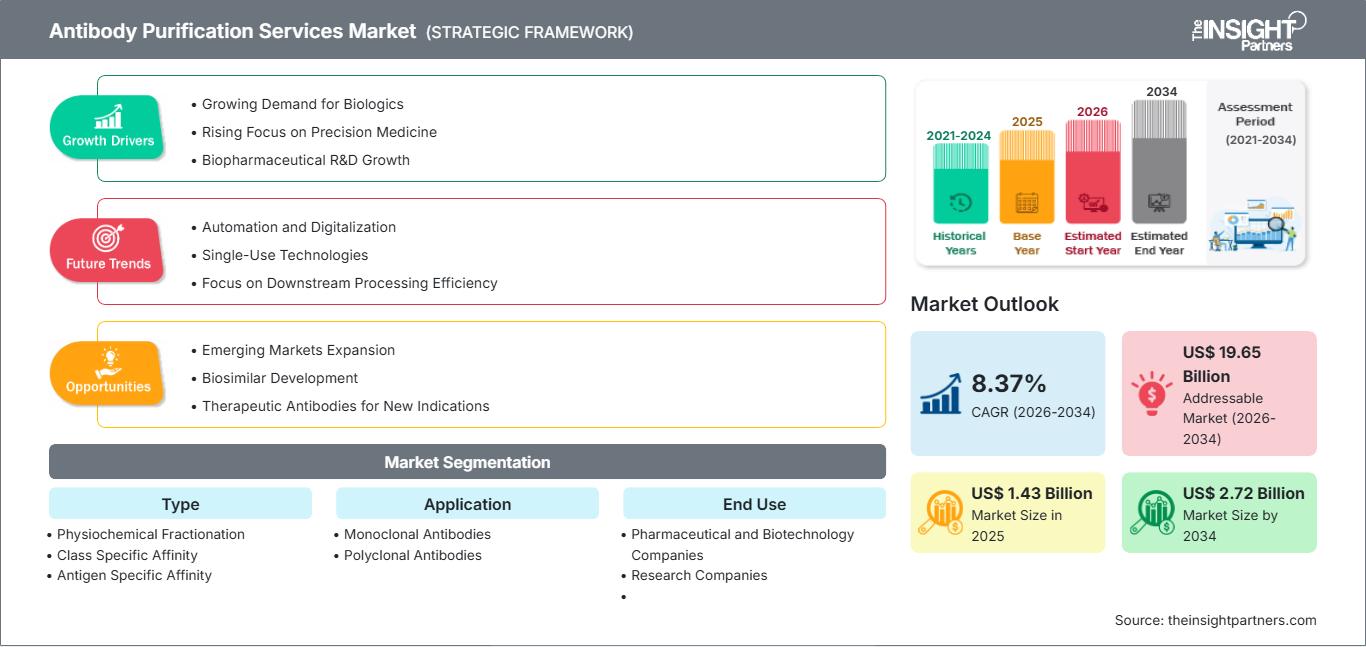
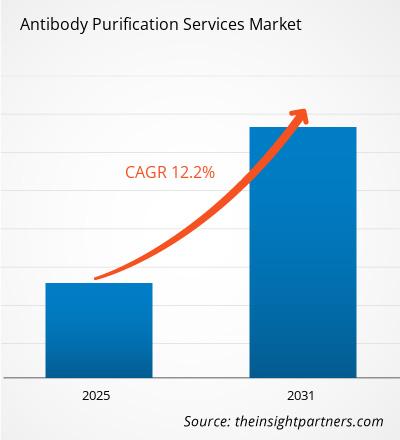
The Antibody Purification Services market was valued at US$ 1.43 billion in 2025 and is expected to reach US$ 2.72 billion by 2034; it is estimated to record a CAGR of 7.41% during 2026-2034.
Antibody Purification Services Market Assessment and Insights
- North America: North America is expected to hold a 34–38% antibody purification services Market share in 2025 and expand at an 8–9% CAGR between 2026–2034, supported by mature biopharma manufacturing, outsourced development, and extensive chromatography expertise.
- US: The US is estimated to represent 82–86% of North America's 2025 value and grow at an 8–9% CAGR between 2026–2034, led by biotechnology pipelines and specialized service providers.
- Europe: Europe is estimated at a 27–31% share in 2025, growing at a 7–8% CAGR between 2026–2034. Germany, the UK, France, Italy, and Switzerland provide established biopharmaceutical and research ecosystems supporting demand.
- Asia Pacific: Asia Pacific is estimated to account for 19–23% in 2025 and grow at a 10–11% CAGR between 2026–2034, with China, Japan, South Korea, and India benefiting from expanding biologics capacity and research outsourcing.
- Largest Segment: Physiochemical Fractionation is estimated to command a 38–42% market share in 2025 and grow at a 7–8% CAGR, reflecting broad applicability across antibody purification workflows.
- High Growth Segment: Antigen Specific Affinity is estimated at a 14–18% market share in 2025 and is projected to grow at a 10–12% CAGR as target-specific purification gains importance.
- Key companies analyzed in detail: Thermo Fisher Scientific Inc., Detai Bio-Tech Co., CUSABIO, GenScript, KMD Bioscience, SouthernBiotech, Pacific Immunology, CovaLab, Envigo, GE HealthCare, Rockland, Creative Biolabs, Abcam, BBI Solutions, KareBay Bio, HuaBio, Antibodies Inc., Davids Biotechnologie GmbH, ProSci Inc., and Bio-Rad.
Source: The Insight Partners' analysis based on proprietary research, government publications, company annual reports, investor presentations, industry databases, and expert interviews.
The antibody purification services market report indicates that the market has transitioned from largely uniform lab-scale purification to an approach that combines capture, polishing, concentration, and characterization of antibodies in application-specific workflows. While affinity chromatography still holds importance, techniques such as ion exchange, membrane separation, ultrafiltration, and process automation have gained prominence as an alternative to conventional techniques. Processes can now be customized based on the type of antibody being developed, including recombinant, monoclonal, polyclonal, bispecific, among others.
During the forecast period, service providers would focus on increasing capacity in the Asia Pacific region and adopting decentralized approaches to reach growing centers of biotech innovations. Automation of chromatographic techniques, use of single-use process equipment, analysis, and control of purification process would see increasing investments by the service providers. Increasing requirements of regulatory agencies for consistent and traceable processes would make service providers well versed in documenting antibody purification parameters and material quality important.
Antibody Purification Services Market Report Scope
| Report Attribute | Details |
|---|---|
| Market size in 2025 | US$ 1.43 Billion |
| Market Size by 2034 | US$ 2.72 Billion |
| Global CAGR (2026 - 2034) | 7.41% |
| Historical Data | 2021-2024 |
| Forecast period | 2026-2034 |
Antibody Purification Services Market Analysis
The growth of the antibody purification service market is strongly tied to the increasing prevalence of outsourcing purification techniques to the growing antibody discovery environment. This environment includes discovery laboratories, biotech firms, drug developers and CROs that are moving more and more of their complex purification processes to service providers. The value chain starts from antibody production and cell culture followed by clarification, capture, intermediate purification, polishing, concentration and testing.
The costs of the purification process include resin consumption, buffer usage, labor costs, batch size and recovery rate. Affinity media including Protein A are highly selective for the purposes of capture while polishing is achieved using ion-exchange and size-based techniques. The use of filtration techniques facilitates concentration and buffer exchange. The service providers that have a full range of capabilities are able to minimize handovers in the process.
Positioning in terms of competition is increasingly defined by the breadth of operations rather than one specific purification technique. Thermo Fisher Scientific Inc. offers infrastructure for life science and bioprocess operations, while GE HealthCare is known for chromatography and downstream processing. Sartorius AG focuses on comprehensive bioprocess solutions, while Bio-Rad Laboratories, Inc. is oriented towards intensive research and purification and analysis needs. GenScript and Creative Biolabs rely on integration of antibody development and outsourced solutions.
Specialists companies offer competitive advantage in terms of expertise in dealing with antibodies, customized conditions for purification and supporting small development projects. CUSABIO, KMD Bioscience, SouthernBiotech, Pacific Immunology, CovaLab, Rockland, HuaBio, Antibodies Inc., ProSci Inc., and Davids Biotechnologie GmbH provide services for research and development to various client groups. The focus of strategic investments is increasingly moving towards automation, intensification, single use technology, and scalable downstream solutions.
● REPORT CUSTOMIZATION
Tailor This Report To Align With Your Specific Business Requirements
This report can be customized to align precisely with your business objectives, scope, and target markets. Customization options include tailored segmentation, geography, competitive analysis, and strategic insights to support informed decision-making.
Customize This Report →WHAT YOU CAN ADJUST
- ● Segmentations
- ● Geography
- ● Competitive Analysis
- ● Language Preferences
Antibody Purification Services Market: Strategic Insights
Regional Insights
North America antibody purification services market
North America is estimated to represent 34–38% of global revenue in 2025 and expand at an 8–9% CAGR through 2034. The region benefits from concentrated pharmaceutical and biotechnology activity, sophisticated laboratory infrastructure, and extensive adoption of outsourced development services. The US accounts for the overwhelming majority of regional demand, while Canada contributes through academic research, biotechnology, and contract laboratory activity.
The ecosystem of the region offers both discovery and development purification services. The pharmaceutical industry demands more flexibility regarding the services offered during the purification process of screening, development, and preclinical production. Research organizations also increase the need for specialized antibodies and the purification process due to the lack of investment in chromatography equipment and specialized staff by biotechnology organizations.
U.S. antibody purification services market
The US is estimated to account for 82–86% of North American revenue in 2025 and grow at an 8–9% CAGR through 2034. Its position reflects a large biopharmaceutical pipeline, extensive venture-backed biotechnology activity, and established outsourcing relationships. Thermo Fisher Scientific Inc., GE HealthCare, Bio-Rad Laboratories, Inc., GenScript, Creative Biolabs, Abcam, and other specialists maintain market-facing capabilities across research and bioprocess applications.
Applications include discovery and characterization of antibodies to development and optimization of processes. Small biotech firms place high importance on outsource purification because service agreements allow the utilization of chromatography know-how without necessitating the construction of facilities. Big pharmaceutical corporations employ outsource only when additional capacity is needed for special molecules and development projects where fast process adaptations are required.
Europe antibody purification services market
It is projected that Europe will have a market share of 27-31% and grow at a CAGR of 7-8% during the period 2025 to 2034. Germany is expected to be the leading nation because of its biopharmaceuticals manufacturing capability and research facilities, while the UK, France, Italy, and Spain will be driving demand through their pharmaceuticals, academia, and biotechnology research.
The UK benefits from both its robust life sciences research and the availability of contract development capabilities, which leads to demand for purification and characterization services. Germany is highly advanced in its industrial sector through its bioprocessing equipment, pharmaceuticals manufacturing, and research facilities. The UK, France, Italy, and Spain drive demand through biotechnology research and pharmaceuticals research. Quality systems and reproducibility are very important to European customers.
APAC antibody purification services market
The APAC region is expected to make up 19–23% of worldwide revenue in 2025, growing at a 10–11% CAGR until 2034. The leading countries include China, Japan, South Korea, India, and Australia. The growth of biologics manufacturing, biotech investments, and government-supported initiatives in life sciences is contributing to improved regional infrastructure.
China capitalizes on the development and production of antibodies, while Japan and South Korea offer highly developed biopharmaceutical platforms. India is becoming significant in outsourcing of R&D activities, biosimilars, and pharmaceutical manufacturing, while Australia is characterized by R&D efforts. The growing need for efficient outsourcing in the region allows for business for providers that can integrate advanced technology with fast delivery and process development.
Middle East & Africa antibody purification services Market
Middle East & Africa is a small market base, but it will experience 8–10% CAGR over the next decade to 2034. The Middle East region is witnessing development through the healthcare industry, biotech investments, and infrastructural improvements, whereas South Africa is a key research and lab facility.
Regional market dynamics are being shaped by the need for increasing domestic healthcare capabilities and reducing dependency on external high-end healthcare inputs. Programs of Saudi Arabia diversification, biotechnology investment in the UAE, and South African research centers can help drive demand in the region. The rest of MEA market is fragmented and dependent on the lab facilities and partnership with international players.
Segmentation Analysis
Type
The Type segment is projected to grow at an 8–9% CAGR from 2026–2034. Demand is distributed between broad physicochemical approaches and increasingly selective affinity methods. Selection depends on antibody characteristics, required purity, available material, downstream application, and economics. Service providers increasingly combine multiple purification principles rather than relying on one method, particularly when customers require higher recovery and reproducibility.
- Physiochemical Fractionation: This established approach remains strategically important because precipitation, filtration, and related separation principles can accommodate diverse antibody materials. It is particularly relevant where scalable processing and cost control are priorities.
- Class Specific Affinity: Class-specific affinity methods provide selective antibody capture based on immunoglobulin class or subclass characteristics. Their established workflows support research and development programs requiring reproducible enrichment before polishing.
- Antigen Specific Affinity: Antigen-specific affinity offers highly targeted purification where selective recovery is critical. Its strategic value increases for specialized antibodies, difficult targets, and applications requiring stringent specificity.
Application
The Application segment is expected to advance at a 9–10% CAGR during 2026–2034. Growth reflects the expanding requirement for purified monoclonal and polyclonal antibodies across therapeutic development, diagnostics, research, and analytical workflows. Providers increasingly tailor purification strategies according to molecular complexity, intended application, batch size, and downstream characterization requirements.
- Monoclonal Antibodies: Monoclonal antibodies represent a major service demand pool because development programs require reproducible capture and polishing as candidates move from discovery toward preclinical and clinical evaluation.
- Polyclonal Antibodies: Polyclonal antibodies sustain demand across research, diagnostics, and immunoassay development. Their heterogeneous composition can require customized purification conditions to achieve appropriate specificity, recovery, and application performance.
End Use
The End Use segment is forecast to grow at a 9–10% CAGR between 2026–2034. Pharmaceutical and biotechnology companies increasingly outsource selected technical activities, while research organizations seek flexible access to specialized purification capabilities. The resulting service model allows customers to scale requirements according to project stage rather than maintaining permanent purification infrastructure.
- Pharmaceutical and Biotechnology Companies: These customers generate substantial demand through antibody discovery, development, process optimization, and preclinical programs. Outsourcing can reduce fixed investment while providing access to specialized purification expertise.
- Research Companies: Research organizations use purification services for antibody characterization, assay development, target validation, and experimental studies. Flexible batch sizes and customized protocols are particularly valuable for project-specific requirements.
Opportunity Snapshot
| Segment Name | Revenue Contribution (High/Medium/Low) | Trend Tag (MAX 2 words) | Adoption Stage (Emerging/Scaling/Mature) |
|---|---|---|---|
| Pharmaceutical and Biotechnology Companies | High | Pipeline Outsourcing | Scaling |
| Research Companies | Medium | Custom Purification | Mature |
Antibody Purification Services Market Growth Drivers and Impact Analysis
Expansion of Outsourced Biopharmaceutical Development
The concept of outsourcing is gaining significance as a model of operation when pharmaceutical and biotechnology companies have wider antibody pipelines and do not need to grow their own laboratory facilities proportionally to that growth. Purification outsourcing is especially well-suited to such a business practice since the outsourcing company can manage the chromatography system, purification materials, filters, and technical staff for several different projects. This means that the customer does not need to invest in the necessary capital for irregular or developmental needs. The practical effects of outsourcing are most significant in the case of biotech companies where they can employ specialists much earlier in the development process. Large pharmaceutical companies benefit from outsourcing overflow and special products.
Increasing Complexity of Antibody Molecules
Antibody development is moving beyond conventional molecules toward formats requiring more sophisticated separation and purification strategies. Bispecific antibodies, engineered antibodies, antibody fragments, conjugated formats, and molecules with unusual physicochemical properties can create challenges involving aggregation, charge heterogeneity, stability, and recovery. These requirements increase the value of specialized purification expertise because standardized workflows may not deliver the required purity or yield. The commercial impact extends across chromatography media selection, process sequencing, buffer optimization, and analytical verification. Providers capable of adapting purification conditions rapidly can command stronger strategic relevance in development programs. Complexity also encourages customers to evaluate suppliers based on technical problem-solving capability rather than price alone, supporting differentiation among specialized service providers and integrated bioprocess organizations.
Advancement of Automated and Intensified Downstream Processing
Automation and process intensification are changing the economics of antibody purification by improving consistency, reducing manual intervention, and enabling better use of equipment and consumables. Automated chromatography systems can standardize loading, washing, elution, and monitoring steps, while intensified workflows can improve throughput and reduce processing footprints. Digital monitoring also creates larger datasets that can support process optimization and deviation management. The impact is particularly relevant for customers moving from laboratory-scale experiments toward repeatable development processes. Service providers investing in automated platforms can manage more projects with standardized operating procedures while preserving customization where required. Over time, automation should also support better documentation and transferability, improving the attractiveness of outsourced services for customers progressing toward regulated development environments.
Antibody Purification Services Market Future Trends
Digitalized Purification Development and Data Integration
The antibody purification services market trends are expected to increasingly center on digital process development, automated data capture, and computational optimization. Providers will integrate chromatography performance, filtration behavior, buffer conditions, recovery, purity, and analytical results into connected datasets. Machine learning tools can then help identify relationships between process parameters and purification outcomes, reducing experimental cycles. Digital process records should also improve technology transfer between laboratories and development stages. Over time, customers are likely to favor providers that can deliver not only purified material but also structured process knowledge supporting downstream development decisions. This shift could transform service relationships from transactional batch execution toward data-enabled development partnerships, particularly for complex molecules requiring iterative purification optimization.
Continuous and Integrated Downstream Workflows
Future purification platforms are likely to move toward more integrated downstream workflows that connect capture, polishing, concentration, and filtration with fewer manual transfers. Continuous chromatography and intensified processing can improve equipment utilization while reducing process footprints and potentially lowering material consumption. Such systems may become particularly relevant as biopharmaceutical manufacturers seek flexible production models for increasingly diverse pipelines. Service providers can use integrated platforms to demonstrate process scalability earlier, reducing the technical gap between laboratory development and larger production environments. The resulting model favors organizations that combine purification expertise with equipment, automation, analytics, and process-development capabilities. This evolution should gradually increase the value of integrated service offerings and encourage partnerships between technology providers, contract organizations, and pharmaceutical developers.
Antibody Purification Services Market Opportunities
Regional Outsourcing Hubs in Asia Pacific
Asia Pacific offers a strategic expansion opportunity as biotechnology manufacturing and research capabilities become more distributed beyond established Western markets. China, India, South Korea, Japan, and Australia provide different demand profiles spanning therapeutic development, biosimilars, diagnostics, and academic research. Service providers can establish regional purification centers or partnerships that reduce turnaround times and address local procurement requirements. The antibody purification services market Forecasts point toward stronger adoption where customers combine cost sensitivity with expectations for international quality systems. Investment should prioritize scalable chromatography infrastructure, trained process-development teams, analytical support, and digital documentation. Localized capacity can also support multinational customers seeking regional redundancy. Partnerships with biotechnology clusters and contract research organizations may accelerate customer acquisition without requiring immediate full-scale facility deployment.
Specialized Purification for Complex Antibody Formats
Specialized purification represents an attractive investment avenue because increasingly sophisticated antibody formats can create technical requirements that general-purpose workflows cannot address efficiently. Providers can develop differentiated offerings around antigen-specific capture, difficult-to-remove impurities, aggregation control, and recovery optimization. The opportunity extends beyond therapeutic developers to diagnostics and research organizations working with highly specific targets. The antibody purification services market scope therefore includes both conventional development programs and emerging applications where molecule-specific purification becomes a critical project parameter. Providers can strengthen positioning by combining purification with analytical characterization and process development. Commercial models based on milestone packages, rapid feasibility studies, and scalable follow-on services could improve conversion from early research projects into longer-term development engagements.
Recent Developments
- July 2026: Sartorius AG reported that its Bioprocess Solutions Division generated first-half sales of EUR 1.475 billion, with operational growth of 8.3% in constant currencies. The company also expanded its Pionic platform with modules supporting intensified continuous downstream processing, including integrated multi-column chromatography and ultrafiltration workflows.
- September 2025: Thermo Fisher Scientific Inc. completed its approximately US$4.0 billion acquisition of Solventum's Purification and Filtration business. The transaction added filtration and separation technologies to Thermo Fisher's bioproduction portfolio and strengthened capabilities relevant to downstream bioprocessing.
- August 2025: GenScript announced a strategic collaboration with Bioelectronica combining single-B-cell high-throughput screening with GenScript's antibody development and expression platforms. The collaboration is intended to accelerate antibody discovery by connecting high-throughput screening, AI-supported prediction, and development capabilities.
Frequently Asked Questions

- Comprehensive Market Sizing and Forecast Analysis
- Detailed Segmentation Analysis
- In-Depth Market Dynamics Assessment
- Regional and Country-Level Insights
- Competitive Landscape and Company Benchmarking
- Strategic Business Intelligence
Recent Reports
Testimonials

The Insight Partners provided valuable market intelligence that supported our global go-to-market strategy. Their team was professional, responsive, and attentive to our feedback, providing thoughtful analysis and helpful methodological clarifications throughout the project.
Junmo Kim Chief Financial Officer (CFO), Enertech Co., Ltd.
The Insight Partners' SCADA System Market report is comprehensive, with valuable insights on current trends and future forecasts. The team was highly professional, responsive, and supportive throughout. We are very satisfied and highly recommend their services.
RAN KEDEM Partner, Reali Technologies LTDs
I requested a report on a very specific software market and the team produced the report in a few days. The information was very relevant and well presented. I then requested some changes and additions to the report. The team was again very responsive and I got the final report in less than a week.
JEAN-HERVE JENN Chairman, Future Analytica
We worked with The Insight Partners for an important market study and forecast. They gave us clear insights into opportunities and risks, which helped shape our plans. Their research was easy to use and based on solid data. It helped us make smart, confident decisions. We highly recommend them.
PIYUSH NAGPAL Sr. Vice President, High Beam Global
The Insight Partners delivered insightful, well-structured market research with strong domain expertise. Their team was professional and responsive throughout. The user-friendly website made accessing industry reports seamless. We highly recommend them for reliable, high-quality research services
YUKIHIKO ADACHI CEO, Deep Blue, LLC.
This is the first time I have purchased a market report from The Insight Partners.While I was unsure at first, I visited their web site and felt more comfortable to take the risk and purchase a market report.I am completely satisfied with the quality of the report and customer service. I had several questions and comments with the initial report, but after a couple of dialogs over email with their analyst I believe I have a report that I can use as input to our strategic planning process.Thank you so much for taking the extra time and making this a positive experience.I will definitely recommend your service to others and you will be my first call when we need further market data.
JOHN SUZUKI President and Chief Executive Officer, Board Director, BK Technologies
I wish to appreciate your support and the professionalism you displayed in the course of attending to my request for information regarding to infectious disease IVD market in Nigeria. I appreciate your patience, your guidance, and the fact that you were willing to offer a discount, which eventually made it possible for us to close a deal. I look forward to engaging The Insight Partners in the future, all thanks to the impression you have created in me as a result of this first encounter.
DR CHIJIOKE ONYIA MANAGING DIRECTOR, PineCrest Healthcare Ltd.Reason to Buy
- Informed Decision-Making
- Understanding Market Dynamics
- Competitive Analysis
- Identifying Emerging Markets
- Customer Insights
- Market Forecasts
- Risk Mitigation
- Boosting Operational Efficiency
- Strategic Planning
- Investment Justification
- Tracking Industry Innovations
- Aligning with Regulatory Trends





 Get Free Sample for