
Antibody Reagent Market Share, Growth & Forecast by 2034
Antibody Reagent Market Size and Forecasts (2021–2034), Global and Regional Share, Trends, and Growth Opportunity Analysis Report Coverage : by Product Type (Polyclonal Antibodies, Monoclonal Antibodies, Recombinant Antibodies, Single-Domain Antibodies, Bi-Specific Antibodies); Application (Cancer Diagnostics, Infectious Disease Diagnostics, Autoimmune Disease Diagnostics, Immunology Research, Drug Discovery and Development, Cell Therapy); Conjugation (Unconjugated Antibodies, Fluorophore-Conjugated Antibodies, Enzyme-Conjugated Antibodies, Magnetic Bead-Conjugated Antibodies, Gold Nanoparticle-Conjugated Antibodies); and Geography (North America, Europe, Asia Pacific, and South and Central America)
- Status : Data Released
- Report Code : TIPRE00039939
- Category : Life Sciences
- No. of Pages : 150
- Available Report Formats :


- Last update date : August 21, 2026


2025 Market Size
US$ 13.83 Bn
Base year value
2034 Forecast
US$ 23.07 Bn
Projected by 2034
CAGR 2026-2034
6.61 %
Growth rate
Addressable Market
US$ 173.77 Bn
(2026-2034)
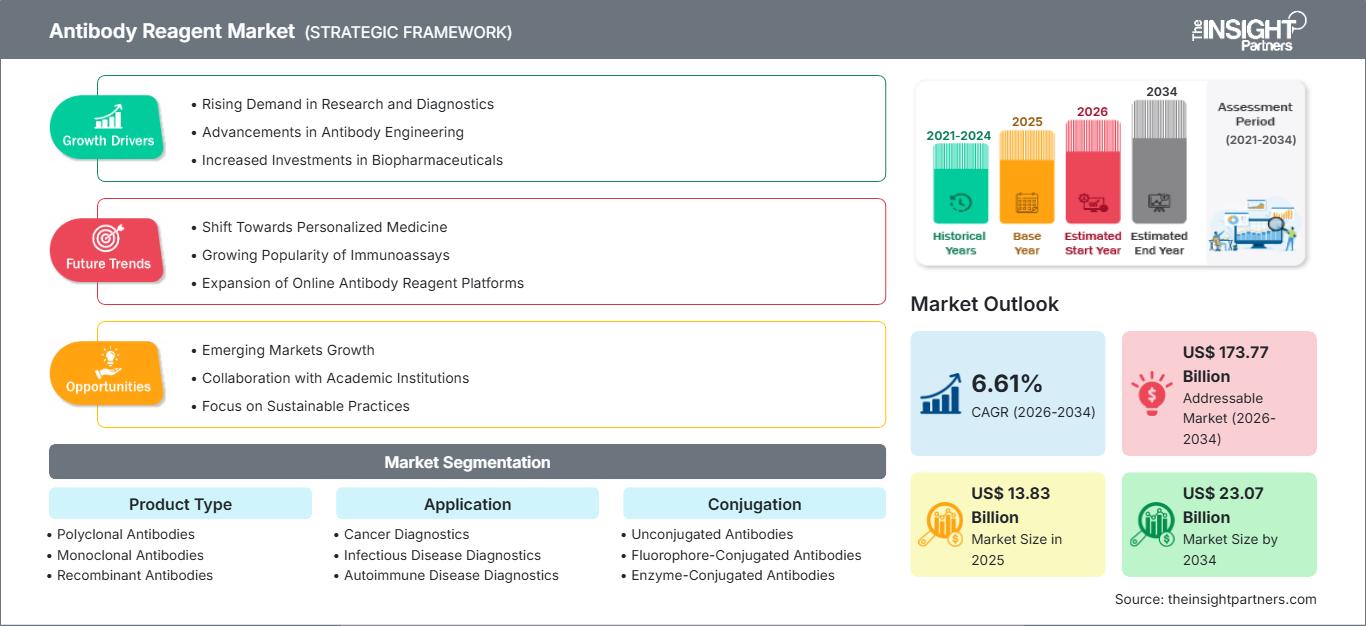
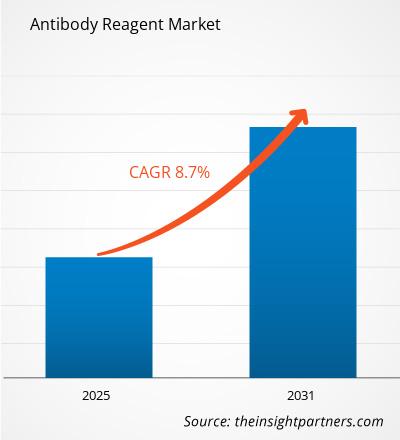
The antibody reagent market size is growing from US$ 13.83 billion in 2025 to reach US$ 23.07 billion by 2034, at a CAGR of 6.61% between 2026 and 2034. Factors driving demand include the rising number of research applications, diagnostics, drug discovery, and assays using validated antibodies. Diversification in antibody types such as monoclonal, recombinant, single domain, and bispecific, as well as developments in antibody conjugation techniques, have increased the market potential for antibody reagents in multiple multiplexing analysis systems.
North America is a structurally favorable market driven by the presence of well-established infrastructure for biomedical research, higher pharmaceutical R&D spend, and ongoing usage of highly specific antibodies. The antibody reagent market in North America is driven by the demand generated for translational research, cancer diagnostics, proteomics, and drug discovery. The market in this region grows at a projected CAGR of 6.4% to 7.0%.
Antibody Reagent Market Assessment and Insights
- North America: North America represents a leading regional market, with a modeled 2025 antibody reagent Market share of 37–41% and CAGR of 6.4–7.0% between 2026–2034. Mature research infrastructure, pharmaceutical R&D, and diagnostics sustain recurring reagent procurement.
- US: The US accounts for 82–86% of North America's 2025 value, supported by extensive biomedical research, clinical diagnostics, biotechnology development, and strong supplier networks, with CAGR of 6.3–6.9% during 2026–2034.
- Europe: Europe holds a 27–31% share in 2025 and is projected to grow at 6.0–6.7% CAGR through 2034. Germany, the UK, France, Italy, and Spain provide established pharmaceutical, academic, and diagnostic demand.
- Asia Pacific: Asia Pacific contributes 20–24% in 2025 and is expected to expand at 7.2–8.0% CAGR through 2034. China, Japan, South Korea, and India benefit from expanding biotechnology manufacturing and research capacity.
- Largest Segment: Monoclonal antibodies represent the largest segment, with a modeled 2025 market share of 38–42% and CAGR of 6.8–7.4%, reflecting specificity and reproducibility requirements.
- High Growth Segment: Recombinant antibodies are the high-growth segment, representing 15–19% in 2025 and recording a modeled CAGR of 7.4–8.2%, supported by consistency and scalable production.
- Key companies analyzed in detail: Abcam plc, Thermo Fisher Scientific Inc., Merck KGaA, Bio-Rad Laboratories, Inc., Sigma-Aldrich Corporation, Santa Cruz Biotechnology, Inc., Cell Signaling Technology, Inc., GenScript Biotech Corporation, Innovagen AB, and Rockland Immunochemicals, Inc.
Source: The Insight Partners' analysis based on proprietary research, government publications, company annual reports, investor presentations, industry databases, and expert interviews.
According to the antibody reagent market report, the market has moved away from reliance on conventional polyclonal antibodies towards more standardized monoclonal and recombinant antibodies. Improved methods of recombinant production, affinity maturation, and validation testing have increased consistency in lots. Specific conjugates have also been developed, including fluorescent, enzymatic, magnetic, and nanoparticle conjugates used in flow cytometry, immunohistochemistry, Western blotting, spatial profiling, and multiplex assays. All these factors are helping increase competition based on validation standards.
Future growth will most likely come from areas in which biotechnological capability is growing quickly, specifically in China, India, South Korea, and certain Southeast Asian markets. Regulations that stress reproducibility and quality control in the laboratory will encourage antibody suppliers that can show antibody specificity and validate use in applications. Development efforts have included investment in digital catalogs, recombinant libraries, automation, and high throughput screening technologies.
Antibody Reagent Market Report Scope
| Report Attribute | Details |
|---|---|
| Market size in 2025 | US$ 13.83 Billion |
| Market Size by 2034 | US$ 23.07 Billion |
| Global CAGR (2026 - 2034) | 6.61% |
| Historical Data | 2021-2024 |
| Forecast period | 2026-2034 |
Antibody Reagent Market Analysis
Increased linkage between research intensity, diagnostic testing, and biologic development has emerged in the antibody reagents market. The growth drivers for the antibody reagent market include research of oncology biomarkers, infectious disease surveillance, research on autoimmune diseases, and target validation. This value chain is composed of antigen design, antibody production, expression, purification, validation, conjugation, packaging, and distribution, along with technical expertise in applications. Suppliers who have the capacity for integration will be able to reduce the development time.
The procurement processes vary greatly depending on the customer type. The academic customers are interested in the performance and target diversity, whereas the pharma customers give more importance to reproducibility, documentation, scalability, and fit into the development process. The diagnostic customers require more lot control and consistency in the assay. Thus, the supply trend is moving towards recombinant antibody production, larger datasets, standardization in validation, and flexibility in packaging.
Positioning itself is becoming more reliant on product validation, application range, and library of antibodies. For that reason, the market analysis of antibody reagents goes beyond merely considering the size of the catalogs to include quality control, technology of being recombinant, conjugation, distribution and customer support. Abcam plc and Thermo Fisher Scientific Inc. have large catalog ranges, whereas Merck KGaA and Bio-Rad Laboratories, Inc. offer their antibody products within their larger life science platforms.
GenScript Biotech Corporation builds its position based on protein expression and antibody development, while Cell Signaling Technology, Inc., Santa Cruz Biotechnology, Inc., Innovagen AB, and Rockland Immunochemicals, Inc. are competing by offering specialized antibodies and research applications. The investment focus now includes recombinant libraries, compatibility with multiplex, validation records, and integration into workflows. Strategic differentiation thus moves beyond the mere number of entries in catalogs towards performance and specific application.
● REPORT CUSTOMIZATION
Tailor This Report To Align With Your Specific Business Requirements
This report can be customized to align precisely with your business objectives, scope, and target markets. Customization options include tailored segmentation, geography, competitive analysis, and strategic insights to support informed decision-making.
Customize This Report →WHAT YOU CAN ADJUST
- ● Segmentations
- ● Geography
- ● Competitive Analysis
- ● Language Preferences
Antibody Reagent Market: Strategic Insights
Regional Insights
North America antibody reagent market
North America is projected to make up 37-41% of total global value by 2025 with a CAGR of 6.4-7.0% until 2034. The United States drives regional consumption as pharmaceutical research, academic research, biotech investment, and diagnosis result in repeated need for validated antibodies. Demand from Canada arises from research at universities, translational medicine, and biotechnology.
Increasing preferences in the region lie in recombinant antibodies, application-specific antibodies, and conjugated forms that fit flow cytometry, imaging, immunohistochemistry, and multiplex applications. Presence of efficient distribution channels and sophisticated laboratories ensure reduced lead time and better documentation. The competitive nature of the region also ensures that suppliers have extensive target libraries and tailor-made solutions for their pharmaceutical and diagnostic clients.
U.S. antibody reagent Market
The United States is estimated to hold 82–86% of North America’s value for 2025 and expected to grow at a CAGR of 6.3–6.9%. This is due to its dominance because of the presence of pharmaceutical companies, biotech companies, universities, hospitals, and contract research organizations that need antibodies for their processes.
Examples of the vendors of antibody reagents in North America include Thermo Fisher Scientific Inc., Merck KGaA, Abcam plc, Bio-Rad Laboratories, Inc., and others. They cater to applications like oncology, immunology, infectious disease research, cell analysis, and drug development. Multiplex immunofluorescence, flow cytometry, spatial biology, and companion diagnostics research have been driving the requirement for application-specific conjugated antibodies.
Europe antibody reagent Market
Europe is expected to have an estimated market share of 27–31% in 2025 with the CAGR of 6.0–6.7%. Germany has the largest market share with the help of pharmaceutical research, diagnostic centers, academia, and life sciences manufacturing. The UK has its significance in biotech and translational research whereas France's contribution will be through public research and pharmaceutical sector. The demand in Italy and Spain comes from clinical research, diagnostics, and universities.
There is a growing trend in procurement that is favoring validated and reproducible products in Europe. In addition, there has been a trend towards recombinant and conjugated format products for imaging, immunophenotyping, and biomarker analysis in European laboratories. European scientific infrastructure helps in procuring high-end reagents but cost-sensitivity helps in procuring standardized formats.
APAC antibody reagent Market
The APAC region represents 20-24% of 2025 value and is estimated to register a 7.2-8.0% CAGR, thus being the fastest-growing large region. China is at the forefront of regional demand, with Japan, South Korea, India, and Australia close behind, due to the growing research infrastructure and biotech facilities.
Industrial policies, pharmaceutical localization, and enhanced lab facilities are boosting reagent consumption. India is seeing increased benefits from growing biopharmaceutical research and lab standards, with China and South Korea building up their biotechnology facilities. Research demand in Australia and Japan is mature. Growth in the region will be increasingly driven by recombinant products and application-specific antibodies.
Middle East & Africa antibody reagent Market
MEA is expected to expand at a 5.5–6.4% CAGR through 2034, with Saudi Arabia and the UAE serving as leading growth centers. South Africa remains an important research and diagnostic market, while the rest of MEA develops from a smaller base. Healthcare infrastructure investment is improving laboratory capabilities.
Saudi Arabia and the UAE are diversifying beyond energy into biotechnology and advanced healthcare, creating opportunities for research reagents. South Africa's academic and diagnostic ecosystem supports established demand. Across the remaining markets, adoption depends on laboratory modernization, import availability, distributor capability, and cold-chain reliability. Suppliers with regional technical support can therefore improve access and customer retention.
Segmentation Analysis
Product Type
Product Type remains the principal basis for differentiation, with a modeled 6.8–7.4% CAGR during 2026–2034. Monoclonal antibodies maintain strong demand because of specificity and reproducibility, while recombinant formats are gaining strategic importance. Single-domain and bi-specific formats broaden the addressable opportunity as research increasingly requires engineered binding characteristics.
- Polyclonal Antibodies: Polyclonal products remain useful where broad epitope recognition and strong signal generation are desirable. Their established use in western blotting, immunohistochemistry, and research assays sustains recurring demand.
- Monoclonal Antibodies: Monoclonal antibodies occupy a leading position because defined specificity and batch consistency support diagnostics, target validation, imaging, and pharmaceutical research workflows.
- Recombinant Antibodies: Recombinant antibodies are increasingly selected where reproducibility, scalable production, and sequence-defined manufacturing are important, particularly for translational research and standardized assay development.
- Single-Domain Antibodies: Single-domain formats offer compact molecular architecture and access to challenging targets, supporting exploratory applications in imaging, diagnostics, and next-generation research workflows.
- Bi-Specific Antibodies: Bi-specific formats support simultaneous target engagement and are particularly relevant to advanced drug discovery, immune-cell research, and increasingly sophisticated assay development.
Application
Application represents a diversified demand base and is modeled to grow at 6.4–7.1% CAGR through 2034. Cancer diagnostics and immunology research remain important, while drug discovery, cell therapy, and multiplex analysis create higher-value opportunities requiring specialized antibody characteristics.
- Cancer Diagnostics: Oncology laboratories use antibody reagents for biomarker detection, tissue characterization, immunohistochemistry, and molecularly guided research, creating sustained demand for validated target-specific products.
- Infectious Disease Diagnostics: Antibody reagents support pathogen detection, serological testing, assay development, and research into host immune responses across established and emerging infectious diseases.
- Autoimmune Disease Diagnostics: Autoimmune research and diagnostics require antibodies targeting disease-associated biomarkers, enabling immunoassays, tissue analysis, and characterization of immune dysregulation.
- Immunology Research: Immunology laboratories rely heavily on antibody-based detection for immune-cell phenotyping, signaling studies, cytokine analysis, and characterization of cellular responses.
- Drug Discovery and Development: Pharmaceutical research uses antibodies for target validation, biomarker studies, screening, mechanism-of-action analysis, and translational development, supporting demand for high-quality application-specific reagents.
- Cell Therapy: Cell therapy development increasingly requires antibodies for characterization, sorting, identity testing, and analytical workflows, supporting demand for reproducible and multiplex-compatible products.
Conjugation
Conjugation is modeled at a 7.0–7.8% CAGR from 2026–2034 as laboratories move toward multiplexed detection and quantitative analysis. Conjugated antibodies improve workflow specificity and enable integration with imaging, flow cytometry, immunoassays, and cell analysis platforms.
- Unconjugated Antibodies: Unconjugated antibodies remain foundational because laboratories can pair them with secondary detection systems, providing flexibility across multiple assay platforms.
- Fluorophore-Conjugated Antibodies: Fluorophore conjugates support flow cytometry, microscopy, and multiplex immunofluorescence, with demand driven by increasingly complex cellular and tissue analysis.
- Enzyme-Conjugated Antibodies: Enzyme-linked formats remain important in ELISA, western blotting, and immunohistochemistry where signal amplification and established workflows remain commercially practical.
- Magnetic Bead-Conjugated Antibodies: Magnetic conjugates facilitate target capture, cell separation, enrichment, and automated sample preparation, supporting higher-throughput laboratory workflows.
- Gold Nanoparticle-Conjugated Antibodies: Gold nanoparticle formats provide strong optical properties for selected diagnostic and analytical applications, particularly where visible or enhanced detection is advantageous.
Opportunity Snapshot
| Segment Name | Revenue Contribution (High/Medium/Low) | Trend Tag | Adoption Stage |
|---|---|---|---|
| Cancer Diagnostics | High | Biomarker Panels | Mature |
| Infectious Disease Diagnostics | Medium | Multiplex Serology | Scaling |
| Autoimmune Disease Diagnostics | Medium | Autoantibody Profiling | Scaling |
| Immunology Research | High | Immune Phenotyping | Mature |
| Drug Discovery and Development | High | Target Validation | Mature |
| Cell Therapy | Medium | Cell Characterization | Scaling |
Antibody Reagent Market Growth Drivers and Impact Analysis
Expansion of Precision Oncology and Biomarker Research
Growing use of biomarker-driven research is increasing the consumption of antibodies in areas such as tissue analysis, immunophenotyping, target validation, and diagnostic test development. Oncology plays a crucial role because laboratories are increasingly performing protein and cellular marker screening for multiple parameters and not just a single parameter. It alters the purchase pattern in favor of validated antibody panels, recombinant antibodies, and conjugated antibodies that suit multiplex assays. Suppliers who can prove their products' performance in specific applications gain more value since it is costly to perform inconclusive experiments due to use of poor quality reagents. Not only does the effect extend to an increase in the market size; validation information, lot-to-lot consistency, and technical assistance become factors in purchase decision-making.
Higher Reproducibility Requirements Across Biomedical Research
Reproducibility has become an increasingly important commercial issue because antibodies that have been poorly characterized may lead to variability in results and higher expenses for research projects. Researchers have started to assess their specificity, sensitivity, lot-to-lot variability, proper use and availability of documentation prior to buying the antibodies. Recombinant antibodies and manufacturers that have developed their validation programs will benefit from the change. The commercial importance of such changes is high as the higher quality of reagents allows charging more for them despite their initial price being higher. The other factor that adds importance to such trends is greater involvement of procurement departments in the standardization of the reagents used in laboratories and purchase of more preferred items repeatedly.
Rising Multiplex and High-Throughput Analytical Workflows
Multiplex analysis is increasing the value of antibodies that can operate reliably within complex workflows involving multiple targets, channels, or detection chemistries. Flow cytometry, immunofluorescence, spatial analysis, and automated screening increasingly require coordinated panels rather than isolated antibodies. This favors fluorophore-conjugated, enzyme-conjugated, and other application-specific formats. Suppliers can capture incremental value by offering compatible panels, custom conjugation, controls, and technical support instead of individual products. The commercial effect is also visible in laboratory workflow design because standardized reagent combinations can reduce preparation time and experimental variability. As high-throughput platforms become more common in pharmaceutical research and advanced diagnostics, purchasing decisions are likely to shift toward complete workflow compatibility. Vendors with broad target coverage and validated conjugation technologies will therefore have stronger opportunities to expand account penetration.
Antibody Reagent Market Future Trends
Recombinant Antibody Libraries Become the Default Quality Benchmark
The antibody reagent market trends are moving toward larger recombinant libraries supported by sequence-defined production and systematic validation. Over the forecast period, buyers are likely to increasingly compare products based on reproducibility, application evidence, affinity characteristics, and lot consistency rather than target availability alone. Recombinant production also enables suppliers to preserve successful clones and reproduce material without dependence on biological immunization cycles. This should strengthen purchasing confidence for long-duration research programs and standardized assay development. Another emerging direction is tighter integration between antibody catalogs and digital validation data, allowing researchers to compare applications, species reactivity, knockout validation, and performance information before purchase. Suppliers that make these datasets easier to interpret can differentiate their portfolios while reducing uncertainty in product selection. The result should be a gradual premiumization of high-confidence reagents.
AI-Assisted Antibody Discovery Influences Research Reagent Portfolios
Artificial intelligence is expected to influence antibody research by accelerating sequence generation, affinity prediction, developability assessment, and candidate prioritization. Its commercial effect may initially appear upstream, but downstream reagent suppliers can benefit as computationally generated candidates require experimental validation, characterization, and assay development. This creates demand for flexible research-grade reagents capable of supporting rapid iteration. Over time, suppliers may integrate computational target information with antibody catalogs, helping customers identify suitable reagents for validation experiments. The technology also creates opportunities for specialized antibodies against difficult or emerging targets where conventional discovery approaches are slower. Vendors that combine computational partnerships with laboratory validation could shorten development cycles and increase the number of commercially addressable targets. Such integration should strengthen the connection between antibody discovery platforms and routine research reagent procurement.
Antibody Reagent Market Opportunities
Localized Supply and Technical Support in High-Growth APAC Markets
The antibody reagent market Forecasts indicate meaningful commercial potential in countries where biotechnology investment is expanding faster than local reagent infrastructure. Suppliers can pursue localized inventory, regional technical support, distributor partnerships, and application laboratories in China, India, South Korea, and Southeast Asia. Local availability can reduce procurement delays and improve confidence among smaller laboratories that lack extensive technical resources. Companies can also tailor packaging sizes and product bundles to different customer economics, supporting penetration without weakening premium positioning. Partnerships with universities, biotechnology incubators, and diagnostic developers could provide access to emerging applications while generating feedback for portfolio localization. A regional strategy should prioritize products with broad research utility, followed by specialized conjugates and customized antibodies. This approach can improve market access while reducing dependence on centralized international distribution.
Workflow-Based Product Bundling for Pharmaceutical and Research Accounts
Suppliers can expand revenue per customer by moving from individual antibody sales toward application-specific workflow packages combining primary antibodies, secondary detection reagents, controls, conjugation options, and technical protocols. Such bundles can address recurring needs in oncology, immunology, cell therapy, and drug discovery while simplifying procurement. The strategy is particularly attractive for pharmaceutical and biotechnology accounts managing multiple projects because standardized products can reduce laboratory variability. Vendors can also create tiered packages for discovery, validation, and translational research, allowing customers to progress within the same supplier ecosystem. Digital ordering platforms can connect these bundles to target information and validation records, improving selection efficiency. This model offers a route to higher customer retention while reducing direct price comparison between individual catalog products and creating greater differentiation through workflow compatibility.
Recent Developments
- May 2026: GenScript Biotech Corporation launched the TurboCHO Protein Expression Kit, an antibody expression reagent designed to provide a faster, ready-to-use route for research-grade antibody and protein production. The company positioned the kit for high-throughput and AI-enabled research workflows, reflecting the growing integration of rapid expression technologies with antibody discovery and development.
- April 2025: Abcam plc received the CiteAb Antibody Supplier Succeeding in Genetics Research award and was highly commended for Recombinant Antibody Supplier of the Year. The recognition highlighted its antibody validation activities and recombinant portfolio, including products designed to improve consistency and reproducibility in genetics research and spatially informed workflows.
- January 2025: Bio-Rad Laboratories, Inc. launched TrailBlazer Tag and TrailBlazer StarBright Dye Label Kits for antibody conjugation. The kits were designed for broad antibody compatibility and long-term stability, supporting flow cytometry and western blot applications and strengthening the company's portfolio of antibody labeling technologies.
Frequently Asked Questions

- Comprehensive Market Sizing and Forecast Analysis
- Detailed Segmentation Analysis
- In-Depth Market Dynamics Assessment
- Regional and Country-Level Insights
- Competitive Landscape and Company Benchmarking
- Strategic Business Intelligence
Recent Reports
Testimonials

The Insight Partners' SCADA System Market report is comprehensive, with valuable insights on current trends and future forecasts. The team was highly professional, responsive, and supportive throughout. We are very satisfied and highly recommend their services.
RAN KEDEM Partner, Reali Technologies LTDs
I requested a report on a very specific software market and the team produced the report in a few days. The information was very relevant and well presented. I then requested some changes and additions to the report. The team was again very responsive and I got the final report in less than a week.
JEAN-HERVE JENN Chairman, Future Analytica
We worked with The Insight Partners for an important market study and forecast. They gave us clear insights into opportunities and risks, which helped shape our plans. Their research was easy to use and based on solid data. It helped us make smart, confident decisions. We highly recommend them.
PIYUSH NAGPAL Sr. Vice President, High Beam Global
The Insight Partners delivered insightful, well-structured market research with strong domain expertise. Their team was professional and responsive throughout. The user-friendly website made accessing industry reports seamless. We highly recommend them for reliable, high-quality research services
YUKIHIKO ADACHI CEO, Deep Blue, LLC.
This is the first time I have purchased a market report from The Insight Partners.While I was unsure at first, I visited their web site and felt more comfortable to take the risk and purchase a market report.I am completely satisfied with the quality of the report and customer service. I had several questions and comments with the initial report, but after a couple of dialogs over email with their analyst I believe I have a report that I can use as input to our strategic planning process.Thank you so much for taking the extra time and making this a positive experience.I will definitely recommend your service to others and you will be my first call when we need further market data.
JOHN SUZUKI President and Chief Executive Officer, Board Director, BK Technologies
I wish to appreciate your support and the professionalism you displayed in the course of attending to my request for information regarding to infectious disease IVD market in Nigeria. I appreciate your patience, your guidance, and the fact that you were willing to offer a discount, which eventually made it possible for us to close a deal. I look forward to engaging The Insight Partners in the future, all thanks to the impression you have created in me as a result of this first encounter.
DR CHIJIOKE ONYIA MANAGING DIRECTOR, PineCrest Healthcare Ltd.Reason to Buy
- Informed Decision-Making
- Understanding Market Dynamics
- Competitive Analysis
- Identifying Emerging Markets
- Customer Insights
- Market Forecasts
- Risk Mitigation
- Boosting Operational Efficiency
- Strategic Planning
- Investment Justification
- Tracking Industry Innovations
- Aligning with Regulatory Trends





 Get Free Sample for