
Antimicrobial Packaging Market Size, Share & Forecast by 2034
Coverage: By Material (Plastics, Biopolymer, Paper and Paperboard, Others); Packaging Type (Bags, Pouches, Trays, Carton packages, Others); End-Use (Food and Beverages, Healthcare, Personal care, Others) , and Geography (North America, Europe, Asia Pacific, and South and Central America)
- Status : Data Released
- Report Code : TIPRE00009931
- Category : Chemicals and Materials
- No. of Pages : 150
- Available Report Formats :


- Last update date : September 01, 2026


2025 Market Size
US$ 13.50 Bn
Base year value
2034 Forecast
US$ 23.46 Bn
Projected by 2034
CAGR 2026-2034
6.33 %
Growth rate
Addressable Market
US$ 167.22 Bn
(2026-2034)
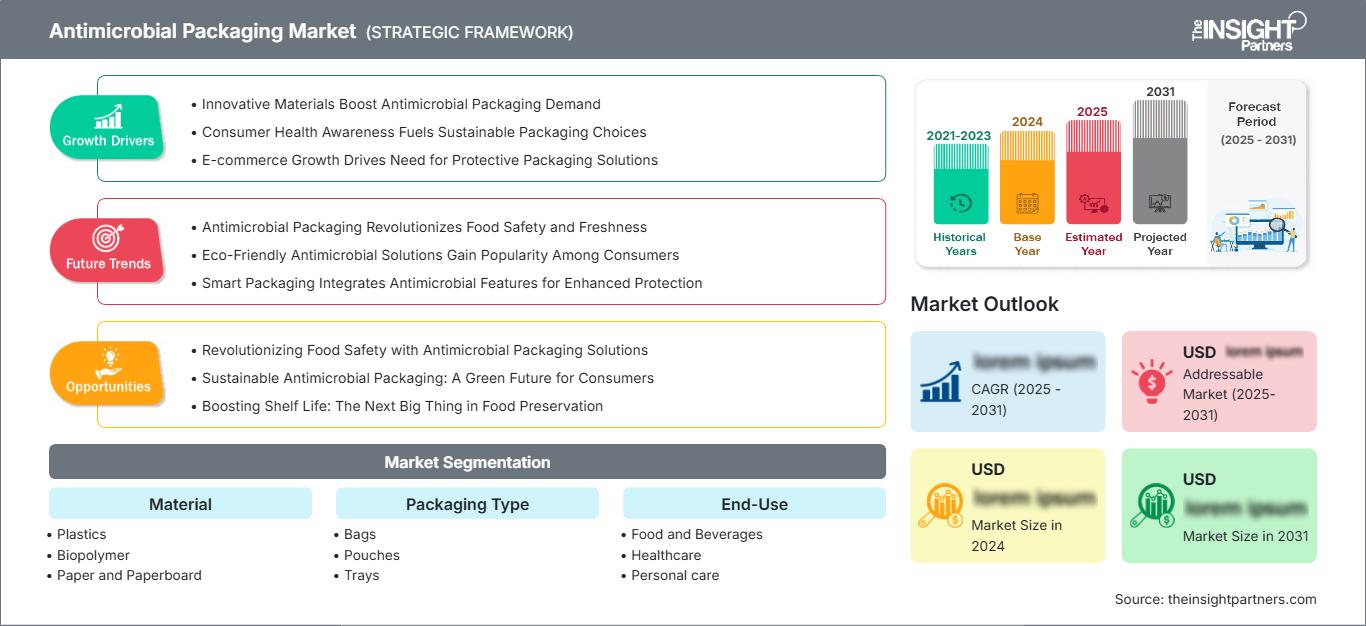
The antimicrobial packaging market size is expanding as food safety, product shelf-life, and material innovation become increasingly important across packaged goods and healthcare supply chains. The market is valued at US$ 13.50 Billion in 2025 and is projected to reach US$ 23.46 Billion by 2034, registering a CAGR of 6.33% during 2026–2034. Demand is supported by wider adoption of active packaging technologies, improved antimicrobial formulations, and growing emphasis on reducing product spoilage.
North America remains a structurally attractive market, supported by stringent food-contact requirements, established packaged-food infrastructure, and high adoption of value-added packaging technologies. The regional market is expected to expand at approximately 6.0–6.8% CAGR between 2026 and 2034. Rising demand for extended shelf life and increasing investments in recyclable packaging platforms are encouraging converters to incorporate antimicrobial functionality without materially changing existing production processes.
Antimicrobial Packaging Market Assessment and Insights
- North America: The region is estimated to account for 32–36% antimicrobial packaging market share in 2025 and expand at a 6.0–6.8% CAGR between 2026–2034, supported by food safety requirements, mature packaging conversion infrastructure, and established antimicrobial technology suppliers.
- US: The US represents approximately 78–83% of North America's 2025 share and is projected to grow at a 5.9–6.7% CAGR between 2026–2034, led by food, healthcare, and personal-care applications.
- Europe: Europe is estimated at 25–29% share in 2025, growing at a 5.8–6.6% CAGR between 2026–2034. Germany, the UK, France, Italy, and Spain are key markets, with sustainability regulations influencing material selection.
- Asia Pacific: Asia Pacific is estimated to hold 24–28% share in 2025 and register a 6.8–7.7% CAGR between 2026–2034. China, Japan, South Korea, and India are leading demand centers because of expanding food processing and packaging production.
- Largest Segment: Plastics is estimated to represent 48–53% market share in 2025, with a 6.1–6.8% CAGR between 2026–2034, reflecting processing flexibility and compatibility with antimicrobial masterbatches.
- High Growth Segment: Biopolymer is estimated at 11–15% market share in 2025, expanding at a 7.2–8.2% CAGR between 2026–2034, driven by renewable-material development and sustainability requirements.
- Key companies analyzed in detail: BASF SE, Mondi plc, The Dow Chemical Company, Avient Corporation, Dunmore Corporation, BioCote Limited, LINPAC Senior Holdings Limited, Olpon Pure Sciences Ltd., Microban International, Takex Labo Co., Ltd.
Source: The Insight Partners' analysis based on proprietary research, government publications, company annual reports, investor presentations, industry databases, and expert interviews.
The antimicrobial packaging market has progressed from simple barrier technologies to advanced functional packaging solutions for curbing the proliferation of microbes. Antimicrobial masterbatches, antimicrobial additives, antimicrobial films, antimicrobial coated paper substrates, and even biopolymer antimicrobial systems have started finding applications through extrusion, lamination, coating, and thermoforming processes. Therefore, formulation approaches in production will increasingly focus on achieving a fine balance between effectiveness against microbes, migration behavior, mechanical characteristics, recyclability, and food-contact safety.
In terms of investments, there will be a focus on bio-based antimicrobial solutions, non-migrating systems, and recycling-friendly packaging platforms during the forecast period. Asia-Pacific will become a key production location owing to capacity expansions by converters in close proximity to food processing locations. Regulations on antimicrobial materials will result in better safety, migration, and efficacy documentation being furnished by suppliers, and collaborations between additive providers and converters will boost commercialization.
Antimicrobial Packaging Market Report Scope
| Report Attribute | Details |
|---|---|
| Market size in 2025 | US$ 13.50 Billion |
| Market Size by 2034 | US$ 23.46 Billion |
| Global CAGR (2026 - 2034) | 6.33% |
| Historical Data | 2021-2024 |
| Forecast period | 2026-2034 |
Antimicrobial Packaging Market Analysis
The antimicrobial packaging market report indicates that there has been an increasing demand for packages which have capabilities for preventing food spoilage, expanding distribution window and hygienically protected products. For the market for antimicrobial packaging, the value chain includes suppliers of polymers, paper, biopolymers, antimicrobial agents and additives; then compounders; film producers; converters; packagers; brand owners and retailers. The antimicrobial property is introduced to the package through masterbatch, coating, additive or functional layer.
The supply dynamics in the antimicrobial packaging market include antimicrobial chemistry availability, resin price, converter capability and regulatory approval. Packaging made from plastic materials is comparatively easier to functionalize, as the antimicrobial additive can be introduced to the packaging material at the time of extrusion or molding. However, paper and biopolymer packaging materials require more considerations for moisture protection, coating capability, active ingredient containment and food contact migration.
Antimicrobial packaging is becoming more technology oriented because more emphasis is being laid on the efficacy, compatibility, sustainability, and the regulatory approval of antimicrobial packaging. In terms of polymers and materials expertise, companies like BASF SE and The Dow Chemical Company play significant roles in antimicrobial packaging. Mondi plc takes an active part in antimicrobial packaging through their packaging structures and paper-based antimicrobial packaging solutions. Companies like Avient Corporation, BioCote Limited, Microban International, and Takex Labo Co., Ltd. offer different antimicrobial solutions for packaging.
Antimicrobial packaging market investments in partnerships with converters and food producers will be strategic. Companies like Dunmore Corporation and LINPAC Senior Holdings Limited have relevance in antimicrobial packaging because of the specialization in specialty and food packaging. There are some technology specialist companies such as Olpon Pure Sciences Ltd. that can cater to the needs of niche antimicrobial requirements.
● REPORT CUSTOMIZATION
Tailor This Report To Align With Your Specific Business Requirements
This report can be customized to align precisely with your business objectives, scope, and target markets. Customization options include tailored segmentation, geography, competitive analysis, and strategic insights to support informed decision-making.
Customize This Report →WHAT YOU CAN ADJUST
- ● Segmentations
- ● Geography
- ● Competitive Analysis
- ● Language Preferences
Antimicrobial Packaging Market: Strategic Insights
Regional Insights
North America antimicrobial packaging market
North America is estimated to hold 32–36% antimicrobial packaging market in 2025, with the regional market expected to expand at a 6.0–6.8% CAGR through 2034. USA is the major source of demand due to highly developed technology of food processing, flexibility of packaging conversion and high consumption of packaged and convenience foods. Canadian contribution includes processed food, healthcare and specialty packaging applications.
Regulatory compliance in terms of food contact materials, antimicrobials claims and migration properties impacts product development. The preference is now given to technologies that allow for integration in regular extrusion, coating or thermoforming processes without significant modification of existing equipment. There is also demand from retail supply chains that require extended distribution times. Healthcare packaging, fresh produce, meat, dairy and ready-to-eat food products continue being relevant application areas, while sustainability demands drive product development towards recyclable structures with antimicrobial components.
U.S. antimicrobial packaging Market
The US accounts for approximately 78–83% of North America's 2025 antimicrobial packaging market and is expected to grow at a 5.9–6.7% CAGR through 2034. High volumes of food-processing activity, flexible packaging usage, and antimicrobial technology vendors ensure market growth. Evaluations of treated articles and food contact substances are critical in choosing antimicrobial chemicals.
They include applications ranging from meat and seafood to bakery products, fresh fruits and vegetables, dairy, healthcare products, and personal care products. Some companies like BASF SE, The Dow Chemical Company, Microban International, and BioCote Limited are technologically significant with their materials, additives, and antimicrobial technologies. Packaging converters are focused on low migration and recycling-friendly solutions with good mechanical performance at high processing speeds.
Europe antimicrobial packaging Market
Europe represents approximately 25–29% share in 2025 and is projected to register a 5.8–6.6% CAGR through 2034. Germany is the dominant country with its huge production of packaging materials and food-processing capabilities. The UK and France have high demand potential, while Italy and Spain are contributing to demand via processed foods and flexible packaging.
Food safety, extension of shelf life, and minimization of packaging waste are important factors for the UK packaging market, with converters looking at recyclable structures and coatings. Germany has sophisticated polymer processing capabilities combined with sustainability requirements. Food, beverages, agriculture, and personal care are driving packaging demand in France, Italy, and Spain.
APAC antimicrobial packaging Market
The antimicrobial packaging market forecasts show that Asia Pacific is estimated to represent 24–28% share in 2025, with growth of 6.8–7.7% CAGR through 2034. China still leads as the largest market, then come Japan, South Korea, India, and Australia. Growth in processed foods production and urban retail networks will drive the use of antimicrobial packaging.
China will benefit from packaging conversions on a large scale, whereas Japan and South Korea focus on advanced materials. India is becoming more important as the result of packaged foods growth and improved cold chain facilities. Demand will come from food, health care, and agriculture packaging markets in Australia.
Middle East & Africa antimicrobial packaging Market
Middle East and Africa represents a smaller but developing opportunity, with Saudi Arabia leading regional demand and the UAE acting as an important distribution and packaging hub. Growth is expected at approximately 5.5–6.4% CAGR through 2034, supported by food imports, processing investment, and infrastructure development.
Saudi Arabia benefits from food-security investments and domestic processing capacity, while the UAE supports premium food and logistics applications. South Africa remains important for processed foods and retail packaging. Rest of MEA demand is linked to imported packaged foods, healthcare distribution, and improving modern retail infrastructure. Hot climates and long transport routes strengthen the value proposition of shelf-life-extending packaging.
Segmentation Analysis
Material
The Material segment is expected to grow at approximately 6.2–6.9% CAGR during 2026–2034. Material selection depends on antimicrobial compatibility, barrier requirements, processing temperature, recyclability, migration behavior, and packaging economics. Plastics currently provide the broadest processing platform, while biopolymers are gaining attention as converters seek renewable alternatives.
- Plastics: Plastics remain the principal material platform because polyethylene, polypropylene, PET, and related polymers can accommodate antimicrobial masterbatches while retaining established extrusion, molding, and thermoforming processes.
- Biopolymer: Biopolymers are gaining strategic importance as brands pursue renewable packaging structures. Development priorities include antimicrobial stability, moisture resistance, shelf-life performance, compostability, and compatibility with existing conversion equipment.
- Paper and Paperboard: Paper and paperboard applications depend heavily on functional coatings and surface treatments. Demand is strongest where brands seek fiber-based structures while retaining barrier, hygiene, and product-protection properties.
Packaging Type
The Packaging Type segment is projected to expand at approximately 6.0–6.7% CAGR during 2026–2034. Format selection is influenced by product geometry, filling equipment, barrier requirements, handling conditions, and antimicrobial functionality. Flexible formats benefit from low material usage, while rigid formats offer structural protection.
- Bags: Bags are important for food and household applications because antimicrobial functionality can be incorporated into films without substantially changing filling and sealing operations.
- Pouches: Pouches offer strong potential where flexible barrier performance and lightweight construction are required. Antimicrobial layers can be integrated into multilayer or coated structures.
- Trays: Trays are strategically relevant for meat, seafood, fresh produce, and ready meals, where direct product contact and microbial control are closely connected with shelf-life performance.
- Carton packages: Carton packages support fiber-based sustainability objectives and can incorporate antimicrobial coatings or functional layers, particularly for food and selected healthcare applications.
End-Use
The End-Use segment is forecast to grow at approximately 6.4–7.1% CAGR during 2026–2034. Food and Beverages represents the largest demand pool because microbial deterioration directly affects shelf life and waste. Healthcare and Personal care provide specialized opportunities where hygiene and product integrity are critical.
- Food and Beverages: Food and Beverages remains the dominant application area, with demand concentrated in meat, seafood, dairy, bakery, fresh produce, and ready-to-eat products requiring improved shelf-life control.
- Healthcare: Healthcare packaging emphasizes microbial protection, sterility, material compatibility, and regulatory documentation. Adoption is strongest where packaging functionality can complement established contamination-control practices.
- Personal care: Personal care applications include creams, wipes, cosmetics, and hygiene products. Antimicrobial functionality can support product integrity and packaging cleanliness where repeated handling increases contamination exposure.
Opportunity Snapshot
| End-Use | Revenue Contribution | Trend Tag | Adoption Stage |
|---|---|---|---|
| Food and Beverages | High | Shelf-Life | Mature |
| Healthcare | Medium | Sterile Protection | Scaling |
| Personal care | Medium | Hygiene Packaging | Scaling |
Antimicrobial Packaging Market Growth Drivers and Impact Analysis
Rising requirement for extended food shelf life
Food packers are looking more towards packaging solutions that provide protection from microbial spoilage while retaining the quality of the food product in storage, transit, and retail display. Antimicrobial packaging could give the added protection against any sort of microbial growth and contamination, especially for fresh, chilled, and ready-to-eat foods. The effect on the market will be the highest in cases where the shelf life of the products is short and they are distributed via long geographical chains. This could help in saving costs on markdowns, returns, and waste. This market driver results in the demand for films, trays, pouches, and coated materials with antimicrobial performance from packaging converters.
Stronger focus on food safety and contamination control
Food safety still remains one of the main criteria influencing the purchases of packaged goods, stimulating producers to investigate technologies which will complement sanitation, cold chain and hygiene. Antimicrobial packaging is not a substitute for existing measures ensuring food safety, however, in some cases it may serve as an additional functional barrier in contact with the package. This question is especially topical for goods requiring multiple handling or prolonged time of transportation. Increasing regulatory requirements regarding food contact materials and antimicrobial properties lead to the rise of significance of technical documentation. Producers able to prove that their technology ensures controlled antimicrobial activity, appropriate migration properties and reliable performance in different batches are more attractive for consumers.
Development of recyclable and bio-based functional packaging
The antimicrobial packaging market trends show that sustainability requirements are changing the formulation priorities of antimicrobial packaging developers. Brand owners increasingly seek recyclable mono-material structures, paper-based solutions, and biopolymers while retaining required barrier and hygiene performance. This creates technical challenges because antimicrobial additives can affect polymer compatibility, coating behavior, recycling streams, or compostability characteristics. Development therefore increasingly targets low-dose, non-migrating, bio-based, and process-compatible technologies. The commercial impact extends beyond material substitution because successful formulations allow converters to maintain existing equipment while improving environmental attributes. Companies that can demonstrate antimicrobial efficacy without compromising recyclability or package functionality are positioned to address procurement requirements from food, personal-care, and healthcare customers pursuing measurable packaging sustainability improvements.
Antimicrobial Packaging Market Future Trends
Integration of non-migrating antimicrobial technologies
Future product development is expected to increasingly favor antimicrobial systems that remain integrated within the packaging structure rather than freely migrating into the packaged product. This approach can simplify food-contact risk assessment while maintaining localized microbial-control functionality. Polymer-bound additives, immobilized active surfaces, and functional inner layers are likely to attract greater investment because they can provide stable performance across the package lifetime. Developers will also emphasize compatibility with recycled polymers and fiber-based structures. As brand owners demand clearer sustainability evidence, suppliers will need to demonstrate antimicrobial effectiveness alongside recyclability, material safety, and end-of-life characteristics. The strongest commercial opportunities should emerge where non-migrating systems can be incorporated into high-volume packaging formats using conventional conversion processes.
Convergence of active packaging and smart packaging
The next stage of development is likely to connect antimicrobial functionality with broader active and intelligent packaging platforms. Packaging may combine microbial-control layers with freshness indicators, oxygen scavengers, moisture management, or digital identification technologies. Such integration can provide multiple functions without proportionally increasing package complexity. Sensors and connected labels could also help manufacturers monitor temperature, distribution conditions, or product quality, allowing antimicrobial functionality to become part of a wider preservation strategy. Commercialization will depend on maintaining low incremental cost and ensuring that combined technologies do not compromise recyclability or food-contact compliance. Packaging suppliers with multidisciplinary capabilities spanning polymers, coatings, electronics, and regulatory testing should benefit from this convergence.
Antimicrobial Packaging Market Opportunities
Expansion of antimicrobial biopolymer packaging
The shift toward renewable packaging materials creates an opportunity to develop antimicrobial biopolymer structures specifically for fresh food and short-to-medium shelf-life applications. Investment should prioritize polymers and coatings that retain antimicrobial performance under humidity, refrigeration, and mechanical handling conditions. Developers can also target combinations of natural antimicrobial agents with bio-based barrier layers to reduce dependence on conventional petrochemical structures. Commercial opportunities are strongest where brands are already transitioning toward compostable or recyclable formats but require additional protection against spoilage. Collaboration among resin producers, additive suppliers, converters, food processors, and testing laboratories can shorten qualification cycles. Successful products will need to demonstrate not only microbial efficacy but also food-contact safety, processing stability, end-of-life compatibility, and economically viable conversion.
Localized manufacturing in emerging packaging hubs
Emerging packaging hubs in India, Southeast Asia, Latin America, and the Middle East offer opportunities for localized antimicrobial material production and conversion. Regional manufacturing can reduce logistics costs, improve customer responsiveness, and allow suppliers to tailor formulations to local food categories and climate conditions. Investment opportunities include antimicrobial masterbatch plants, coated-film capacity, specialty pouch production, and technical laboratories for migration and efficacy testing. Local partnerships with food processors and packaging converters can provide faster validation and improve market access. Producers should prioritize scalable technologies compatible with existing equipment rather than requiring entirely new manufacturing lines. Localization also enables companies to address regional regulatory requirements and customer specifications more efficiently.
Recent Developments
- October 16, 2025: Amcor plc launched AmSecure thermoformed trays and rollstock as part of its HealthCare portfolio. The APET-based solution was developed for healthcare applications, providing clarity, durability, sterilization compatibility, and an alternative to PETG. The development reinforces the broader shift toward engineered packaging materials that combine product protection with improved cost and sustainability characteristics.
- July 29, 2025: SHARPAK announced a commercial partnership with OSY Group to apply antimicrobial coating technology to soft-fruit packaging. The solution targets strawberries, raspberries, blackberries, blueberries, and grapes, with the objective of extending freshness and reducing food waste. The technology is designed to address microbial activity on packaging surfaces while supporting food-contact requirements.
Frequently Asked Questions

- Comprehensive Market Sizing and Forecast Analysis
- Detailed Segmentation Analysis
- In-Depth Market Dynamics Assessment
- Regional and Country-Level Insights
- Competitive Landscape and Company Benchmarking
- Strategic Business Intelligence
Recent Reports
Testimonials

The Insight Partners provided valuable market intelligence that supported our global go-to-market strategy. Their team was professional, responsive, and attentive to our feedback, providing thoughtful analysis and helpful methodological clarifications throughout the project.
Junmo Kim Chief Financial Officer (CFO), Enertech Co., Ltd.
The Insight Partners' SCADA System Market report is comprehensive, with valuable insights on current trends and future forecasts. The team was highly professional, responsive, and supportive throughout. We are very satisfied and highly recommend their services.
RAN KEDEM Partner, Reali Technologies LTDs
I requested a report on a very specific software market and the team produced the report in a few days. The information was very relevant and well presented. I then requested some changes and additions to the report. The team was again very responsive and I got the final report in less than a week.
JEAN-HERVE JENN Chairman, Future Analytica
We worked with The Insight Partners for an important market study and forecast. They gave us clear insights into opportunities and risks, which helped shape our plans. Their research was easy to use and based on solid data. It helped us make smart, confident decisions. We highly recommend them.
PIYUSH NAGPAL Sr. Vice President, High Beam Global
The Insight Partners delivered insightful, well-structured market research with strong domain expertise. Their team was professional and responsive throughout. The user-friendly website made accessing industry reports seamless. We highly recommend them for reliable, high-quality research services
YUKIHIKO ADACHI CEO, Deep Blue, LLC.
This is the first time I have purchased a market report from The Insight Partners.While I was unsure at first, I visited their web site and felt more comfortable to take the risk and purchase a market report.I am completely satisfied with the quality of the report and customer service. I had several questions and comments with the initial report, but after a couple of dialogs over email with their analyst I believe I have a report that I can use as input to our strategic planning process.Thank you so much for taking the extra time and making this a positive experience.I will definitely recommend your service to others and you will be my first call when we need further market data.
JOHN SUZUKI President and Chief Executive Officer, Board Director, BK Technologies
I wish to appreciate your support and the professionalism you displayed in the course of attending to my request for information regarding to infectious disease IVD market in Nigeria. I appreciate your patience, your guidance, and the fact that you were willing to offer a discount, which eventually made it possible for us to close a deal. I look forward to engaging The Insight Partners in the future, all thanks to the impression you have created in me as a result of this first encounter.
DR CHIJIOKE ONYIA MANAGING DIRECTOR, PineCrest Healthcare Ltd.Reason to Buy
- Informed Decision-Making
- Understanding Market Dynamics
- Competitive Analysis
- Identifying Emerging Markets
- Customer Insights
- Market Forecasts
- Risk Mitigation
- Boosting Operational Efficiency
- Strategic Planning
- Investment Justification
- Tracking Industry Innovations
- Aligning with Regulatory Trends





 Get Free Sample for