
Battery Packaging Market Size, Growth & Demand by 2034
Battery Packaging Market Size and Forecasts (2021–2034), Global and Regional Share, Trends, and Growth Opportunity Analysis Report Coverage : by Battery Type (Lithium-ion Batteries, Lead-acid Batteries, Nickel-based Batteries); Packaging Material (Plastic Materials, Cardboard & Paper, Metal Cases, Foam Materials); End-use Industry (Automotive, Consumer Electronics, Industrial, Energy Storage); and Geography (North America, Europe, Asia Pacific, and South and Central America)
- Status : Data Released
- Report Code : TIPRE00040548
- Category : Chemicals and Materials
- No. of Pages : 150
- Available Report Formats :


- Last update date : August 18, 2026


2025 Market Size
US$ 30.09 Bn
Base year value
2034 Forecast
US$ 71.72 Bn
Projected by 2034
CAGR 2026-2034
10.13 %
Growth rate
Addressable Market
US$ 452.47 Bn
(2026-2034)
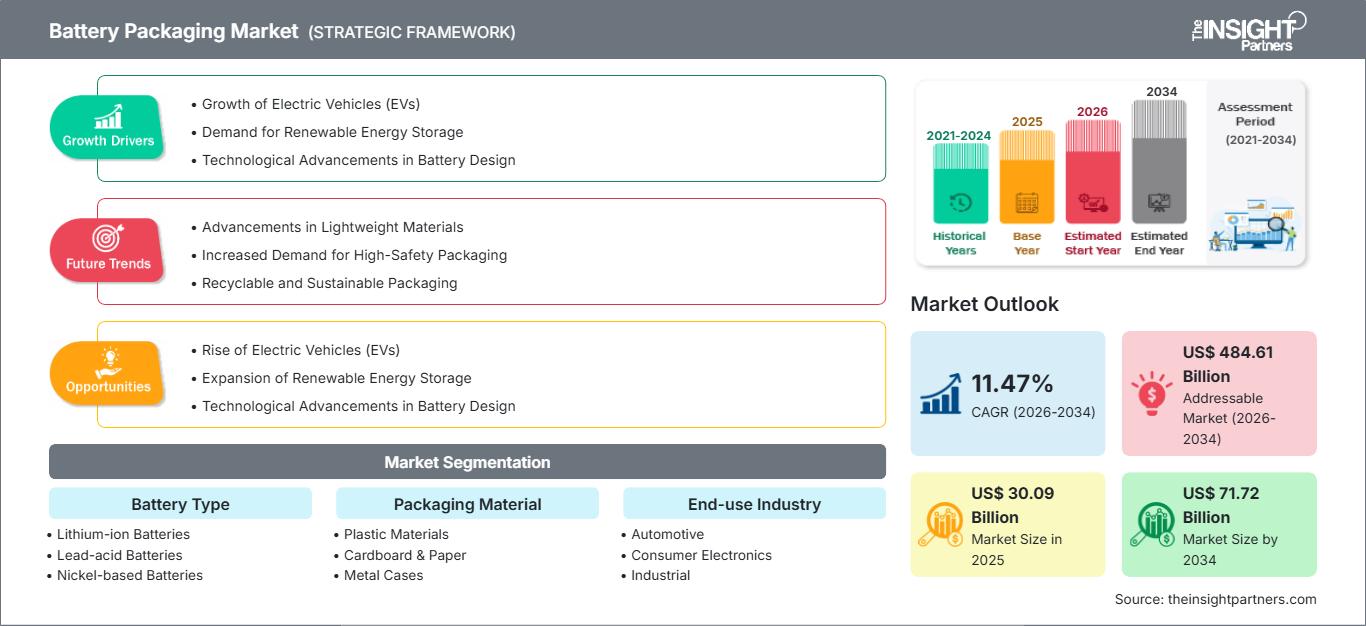
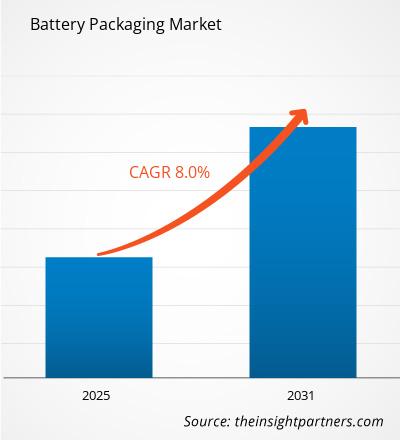
The Battery Packaging market was valued at US$ 30.09 billion in 2025 and is expected to reach US$ 71.72 billion by 2034; it is estimated to record a CAGR of 10.13% during 2026-2034.
Battery Packaging Market Assessment and Insights
- North America: North America accounted for an estimated 29–31% share in 2025 and is anticipated to expand at a CAGR of 10.2%–11.2% during 2026–2034. Regional growth is supported by expanding battery gigafactory investments, stringent transportation safety regulations, and increasing demand from electric vehicles and stationary energy storage systems.
- U.S.: The U.S. represented approximately 78–82% of the North American market in 2025 and is projected to register a CAGR of 10.4%–11.4% during 2026–2034, supported by domestic battery manufacturing expansion, advanced packaging innovation, and federal incentives for clean energy technologies.
- Europe: Europe held an estimated 24–26% share in 2025 and is forecast to grow at a CAGR of 10.8%–11.8% during 2026–2034. Germany, France, and the UK remain leading contributors due to battery manufacturing investments, sustainable packaging initiatives, and expanding electric mobility production.
- Asia Pacific: Asia Pacific accounted for an estimated 37–40% share in 2025 and is expected to witness a CAGR of 12.3%–13.3% during 2026–2034. China, Japan, South Korea, and India continue to drive regional demand through strong battery manufacturing ecosystems, electronics production, and supportive industrial policies.
- Largest Segment: Lithium-ion Batteries represented an estimated 54–58% market share in 2025 and are projected to grow at a CAGR of 12.0%–13.0% during 2026–2034, driven by accelerating electric vehicle deployment, consumer electronics demand, and large-scale energy storage installations.
- High Growth Segment: Energy Storage accounted for an estimated 14–17% market share in 2025 and is expected to register the fastest CAGR of 13.8%–14.8% during 2026–2034, supported by increasing renewable energy integration, utility-scale battery deployments, and grid modernization initiatives.
- Key companies analyzed in detail: Amcor plc, C.L. Smith, Inc., Covestro AG, EaglePicher Technologies, LLC, GWP Group Ltd., Mondi plc, NEFAB Group AB, Rogers Corporation, Söhner Kunststofftechnik GmbH, Targray Technology International Inc., TOPPAN Inc., Wellplast AB.
Source: The Insight Partners' analysis based on proprietary research, government publications, company annual reports, investor presentations, industry databases, and expert interviews.
The manufacturers have been making efforts to focus on packaging technologies that will aid in safer transport and mechanical protection as well as sustainable packaging of high energy battery cells. There has been an increased demand for custom packaging owing to the use of lithium-ion batteries and growth in the export of batteries and hazardous goods. Manufacturers have been adopting technologies in packaging that are efficient in terms of logistics, lighter weight, heat insulation, shock absorbent, and recyclable.
Future growth of the industry will be determined by the investment made by manufacturers in building battery gigafactories in Asia Pacific, North America, and Europe, and by the environmental regulations that support circular packaging. Growth of localized battery manufacturing, increase in the use of stationary energy storage systems, and developments in molded fiber, engineered plastics, and protective foam will bring new opportunities to packaging vendors serving automotive and consumer electronics makers.
Battery Packaging Market Report Scope
| Report Attribute | Details |
|---|---|
| Market size in 2025 | US$ 30.09 Billion |
| Market Size by 2034 | US$ 71.72 Billion |
| Global CAGR (2026 - 2034) | 10.13% |
| Historical Data | 2021-2024 |
| Forecast period | 2026-2034 |
Battery Packaging Market Analysis
Growth of Battery Packaging is facilitated due to the quick growth of capacity of production of batteries in applications including electric vehicles, consumer electronics, industrial machinery, and energy storage at utility scale. Higher production volumes have led to higher need for packaging products providing protection against mechanical shocks, vibrations, moisture, and fluctuations of temperatures during storage and shipping of batteries. At the same time, changes in the legislation concerning international shipping of dangerous goods have pushed manufacturers to use certified, reusable, and recyclable packaging solutions, which boost effectiveness and have less adverse environmental effects.
Raw material producers, converters of packaging products, battery manufacturers, logistics providers, and recycling firms are collaborating in the industry along the whole value chain to enhance the performance of packaging products and resilience of the supply chain. Higher adoption of engineered plastic, molded pulp, corrugated paperboard, protective foam, and metal packaging is allowing to customize packaging products for various chemistries of batteries. Also, digital tracking, reusable packaging, and automation of warehouse operations are helping to reduce damage during transportation.
According to the Battery Packaging Market report, competition is not just about price anymore; competition is now more focused on sustainable materials research and development, regulatory compliance, and custom design. Some of the major global players in the market like Amcor plc, Mondi plc, TOPPAN Inc. and NEFAB Group AB have been increasing their product portfolio by coming up with recyclable and superior performance oriented packaging solutions. The other companies that specialize in providing battery packaging solutions include Rogers Corporation, Covestro AG, Wellplast AB, Söhner Kunststofftechnik GmbH, C.L. Smith, Inc., Targray Technology International Inc., GWP Group Ltd., and EaglePicher Technologies, LLC.
The investment in the industry has only been growing stronger since there has been increased efforts from both the government and private firms to set up regional battery production facilities for establishing supply chain within the region. Packaging industry players have been responding by expanding their capacities and capabilities by means of automation, material innovation and collaborating with the battery manufacturing industry in order to come up with lighter, reusable and compliance packaging solutions.
● REPORT CUSTOMIZATION
Tailor This Report To Align With Your Specific Business Requirements
This report can be customized to align precisely with your business objectives, scope, and target markets. Customization options include tailored segmentation, geography, competitive analysis, and strategic insights to support informed decision-making.
Customize This Report →WHAT YOU CAN ADJUST
- ● Segmentations
- ● Geography
- ● Competitive Analysis
- ● Language Preferences
Battery Packaging Market: Strategic Insights
Regional Insights
North America Battery Packaging Market
North America accounted for an estimated 29–31% of the Battery Packaging Market share in 2025 and is projected to expand at a CAGR of 10.2%–11.2% during 2026–2034. The region benefits from rapid investments in lithium-ion battery manufacturing, increasing electric vehicle production, and expanding battery energy storage installations. Regulatory frameworks governing hazardous material transportation and packaging certification continue to encourage the adoption of advanced protective packaging solutions across domestic and international supply chains.
There is an increasing trend in manufacturers spending on reusable transportation containers, cushioned materials, and recyclable packaging systems. An increase in battery recycling programs, local battery manufacturing facilities, and the construction of gigafactories in the U.S. and Canada will create strong demand for robust packaging solutions that guarantee product integrity at reduced costs of transportation.
U.S. Battery Packaging Market
The U.S. constituted around 78% to 82% of the North American market share in 2025 and is expected to witness a CAGR of 10.4% to 11.4% from 2026 to 2034. Significant investments made in electric vehicle batteries, production of consumer electronics, and stationary energy storage systems have driven the demand for specialized packaging materials that can comply with safety and transport regulations.
Packaging providers and battery companies are partnering to innovate light-weight and recyclable packaging systems that comply with regulatory requirements and boost efficiency in operations. Innovations in warehouse automation, digital tracking of shipments, and circular packaging systems are aiding in the adoption of the technology in automotive, industrial, and renewable energy segments, thereby strengthening the position of the nation as the largest contributor in North America.
Europe Battery Packaging Market
Europe accounted for an estimated 24–26% share in 2025 and is forecast to grow at a CAGR of 10.8%–11.8% during 2026–2034. Germany leads the regional market through its strong automotive manufacturing base, expanding battery gigafactory investments, and advanced packaging technologies. Increasing implementation of sustainable packaging regulations and circular economy initiatives further supports regional demand.
The UK shows stable development, which is facilitated by investments into innovations in batteries, electric vehicles, and batteries recycling. Emphasis on safe lithium-ion batteries transportation and supply chain localization encourages companies to use reusable and recyclable packaging solutions for both industrial and consumer purposes.
France, Italy, and Spain are working together to boost regional demand for batteries via development of production of electric vehicles, energy storage systems and improving manufacturing capacities. Low carbon technology incentives and increasing production of batteries create good prerequisites for protective packaging solutions development.
APAC Battery Packaging Market
Asia Pacific held an estimated 37–40% share in 2025 and is projected to record a CAGR of 12.3%–13.3% during 2026–2034, making it the fastest-growing regional market. China remains the regional leader, followed by Japan, South Korea, and India, owing to their extensive battery manufacturing ecosystems and expanding exports of lithium-ion batteries.
Government support for electric mobility, investments in battery gigafactories, and rising consumer electronics production continue to strengthen regional demand. Australia also contributes through critical mineral development and battery supply chain investments, supporting long-term packaging requirements across domestic and export markets.
Middle East & Africa Battery Packaging Market
Market for ME&A region is projected to grow at a CAGR of 9.6%–10.6% from 2026 to 2034. Saudi Arabia will be the key country for growth in the region, thanks to the diversification strategies of industries and EV production facilities, while UAE will improve its position in battery logistics and clean energy development.
South Africa continues to hold its significance because of the country’s mining industry and increasing use of renewable energy storage systems, whereas rest of ME&A will show gradual acceptance of battery packaging solutions owing to the growth of industrialization and energy infrastructure development.
Segmentation Analysis
Battery Type
Battery Type represents the largest segment within the Battery Packaging Market scope, supported by increasing production and transportation requirements for rechargeable batteries across automotive, consumer electronics, industrial equipment, and stationary energy storage systems. The segment is projected to register a CAGR of 11.8%–12.8% during 2026–2034, driven by higher battery output, stricter transportation regulations, and growing demand for customized protective packaging that minimizes physical damage and thermal risks during storage and shipment.
- Lithium-ion Batteries: The dominant sub-segment owing to extensive deployment in electric vehicles, portable electronics, and energy storage systems. Manufacturers require high-performance packaging with thermal insulation, shock absorption, and regulatory compliance for global transportation.
- Lead-acid Batteries: Continues to maintain stable demand across automotive starter batteries, industrial backup power, and material handling equipment. Packaging solutions prioritize durability, leak prevention, and efficient bulk transportation for domestic and export markets.
- Nickel-based Batteries: Used in specialized industrial equipment, medical devices, aviation, and backup power applications. Packaging emphasizes mechanical protection, moisture resistance, and safe handling throughout extended transportation and storage cycles.
Packaging Material
Packaging Material plays a critical role in ensuring battery safety, logistics efficiency, and sustainability throughout the supply chain. The segment is anticipated to grow at a CAGR of 11.1%–12.1% during 2026–2034, supported by increasing adoption of lightweight, recyclable, and impact-resistant materials that comply with hazardous goods transportation standards while reducing packaging costs and environmental impact.
- Plastic Materials: Widely utilized because of excellent impact resistance, lightweight characteristics, moisture protection, and design flexibility, making them suitable for transporting lithium-ion batteries across diverse industrial and commercial applications.
- Cardboard & Paper: Demand is increasing due to sustainability initiatives and recyclable packaging requirements. These materials are commonly combined with protective inserts for lightweight battery shipments and consumer electronics applications.
- Metal Cases: Preferred for high-value and industrial battery transportation requiring maximum structural integrity, enhanced fire resistance, and protection against harsh environmental conditions during long-distance logistics.
- Foam Materials: Essential for cushioning, vibration control, and impact absorption. Engineered foam inserts improve transportation safety by minimizing movement and protecting sensitive battery components from mechanical damage.
End-use Industry
End-use Industry reflects the broad adoption of battery packaging across multiple sectors as battery production continues to accelerate worldwide. The segment is expected to register a CAGR of 12.2%–13.2% during 2026–2034, driven by expanding electric vehicle manufacturing, renewable energy storage investments, and increasing demand for portable electronic devices requiring safe transportation and storage solutions.
- Automotive: The largest end-use segment, driven by rapid electric vehicle production and battery manufacturing expansion. Demand centers on reusable transport packaging, hazardous goods compliance, and efficient supply chain management.
- Consumer Electronics: Continues to generate consistent demand due to high shipment volumes of smartphones, laptops, wearable devices, and portable electronics requiring compact, lightweight, and protective battery packaging.
- Industrial: Industrial batteries used in telecommunications, manufacturing, material handling, and backup power systems require durable packaging capable of supporting heavy loads, extended storage, and long-distance transportation.
- Energy Storage: The fastest-growing application due to increasing deployment of utility-scale battery energy storage systems supporting renewable energy integration, grid modernization, and commercial backup power infrastructure.
Opportunity Snapshot
| End-use Industry | Revenue Contribution | Trend Tag | Adoption Stage |
|---|---|---|---|
| Automotive | High | EV Logistics | Mature |
| Consumer Electronics | High | Device Miniaturization | Mature |
| Industrial | Medium | Smart Warehousing | Scaling |
| Energy Storage | High | Grid Storage | Emerging |
Battery Packaging Market Growth Drivers and Impact Analysis
Expansion of Electric Vehicle Battery Manufacturing
Rapid growth in electric vehicle production is significantly increasing demand for specialized battery packaging capable of protecting high-value lithium-ion batteries throughout complex global supply chains. Battery manufacturers require packaging that meets stringent international transportation regulations while minimizing vibration, moisture exposure, and thermal risks. At the same time, automotive manufacturers are investing in reusable transport systems that lower logistics costs and improve sustainability performance. Expansion of battery gigafactories across North America, Europe, and the Asia Pacific is also generating long-term demand for standardized protective packaging. As battery production volumes continue to increase, packaging suppliers are investing in lightweight materials, engineered cushioning technologies, and digital tracking capabilities to improve operational efficiency and ensure safe movement of batteries from manufacturing facilities to vehicle assembly plants and aftermarket distribution networks.
Growing Demand for Safe Transportation of Lithium-ion Batteries
The rapid increase in international shipments of lithium-ion batteries for consumer electronics, industrial equipment, and renewable energy storage has intensified the need for certified packaging solutions. Regulatory authorities continue to strengthen standards governing hazardous goods transportation, encouraging manufacturers to adopt packaging systems that provide higher levels of impact resistance, fire mitigation, and product traceability. Advanced protective materials, returnable packaging systems, and customized container designs are improving shipment reliability while reducing product damage during transit. Increasing cross-border battery trade and expansion of global manufacturing networks are further accelerating investments in packaging innovation, creating opportunities for suppliers capable of delivering compliant, sustainable, and cost-effective solutions across multiple battery formats and transportation modes.
Increasing Focus on Sustainable and Reusable Packaging Solutions
Environmental regulations and corporate sustainability targets are encouraging battery manufacturers and logistics providers to replace single-use packaging with recyclable and reusable alternatives. Growing adoption of molded fiber materials, recyclable plastics, engineered corrugated packaging, and returnable transport containers is reducing packaging waste while lowering lifecycle costs. Manufacturers are also integrating digital asset tracking technologies to improve reuse rates and optimize reverse logistics operations. As battery recycling infrastructure expands globally, packaging suppliers are developing solutions that support both forward distribution and end-of-life battery collection. These innovations are helping manufacturers achieve operational efficiency, regulatory compliance, and environmental objectives while strengthening long-term competitiveness across rapidly expanding battery supply chains.
Battery Packaging Market Future Trends
Digitalization and Smart Monitoring in Battery Logistics
The Battery Packaging Market trends indicate increasing adoption of intelligent packaging technologies that improve visibility, safety, and operational efficiency throughout battery supply chains. Manufacturers are integrating RFID tags, QR codes, GPS-enabled tracking devices, and condition-monitoring sensors into transport packaging to monitor battery movement, temperature, humidity, and shock exposure in real time. These technologies help reduce logistics risks, improve regulatory compliance, and enable predictive supply chain management. As battery shipments continue to increase globally, digital packaging solutions are expected to become a standard feature for high-value battery transportation, particularly across electric vehicle and utility-scale energy storage applications.
Transition Toward Circular and Low-Carbon Packaging Materials
Packaging manufacturers are increasingly developing recyclable, reusable, and bio-based materials to support circular economy objectives and reduce environmental impact. Lightweight engineered plastics, molded fiber packaging, recycled paperboard, and reusable transport containers are gaining wider commercial adoption as companies seek to lower carbon emissions and comply with evolving environmental regulations. Future product development is expected to emphasize material recovery, longer packaging life cycles, and compatibility with automated logistics systems. These advancements will strengthen sustainable battery supply chains while creating new business opportunities for packaging suppliers capable of delivering environmentally responsible and high-performance solutions.
Battery Packaging Market Opportunities
Expansion of Packaging Solutions for Grid-Scale Energy Storage
The increasing deployment of utility-scale battery energy storage systems presents significant opportunities for manufacturers specializing in protective packaging. Battery Packaging Market Forecasts indicate that investments in renewable energy integration, smart grids, and commercial energy storage projects will substantially increase shipments of large-format battery modules and packs. These applications require customized packaging capable of handling greater weight, enhanced thermal protection, and improved transportation safety. Companies that develop reusable transport systems, modular packaging designs, and advanced protective materials are expected to strengthen their competitive position while supporting the efficient movement of energy storage batteries across domestic and international supply chains.
Development of Sustainable Export Packaging for Global Battery Trade
Growing international trade in lithium-ion batteries is creating opportunities for suppliers offering lightweight, recyclable, and regulation-compliant export packaging. Manufacturers are increasingly seeking packaging systems that reduce shipping costs while maintaining product protection and meeting hazardous goods transportation requirements. Investments in engineered corrugated packaging, returnable plastic containers, molded fiber cushioning, and digital tracking technologies will enable suppliers to address evolving customer requirements. Companies that align product innovation with sustainability objectives, logistics optimization, and international compliance standards are likely to benefit from expanding battery exports and increasingly complex global supply chain networks.
Recent Developments
- May 2025: ITEN SAS – ITEN and ASTAR Institute of Microelectronics (ASTAR IME) announced a breakthrough in integrating solid-state batteries with advanced semiconductor packaging. The collaboration demonstrated embedded solid-state battery technology for System-in-Package (SiP) architectures, enabling compact, high-performance power solutions for IoT devices, medical electronics, and industrial applications. The development is expected to accelerate innovation in advanced battery packaging and miniaturized electronic systems.
- January 2025: Energizer Holdings, Inc. – Energizer introduced 100% plastic-free, curbside recyclable battery packaging across its consumer battery portfolio in North America. The redesigned packaging eliminates plastic blister packs, reduces single-use plastic consumption, and improves recyclability while maintaining product protection during transportation and retail distribution. The initiative reflects the industry's growing focus on sustainable battery packaging solutions.
Frequently Asked Questions

- Comprehensive Market Sizing and Forecast Analysis
- Detailed Segmentation Analysis
- In-Depth Market Dynamics Assessment
- Regional and Country-Level Insights
- Competitive Landscape and Company Benchmarking
- Strategic Business Intelligence
Recent Reports
Testimonials

The Insight Partners provided valuable market intelligence that supported our global go-to-market strategy. Their team was professional, responsive, and attentive to our feedback, providing thoughtful analysis and helpful methodological clarifications throughout the project.
Junmo Kim Chief Financial Officer (CFO), Enertech Co., Ltd.
The Insight Partners' SCADA System Market report is comprehensive, with valuable insights on current trends and future forecasts. The team was highly professional, responsive, and supportive throughout. We are very satisfied and highly recommend their services.
RAN KEDEM Partner, Reali Technologies LTDs
I requested a report on a very specific software market and the team produced the report in a few days. The information was very relevant and well presented. I then requested some changes and additions to the report. The team was again very responsive and I got the final report in less than a week.
JEAN-HERVE JENN Chairman, Future Analytica
We worked with The Insight Partners for an important market study and forecast. They gave us clear insights into opportunities and risks, which helped shape our plans. Their research was easy to use and based on solid data. It helped us make smart, confident decisions. We highly recommend them.
PIYUSH NAGPAL Sr. Vice President, High Beam Global
The Insight Partners delivered insightful, well-structured market research with strong domain expertise. Their team was professional and responsive throughout. The user-friendly website made accessing industry reports seamless. We highly recommend them for reliable, high-quality research services
YUKIHIKO ADACHI CEO, Deep Blue, LLC.
This is the first time I have purchased a market report from The Insight Partners.While I was unsure at first, I visited their web site and felt more comfortable to take the risk and purchase a market report.I am completely satisfied with the quality of the report and customer service. I had several questions and comments with the initial report, but after a couple of dialogs over email with their analyst I believe I have a report that I can use as input to our strategic planning process.Thank you so much for taking the extra time and making this a positive experience.I will definitely recommend your service to others and you will be my first call when we need further market data.
JOHN SUZUKI President and Chief Executive Officer, Board Director, BK Technologies
I wish to appreciate your support and the professionalism you displayed in the course of attending to my request for information regarding to infectious disease IVD market in Nigeria. I appreciate your patience, your guidance, and the fact that you were willing to offer a discount, which eventually made it possible for us to close a deal. I look forward to engaging The Insight Partners in the future, all thanks to the impression you have created in me as a result of this first encounter.
DR CHIJIOKE ONYIA MANAGING DIRECTOR, PineCrest Healthcare Ltd.Reason to Buy
- Informed Decision-Making
- Understanding Market Dynamics
- Competitive Analysis
- Identifying Emerging Markets
- Customer Insights
- Market Forecasts
- Risk Mitigation
- Boosting Operational Efficiency
- Strategic Planning
- Investment Justification
- Tracking Industry Innovations
- Aligning with Regulatory Trends





 Get Free Sample for