
Antioxidants Market Share, Demand & Growth by 2034
Coverage: by Type (Natural Antioxidants, Synthetic Antioxidants); Form (Dry, Liquid); Application (Pharmaceuticals, Food and Beverages, Feed Additives, Cosmetics) , and Geography (North America, Europe, Asia Pacific, and South and Central America)
- Status : Data Released
- Report Code : TIPRE00009399
- Category : Chemicals and Materials
- No. of Pages : 150
- Available Report Formats :


- Last update date : November 03, 2026


2025 Market Size
US$ 10.32 Bn
Base year value
2034 Forecast
US$ 16.27 Bn
Projected by 2034
CAGR 2026-2034
5.19 %
Growth rate
Addressable Market
US$ 120.64 Bn
(2026-2034)
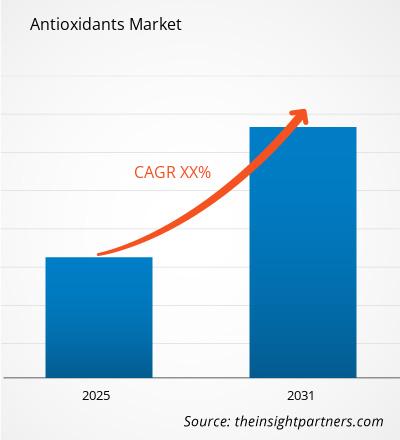
The antioxidants market was valued at US$ 10.32 Billion in 2025 and is projected to reach US$ 16.27 Billion by 2034, expanding at a CAGR of 5.19% during 2026–2034. The market covers natural and synthetic antioxidants supplied in dry and liquid forms for pharmaceuticals, food and beverages, feed additives, and cosmetics. Demand is shaped by oxidation-control requirements, shelf-life extension, formulation stability, and increasing use of antioxidant systems across health, nutrition, personal care, and food-processing applications.
North America is positioned as a mature demand center, supported by established food processing, dietary supplement, pharmaceutical, animal nutrition, and personal care industries. The region is expected to expand at a modeled CAGR of ~4% through 2034, with demand increasingly influenced by clean-label formulations, replacement of selected synthetic ingredients, and the need for oxidation protection in processed foods and specialty formulations.
Antioxidants Market Assessment and Insights
Regional Outlook
- North America: ~31% of the global market in 2025 | ~4% CAGR through 2034. Market position: North America remains a major regional market because of established food, pharmaceutical, feed, and cosmetics manufacturing. Mature formulation capabilities, regulatory oversight, and demand for shelf-life extension support sustained consumption.
- US: ~82% of North American market revenue in 2025 | ~4% CAGR through 2034. Market position: The US is the leading country in North America, supported by extensive processed-food manufacturing, dietary supplement consumption, pharmaceutical formulation, animal nutrition, and personal-care production requiring oxidation control.
- Europe: ~29% of the global market in 2025 | ~4% CAGR through 2034. Market position: Europe represents a mature market supported by sophisticated food and pharmaceutical manufacturing. Germany is the leading country in Europe, followed by strong demand from the UK, France, Italy, and Spain across regulated formulation and ingredient applications.
- Asia Pacific: ~32% of the global market in 2025 | ~7% CAGR through 2034. Market position: Asia Pacific is the fastest-growing region, led by China, with India, Japan, South Korea, and Australia contributing through expanding food processing, pharmaceuticals, animal feed, and personal-care manufacturing.
Segment Outlook
- Synthetic Antioxidants: ~62% Share in 2025 | ~4% CAGR through 2034. Market position: Synthetic antioxidants lead because of established industrial-scale production, consistent performance, formulation familiarity, and broad use where controlled oxidative stability and predictable processing characteristics are important.
- Natural Antioxidants: ~38% Share in 2025 | ~7% CAGR through 2034. Market position: Natural antioxidants have the stronger growth outlook as food, beverage, nutrition, and personal-care manufacturers respond to clean-label preferences, plant-derived ingredient demand, and reformulation away from selected conventional synthetic additives.
Competitive Coverage
BASF SE, International Flavors & Fragrances Inc., Kemin Industries, Inc., Archer Daniels Midland Company, Barentz International B.V., Kalsec Inc., Eastman Chemical Company, Camlin Fine Sciences Ltd., DuPont de Nemours, Inc., dsm-firmenich AG, SI Group, Inc., Songwon Industrial Co., Ltd.
Methodology
The Insight Partners follows Data Collection & Secondary Research, Primary Research, Data Analysis, and Data Triangulation & Final Review to validate market estimates and insights.
Source: The Insight Partners' analysis based on proprietary research, government publications, company annual reports, investor presentations, industry databases, and expert interviews.
The antioxidants market has evolved from commodity oxidation-control ingredients toward application-specific systems engineered around stability, sensory performance, regulatory requirements, and processing conditions. Synthetic phenolic, phosphite, amine, and related chemistries remain important where consistent oxidative protection is required, while natural systems based on tocopherols, rosemary, green tea, and other botanical sources are gaining formulation attention. Suppliers increasingly combine antioxidant ingredients with technical services, blends, and application guidance rather than competing only on individual molecules. This shift is evident across food preservation, animal feed, pharmaceuticals, cosmetics, polymers, and lubricant-related applications.
Looking ahead, production and investment in the antioxidants market share are expected to move toward Asia Pacific, particularly China and India, as food processing, pharmaceutical manufacturing, dietary nutrition, and consumer-product industries expand. Regulatory scrutiny of additives, greater traceability expectations, and clean-label positioning will influence product development in developed markets. Manufacturers are also likely to prioritize supply-chain resilience, regional production, natural-source extraction, and formulation technologies that improve antioxidant efficiency at lower inclusion levels. These developments should broaden the addressable customer base while increasing technical differentiation among suppliers.
Antioxidants Market Report Scope
| Report Attribute | Details |
|---|---|
| Market size in 2025 | US$ 10.32 Billion |
| Market Size by 2034 | US$ 16.27 Billion |
| Global CAGR (2026 - 2034) | 5.19% |
| Historical Data | 2021-2024 |
| Forecast period | 2026-2034 |
Antioxidants Market Analysis
The antioxidants market is driven by the need to slow oxidation, protect product quality, extend shelf life, and maintain functional properties during storage and use. In food and beverages, oxidation can cause rancidity, color deterioration, flavor changes, and nutritional losses. Feed manufacturers use antioxidants to stabilize fats and oils, while pharmaceutical and cosmetic formulators employ antioxidant systems to improve formulation stability and protect sensitive ingredients. Demand therefore connects directly with production volumes and quality requirements across several downstream industries rather than depending on a single end-use sector.
Product innovation in the future would integrate antimicrobial attributes with several other qualities of textiles in a single construction. Buyers in the healthcare sector continue to demand fabrics with a blend of several other qualities, including fluid resistance, breathability, flame resistance, durability, comfort, and easy care. It pushes suppliers to stop manufacturing single-functional antimicrobial fabrics and shift towards multifunctional fabrics tailored for use in hospitals. Fiber level blending, engineered coatings, and multilayer construction could give different performance mixes in clinical apparel, clinical textiles, operating room textiles, clinical furniture textiles, etc. The implication is that antimicrobial performance alone would not be enough as a product differentiator. Instead, suppliers would have to compete on balancing performance while still achieving stability during laundering and meeting the relevant standards. This product innovation could also help manufacturers position their products as premium in specialized clinical applications based on performance considerations instead of commodity fabric prices.
Market competition in antioxidants involves a range of chemical and ingredient companies, along with natural preservative experts. BASF SE enjoys a wide range of antioxidant technologies, whereas Kemin Industries, Inc. provides a range of antioxidants for food and animal nutrition applications that include artificial and natural antioxidants. Archer Daniels Midland Company and DSM-Firmenich AG enjoy the benefits of their huge portfolio of ingredients and wide distribution network and customer relationships.
Investments into the antioxidants market forecast are focused increasingly on product differentiation, geographical capacity, botanical extraction, formulation services, and supply security. Eastman Chemical Company and SI Group, Inc. have positions based on specialty chemical technology and antioxidant technology, respectively, while Barentz International B.V. offers geographical distribution and formulation options in several regions. International Flavors & Fragrances Inc. has competencies derived from its Frutarom division, whereas DuPont de Nemours, Inc. is significant by virtue of its specialty ingredients and formulation legacy.
● REPORT CUSTOMIZATION
Tailor This Report To Align With Your Specific Business Requirements
This report can be customized to align precisely with your business objectives, scope, and target markets. Customization options include tailored segmentation, geography, competitive analysis, and strategic insights to support informed decision-making.
Customize This Report →WHAT YOU CAN ADJUST
- ● Segmentations
- ● Geography
- ● Competitive Analysis
- ● Language Preferences
Antioxidants Market: Strategic Insights
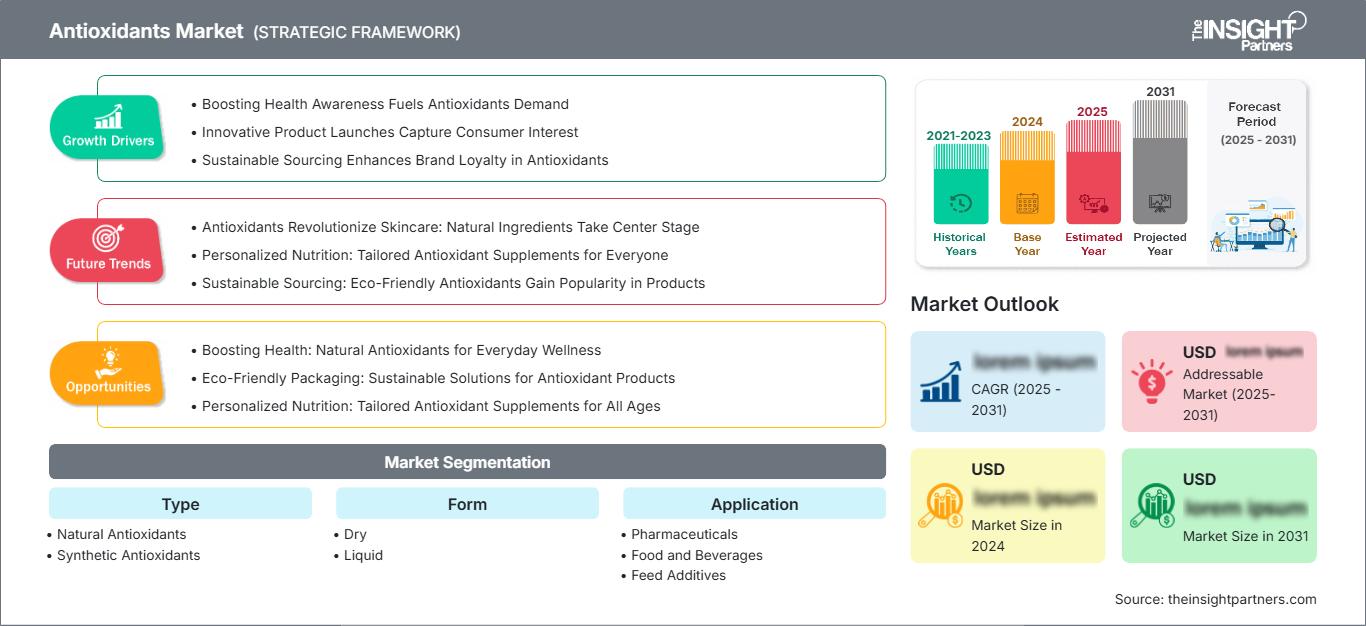
Regional Insights
North America antioxidants market
North America accounted for ~31% of the global antioxidants market in 2025 and is expected to expand at a CAGR of ~4% through 2034. The United States is the leading center for demand due to its strong processed food industry, strong base for production of pharmaceuticals, the animal nutrition industry, and an existing cosmetics industry. The use of antioxidants is aimed at protecting oils and fats, ensuring stabilization of the formulation, preserving appearance, and extending shelf life in these sectors.
The regional market is mature, but there is an increase in demand for high-quality products as opposed to increased demand in terms of quantity. The clean label concept is driving demand for natural systems of antioxidants, while the need for technical attributes continues to fuel demand for synthetic antioxidants where performance is crucial. Demand from Canada and Mexico comes from the food-processing sector, agriculture, animal nutrition, and the production of consumer goods.
U.S. antioxidants market
The US represented ~82% of North American antioxidants market revenue in 2025 and is projected to grow at a CAGR of ~4% through 2034. The country's situation speaks for itself in relation to the size of the markets for packaged foods, dietary supplements, pharmaceuticals, animal feeds, cosmetics, and specialty products. In these industries, there is a need for oxidation protection in various stages of the handling of raw materials and end-product storage.
Differentiation occurs on the grounds of the purpose of formulation. Manufacturers of food products focus on extending the shelf life and protecting against rancidity of the product, whereas manufacturers of supplements and pharmaceuticals pay attention to protecting the stability and integrity of the product. Even cosmetic companies are beginning to use the antioxidant components in the formulation of products that protect against the environment and skin.
Europe antioxidants market
Europe held ~29% of the global antioxidants market in 2025 and is expected to register a CAGR of ~4% through 2034. Germany is the dominating country in Europe owing to its strong chemical, food processing, pharmaceutical and industrial manufacturing capabilities. UK keeps up the demand owing to formulation in the fields of food, nutrition, pharmaceuticals and personal care. France gains due to formulations related to food, beverages, cosmetics and ingredients.
Italy and Spain have their contribution in the field of food processing, edible oils, beverages, animal nutrition and cosmetics. Formulation quality, traceability, regulation and consumers' preference for recognizable ingredients influence the demand in Europe a lot. This creates good conditions for natural antioxidant manufacturers as their products could combine preservation and clean label requirements. In turn, synthetic antioxidants have their application where performance and storage stability are important.
Europe also has an established specialty ingredient distribution structure. Manufacturers can reach fragmented downstream customers through distributors and technical partners, reducing the need for every producer to maintain a direct sales infrastructure in each country. Investment, therefore, favors application development, natural-source technologies, regulatory documentation, and differentiated formulations rather than simple capacity expansion. Sustainability requirements and tighter scrutiny of ingredient origin are expected to influence product selection throughout the forecast period.
APAC antioxidants market
Asia Pacific represented ~32% of the global antioxidants market in 2025 and is projected to grow at a CAGR of ~7% through 2034, making it the fastest-growing region. China is the leading country in the Asia Pacific, supported by large food, feed, pharmaceutical, chemical, and consumer-product industries. India is gaining importance through expanding food processing, pharmaceuticals, and nutrition manufacturing.
Japan and South Korea contribute through advanced food, pharmaceutical, cosmetics, and specialty chemical industries, while Australia provides demand from food processing, animal nutrition, and health-oriented applications. Regional growth is reinforced by industrialization, rising packaged-food consumption, expanding middle-income populations, and investment in domestic manufacturing. Policy emphasis on food quality, pharmaceutical production, and manufacturing localization further supports the adoption of both synthetic and natural antioxidant solutions.
Middle East & Africa antioxidants market
The Middle East & Africa market is developing from a smaller base and is expected to expand at a CAGR of ~6% through 2034. Saudi Arabia is the leading country in the Middle East & Africa region, where industrial diversification, food manufacturing investment, and expanding consumer-product production support antioxidant demand. The UAE functions as an important distribution and re-export hub.
South Africa remains an important African market because of its established food processing, animal nutrition, pharmaceutical, and personal-care industries. Across the wider region, investment in food security, packaged foods, cold-chain infrastructure, and local manufacturing is increasing the need for ingredients that protect product quality during processing and storage. Antioxidant demand should therefore benefit from both industrial development and the expansion of modern retail and food manufacturing.
Segmentation Analysis
Type
The Type segment in the antioxidants market distinguishes between natural and synthetic antioxidant systems. Synthetic antioxidants remain the largest category because they offer established manufacturing routes, consistent composition, predictable performance, and broad formulation compatibility. However, natural antioxidants are expected to expand faster as food, beverage, cosmetic, and nutrition manufacturers respond to clean-label positioning and consumer preference for plant-derived ingredients. The main-segment CAGR for Type is represented by the individual category outlooks below.
- Natural Antioxidants: Plant extracts, tocopherols, rosemary-derived compounds, green tea extracts, and related ingredients are increasingly used where manufacturers seek recognizable sources and clean-label positioning. Their strategic importance is highest in food, beverage, nutrition, and personal-care formulations.
- Synthetic Antioxidants: Synthetic systems remain important where controlled performance, formulation consistency, oxidative stability, and cost-effective protection are priorities. They retain strong relevance across processed foods, feed, pharmaceuticals, cosmetics, and technically demanding formulations.
Form
The Form segment in the antioxidants market is divided between dry and liquid products and is shaped by formulation compatibility, dosing requirements, transportation, storage, and processing conditions. Dry products are useful where stability, handling, and incorporation into powders or premixes are priorities, while liquid systems provide advantages for direct blending, emulsification, and certain food and cosmetic formulations.
- Dry: Dry antioxidants are widely suited to powdered food ingredients, feed premixes, nutritional preparations, and formulations where controlled dosing and storage stability are important. Their handling characteristics support bulk transportation and integration into dry manufacturing systems.
- Liquid: Liquid antioxidants provide convenient incorporation into oils, beverages, emulsions, coatings, and other formulations. Their strategic value is linked to rapid dispersion, simplified dosing, and compatibility with manufacturing processes that already operate with liquid ingredients.
Application
Application demand in the antioxidants market is diversified across pharmaceuticals, food and beverages, feed additives, and cosmetics. Food and beverages represent the largest application because oxidation directly affects shelf life, flavor, color, and quality across oils, processed foods, beverages, bakery products, and other categories. Application CAGR is modeled at ~5% through 2034.
- Pharmaceuticals: Antioxidants support stability in formulations containing oxidation-sensitive active ingredients, excipients, oils, vitamins, and other compounds. Demand is influenced by product shelf-life requirements, formulation complexity, regulatory controls, and expansion of pharmaceutical manufacturing.
- Food and Beverages: This application remains central because antioxidants help delay rancidity, preserve sensory attributes, and maintain product quality. Demand spans edible oils, processed foods, beverages, bakery products, meat products, sauces, and other oxidation-sensitive categories.
- Feed Additives: Feed antioxidants protect fats and oils from oxidation, helping preserve nutritional value and maintain feed quality during storage. Demand is connected with compound-feed production, livestock and poultry production, aquaculture, and the increasing use of stabilized lipid sources.
- Cosmetics: Cosmetic formulations use antioxidant ingredients to improve formulation stability and support skin-care positioning. Natural botanical antioxidants are gaining attention as brands seek multifunctional ingredients that combine oxidative protection with consumer-facing claims around skin health and environmental stress.
Opportunity Snapshot
| Application | Revenue Contribution | Trend Tag | Adoption Stage |
|---|---|---|---|
| Pharmaceuticals | Medium | Formulation Stability | Mature |
| Food and Beverages | High | Clean Label | Mature |
| Feed Additives | Medium | Lipid Protection | Scaling |
| Cosmetics | Medium | Botanical Actives | Scaling |
Antioxidants Market Growth Drivers and Impact Analysis
Expansion of Processed Food and Shelf-Life Requirements
Growth in processed and packaged foods is increasing the need for oxidation-control ingredients because oils, fats, pigments, flavors, and other components can deteriorate during manufacturing, storage, and distribution. Longer supply chains and greater use of convenience foods also increase the importance of maintaining sensory quality through the intended shelf life. The impact is strongest in edible oils, bakery products, meat products, sauces, snacks, and beverages where oxidation can directly affect consumer acceptance. Suppliers that combine antioxidant ingredients with application testing and formulation guidance can capture higher-value demand. The shift also encourages development of antioxidant blends that balance efficacy, sensory performance, regulatory requirements, and label positioning rather than relying on a single active ingredient.
Rising Demand for Natural and Clean-Label Formulations
Consumer and brand preferences for recognizable ingredients are accelerating interest in natural antioxidants derived from botanical and food-compatible sources. Manufacturers are increasingly evaluating tocopherols, rosemary extracts, green tea extracts, and other plant-derived ingredients where they can replace or reduce selected synthetic preservatives without compromising product stability. The commercial impact extends beyond ingredient substitution because natural antioxidant suppliers can differentiate through sourcing, standardization, extraction technology, and formulation support. This trend is particularly relevant in food and beverages, dietary nutrition, and cosmetics. It also creates opportunities for suppliers with vertically integrated botanical sourcing and standardized extraction capabilities, while increasing pressure on manufacturers to demonstrate consistent activity, sensory neutrality, supply reliability, and regulatory suitability across multiple markets.
Growth of Pharmaceutical and Animal Nutrition Manufacturing
Expansion of pharmaceutical and animal nutrition production supports demand for antioxidants that protect oxidation-sensitive ingredients and lipid components. Pharmaceutical formulations increasingly contain complex combinations of active compounds, oils, vitamins, and excipients that require controlled stability during storage. In animal nutrition, oxidation of fats and oils can reduce feed quality and affect the nutritional value of associated ingredients. The market impact is therefore tied to manufacturing volumes as well as formulation complexity. Suppliers with technical expertise can benefit by developing application-specific systems rather than selling generic antioxidant products. Growth in feed production across Asia Pacific and pharmaceutical manufacturing in emerging economies should further broaden the customer base and encourage regional supply development.
Antioxidants Market Future Trends
Greater Use of Multifunctional Natural Antioxidant Systems
Natural antioxidant development is likely to move beyond single botanical extracts toward standardized blends designed for specific food, beverage, nutrition, and cosmetic applications. Suppliers are expected to combine antioxidant activity with color protection, flavor preservation, antimicrobial support, or formulation stability where technically feasible. Such multifunctionality can reduce the number of individual ingredients required and simplify formulation development. Advances in extraction, purification, encapsulation, and stabilization should improve consistency and expand the usable range of plant-derived ingredients. Over time, the competitive advantage will increasingly depend on reproducible antioxidant activity, supply-chain traceability, sensory performance, and application data rather than simply the natural origin of an ingredient.
Digitalized Formulation and Precision Antioxidant Selection
Formulation development is expected to become more data-driven as manufacturers seek to optimize antioxidant combinations against specific oxidation pathways and storage conditions. Suppliers can use application testing, predictive models, and formulation databases to identify suitable antioxidant systems based on food matrix, oil composition, processing temperature, packaging conditions, and expected shelf life. This approach can reduce trial-and-error formulation and support more precise dosing. The trend is also relevant to pharmaceuticals and cosmetics, where compatibility and stability requirements can be highly specific. As customers demand measurable performance, technical service and formulation analytics are likely to become increasingly important components of supplier differentiation.
Antioxidants Market Opportunities
Localized Production and Supply-Chain Integration in Asia Pacific
Asia Pacific offers an attractive opportunity for antioxidant suppliers because expanding food processing, pharmaceutical manufacturing, animal nutrition, and personal-care industries are increasing regional demand. Companies can strengthen their position by establishing local manufacturing, blending, extraction, warehousing, and technical-support capabilities rather than relying exclusively on imports. China and India provide particularly strong opportunities because of their industrial scale and growing domestic consumption. Localized supply can shorten lead times, reduce exposure to international freight disruptions, and improve customer responsiveness. Natural antioxidant producers can also benefit from proximity to agricultural raw materials, while synthetic antioxidant suppliers can use regional chemical infrastructure to improve production economics and supply reliability.
Premium Natural Ingredients for High-Value Formulations
Premium natural antioxidants present an opportunity for suppliers to move toward higher-value ingredients supported by standardized activity, traceable sourcing, clinical or application evidence, and specialized formulation services. Food, nutrition, and cosmetics companies increasingly require more than a basic preservative function, creating room for ingredients that deliver antioxidant protection alongside recognizable botanical positioning or functional benefits. Suppliers can target premium applications where formulation performance and consumer acceptance justify higher ingredient value. Investment in extraction technology, stabilization, encapsulation, and application testing can create defensible differentiation. Companies that establish reliable raw-material sourcing and demonstrate consistent performance across geographies will be better positioned to serve multinational brands and specialized regional manufacturers.
Recent Developments
- April 27, 2026: BASF SE announced further price increases of up to 25% for its global portfolio of antioxidants, process stabilizers, and light stabilizers used in plastic applications. The company cited higher raw-material, energy, and logistics costs associated with geopolitical disruption. The move highlights continued cost pressure across antioxidant supply chains.
- August 7, 2025: Clariant AG introduced AddWorks LXR 548, a phenol-free antioxidative solution for polyolefin applications, including medical devices and hygiene products. The product targets stringent applications requiring color protection and stability after sterilization, illustrating continued development of alternatives designed around regulatory and performance requirements.
Frequently Asked Questions

- Comprehensive Market Sizing and Forecast Analysis
- Detailed Segmentation Analysis
- In-Depth Market Dynamics Assessment
- Regional and Country-Level Insights
- Competitive Landscape and Company Benchmarking
- Strategic Business Intelligence
Recent Reports
Testimonials

The Insight Partners provided valuable market intelligence that supported our global go-to-market strategy. Their team was professional, responsive, and attentive to our feedback, providing thoughtful analysis and helpful methodological clarifications throughout the project.
Junmo Kim Chief Financial Officer (CFO), Enertech Co., Ltd.
The Insight Partners' SCADA System Market report is comprehensive, with valuable insights on current trends and future forecasts. The team was highly professional, responsive, and supportive throughout. We are very satisfied and highly recommend their services.
RAN KEDEM Partner, Reali Technologies LTDs
I requested a report on a very specific software market and the team produced the report in a few days. The information was very relevant and well presented. I then requested some changes and additions to the report. The team was again very responsive and I got the final report in less than a week.
JEAN-HERVE JENN Chairman, Future Analytica
We worked with The Insight Partners for an important market study and forecast. They gave us clear insights into opportunities and risks, which helped shape our plans. Their research was easy to use and based on solid data. It helped us make smart, confident decisions. We highly recommend them.
PIYUSH NAGPAL Sr. Vice President, High Beam Global
The Insight Partners delivered insightful, well-structured market research with strong domain expertise. Their team was professional and responsive throughout. The user-friendly website made accessing industry reports seamless. We highly recommend them for reliable, high-quality research services
YUKIHIKO ADACHI CEO, Deep Blue, LLC.
This is the first time I have purchased a market report from The Insight Partners.While I was unsure at first, I visited their web site and felt more comfortable to take the risk and purchase a market report.I am completely satisfied with the quality of the report and customer service. I had several questions and comments with the initial report, but after a couple of dialogs over email with their analyst I believe I have a report that I can use as input to our strategic planning process.Thank you so much for taking the extra time and making this a positive experience.I will definitely recommend your service to others and you will be my first call when we need further market data.
JOHN SUZUKI President and Chief Executive Officer, Board Director, BK Technologies
I wish to appreciate your support and the professionalism you displayed in the course of attending to my request for information regarding to infectious disease IVD market in Nigeria. I appreciate your patience, your guidance, and the fact that you were willing to offer a discount, which eventually made it possible for us to close a deal. I look forward to engaging The Insight Partners in the future, all thanks to the impression you have created in me as a result of this first encounter.
DR CHIJIOKE ONYIA MANAGING DIRECTOR, PineCrest Healthcare Ltd.Reason to Buy
- Informed Decision-Making
- Understanding Market Dynamics
- Competitive Analysis
- Identifying Emerging Markets
- Customer Insights
- Market Forecasts
- Risk Mitigation
- Boosting Operational Efficiency
- Strategic Planning
- Investment Justification
- Tracking Industry Innovations
- Aligning with Regulatory Trends





 Get Free Sample for