
Anxiety Disorders and Depression Treatment Market Size, Share & Demand by 2034
Coverage: By Drug Class (Selective Serotonin Reuptake Inhibitors (SSRIs), Tricyclic Antidepressants (TCAs), Monoamine Oxidase Inhibitors (MAOIs), Antidepressant Drugs, Atypical Antipsychotics, Benzodiazepines, Beta-Blockers ); Therapies ( Electroconvulsive Therapy (ECT), Psychotherapy, Deep Brain Stimulation, Cognitive Behavior Therapy (CBT), Cranial Electrotherapy Stimulation (CES), Trans Cranial Magnetic Stimulation (TMS)); Devices (Cranial Electrotherapy Stimulator, fisher-wallace stimulator); Application (Phobia, Obsessive Compulsive Disorder (OCD), Post-Traumatic Stress Disorder, Major Depressive Disorder, other); End User (Hospitals, Mental Healthcare Centers, Other) , and Geography (North America, Europe, Asia Pacific, and South and Central America)
- Status : Data Released
- Report Code : TIPRE00008009
- Category : Life Sciences
- No. of Pages : 150
- Available Report Formats :


- Last update date : August 26, 2026


2025 Market Size
US$ 15.39 Bn
Base year value
2034 Forecast
US$ 53.56 Bn
Projected by 2034
CAGR 2026-2034
14.86 %
Growth rate
Addressable Market
US$ 294.96 Bn
(2026-2034)
The Anxiety Disorders and Depression Treatment Market Size is valued at US$ 15.39 Billion in 2025 and is estimated to increase to US$ 53.56 Billion by 2034, growing at a CAGR of 14.86% during 2026-2034. The market includes pharmaceutical and non-pharmaceutical treatments, which include conventional antidepressants, neuromodulation, psychotherapy, and novel therapies for various anxiety and depressive disorders.
Anxiety Disorders and Depression Treatment Market growth drivers include unmet needs and diagnosis improvements in North America. The market’s regional 2025 share modelled at 38–42% is attributed to wide coverage of insurance, access to specialists, presence of established infrastructure for behavioral health care, and adoption of novel pharmaceutical and technological solutions. Growth in the region should be resilient due to increased adoption of combined approach of medication and psychotherapy, along with technological support.
Anxiety Disorders and Depression Treatment Market Assessment and Insights
- North America: The region represented an estimated 38–42% Anxiety Disorders and Depression Treatment Market share in 2025 and is projected to grow at a 12–15% CAGR between 2026–2034, supported by high treatment access, reimbursement depth, specialist capacity, and rapid uptake of newer therapies.
- US: The US accounted for approximately 31–35% of global revenue in 2025 and is expected to expand at a 12–15% CAGR between 2026–2034, supported by broad clinical adoption and innovation.
- Europe: Europe held an estimated 27–31% share in 2025, with a 13–15% CAGR between 2026–2034. Germany, the UK, France, Italy, and Spain provide the region's principal commercial base through established psychiatric services.
- Asia Pacific: Asia Pacific represented approximately 21–25% share in 2025 and is projected to register a 16–19% CAGR between 2026–2034, led by China, Japan, South Korea, India, and Australia as diagnosis and specialist access improve.
- Largest Segment: Drug Class represented an estimated 63–67% market share in 2025, with a 13–15% CAGR from 2026–2034, reflecting the continuing role of pharmacotherapy in routine treatment pathways.
- High Growth Segment: Devices held approximately 3–5% market share in 2025 but are expected to achieve a 18–22% CAGR from 2026–2034, driven by noninvasive neuromodulation and treatment-resistant cases.
- Key companies analyzed in detail: Sumitomo Dainippon Pharma Co., Sage Therapeutics, GlaxoSmithKline plc, F. Hoffmann-La Roche Ltd., Eli Lilly and Company, Abbott, Sanofi, H. Lundbeck A/S, Biogen Inc., and Supernus Pharmaceuticals, Inc.
Source: The Insight Partners' analysis based on proprietary research, government publications, company annual reports, investor presentations, industry databases, and expert interviews.
The Anxiety Disorders and Depression Treatment Market report indicates that the market has shifted from the conventional approach of prescription of antidepressants to a more specialized approach that involves the use of a combination of drugs and non-drug methods such as psychotherapy and neuromodulation. The traditional methods have maintained their relevance in the form of SSRIs and other drugs while novel approaches target treatment-resistant cases as well as particular patient segments. Similarly, the device sector has undergone development in the form of TMS obtaining proper regulatory clearance.
According to the Anxiety Disorders and Depression Treatment Market forecast, the future prospects of the market will see improvements in diagnosis and treatment of the disease in developing countries along with more focus on the treatment of mental illness. The regulatory environment in favor of treatment-resistant depression and noninvasive neuromodulation will make way for more interest in novel therapies. The adoption of digital monitoring and telebehavioral therapy is anticipated to play a role in the commercialization of products in the market.
Anxiety Disorders and Depression Treatment Market Report Scope
| Report Attribute | Details |
|---|---|
| Market size in 2025 | US$ 15.39 Billion |
| Market Size by 2034 | US$ 53.56 Billion |
| Global CAGR (2026 - 2034) | 14.86% |
| Historical Data | 2021-2024 |
| Forecast period | 2026-2034 |
Anxiety Disorders and Depression Treatment Market Analysis
Demand drivers include the untreated population and the recurring nature of many mental illnesses. WHO estimates the number of people affected by anxiety disorders to be 359 million in 2021 and the prevalence of depression to be 280 million in 2019. More than 75% of those with mental disorders in low- and middle-income countries go untreated, suggesting high levels of potential demand. Key participants within the ecosystem are pharmaceutical companies, device companies, psychiatrists, primary care physicians, hospitals, clinics, pharmacies, insurance companies, and behavioral health platforms.
Key dynamics of the supply side increasingly benefit companies able to offer an integrated commercial portfolio and differentiated central nervous system pipeline. The nature of production process is highly variable depending on the modality, ranging from generic oral drugs to specialized biologicals, modified release technologies, and neuromodulation devices. Guidelines, reimbursement, regulatory approval, physician adoption, and clinical proof continue to be important drivers of commercial success. Therefore, the anxiety disorders and depression treatment market is characterized by a diversified supply base.
The Anxiety Disorders and Depression Treatment Market trends indicate that competitive dynamics include extensive drug pipelines and specific neuroscience experts. GlaxoSmithKline plc, Sanofi, F. Hoffmann-La Roche Ltd., and Eli Lilly and Company have extensive R&D and commercialization capabilities, while H. Lundbeck A/S has a CNS-focused position. Sumitomo Dainippon Pharma Co. and Biogen Inc. are involved with neuroscience know-how. Abbott has neuromodulation expertise, which adds neuromodulation as a competitive perimeter.
The strategic positioning factor now depends more on the company's pipeline uniqueness, fast regulatory process, and proof of clinical effectiveness. In 2025, Sage Therapeutics merged with Supernus Pharmaceuticals, introducing ZURZUVAE into Supernus' neuropsychiatric product line. In turn, investors are interested in resistant depression treatments, fast-acting solutions, and noninvasive stimulation. The companies that show unique results can secure better positioning compared to their competitors even in presence of generic products.
● REPORT CUSTOMIZATION
Tailor This Report To Align With Your Specific Business Requirements
This report can be customized to align precisely with your business objectives, scope, and target markets. Customization options include tailored segmentation, geography, competitive analysis, and strategic insights to support informed decision-making.
Customize This Report →WHAT YOU CAN ADJUST
- ● Segmentations
- ● Geography
- ● Competitive Analysis
- ● Language Preferences
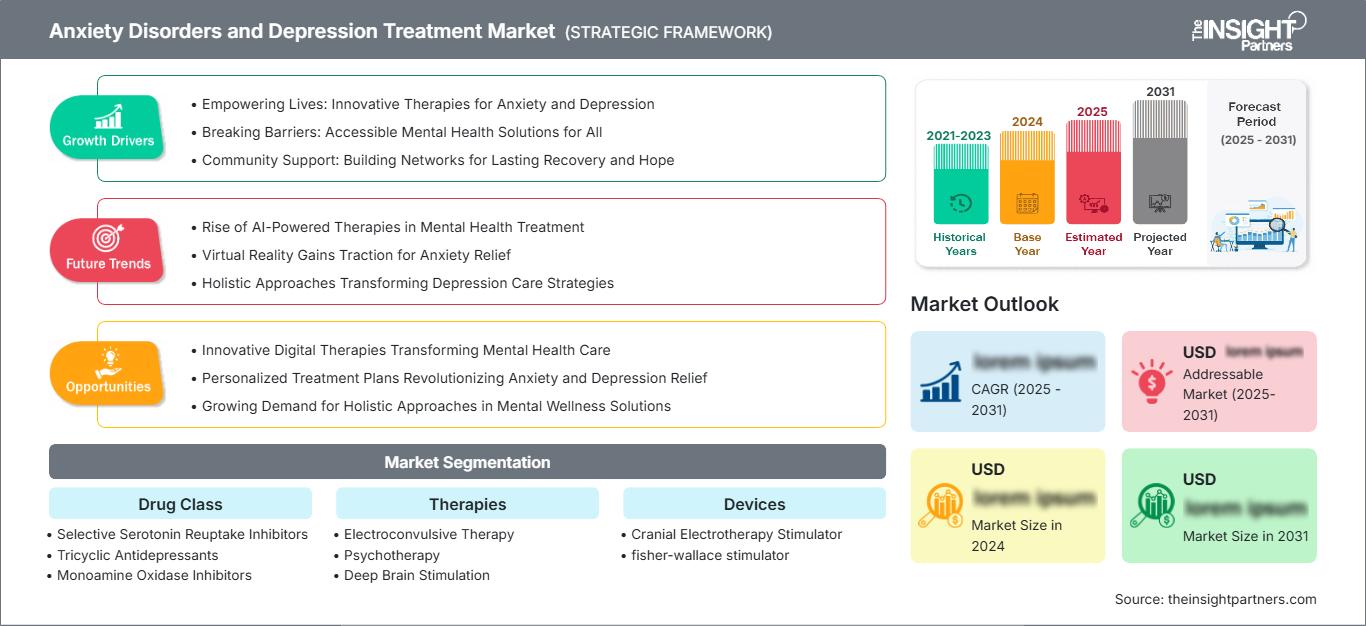
Anxiety Disorders and Depression Treatment Market: Strategic Insights
Regional Insights
North America Anxiety Disorders and Depression Treatment Market
North America is estimated to hold a 38–42% share in 2025 and is projected to grow at a 12–15% CAGR through 2034. The US remains the principal contributor because of extensive psychiatric infrastructure, specialist availability, pharmaceutical innovation, insurance coverage, and relatively rapid adoption of newly approved therapies. Canada adds a smaller but established market supported by public healthcare access and expanding recognition of mental-health treatment needs.
Device ecosystem is also quite mature. The guidance from the FDA creates a well-defined regulatory regime for repetitive TMS systems used for treating major depressive disorder. Growing use of therapeutic algorithms that integrate pharmacology, psychotherapy, and neuromodulation can help to drive continued demand. Commercial prospects will be brightest in cases of therapy-resistant depression, ambulatory psychiatry, and integrated behavioral health.
U.S. Anxiety Disorders and Depression Treatment Market
The US represents around 82% – 86% of North America's revenue in 2025 and has a growth rate of 12% - 15% CAGR till 2034. Its dominance in the industry can be attributed to higher prescription rates, density of specialists, reimbursement system, clinical trials, and early adoption of innovative drugs for the CNS. Big pharmaceutical companies have extensive distribution and research facilities in the region.
Treatment trends are moving towards treatment-resistant depression, postpartum depression, and pathway towards individualized treatments. The FDA approves pharmacotherapy, psychotherapy, TMS, VNS, ECT, and many other methods of treatment for major depressive disorder. Such wide range creates demand for multimodal treatment, and provides pharmaceutical and device companies with possibilities to compete on efficacy, tolerability, length of treatment, and convenience of it.
Europe Anxiety Disorders and Depression Treatment Market
Europe constitutes a 27-31% market share in 2025 and is forecasted to grow with a 13-15% CAGR, with Germany being the most important national market. Public health facilities, national guidelines, mental health awareness, and access disparities play a key role in ensuring stable demand from major nations.
The UK ensures a high base of treatments through existing mental health infrastructure and the focus on community-based care. Germany has high specialization capabilities coupled with pharmaceuticals distribution. France enjoys the existence of a reimbursable healthcare infrastructure, while Italy and Spain are enhancing behavioral healthcare infrastructure and access to outpatient treatments. Overall, Europe provides a diverse market for opportunities, although reimbursement and procurement policies might influence pricing.
APAC Anxiety Disorders and Depression Treatment Market
APAC is estimated to hold 21–25% share in 2025 and is expected to grow at a 16–19% CAGR, making it the fastest-growing major region. China represents the leading market, followed by Japan, South Korea, India, and Australia. Rising diagnosis, urbanization, healthcare investment, and improving specialist access support expansion.
China and India represent some of the most prominent examples of untouched patients in the market, whereas Japan and South Korea have well-developed drug markets. Australia has a combination of mental health development and payment for services in place already. There are more and more opportunities that open up access to treatment due to government initiatives, modernized hospitals, telepsychiatry, and acceptance of the treatment approach.
Middle East & Africa Anxiety Disorders and Depression Treatment Market
Middle East & Africa is expected to record a 12–15% CAGR through 2034. Saudi Arabia and the UAE are leading commercial markets, supported by healthcare modernization, private hospital investment, and expansion of specialist services. South Africa represents a key sub-Saharan market because of its relatively developed pharmaceutical and clinical infrastructure.
Rest of MEA remains constrained by specialist shortages, affordability limitations, and uneven access to psychiatric services. Nevertheless, healthcare infrastructure programs and digital health investments are creating new access channels. Saudi Arabia's healthcare transformation agenda and UAE investment in advanced medical facilities provide a stronger foundation for premium therapies and specialized devices than many lower-income markets.
Segmentation Analysis
Drug Class
Drug Class is the largest component, with an estimated 13–15% CAGR during 2026–2034. Oral medicines remain the first-line commercial foundation across many indications because of established physician familiarity, broad distribution, and relatively scalable manufacturing. Growth increasingly depends on differentiated mechanisms, improved tolerability, treatment-resistant populations, and products addressing specific patient groups.
- Selective Serotonin Reuptake Inhibitors: Remain foundational treatments because of extensive clinical experience, established prescribing pathways, and availability across branded and generic formulations.
- Tricyclic Antidepressants: Maintain specialized demand where clinicians require established efficacy or alternative mechanisms, although tolerability considerations limit broader first-line adoption.
- Monoamine Oxidase Inhibitors: Occupy a narrower treatment position, primarily serving selected patients requiring alternative pharmacological approaches after inadequate response to conventional medicines.
- Antidepressant Drugs: Represent a broad commercial category spanning multiple mechanisms and formulations, supporting portfolio diversification and continued physician choice.
- Atypical Antipsychotics: Support adjunctive treatment strategies for selected depressive conditions and treatment-resistant patients, increasing the value of differentiated CNS portfolios.
- Benzodiazepines: Remain relevant for selected anxiety indications, although dependence, tolerance, and duration-of-use considerations constrain long-term utilization.
- Beta-Blockers: Address selected physical manifestations of anxiety and performance-related symptoms, providing a complementary role rather than a comprehensive psychiatric treatment.
Therapies
Therapies are projected to expand at a 15–18% CAGR during 2026–2034, supported by greater recognition that pharmacological treatment alone does not address every patient need. Provider capacity, reimbursement, clinical evidence, and treatment-resistant populations will determine adoption across nonpharmacological interventions.
- Electroconvulsive Therapy: Retains clinical importance for severe or treatment-resistant depression, particularly when rapid therapeutic response is considered necessary.
- Psychotherapy: Remains a core intervention across anxiety and depressive disorders, with increasing delivery through outpatient, community, and technology-enabled care models.
- Deep Brain Stimulation: Represents a specialized intervention for highly refractory cases, with adoption dependent on clinical evidence, procedural expertise, and patient selection.
- Cognitive Behavior Therapy: Maintains strong relevance because structured techniques can address maladaptive thoughts and behaviors across multiple anxiety and depressive conditions.
- Cranial Electrotherapy Stimulation: Provides a noninvasive electrical approach with potential appeal where patients and providers seek alternatives to conventional medication.
- Trans Cranial Magnetic Stimulation: Benefits from expanding clinical familiarity and regulatory pathways, particularly for patients who have not achieved adequate response to antidepressants.
Devices
Devices are expected to achieve a 18–22% CAGR during 2026–2034. Adoption is concentrated in treatment-resistant populations and specialized psychiatric settings, where nonpharmacological intervention can complement or follow medication. Regulatory clearance, clinical evidence, treatment workflow, and device usability remain central purchasing considerations.
- Cranial Electrotherapy Stimulator: Supports noninvasive neuromodulation and may gain adoption through outpatient treatment models emphasizing portability and patient convenience.
- fisher-wallace stimulator: Represents a focused neuromodulation approach positioned around noninvasive stimulation, with commercial prospects linked to evidence development and clinician acceptance.
Application
Application is projected to expand at a 14–17% CAGR during 2026–2034 as diagnosis improves and treatment pathways become more differentiated by disorder. Major depressive disorder remains commercially important, while anxiety-related conditions create substantial additional demand and opportunities for targeted therapies.
- Phobia: Generates demand for behavioral interventions and selected pharmacological approaches, with treatment decisions strongly influenced by symptom severity and functional impairment.
- Obsessive Compulsive Disorder: Requires specialized treatment strategies, supporting demand for pharmacotherapy and structured psychotherapy delivered by trained mental-health professionals.
- Post-Traumatic Stress Disorder: Creates opportunities for integrated treatment because medication, psychotherapy, and emerging interventions may be combined according to patient response.
- Major Depressive Disorder: Represents a central commercial application, encompassing conventional antidepressants, adjunctive therapies, ECT, TMS, and emerging treatment-resistant approaches.
Opportunity Snapshot
| Segment Name | Revenue Contribution (High/Medium/Low) | Trend Tag (MAX 2 words) | Adoption Stage (Emerging/Scaling/Mature) |
| Phobia | Medium | Exposure Therapy | Mature |
| Obsessive Compulsive Disorder | Medium | ERP Integration | Scaling |
| Post-Traumatic Stress Disorder | Medium | Trauma Care | Scaling |
| Major Depressive Disorder | High | Rapid Acting | Mature |
Anxiety Disorders and Depression Treatment Market Growth Drivers and Impact Analysis
Large Untreated Patient Population
The main structural factor driving the market is the wide discrepancy between disease prevalence and the availability of efficacious treatment. WHO estimates that there were 359 million patients suffering from anxiety disorders in 2021, as well as 280 million individuals affected by depression according to the latest globally referenced estimate made by WHO. In addition, the provision of treatment is particularly insufficient in LMICs, thereby generating an enormous target population as healthcare organizations extend their psychiatric services. The discrepancy influences pharmaceutical needs, use of psychotherapy, and treatment through medical devices at once. The market will be most influenced by the progress in diagnostics coupled with low treatment penetration. Manufacturers will be able to benefit from products that improve adherence, tolerance, treatment period, and ease of treatment delivery.
Rising Economic Burden of Untreated Mental Health Conditions
The economic consequences of anxiety and depression are strengthening the policy case for earlier intervention. WHO reports that depression and anxiety together are associated with an estimated 12 billion lost productive workdays annually and nearly US$1 trillion in lost productivity. This provides incentive to employers, insurers, governments, and treatment providers to focus on interventions which help in achieving functional improvement rather than concentrating only on treating symptoms. The economic impact is not limited to the prescription drugs alone since more and more employers are providing coverage for behavioral health, and insurers are assessing the impact of the intervention on health-economic outcomes. Treatment providers which can prove their ability in minimizing relapse rates, maximizing adherence, faster functional recovery, and decreased healthcare utilization may have better contracts.
Expansion of Noninvasive Neuromodulation
Neuromodulation is creating a differentiated growth pathway within psychiatric treatment by providing alternatives for patients who experience inadequate response or tolerability limitations with medication. FDA guidelines define certain controls for repetitive TMS devices in major depressive disorder, while new clearance applications expand the medical device market continuously. The commercial value lies in increased outpatient capability, improved device ease-of-use, and greater physician awareness of the devices. Repetitive TMS systems can also offer repeatable revenue streams from the treatment process to the provider. Therefore, the competition for device companies lies not only in clinical efficiency but also in the workflow of the treatment process, treatment footprint, patient experience, software, and service. In the future, better evidence generation and education may drive adoption in treatment-refractory patients.
Anxiety Disorders and Depression Treatment Market Future Trends
Rapid-Acting and Precision Psychiatry
The anxiety disorders and depression treatment market is moving toward therapies designed to address limitations associated with delayed onset, inadequate response, and heterogeneous patient outcomes. Future development is likely to emphasize rapid-acting mechanisms, biomarker-informed patient selection, and treatment algorithms that identify appropriate interventions earlier. Precision approaches may combine clinical history, symptom patterns, treatment-response data, and potentially biological markers to improve therapy selection. This shift can change competitive dynamics because efficacy alone may no longer determine product differentiation. Developers that establish predictable response profiles and clinically meaningful durability could gain stronger positioning with physicians and payers. The trend is particularly relevant to treatment-resistant depression, where unmet need remains high and clinicians require alternatives after multiple failed therapies. Digital assessment tools may increasingly support these individualized treatment decisions.
Integrated Hybrid Mental-Health Care
Future care models are likely to integrate psychiatric medication, psychotherapy, neuromodulation, remote monitoring, and digital engagement within coordinated treatment pathways. Rather than positioning modalities as isolated alternatives, providers can increasingly sequence or combine interventions according to disease severity and response. This model may improve continuity between primary care, psychiatry, specialty clinics, and community services. Technology can support symptom tracking, treatment adherence, appointment management, and early identification of deterioration. For manufacturers, the opportunity extends from individual products toward connected treatment ecosystems and partnerships with providers. Reimbursement structures will influence the pace of adoption because coordinated care requires payment mechanisms that recognize clinical outcomes across multiple services. Companies capable of generating evidence across the full patient journey may achieve stronger strategic relevance than businesses focused exclusively on individual products.
Anxiety Disorders and Depression Treatment Market Opportunities
Emerging-Market Treatment Access
The strongest geographic opportunity lies in countries where disease burden is substantial but treatment penetration remains comparatively low. Asia Pacific, Latin America, the Middle East, and parts of Africa offer expanding opportunities as governments increase mental-health capacity and private healthcare providers add psychiatric services. Companies can improve market access through tiered pricing, local manufacturing, physician education, and partnerships with hospitals or community providers. Generic medicines can support volume expansion, while differentiated therapies can target higher-income patient groups and specialized centers. Telepsychiatry can further extend specialist expertise beyond major urban locations. Strategic investors should prioritize markets where reimbursement reforms, hospital modernization, and rising diagnostic awareness are occurring simultaneously, because these conditions can accelerate conversion of unmet need into measurable treatment demand.
Treatment-Resistant Depression Platforms
Treatment-resistant depression presents an attractive opportunity for companies developing differentiated pharmacological and device-based interventions. Patients who fail conventional treatment often require additional therapeutic options, creating a commercial segment less exposed to simple generic substitution. Emerging rapid-acting medicines, adjunctive pharmacotherapies, TMS, ECT, and other neuromodulation approaches can address different stages of the treatment pathway. Investors should assess evidence quality, durability of response, administration burden, reimbursement feasibility, and scalability of specialist delivery rather than relying solely on clinical novelty. Strategic partnerships can accelerate development by combining pharmaceutical discovery capabilities with device expertise, digital monitoring, or specialty-provider networks. Products demonstrating faster response or meaningful functional improvement could establish differentiated positioning if clinical outcomes translate into payer-recognized value.
Recent Developments
- July 2026: Eli Lilly and Company announced a definitive agreement to acquire AtaiBeckley Inc. to advance therapies for treatment-resistant depression and other mental-health conditions. The transaction is intended to expand Lilly's neuroscience pipeline through BPL-003 and other rapid-acting neuroplastogen programs. The deal underscores growing strategic interest in differentiated mechanisms for difficult-to-treat psychiatric conditions.
- July 2025: Supernus Pharmaceuticals, Inc. completed its acquisition of Sage Therapeutics, strengthening its neuropsychiatric portfolio with ZURZUVAE, an FDA-approved oral treatment for postpartum depression. Supernus stated that the acquisition was expected to diversify its revenue base and strengthen its CNS discovery capabilities.
- March 2025: The Magstim Company Limited received FDA substantial-equivalence clearance for the Horizon 3.0 TMS Therapy System. The clearance covers a transcranial magnetic stimulation system under FDA regulation 882.5805, reinforcing continued device development for depression treatment.
Frequently Asked Questions

- Comprehensive Market Sizing and Forecast Analysis
- Detailed Segmentation Analysis
- In-Depth Market Dynamics Assessment
- Regional and Country-Level Insights
- Competitive Landscape and Company Benchmarking
- Strategic Business Intelligence
Recent Reports
Testimonials

The Insight Partners' SCADA System Market report is comprehensive, with valuable insights on current trends and future forecasts. The team was highly professional, responsive, and supportive throughout. We are very satisfied and highly recommend their services.
RAN KEDEM Partner, Reali Technologies LTDs
I requested a report on a very specific software market and the team produced the report in a few days. The information was very relevant and well presented. I then requested some changes and additions to the report. The team was again very responsive and I got the final report in less than a week.
JEAN-HERVE JENN Chairman, Future Analytica
We worked with The Insight Partners for an important market study and forecast. They gave us clear insights into opportunities and risks, which helped shape our plans. Their research was easy to use and based on solid data. It helped us make smart, confident decisions. We highly recommend them.
PIYUSH NAGPAL Sr. Vice President, High Beam Global
The Insight Partners delivered insightful, well-structured market research with strong domain expertise. Their team was professional and responsive throughout. The user-friendly website made accessing industry reports seamless. We highly recommend them for reliable, high-quality research services
YUKIHIKO ADACHI CEO, Deep Blue, LLC.
This is the first time I have purchased a market report from The Insight Partners.While I was unsure at first, I visited their web site and felt more comfortable to take the risk and purchase a market report.I am completely satisfied with the quality of the report and customer service. I had several questions and comments with the initial report, but after a couple of dialogs over email with their analyst I believe I have a report that I can use as input to our strategic planning process.Thank you so much for taking the extra time and making this a positive experience.I will definitely recommend your service to others and you will be my first call when we need further market data.
JOHN SUZUKI President and Chief Executive Officer, Board Director, BK Technologies
I wish to appreciate your support and the professionalism you displayed in the course of attending to my request for information regarding to infectious disease IVD market in Nigeria. I appreciate your patience, your guidance, and the fact that you were willing to offer a discount, which eventually made it possible for us to close a deal. I look forward to engaging The Insight Partners in the future, all thanks to the impression you have created in me as a result of this first encounter.
DR CHIJIOKE ONYIA MANAGING DIRECTOR, PineCrest Healthcare Ltd.Reason to Buy
- Informed Decision-Making
- Understanding Market Dynamics
- Competitive Analysis
- Identifying Emerging Markets
- Customer Insights
- Market Forecasts
- Risk Mitigation
- Boosting Operational Efficiency
- Strategic Planning
- Investment Justification
- Tracking Industry Innovations
- Aligning with Regulatory Trends





 Get Free Sample for